

How to Read a Smile Makeover Plan: Questions About Each Step and Temporary Teeth
Key Takeaways
- In the US tooth-numbering system, "veneers 6 through 11" means the six upper front teeth from canine to canine, so you can check any plan against your own mirror.
- Placing a porcelain veneer usually requires removing a thin layer of enamel, which the Cleveland Clinic describes as permanent; the tooth will always need a covering afterward.
- Temporary teeth are made of acrylic or composite held with weak cement on purpose, and they judge shape and length far better than they judge final color.
- Public sources report porcelain veneers commonly lasting about 10–15 years and crowns about 5–15 years, with heavy grinding shortening both.
- The Mayo Clinic notes implant treatment happens in stages with several months of healing, so provisionals for implants are worn much longer than for veneers.
- The "3-3-3" and "50-40-30" rules are informal mnemonics, not clinical guidelines, and a plan that cites them should be able to explain what it means by them.
A smile makeover treatment plan is a written, sequenced document that lists each proposed procedure, the order it will happen in, what temporary teeth you will wear between visits, the expected number of appointments, the risks and the alternatives. Reading it well means asking why each step is included, what is reversible, and how the provisional teeth will look, feel and be cared for.
The folder arrives with a rendering on the front: your face, your lips, and a row of teeth that are not quite yours yet. Inside sit three pages of codes, tooth numbers and words like “provisionalization” and “definitive restoration.” You nod through the appointment, then sit in the parking lot rereading a line about “temporary teeth for 4 to 8 weeks” and realize you have no idea what that means for a wedding, a job interview or a Tuesday morning coffee.
That gap between the picture and the paperwork is where most smile makeover treatment plan questions live. The image sells the destination; the document describes the road, and the road is what you actually travel.
This guide is about the road. It walks through how a plan is structured, why steps sit in a particular order, what temporary teeth do and how they behave, and which questions turn a confusing printout into an informed decision that you and your dental team make together.
What a smile makeover treatment plan actually is
A treatment plan is a clinical proposal, not a receipt and not a guarantee. In dentistry it is usually a numbered list of procedures tied to specific teeth, arranged in the sequence the dentist intends to carry them out, with a note about the materials involved and the visits required. The best versions also include a short problem list (why each step is being proposed), a statement of alternatives, and a description of the temporary phase.
Tooth numbers matter here. Dentists in the US use a 1 to 32 system, starting at the upper right third molar and running around to the lower right. If your plan says “veneers 6 through 11,” it is describing the six upper front teeth, from canine to canine. Knowing that lets you cross-check the plan against your own mouth in the mirror.
Smile makeover treatment plan questions usually cluster around three things: what is being done, why that particular option was chosen over another, and what happens in between. A plan that answers only the first is incomplete, and it is fair to say so. Guideline-level dental care, as described by public bodies such as the NHS, starts with diagnosis and disease control before any elective cosmetic work, so a plan that jumps straight to veneers without mentioning gum health or decay deserves a follow-up conversation.
One more distinction worth holding onto: elective cosmetic dentistry sits alongside functional dentistry, not instead of it. A plan can be both, and the document should make clear which steps address disease and which address appearance. That line shapes what is optional and what your dentist would recommend regardless of how you feel about the shade of your front teeth.
What does a smile makeover include?
There is no single procedure called a smile makeover. The phrase is an umbrella for a combination of treatments chosen to change how the front teeth and gums look together. The mix varies enormously from one person to the next, which is exactly why two plans with the same title can describe completely different experiences.
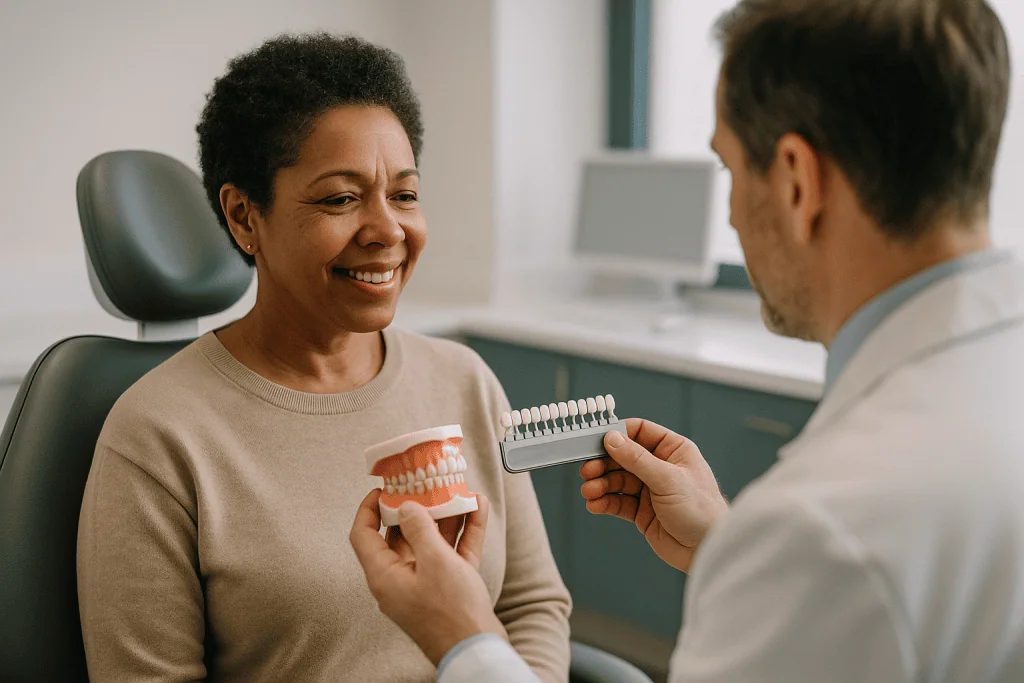
Commonly bundled components include tooth whitening (bleaching agents that lighten stains within enamel), dental bonding (tooth-colored resin sculpted directly onto a tooth), veneers (thin shells of porcelain or composite bonded to the front surface of a tooth), crowns (caps that cover the whole visible tooth), and orthodontics (braces or clear aligners that move teeth). Some plans add gum reshaping, replacement of missing teeth with bridges or implants, or replacement of old dark fillings.
The Cleveland Clinic describes veneers as a way to change color, shape, size or length of front teeth, and notes that placing them usually involves removing a thin layer of enamel, which makes the treatment permanent. That single fact shapes the whole plan: once enamel is removed, the tooth will always need a covering of some kind.
So when you read “smile makeover” at the top of the page, translate it immediately into its parts. For each tooth, ask which category the procedure belongs to: additive (whitening, bonding, aligners), which leaves the tooth largely intact, or subtractive (veneers, crowns), which removes structure. A plan that leans additive is more reversible; a plan that leans subtractive is more predictable in appearance but commits you for life. Neither is wrong, but you should know which one you are reading.
What are the 5 phases of dental treatment planning?
Dental schools have long taught a phased approach to planning, and although the exact wording differs between programs, the logic is consistent. Understanding it helps you see why your dentist may insist on “boring” steps before the exciting ones.
The first phase is urgent care: pain, infection, a fractured tooth. The second is disease control: treating decay, cleaning below the gum line, stabilizing loose teeth, and addressing habits such as grinding. The third is re-evaluation, where the dentist checks that gums have healed and decay is under control before committing to expensive, irreversible work. The fourth is definitive or corrective treatment, which is where veneers, crowns, implants and orthodontics live. The fifth is maintenance: cleanings, checks of the restorations, night guards if needed.
Why does this sequence matter for a smile makeover? Because cosmetic work bonded to a tooth with active decay, or placed next to inflamed gums, is built on shifting ground. The NIH’s dental research institute describes how untreated gum disease damages the bone and tissue that hold teeth in place, and receding or swollen gums change where the edge of a veneer sits. A margin that looked perfect against inflamed tissue can look uneven once the gum heals and settles.
When you read your plan, look for the phases. Is there a cleaning or gum treatment before the cosmetic steps? Is there a re-evaluation visit? If the plan moves from consultation straight to preparation of teeth, it is reasonable to ask how disease control has been confirmed. A dentist working to this framework will be glad you noticed.
How the process works: what actually happens at each visit
Most makeover plans, whatever the mix of procedures, follow a recognizable rhythm of appointments.

The first is diagnosis and records: photographs, X-rays, a bite assessment, and either physical impressions or a digital scan of your teeth. From these, a wax or digital mock-up is designed. Many dentists then try the design in your mouth using a temporary resin overlay, sometimes called a trial smile, so you can see the proposed shapes before any enamel is touched. This is the single most useful checkpoint in the whole process, because it is fully reversible.
The second appointment is preparation. For veneers or crowns, the dentist numbs the area, removes a thin layer of enamel or a larger amount for crowns, takes a new scan or impression, and fits temporary teeth made of acrylic or composite. The definitive restorations are then made in a laboratory or by an in-office milling machine.
The third appointment is the fit. Temporaries come off, the final restorations are tried in unbonded, and you look at them in daylight and in a mirror before anything is cemented. Adjustments to shape and shade can still be made at this stage; once bonded, they cannot.
Implants follow a longer arc. The Mayo Clinic notes that dental implant surgery is usually performed in stages, with several months of healing between placing the titanium post and attaching the final tooth, so the whole process can take many months. Orthodontics adds its own timeline. A well-written plan will show these longer branches running alongside the shorter cosmetic steps, and it will say where the temporary teeth fit in while you wait.
Who a smile makeover is usually for, and who is usually asked to wait
Cosmetic dentistry is elective, so the honest starting point is a person who is unhappy with a specific, describable aspect of their smile and whose mouth is otherwise healthy. Chipped or worn front teeth, gaps, deep staining that whitening cannot shift, old mismatched restorations and mildly crooked teeth are the common reasons people arrive at a consultation.
Certain situations lead dentists to pause or reorder the plan rather than refuse it outright. Active gum disease is the most common. The NIH describes periodontitis as an infection that destroys the bone supporting teeth; cosmetic work placed while that process is uncontrolled tends to have a shorter life and can hide progression. Untreated decay is another. So is heavy tooth grinding, which can chip porcelain; a plan for a grinder usually includes a night guard and may favor tougher materials.
People who are pregnant are generally advised to defer elective procedures that involve prolonged chair time or elective radiographs until after delivery, though routine care continues. Anyone under treatment for a medical condition affecting healing or bleeding will be asked to involve their physician, and the CDC notes that conditions such as diabetes and smoking raise the risk of gum disease, which feeds back into timing.
Younger patients with teeth still erupting or jaws still growing are typically steered toward orthodontics and whitening rather than veneers, because a restoration placed on a moving target rarely ages well.
None of this is a verdict. It is sequencing. If your plan says “defer,” ask what needs to change and how the team will confirm it has changed. The decision about readiness always rests with the treating dentist, informed by your history.
Temporary teeth explained: what are provisional veneers and crowns?
A provisional, in dental language, is a temporary restoration worn between the day a tooth is prepared and the day the final one is fitted. Patients call them temporary teeth, temps or trial teeth. They are usually made of acrylic or composite resin, formed either from a mold of the planned design or shaped directly in the mouth, and held on with a weaker, temporary cement so they can be removed cleanly later.
Provisionals do four jobs. They protect the prepared tooth, whose dentin (the softer layer under enamel) is now exposed and sensitive. They hold the gum tissue in the position the final restoration will need. They keep neighboring teeth from drifting into the space. And they act as a rehearsal: you get to test the length, the fullness under your lip, the way your tongue meets the back of the teeth when you say “s” sounds.
That rehearsal role is why experienced clinicians ask you to live with provisionals for a stretch and report back. Anything you dislike about them, from a tooth that feels too long to a lisp that will not settle, should be raised before the final restorations are made, because the laboratory often copies the provisional design.
Provisionals are not built to last. The resin picks up stain faster than porcelain, the edges are slightly bulkier, and the temporary cement can loosen. Understanding that they are a deliberate compromise, engineered to come off, saves a lot of anxiety when they feel less than perfect. If your plan does not describe the provisional phase in writing, ask for it to be added, including who to contact if one comes loose.
The following days and weeks: temporary veneers care and what to expect
The first day or two after preparation, expect numbness to wear off into mild soreness of the gums and some sensitivity to cold. Provisionals sit slightly rougher against the lip than final porcelain, so the inside of the lip can feel tender at first. Most people describe the second week as the point where they stop noticing the temporaries all the time.
Caring for temporary teeth is mostly about respecting the weak cement. Chewing should shift toward the back teeth and away from hard, crunchy or sticky foods: ice, nuts, crusty bread, caramel and chewing gum are the usual culprits for dislodging a provisional. Flossing continues, but with a change in technique: slide the floss down between the teeth and pull it out sideways rather than snapping it back up, which can lift the edge of a temporary. A soft brush and fluoride toothpaste, twice a day, remain the baseline the NHS recommends for all teeth.
Staining is worth anticipating. Resin absorbs coffee, tea, red wine and curry spices more readily than porcelain, and because the shade of the provisional is not the shade of the final restoration, a slightly dull look after a fortnight is expected rather than alarming.
The length of the provisional phase depends on the plan. For laboratory-made veneers or crowns it typically spans the time needed to fabricate the final pieces, while implant provisionals may be worn for the several months of healing the Mayo Clinic describes. Your plan should state the expected range for your case, and you should treat it as an estimate, not a promise.
Use this period actively. Photograph your smile, say your name out loud, read a paragraph aloud, and write down anything that bothers you for the fit appointment.
Veneers, crowns, bonding, implants: how the main steps compare
Reading a plan is easier when you can see the main options side by side. The table below summarizes what each involves, how much tooth structure it touches, and how long public sources say the results commonly last. These are typical ranges reported by the Cleveland Clinic and the Mayo Clinic, not promises for any individual.
| Procedure | What it involves | Tooth structure removed | Temporary phase | Typical longevity (source) |
|---|---|---|---|---|
| Whitening | Peroxide-based gel lightens enamel stains | None | None | Fades over time; touch-ups common (Cleveland Clinic) |
| Bonding | Composite resin sculpted onto tooth, cured with light | Minimal or none | Usually none; done in one visit | Shorter than porcelain; chips and stains more readily (Cleveland Clinic) |
| Porcelain veneer | Thin ceramic shell bonded to front surface | Thin enamel layer, permanent | Provisional veneers between visits | About 10–15 years (Cleveland Clinic) |
| Crown | Cap covering the whole visible tooth | Substantial, all surfaces | Temporary crown between visits | About 5–15 years (Cleveland Clinic) |
| Implant | Titanium post in bone, then crown on top | Replaces a missing tooth; none removed | Several months of healing with a provisional or flipper | Post can last decades; crown may need replacement (Mayo Clinic) |
Two patterns stand out. First, longevity tracks material and bite forces more than skill alone; a heavy grinder shortens every figure in the last column. Second, the amount of tooth removed sets the floor for the rest of your life: a bonded tooth can later become a veneered tooth, and a veneered tooth can later become a crowned tooth, but the sequence does not run backward. When a plan proposes crowns on front teeth that could take veneers, or veneers on teeth that could take bonding, the question to ask is simply, why this level and not the one below it?
What is the 3-3-3 rule in dentistry, and the 50-40-30 rule?
Both phrases turn up in search results and in consultation-room shorthand, and neither is a formal clinical guideline. That matters, because a plan that references them is using a teaching aid or a marketing mnemonic, not a standard you can look up in a national guideline.
The “3-3-3 rule” is used in at least two unrelated ways. In everyday dental hygiene advice it sometimes means brushing three times a day, for three minutes, within three minutes of eating. Mainstream guidance is simpler and better evidenced: the NHS and the CDC advise brushing twice daily with fluoride toothpaste and cleaning between teeth daily, and specifically suggest waiting after acidic meals rather than brushing immediately, because softened enamel is more easily abraded. In cosmetic planning, some dentists use “3-3-3” informally to describe a design check: viewing the proposed smile from three distances, in three lighting conditions, at three expressions. If your dentist uses the phrase, ask which meaning they intend.
The “50-40-30 rule” is likewise informal. Some clinicians use it as a rough proportional guide when designing front teeth, referring to the apparent widths of the central incisor, lateral incisor and canine as seen from the front. It borrows from older ideas about “golden proportion” in smile design. Evidence that any single ratio produces a smile most people find attractive is weak and culturally variable; published studies find natural, well-liked smiles that deviate widely from these numbers.
The practical lesson: mnemonics can be useful conversation starters, but your plan should rest on your face, your lip line and your bite, not on a formula. When a rule of thumb appears in a plan, it is a prompt for a question, not a reason for confidence.
Risks and trade-offs the plan should spell out
Every dental procedure carries risks, and a trustworthy plan names them in plain language rather than leaving them to a consent form signed on the day. Here are the ones that recur across smile makeover components, drawn from the way the Cleveland Clinic and Mayo Clinic describe these treatments.
Sensitivity is the most common. Removing enamel exposes dentin, and teeth can react to cold or sweetness for weeks after veneers or crowns. Usually this settles; occasionally it does not, and a tooth may eventually need root canal treatment (removal of the nerve inside the tooth). The plan should acknowledge this possibility for any tooth that is being cut.
Irreversibility is a risk in itself. Once prepared, a veneered tooth will always need a veneer or crown. Chipping and debonding happen, more often in people who grind or who bite fingernails, pens or ice. Color mismatch can occur if surrounding natural teeth darken over the years while porcelain does not, which is why whitening is often sequenced before shade selection rather than after.
Gum-line changes are a subtler issue: as gums recede naturally with age, a thin dark line or the edge of a restoration can become visible. Implants carry surgical risks, including infection, injury to nerves or neighboring teeth, and sinus problems for upper implants, as the Mayo Clinic lists, and they depend on adequate bone and healthy gums.
Orthodontics adds root shortening and temporary speech changes. Whitening can cause transient gum irritation.
Read the risk section of your plan looking for specificity. “Some sensitivity possible” is thin; “tooth 9 has a large existing filling and a higher chance of needing root canal treatment after preparation” is the level of detail that lets you decide.
Alternatives to a full makeover, and what is reversible
A plan that presents one path is a plan that has skipped a step. Standard consent in medicine and dentistry includes the alternatives, including the alternative of doing nothing for now, and you are entitled to see them laid out.
For discoloration, professional or dentist-supervised whitening is the least invasive option and is fully reversible in the sense that it removes nothing. For small chips, gaps and minor shape changes, composite bonding adds material without removing it, and can later be replaced or upgraded. For crowding, spacing or rotated teeth, orthodontics moves the teeth you have rather than covering them; the trade-off is time, often many months, against the preservation of enamel for life.
Where teeth are already heavily filled or broken, crowns may genuinely be the conservative choice, because there is little enamel left to bond a veneer to. Where a tooth is missing, the alternatives to an implant include a bridge (a false tooth anchored to crowns on neighboring teeth), a removable partial denture, or leaving the gap. Each has a different effect on the adjacent teeth, and the plan should say which.
A useful exercise is to ask your dentist to mark each step in the plan with one of three labels: reversible, partially reversible, or permanent. Then ask what the smile would look like if only the reversible and partially reversible steps were done. Sometimes the answer is “nearly the same.” Sometimes it is “not close.” Either way, you have moved from a single proposal to a genuine choice, which is what informed consent is supposed to feel like.
Phasing is also an alternative. Whitening and bonding first, veneers later if still wanted, is a legitimate plan, and a good team will write it down without pressure.
What people often get wrong about smile makeover plans
“Veneers are like false nails.” They are not. Most porcelain veneers require enamel removal and are permanent; the Cleveland Clinic is explicit that the process cannot be undone. So-called no-prep veneers exist for selected cases, but they are the exception and depend on tooth position.
“Temporaries show what the final result will look like.” Partly. They show shape and length well; they show color and translucency poorly, because acrylic and porcelain behave differently in light. Judge the temporaries for form, not for shade.
“Whiter is always better.” Natural teeth are not uniformly white; they are slightly warmer at the gum line and more translucent at the edges. A shade chosen brighter than the whites of the eyes tends to read as artificial in photographs. The plan should record a chosen shade, and you should see it in daylight before agreeing.
“Gum work is optional decoration.” Gum health is the foundation. The NIH’s description of periodontitis makes clear that bone loss is silent until it is advanced; treating it first is not an upsell, it is sequencing.
“Once it’s done, it’s done.” Every restoration ages, stains at the margins and eventually needs maintenance or replacement. The longevity ranges in the table above are averages, not lifetimes.
“A 3-3-3 or 50-40-30 rule means the design is scientifically proven.” These are informal mnemonics, not guidelines, as discussed above.
“The rendering is the contract.” A digital mock-up is a design intention. Bone, gum, bite and the physical properties of materials constrain what can be delivered. Ask what in the rendering is firm and what is illustrative.
Questions to ask your care team about your smile makeover treatment plan
Take the plan home, then bring these back. They are ordered roughly as a plan reads, from diagnosis to maintenance.
- Which steps treat disease and which are purely cosmetic? Which would you recommend even if I decided against the cosmetic part?
- For each tooth, why this option rather than the less invasive one below it? What would I lose by choosing the more conservative route?
- How much enamel will be removed from each tooth, and which teeth have existing fillings or cracks that raise the chance of later root canal treatment?
- Will I have a reversible trial smile before any tooth is prepared? Can I take it home for a day?
- What are the temporary teeth made of, how long do you expect me to wear them, and what should I do if one loosens or breaks in the evening or at a weekend?
- Will I see the final restorations unbonded, in daylight, before they are cemented? Can shape and shade still change at that point?
- How will the plan handle my bite and any grinding? Is a night guard included?
- What is the total number of visits and the rough span between them, and which dates are flexible if I have a fixed event?
- What are the specific risks for my teeth, not the general list?
- What does maintenance look like, how often will you check the restorations, and what usually needs replacing first?
- If I want to phase the work, whitening and bonding now and veneers later, how would the plan change?
- Who else is involved, such as a laboratory, periodontist or orthodontist, and who coordinates the sequence?
Write the answers on the plan itself. A team that welcomes this level of scrutiny is telling you something reassuring about how they will handle the small problems that arise in any multi-visit treatment.
When to call your doctor or dentist during a smile makeover
Most of the sensations during a makeover are expected: mild soreness, cold sensitivity, a temporary that feels bulky. Some are not, and the plan should give you a direct number for them.
Call the dental team the same day if a temporary tooth comes off or fractures, if a sharp edge is cutting your tongue or cheek, or if cold sensitivity is severe enough to disturb sleep. A lost temporary leaves prepared dentin exposed and can let neighboring teeth shift, so it is worth fixing promptly even if it does not hurt.
Seek urgent care, from the dental team or, if unavailable, an urgent care or emergency service, for red-flag signs: throbbing pain that wakes you at night or does not ease with the pain relief your dentist advised; swelling of the face, jaw or floor of the mouth; fever with dental pain; a bad taste or discharge from the gum; difficulty swallowing or breathing; or bleeding that does not stop with firm pressure after 15–20 minutes. After implant surgery, the Mayo Clinic lists persistent swelling, numbness that does not fade, or pain worsening after the first few days as reasons to contact the surgeon. Swelling that spreads toward the eye or neck, or any trouble breathing, is an emergency.
Also call, without urgency, if a bonded restoration feels high when you bite, if your gum around a new crown stays red and bleeds for more than a couple of weeks, or if you simply cannot get used to the shape of a temporary. Those are design and fit questions, and they are far easier to address before the final pieces are made.
The people who wrote your plan are the right people to interpret these signs. Trust the plan’s contact instructions, and if it has none, ask for them before treatment begins.
Frequently asked questions
What does a smile makeover include, exactly?
It is a combination of procedures rather than one treatment, chosen to change how the front teeth and gums look together. Typical components are whitening, composite bonding, porcelain or composite veneers, crowns, orthodontics such as clear aligners, gum reshaping, and replacement of missing teeth with bridges or implants. The exact mix depends on your teeth, so ask your dentist to label each step as additive or subtractive.
What are the 5 phases of dental treatment planning?
The commonly taught sequence is urgent care, disease control, re-evaluation, definitive or corrective treatment, and maintenance. Cosmetic work such as veneers belongs to the fourth phase, after decay and gum disease are controlled and healing has been checked. Wording varies between dental schools, but a plan that skips straight from consultation to tooth preparation without a disease-control step is worth questioning.
What is the 3-3-3 rule in dentistry?
It is not a formal guideline. Some people use it to mean brushing three times a day for three minutes within three minutes of eating; mainstream advice from the NHS and CDC is twice-daily brushing with fluoride toothpaste and waiting after acidic foods. Some cosmetic dentists use the same phrase for a design check at three distances, in three lights and three expressions. Ask which meaning your dentist intends.
What is the 50-40-30 rule in dentistry?
It is an informal proportional guide some clinicians use when designing front teeth, referring to the apparent widths of the central incisor, lateral incisor and canine as seen from the front. It borrows from older golden-proportion ideas. Evidence that any single ratio produces a smile most people prefer is weak, and attractive natural smiles vary widely, so treat it as a conversation starter rather than a standard.
How long do you wear temporary teeth during a smile makeover?
It depends on what is being made. For laboratory-fabricated veneers or crowns, provisionals are worn for the time it takes to produce the final pieces, typically a matter of weeks. For implants, the Mayo Clinic describes several months of healing between stages, so a provisional may be worn far longer. Your written plan should give a range for your case, understood as an estimate.
What is the best way to care for temporary veneers?
Protect the weak cement. Chew on the back teeth, avoid hard, sticky and very chewy foods, and floss by sliding down and pulling out sideways rather than snapping upward. Brush gently twice a day with fluoride toothpaste, as the NHS advises for all teeth. Expect some staining from coffee, tea and wine, since resin absorbs pigment faster than porcelain, and report any loosening the same day.
Can I see what my smile will look like before any teeth are prepared?
Usually, yes. Many dentists offer a trial smile, a temporary resin overlay shaped from a wax or digital mock-up and placed over your unprepared teeth. It is fully reversible and shows shape and length well, though not final color. Ask whether it is part of your plan and whether you can wear it for a day to judge speech and lip comfort.
Are veneers reversible?
Conventional porcelain veneers are not. The Cleveland Clinic notes that preparation removes a thin layer of enamel, so the tooth will always need a veneer or crown afterward. Composite bonding and whitening, by contrast, add or lighten without removing structure. So-called no-prep veneers exist for selected cases but are not suitable for everyone, and your dentist should explain which category each tooth in your plan falls into.
Why does my plan include gum treatment before cosmetic work?
Because gum health is the foundation the restorations sit on. The NIH describes periodontitis as an infection that destroys the bone and tissue supporting teeth, often silently. Veneers or crowns placed against inflamed or receding gums can end up with visible margins once the tissue heals and settles. Treating gum disease first, then re-evaluating, is standard sequencing rather than an add-on.
What should prompt me to call the dentist during treatment?
Call the same day if a temporary comes off, breaks or cuts your cheek, or if cold sensitivity disturbs sleep. Seek urgent care for throbbing pain that does not ease, facial or jaw swelling, fever, discharge from the gum, bleeding that will not stop with pressure, or any difficulty swallowing or breathing. Milder issues, such as a high bite or a shape you dislike, are best raised before the final restorations are made.
References
- Cleveland Clinic: Dental Crowns
- NHS: How to keep your teeth clean
- NIH National Institute of Dental and Craniofacial Research: Periodontal (Gum) Disease
- CDC: About Oral Health
This article is for general information only and is not a substitute for professional medical advice. Please consult a qualified doctor about your individual situation.

More from the Blog
Tooth Decay Treatment Visit: Numbing, Removing Damaged Tissue and Restoring the Tooth
A cavity treatment procedure usually has three steps: the dentist numbs the area with a local anesthetic, removes the softened, decayed part of the…

How a Smile Makeover Is Planned: Photographs, Digital Impressions and Smile Design
A smile makeover is planned in stages: a dental health examination first, then a set of standardized photographs, a digital scan of the teeth,…

Gum Recession Treatment Results: How Grafted Gum Matures and What It Can and Cannot Restore
Gum graft results develop in stages: the graft attaches over the first one to two weeks, swelling and a pale or reddish look settle…
What Happens During a Root Canal? Cleaning, Shaping and Sealing the Canals Step by Step
A root canal procedure treats infection or inflammation inside a tooth by removing the soft tissue in its center, cleaning and shaping the narrow…

How Aesthetic Dentistry Is Planned: Smile Assessment, Imaging and Treating Decay First
Aesthetic dentistry treatment planning follows a fixed order: first a full smile assessment of the teeth, gums, bite and facial proportions; then imaging such…

When Aesthetic Dentistry Makes Sense and When Gum Health Has to Come First
Cosmetic dentistry usually makes sense once your gums are healthy and stable, any decay or infection has been treated, and a specific feature of…