

How to Wash Long Hair After a Hair Transplant Without Shaving: Protecting the Grafts
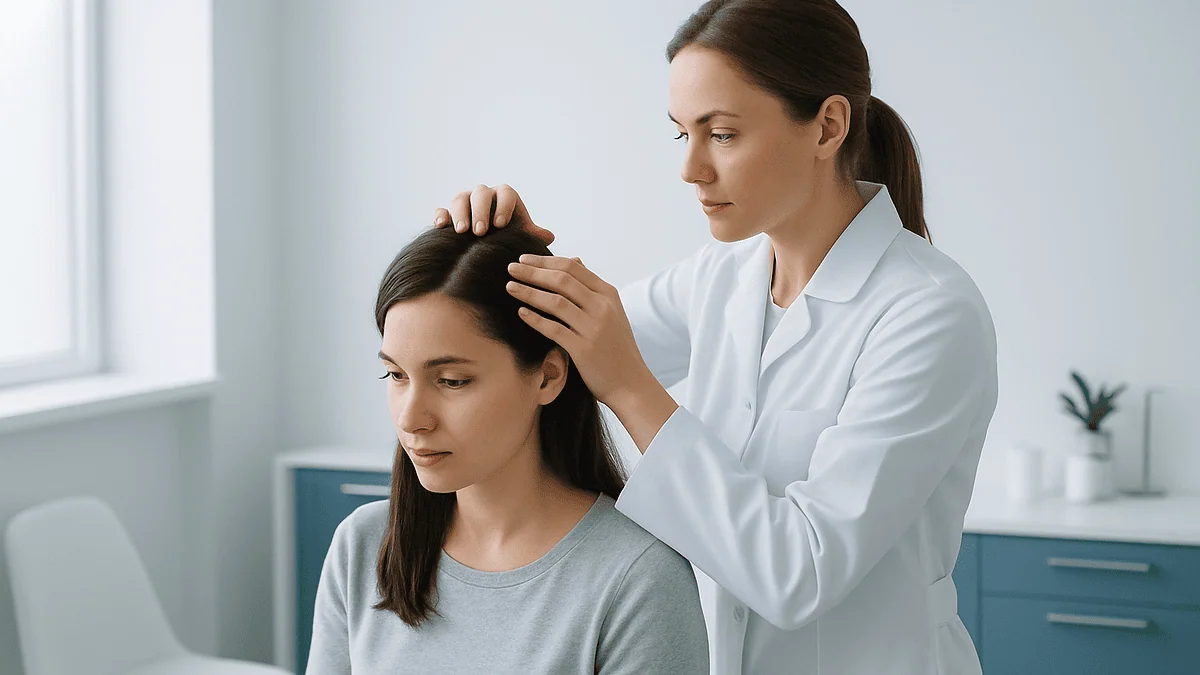
Key Takeaways
- NHS guidance describes about two weeks of special care for transplanted hair, and that window applies whether or not the scalp was shaved.
- A graft is not held in by anything mechanical in the first days; it is anchored by clotting and then by new blood vessels growing in, so force rather than water is the real threat.
- Most protocols allow a first pour-rinse with foam laid on by the flat of the fingers within the first few days, with no direct shower stream on the grafts.
- Long hair should be parted and softly clipped away from the grafted zone during washing, drying and sleep so wet strands do not drag across healing sites.
- Transplanted hair shafts commonly shed between roughly two and eight weeks after surgery while the follicles rest, a normal phase rather than a sign of damage.
- After about ten days the risk shifts from dislodging grafts to infection, sunburn and traction, so hands off the scalp, sun protection and loose hairstyles still matter.
Washing hair after an unshaven hair transplant follows the same cautious timeline as any transplant: most surgical teams allow a first gentle rinse within the first few days, with no direct water pressure, rubbing or fingernails on the grafted area for roughly two weeks. Long hair is parted away from the grafts, washed by hand, and patted rather than towel-dried. Your own surgeon's written instructions always take priority.
The first morning after surgery, Maya stood in front of the bathroom mirror with a towel over her shoulders and realized she had no idea how to touch her own head. Her hair was still long. The surgeon had worked between the strands, so from the front she looked almost unchanged. But somewhere under that familiar sweep of hair sat a few thousand tiny wounds, and the leaflet in her hand simply said: wash gently.
Gently how? With what? Could the long hair itself, falling against the grafted zone every time she moved, do harm? These are the questions that fill forums and late-night searches, and they are reasonable ones. Washing hair after unshaven hair transplant surgery is not complicated, but it is specific, and the specifics matter most in the first fortnight.
This explainer walks through what actually happens on the scalp as it heals, what the published guidance says about timing, and how to handle a full head of hair without disturbing a single graft.
What an unshaven hair transplant is, and why washing feels different
A hair transplant moves hair follicles from a part of the scalp where hair grows thickly, called the donor area, to a thinning or bald area, called the recipient area. Each moved unit is a graft: a tiny plug of skin containing one to four hairs and their roots. In the two most common techniques, follicular unit extraction (FUE) removes grafts one by one with a small punch, while follicular unit transplantation (FUT) removes a thin strip of scalp and divides it into grafts under magnification.
Traditionally the whole head, or at least the back and sides, is clipped short so the surgeon can see and reach the follicles. An unshaven, or no-shave, transplant keeps most of the existing hair at length. The surgeon either trims only the hairs that will be extracted, leaving the surrounding hair long enough to cover the work, or extracts grafts carefully between long strands. The recipient area may be left entirely unshaven.
Why does this change how you wash? Three reasons. First, long hair hides the grafted zone, so you cannot easily watch what your hands are doing. Second, every wet strand carries weight and drag; a clump of long hair sliding across fresh grafts in the first days is a mechanical force the grafts do not need. Third, crusts and dried fluid can bind to neighboring long hairs, so the usual “crusts fall away on their own” process can get tangled, literally, in your existing hair.
None of this makes an unshaven transplant riskier by nature. It simply means that the standard washing instructions need a few extra habits layered on top, mostly about parting, lifting and supporting the hair rather than letting it fall where it likes.
How grafts actually heal: what is happening under the water
Understanding the biology makes the rules feel less arbitrary. When a graft is placed into a small incision in the recipient area, it is not held in place by anything mechanical. It sits in a channel, surrounded by blood and tissue fluid that begin to clot almost immediately. Over the first hours this clot dries into the small crust you see around each graft.
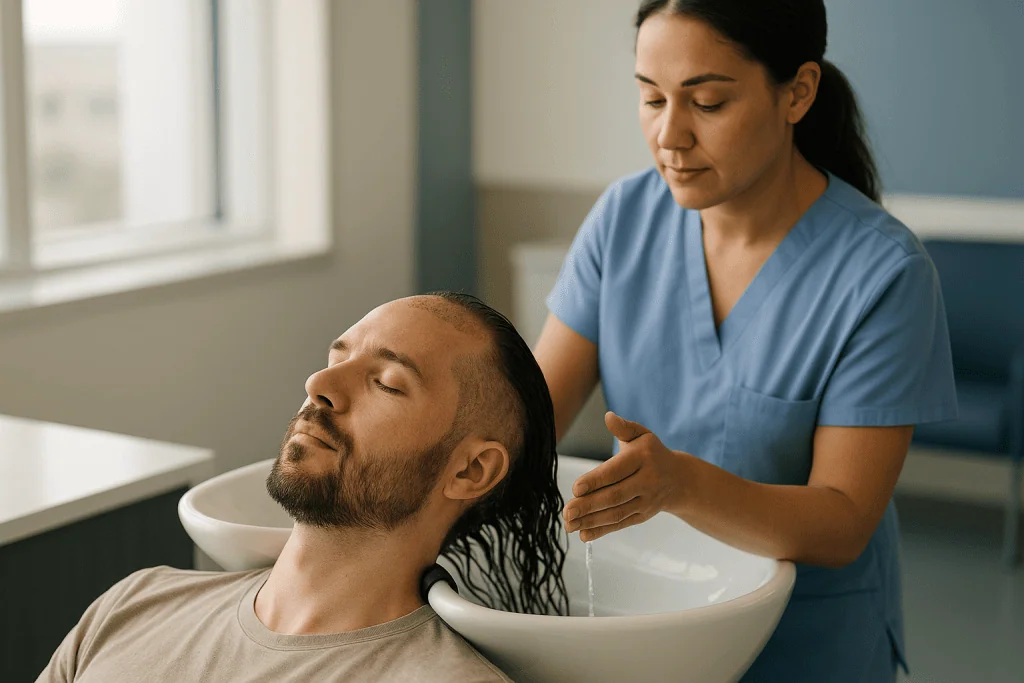
In the following days, new blood vessels begin to grow into the base of the graft from the surrounding scalp, a process called revascularization. Until that connection forms, the graft is living on diffusion from the fluid around it, which is why it is vulnerable to being lifted out, dried out or starved by pressure. Within roughly the first week the graft is increasingly anchored by new tissue; by about two weeks the surrounding skin has usually closed over, which is the point at which published patient guidance, including the NHS page on hair transplants, stops describing the grafts as fragile.
Water itself is not the enemy. A graft can be wet. What harms it is force: a jet of water that lifts the edge of a crust, a fingertip that scrapes, a towel that drags. The purpose of early washing is almost the opposite of a normal shower. You are not scrubbing; you are softening crusts so they loosen on their own schedule, rinsing away dried fluid that could trap bacteria, and keeping the scalp from drying into tight, itchy scabs that tempt picking.
Soap plays a supporting role. A mild cleanser lowers the surface tension of water so it spreads into crusts, and it reduces the bacterial load on skin that is, for now, full of tiny open channels. That is the whole mechanism. Nothing you pour on the grafts makes them grow faster.
When can I start washing hair after an unshaven hair transplant?
Published patient guidance is consistent on the broad timeline, even though individual surgeons vary in the details. The NHS advises that people are usually able to return to work about three days after a hair transplant and that the transplanted hair should be treated with great care for the first two weeks. MedlinePlus and Cleveland Clinic describe recovery in similar terms, with scabs forming around each graft and loosening over the first one to two weeks.
Within that frame, most surgical teams permit a first very gentle rinse somewhere in the first few days. Some ask you to wait a full 48 hours to let clots consolidate; others arrange the first wash in the clinic the day after surgery so they can demonstrate the technique. Neither approach is right or wrong in the evidence. What matters is that you follow the specific instruction you were given, because the surgeon knows how densely the grafts were placed, how long the incisions were kept moist, and whether any area bled more than expected.
With long hair, the timing question has a second layer: the donor area. In an unshaven FUE the small extraction sites at the back and sides are hidden under hair, and dried blood there can mat the strands together. Many teams encourage rinsing the donor region a little sooner and a little more thoroughly than the recipient area, since those wounds are tiny, shallow and not holding anything precious.
A useful mental model: the recipient area is a seed tray that must not be disturbed; the donor area is a scraped knee that simply needs to be kept clean. Treat the two zones differently from the first wash onward, and ask your team to confirm which is which if hair cover makes the boundary hard to see.
Who is usually offered an unshaven transplant, and who is asked to wait
The unshaven approach is a surgical choice made before the operation, but it shapes aftercare, so it helps to know why someone ends up in this position. People with longer hair who want to keep working, socializing or appearing on camera without a visible recovery period are the most common candidates. Women, who are more likely to wear hair long and less likely to accept a clipped scalp, make up a growing share. Smaller sessions, where fewer grafts are needed, suit the technique well because the surgeon has to work around existing hair and the pace is slower.
Not everyone is offered it. When a very large number of grafts is planned, many surgeons prefer a shaved or partially shaved donor area so they can harvest evenly without over-taking from one spot, a problem called overharvesting that can leave thin patches. Some hair textures and very fine hair make long-strand extraction harder. People whose hair loss pattern is still changing are often asked to wait for the transplant itself, shaved or not, because placing grafts into an area that will keep thinning can produce an unnatural island of hair later.
Medical factors also prompt a pause. Active scalp infection, uncontrolled bleeding disorders, certain autoimmune forms of hair loss such as alopecia areata, and a diagnosis of scarring alopecia are all reasons a team may decline or delay surgery. The Mayo Clinic notes that hair transplantation works for pattern hair loss and some scarring conditions but is not a solution for every cause of thinning.
If you are reading this before surgery, these are good questions to raise. If you are reading it afterward, know that the unshaven choice was made with your pattern and goals in mind, and the washing method below applies to you.
Washing hair after unshaven hair transplant surgery: the first wash, step by step
Set the scene before you turn on a tap. Lay out a mild, fragrance-free shampoo or whichever cleanser your team recommended, a cup or small jug, two soft hair clips or gentle fabric ties, and a clean soft towel. Many people find it easier to do the first washes bent forward over a sink or bath rather than standing in a shower, because it keeps running water off the grafts entirely.
Start by parting your long hair away from the recipient area. Use your fingers, never a comb, and clip the lifted sections so they cannot fall back. If the grafts are at the hairline, sweep everything backward; if they sit at the crown, part on either side and clip. The goal is a clear view and no stray weight on the grafts.
Wet the hair and scalp by pouring lukewarm water from the cup, aiming it at the long hair above the grafted zone and letting it trickle down. No direct stream on the grafts. Next, work a small amount of shampoo into a loose foam in your palms and lay the foam onto the grafted area with the flat of your fingers. Do not rub. Leave it to sit for a minute or two if your team has advised that, so it can soften the crusts.
Rinse the same way you wet it, cup by cup, letting gravity do the work. Then move to the donor area at the back and sides, where you can use gentle fingertip pressure in circles to lift dried blood from the roots.
Finally, pat the grafted area with the towel; press and lift, never wipe. Let the long hair air-dry or use a hair dryer on a cool, low setting held well away. Unclip the hair only once the grafts are dry.
Handling long hair around grafts: parting, tying and sleeping
Between washes, long hair becomes the main variable you can control. Each strand is light, but a wet or product-laden sweep of hair dragging across the grafts several times a day adds up to repeated friction at exactly the wrong time. The practical fixes are simple and borrowed from the same two-week caution window that NHS guidance describes.
Part the hair away from the grafted area and keep it there with soft clips or a wide fabric tie placed well behind or beside the zone. Avoid tight elastics, metal clips and anything that pulls on the roots; tension on existing hair near the grafts can tug the surrounding skin. A loose, low ponytail is often fine for crown grafts. For hairline work, many people wear the hair swept straight back and loosely secured at the nape.
Combing and brushing can resume on the long hair itself quite early, provided the comb stays well clear of the grafts. Start at the ends and work upward in short strokes so you never catch a knot and yank. Hold the hair in a fist between the tangle and the scalp to absorb the pull, exactly as you would with a child’s hair.
Sleep is the overlooked risk. Long hair spreads across the pillow and the grafted area can roll onto it or onto the pillow surface itself. Sleeping on your back with the head slightly raised on an extra pillow for the first several nights reduces swelling and keeps the grafts off fabric. Some people loosely braid or tie back the hair before bed so it does not drift. A clean pillowcase each night, or a soft clean towel laid over it, keeps dried fluid from gluing hair to the pillow and tearing crusts when you sit up.
What the first two weeks usually look like after a no-shave transplant
Timelines vary, and the ranges below are typical rather than promised. They draw on the general recovery descriptions in NHS, MedlinePlus and Cleveland Clinic patient material. Your team may shorten or extend any stage based on what they see.
| Timeframe | What is usually happening | Washing approach |
|---|---|---|
| Day 0–1 | Clots form around grafts; mild oozing possible; swelling begins at forehead | Usually no washing, or a clinic-supervised rinse; donor area may be dabbed |
| Day 2–4 | Crusts dry and darken; swelling may migrate toward eyes; itching starts | First gentle pour-rinse with foam laid on, no rubbing |
| Day 5–9 | Crusts begin to loosen; grafts increasingly anchored; donor sites largely closed | Daily gentle wash; slightly longer foam contact to soften crusts |
| Day 10–14 | Most crusts shed; redness fading; hair in grafts may start to shed (normal) | Light fingertip contact usually allowed; gentle crust removal if advised |
| Week 3 onward | Skin closed; shedding of transplanted hair shafts continues for weeks | Normal washing in most protocols; styling resumes gradually |
Two things on this timeline surprise people. The swelling that drifts down from the forehead to the eyelids around day three looks alarming but is gravity moving fluid, not infection, and it usually settles within a few days. The shedding of the newly transplanted hairs between roughly two and eight weeks, described by Cleveland Clinic as an expected phase, is also normal: the hair shaft falls out while the root stays and rests before producing new growth over the following months.
With long hair, the visible cues are muted. You may not see crusts shedding because they are caught in surrounding strands. A quick daily check in good light, parting the hair with clean fingers, keeps you informed without touching the grafts.
Scabs and crusts in long hair: why not to pick, and how they come away
A crust is simply a dried clot of blood and serum, the clear fluid that weeps from any small wound. Around each graft it forms a tiny cap that protects the opening while the skin closes beneath. Picking it off early can lift the graft with it, because in the first week the crust may still be adherent to the top of the graft. After about ten days the skin under most crusts has sealed, and the crust is sitting on a healed surface, which is why protocols relax at that point.
In a shaved scalp, loosened crusts fall off onto the pillow or down the drain. In long hair they often stay suspended, tangled at the base of neighboring strands, where they can feel like grit. People understandably reach in to pull them out, and that is where the risk lies, because pulling a crust that is still attached to a hair that runs through a graft can tug the graft itself.
The gentler method is patience plus softening. During each wash, let shampoo foam rest on the area for the time your team suggests, then pour-rinse. Crusts that are ready will slide down the hair shaft and out. Those that are not ready will loosen a little more each day. If your team has approved it, around the ten-to-fourteen-day mark you can use the pads of your fingertips in slow circular motions to help the last crusts away, still never the nails.
Crusts stuck in the long hair after they have detached from the scalp can be slid off with wet fingers, working down the strand away from the root. Itching at this stage is common and is a sign of healing nerve endings rather than a problem; your team can advise on soothing measures if it is intense.
Can you damage grafts after 10 days? What the healing evidence suggests
Short answer: it becomes much harder, but “harder” is not “impossible” for a few more days, and it depends on what you mean by damage.
By day ten the physical risk that dominates the first week, a graft being lifted out of its channel, has largely passed. Revascularization and new tissue have anchored the graft, and the skin surface has usually closed. This is why the NHS frames the period of special care as about two weeks and why most surgical protocols allow light fingertip washing around this point. A normal shower stream, a soft hat, resting your head on a pillow: these are no longer threats in most people’s recovery.
What can still go wrong is subtler. Hard scratching or picking can create a small wound, and any wound can become infected. Infection in the recipient area, though uncommon, can damage follicles through inflammation. Severe sunburn on a freshly healed scalp can also inflame the tissue and cause pigment changes. Vigorous exercise that produces heavy sweating is less about the grafts and more about keeping healing skin clean. Heavy tension from tight hairstyles on surrounding long hair in the weeks after surgery may stress the area while it is still remodeling.
The transplanted hair shafts falling out between weeks two and eight, which Cleveland Clinic lists as a normal part of the cycle, is often mistaken for damage. It is not. The follicle has entered a resting phase and will typically begin growing new hair over the following months; MedlinePlus notes that new growth usually begins within a few months of surgery.
So after ten days, relax the washing but keep the common sense: no picking, no scratching with nails, sun protection, and a call to your team if anything looks unusual rather than a late-night experiment.
When can I wash my hair normally again, and resume styling?
For most protocols, the shift to normal washing happens gradually over the second and third weeks, rather than on one specific morning. Once the crusts have shed and the skin has closed, usually around two weeks according to the general NHS and Cleveland Clinic recovery descriptions, standing under a shower, using your usual gentle shampoo and massaging with fingertips are typically permitted. Confirm the exact green light with your team, since dense sessions or slower healers may be asked to wait a few extra days.
Normal does not mean everything at once. Think of styling as a ladder you climb a rung at a time. Air-drying and cool blow-drying come first. Warm blow-drying, where the nozzle is kept moving and well away from the scalp, follows once the skin is no longer pink and tender. Styling products that touch the scalp, such as gels, waxes, dry shampoo and hairspray, are generally held back until the grafted area is fully healed, because they can clog the follicular openings and are difficult to rinse out of long hair without rubbing. Hair color, bleach, perms and chemical straightening involve agents that irritate healing skin, and many teams ask people to wait several weeks before any chemical processing; ask yours for a specific window.
Tight styles deserve a special mention for long-haired patients. Ponytails pulled high and hard, tight braids and extensions all exert traction on existing hair near the grafts. Traction over time is a recognized cause of hair loss in its own right, and it makes little sense to add it to a scalp you have just invested in. Loose, low styles for the first month or so are a reasonable compromise that most people barely notice.
The transplanted hair shedding during this period is expected, so do not read a few hairs in the drain as a sign you returned to normal washing too soon.
Sweat, exercise, swimming and sex after a hair transplant
Washing is only half the hygiene story; the other half is what you do between washes that makes the scalp dirty, hot or stretched.
Exercise and sweating. Sweat itself is mostly water and salt and does not harm grafts. The concerns are raised blood pressure, which can cause oozing from fresh sites in the first days, and bending or straining that increases pressure in the head. Most teams ask for light activity only, such as walking, for roughly the first week, then a gradual return. Heavy weightlifting and contact sports that could knock the head usually wait longer. If you do sweat in the early days, a gentle pour-rinse that day rather than leaving salt to dry on crusts is sensible.
Swimming. Pools contain chlorine and open water contains bacteria; both sit on skin with tiny open channels in the first two weeks, and the swimming motion involves water flow across the scalp. Swimming is typically deferred until the grafted area is fully closed, and many teams suggest waiting longer for open water.
Sexual activity, including masturbation. This question is asked far more often than it is answered in leaflets, so here is the plain version. There is no evidence that sexual arousal or orgasm affects graft survival. The practical considerations are the same as for exercise: a temporary rise in heart rate and blood pressure, sweating, and the risk of the head rubbing against a pillow, headboard or partner. For that reason many surgeons suggest a few days of abstinence, then resuming with care taken to keep the grafted area untouched. Ask your team; they will not be embarrassed by the question.
Alcohol and smoking both impair wound healing and blood supply to the skin. Teams commonly ask people to avoid them for a period before and after surgery; follow their specific advice.
What people often get wrong about unshaven hair transplant aftercare
Myth: long hair protects the grafts, so you can be less careful. The opposite is closer to the truth. Hair hides the area from view and adds friction, so early handling needs more attention, not less. The two-week caution window in published guidance applies whether or not the scalp was shaved.
Myth: you must not let water touch the grafts for a week. Water is not the risk; force is. Most protocols introduce gentle pour-rinsing within the first few days precisely because clean, softened crusts shed more safely than dry, cracked ones that invite picking.
Myth: the more special shampoo, lotion or spray you apply, the better the grafts will take. No topical product has been shown in mainstream evidence to improve graft survival. Cleansers help by keeping the area clean and softening crusts; that is the extent of the mechanism. Expensive routines mostly add more handling, which is the thing to minimize.
Myth: hair falling out at three weeks means the transplant failed. The shedding of transplanted shafts between roughly two and eight weeks is an expected phase described by Cleveland Clinic. The follicles rest and then begin producing new hair over the following months.
Myth: once the crusts are gone, nothing can go wrong. After ten to fourteen days the grafts are secure, but infection from scratching, sunburn on new skin, and traction from tight hairstyles can still cause trouble. The precautions simply change from protecting grafts to protecting healing skin.
Myth: swelling around the eyes on day three means an allergic reaction or infection. Swelling that migrates down from the forehead with gravity is common after work at the hairline, is usually painless, and tends to resolve within days. Fever, spreading redness, warmth or pus are the signs that distinguish infection, and those warrant a call.
Questions to ask your care team before your first wash
Written instructions vary between surgeons, and an unshaven procedure adds a few variables. Having a short list ready at discharge, or for the follow-up call, saves anxious guessing later.
- On which day should I do the first rinse, and should the donor and recipient areas be washed differently?
- Will you demonstrate the first wash in person or by video, given that my long hair makes the grafted zone hard to see?
- Which cleanser do you recommend, how long should the foam sit, and is there anything I should avoid, such as fragranced or medicated shampoos?
- When may I use fingertips on the grafts, and when may I start helping crusts away?
- How should I secure my long hair during the day and at night so it stays off the grafts without pulling at the roots?
- When can I stand under a shower stream, use a warm hair dryer, and apply styling products?
- How long should I wait before coloring, bleaching or chemically treating my hair?
- What activity, sweating and sexual activity restrictions apply, and for how many days?
- When can I wear a hat or helmet, and what kind?
- Which signs should prompt me to call, and what is the out-of-hours number?
- If I was prescribed any medicine for the recovery period, what is it for, how long will I take it, and what should I do if I miss a dose or notice a side effect?
That last point matters. Some teams prescribe a short course of medicine to reduce swelling or the risk of infection, and some people are also on longer-term treatments for pattern hair loss. Any question about starting, continuing or adjusting those belongs with the prescriber, not with a forum or a friend who had a different procedure. Writing the answers down, or recording the conversation with permission, means you can check the plan at three in the morning without a phone call.
When to call your doctor
Most recoveries after a hair transplant are uneventful: some soreness, tightness in the donor area, itching as crusts loosen, and swelling that comes and goes. A short list of signs, however, should prompt a same-day call to your surgical team or, if they are unreachable, to a local healthcare provider.
- Bleeding that soaks through a dressing or does not stop with ten minutes of gentle, steady pressure.
- Increasing pain after the first two or three days rather than steady improvement.
- Spreading redness, warmth or swelling around the grafted or donor area, especially with a yellow or green discharge or a bad smell, which MedlinePlus lists among signs of a surgical wound infection.
- A fever, chills or generally feeling unwell.
- Grafts that appear to have fallen out with a visible hair root attached, particularly in the first week.
- Patches of grafted skin turning dark, dusky or black, which can indicate poor blood supply.
- Swelling that closes the eyes, affects vision or is accompanied by severe headache.
- Any rash, hives, facial or lip swelling or difficulty breathing after taking a prescribed medicine; this needs emergency care.
Call sooner rather than later if in doubt. Teams would far rather look at a photograph of a harmless crust than miss an early infection. Seek care urgently, through emergency services if needed, for chest pain, breathlessness or a swollen, painful calf in the days after any procedure, since these can signal a blood clot, which is rare after scalp surgery but serious. Every decision about treatment, including whether an antibiotic or any other medicine is needed, rests with the clinicians who can examine you.
Frequently asked questions
When can I start washing my hair normally after a hair transplant?
Most people move to ordinary showering with fingertip massage around the two-week mark, once crusts have shed and the skin has closed, which matches the roughly two-week period of special care described by the NHS. Styling products, warm blow-drying and tight styles are usually added back gradually over the following weeks. Your surgeon’s instructions take priority, since denser sessions or slower healing can extend the cautious phase.
Can I wash my hair after a hair transplant for the first 10 days?
Yes, in a specific way. Most protocols begin gentle pour-rinsing within the first few days: lukewarm water from a cup, shampoo foam laid on with the flat of the fingers, no rubbing, and patting rather than wiping to dry. Washing during the first ten days keeps the area clean and softens crusts so they shed on their own. Direct shower streams and fingernails wait until the team gives the go-ahead.
Can you damage grafts after 10 days?
It becomes far less likely. By about ten days grafts are anchored by new tissue and the skin has usually closed, so ordinary showering and sleeping no longer threaten them. Scratching hard enough to break skin, severe sunburn, infection and tight hairstyles that pull on surrounding hair can still cause problems. The transplanted hairs shedding over the following weeks is expected and is not a sign of damage.
Is it okay to masturbate or have sex after a hair transplant?
There is no evidence that sexual activity itself affects graft survival. The concerns are indirect: a temporary rise in heart rate and blood pressure, sweating, and rubbing the head on a pillow, headboard or partner during the first week. Many surgeons suggest a few days of abstinence and then care to keep the grafted area untouched. Ask your team for their specific advice; it is a routine question.
How is unshaven hair transplant aftercare different from a shaved transplant?
The timeline and the biology are the same; the handling differs. Long hair hides the grafts, adds friction when wet, and traps loosened crusts near the roots. Aftercare therefore adds habits: parting and softly clipping hair away from the grafted zone, pour-rinsing rather than showering, combing only the lengths from the ends upward, and securing hair loosely at night so it stays off the pillow and the grafts.
Should I wash the donor area differently from the grafted area?
Usually yes. Donor sites after FUE are tiny, shallow wounds that hold nothing precious, so most teams allow gentle fingertip washing there sooner and more thoroughly to lift dried blood that mats long hair. The recipient area, where grafts sit, is treated far more cautiously for about two weeks. If hair cover makes the boundary unclear, ask your team to show you exactly where each zone begins.
What should the first wash after a hair transplant feel like?
Slow, deliberate and almost anticlimactic. Expect lukewarm water poured from a cup, foam resting on the grafts for a minute or two, a gravity rinse and gentle patting dry. Mild stinging or tightness is common; sharp pain, fresh bleeding or a graft coming away with a visible root is not and should be reported. Many surgeons demonstrate the first wash in person or by video, which is worth requesting.
Why is my hair falling out three weeks after the transplant?
This is almost always the expected shedding phase. Cleveland Clinic patient material describes transplanted hair shafts falling out between roughly two and eight weeks while the follicle beneath rests. MedlinePlus notes new growth usually begins within a few months. The root stays in place; only the shaft is lost. Returning to normal washing does not cause it, though call your team if shedding comes with pain, redness or discharge.
Can I use my usual shampoo, conditioner and styling products?
In the early weeks, most teams recommend a mild, fragrance-free cleanser and ask you to keep conditioner to the lengths of the hair, away from the grafted scalp. Gels, waxes, hairspray and dry shampoo are typically paused until the skin is fully healed because they are hard to remove without rubbing. No product has been shown to improve graft survival; cleansing simply keeps the area clean and softens crusts.
When can I color, bleach or chemically straighten my long hair again?
Chemical processes irritate healing skin and the agents are difficult to keep off the scalp, so most surgeons ask for a wait of several weeks until the grafted area is completely healed and no longer pink or tender. The exact window varies with the size of the session and how quickly you heal. Ask your team for a specific date rather than estimating, and do a strand test first when you return.
References
- NHS: Hair transplant
- MedlinePlus Medical Encyclopedia: Hair transplant
- MedlinePlus Medical Encyclopedia: Surgical wound infection, treatment
This article is for general information only and is not a substitute for professional medical advice. Please consult a qualified doctor about your individual situation.

More from the Blog

U-FUE vs Standard FUE: How Unshaven Extraction Changes Session Length and Graft Handling
U-FUE (unshaven follicular unit extraction) removes individual grafts while surrounding hair stays long, whereas regular FUE usually shaves the donor area first. Because long…
Sapphire Hair Transplant Myths: Does the Blade Alone Decide Density and Natural Direction?
No. In a sapphire hair transplant, the sapphire blade only makes the tiny recipient slits; it does not decide density or direction. Density depends…
Questions to Ask Before Robotic Hair Surgery: Who Places the Grafts and How Results Are Checked
Before robotic hair surgery, ask who performs each stage: the robot usually harvests follicular units, but a surgeon or trained technicians still make recipient…
Why the Cause of Hair Loss Sets the Plan: Tests Before Non-Surgical Hair Restoration
Before non-surgical hair restoration, clinicians usually confirm the cause first: a history and scalp examination, a gentle pull test, magnified scalp imaging (trichoscopy), and…
Who Is a Candidate for Laser Hair Therapy? Early Thinning vs Long-Standing Bald Areas
A laser hair therapy candidate is usually an adult with early to moderate hereditary (pattern) thinning, where follicles have shrunk but are still alive,…
How Scalp Micropigmentation Is Done: Pigment Dots, Session Spacing and Matching Your Hair Shade
Scalp micropigmentation is a cosmetic tattooing technique in which a trained practitioner deposits thousands of tiny pigment dots into the upper layer of the…