

ILASIK vs Standard LASIK: Is a Blade-Free Flap Actually Different for Patients?
Key Takeaways
- iLASIK is a trademarked bundle of femtosecond flap creation plus wavefront-guided planning, not a separate operation from LASIK.
- A Cochrane systematic review found no clear difference in final visual outcomes between femtosecond-laser and microkeratome flaps, though the types of flap complications differ.
- Dry eye after LASIK is caused by cutting corneal nerves during flap creation and commonly lasts around six months, regardless of whether the flap was made by blade or laser.
- Mayo Clinic advises that full healing and stable vision can take two to three months, so enhancement decisions are usually postponed until then.
- Candidates are generally adults over eighteen with a prescription stable for at least a year, adequate corneal thickness and no keratoconus or significant pre-existing dry eye.
- The NHS estimates that complications from laser eye surgery occur in fewer than around one in twenty cases, most of them minor and treatable.
iLASIK is a trademarked name for LASIK performed with a femtosecond laser to cut the corneal flap, instead of a mechanical blade, combined with wavefront-guided treatment mapping. Standard LASIK may use a bladed microkeratome and a conventional treatment plan. A systematic review found no clear difference in final vision between the two flap methods, though the types of flap complications differ. Your eye's suitability, not the label, matters most.
The consultation room has two brochures on the table. One says LASIK. The other says iLASIK, in a slightly friendlier font, and the word that keeps catching the eye is blade-free. The person holding them has worn glasses since fourth grade, has tried every brand of contact lens, and has one question that the brochures never quite answer: is this a genuinely different operation, or the same operation with a nicer name?
It is a fair thing to wonder. The ilasik vs lasik debate is unusual in medicine because one side of it is a marketing term. Behind that term sit two real technologies, one of which changes how the flap is made and one of which changes how the laser is aimed. Both deserve a clear explanation.
What follows is the version a careful ophthalmologist might give if the appointment ran long: what actually happens to the cornea, what the trials show, and where the honest answer is that we do not know.
iLASIK vs LASIK: what the two names actually mean
LASIK is a procedure. iLASIK is a brand. That distinction settles half of the confusion before any anatomy is discussed.
LASIK stands for laser-assisted in situ keratomileusis, which in plain language means reshaping the cornea, the clear dome at the front of the eye, with a laser after lifting a thin hinged flap of its surface. The flap is folded back, the tissue beneath is sculpted, and the flap is laid down again to heal in place. That is the operation, and every variety of LASIK shares it.
iLASIK is a trademarked name owned by one laser manufacturer. It describes a bundle of two features used together: a femtosecond laser that creates the flap without a metal blade, and a wavefront-guided measurement that maps the eye’s optical irregularities and feeds them into the treatment plan. Neither feature is exclusive to the trademark. Many surgeons use a femtosecond laser from another maker and a different wavefront system and simply call the result bladeless or custom LASIK.
So when someone compares iLASIK to standard LASIK, they are really comparing two variables at once. First, how the flap is cut: with a femtosecond laser or with a microkeratome, the small oscillating blade that has been used for decades. Second, how the correction is planned: from the glasses prescription alone, or from a wavefront map as well.
Keeping those two variables separate is the most useful habit a patient can bring into the discussion. A surgeon may offer a laser-cut flap with a conventional treatment, or a bladed flap with a wavefront-guided one. The brand name tells you a package exists; it does not tell you which parts of it matter for your eye. According to Mayo Clinic, the core procedure takes roughly half an hour or less regardless of which tools are used.
How standard LASIK works, step by step
Picture the cornea as a contact lens that grew there. It is thinner than a credit card, transparent, and responsible for most of the eye’s focusing power. If it is too steep, distant objects blur, which is myopia, or nearsightedness. If it is too flat, near objects blur, which is hyperopia, or farsightedness. If it is shaped more like a football than a basketball, light lands in two places instead of one, which is astigmatism.
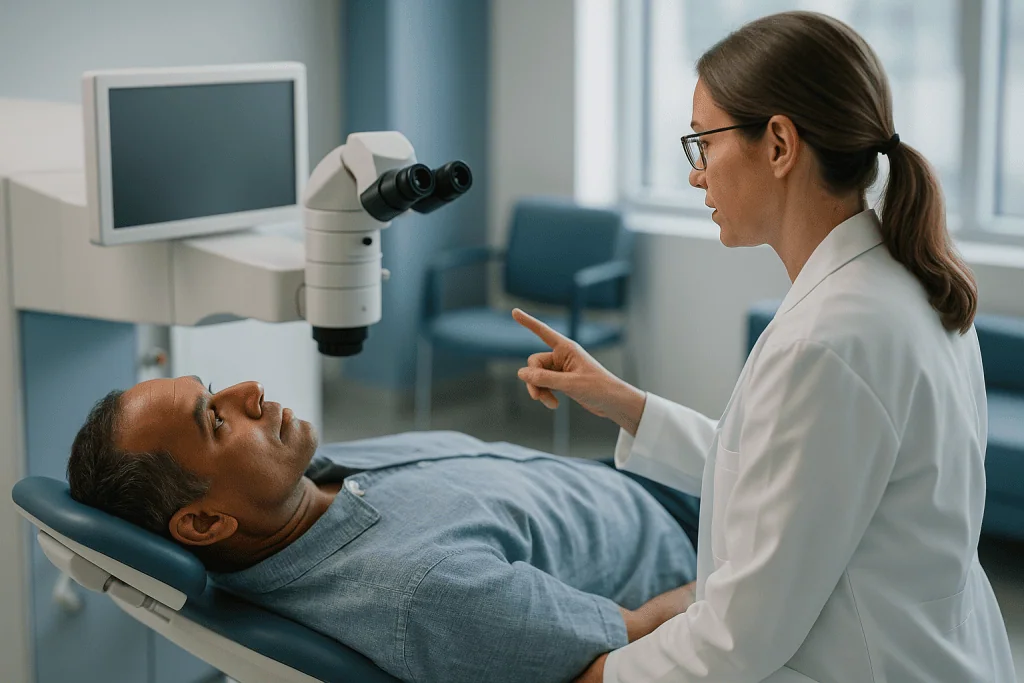
LASIK changes that shape. The patient lies under the laser awake, with numbing drops in the eye and a small device holding the lids open. The surgeon marks the cornea, then creates the flap. In standard LASIK this is done with a microkeratome, a precision instrument with a very fine blade that glides across the cornea under suction and slices a thin layer, leaving one edge attached as a hinge.
With the flap folded aside, a second laser, called an excimer laser, does the reshaping. It removes microscopic amounts of tissue with each pulse, following a plan calculated from the patient’s prescription. The surgeon then floats the flap back into position. Because the cornea is naturally adhesive once the surface layer settles, no stitches are needed.
Mayo Clinic describes the whole process as lasting about thirty minutes or less for both eyes, with most of that time spent on positioning and measurement rather than on the laser itself. Patients commonly describe pressure during the flap step and a faint smell during the excimer step, but not pain.
Every one of these steps is shared with iLASIK. The only mechanical difference lies in how the flap is created, which is where the story gets more interesting.
What actually changes with a blade-free femtosecond flap
A femtosecond laser fires pulses that last a quadrillionth of a second, hence the name. Each pulse creates a microscopic bubble of gas inside the cornea at a precisely chosen depth. Fire tens of thousands of them side by side in a flat plane and you have separated a layer of tissue without ever touching it with steel. A final line of pulses around the edge cuts the flap’s border, leaving a hinge exactly where the surgeon programmed it.
Three things follow from that mechanism.
The flap can be planned rather than performed. Its thickness, diameter, hinge position, and edge angle are typed in before the laser fires. A microkeratome flap depends on the blade, the suction, the corneal curvature and the surgeon’s hand, so its dimensions vary somewhat from eye to eye.
The flap tends to be more uniform. A bladed flap is often slightly thicker at the edges than the center, like a shallow bowl. A laser flap is closer to a flat disc. That uniformity is one reason surgeons often choose femtosecond flaps in corneas where they want to preserve as much untouched tissue as possible.
The edge can be angled. Laser-cut flaps can have a bevelled side wall that sits into the surrounding tissue like a manhole cover, which is thought to help the flap settle back into position. Whether this translates into fewer flap displacements in real life is discussed in the evidence section below.
What does not change is the reshaping itself. The excimer laser, the calculation behind it, and the healing that follows are the same. A femtosecond flap changes how the door is opened, not what is done in the room. Cleveland Clinic describes both approaches as accepted ways of performing the same procedure.
Wavefront-guided LASIK: the second half of the package
The other component bundled into the iLASIK name has nothing to do with blades. Wavefront-guided LASIK uses a device called an aberrometer to measure how light travels through the entire optical system of the eye, not just how much correction a pair of glasses would need.
A conventional prescription captures three numbers: sphere, cylinder and axis. Those describe nearsightedness or farsightedness and astigmatism. Real eyes also carry smaller, more irregular distortions called higher-order aberrations. These do not show up on an eye chart, but they can contribute to glare, halos and reduced contrast, especially at night when the pupil widens.
A wavefront map records those irregularities across the pupil and passes them to the excimer laser, which adjusts its pattern to smooth them out rather than simply flattening or steepening the cornea evenly. A related technique, wavefront-optimized treatment, does not measure the individual eye’s aberrations but applies a general correction designed to avoid inducing new ones at the corneal edge.
Does the custom map produce better vision? The honest reading of the literature is that the advantage, where it exists, is modest and most relevant to eyes with unusual optics or large pupils. Many patients with straightforward prescriptions see very similarly with either planning method. Johns Hopkins notes that the choice of laser platform and treatment profile is one the surgeon makes based on the individual eye, rather than a universal upgrade.
This matters for the ilasik vs lasik question because the brand name implies both components arrive together. In practice a clinic may offer wavefront-guided treatment with a bladed flap, or a laser flap with conventional planning. Ask which combination is being proposed for you and why.
Femtosecond laser vs microkeratome: what the evidence actually shows
The strongest evidence on the flap question comes from a systematic review published by the Cochrane collaboration, an organization that pools randomized trials and grades their quality. The reviewers gathered trials comparing LASIK with a femtosecond laser flap to LASIK with a microkeratome flap in adults with myopia.
Their central finding was cautious. They reported no clear evidence of a difference between the two methods in the outcomes patients care about most: how sharp the uncorrected vision was afterward, how close the result came to the intended correction, and how many eyes lost lines of best-corrected vision. The quality of the evidence was judged low for most outcomes, largely because trials were small and reported results inconsistently.
That is not the same as saying the two methods are identical. The review and the wider literature suggest the types of flap complications differ. Bladed flaps are more often associated with incomplete or irregular cuts and with buttonholes, where the blade breaks through the surface. Laser flaps have their own signature issues, including an opaque bubble layer that can temporarily obscure the surgeon’s view and, uncommonly, a transient inflammatory sensitivity to light in the weeks after surgery.
Surgeons have their own reasons for preferring one tool. Predictable flap thickness is valuable when the cornea is on the thinner side of normal, or when a higher prescription will consume more tissue. Familiarity counts too: a surgeon with long experience on a well-maintained microkeratome may achieve results that match those of a colleague using a newer laser.
The takeaway for a patient is neither that blade-free is a gimmick nor that it is essential. It is a genuine engineering difference whose benefit in trial data is smaller than the brochures imply.
iLASIK vs LASIK at a glance
The table below separates the components that the brand name bundles together. Read across each row rather than down a column, because the meaningful comparison is feature by feature, not package by package.
| Feature | Standard LASIK | iLASIK (branded bundle) | What the evidence says |
|---|---|---|---|
| How the flap is made | Microkeratome, a fine oscillating blade under suction | Femtosecond laser creating a plane of micro-bubbles | No clear difference in final vision in the Cochrane review; complication types differ |
| Flap dimensions | Vary with blade, suction and corneal shape | Programmed thickness, diameter and hinge | Laser flaps are more uniform in thickness |
| Treatment planning | Based on the glasses prescription; may be wavefront-optimized | Wavefront-guided map of the individual eye’s aberrations | Modest benefit, mainly in eyes with unusual optics or large pupils |
| Reshaping step | Excimer laser | Excimer laser | Identical mechanism |
| Anesthesia | Numbing drops | Numbing drops | Identical |
| Typical procedure time | About thirty minutes or less (Mayo Clinic) | About thirty minutes or less (Mayo Clinic) | Similar |
| Dry eye afterward | Common in the first months | Common in the first months | Both cut corneal nerves; a flap is a flap |
| Who decides | Surgeon, based on corneal thickness, prescription and pupil size | Same | Suitability outweighs the label |
Two rows deserve a second look. The reshaping step and the dry-eye row are identical because the parts of the operation most likely to affect long-term comfort and vision are shared. The flap and planning rows show real technical differences, and it is legitimate to prefer them. The point is simply that the difference sits in the details of how the surgery is performed, not in whether it is fundamentally a different surgery.
Who is usually a candidate, and who is asked to wait
Candidacy for LASIK does not change with the flap method. The same eye that suits a microkeratome suits a femtosecond laser, and the same eye that should avoid one should usually avoid both.
Mayo Clinic and MedlinePlus describe the typical candidate as an adult, generally over eighteen, whose glasses or contact lens prescription has been stable for at least a year. Stability matters because the laser corrects the eye as it is on the day of surgery; if the prescription is still drifting, the correction drifts with it. Corneal thickness has to be adequate for the planned flap plus the planned reshaping, with a comfortable reserve left underneath. The corneal surface should be regular on mapping, and the eye should be free of active disease.
Several groups are commonly asked to wait or to consider other options. People who are pregnant or breastfeeding are usually deferred because hormonal changes can shift the prescription temporarily. Those with uncontrolled diabetes, active autoimmune disease or a history of poor wound healing may heal unpredictably. Significant dry eye before surgery is a particular concern, because LASIK reliably makes dryness worse for a period. Keratoconus, a condition in which the cornea progressively thins and bulges, is a firm reason not to proceed, since removing tissue can accelerate it.
Very high prescriptions, very large pupils and corneas at the thin end of normal do not automatically rule someone out, but they change the conversation. This is where a surgeon might specifically favor a femtosecond flap for its predictable thickness, or might instead suggest a different procedure altogether.
Cleveland Clinic frames the screening examination as the most important appointment in the whole process. A thorough evaluation, including corneal mapping and a measurement of tear function, does more to determine a good outcome than any choice between brand names.
Risks that stay the same whichever flap you have
Because the reshaping and the healing are shared, most LASIK risks apply equally to standard and blade-free versions.
Dry eye is the most common. Creating a flap cuts through corneal nerves that normally signal the tear glands, and the eye may produce fewer tears until those nerves regrow. Mayo Clinic notes that this reduction in tear production commonly lasts for the first six months or so, and that lubricating drops are often used during that period. For most people it improves; for a minority it persists longer.
Glare, halos and starbursts around lights, particularly at night, are also frequent in the early months. They tend to fade as the cornea settles, though some people notice a lasting change in night vision. Wavefront-guided planning was developed partly to reduce these symptoms, and it may help in some eyes, but it does not eliminate them.
Under-correction and over-correction happen when the eye heals differently from what the calculation predicted. Some patients need glasses for certain tasks afterward, and some are offered an enhancement procedure once the eye has stabilized. Regression, in which the eye slowly drifts back toward its original prescription, is more likely with higher initial corrections.
Less common but more serious problems include infection, inflammation beneath the flap, and corneal ectasia, a progressive weakening and bulging of the cornea that is the reason surgeons are so careful about thickness and about ruling out early keratoconus. The NHS puts the overall rate of complications from laser eye surgery at fewer than around one in twenty, with most of those being minor and treatable.
None of these risks is abolished by a laser-cut flap. Anyone told otherwise should ask for the evidence.
Is bladeless LASIK safer? Separating flap complications from the rest
Safer is a word that needs a definition before it can be answered. If it means fewer of the specific mechanical problems that can occur while cutting the flap, there is a reasonable case that a femtosecond laser reduces certain ones. If it means a lower overall complication rate, or better vision at the end, the trial evidence reviewed by Cochrane did not demonstrate that.
Consider what can go wrong during flap creation. With a blade, the risks include a flap that is too thin, incomplete or irregular, a free cap with no hinge, or a buttonhole in the center. These events are uncommon in experienced hands but, when they happen, may require the surgery to be stopped and rescheduled. With a laser, the plane of bubbles is cut at a set depth, so these particular failures are rarer. In exchange, the laser has its own list: suction loss partway through, gas bubbles migrating into the wrong layer, and the transient light sensitivity mentioned earlier.
Then consider what happens after the flap. Dry eye, night-vision symptoms, regression and ectasia have very little to do with how the flap was cut and a great deal to do with how much tissue was removed and how the individual cornea heals. These are the complications that trouble patients months and years later, and they are shared.
A fair summary: bladeless flaps trade one set of rare intraoperative problems for a different, arguably smaller, set. They do not change the risks that matter most over the long run. Johns Hopkins lists the same core risks for LASIK without distinguishing by flap method, which is a reasonable reflection of how the evidence currently stands.
The safest choice is less about the tool and more about the screening, the surgeon’s experience with whatever tool they use, and honest counselling about expectations.
What the first days and weeks usually look like
Recovery after LASIK follows a similar arc whether the flap was made by blade or by laser, and the arc is faster than many people expect.
In the first few hours, vision is typically blurry or hazy and the eyes often feel gritty, watery and sensitive to light. Mayo Clinic describes a burning or itching sensation as common in this window, along with the strong instinct to rub the eyes, which is exactly what must be avoided because the flap is still settling. Most patients are sent home with protective shields to wear while sleeping and with antibiotic and anti-inflammatory drops prescribed by the surgeon, used according to that surgeon’s instructions.
By the next morning, many people can see well enough to function without glasses, though sharpness fluctuates through the day. Mayo Clinic notes that a follow-up visit is usually arranged for a day or two after surgery so the surgeon can lift the shield, check that the flap is in place and look for early signs of infection.
Over the following weeks, dryness and night-time halos are the most frequent complaints. Surgeons commonly advise against swimming, hot tubs, eye makeup and contact sports for a period, since each carries a risk of infection or a blow to the eye while the flap edge is still knitting. The exact intervals vary by surgeon and are best taken from the written aftercare plan.
Vision keeps refining for longer than the eye feels healed. Mayo Clinic advises that it can take two to three months for the eye to fully heal and vision to stabilize, and enhancement decisions are usually postponed until then. Patients who had wavefront-guided treatment or a laser flap should expect the same timeline; neither shortens the biology of corneal healing.
LASIK alternatives: PRK, SMILE and lens-based options
The question people type into search engines, is anything better than LASIK, has a truthful answer: for some eyes, yes, and for others, no. Better depends on the cornea, the prescription and the person’s life.
PRK, or photorefractive keratectomy, is the older sibling of LASIK. Instead of a flap, the surgeon removes the cornea’s thin surface layer entirely and reshapes the tissue beneath; the surface then regrows over several days. Because there is no flap, there is nothing to dislodge later, which is one reason some occupations with a risk of facial trauma have historically preferred it. The trade-off is a slower and less comfortable recovery, with vision taking longer to sharpen.
SMILE, small incision lenticule extraction, uses a femtosecond laser to carve a thin lens-shaped disc of tissue inside the cornea and remove it through a small keyhole opening, with no flap and no excimer laser. It is currently used mainly for nearsightedness with or without astigmatism, and its range of approved corrections is narrower than LASIK’s.
For people whose corneas are too thin or whose prescriptions are too high for any corneal laser, lens-based surgery may be discussed. An implantable lens can be placed inside the eye in front of the natural lens, or, in older adults, the natural lens can be replaced, similar to cataract surgery. The NHS describes lens surgery as an option generally considered when laser surgery is not suitable, and notes it carries its own set of risks distinct from those of corneal procedures.
None of these is universally superior. A surgeon’s job is to match the procedure to the eye, and a patient’s job is to ask why a particular one is being recommended.
What people often get wrong about iLASIK vs LASIK
Several beliefs circulate widely enough to deserve direct correction.
The first is that iLASIK is a newer, separate operation. It is not. It is LASIK, performed with a laser-cut flap and a wavefront-guided plan, sold under a trademark. Many surgeons offer the identical combination without the brand name.
The second is that blade-free means no cutting. A femtosecond laser cuts; it simply cuts with light rather than steel. The flap it creates is just as real, and the corneal nerves it severs are just as severed, which is why dry eye is not reduced by going bladeless.
The third is that a laser flap guarantees better vision. The Cochrane review found no clear difference in visual outcomes between femtosecond and microkeratome flaps. The advantages are in predictability of the flap and in the profile of rare intraoperative complications, not in the eye chart result for the average patient.
The fourth is that LASIK is permanent in every sense. The corneal reshaping is permanent, but the eye keeps aging. Presbyopia, the loss of near focus that arrives in middle age, happens regardless of LASIK, and most people who had surgery in their twenties will need reading glasses in their forties like everyone else. Higher prescriptions can also regress somewhat over the years.
The fifth is that doctors secretly avoid LASIK. Some ophthalmologists do choose not to have it, usually for the same reasons any patient might: borderline dry eye, a mild prescription that glasses handle easily, or a preference for reversibility. Others have had it. Neither choice is evidence about the procedure’s safety; both are personal risk-benefit decisions, which is exactly what LASIK should be for everyone.
Finally, a celebrity’s experience tells you nothing about your own eyes. Public figures who have described having LASIK were candidates for their own reasons, screened by their own surgeons.
Questions to ask your care team before choosing a flap method
A good consultation should leave you able to explain, in your own words, why a particular version of LASIK was proposed for you. These questions help get there.
- Which method will you use to create my flap, and why do you prefer it for my cornea specifically?
- What is my corneal thickness, and how much will remain untouched after the flap and the reshaping?
- Is my treatment plan conventional, wavefront-optimized or wavefront-guided, and what in my measurements makes that the right choice?
- How large are my pupils in dim light, and does that change your recommendation?
- What did my tear-film testing show, and how do you expect my dry eye to behave in the months afterward?
- If the flap step cannot be completed, what happens next?
- What proportion of your patients need an enhancement, and how long do you wait before considering one?
- Would PRK, SMILE or a lens-based procedure suit my eye better, and if not, why not?
- What activities should I avoid, and for how long, according to your written aftercare plan?
- What symptoms should prompt me to call you the same day?
Listen for specifics. A surgeon who answers the first question with a description of your corneal map and your prescription is engaging with your eye. One who answers with the brand name alone is describing their equipment.
It is also entirely reasonable to ask how many procedures the surgeon performs with the particular flap method being offered. Experience with a tool matters at least as much as the tool itself, a point that runs through the comparative literature. And if any answer leaves you uncertain, a second opinion from another ophthalmologist is a normal part of deciding on elective surgery, not a sign of distrust.
When to call your doctor after LASIK
Most recovery symptoms after LASIK are expected and settle on their own: mild grittiness, watering, light sensitivity in the first day, fluctuating sharpness and dryness over the first weeks. A few symptoms are not part of normal healing and should prompt a same-day call to the surgical team, whatever flap method was used.
Seek care urgently if you notice sudden worsening of vision after it had begun to improve, especially if accompanied by pain. Increasing pain rather than steadily decreasing discomfort is a warning sign, as is a new, intense sensitivity to light that develops after the first day or two. Redness that spreads or deepens, a thick or colored discharge, or a sensation that something is stuck under the eyelid can indicate infection or a displaced flap. Any direct blow to the eye, or an episode of forceful rubbing in the early weeks, warrants a prompt check even if vision seems unchanged, because a shifted flap is far easier to reposition early.
Later in recovery, contact the team if halos, glare or double images are worsening rather than fading, if one eye is noticeably behind the other, or if dryness is severe enough to interfere with daily life despite the lubricating drops the surgeon recommended. Persistent regression of vision months after surgery, or any distortion of straight lines, should also be reported so the cornea can be examined for early signs of ectasia.
The surgical team will have given a direct number for exactly these situations. Use it. Cleveland Clinic and Mayo Clinic both emphasize that early review of a suspected complication is what keeps a treatable problem from becoming a lasting one, and no question about a healing eye is too small to ask.
Frequently asked questions
Is bladeless LASIK vs traditional LASIK really a different surgery?
No. Both are LASIK: a hinged corneal flap is lifted, the tissue beneath is reshaped with an excimer laser, and the flap is replaced. The only mechanical difference is whether the flap is cut with a femtosecond laser or a microkeratome blade. The reshaping, the anesthetic drops, the healing timeline and most of the risks are the same. Think of it as a different tool for one step, not a different procedure.
Femtosecond laser vs microkeratome: which gives better vision?
The best available evidence, a Cochrane systematic review of randomized trials in adults with myopia, found no clear difference in uncorrected vision, accuracy of correction or loss of best-corrected vision between the two flap methods. The quality of evidence was rated low, so a small difference cannot be excluded. What does differ is the pattern of rare intraoperative flap complications, which favors different tools in different situations.
Is bladeless LASIK safer than standard LASIK?
It reduces certain flap-cutting problems such as incomplete flaps and buttonholes, but introduces its own rare issues like gas bubbles and transient light sensitivity. The complications patients worry about most over the long term, including dry eye, night-vision symptoms, regression and corneal ectasia, are shared because they relate to tissue removal and healing rather than flap creation. Overall safety depends more on screening and surgeon experience than on the tool.
What is wavefront guided LASIK and do I need it?
Wavefront-guided LASIK measures the eye’s individual optical distortions with an aberrometer and adjusts the laser pattern to smooth them, rather than correcting only the glasses prescription. It may help reduce glare and halos in eyes with large pupils or unusual optics. For many straightforward prescriptions the benefit is modest. Whether it is worthwhile for you is a judgement your surgeon makes from your corneal and pupil measurements.
Why does the military prefer PRK over LASIK?
Historically, some branches favored PRK because it creates no corneal flap, so there is no flap to dislodge in a blast, a fall or a fight, and no concern about flap stability in high-altitude or high-G environments. PRK has a slower, less comfortable recovery, which was accepted as the price of that durability. Policies have since broadened in many services to allow both procedures, with the choice made case by case.
What eye surgery did Taylor Swift get?
She has spoken publicly about having LASIK, and a widely shared video showed her in the groggy, goggle-wearing hours afterward. Her experience is a reminder that the first day after LASIK is often blurry and disorienting, but it says nothing about whether the procedure suits anyone else. Candidacy depends on your own corneal thickness, prescription stability and tear function, assessed in a full pre-operative examination.
Why don't some doctors recommend LASIK for themselves?
Some ophthalmologists decline it for personal reasons: a mild prescription that glasses manage easily, borderline dry eye that surgery could worsen, or a preference to keep options open as presbyopia approaches. Others have had it. Neither choice is evidence about the procedure’s overall safety; it is a risk-benefit decision that reasonable people make differently. The same individualized weighing should happen in your own consultation.
Is anything better than LASIK?
For some eyes, yes. PRK avoids a flap and suits people at risk of eye trauma. SMILE reshapes the cornea through a small keyhole with no flap, mainly for nearsightedness. Implantable or replacement lenses help those whose corneas are too thin or prescriptions too high for lasers. Better means better matched to your cornea, prescription and life, which is why the pre-operative assessment matters more than any single technology.
How long does recovery take after blade-free LASIK compared with standard LASIK?
The timelines are essentially the same. Vision is typically blurry for the first hours and functional by the next day, with a follow-up visit usually a day or two after surgery. Dryness and night-time halos are common in the early weeks. Mayo Clinic notes that full healing and stable vision can take two to three months. Neither the flap method nor wavefront planning changes the biology of corneal healing.
Can I have LASIK if my prescription is still changing?
Surgeons generally ask for a prescription that has been stable for at least a year before LASIK, because the laser corrects the eye as it is on the day, and a drifting prescription would drift away from the result. This is one reason candidates are usually adults over eighteen. Pregnancy, breastfeeding and some medical conditions can also shift the prescription temporarily and are common reasons to be asked to wait.
References
- NHS: Laser eye surgery and lens surgery
- MedlinePlus: LASIK eye surgery
- Cleveland Clinic: LASIK Eye Surgery
This article is for general information only and is not a substitute for professional medical advice. Please consult a qualified doctor about your individual situation.

More from the Blog
Esotropia, Exotropia and Beyond: How Strabismus Disorders Differ and How Care Is Planned
Strabismus is a misalignment of the eyes, and the main types of strabismus are named for the direction of the turn: esotropia (inward), exotropia…
Preparing for an Eye Examination: Glasses, Old Reports, Medication Lists and a Driver
For an eye exam, bring the glasses and contact lenses you actually use, any previous prescriptions or eye reports, a complete list of your…
Laser, Injections or Vitrectomy: How Retina Specialists Match the Treatment to the Problem
Retinal treatment options fall into three main groups: laser, which seals tears or treats leaking blood vessels; injections into the eye, which block the…

Observation, Laser, Injections or Surgery: How Diabetic Retinopathy Treatment Is Chosen
Diabetic retinopathy treatment options are chosen by stage and by what is threatening sight. Early disease without swelling of the central retina is usually…

What Happens at a Contact Lens Fitting: Tear Film Checks, Trial Lenses and Wear Rules
A contact lens fitting appointment is a separate visit, or an add-on to an eye exam, in which an eye care professional measures the…

When an Intraocular Lens Needs Repositioning or Exchange: What Happens Next
An intraocular lens exchange is an operation to remove an artificial lens implanted during earlier cataract surgery and replace it with a new one.…