

Inside a DHI Hair Transplant Session: Extraction, Loading the Implanter Pen and Placement Order
Key Takeaways
- DHI and FUE share the same donor extraction; the only difference is that the implanter pen makes the opening and places the graft in one motion instead of two.
- Follicular units contain one to four hairs, and surgeons reserve single-hair units for the front edge of the hairline to avoid a ruler-straight look.
- No mainstream health authority recommends DHI over pre-made-channel FUE, and published comparisons are small and prone to bias.
- Most transplanted hairs shed within the first weeks and regrow over months, with the NHS describing the fuller result at around twelve to eighteen months.
- The NHS advises most people can return to work around three days after surgery but suggests avoiding strenuous exercise for about a month.
- A transplant relocates hair but does not slow pattern hair loss, so native hair around the grafts continues to thin unless separately managed.
A DHI hair transplant procedure is a variation of follicular unit extraction. A surgeon removes individual follicular units from the back or sides of the scalp with a small punch, keeps them briefly in a chilled holding solution, loads them one at a time into a hollow-needle implanter pen, and places each graft directly into the thinning area without pre-made channels, usually under local anesthesia over several hours.
The mirror in the consultation room is small and unflattering, and the man holding it has been studying the same two inches of forehead for a decade. What surprises him is not the diagram of his hairline but the object the surgeon sets on the table: a slim, pen-shaped instrument with a hollow needle at the tip. “This is where most of the day happens,” she says. He had imagined scalpels. He had not imagined something that looks like it belongs in a pencil case.
That instrument is the reason people search for the dhi hair transplant procedure by name. DHI stands for direct hair implantation, and the phrase describes one specific change to a familiar operation: the graft is placed and the opening is made in a single motion, rather than in two separate steps.
What follows is a walk through the session in order, from the first marker line to the last graft, with the evidence separated from the marketing wherever the two have become tangled.
What actually happens in a DHI hair transplant procedure, start to finish
A hair transplant moves hair-bearing skin from a part of the scalp that keeps its hair for life to a part that is losing it. Every modern version of the operation, DHI included, follows the same four-beat rhythm: plan, extract, hold, place. The differences between techniques live almost entirely in the last beat.
The session begins with photographs, marking of the hairline and target zones, and a careful trim of the donor area at the back and sides. Local anesthetic is injected into both donor and recipient regions; the NHS notes that hair transplants are usually performed under local anesthesia, sometimes with mild sedation, and that a session commonly takes most of a day. A patient is awake, can speak, and often listens to music or dozes.
Extraction comes next. The surgeon or a trained technician uses a small motorized or manual punch to free individual follicular units, which are the natural bundles of one to four hairs that grow together from a single opening, as MedlinePlus and the Cleveland Clinic describe. Each unit is lifted out with fine forceps and passed to an assistant.
Here the DHI pathway diverges. In classic follicular unit extraction, or FUE, the surgeon first makes hundreds or thousands of tiny slits across the recipient area and then, in a separate pass, tucks a graft into each slit. In DHI, the graft is loaded into the implanter pen and the pen itself creates the opening and deposits the graft in one press. There is no waiting field of empty channels.
The session ends with a rinse, a light dressing over the donor area or none at all, and a long conversation about the first two weeks. Those weeks are covered later; the point here is that the structure is conventional even when the tool is not.
How does a DHI hair transplant work at the level of a single follicle?
To understand why the implanter pen exists, it helps to think about one follicle rather than thousands. A follicle is a living tube of skin cells with a bulb at its base, a small sebaceous gland partway up, and a stem-cell-rich bulge region near the middle. Everything the surgeon does is an attempt to move that tube from one address to another without letting it dry, crush, kink, or lose its orientation.
Once a graft leaves the donor scalp it has no blood supply. It survives on stored energy and on whatever the surrounding fluid offers until new capillaries grow into it in the recipient bed, a process that begins over the first days after placement. The longer the graft sits outside the body, and the warmer and drier it gets, the more of its cells die. Chilled holding solutions, careful handling, and a short time between extraction and placement exist to shrink that window.
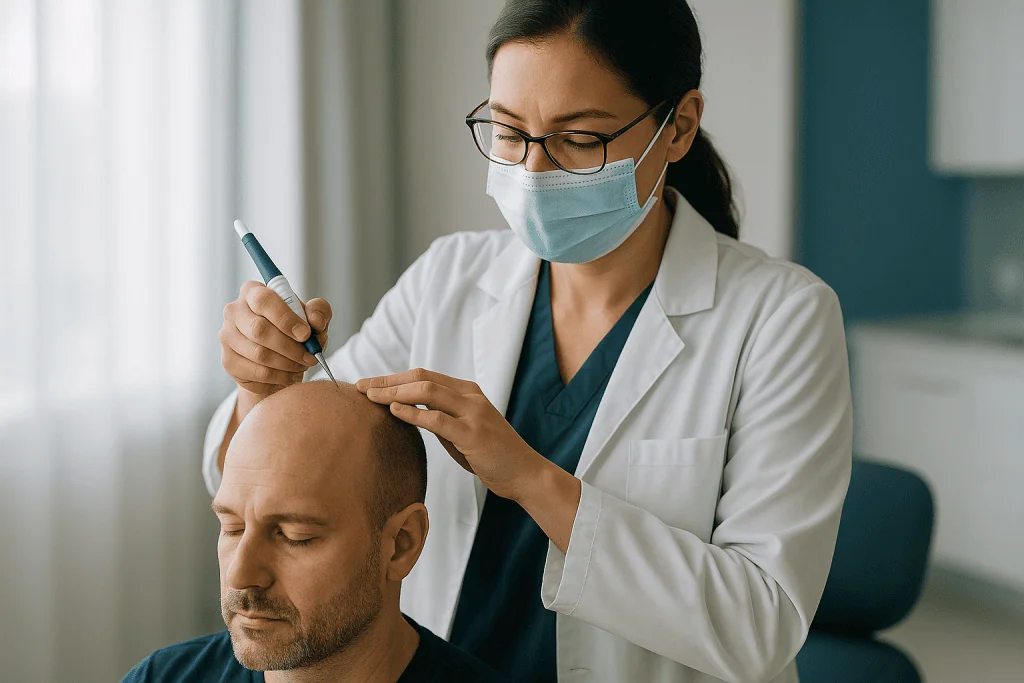
The implanter pen addresses a different hazard: mechanical damage during placement. When a graft is pushed into a pre-made slit with forceps, the surgeon grips it, and the bulb or the bulge can be squeezed or folded. The pen holds the graft inside a hollow needle so that the delicate tissue is not gripped at the moment it enters the skin. A plunger then slides the graft out as the needle withdraws, leaving it seated at the chosen depth and angle.
Whether that theoretical protection translates into more surviving hairs is the central scientific question about DHI, and it remains open. Comparative studies are small and mostly from single centers. Mainstream reviewers describe DHI as one acceptable way of performing follicular unit extraction rather than as a proven superior method. The mechanism is plausible; the magnitude of any benefit is not established.
Before the first punch: planning, marking and anesthesia
The quietest part of the day is arguably the most consequential. A hairline drawn a centimeter too low, or a density plan that spends the donor supply too freely, cannot be undone by any instrument. So the surgeon starts with a marker, a comb, and time.
Planning has three practical goals. The first is a hairline that will still look natural when the patient is twenty years older and the surrounding hair has thinned further; hair loss in androgenetic alopecia, the common inherited pattern, is progressive, as the Mayo Clinic explains, and a transplant does not stop it. The second is a realistic distribution of a finite number of grafts across the areas that matter most to the person, often the frontal hairline and the mid-scalp before the crown. The third is protecting the donor zone so that it does not become visibly thin.
Donor hair is trimmed short, usually to a few millimeters, so that the punch can be centered on each follicular unit and the exit angle of the hairs can be read. Some surgeons trim only strips and leave longer hair to cover them; this is a discussion point rather than a standard.
Anesthesia is local. A dilute solution is injected in a ring around the donor and recipient areas, often preceded by a cooling device or vibration to reduce the sting. Patients commonly describe the injections as the most uncomfortable minutes of the day and the rest as pressure without pain. Mild oral sedation may be offered; that decision, like all medication decisions, belongs to the treating team. A pre-operative check of medical history, bleeding tendency, blood pressure, and current medicines is routine, and it is the moment to mention anything that has been left off the forms.
Extraction: how follicular units leave the donor area
The donor area on the back and sides of the head is genetically stubborn. Its follicles tend to ignore the hormonal signals that shrink hair on the crown and temples, which is why hair moved from there generally keeps growing in its new location. Extraction is the act of harvesting that stubbornness one unit at a time.
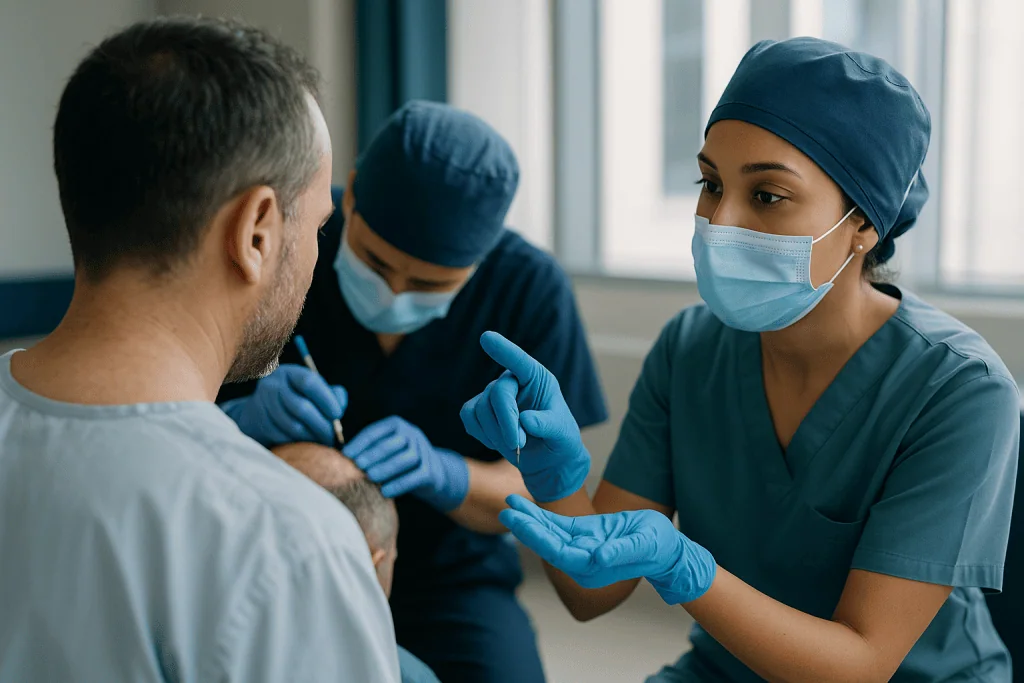
A punch, either hand-driven or on a slow motor, is centered over a follicular unit and advanced a short distance along the axis of the hairs. The goal is to cut the skin around the unit while leaving the deeper bulb attached only by loose tissue. The unit is then lifted with forceps. Done well, each site leaves a dot smaller than a lentil that heals as a pale fleck hidden by the surrounding hair; the NHS notes that FUE leaves many tiny scars rather than one linear scar, and DHI shares this donor pattern because the extraction step is the same.
Skill matters here more than the brand of punch. Two numbers that surgeons watch are the transection rate, meaning the proportion of grafts damaged during removal, and the pattern of extraction, which should be spread evenly so no region is overharvested. A patchy donor area is one of the more visible complications of poorly planned surgery and is difficult to correct.
Extraction is also where the day’s pace is set. Grafts are usually taken in batches, passed to technicians for sorting, and placed within a relatively short interval, then the cycle repeats. Patients often lie face down or on their side for this portion, with breaks to stretch and drink. The scalp feels tugged rather than cut, and the sound of the motor is more noticeable than any sensation.
What happens to grafts between extraction and placement
Between leaving one part of the scalp and entering another, a graft spends its time on a cold tray under a magnifier, and this interlude gets little attention in patient conversations. It deserves more, because the survival of the graft is decided as much here as anywhere.
Technicians sort the harvested units by the number of hairs they contain. Single-hair grafts are set aside for the very front of the hairline, where they mimic the fine, irregular fringe of natural hair. Two- and three-hair units go behind them to build density. Any graft with a stripped or transected bulb is noted; the count of usable grafts, not the count of punches, is the figure that matters.
The trays hold a chilled solution. Options range from simple saline to more elaborate preservation media borrowed from organ transplantation. Laboratory work suggests cooling slows cellular energy loss and that time out of the body should be kept short, but robust clinical trials showing one solution produces better hair growth than another are lacking. A reasonable summary of the evidence is that keeping grafts cool, moist, and moving quickly to placement is sound practice, while specific proprietary media have not been shown to change outcomes.
In a DHI workflow this stage has one extra task. Instead of resting until the surgeon’s channels are ready, each graft is drawn directly into an implanter pen by a technician, and a small rack of loaded pens is kept ready at the surgeon’s elbow. The graft’s time on the tray is therefore often shorter, though the loading step itself involves handling. How those two effects balance out has not been settled by comparative data.
Loading the DHI implanter pen: what the technician is actually doing
An implanter pen is a spring-loaded or manual device, roughly the size of a ballpoint pen, with a hollow, beveled needle at one end and a plunger inside. The design is often called a Choi-type implanter after the Korean surgeon who popularized it, though many manufacturers now make versions and none has been shown in mainstream literature to outperform the others.
Loading is fiddly, repetitive work done under magnification. The technician grips the graft by the fatty tissue above the bulb, never by the bulb itself, and slides it into the bevel of the needle bulb-first until only the hair shaft protrudes. A correctly loaded graft sits with its curve following the needle’s curve, so that when it exits it will lie in the direction of surrounding hair. Loading against the curve can leave a hair growing in a slightly wrong direction, which is unfixable once healed.
Needle size is matched to the graft. Single-hair grafts go into narrower needles; three- and four-hair units need wider ones. A graft forced into a needle that is too small is compressed, which defeats the pen’s purpose. One that rattles in a needle too large may be placed too deep or slip out.
Each pen holds one graft at a time. In a session of several thousand grafts, that means several thousand loadings, typically handled by a team of two or more technicians working in a steady relay with the surgeon. The rhythm of the room is set by this handoff: load, pass, place, return. Patients sometimes hear the small click of the plunger repeated for hours.
A fair question to ask during consultation is who does the loading and how experienced they are, since technician skill at this step directly affects graft handling.
Placement order: why the sequence of grafts matters
If extraction is about harvesting hair safely, placement is about making it look like it was always there. Order, angle, and depth are the three variables, and experienced surgeons tend to hold strong views on all three.
Most place the hairline first, while the surgeon is freshest and the field is clearest. The front edge is built from single-hair grafts set in a deliberately irregular line, because a ruler-straight hairline is the most common giveaway of transplanted hair. Just behind it come two-hair units, and behind those the denser three- and four-hair units that give the appearance of fullness. Working front to back also lets the surgeon see the emerging pattern and adjust density before the graft supply runs low.
Angle is controlled by how the pen meets the skin. Natural hair at the hairline exits at a low angle, often described as nearly parallel to the forehead, and points forward or slightly to one side; hair at the crown spirals in a whorl. The pen is tilted to match each region, and the bevel of the needle is turned to follow the direction the hair should fall. Depth is set by how far the needle enters before the plunger releases the graft: too shallow and the graft may pop out or heal with a small bump, too deep and it may form a pit or, rarely, a cyst.
Density is a matter of judgment. Packing grafts very closely can compromise blood supply to the area and lower survival; spacing them too widely leaves a see-through result. Surgeons work toward a density that looks full under normal lighting without starving the tissue. A staged approach, with a second session after the first has grown in, is common when the target area is large, as MedlinePlus notes that multiple sessions may be needed.
DHI vs FUE: what the evidence actually shows
Patients often arrive believing DHI and FUE are competing operations. They are better understood as one operation with two placement methods. The donor step is identical. The difference is whether channels are made in advance with a blade or needle and grafts inserted with forceps, or whether the implanter pen makes each channel and deposits the graft at once.
| Feature | Classic FUE (pre-made channels) | DHI (implanter pen) |
|---|---|---|
| Donor extraction | Individual punch harvest | Identical punch harvest |
| Recipient site creation | Separate pass with blade or needle | Made by the pen at the moment of placement |
| Graft handling at placement | Gripped with forceps | Held inside a hollow needle |
| Shaving of recipient area | Usually required | Sometimes avoidable in small areas |
| Time per graft | Generally faster per graft | Generally slower; needs a loading team |
| Evidence of superior growth | Not demonstrated over DHI | Not demonstrated over FUE |
| Donor scarring | Many small dots | Same pattern |
The last row of evidence is the one to hold onto. Published comparisons are few, small, and generally from clinics that perform one method predominantly, which invites bias. Neither the NHS nor other mainstream health authorities recommend one placement method over the other; both describe FUE broadly as an established technique. Claims that one method achieves a specific higher survival percentage should be treated as marketing until a systematic review says otherwise.
Where DHI may genuinely differ in day-to-day terms is the ability to place grafts among existing hair without shaving the recipient area, which some people value for privacy during recovery, and the longer operating time, which can mean a longer day or a split session. These are practical trade-offs, not measures of quality.
Who a DHI hair transplant procedure is usually for, and who is asked to wait
The ideal candidate is not the person with the most hair loss but the person whose loss has settled into a predictable pattern with a healthy donor reserve behind it. That usually describes an adult with androgenetic alopecia, the inherited, hormone-sensitive thinning that the Mayo Clinic identifies as the most common cause of hair loss in both men and women, who has tried or considered medical treatment and understands that surgery relocates hair rather than creating it.
Surgeons commonly ask certain people to wait. Younger adults in their early twenties with rapidly advancing loss are often deferred, because the final pattern is not yet known and grafts placed today may end up stranded in front of a receding line. People with diffuse thinning across the whole scalp, including the donor area, may lack a stable reserve. Active inflammatory scalp conditions such as scarring alopecias are usually treated and quieted first, since operating on inflamed skin risks poor graft survival and further scarring. Hair loss from a recent illness, surgery, or major stress, known as telogen effluvium, generally recovers on its own over months and is not a surgical problem.
Medical factors count too. Uncontrolled diabetes, bleeding disorders, medicines that affect clotting, heavy smoking, and unrealistic expectations are all reasons a careful surgeon may pause or decline. The NHS advises anyone considering cosmetic surgery to confirm the surgeon’s registration and specialty and to allow time between consultation and surgery.
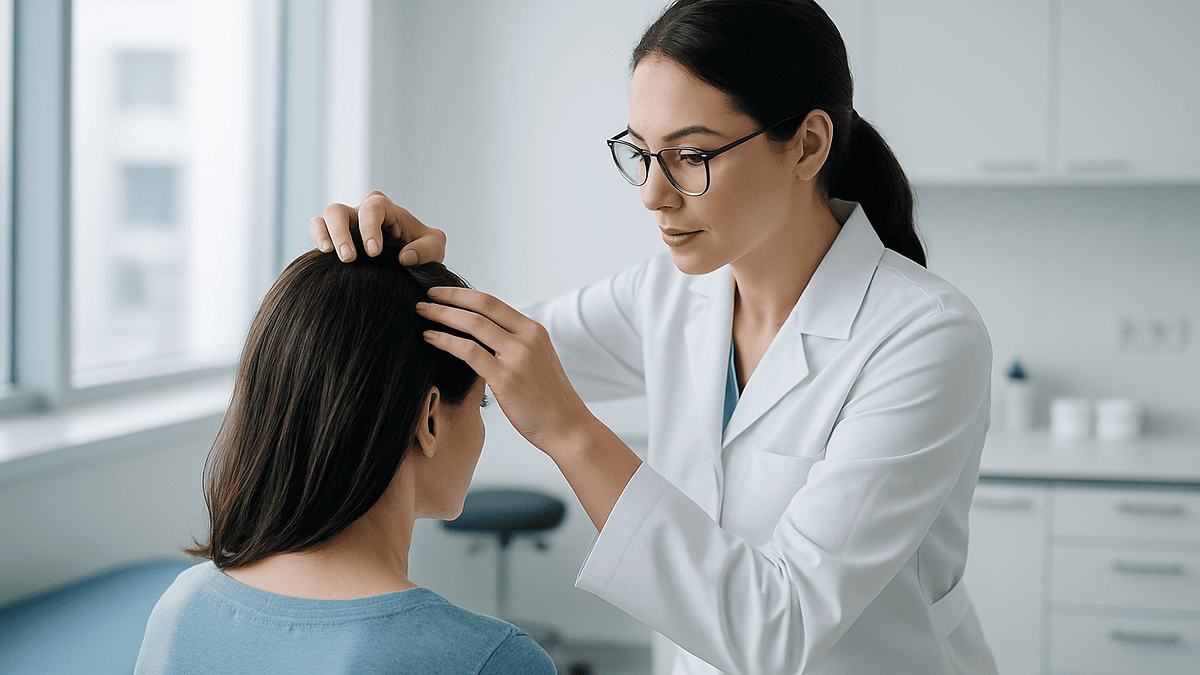
Women are candidates less often than the marketing suggests, not because of any rule, but because female pattern hair loss is more frequently diffuse and the donor area is less reliably spared. A dermatologist’s assessment, sometimes with blood tests or a scalp biopsy, is a sensible first step for any woman with thinning before surgery is discussed.
DHI hair transplant recovery: the first days and weeks
The transplant itself is the shortest part of the story. What follows is a stretch of weeks that surprises many people, mostly because the newly placed hair leaves before it returns.
The first two or three days bring tightness, mild swelling that can drift toward the forehead and around the eyes, and small crusts around each graft. The donor area may feel tender when lying down. The NHS notes that most people can return to work around three days after a hair transplant, though anyone with a physical job or a public-facing role may choose longer. Sleeping semi-upright for a few nights reduces swelling.
Grafts are most vulnerable in the first week to ten days, before they are anchored by healing tissue. Instructions usually cover gentle washing from a set day onward, no rubbing or picking at crusts, and avoiding hats that press on the recipient area. The NHS recommends avoiding strenuous exercise for about a month, partly to limit sweating and partly to avoid knocks. Alcohol and smoking are commonly discouraged during early healing because both affect blood flow to skin.
Then comes the part that unnerves people: shock loss. Within the first several weeks, most transplanted hairs shed. The follicles remain, having entered a resting phase, and this shedding is expected rather than a sign of failure. The NHS describes new growth appearing over the following months, with the fuller result visible around twelve to eighteen months after surgery. Growth is uneven at first, with fine, sometimes curly hairs that thicken over time.
Numbness or altered sensation over the donor or recipient area can persist for weeks and usually resolves. Persistent numbness beyond a few months is uncommon and worth reporting to the surgical team.
Risks, limits and alternatives in neutral terms
Hair transplantation is elective surgery, and the honest framing is that it carries real but generally modest risks, that its result is limited by the donor supply, and that it is one option among several.
Common, usually self-limiting effects include swelling, bruising, itching, small crusts, temporary numbness, and folliculitis, which is inflammation of hair follicles that can appear as small pimples in the weeks after surgery. Less common problems listed by the NHS and the Cleveland Clinic include infection, bleeding, visible donor scarring or thinning, grafts that fail to grow, cysts where a graft has been buried, and an unnatural appearance from poor angle or hairline design. Rarely, larger areas of skin can heal poorly, particularly in smokers or people with certain medical conditions. Scalp surgery can also trigger temporary shedding of existing native hair around the recipient area.
The central limit is arithmetic. Each person has a finite donor reserve, and every graft moved to the front is one that cannot later cover a widening crown. Because androgenetic alopecia continues, a surgeon plans against the likely future pattern, and many patients ultimately have more than one session over years.
Alternatives exist along a spectrum. Medical therapy, chiefly topical minoxidil and, in men, oral or topical finasteride, aims to slow loss and modestly thicken existing hair; the Mayo Clinic describes both as taking several months to show an effect and notes that benefit fades if treatment stops. These medicines are frequently continued after surgery to protect the surrounding native hair, and whether to use them is a decision for the prescribing clinician. Low-level laser devices have some supportive evidence of uncertain size. Platelet-rich plasma injections remain investigational, with mixed trial results. Camouflage products, hairpieces, and simply accepting the change are legitimate choices that no evidence ranks below surgery.
What people often get wrong about the DHI hair transplant procedure
Much of the confusion around DHI comes from the gap between how the technique is sold and what it is. A few corrections, each grounded in what the evidence supports.
The first misconception is that DHI is a different operation from FUE. It is not. The donor harvest is identical; only the placement tool changes. Anyone quoting dramatically different outcomes for the two is describing surgeon skill, patient selection, or marketing, not a property of the pen.
The second is that the pen guarantees higher graft survival. The mechanical argument is reasonable, but no large randomized comparison has shown it, and mainstream authorities do not endorse one method over the other. Survival depends more on time out of the body, handling, recipient blood supply, and aftercare than on the instrument.
The third is that a transplant stops hair loss. It moves hair; it does nothing to the hormonal process thinning the rest of the scalp. The Mayo Clinic is clear that pattern hair loss is progressive, and untreated native hair around the grafts will continue to recede.
The fourth is that results appear quickly. They do not. Most transplanted hairs shed within weeks, and the NHS describes the mature result as taking roughly a year to eighteen months. Photographs taken at three months tell you almost nothing.
The fifth is that more grafts is always better. Overharvesting the donor area to chase density in one session can leave the back of the head visibly thin, a trade many people regret. A conservative first session with an honest plan for the future is the more common recommendation among surgeons who work within recognized specialty bodies.
The last is that the procedure is minor. It is day surgery under local anesthesia, but it involves thousands of small wounds, hours of operating, and weeks of careful healing.
Questions to ask your care team before a DHI session
A good consultation should leave you with fewer questions than you walked in with, and the questions you do ask should be specific enough to expose vague answers. The following are ones that experienced surgeons tend to welcome.
- Who will perform the extraction and who will place the grafts? In some settings technicians do most of the surgical work; you are entitled to know how much the surgeon does personally.
- What is your training, and are you registered with the relevant medical regulator as a surgeon or dermatologist? The NHS advises checking registration before any cosmetic procedure.
- Why do you recommend DHI for me rather than pre-made channels, and what do you see as its trade-offs in my case?
- How many grafts do you plan, where will they go, and how much donor reserve will remain for future sessions?
- What hairline design do you propose, and how will it look if my native hair continues to recede over the next twenty years?
- What will the day involve, how long will I be in the chair, and will the session be split?
- What complications have you seen in your own practice, and how are they handled?
- What aftercare will I need to do myself, and when can I wash my hair, exercise, and return to work?
- Do you recommend medical therapy to protect my existing hair, and who would prescribe and monitor it?
- Who do I contact after hours if something worries me, and when is my follow-up?
Write the answers down. A surgeon who resists any of these questions, promises a specific outcome, or presses for a quick decision is giving you information of a different kind, and it is worth taking seriously.
When to call your doctor after a hair transplant
Most of what you feel in the first week is expected: tightness, itching, small crusts, mild swelling that peaks around the second or third day and settles. A short list of signs, however, should prompt a call to the surgical team the same day rather than a wait until the scheduled follow-up.
Call promptly if you notice spreading redness, warmth, or increasing pain in either the donor or recipient area after the first two or three days, especially with pus or a foul smell, since these suggest infection. Bleeding that does not stop with gentle pressure over ten minutes, or that soaks through dressings, needs assessment. Fever, chills, or feeling generally unwell in the first week are red flags. Swelling that closes an eye or spreads rapidly down the face, or any difficulty breathing or swallowing, should be treated as urgent and warrants emergency care.
Later concerns deserve a routine call rather than alarm. Persistent pimples in the recipient area beyond a few weeks may indicate folliculitis needing treatment. A firm lump under a graft site could be a cyst. Numbness that is not improving after two to three months, patchy growth at twelve months, or any part of the donor area that looks obviously thin are all worth a documented conversation with the surgeon who operated.
The general rule applies here as everywhere in medicine: you know your own body, and a symptom that feels wrong to you is a reasonable reason to ask. The treating team, not a search engine or a forum, is the right place to take that question, and every decision about wound care, medicines, or further procedures rests with them.
Frequently asked questions
How does a DHI hair transplant work differently from other methods?
DHI changes only the placement step. After follicular units are extracted with a punch, each graft is loaded into a hollow-needle implanter pen, and the pen creates the recipient opening and deposits the graft in a single press. Classic FUE makes all the channels first and then inserts grafts with forceps. Extraction, anesthesia, and aftercare are essentially the same for both.
What is a DHI implanter pen and who loads it?
An implanter pen is a slim, spring-loaded or manual device with a hollow beveled needle and an internal plunger that holds one graft at a time. Trained technicians load grafts under magnification, gripping the tissue above the bulb and sliding the graft in bulb-first, then pass the pen to the surgeon. Loading quality directly affects graft handling, so asking about technician experience is reasonable.
Is DHI better than FUE for graft survival?
This has not been demonstrated. The pen plausibly reduces squeezing of the graft at placement, but comparative studies are small, often single-center, and mainstream authorities such as the NHS do not endorse one placement method over the other. Survival depends more on time out of the body, gentle handling, blood supply, and aftercare than on the instrument used.
How long does a DHI hair transplant session take?
Typically most of a day. The NHS describes hair transplants as day procedures under local anesthesia that commonly take several hours, and DHI often runs longer per graft than pre-made channels because each graft must be individually loaded. Larger plans are sometimes split across two days or two sessions. Your surgeon should give you an estimate based on the planned graft count.
What does DHI hair transplant recovery look like in the first week?
Expect tightness, mild swelling that may drift toward the forehead, small crusts around grafts, and donor-area tenderness. Grafts are fragile for roughly the first week to ten days, so instructions usually cover gentle washing, no rubbing, and avoiding pressure from hats. The NHS notes most people return to work around three days after surgery.
Why does the transplanted hair fall out after surgery?
Because the follicles enter a resting phase after being moved, a normal response often called shock loss. The hair shafts shed within the first several weeks while the follicles remain in place, then new growth emerges over the following months. The NHS describes the fuller result appearing around twelve to eighteen months after surgery, so early shedding is expected rather than a sign of failure.
Do I need to shave my head for a DHI procedure?
The donor area at the back and sides is almost always trimmed short so the punch can be centered on each follicular unit. The recipient area is sometimes left unshaved with DHI because the pen can place grafts between existing hairs, which some people prefer for privacy. Whether that is practical depends on the size of the area and your surgeon’s approach.
Who is usually asked to wait before having a hair transplant?
Younger adults with rapidly progressing loss whose final pattern is unclear, people with diffuse thinning that includes the donor area, anyone with an active inflammatory scalp condition, and those with temporary shedding after illness or stress. Uncontrolled medical conditions, bleeding problems, heavy smoking, and unrealistic expectations are also common reasons a surgeon may recommend delaying.
Does a DHI transplant stop future hair loss?
No. It relocates hair from a resistant donor zone; it does not alter the hormonal process that thins the rest of the scalp. The Mayo Clinic describes pattern hair loss as progressive, so native hair around the grafts can keep receding. Many surgeons discuss medical therapy to protect existing hair, and that decision rests with the prescribing clinician.
What are the main risks of DHI hair transplant surgery?
Common effects include swelling, itching, crusting, temporary numbness, and folliculitis. Less common problems listed by the NHS and Cleveland Clinic include infection, bleeding, visible donor thinning, grafts that fail to grow, cysts from buried grafts, and an unnatural hairline from poor design or angle. Persistent numbness or patchy growth at twelve months should be reviewed by the operating surgeon.
References
This article is for general information only and is not a substitute for professional medical advice. Please consult a qualified doctor about your individual situation.

More from the Blog

How Many Grafts Do I Need? Norwood Stage to Graft Count, Mapped
Typical ranges run from about 500–1,500 grafts for early hairline recession (Norwood 2–3), 2,000–3,500 for moderate loss (Norwood 4–5), and 4,000–6,000 or more for…
How to Choose a Hair Transplant Clinic: Questions That Reveal Quality
To choose a hair transplant clinic, verify that a licensed physician trained in hair restoration performs or directly supervises every stage, ask exactly who…
Does Transplanted Hair Fall Out? Shedding vs Losing Grafts, Explained
Yes, most transplanted hairs shed between roughly two and eight weeks after surgery, and this is normal and expected. The follicles beneath the…
Female Hair Transplant Cost: How Unshaven Techniques Affect the Price
A female hair transplant using unshaven FUE or DHI typically falls in a guide range of EUR 3,250–6,500 for international patients treated in Turkey,…

When Can You Shave After a Beard Transplant? Trimming, Razors and Grooming in the First Months
Most surgical teams ask patients not to shave the transplanted beard area for at least two weeks, and many prefer around four weeks before…

DUPA: Why Diffuse Unpatterned Alopecia Usually Rules Out a Transplant
Diffuse unpatterned alopecia (DUPA) thins hair evenly across the entire scalp, including the back and sides that supply grafts for a hair transplant. Because…