

Is a Bronchoscopy Done Under General Anesthesia? Sedation Options Explained

Key Takeaways
- Most diagnostic flexible bronchoscopies use local anesthetic sprayed into the nose and throat plus intravenous sedation, not general anesthesia; you breathe on your own throughout.
- General anesthesia is typically reserved for rigid bronchoscopy, long interventional procedures such as airway stenting, children, and adults whose medical picture or anxiety makes sedation impractical.
- Bronchoscopy can be performed with local anesthetic alone and no sedation, though coughing and anxiety are more likely and studies find sedated patients are more willing to repeat the test.
- The Mayo Clinic puts a routine flexible bronchoscopy at about 30 to 60 minutes, but check-in, recovery, and a possible chest X-ray after biopsy often turn it into a half-day visit.
- The Cleveland Clinic and NHS advise no driving, machinery, or alcohol for 24 hours after either sedation or general anesthesia, because reaction times stay impaired after the sleepiness fades.
- Sharp chest pain or worsening breathlessness after a lung biopsy can signal a pneumothorax, an air leak around the lung, and needs emergency assessment rather than watchful waiting.
Most bronchoscopies are not done under general anesthesia. A flexible bronchoscopy is usually performed with local anesthetic sprayed into the nose and throat plus light to moderate sedation given through a vein, so the person is drowsy but breathing on their own. General anesthesia is typically reserved for rigid bronchoscopy, longer interventional procedures, or people with specific medical needs. The choice rests with the treating team.
The letter arrives with the appointment time, a line about not eating beforehand, and a single sentence that stops most people cold: “You will be given sedation.” Not “put to sleep.” Not “awake.” Something in between, and nobody at home can say what that in-between feels like when a thin camera is heading toward your lungs.
That uncertainty is the real question behind searches for bronchoscopy sedation or general anesthesia. People are not asking about pharmacology. They want to know whether they will remember it, whether it will hurt, and whether they will be the one gagging on a tube while strangers watch.
The honest answer is that the level of anesthesia is a decision, not a default. It changes with the type of scope, the reason for the test, your heart and lung reserve, and the routines of the team doing it. This article walks through what each option actually involves, who tends to get which, and what the evidence says about comfort, so that the conversation with your care team starts from facts rather than hospital-corridor rumor.
Bronchoscopy sedation or general anesthesia: what the choice really means
A bronchoscopy is a test in which a doctor passes a thin tube with a light and camera, called a bronchoscope, through the nose or mouth, past the voice box, and into the airways of the lungs. The Mayo Clinic describes it as a way to look at the airways directly, take small tissue samples, clear blockages, or treat problems that cannot be reached any other way.
Two very different instruments carry that name. A flexible bronchoscope is roughly the width of a pencil, bends around corners, and is used for the large majority of diagnostic bronchoscopies. A rigid bronchoscope is a straight metal tube, wider and stiffer, used when a doctor needs a larger working channel, for example to remove a large object, control heavy bleeding, or place a stent (a small tube that props an airway open).
The anesthesia plan follows the instrument. Flexible bronchoscopy is usually performed with local anesthetic, meaning a numbing medicine applied directly to the lining of the nose, throat, and airway, combined with sedation given through a vein. Rigid bronchoscopy almost always requires general anesthesia, because a rigid tube in the throat is not something a lightly sedated person can tolerate, and because the anesthesia team needs full control of breathing.
So when someone asks whether a bronchoscopy is done under general anesthesia, the useful reply is another question: which kind, and for what purpose? A quick inspection of the airways in a healthy adult and a two-hour procedure to open a narrowed airway in someone with a tumor sit at opposite ends of the same spectrum. Both are bronchoscopies. Neither tells you much about the other.
What matters most, in my reading of the evidence, is that the plan is matched to the procedure and the person, and that you understand which end of the spectrum yours sits on before the day arrives.
What actually happens during a flexible bronchoscopy
Picture the room first. It is usually an endoscopy suite or a procedure room rather than an operating theater, though some units use theaters. You lie on a bed, often propped slightly upright or flat on your back, with monitors clipped to a finger and stuck to your chest. A small plastic tube under your nose delivers oxygen. A cannula, a small soft tube placed in a vein in your hand or arm, is already in place.
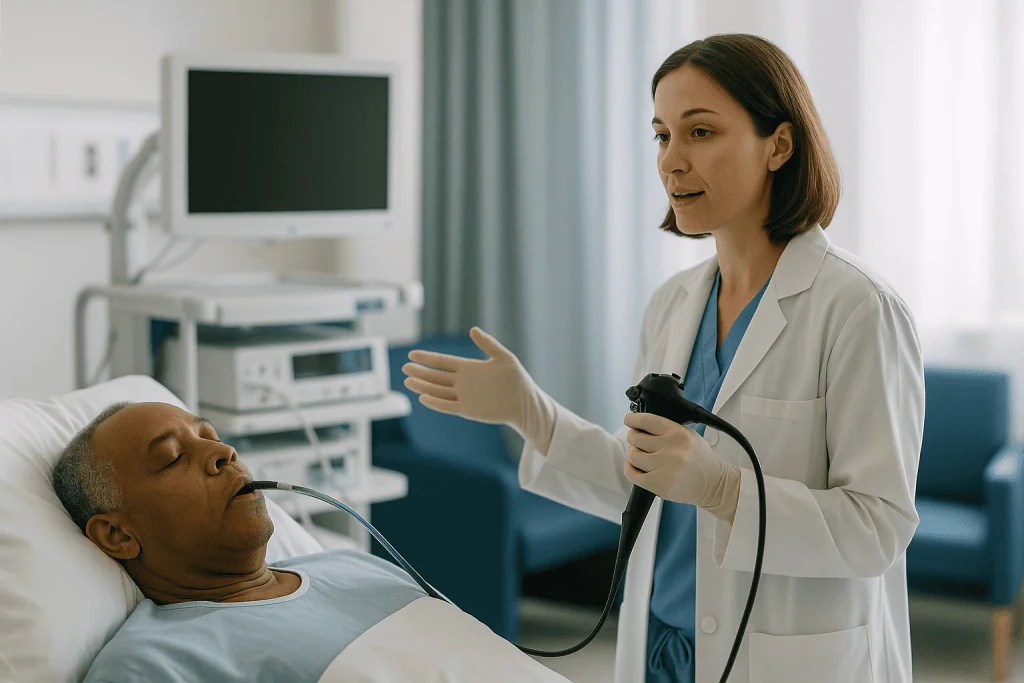
The team sprays or drips a local anesthetic into one nostril and the back of the throat. It tastes bitter. Within a minute or two the throat feels thick and swallowing feels odd, similar to the numbness after dental work but higher up. Sedative medicine then goes into the cannula. According to MedlinePlus, most people become relaxed and sleepy, and many remember little or nothing of what follows.
The bronchoscope goes in through the nose or mouth. As it passes the voice box, more local anesthetic is squirted through the scope onto the vocal cords and into the windpipe. The doctor watches a screen, steering the tip down the main airways and into the branches on each side. If samples are needed, tiny instruments pass down a channel inside the scope: a brush to collect cells, forceps for a pinhead-sized biopsy, or saline that is squirted in and sucked back out to collect fluid, a technique called bronchoalveolar lavage.
The Mayo Clinic notes that the procedure itself usually lasts about 30 to 60 minutes. You are breathing on your own throughout. The scope occupies only part of the airway, and air moves freely around it, which is why coughing, though common, is not dangerous.
When the scope comes out, the whole thing often feels to the patient like it lasted five minutes. That compression of time is the sedation doing its job.
Are you awake during a bronchoscopy? Levels of sedation explained
“Awake” turns out to be a poor word for what happens, because sedation is a dial rather than a switch. Anesthesia professionals describe a continuum that runs from minimal sedation, where you are calm but fully responsive, through moderate sedation, where you respond to voice or touch but drift and may not remember, to deep sedation, where you rouse only to repeated or painful stimulation, and finally to general anesthesia, where you cannot be roused and the team supports or controls your breathing.
Flexible bronchoscopy most often sits in the moderate band. The NHS describes the experience of sedation as being drowsy and relaxed rather than unconscious, and notes that many people do not remember the procedure afterward even though they could respond during it. That gap between “conscious at the time” and “no memory later” is the source of most confusion. People who were told they were awake are startled to find they cannot recall a thing. Both statements are true.
The medicines used are typically from two classes. Benzodiazepines act on the brain’s calming receptors, reducing anxiety and blocking the formation of new memories for a period. Opioids blunt the cough reflex and the discomfort of the scope passing the throat, which is why they are often combined with a benzodiazepine. Some teams use propofol, a fast-acting sedative that wears off within minutes of being stopped; because it can tip into deep sedation quickly, its use is often restricted to anesthesia-trained staff.
Which combination, and how deep, is not a decision for a magazine article. It depends on your weight, age, kidney and liver function, sleep apnea, other medicines, and how much sampling is planned. The team titrates in the room, watching your breathing and oxygen level moment to moment, and adjusts. Your job is to tell them honestly beforehand about alcohol, sedative use, and any previous bad reaction to anesthesia.
When is a bronchoscopy done under general anesthesia?
General anesthesia means a medicine-induced state of controlled unconsciousness in which you feel nothing and an anesthesia specialist manages your breathing, usually through a tube in the windpipe or a mask over the voice box. For bronchoscopy, it is chosen in a handful of recognizable situations.
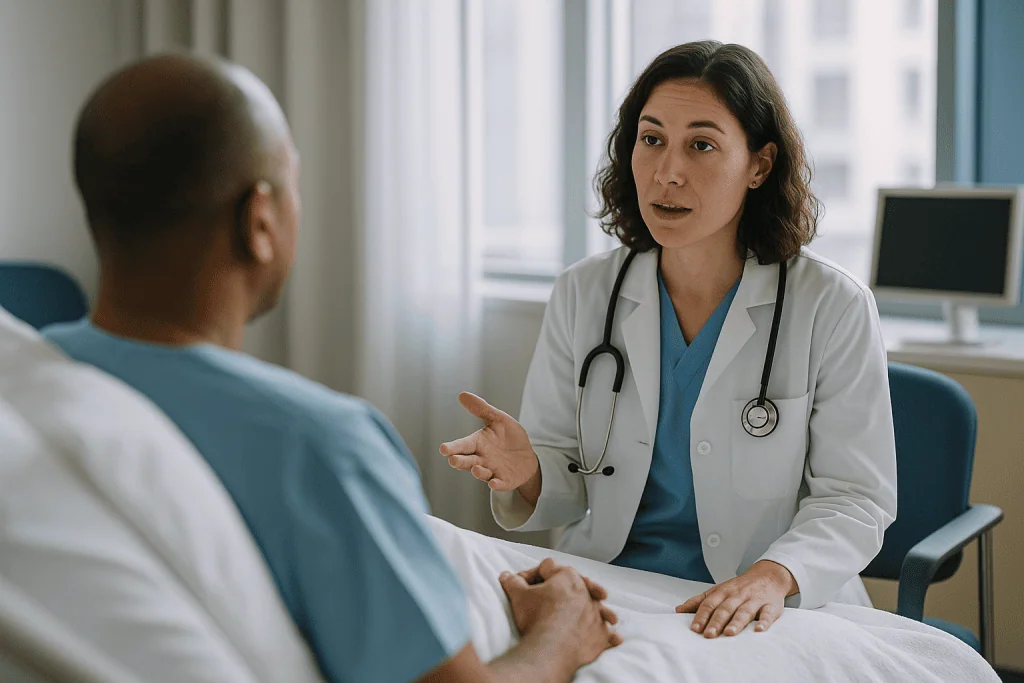
The first is rigid bronchoscopy, described above. The second is the group of longer or more complex interventional procedures done through a flexible scope: laser or heat treatment of tumors in the airway, placing valves or stents, and some advanced sampling techniques where the scope must sit very still for a long time. Johns Hopkins Medicine notes that some bronchoscopies are performed in the operating room under general anesthesia for exactly these reasons.
The third group is about the person rather than the procedure. Children almost always have bronchoscopy under general anesthesia because cooperation and stillness cannot be expected. Adults with severe anxiety, a strong gag reflex that defeated a previous attempt, certain neurological conditions, or an airway so narrowed that the team wants complete control from the start may also be offered it.
A fourth reason is logistical. Some centers combine a bronchoscopy with another procedure under the same anesthetic, for example a chest ultrasound-guided biopsy or a surgical procedure, and it makes sense to do both at once.
General anesthesia is not “more” of the same thing as sedation. It brings its own preparation, usually a longer fasting period, a formal pre-anesthetic assessment, and a longer recovery, along with a small set of risks that the NHS describes as generally rare in healthy people but higher in those with serious heart, lung, or kidney disease. None of this makes it the wrong choice. It makes it a different choice, one with a different set of trade-offs that your team weighs against the alternative.
Is it possible to have a bronchoscopy without sedation?
Yes, and it is done more often than people expect. Local anesthetic alone, with no medicine given into the vein, is a recognized approach for flexible bronchoscopy. Some units in various countries use it routinely; others reserve it for people who request it or for whom sedatives carry particular risk.
There are reasons a person might choose or be offered this. Someone with very poor lung reserve may not tolerate the mild drop in breathing that sedatives cause. Someone who needs to drive themselves or return to work the same day, though not advisable in most cases, may ask. Someone who simply wants to remain fully present, and who has a calm temperament, may prefer it. Unsedated bronchoscopy is also used in intensive care units, where patients already have a breathing tube in place and the scope passes through it.
What does it feel like? The numbing works well on the throat and windpipe, so the scope itself is more strange than painful. The hard part for most people is the cough. The airways carry reflexes designed to expel foreign objects, and a camera is a foreign object. Even with generous local anesthetic, coughing spells are common, and the sensation of a scope moving in the chest is unusual and, for some, distressing.
Studies that have compared sedated and unsedated bronchoscopy generally find that patients report the procedure as tolerable either way, but that those who received sedation more often say they would be willing to repeat it. The MedlinePlus entry lists sedation as the usual approach for a reason: comfort and willingness to return matter clinically, because bronchoscopies sometimes need repeating.
If you are leaning toward no sedation, raise it early rather than on the day. The team can tell you whether it suits the sampling planned for you, and whether they have experience doing it that way.
Is a bronchoscopy painful? What the numbing and the scope feel like
Pain is the wrong lens, and it helps to say so plainly. The lining of the airways has few pain receptors of the sharp, cutting kind. What it has in abundance are cough receptors and stretch receptors. The dominant sensations during and after bronchoscopy are pressure, tickle, the urge to cough, and afterward a scratchy throat. The Cleveland Clinic describes the test as uncomfortable rather than painful for most people, and Mayo Clinic patient information uses similar language.
Breaking the experience into its parts is useful:
- The local anesthetic spray stings briefly and tastes bitter. The sensation of a numb throat that will not swallow properly bothers some people more than the scope does.
- Passing through the nose can produce a sharp, brief pressure, like the moment a swimmer gets water up the nose. Going through the mouth avoids this but tends to trigger more gagging, which is why a mouth guard is used.
- Crossing the voice box is the moment most likely to provoke a strong cough. More local anesthetic is applied here for exactly that reason.
- Biopsies deep in the lung are usually not felt at all, because lung tissue itself has no pain fibers. Brushing and lavage produce a sensation of fullness or a need to cough.
Afterward, a sore throat and hoarseness are common and typically settle over a few days, according to the Mayo Clinic. If a biopsy was taken, small amounts of blood-streaked mucus can be coughed up for a day or two. A low fever on the evening of the procedure sometimes follows lavage as the body reacts to the fluid; it should be short-lived.
Where discomfort tips into something that needs attention is covered later in this article. For the procedure itself, the fair summary is this: with adequate local anesthetic and sensible sedation, most people do not describe it as painful, and many do not remember it.
Is a bronchoscopy considered major surgery?
No. A diagnostic flexible bronchoscopy is classified as a minimally invasive procedure, meaning it is done through a natural opening in the body without any cut in the skin. There is no incision, no stitches, and no wound to heal. MedlinePlus lists it among diagnostic tests rather than operations, and it is typically performed as a day case, with the person going home the same day.
The confusion arises because bronchoscopy shares a room, a set of monitors, and often the same fasting instructions with surgery, and because the word “anesthesia” appears on the consent form. It is also true that the interventional end of bronchoscopy blurs the line. Removing a tumor from an airway with a rigid scope under general anesthesia, or placing a stent in a narrowed bronchus, involves an operating room and a surgical level of planning. Some of these are performed by thoracic surgeons rather than pulmonologists. But these are a minority of all bronchoscopies.
Why does the classification matter to you? Three practical consequences follow. First, recovery for a diagnostic bronchoscopy is measured in hours to days, not weeks. Second, the risk profile is that of a sedated endoscopic test rather than an operation: the concerns are breathing depression during sedation, a small chance of air leak if lung tissue is sampled, and bleeding at a biopsy site, rather than surgical wound or deep-vein complications. Third, the pre-procedure workup is lighter, though people on blood thinners need specific advice about whether and when to pause them, and that instruction must come from the prescribing clinician and never from a general article.
It is fair to take the procedure seriously without treating it as surgery. The airway is a sensitive place, sedation is a real medicine with real effects, and the team will monitor you accordingly. But most people are back to normal activity within a day or two, and the experience is closer to a colonoscopy or an upper endoscopy than to an operation.
Who is usually offered sedation, who gets general anesthesia, and who is asked to wait
Sedated flexible bronchoscopy is the default for most adults being investigated for a persistent cough, an abnormal chest scan, unexplained bleeding from the lungs, a suspected infection that has not responded to treatment, or a lump seen on imaging. If you are otherwise reasonably well and the plan is inspection plus straightforward sampling, this is very likely what you will be offered.
General anesthesia becomes the plan in the circumstances covered earlier: rigid scopes, long interventional work, children, and adults whose medical picture or previous experience makes sedation impractical. Some people with severe sleep apnea or a very high body weight are also steered toward an anesthetist-led approach, not because sedation is forbidden but because managing their breathing safely needs more hands and more monitoring.
Then there is the group asked to wait, and this is worth understanding because a postponement can feel like bad news when it is usually the opposite. The Mayo Clinic and MedlinePlus both describe situations that raise procedural risk. Teams commonly delay when someone has:
- An active flare of asthma or chronic obstructive pulmonary disease, because irritated airways are more likely to spasm around the scope.
- A recent heart attack or unstable angina, because sedation and coughing put strain on the heart.
- Oxygen levels that are already low at rest, leaving little margin during the procedure.
- Blood clotting that is poorly controlled, or blood-thinning medicines that have not been paused according to the prescriber’s plan, when biopsies are needed.
- An acute chest infection that would cloud the very samples the test is meant to collect.
None of these is an absolute barrier. Some become reasons to switch from sedation to a fully controlled anesthetic in an operating room instead. The decision about whether you fall into one of these categories, and what to do about it, rests entirely with your treating team. A postponement is them buying safety margin, not delivering a verdict.
Bronchoscopy sedation vs general anesthesia: a side-by-side comparison
The table below sets the two common approaches next to each other, with the unsedated option included for completeness. Every row describes what is typical, not what will happen to you; your team may differ from any of these for good reasons.
| Feature | Local anesthetic only | Local anesthetic plus sedation | General anesthesia |
|---|---|---|---|
| Usual scope | Flexible | Flexible | Rigid, or flexible for long interventional work |
| Awareness | Fully aware | Drowsy, often little or no memory | Unconscious |
| Breathing | Your own | Your own, with oxygen support | Supported or controlled by the anesthesia team |
| Where done | Endoscopy suite | Endoscopy suite | Operating room |
| Who gives the medicines | Bronchoscopy team | Bronchoscopy team or anesthesia staff | Anesthesia specialist |
| Typical procedure time (Mayo Clinic) | About 30–60 minutes | About 30–60 minutes | Varies widely with the intervention |
| Going home | Same day, once throat numbness wears off | Same day, with an escort; no driving for 24 hours (Cleveland Clinic) | Same day or overnight, depending on procedure |
| Main advantages | Fastest recovery; avoids sedative effects | Comfort with preserved breathing; most widely used | Complete stillness and airway control for complex work |
| Main trade-offs | Coughing and anxiety more likely | Small risk of breathing depression; needs monitoring | Longer fasting and recovery; anesthesia-related risks |
A few things stand out. Time in the room is similar across the first two columns, because the sedation does not change what the doctor does; it changes what you experience. The largest practical difference for most people is the third column’s longer recovery and its need for an anesthesia specialist, which is why teams do not reach for it without a clear reason.
The other point worth pulling out is the driving rule. Sedatives affect judgment and reaction time long after you feel fine. The Cleveland Clinic advises against driving for 24 hours after sedation, and the NHS gives the same 24-hour guidance for both driving and alcohol after a general anesthetic. Plan for someone to take you home and, ideally, stay with you that night.
How long does a bronchoscopy take, from check-in to going home?
The number people search for is the procedure length, and the Mayo Clinic puts a routine flexible bronchoscopy at roughly 30 to 60 minutes. That is the answer to the question asked, but it is not the answer to the question people mean, which is “how long will my day be?”
Working backward from the scope, the timeline typically runs like this. Fasting comes first. The Mayo Clinic advises not eating or drinking for several hours beforehand, with the precise window set by the unit; MedlinePlus gives a range of 6 to 12 hours. An empty stomach reduces the risk of vomiting and inhaling stomach contents while your protective reflexes are dulled.
On arrival, expect check-in, a nursing assessment, consent, and placement of the cannula. This often takes 30 to 60 minutes and sometimes longer if the list is running behind. Then the procedure itself. Then recovery, which is the part most people underestimate. Johns Hopkins Medicine describes a recovery period in which staff monitor your breathing, blood pressure, and oxygen level until the sedation has worn off enough for you to be safe. Mayo Clinic information notes that you should not eat or drink until the throat numbness has gone, typically within one to two hours, because swallowing with a numb throat risks food going the wrong way.
If a lung biopsy was taken, many units also arrange a chest X-ray before discharge to check for an air leak, which adds time. Put together, a morning appointment often means going home in the early afternoon. A general anesthetic, particularly for an interventional procedure, stretches this further and can mean an overnight stay.
Results follow a different clock. Cells and tissue go to a pathology laboratory, and cultures for infection may need days to grow. Ask before you leave how and when results will reach you, so that the silence of the following week does not read as bad news.
The hours and days after a bronchoscopy: what usually happens
The first few hours are about waiting for medicines to fade. Sedatives leave people groggy, slightly unsteady, and sometimes emotional or forgetful. It is common to ask the same question twice and not remember the answer. Write down anything the team tells you, or have your escort do it.
The throat is the loudest complaint for most. Hoarseness, a raw feeling, and a dry cough are typical and, according to the Mayo Clinic, tend to ease over a few days. Warm drinks and rest help. Voice strain is worth avoiding for a day, particularly if the scope passed the voice box several times.
If samples were taken, expect a small amount of blood in what you cough up for a day or two. Streaks or flecks are normal; a steady flow is not, and the red-flag section below covers that. After a lavage, a mild fever on the first evening is a known reaction and usually settles overnight; the NHS notes that a temperature that persists or climbs is a reason to seek advice.
By the next morning most people who had sedation for a diagnostic procedure feel close to normal and can return to desk work or light activity. The 24-hour restrictions on driving, operating machinery, signing legal documents, and drinking alcohol described by the Cleveland Clinic and the NHS still apply through that first day. Strenuous exercise is usually best deferred a little longer if biopsies were taken, mainly to avoid provoking bleeding, though your team will give the specific guidance.
After a general anesthetic, the fog can last longer. The NHS describes tiredness, nausea, and difficulty concentrating as common for a day or two, and advises having an adult with you for the first 24 hours. People who had interventional work may have additional instructions about breathing exercises, medicines, or follow-up imaging.
The days after are also when results begin to arrive. That waiting is often harder than the procedure. Knowing the expected timeline in advance takes some of the sting out of it.
Risks of sedation and general anesthesia during bronchoscopy, in neutral terms
Every honest explainer owes readers a clear account of what can go wrong, and equally a sense of proportion. Flexible bronchoscopy has a long safety record. The Mayo Clinic describes complications as uncommon and usually minor. The risks that do exist fall into two groups: those from the scope, and those from the anesthesia.
From the scope, the recognized problems are bleeding at a biopsy site, which is usually slight and stops on its own; a collapsed lung, called a pneumothorax, in which air leaks from a biopsied area into the space around the lung, more likely when deep lung tissue is sampled; a temporary drop in oxygen level; airway spasm; and, rarely, infection introduced by the procedure. Injury to the voice box or teeth from the scope or mouth guard is uncommon but possible.
From sedation, the central concern is breathing depression. Benzodiazepines and opioids both quiet the drive to breathe, and together they do so more than either alone. This is why the oxygen monitor on your finger matters, why extra oxygen is given routinely, and why reversal medicines are kept in the room. A drop in blood pressure and a slowed heart rate are also watched for. People with sleep apnea, heart failure, or advanced lung disease sit at higher risk, which is part of why they are sometimes routed to an anesthesia-led setting instead.
General anesthesia adds its own list. The NHS describes common, short-lived effects such as nausea, shivering, sore throat from the breathing tube, and confusion on waking. Serious complications, including severe allergic reaction, aspiration of stomach contents, and awareness during the anesthetic, are described as rare, with risk rising in people who are older, unwell, or having emergency procedures.
No article can tell you your individual risk. That number comes from your history, your test results, and your team’s judgment. What an article can do is make the categories familiar, so that the consent conversation is a discussion rather than a recitation.
What people often get wrong about bronchoscopy anesthesia
Several beliefs circulate widely enough to deserve a direct correction.
“They put you to sleep for it.” Sometimes, but usually not. Most diagnostic bronchoscopies use local anesthetic plus sedation. You are breathing on your own and could respond if spoken to, even if you do not remember doing so. General anesthesia is the exception, reserved for specific procedures and specific people.
“If I’m awake, I’ll feel everything.” The lining of the airway is thoroughly numbed, and lung tissue itself has no pain fibers. The sensations people report are coughing, pressure, and strangeness, not sharp pain. Being aware and being in pain are not the same thing.
“Sedation is just a lighter version of general anesthesia, so it must be safer in every way.” Sedation is safer for many people, which is why it is the default, but it is not risk-free and it is not simply “less.” A sedated person breathes for themselves without a protected airway, which is a different safety problem from a general anesthetic where the airway is fully controlled. For certain patients, the controlled option is the safer one.
“I’ll be able to drive home if I only had sedation.” No. The Cleveland Clinic and the NHS both advise against driving for 24 hours after sedation or general anesthesia. Feeling alert is not the same as having normal reaction times; the medicines linger in the body long after the sleepiness fades.
“Not remembering it means something went wrong.” Memory loss for the period of sedation is an expected effect of benzodiazepines, not a sign of a problem. Many people find it a relief.
“They’ll find out what’s wrong right away.” The doctor may describe what the airways looked like, but tissue and fluid samples go to a laboratory. Results can take days, and cultures for slow-growing organisms can take longer. A bronchoscopy is the start of an answer, not the answer itself.
Correcting these is not about reassurance for its own sake. People who arrive with accurate expectations tend to find the experience easier, and that is worth something on the day.
Questions to ask your care team before a bronchoscopy
The pre-procedure conversation is short and often rushed. Arriving with questions written down changes its shape. These are the ones that tend to matter most for the sedation-or-anesthesia decision.
- Which type of bronchoscope will you use, flexible or rigid, and why?
- What level of anesthesia are you planning for me: local only, sedation, or general anesthesia? What led you to that choice for my case?
- Who will be giving and monitoring the sedation, and will an anesthesia specialist be present?
- What samples are you planning to take, and does that affect the sedation plan or the risk of an air leak?
- How long should I fast, and does that include water and my usual morning medicines?
- I take these medicines (bring a list). Should any be paused, and who decides that? This is especially important for blood thinners and diabetes medicines.
- I have sleep apnea, heart disease, or lung disease. Does that change the plan or where the procedure is done?
- I had a bad experience with sedation or anesthesia before. What can be done differently?
- If I am very anxious, can the plan be adjusted, or can I be offered general anesthesia instead?
- Could I have it without sedation if I preferred, and would you recommend that for the sampling you have planned?
- How long should I expect to be in the unit, and what arrangements do I need for getting home?
- What symptoms afterward are normal, and which should prompt a call?
- How and when will I get the results, and who will explain them to me?
Two things are worth saying about this list. First, none of these questions is a challenge to the team’s judgment; clinicians generally welcome a patient who wants to understand the plan. Second, the answers belong to your specific situation. An article can prepare you to ask; only the people who have examined you and read your scans can answer.
When to call your doctor after a bronchoscopy: red-flag signs
Most people go home with a scratchy throat and nothing more. A small number develop problems in the hours or days afterward that need prompt attention. The following signs, drawn from Mayo Clinic, MedlinePlus, and NHS patient guidance, are the ones that should prompt a call to your care team or, if severe, emergency services.
Seek emergency care immediately if you have:
- Sudden or worsening shortness of breath, or breathing that feels harder than it did before the procedure.
- Sharp chest pain, especially on one side or when breathing in, which can signal an air leak around the lung.
- Coughing up more than small streaks of blood, or blood that keeps coming rather than tapering off.
- Blue or gray tinge to the lips or fingertips.
- Fainting, severe dizziness, or a racing or irregular heartbeat.
- Difficulty swallowing your own saliva, a rapidly swelling throat, or a voice that is disappearing.
Call your care team the same day if you have:
- A fever that does not settle within a day, or one that climbs, chills, or shaking. A brief mild temperature on the first evening after lavage is common, but a persistent or rising one is not.
- Increasing cough with thick or discolored sputum.
- Chest discomfort that is new, lasting, or getting worse rather than better.
- Ongoing nausea or vomiting after a general anesthetic that prevents you keeping fluids down.
- Confusion, unusual drowsiness, or any symptom that simply worries you and does not fit what you were told to expect.
Trust the instinct that something is off. Staff in bronchoscopy units would far rather field a phone call about a symptom that turns out to be benign than miss an air leak or a bleed. Keep the contact number you were given somewhere you can find it, and if you were sent home with someone, make sure they know these signs too, because sedation can dull your own judgment about how you feel.
Every decision about what to do next, including whether you need to be seen, imaged, or admitted, belongs to the team that performed your procedure or your local emergency service. This list exists so that you know when to reach them.
Frequently asked questions
Are you fully sedated for a bronchoscopy?
Usually not fully. Most flexible bronchoscopies use moderate sedation, in which you are drowsy, breathing on your own, and able to respond to voice or touch, though many people remember little afterward. Deep sedation or general anesthesia, where you cannot be roused, is used for rigid bronchoscopy, long interventional procedures, children, and some adults with specific needs. The depth is set by your treating team based on the procedure and your health.
Are you awake during a bronchoscopy?
In a technical sense, often yes, but not in the way people fear. With sedation you are in a drowsy state where you could respond if spoken to, yet the medicines commonly prevent memories from forming, so afterward it feels as though you slept. With local anesthetic alone you are fully aware. Under general anesthesia you are unconscious. Ask your team which of these applies to your planned procedure.
Is bronchoscopy very painful?
For most people, no. The airway lining is numbed with local anesthetic and lung tissue itself has no pain fibers, so the main sensations are coughing, pressure, and strangeness rather than sharp pain. The Cleveland Clinic and Mayo Clinic describe it as uncomfortable rather than painful. Afterward, a sore throat and hoarseness are common and typically ease over a few days. Persistent or severe chest pain is not expected and should be reported.
Is a bronchoscopy considered major surgery?
No. A diagnostic flexible bronchoscopy is a minimally invasive test done through the nose or mouth with no incision, usually as a day case. It sits closer to an upper endoscopy or colonoscopy than to an operation. Some interventional bronchoscopies, such as removing airway tumors with a rigid scope under general anesthesia, do take place in an operating room and carry a surgical level of planning, but these are a minority.
Is it possible to have a bronchoscopy without sedation?
Yes. Flexible bronchoscopy with local anesthetic only, and no medicine into the vein, is an accepted approach used routinely in some units and on request in others. It avoids sedative side effects and allows a faster recovery, but coughing and anxiety are more likely, and comparative studies find sedated patients more often say they would repeat the test. Raise the option early so your team can judge whether it suits the sampling planned.
How long does a bronchoscopy take under sedation?
The procedure itself usually lasts about 30 to 60 minutes, according to the Mayo Clinic, and sedation does not change that; it changes what you experience. The full visit is longer. Check-in and cannula placement, then recovery until the sedation has worn off and throat numbness has gone, typically within one to two hours, and sometimes a chest X-ray after biopsy, mean a morning appointment often ends in the early afternoon.
Will I remember anything after bronchoscopy sedation?
Many people remember little or nothing, and that is an expected effect rather than a problem. Benzodiazepine sedatives interfere with the formation of new memories for a period, so even though you may have been responsive during the procedure, the recording simply was not made. Some people recall fragments, such as coughing or the taste of the numbing spray. With local anesthetic alone, you would remember the whole procedure.
Can I drive home after a bronchoscopy with sedation?
No. The Cleveland Clinic advises against driving for 24 hours after sedation, and the NHS gives the same 24-hour guidance after a general anesthetic, along with avoiding alcohol, operating machinery, and signing important documents. The medicines slow reaction time and judgment well after you feel alert. Arrange for an adult to take you home and, ideally, stay with you overnight. Units generally will not discharge a sedated patient without an escort.
What is the difference between rigid and flexible bronchoscopy anesthesia?
Flexible bronchoscopy uses a thin bendable scope and is usually done with local anesthetic plus sedation in an endoscopy suite, with you breathing on your own. Rigid bronchoscopy uses a straight metal tube that is wider and stiffer, giving a larger working channel for removing objects, controlling bleeding, or placing stents. Because a rigid tube cannot be tolerated while lightly sedated, it is almost always performed under general anesthesia in an operating room.
Why would a doctor choose general anesthesia for my bronchoscopy?
Common reasons include a rigid scope, a long or complex interventional procedure that needs complete stillness and airway control, combining the bronchoscopy with another procedure under one anesthetic, a very narrowed airway, severe anxiety or a strong gag reflex that defeated a previous attempt, or medical conditions that make unprotected sedation riskier. Children nearly always have general anesthesia. Your team weighs these factors against the longer recovery and anesthesia-related risks.
References
This article is for general information only and is not a substitute for professional medical advice. Please consult a qualified doctor about your individual situation.

More from the Blog

Living With Asbestosis: Pulmonary Rehabilitation, Vaccinations and Protecting Your Lungs
Living with asbestosis means managing permanent lung scarring rather than reversing it. The evidence supports four things most: joining a supervised pulmonary rehabilitation program,…

How Family Can Support Someone Through a Smoking Cessation Program Without Nagging
The most effective way to support someone quitting smoking is to ask how they want help, then follow their lead: listen without lecturing, keep…

What Does Asbestosis Follow-Up Involve? Lung Tests, Imaging and Complication Checks
Asbestosis follow-up monitoring usually combines a clinical review, breathing tests such as spirometry and gas transfer, a check of resting and exertional oxygen levels,…

How Do You Prepare for a Quit Date? The Week Before a Smoking Cessation Program Starts
To prepare for a quit date, most guidelines suggest choosing a day within the next two weeks, telling people who can support you, listing…

Traveling With COPD: Flights, Altitude and Planning Oxygen for Long Journeys
Most people with stable COPD can travel, including by air, when the trip is planned with their care team. Cabin pressure on commercial flights…

Recovery After Robotic Lung Surgery Week by Week: Chest Drain Removal, First Walks and Work
Robotic lung surgery recovery time typically runs a few days in hospital, with the chest drain often removed once any air leak has sealed…