

Is a Lip Lift Right for You? Philtrum Length, Tooth Show and Facial Proportions Explained

Key Takeaways
- A lip lift shortens the philtrum, the skin between nose and upper lip, by removing a strip of skin under the nostrils; it changes lip position, not lip volume.
- The three measurements that drive candidacy are philtrum length, upper tooth show at rest and lower-face proportion, and there is no universally agreed "normal" philtrum length.
- People with a short or average philtrum, active skin problems around the mouth, a keloid tendency, ongoing nicotine use or unstable health are typically asked to wait or steered elsewhere.
- Age alone does not decide candidacy; younger patients must weigh permanence over decades, while older patients often consider the lift alongside a facelift, which does not alter the lips.
- The scar is permanent and sits at the junction of nostrils and lip; MedlinePlus notes scars fade but never fully disappear, with maturation continuing for a year or more.
- Over-correction cannot be reversed because removed skin cannot be replaced, which is why conservative measurement matters more than any promise of a dramatic result.
A lip lift candidate is usually an adult with a long upper lip (the skin between nose and lip), little or no upper tooth show at rest, and realistic goals about a permanent scar under the nose. People with active skin infection, uncontrolled medical conditions, smoking they cannot pause, or expectations that surgery will transform mood or confidence are typically asked to wait. The decision rests with the treating team after a face-to-face assessment.
She noticed it first in a photograph taken mid-laugh. Everyone else in the frame showed a flash of upper teeth; she showed none. Her upper lip, she decided, had somehow grown longer since her thirties, and no amount of filler had made it look fuller, only puffier. So she did what most people do: typed lip lift candidate into a search bar at midnight and found a wall of clinic adverts promising to tell her whether she qualified.
What she actually needed was a plain explanation. A lip lift is a small operation with a permanent result, a visible scar, and a very specific set of people for whom it makes anatomical sense. It is not a filler substitute, and it is not for everyone with thin lips.
This explainer walks through the three measurements surgeons weigh most, who is typically offered the procedure and who is asked to wait, what the risks and recovery honestly look like, and the questions worth bringing to a consultation.
What a lip lift actually is, and what it is not
A lip lift is a surgical procedure that shortens the philtrum, the strip of skin between the base of the nose and the pink edge of the upper lip. A small piece of skin is removed just under the nostrils, and the remaining skin is stitched upward. The upper lip rolls slightly outward and sits higher on the face, which can reveal a sliver of the upper teeth when the mouth is relaxed.
That is the entire mechanical idea. Nothing is injected, and no volume is added from outside. Whatever fullness appears comes from the lip’s own pink tissue being turned outward, the way a cuff looks wider when it is folded back.
It helps to be clear about what the operation does not do. It does not plump a lip that is thin from edge to edge. It does not lift the corners of the mouth, which are governed by different muscles and a different procedure. It does not change the lower lip at all, and it does not erase vertical lines around the mouth, although some people report the upper lip looks smoother once the skin is under slightly more tension.
Plastic and cosmetic surgery, as MedlinePlus describes it, is any procedure performed to reshape structures of the body and improve appearance. The lip lift belongs to a small subgroup of these operations in which millimetres matter enormously. Remove too little skin and the change is invisible. Remove too much and the lip cannot close comfortably over the teeth.
Surgeons therefore spend most of a consultation measuring rather than selling, and that is exactly the behaviour a thoughtful patient should hope to see.
How a lip lift works: what actually happens in the operating room
The most common technique is often called a bullhorn lift, named for the curved shape of the skin that is removed. The surgeon draws a wavy line that follows the natural crease where the nostrils meet the upper lip, then a second line a few millimetres below it. The strip between the two lines is excised. Because the upper edge hides in the shadow of the nose, the resulting scar is designed to sit at the junction of two surfaces rather than across open skin.

The procedure is usually performed under local anaesthetic, meaning the area is numbed while you stay awake, sometimes with light sedation to help you relax. General anaesthetic is uncommon for a lip lift performed on its own. The surgery itself is short compared with most facial operations, although the time spent marking and re-measuring before the first cut can rival the operation.
Closure typically happens in layers. Deeper stitches, often dissolvable, take the tension so the skin edges can rest together without pulling. Fine surface stitches then align the skin precisely. That layered approach is what gives the scar its best chance of maturing into a thin, pale line.
Some surgeons add a step to release or weaken the muscle attachments that would otherwise drag the lip back down over time. Others reposition the base of the nostrils slightly if the nose shape makes the incision hard to hide. Whether either addition suits you depends on your anatomy and your surgeon’s assessment, not on what is popular online.
You will go home the same day. The Mayo Clinic’s general guidance on cosmetic surgery recommends arranging someone to drive you and to help during the first evening, advice that applies even to small facial procedures performed under local anaesthetic.
Philtrum length: why millimetres matter so much on the upper lip
The philtrum is the vertical groove running from the base of the nose to the upper lip, bordered by two soft ridges. Its length is the single measurement most lip lift decisions turn on.
Here is the uncomfortable honesty: there is no official “normal” philtrum length. Different textbooks, surgeons and online calculators quote different ranges, and most of those figures came from small studies of particular populations. A number that looks long on one face sits in perfect harmony on another, depending on nose size, chin projection and the height of the whole lower face. Treat any website that gives you a single cut-off in millimetres as marketing rather than medicine.
What surgeons actually assess is proportion and behaviour. Does the philtrum look stretched relative to the lip itself? Does the pink part of the lip appear to thin as it tucks under? Does the upper lip hang like a curtain over the teeth when the face is relaxed? These visual judgements matter more than a single measurement.
Philtrum length also changes across life. Skin loses elasticity, the soft tissue of the midface drifts downward and the bony support of the jaw slowly remodels. The combined effect is that many people in their fifties and sixties have a longer philtrum than they did at twenty, which is why a lip lift is sometimes discussed alongside a facelift. Mayo Clinic’s facelift guidance notes that a facelift does not address the lips themselves, which explains the pairing.
Equally, some people are simply born with a long upper lip. For them the question is about harmony with the rest of the face rather than ageing.
Tooth show: the detail many people never notice until a surgeon points it out
Tooth show, sometimes called incisor display, is the amount of upper front tooth visible when the lips are relaxed and slightly parted, as they are when you are listening rather than talking. In facial analysis a small amount of upper tooth show at rest is commonly described as a youthful feature, and its gradual loss as a sign of lower-face ageing.
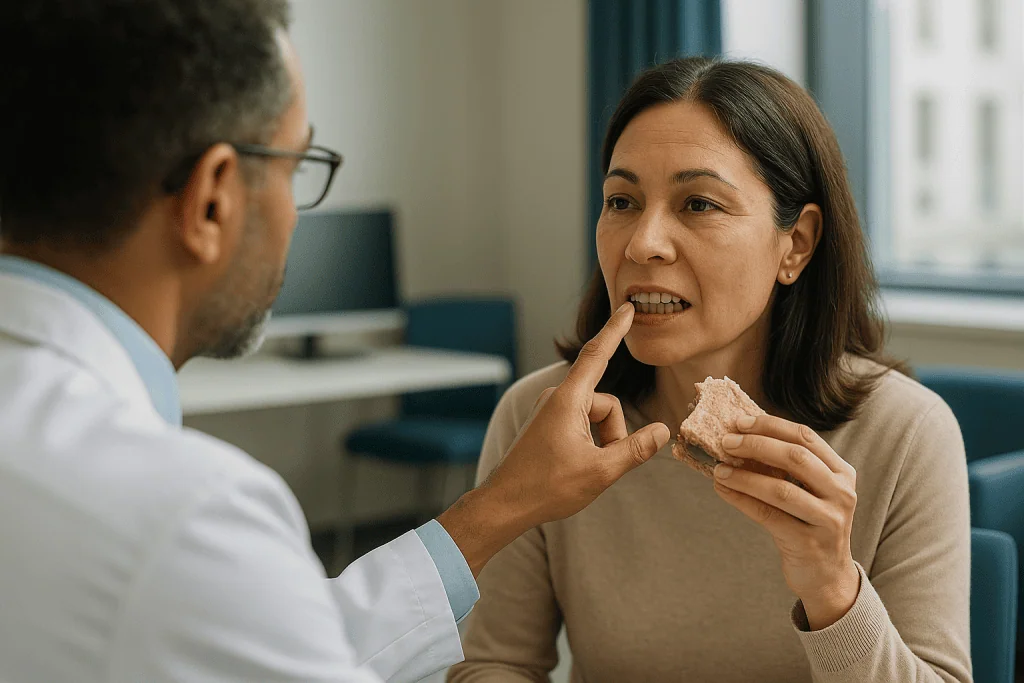
The reason is simple geometry. If the upper lip lengthens by even a few millimetres, it drops below the edge of the teeth, and the mouth reads as heavier or more tired, even when nothing else has changed. People frequently describe this as “my smile disappeared” without being able to say why.
A lip lift addresses this directly because it raises the pink lip edge. That is also why tooth show is the measurement surgeons watch most anxiously. Too much upper tooth show produces what dentists call a gummy smile, and an over-shortened lip can create it or worsen it. Once skin has been removed it cannot be put back, so surgeons tend to be deliberately conservative.
Your dental situation matters here more than many people expect. Worn-down incisors show less tooth regardless of lip position. Planned orthodontic work, crowns or veneers can change tooth length and therefore change how a lip lift will look. If dental treatment is on your horizon, most surgeons would rather you finish it first, or at least coordinate with your dentist, so that the two plans do not fight each other.
Tooth show also varies with facial expression, posture and even time of day. A careful consultation looks at the lips in repose, in speech and in a full smile before any decision is reached.
Facial proportions: how surgeons read the lower third of the face
Classical descriptions of facial proportion divide the face into horizontal thirds: hairline to brow, brow to the base of the nose, and nose to chin. Within that lower third, the upper lip occupies roughly the top portion and the lower lip plus chin the remainder. These canons come from art as much as from anatomy, and real faces depart from them constantly, but they give surgeons a shared language.
A lip lift changes only the balance inside the lower third. It makes the upper lip region shorter and, by rolling the lip outward, slightly fuller in profile. That has knock-on visual effects. A nose can appear a fraction longer because the distance beneath it shrinks. A chin that already projects strongly can look more prominent when the lip above it lifts.
This is why candidacy is never judged on the lip alone. Surgeons look at the nose tip and nostril shape, because the scar must hide against them. They look at the depth of the groove between the lip and the nose, because a very flat junction offers less camouflage. They look at the lower lip, because a lifted upper lip should not leave the lower one looking oversized.
Ethnic and individual variation in these proportions is wide and entirely normal. Guidance from the NHS on cosmetic procedures stresses that a good practitioner discusses what is achievable for your face, not an idealised template. If a consultation leans heavily on a single celebrity reference or a fixed ratio, that is a signal to slow down.
In practice, the people who tend to be pleased with a lip lift are those whose lower-face proportions already tilt toward a long upper lip. For everyone else, the measurement that needs correcting may lie somewhere other than the philtrum.
Who is usually a good lip lift candidate
Strip away the advertising and the profile of a typical lip lift candidate is fairly consistent across surgical practice.
- An adult whose philtrum looks long in proportion to the rest of the lower face, whether from birth or from age-related change.
- Little or no upper tooth show at rest, with the lip hanging below the edge of the front teeth when the mouth is relaxed.
- An upper lip that has thinned or tucked under as it has lengthened, so that filler has produced bulk rather than shape.
- Good general health, with any long-term conditions such as diabetes or high blood pressure well controlled, as Mayo Clinic’s general cosmetic-surgery guidance advises for elective procedures.
- A non-smoker, or someone willing and able to stop well before and after surgery. MedlinePlus notes that smoking narrows blood vessels and slows wound healing, which matters greatly for a scar sitting in the middle of the face.
- Realistic expectations: an understanding that the result is a shorter upper lip and a permanent, fine scar, not a different face or a different life.
- A stable sense of self. The decision comes from the person, not from a partner, a comment online or a bad photograph.
Notice what is missing from that list: a particular age, gender or lip size. A lip lift can suit a thirty-year-old with a congenitally long philtrum and a seventy-year-old whose upper lip has lengthened over decades. It is the proportion and the tooth show that count.
Also absent is any guarantee. Meeting every point above makes you someone a surgeon will likely discuss the procedure with seriously. It does not mean the procedure is right for you, and only an in-person assessment, including measurement and photographs, can move the conversation from “possible” to “planned”. That judgement belongs to your treating team.
Who is not a good lip lift candidate, and who is usually asked to wait
Some people are told no outright. Many more are told not yet. The distinction matters because several of the reasons for waiting are fixable.
Surgeons commonly decline or defer when the philtrum is already short. Taking skin from an upper lip that is average or compact risks an unnatural, pulled look and a gummy smile that no second operation can fully reverse. People who want fuller lips but have normal philtrum length are usually steered toward other options.
Active skin problems around the nose and mouth, such as a cold sore flare, acne cysts or an infected piercing, are a reason to postpone. Operating through inflamed skin increases infection risk and worsens scarring. A history of keloid or hypertrophic scars, which are raised, thickened scars that extend beyond or above the original wound, prompts a frank discussion, because the lip lift scar is permanent and prominent in position.
Smoking, including vaping nicotine, is a frequent reason for a pause. MedlinePlus explains that nicotine reduces blood flow to healing tissue and raises the risk of wound breakdown; most surgeons ask for a nicotine-free window before and after surgery and will defer until that is realistic.
Blood-thinning medicines, uncontrolled blood pressure, poorly controlled diabetes or a recent major illness are medical reasons to wait. Never stop or adjust a prescribed medicine for a cosmetic operation without the prescribing clinician’s direct advice.
Planned dental or orthodontic work, as discussed above, usually comes first. So does any recent lip filler; many surgeons prefer the filler to have fully settled or dissolved so they can judge true lip anatomy.
Finally, surgeons look carefully at motivation. NHS guidance on cosmetic procedures advises that anyone feeling pressured, going through a major life upheaval or hoping surgery will fix emotional distress should talk to a GP first. Body dysmorphic disorder, a condition in which a person is intensely preoccupied with a perceived flaw others barely notice, is a recognised reason to decline cosmetic surgery and offer psychological support instead.
What is the best age for a lip lift?
There is no best age, and any source that gives you one is simplifying to the point of error. The honest answer is that the operation is for a proportion, not a birthday.
That said, the reasons people seek it do cluster at two ends of adult life. Younger adults, typically in their twenties and thirties, usually have a naturally long philtrum. Their skin is elastic, their healing tends to be robust and the goal is harmony rather than rejuvenation. The main caution in this group is permanence. A lift that looks ideal at twenty-five must still look right at sixty, after the natural lengthening of the upper lip that comes with age. Conservative removal is particularly important here.
Older adults come to it because the upper lip has lengthened and thinned over time, often alongside other lower-face changes. For them the lip lift may be discussed as a companion to a facelift or neck lift, since those operations do not alter the lips, as Mayo Clinic notes in its facelift overview. Healing is generally a little slower with age, and surgeons pay closer attention to skin quality and medical history.
Across both groups the same screening applies: general health, nicotine, medicines that affect bleeding, skin condition and expectations. Age is a factor the surgeon weighs, not a gate that opens or closes on its own.
One sensible rule of thumb, grounded in general NHS advice on cosmetic procedures, is never to book surgery to a deadline. A wedding, a birthday or a reunion is a poor reason to compress the decision, because the early weeks after a lip lift involve visible swelling and a fresh scar. If a date is driving the timing, that is a reason to wait, whatever your age.
Lip lift vs lip filler: how the two actually compare
Many people arrive at a lip lift consultation after years of filler, and the two are often confused because both can make the upper lip look fuller. They solve different problems.
Lip filler is an injectable gel, most commonly based on hyaluronic acid, a substance found naturally in skin, placed into the lip to add volume. It does nothing to philtrum length and does not change tooth show; in some cases, adding weight to a long upper lip pushes it further down over the teeth. A lip lift, by contrast, changes position rather than volume. The table below sets the two side by side in neutral terms.
| Aspect | Lip lift | Lip filler |
|---|---|---|
| What it changes | Shortens philtrum, raises lip edge, may increase tooth show | Adds volume to the lip body; no change to lip position |
| Permanence | Permanent surgical change | Temporary; gradually absorbed and repeated |
| Anaesthesia | Usually local, sometimes with sedation | Topical or local numbing |
| Scar | Permanent fine scar at the nose base | No scar; possible bruising and lumps |
| Reversibility | Not reversible | Hyaluronic acid types can be dissolved |
| Key risks | Visible scar, asymmetry, over-correction, infection, numbness | Lumps, asymmetry, infection, rare vascular injury |
| Best suited to | Long philtrum with low tooth show | Normal philtrum length with thin lip volume |
The NHS lists lip fillers among non-surgical cosmetic procedures and advises checking the practitioner’s training and the product used. For some people the two approaches are combined over time: a lift to correct position, then modest filler for shape. For others the lift alone makes filler unnecessary. Your surgeon should be able to explain which category your anatomy falls into without steering you toward the option they happen to offer.
What are the downsides and risks of a lip lift?
Every operation carries risk, and a lip lift’s risks are amplified by location: the middle of the face, in constant motion, impossible to cover. Understanding them is not pessimism; it is the foundation of informed consent.
The scar is the headline downside. It is permanent. In most people it matures into a thin, pale line tucked at the nostril base, but in some it stays pink, widens or thickens. MedlinePlus notes that scars fade over time but never disappear completely, and that people with a tendency to keloids are at higher risk of raised scars.
Over-correction is the risk surgeons fear most, because it cannot be undone. A lip lifted too far produces excessive tooth and gum display, difficulty bringing the lips together comfortably and a tense look that worsens with ageing. Under-correction is less serious but disappointing; a small revision is sometimes possible once healing is complete.
Asymmetry can occur because no face is perfectly symmetrical to begin with and because swelling settles unevenly. Minor differences often resolve as tissues relax; persistent ones may need revision.
Numbness or altered sensation in the upper lip is common early on and usually improves, although a small number of people notice lasting change. Infection, bleeding and delayed healing are general surgical risks that the Mayo Clinic’s cosmetic surgery guidance lists for all procedures; smoking and uncontrolled medical conditions raise them.
Nostril distortion, where the nostril bases are pulled slightly downward or widened, is specific to this operation and depends on how the incision is placed and closed.
Finally there is the risk of regret. A lip lift changes a central feature of the face permanently. People who proceed under pressure, during distress or hoping for a transformed life are the ones most likely to wish they had waited.
The lip lift scar: where it sits and how it heals
If the scar is the main downside, it deserves its own plain explanation.
The incision is placed at the alar base, the point where the curved edges of the nostrils meet the upper lip, and it runs beneath the columella, the strip of skin between the nostrils. This junction between nose and lip casts a natural shadow and already contains a crease on most faces, which is why it is chosen. The scar does not run down the philtrum or across the pink lip.
Healing follows a predictable arc that MedlinePlus describes for scars generally. In the first days the wound is held by stitches and the line is red. Over the following weeks the body lays down new collagen, and the scar often looks its worst, pink and slightly raised, before it begins to soften. Fading and flattening continue gradually, and full maturation of a scar can take a year or more. During that period the line usually becomes paler and less noticeable, although it will always exist.
Several factors influence the outcome. Skin tone matters: darker skin can be more prone to pigment change along a scar, and very fair skin can hold redness longer. A tendency to keloid or hypertrophic scarring anywhere on the body is a strong predictor. Sun exposure on a fresh scar can darken it permanently, which is why surgeons emphasise shade and high-factor sunscreen once the wound is closed.
Tension is the enemy of a fine scar. That is why layered closure, avoiding wide smiles or heavy pulling expressions in the early weeks, and not smoking are all routinely advised. Your surgeon may also suggest silicone sheets or gels or gentle massage once healed; follow their specific instructions rather than general internet advice, since every closure technique has its own aftercare.
Lip lift recovery time: what the first days and weeks usually look like
Recovery from a lip lift is shorter than from most facial surgery but more visible, because you cannot hide the area with hair or clothing. The timeline below reflects general guidance on healing after cosmetic surgery from the Mayo Clinic and MedlinePlus; your own course may differ, and your surgeon’s instructions take precedence.
The first two or three days. Expect swelling of the upper lip, some bruising and tightness, and mild discomfort when speaking or eating. Keeping the head elevated, sleeping on your back and avoiding hot drinks or very chewy foods are typical instructions. The wound is usually covered with a thin strip or antibiotic ointment, and you will be told how to keep it clean without disturbing the stitches.
The first week. Swelling peaks and then begins to recede. Many surgeons remove surface stitches around the end of the first week, although dissolvable deeper stitches are left to absorb. Most people feel comfortable working from home within days but prefer to avoid social situations until the stitches are out and the bruising fades.
Weeks two to six. The incision line is pink and may feel firm. Numbness in the upper lip is common and gradually improves. Strenuous exercise is usually restricted at first because raised blood pressure can increase swelling or bleeding; your surgeon will set the date for resuming it. Wide smiling and exaggerated mouth movements are often discouraged to protect the scar.
Beyond six weeks. The lip’s final position becomes clearer as residual swelling settles, although the scar continues to mature for many months, as MedlinePlus notes for scars generally. Judge the result only when your surgeon says the tissues have settled, not from mirror checks in week two.
Follow-up appointments are not optional. They are where small concerns are caught early.
What people often get wrong about lip lifts
Misunderstandings about this operation are common because so much of what circulates online is written to sell it. A few corrections, in plain terms.
“A lip lift is a permanent filler.” No. Filler adds volume; a lift changes position. A lift can make the lip look fuller because the pink tissue rolls outward, but it will not plump a lip that is thin across its whole width.
“The scar is invisible.” It is designed to be discreet, not invisible. It is permanent, and in some people it stays noticeable. Anyone who promises an undetectable scar is promising something no surgeon can control.
“There is an ideal philtrum length.” Quoted figures vary by source and population. Surgeons judge proportion and tooth show, not a universal number.
“Younger is better.” There is no best age. Younger patients heal well but must live with the result for longer, which argues for caution rather than haste.
“If I don’t like it, it can be reversed.” Skin that has been removed cannot be replaced. Minor asymmetries or under-correction can sometimes be revised; over-correction largely cannot.
“It will fix my smile lines or lift the corners of my mouth.” It affects neither. Those are separate issues with separate options.
“Recovery is a weekend.” You may be functional in days, but visible swelling and a fresh scar last weeks, and the scar matures over a year or more, according to MedlinePlus guidance on scars.
“If a clinic says I’m a candidate, I’m a candidate.” Candidacy is a clinical judgement that should include measurement, photographs, medical history and a frank discussion of risks. The NHS advises taking time, seeking a second opinion if unsure and never booking at a first visit under pressure.
Questions to ask your care team before deciding
A good consultation should feel like an examination and a conversation, not a pitch. These questions help you gauge both the plan and the person proposing it. There is no reason to feel awkward asking any of them; a competent surgeon expects them.
- Based on my measurements, is a lip lift actually the right operation for what I dislike, or would something else address it better?
- Roughly how much skin would you plan to remove, and how did you arrive at that figure for my face?
- How much upper tooth show do I have now, and how much do you expect after surgery?
- Where exactly will the incision sit on my nose and lip, and can you show me healed scars on patients with similar skin tone?
- Which technique do you use and why does it suit my nostril shape and philtrum?
- What are the specific risks for me, given my medical history, medicines and any tendency to scar?
- What would you do if the result were asymmetrical or under-corrected, and how long would you wait before considering revision?
- Do I need to pause or change any medicine before surgery, and will you coordinate that with the clinician who prescribes it?
- How long should I stop nicotine before and after the operation?
- What will the first two weeks look like day by day, and when can I return to work, exercise and normal eating?
- What is your plan for follow-up, and who do I contact out of hours if something worries me?
- Would you advise me to wait, and if so, why?
You may also have questions about fees. This article deliberately gives no figures, because the decision should rest on anatomy, risk and expectations rather than on price, and because costs vary widely by setting and by what is included. Ask the team for a written, itemised quotation that covers follow-up and any possible revision policy, and treat an unusually low figure as a reason for more questions rather than fewer. The NHS advises checking a surgeon’s registration and specialist training before any cosmetic procedure.
When to call your doctor after a lip lift
Most recovery concerns are ordinary: swelling that looks alarming on day two, a scar that seems too pink at week three, a lip that feels oddly numb. Your surgical team expects these calls and would rather hear from you than have you worry. Some signs, however, need prompt attention and should not wait for a scheduled appointment.
Contact your surgeon or seek urgent care the same day if you notice:
- Bleeding that soaks through dressings or does not stop with gentle, steady pressure after a few minutes.
- Rapidly increasing swelling on one side of the lip, especially if it is tense, shiny or painful, which can indicate a collection of blood under the skin.
- Spreading redness, warmth, pus or a foul smell at the wound, or wound edges that have opened.
- A fever, chills or feeling generally unwell in the days after surgery.
- Severe or worsening pain that is not relieved by the measures your team recommended.
- Any part of the lip or nose turning pale, dusky or purple, which can signal compromised blood supply.
- Difficulty breathing, facial swelling beyond the surgical area, hives or dizziness, which can indicate an allergic reaction and warrant emergency care.
Call during normal hours, without alarm but without delay, for stitches that have come loose early, numbness that is not improving after several weeks, a scar that is thickening or becoming raised, persistent asymmetry once swelling has settled, or any difficulty closing the lips comfortably.
Your emotional response matters too. The Cleveland Clinic describes body dysmorphic disorder as a condition in which distress about appearance persists regardless of the actual result; if you find yourself unable to stop checking or feel worse rather than better as healing progresses, say so to your GP or surgical team. Support is available and asking for it is not a failure.
Every decision about treatment, revision or further care rests with the team who know your case. Written aftercare instructions from your surgeon take precedence over anything in this article.
Frequently asked questions
Who is not a good candidate for a lip lift?
People with a short or average-length philtrum, who would risk a pulled look and excessive gum show, are generally not suited. Surgeons also defer or decline for active skin infection or cold sores near the mouth, a history of keloid scars, current nicotine use, poorly controlled medical conditions, medicines that affect bleeding without prescriber input, recent unsettled lip filler, pending dental work, and signs of body dysmorphic disorder or external pressure to have surgery.
How much does a lip lift usually cost?
This article does not give prices, because fees vary widely by setting, surgeon and what the quotation includes, and because cost is the wrong starting point for a permanent facial change. Ask any team you consult for a written, itemised quotation covering anaesthesia, follow-up visits and their policy on revision, and be cautious about unusually low figures. Anatomy, risk and expectations should drive the decision first.
What is the best age for a lip lift?
There is no best age. The operation suits a proportion, a long philtrum with low tooth show, rather than a birthday. Younger adults usually have a congenitally long upper lip and should weigh permanence carefully, since the lip naturally lengthens with age. Older adults often seek it for age-related lengthening, sometimes alongside a facelift. In every age group, health, nicotine use, skin quality and realistic expectations matter more than the number.
What are the downsides of a lip lift?
The main downsides are a permanent scar at the base of the nose, the possibility of asymmetry, over-correction that cannot be reversed, temporary or occasionally lasting numbness of the upper lip, slight nostril distortion, and the general surgical risks of infection, bleeding and delayed healing. It also does not add true volume, lift the mouth corners or smooth lip lines, so expecting those changes leads to disappointment.
What are the main lip lift risks surgeons warn about?
Surgeons most often warn about scar quality, since the line is permanent and central on the face, and about over-correction producing a gummy smile or difficulty closing the lips. Other risks include asymmetry, altered sensation, nostril base changes, infection and bleeding. Smoking, uncontrolled diabetes or blood pressure and a keloid tendency raise these risks, which is why they are screened for before surgery is offered.
What is lip lift recovery time like?
Swelling and bruising are most noticeable in the first few days, surface stitches are typically removed around the end of the first week, and most people feel socially comfortable within a couple of weeks, though individual courses vary. Numbness and firmness along the incision gradually improve over weeks. The scar itself keeps maturing and fading for a year or more, according to MedlinePlus guidance on scars. Your surgeon’s instructions set your specific timeline.
How visible is a lip lift scar?
The scar runs along the junction where the nostrils meet the upper lip, a natural crease and shadow that helps disguise it. It is permanent and usually matures into a thin, pale line, but it is never truly invisible, and in some people it stays pink, widens or thickens. Skin tone, sun exposure on the fresh wound, tension on the closure and a personal tendency to raised scars all influence the final appearance.
Lip lift vs lip filler: which is right for me?
A lip lift suits a long philtrum with little tooth show, because it raises the lip’s position permanently. Filler suits a normal-length philtrum where the issue is thin lip volume, because it adds bulk temporarily and can often be dissolved. Filler cannot shorten the upper lip, and a lift cannot plump a uniformly thin lip. A surgeon who measures your philtrum and tooth show can tell you which problem you actually have.
Can a lip lift be reversed if I dislike the result?
No, not in the way filler can. Skin that has been removed cannot be replaced, so an over-lifted lip or excessive gum show cannot be fully undone. Minor asymmetry or under-correction can sometimes be improved with a small revision once tissues have fully settled, which surgeons usually judge many months after the first operation. This permanence is the strongest argument for conservative removal and for taking time over the decision.
Will a lip lift make my nose look longer or change my smile?
It can create a subtle visual effect on the nose, because shortening the skin beneath it slightly changes the proportions people perceive, and it may change how much upper tooth shows when you smile. These effects are why surgeons assess the nose tip, nostril shape, chin and lower lip together rather than the lip alone. A careful consultation looks at your face at rest, speaking and smiling before advising whether the trade-offs suit you.
References
- MedlinePlus: Plastic and Cosmetic Surgery
- NHS: Cosmetic procedures
- MedlinePlus: Scars
- MedlinePlus: Smoking and surgery
This article is for general information only and is not a substitute for professional medical advice. Please consult a qualified doctor about your individual situation.

More from the Blog

How Long Does Rhinoplasty Swelling Last? Why the Nasal Tip Is the Last Part to Settle
Rhinoplasty swelling usually follows a long, uneven curve. Visible puffiness and bruising peak in the first few days, most obvious swelling fades over the…

How Lip Reconstruction Rebuilds the Lip: Local Flaps, Staged Repair and Restoring Function
Lip reconstruction rebuilds a missing part of the lip by moving nearby tissue that keeps its own blood supply, called a flap, from the…

Buccal Fat Removal Recovery Week by Week: Liquids, Soft Foods and When Cheeks Settle
Buccal fat removal recovery time is usually measured in weeks for the visible part and months for the final shape. Most people manage daily…
How a Combined Neck and Face Lift Is Performed: Incisions, Deeper Tissue Work and Closure
A combined neck and face lift is one operation, usually under general anesthesia and typically lasting two to four hours or longer. The surgeon…

Do Facial Augmentation Results Last? Implants vs Fat Transfer Over the Years
Facial augmentation results vary by method. Solid cheek and chin implants are designed to stay in place indefinitely and usually keep their shape for…
Preparing for Face Aesthetics Surgery: Blood Tests, Anesthesia Review and Medicine Changes
Preparing for facial surgery usually means a pre-assessment visit where blood tests check clotting, blood count and kidney function, an anesthesia review covers your…