

Jaw Exercises: What They Can and Cannot Change: Jawline, TMJ and Bruxism

Key Takeaways
- The masseter is the only part of the jawline that exercise can change, and making it larger widens the lower face rather than sharpening it.
- Roughly 5 to 12 percent of adults have a temporomandibular disorder, it is about twice as common in women, and most cases resolve without aggressive treatment.
- Small randomized trials support gentle jaw exercises for reducing TMJ pain and improving mouth opening, though reviews rate the evidence as low to moderate quality.
- A click when opening the mouth is usually the jaw sliding over a slightly forward disc; without pain or restriction it needs no treatment and no reset.
- Daytime clenching can respond to awareness and relaxation exercises, but nighttime grinding is driven by sleep arousals that daytime exercises do not switch off.
- Spot reduction of fat has failed in controlled studies of limbs, and there is no reason the fat pad under the chin behaves differently.
Jaw exercises can modestly ease temporomandibular joint (TMJ) pain and stiffness and can help some people notice and release daytime clenching, but they cannot reshape bone, remove fat under the chin or create a sharper jawline. Support for pain relief comes from small randomized trials and physiotherapy guidance; evidence for cosmetic jawline sculpting is essentially absent. Persistent jaw pain, locking or grinding deserves a dentist or doctor.
Scroll for thirty seconds and you will meet a jaw. A teenager pressing his tongue to the roof of his mouth and promising a chiseled profile by summer. A woman biting down on a silicone puck, timer running. A physiotherapist, somewhere in the same feed, patiently demonstrating a slow half-open of the mouth for a patient whose jaw clicks every morning. Jaw exercises have become one of the most searched fitness-adjacent topics of the moment, as of spring 2025, driven almost entirely by short-video claims that the face can be trained like a bicep.
Two very different hopes are riding on the same phrase. One is cosmetic: a sharper jawline, a smaller chin, a “snatched” face. The other is medical: relief from a jaw that aches, pops or grinds itself sore at night. The muscles are the same. The evidence is not.
This piece separates the two, grades what the research actually supports, and is honest about the gap between a good stretch and a new face.
What changed recently: why jaw exercises are trending now
Nothing in the medical literature flipped overnight. What changed is attention. Jawline-training videos, tongue-posture challenges and hard-chew devices have circulated for several years, and the sheer volume in 2024 and 2025 pushed “jaw exercises” from a physiotherapy niche into a mainstream search term. The claims travel faster than the caveats.
The medical backdrop is worth knowing because it explains why clinicians are answering more jaw questions than they used to. In March 2020 the National Academies of Sciences, Engineering, and Medicine published a consensus report on temporomandibular disorders, the umbrella term for pain and dysfunction of the jaw joint and its muscles. The report, summarized by the National Institute of Dental and Craniofacial Research (NIDCR), described these disorders as a public health problem that had been under-researched and often poorly managed, and called for care that starts conservative and stays conservative wherever possible.
NIDCR estimates that roughly 5 to 12 percent of adults live with a temporomandibular disorder, that it is about twice as common in women as in men, and that most cases are temporary. Those figures matter for the trend. A condition that common, with symptoms that often fade, is exactly the kind of problem where a simple daily routine can feel like a cure even when time did most of the work.
Meanwhile the cosmetic side has produced no comparable evidence. There is no randomized trial, guideline or major health body endorsing exercise as a way to reshape the lower face. The trend is real; the science behind half of it is not. The rest of this article works through which half is which.
Do jawline exercises actually work?
The honest answer is: it depends entirely on what “work” means, and the videos rarely say.
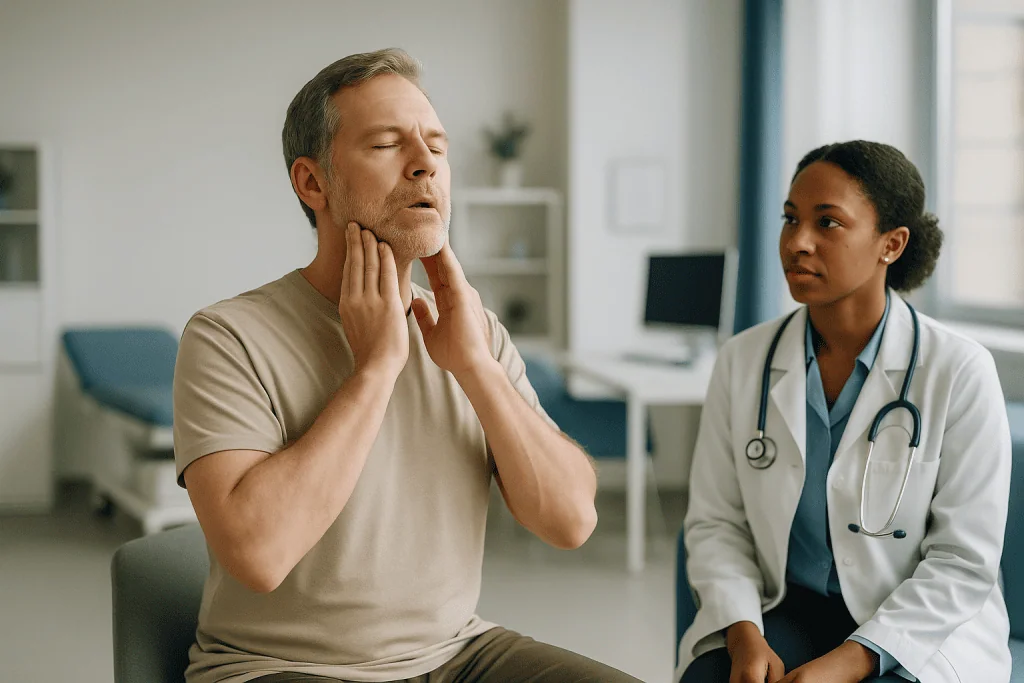
If working means the muscles of chewing get a little stronger and more fatigue-resistant, then yes, in the same modest way any muscle responds to repeated resistance. The masseter, the thick muscle you can feel bulge at the angle of your jaw when you clench, is one of the strongest muscles in the body for its size. It already does thousands of contractions a day. Adding a few minutes of extra clenching against a chew toy is a small increment on a muscle that is already well trained.
If working means a visibly sharper, more angular jawline, the evidence runs out. A jawline is a silhouette made by bone, the fat pad under the chin, skin tension and the size of the masseter. Exercise can only influence the last of those, and larger masseters tend to widen the face rather than sharpen it. That is why some people seek treatment to shrink an enlarged masseter, not grow one.
Before-and-after images are the engine of this trend, and they are almost never controlled. Lighting, head tilt, jaw jut, a tucked chin, a slight weight change, a beard trimmed to a line, a flexed neck: any one of these produces a more dramatic “after” than months of chewing. Mayo Clinic and other mainstream sources describe jaw exercises purely in the context of pain and mobility; none describe them as a cosmetic tool.
So: do jawline exercises work? For stiffness and awareness, sometimes. For sculpting, there is no credible evidence, and a plausible mechanism for the opposite effect.
What a jawline is actually made of (and what exercise cannot touch)
Picture the lower face as four stacked layers, because that is roughly how a surgeon or dermatologist thinks about it.
The foundation is the mandible, the lower jawbone. Its angle, width and the projection of the chin are set by genetics and finished by early adulthood when growth plates close. No amount of pressure from the tongue or teeth remodels an adult mandible in a way that shows on the outside. Bone does respond to load over a lifetime, but the changes are measured in millimeters at the microscopic level, not in the shape of a profile.
Above the bone sits muscle, mainly the masseter and, higher up, the temporalis. These are the only tissues exercise can change, and their response is to thicken. A thicker masseter sits at the back corner of the jaw and can make the face look squarer or rounder from the front.
Next comes fat. The submental fat pad under the chin and the buccal fat in the cheeks soften the line between jaw and neck. Fat is lost or gained across the whole body according to energy balance and hormones; you cannot choose to burn it from one spot by working the muscle beneath it. The idea of spot reduction has been tested repeatedly in limb studies and has never held up.
Finally, skin. Its firmness depends on collagen, elastin, sun exposure, smoking and age. Exercising the muscle underneath does not tighten the skin above it; if anything, repetitive facial movement is linked to expression lines.
Three of those four layers are out of reach for any exercise. The one you can change tends to push in the wrong direction for the look people want. That is the anatomical core of this whole debate.
How to strengthen jaw muscles safely, and whether you should
People searching “how can I strengthen my jaw” usually have one of two reasons: they want a stronger-looking face, or they have been told by a clinician that their jaw muscles are weak or uncoordinated after an injury, surgery or a long period of soft-food eating.
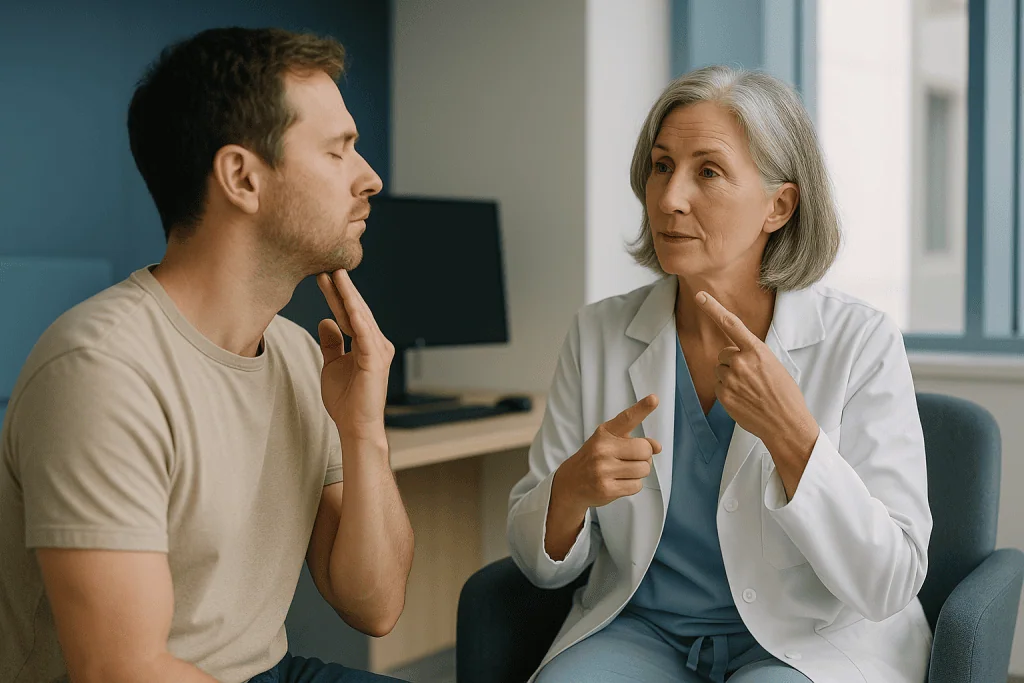
The second group has a real goal, and it is met the way any rehabilitation goal is met: gradually, with resistance the tissue can tolerate, and usually under the eye of a physiotherapist or dentist. Typical strengthening moves involve placing a thumb under the chin and slowly opening the mouth against gentle pressure, or holding a finger against the chin and pushing the jaw forward against light resistance. These are the exercises that appear on mainstream patient pages from the NHS and Cleveland Clinic. The emphasis is on control and symmetry, not force.
The first group deserves a gentler truth. The masseter is already strong; bite force in healthy adults is measured in hundreds of newtons. Chewing devices and constant gum-chewing add load, and load produces hypertrophy, which simply means the muscle fibers get bigger. In the jaw that tends to show as a wider face rather than a sharper one. It also risks overuse: sore muscles, morning stiffness, headaches at the temples, and in some cases a flare of a jaw disorder that was quietly dormant.
Dentists see the downstream effects of a hard-working jaw every day in worn enamel and cracked fillings. Deliberately adding hours of chewing to a joint that is designed for meals is not a neutral choice.
Strengthen if a clinician has identified weakness. Otherwise the jaw is one of the few muscle groups where “more” has a clear downside and no proven upside.
What the evidence actually says, graded by strength
Evidence comes in tiers, and the jaw-exercise conversation collapses them all into one. Pulling them apart is the most useful thing this article can do.
Exercise for TMJ pain and limited opening: moderate evidence. Multiple small randomized controlled trials, the kind of study that assigns people to exercise or a comparison group by chance, have found that structured jaw exercises reduce pain and improve how far the mouth opens, at least in the short term. Systematic reviews indexed in PubMed generally rate the evidence as low to moderate quality because trials are small, use different exercise programs and rarely follow people for long. Mayo Clinic, the NHS, Cleveland Clinic and NIDCR all list exercises among first-line conservative measures. That is a meaningful consensus, even if the trials are imperfect.
Exercise for awake bruxism (daytime clenching): weak to moderate evidence. Awareness and relaxation exercises are recommended by expert bodies and appear in guidance from the NHS, but the trials are few and outcomes are often self-reported.
Exercise for sleep bruxism: weak evidence. Grinding during sleep is driven by the brain’s arousal system, not by daytime muscle habits. Exercises may ease the soreness that follows a night of grinding, but there is no strong evidence they reduce the grinding itself.
Exercise for jawline definition or fat loss under the chin: no credible evidence. There are no randomized trials, no guideline statements and no mainstream medical endorsements. The claim rests on testimonials and uncontrolled photographs.
Tongue posture (“mewing”) for facial reshaping: no credible evidence. Expert opinion from orthodontists is that adult bone does not remodel in response to tongue pressure to a visible degree.
Read across the tiers and a pattern appears: the medical uses have real, if modest, support. The cosmetic uses have none.
TMJ exercises for pain relief: what physiotherapists actually prescribe
A temporomandibular disorder, often shortened to TMD or loosely called TMJ, is pain or dysfunction in the hinge joint just in front of the ear or in the muscles that move it. When physiotherapists treat it, the program looks nothing like a jawline-sculpting video. It is slow, quiet and almost boring, which is the point.
The first exercise is usually not an exercise at all but a resting position: lips together, teeth slightly apart, tongue resting lightly behind the upper front teeth. Cleveland Clinic and the NHS both describe this relaxed jaw posture because many people with TMD hold their teeth clenched all day without knowing it. Learning to notice the gap between your teeth is, on its own, a therapeutic act.
From there, programs typically add controlled movement. A partial opening, sometimes nicknamed the goldfish exercise, involves resting the tongue on the palate, placing a finger on the jaw joint, and opening halfway while keeping the movement straight rather than swinging to one side. Full openings follow once partial ones are comfortable. Gentle side-to-side and forward glides train the joint to move symmetrically.
Resistance comes later and stays light: a thumb under the chin during opening, or fingers on the chin during closing, offering just enough pressure to make the muscles work without provoking pain.
Neck and posture work often appears too. The jaw hangs from the skull, and a forward head position changes how it closes. Chin tucks and shoulder-blade squeezes show up in TMD programs for that reason.
Two rules run through every reputable version of these routines. Movement should stay within a pain-free range, and clicking is not a target to chase. Relief from these exercises, when it comes, arrives over weeks, not days.
How do I reset my TMJ jaw? The honest answer
Type this into a search bar and you will find videos of people pressing on their jaw, opening wide, and reporting a satisfying click that “puts it back.” The language of resetting is appealing because it implies something is out of place and can be snapped home. Usually neither is true.
The temporomandibular joint has a small cushioning disc between the skull and the jawbone. In many people that disc sits slightly forward of ideal, and the click you hear on opening is the jaw slipping back onto it. Mayo Clinic notes that clicking without pain or restricted movement generally needs no treatment at all. It is common, it is often lifelong, and it is not a sign that anything requires resetting.
When the jaw does lock, two very different things can be happening. A closed lock means the disc is stuck in front and the mouth cannot open fully. An open lock, or dislocation, means the jaw has slipped forward out of its socket and cannot close. Both are uncomfortable; the second is an emergency that a clinician resolves with a specific maneuver. Neither is something to force at home, and attempts to do so can inflame the joint or stretch its ligaments further.
What people can do safely is the opposite of a reset: calm the system. Relaxed jaw posture, warmth over the joint, soft foods for a few days, avoiding wide yawns and hard chewing, and the gentle controlled openings described above. In most cases the joint settles without anyone snapping anything.
If the jaw locks and stays locked, if it happens repeatedly, or if the click is joined by pain or a change in how your teeth meet, that is a clinician’s job, not a video’s.
Exercises for teeth grinding: can jaw exercises stop bruxism?
Bruxism is the medical name for clenching or grinding the teeth, and the answer to whether exercise helps depends on when the grinding happens.
Awake bruxism is the daytime version. It is usually a habit tied to concentration or stress: the jaw tightens over a spreadsheet, in traffic, mid-argument. Because it happens while you are conscious, awareness is a real lever. Relaxation exercises, the resting jaw position, and brief pauses to check whether the teeth are touching all address the behavior directly. The NHS lists this kind of self-monitoring among first steps for teeth grinding. The evidence is modest and mostly self-reported, but the mechanism is plausible and the downside is nil.
Sleep bruxism is different in kind, not degree. Grinding during sleep is linked to brief arousals in the brain, and it is associated with sleep-disordered breathing, some medicines and stress. Cleveland Clinic and MedlinePlus both describe it as something the sleeper does not control. You cannot practice a habit while unconscious, so daytime exercises do not stop nighttime grinding. What they can do is loosen muscles that wake up sore and may reduce the morning headache that often accompanies a hard night.
This is why dentists reach for a protective splint, a custom-fitted guard worn over the teeth at night, rather than an exercise sheet when enamel is wearing down. The splint does not stop the grinding either, but it takes the damage.
A practical way to think about it: exercises help you notice and release a clench you can feel. They cannot cancel a clench that happens three hours into a dream. Anyone who wakes with jaw pain, a headache at the temples, or who has been told by a partner that they grind should have a dentist look, and if snoring or gasping accompanies it, a doctor should hear about that too.
Jaw exercises at a glance: what they can and cannot change
Here is the whole argument compressed into one table. The evidence grades reflect mainstream sources and the systematic reviews indexed in PubMed, not any single viral claim.
| Goal | Can jaw exercises help? | Strength of evidence | What actually governs the outcome |
|---|---|---|---|
| Reduce TMJ pain | Yes, modestly, over weeks | Moderate: small randomized trials plus guideline consensus | Muscle tension, joint irritation, stress, sleep, time |
| Improve how far the mouth opens | Yes, when limitation is muscular | Moderate: randomized trials | Muscle guarding, disc position, scar tissue after injury |
| Stop jaw clicking | Rarely; clicking is usually harmless | Weak | Disc position, which exercise does not reliably change |
| Reduce daytime clenching | Yes, through awareness and relaxation | Weak to moderate: expert guidance, self-report | Stress, concentration habits, posture |
| Stop nighttime grinding | No; may ease morning soreness only | Weak | Sleep arousals, breathing during sleep, medicines, stress |
| Sharpen the jawline | No; may widen the face | None: no trials, no guidance | Bone shape, fat under chin, skin firmness, age |
| Lose fat under the chin | No | None; spot reduction disproven in limb studies | Whole-body energy balance, genetics, hormones |
| Reshape the jawbone or bite | No | None; contradicts basic orthodontics | Genetics, growth completed by early adulthood |
Two rows deserve a second look. The first, TMJ pain, is where most of the genuine benefit lives, and it is real even though the trials are small. The last three rows are where most of the marketing lives, and they share a column: none.
If a routine promises something in the bottom half of this table, the burden of proof sits with the person selling it, and so far no one has met it.
How to do jaw exercises safely: principles that matter more than the moves
Individual exercises vary from one physiotherapist to the next. The principles do not, and they are what keep a helpful routine from becoming a harmful one.
Start from rest. Every reputable program begins with the relaxed jaw position: lips closed, teeth apart, tongue resting lightly. If you cannot find that position, the exercises that follow will be layered on top of a clench.
Stay inside comfort. Movement should reach the point of a gentle stretch and stop. Pain during or after an exercise is information that the tissue is not ready, not a sign of progress. This is the sharpest difference between jaw rehabilitation and gym training, where discomfort is often part of the deal.
Move straight. When opening, watch in a mirror or feel with a finger at the joint; the jaw should drop in a line rather than swing toward one side. Deviation is worth mentioning to a clinician because it hints at which structures are involved.
Keep resistance light. Fingers, not fists. The masseter does not need heavy loading to recover coordination, and heavy loading is exactly what tends to aggravate a sore joint.
Little and often beats long and rare. Programs on NHS and Cleveland Clinic pages describe brief sets performed a few times through the day. Ten quiet minutes spread across a morning and evening is a common shape.
Give it time. Muscle guarding and joint irritation calm over weeks. If nothing has shifted after several weeks of consistent, pain-free practice, that is a reason to reassess with a professional rather than to push harder.
Pair it with the boring things. Softer food during a flare, warmth on the muscles, better sleep, fewer hard-chew snacks, an honest look at stress. Mayo Clinic frames these self-care steps as the backbone of conservative TMD management; exercises are one strand of that backbone, not the whole spine.
Common myths about jaw exercises, corrected
The trend has generated a set of claims that sound anatomical and are not. Each deserves a plain correction.
“Mewing reshapes your jaw.” Mewing is the practice of pressing the tongue flat against the roof of the mouth for hours a day in the hope of changing facial bone. In adults the mandible and maxilla have finished growing; orthodontists apply carefully calibrated forces over years to move teeth within bone, and even that does not change the outline of the face without surgery. Tongue pressure does not remodel an adult skull.
“Chewing hard gum or a jaw trainer defines the jawline.” Chewing enlarges the masseter. An enlarged masseter widens the lower face. That is the opposite of definition, and it is why some people seek treatment to reduce masseter size.
“You can burn chin fat with jaw moves.” Fat is mobilized from the whole body, not from the tissue above a working muscle. Spot reduction has been tested in controlled studies of arms and abdomens and has not held up.
“A satisfying crack means the joint is back in place.” A click on opening is usually the jaw riding over a slightly forward disc. It is common, often harmless and not a dislocation. Forcing a crack can irritate the joint.
“Jaw exercises will stop me grinding at night.” Sleep bruxism is driven during sleep by the nervous system. Daytime exercises can ease the soreness but do not switch off the grinding.
“No pain, no gain applies to the jaw.” In jaw rehabilitation, pain is the stop signal. Every mainstream program tells patients to stay within a comfortable range.
“Exercises fix a bad bite.” How the teeth meet is determined by tooth position and jaw shape. Exercise can improve coordination of the muscles; it does not move teeth.
None of these myths are harmless. Several lead people to load a joint that would have settled on its own.
Who should be cautious with jaw exercises
For most people with a stiff, achy jaw, gentle exercises are low risk. A few situations change that calculation, and they are worth checking against before starting a routine found online.
Recent injury to the face or jaw is the clearest one. A blow that leaves the jaw painful, swollen or unable to close normally needs imaging to rule out a fracture before anyone stretches it. Exercising a broken mandible is not conservative care.
A jaw that has locked, either open or closed, should not be worked through at home. Closed lock may respond to professional guidance and specific mobilization; open lock is a dislocation that a clinician reduces. Self-directed force in either case can worsen things.
Generalized joint hypermobility, meaning joints that move well beyond the usual range, is a reason to be careful with wide openings and stretches. Hypermobile jaws tend to need stability work rather than more range, and a physiotherapist can tell the difference.
Inflammatory arthritis that involves the jaw, such as rheumatoid arthritis, calls for coordination with the treating rheumatologist. The same is true after jaw surgery, dental implants or orthodontic procedures, where the surgeon or orthodontist will set the timeline for movement.
Severe pain, especially pain that has arrived suddenly, spreads to the ear or is accompanied by fever or swelling, is not a candidate for exercise until its cause is known. Ear infections, dental abscesses and salivary gland problems can all masquerade as jaw pain.
Children and adolescents whose jaws are still growing are a special case. Facial growth continues into the late teens, and any deliberate program to influence it belongs with an orthodontist, not a video.
The common thread is simple. Exercises are for jaws that hurt because muscles are tense or a joint is irritated. When something else may be going on, find out first.
When to see a doctor or dentist about your jaw
Most jaw pain is temporary. Mayo Clinic notes that in many people the discomfort of a temporomandibular disorder goes away without treatment, and self-care plus gentle exercise is enough. That makes the exceptions more important, not less.
See a dentist or doctor promptly if any of the following applies:
- The jaw locks open or closed, or you cannot open your mouth wide enough to eat normally.
- Pain has lasted more than a few weeks despite rest, soft foods and gentle movement, or it is getting worse.
- Your bite has changed, meaning your teeth no longer meet the way they used to.
- There is swelling, redness or warmth over the joint or along the jaw, or you have a fever.
- Pain followed a fall, a blow to the face or a wide yawn and has not settled within a day or two.
- You wake with jaw pain or temple headaches most mornings, or a partner hears grinding; if you also snore loudly or gasp during sleep, mention that specifically.
- You notice worn, chipped or cracked teeth, or increasing tooth sensitivity.
- Numbness or tingling develops in the lip, chin or face.
Seek urgent care the same day if the jaw is stuck open and will not close, if there is severe swelling that affects swallowing or breathing, or if jaw pain comes on suddenly alongside chest pain, shortness of breath, sweating or pain spreading down the arm. The American Heart Association lists jaw pain among less typical presentations of a heart attack, particularly in women, and that possibility should be excluded before anyone thinks about the joint.
Whichever clinician you see, bring the specifics: when the pain started, what makes it worse, whether it clicks or locks, how you sleep, and any exercises or devices you have been using. Decisions about splints, medicines, physiotherapy referral or further tests belong with that clinician, who can weigh your history in a way no article can.
Beyond exercises: what else the evidence supports for TMJ and bruxism
Exercises are one tool on a fairly short list, and the list is worth knowing because it puts them in proportion.
Self-care sits at the top. Mayo Clinic, the NHS and NIDCR converge on the same advice for a jaw in a flare: softer foods cut small, no gum or hard chewing, no wide yawns, warmth or cold on the sore muscles, and attention to habits like nail-biting, pen-chewing or resting the chin on a hand. These sound trivial. They are the interventions with the least risk and, in most people, they are enough.
Stress and sleep come next, not as an afterthought but because both clenching and grinding track with them. Cleveland Clinic and MedlinePlus both link bruxism to stress and to disrupted sleep; addressing either can change jaw symptoms more than any single stretch. Relaxation techniques and, where appropriate, talking therapies have support for chronic pain generally and appear in TMD guidance.
Occlusal splints, custom-made guards worn over the teeth, are widely used, particularly for people whose grinding is damaging enamel. The evidence that they reduce pain is mixed; the evidence that they protect teeth is straightforward. A dentist decides whether one is appropriate and fits it.
Short-term pain relief medicines, muscle-relaxing approaches and, in selected cases, injections are options a clinician may raise. Their use, choice and duration are individual decisions between patient and prescriber and sit outside the scope of a wellness article.
Surgery is rare and reserved for structural problems that have not responded to everything above. The 2020 National Academies report was explicit that irreversible treatments should be a last resort, and mainstream guidance agrees.
Where do jaw exercises fit? Squarely in the conservative tier, alongside self-care, as a low-risk way to restore comfortable movement and interrupt daytime clenching. That is a genuinely useful role. It is just not the role the videos are selling.
Frequently asked questions
Do jawline exercises actually work?
Not for a sharper jawline. Exercise can only enlarge the chewing muscles, and a bigger masseter tends to make the face look wider and squarer, not more defined. Bone shape, fat under the chin and skin firmness set the jawline, and none of them respond to jaw exercise. There are no randomized trials or health-body endorsements for cosmetic jaw training; the claims rest on uncontrolled before-and-after photographs.
Are jawline exercises before and after photos real?
They are often real photographs of the same person, but rarely a fair comparison. Head tilt, jaw jut, lighting, a tucked chin, facial hair, weight change and a flexed neck all alter the silhouette dramatically within seconds. Without matched lighting, angle and posture, the photos cannot separate the exercise from everything else that changed, which is why they are not considered evidence.
How can I strengthen my jaw?
If a clinician has found weakness after injury, surgery or prolonged soft-food eating, physiotherapists use light resistance: a thumb under the chin while opening slowly, or fingers on the chin while closing, always within a comfortable range. For people without a medical reason, the masseter is already one of the strongest muscles for its size, and adding heavy chewing risks soreness, headaches and worn teeth without any proven cosmetic benefit.
How do I reset my TMJ jaw?
In most cases the jaw does not need resetting. Clicking is usually the joint riding over a slightly forward disc and is harmless if painless. Forcing a crack can irritate the joint. If the jaw locks open, that is a dislocation a clinician should reduce; if it locks closed and will not release, see a dentist or doctor. At home, rest, warmth, soft food and gentle controlled opening calm the joint more safely than any maneuver.
What are the best TMJ exercises for pain relief?
Programs from mainstream sources start with the relaxed jaw posture (lips together, teeth apart, tongue resting lightly), then add controlled partial and full openings performed straight, gentle side-to-side and forward glides, and light resisted opening and closing. Chin tucks for posture often appear too. Small randomized trials suggest these reduce pain and improve opening over several weeks. Everything should stay within a pain-free range.
Can exercises for teeth grinding stop bruxism?
They can help with daytime clenching, which is a conscious habit that awareness and relaxation exercises can interrupt. Nighttime grinding is different: it is triggered by brief arousals during sleep and is not under voluntary control, so daytime exercises do not stop it. They may ease morning soreness. Dentists usually protect the teeth with a custom splint and look for contributing factors such as stress and sleep-related breathing problems.
What exercise tightens the jawline?
None does, in the sense people mean. Tightness under the jaw is a matter of skin firmness and the fat pad beneath the chin, and exercise changes neither. Facial muscles can become more toned in the physiological sense, but that does not lift skin or shrink fat. Any tightening seen in videos almost always comes from posture, chin position, weight change or lighting rather than from the exercise itself.
Does mewing change your face shape?
There is no credible evidence that it does in adults. Mewing means pressing the tongue against the roof of the mouth for long periods in the hope of remodeling bone. Adult facial bones have finished growing, and orthodontists need years of calibrated force to move teeth within bone, let alone change the skull’s outline. Expert opinion is that tongue posture does not reshape an adult jaw.
How long do jaw exercises take to help TMJ pain?
Trials and clinical guidance describe improvement over weeks rather than days, with brief sets performed several times daily. Muscle guarding and joint irritation settle gradually. If several weeks of consistent, pain-free practice bring no change, or if pain worsens during exercises, that is a reason to be reassessed by a dentist, doctor or physiotherapist rather than to increase intensity.
Is jaw clicking dangerous?
Usually not. Painless clicking or popping when opening the mouth is common and reflects the jaw moving over a slightly displaced disc; Mayo Clinic notes it generally needs no treatment. It becomes worth a professional look when the click is joined by pain, when the jaw catches or locks, when opening becomes limited, or when the way the teeth meet changes.
References
- NIH National Institute of Dental and Craniofacial Research: TMD (Temporomandibular Disorders)
- NHS: Temporomandibular disorder (TMD)
- NHS: Teeth grinding (bruxism)
- Cleveland Clinic: Teeth Grinding (Bruxism)
This article is for general information only and is not a substitute for professional medical advice. Please consult a qualified doctor about your individual situation.

More from the Blog

Chlorophyll: The Green-Drops Trend vs Plant Biology
Chlorophyll is the pigment plants use to capture sunlight for photosynthesis. Most liquid "chlorophyll" supplements actually contain chlorophyllin, a semi-synthetic, copper-based derivative. Evidence for…
Red Light Therapy: The Home-Panel Boom vs the Clinical Data
Red light therapy uses low-level red and near-infrared light to nudge cellular energy production, and controlled trials show modest, gradual benefits for skin texture,…

Why Antibiotics Cause Thrush and What Helps
Yes. Antibiotics can cause thrush because they kill helpful bacteria that normally keep Candida yeast in check in the mouth, gut, vagina and skin…

The Smallest Bone in the Body: Meet the Stapes
The smallest bone in the human body is the stapes, one of three tiny ossicles in the middle ear. Shaped like a stirrup, it…

Does Coffee Stunt Your Growth? A Century-Old Myth, Measured
No, coffee does not stunt growth. Adult height is determined mostly by genetics, along with childhood nutrition, sleep, and overall health, and no credible…

How Much Blood Is in the Human Body? Liters, Pints and Donations
The average adult carries about 4.5 to 5.7 liters of blood, roughly 9 to 12 pints, or 1.2 to 1.5 gallons, equal to about…