

LASEK PRK Recovery: The Bandage Contact Lens, the Hazy Days and When Sight Sharpens

Key Takeaways
- The bandage contact lens after LASEK or PRK has zero corrective power; its only job is to shield exposed corneal nerves and give regrowing surface cells a stable scaffold until the surgeon removes it.
- The Cochrane review comparing LASEK with PRK found similar epithelial healing time and twelve-month vision outcomes, with only low-quality evidence for slightly less early pain in LASEK.
- Vision often gets briefly worse, not better, for a day or two after the bandage lens comes out because the newly formed epithelium is still optically bumpy.
- Mild subepithelial haze appearing a few weeks after surface ablation is an expected part of healing that usually fades over months; steroid drops and, in some cases, mitomycin C during surgery are used to limit it.
- The NHS describes LASEK and PRK recovery as longer and more uncomfortable than LASIK, with vision continuing to change for weeks to months rather than days.
- UV-blocking sunglasses are one of the few post-PRK precautions that most surgeons extend for months, because ultraviolet exposure is thought to increase haze risk during corneal remodeling.
After LASEK or PRK, a soft bandage contact lens protects the cornea while its surface layer regrows, and it is usually removed by the surgeon a few days after surgery. Vision is typically blurry and light-sensitive during that first week, then sharpens gradually over several weeks, with full stability often taking one to three months. Your surgeon sets the exact schedule.
The waiting room is quiet, the lights are dimmed, and someone is sitting with dark glasses on, counting hours until a follow-up visit. The surgery itself took minutes. The part nobody quite prepared them for is now: gritty eyes, a world that looks like a steamed-up window, and a tiny clear disc sitting on each cornea that they have been told not to touch.
That disc is the center of the whole lasek prk recovery bandage contact lens conversation. It is not a corrective lens. It is a temporary shield, and understanding what it does, when it comes out and why sight stays foggy for a while afterward turns a nerve-racking week into a predictable one.
This explainer walks through the surface-based laser procedures, the days of soreness and haze, and the slower-than-expected climb toward crisp vision, with the evidence laid out plainly and the decisions left where they belong: with your surgical team.
What actually happens during LASEK and PRK
Both procedures reshape the cornea, the clear dome at the front of the eye that does most of the eye’s focusing. Reshaping it changes where light lands on the retina, which is how nearsightedness, farsightedness and astigmatism are corrected. MedlinePlus groups these under refractive surgery, and both are surface techniques, meaning the laser works on the outer part of the cornea rather than under a flap.
The cornea has a thin outer skin called the epithelium, a layer of cells roughly the thickness of a sheet of tissue paper. In PRK (photorefractive keratectomy), the surgeon removes that epithelium in the center, either with a dilute alcohol solution, a brush or a blunt instrument, and then applies an excimer laser to the exposed tissue beneath. The epithelium is discarded and left to regrow on its own.
LASEK (laser-assisted subepithelial keratectomy) starts the same way but treats the epithelium differently. A weak alcohol solution loosens it, the surgeon gently folds it aside as a single sheet, the laser reshapes the cornea, and the sheet is floated back into place before a bandage lens goes on. Whether that repositioned sheet truly survives or simply acts as a temporary cover is debated; the Cochrane review comparing the two techniques treats them as close cousins with a shared recovery pattern.
Either way, the laser portion typically lasts under a minute per eye. Numbing drops keep the procedure painless, and most people are home within an hour or two. The real work, and the reason recovery is the subject of this article, begins after the surgeon switches the laser off: a fresh cornea with its protective skin missing, and a body that needs time to rebuild it.
Why LASEK and PRK recovery is slower than LASIK
The difference comes down to a flap. In LASIK, the surgeon cuts a thin hinged flap in the cornea, lifts it, lasers the tissue beneath, and lays the flap back down. The epithelium is largely preserved on top of that flap, so the eye’s surface is essentially intact by the time the patient leaves. Mayo Clinic notes that many people see reasonably well within a day or two of LASIK, even though full stabilization can take two to three months.
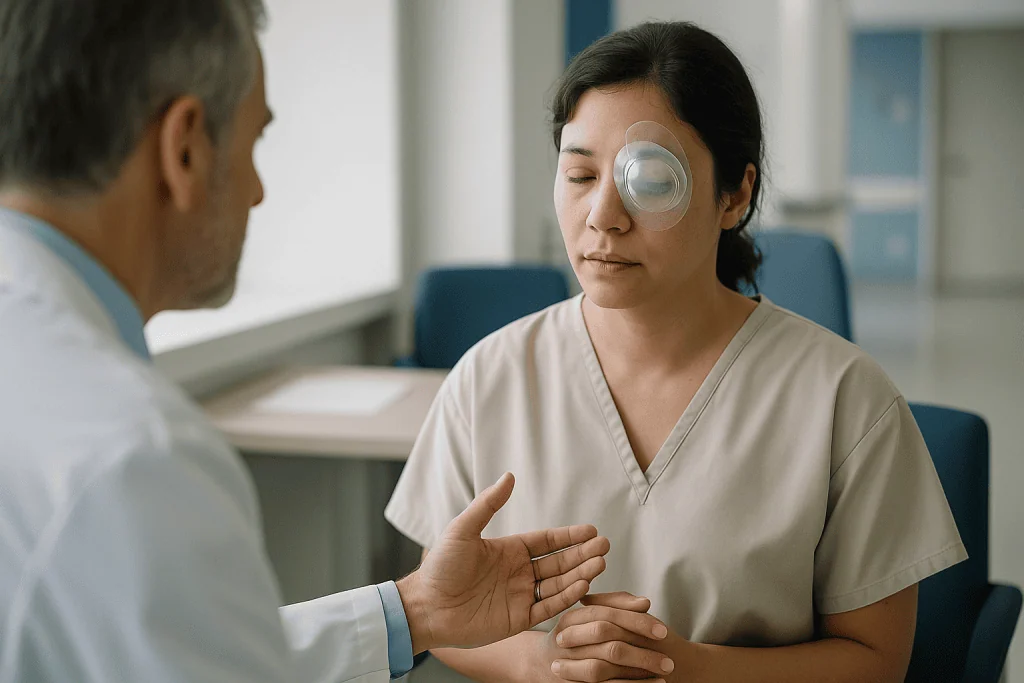
Surface procedures skip the flap entirely, and that is their main appeal for some eyes: no flap means no flap complications and more corneal tissue left untouched at depth. The trade-off is exposed nerve endings. The cornea is one of the most densely innervated tissues in the body, and stripping its epithelium leaves those nerves uncovered until new cells migrate in from the edges. The NHS describes LASEK and PRK recovery as longer and often more uncomfortable than LASIK for exactly this reason.
Think of it like a scraped knee versus a cut that has been closed neatly. The neat cut feels better fast. The scrape stings for days, needs a dressing, and looks messy while new skin creeps across it. The cornea heals in a similar way, with cells moving inward from the periphery to close the gap, usually meeting in the middle within the first several days.
The hazy vision that follows is not a sign of something wrong. New epithelium is initially irregular, like a freshly plastered wall before it is sanded smooth. It takes weeks for those cells to organize into the optically smooth surface that gives crisp sight, and that remodeling is what patients experience as gradual, sometimes frustrating, sharpening.
The lasek prk recovery bandage contact lens: what it is and why it's there
A bandage contact lens is a soft, usually plano (zero-power) lens placed on the cornea at the end of surgery. It has no job in correcting your vision. Its purpose is mechanical and protective, and it does three things.
First, it covers exposed nerve endings. Every blink drags the inner eyelid across the cornea, and without a barrier that friction is painful. The lens takes the rub instead of the raw surface.
Second, it acts as a scaffold. Migrating epithelial cells need a stable, moist environment to spread across the wound. A lens that stays in place and holds a film of tears against the cornea gives them that. In LASEK specifically, it also helps hold the repositioned epithelial sheet against the eye.
Third, it keeps eye drops in contact with the surface longer and reduces the chance of a blink or a rubbed eye disturbing the healing tissue.
The lens is not meant to be handled by the patient. It sits in place around the clock, through sleep, until the surgeon removes it at a follow-up visit once the epithelium has closed. That check typically happens within the first week; the exact day depends on how the surface looks under the microscope, not on a fixed calendar.
Because the lens is worn continuously over a healing wound, hygiene matters more than with ordinary contacts. Teams generally ask patients not to touch the lens, not to swim, and to use only the prescribed drops. If the lens falls out on its own, the standard advice is not to try to reinsert it and to call the clinic, since a bare cornea may need a replacement lens or simply close monitoring. Your team will tell you what to do in that situation before you leave.
Days one to three: soreness, watering and light sensitivity
The numbing drops used during surgery wear off within an hour or so, and that is when the first real sensation arrives. Most people describe it as a strong foreign-body feeling, as though an eyelash or sand is trapped under the lid, along with tearing, redness and a pronounced dislike of bright light. The NHS lists these among the expected effects after LASEK and PRK, and they tend to peak in the first two to three days.

Pain varies widely between individuals. Some find it a nuisance; others describe it as the hardest part of the whole experience. The Cochrane review of LASEK versus PRK found low-quality evidence that LASEK may involve somewhat less early pain, but the difference was small and inconsistent across trials, so it should not drive expectations either way.
Comfort measures commonly used in this phase include cold compresses over closed lids (never pressing on the eye), a dark room, sunglasses indoors and out, and rest with eyes closed. Surgeons also prescribe drops that reduce inflammation and pain; these are covered in a later section. Screens are not dangerous, but the eye’s reduced blink rate while staring at one tends to dry and irritate a healing surface, so most people naturally avoid them.
Vision during these days is typically poor. With a bandage lens on an uneven cornea, the world looks smeared and glare-filled. Reading a phone is often impossible, and many patients cannot drive or return to close work in this window. Planning a few days off, with someone available to help around the house and attend follow-up visits, is standard guidance rather than an exaggeration.
Sleep can help: eyelids closed for hours provide exactly the still, moist conditions new cells prefer, and many people wake on day three or four noticing the sharp grittiness has begun to ease.
PRK bandage contact lens removal: what to expect at the visit
Removal is quick and usually painless. The surgeon or a technician instils a numbing drop, checks the cornea under a slit lamp (a microscope with a bright beam), and confirms that the epithelium has closed over the treated area. If it has, the lens is slid off with a gloved finger or fine forceps. Many people feel a brief cool sensation and then a strange nakedness, as though the eye has been unwrapped.
Timing depends on the eye rather than the clock. In the trials pooled by the Cochrane review, epithelial healing time was a formal outcome, and both LASEK and PRK groups typically healed within the first several days. If the defect is not yet closed at the visit, the surgeon may leave the lens in place and recheck a day or two later. That is a common adjustment and not a sign of failure.
A frequent surprise is that vision often gets briefly worse, not better, right after removal. The lens was providing a smooth optical surface over an irregular one; without it, the freshly laid epithelium is exposed and slightly bumpy. Blur, glare and a mild return of grittiness for a day or two are common and expected.
The visit is also where the drop schedule is usually revised: antibiotic drops are often reduced or stopped once the surface is sealed, while anti-inflammatory drops continue for longer. The surgeon decides these changes; patients are asked not to adjust them alone.
Removal is a milestone. It marks the end of the truly raw phase and the beginning of the longer remodeling phase, where the question shifts from “does it hurt” to “when will it be sharp”.
The hazy days: why vision stays blurry after the lens comes out
Two separate things create the fog, and they resolve on different timescales.
The first is surface irregularity. New epithelium arrives as a patchwork of cells that have crawled in from several directions and met in the middle. The junction where they meet is often visible under the microscope as a faint line, and the whole layer is thicker in some spots than others. Light passing through an uneven surface scatters, which the brain interprets as blur and halos. Over one to several weeks, the cells reorganize, thin where they are too thick, and smooth out. Vision clears in step.
The second is true corneal haze, a faint cloudiness within the tissue just beneath the epithelium. It occurs when the corneal cells that repair the laser-treated zone lay down slightly disorganized new material during healing, a bit like the way a healing skin wound can look pink and glossy before it fades. This subepithelial haze tends to appear a few weeks after surgery, is usually mild, and often fades over months. Higher corrections carry more haze risk, which is one reason surgeons take time over candidacy.
To reduce haze, many surgeons apply an antimetabolite called mitomycin C to the cornea for a brief period during surgery. It works by slowing the activity of the repairing cells so they lay down a more orderly matrix. Whether it is used, and for whom, is a surgical judgment based on the amount of correction and the individual eye.
Patients often describe this phase as the most psychologically difficult: the pain is gone, yet the vision they hoped for has not arrived. Fluctuation from morning to evening is also common, because the tear film thins and the surface dries through the day. Knowing this is normal helps; so does reporting any sudden worsening rather than waiting it out.
PRK recovery timeline: week by week
Every eye heals on its own schedule, and the ranges below are typical patterns described by the NHS, MedlinePlus and the Cochrane review, not promises. Your surgeon’s plan takes priority over any table.
| Phase | What is usually happening | What people commonly notice |
|---|---|---|
| Day of surgery to day 3 | Epithelium regrowing under the bandage lens | Grittiness, tearing, light sensitivity, very blurry sight |
| Days 3 to 7 | Surface closes; lens removed at a visit | Discomfort easing; blur and glare persist, may briefly worsen after removal |
| Weeks 2 to 4 | Epithelium smoothing; inflammation settling | Noticeable sharpening, daily fluctuation, dryness |
| Months 1 to 3 | Corneal remodeling; any haze fading | Vision stabilizing; night halos usually lessening |
| Beyond 3 months | Final refraction assessed | Decision about any enhancement made with the surgeon |
A few points deserve emphasis. Driving is off the table until the surgeon confirms the legal standard has been met, which varies by jurisdiction and is not something to estimate at home. Return to desk work often happens within the first week or two, but comfort with screens lags behind, and generous lubrication helps. Contact sports, swimming and dusty or smoky environments are typically restricted for weeks because the surface, although closed, is fragile and infection-prone.
The NHS notes that full recovery from LASEK and PRK takes weeks rather than days, and that vision may continue to change for several months. The longer horizon is the price paid for avoiding a flap, and most surgeons discuss this trade-off openly at the consultation stage.
LASEK healing time: is it really different from PRK?
Marketing often positions LASEK as the gentler surface option, on the logic that preserving the epithelial sheet should mean less pain and faster comfort. The evidence is less tidy.
The Cochrane systematic review comparing LASEK with PRK for myopia pooled randomized trials and looked at refractive outcome, visual acuity, pain, epithelial healing time and haze. It found no meaningful difference in how well the two procedures corrected vision at twelve months. On pain, some trials favored LASEK in the first days, but the overall quality of that evidence was rated low, meaning the true effect could be smaller or absent. Epithelial healing time was similar in both groups, and haze outcomes were not clearly different.
Why might the theoretical advantage not translate? The alcohol used to loosen the epithelium in LASEK damages many of the cells in that sheet, so what is replaced may function more as a biological dressing than as living tissue that knits back in place. In practice, the eye still regrows most of its surface from the periphery, just as in PRK. The bandage lens, the sore first days and the hazy weeks that follow look much the same.
This does not make LASEK pointless. Some surgeons prefer it for handling reasons, and some patients report a subjectively easier first day. But if you are weighing the two, the honest summary is that recovery expectations should be nearly identical, and choosing between them is a technical decision your surgeon will make based on training, equipment and your cornea rather than a choice that meaningfully changes your recovery timeline.
A variant called epi-LASIK uses a blunt blade rather than alcohol to separate the sheet; the same broad recovery pattern applies.
Eye drops after PRK and LASEK: what each class does
Drops are the main tool for protecting the healing cornea, and most surgeons prescribe several types. Understanding the purpose of each helps with adherence, but the schedule, the choice of agent and any changes are entirely the prescribing clinician’s call.
Antibiotic drops are used while the epithelium is open, because a bare cornea is a route for bacteria to enter tissue that has no natural barrier. They are commonly stopped once the surface has sealed, often at or shortly after the bandage lens comes out.
Corticosteroid drops dampen the inflammatory response. In surface procedures they serve a second role: by calming the repairing corneal cells, they help limit the disorganized tissue deposition that causes haze. For this reason they are frequently continued for weeks and then tapered gradually rather than stopped abruptly. Steroid drops can raise pressure inside the eye in some people, which is one reason follow-up visits include a pressure check.
Non-steroidal anti-inflammatory drops are sometimes used briefly in the first days for pain. They work by blocking prostaglandins, chemicals that sensitize nerve endings. Prolonged use on a healing cornea has been linked to delayed healing, so they are typically time-limited.
Preservative-free lubricating drops, often called artificial tears, are the workhorse of the later weeks. They replace a tear film that is thinner and less stable after surgery, reduce the daily fluctuation in vision, and ease the dryness that Mayo Clinic notes is one of the most common complaints after any laser vision correction.
Practical points most teams stress: wash hands before every drop, do not let the bottle tip touch the eye or the bandage lens, leave a few minutes between different drops so one does not wash out the next, and never share bottles. If a drop stings badly or vision drops sharply after using it, that is a phone call, not a wait-and-see.
Who is usually offered LASEK or PRK, and who is asked to wait
Surface procedures are often suggested when a flap is undesirable. The most common reason is a thinner-than-average cornea, where removing tissue for a flap on top of the laser reshaping would leave too little structural depth. Without the flap, PRK and LASEK preserve more of that depth, which matters for long-term corneal stability.
People whose work or sport carries a real risk of a direct blow to the eye are also frequently steered toward surface treatment, because a LASIK flap can, rarely, be displaced by trauma even years later. Certain surface irregularities, mild epithelial disorders and previous eye surgery can also make a surface approach preferable.
Candidacy in general follows the same rules as any refractive surgery. The NHS and MedlinePlus both stress that the prescription should be stable, usually for at least a year, that the person should be an adult, and that the eyes should be free of active disease. Pregnancy and breastfeeding are typical reasons to postpone, because hormonal changes can shift the prescription and alter healing. Uncontrolled diabetes, autoimmune conditions affecting the eye surface, active infection, severe dry eye and keratoconus (a progressive thinning and bulging of the cornea) are common reasons a surgeon will decline or defer.
Age matters in a different way. Refractive surgery corrects distance focus; it does not stop presbyopia, the age-related stiffening of the lens inside the eye that makes reading harder in the forties and beyond. Someone approaching that stage is usually counseled that reading glasses may still arrive on schedule.
None of these is a verdict a patient can reach alone. The pre-operative assessment, with corneal mapping, thickness measurement and a careful tear-film examination, exists precisely to sort who is well suited from who would be better served by waiting or by a different option. That judgment sits with the surgical team.
What can you not do after PRK eye surgery?
Restrictions cluster around three risks: disturbing the fragile surface, introducing infection, and drying or straining an eye that already struggles with both. The specifics vary between surgeons, so the list below describes common guidance rather than rules to follow over your own team’s instructions.
Rubbing the eyes is the single most emphasized prohibition. With a bandage lens in place it can dislodge the lens; after removal, it can scuff epithelium that is attached only loosely for weeks. Many teams recommend protective shields during sleep for the first nights because rubbing while asleep is involuntary.
Water exposure is restricted. Tap water, pools, hot tubs, lakes and the sea all carry microorganisms that a healthy cornea repels but a healing one may not. Showering is usually fine with eyes closed and face turned away from the spray; swimming is typically off limits for a few weeks.
Eye makeup, especially mascara and eyeliner, is usually paused for a week or more, since particles can lodge under the lens or in the healing zone and applicators harbor bacteria. Dusty, smoky or windy environments, gardening, and workshop tasks with flying debris are treated the same way.
Driving waits for the surgeon’s clearance. Strenuous exercise is often allowed sooner than people expect, but sweat dripping into the eye and contact sports are separate matters; the former is an irritant, the latter a trauma risk, and both are usually restricted for a period.
Sun exposure deserves a special mention. Ultraviolet light is thought to increase the risk of corneal haze in the months after surface ablation, so many surgeons ask patients to wear UV-blocking sunglasses outdoors well beyond the point where light sensitivity has faded. It is one of the few restrictions that lasts for months rather than days.
Can I wear contacts after PRK or LASIK surgery?
The short answer is: eventually, in most cases, but not soon, and not without the surgeon’s agreement. It is a question that comes up more often than one might expect, usually from people who need a temporary lens while the second eye is treated, want colored lenses for cosmetic reasons, or are left with a small residual prescription.
The bandage lens itself is a contact lens, of course, but it is chosen, fitted and removed by the team and is not a template for what patients should do afterward. Once it is off, the epithelium remains loosely attached for weeks and the tear film is disrupted. Placing and removing a lens on that surface risks abrasion, and wearing one increases infection risk while natural defenses are still recovering. Most surgeons ask patients not to wear any contact lens until the cornea has fully stabilized, which after PRK or LASEK often means several months.
The same caution applies after LASIK, for a different reason. The flap edge is the vulnerable point. Lens insertion and removal involve pinching and pulling near that edge, and while flap displacement long after surgery is rare, it is the kind of avoidable risk that leads surgeons to advise a substantial waiting period.
When contacts are eventually considered, the fit changes. A cornea that has been flattened centrally to correct myopia has a different shape from the one the old lenses were fitted to, so a new fitting is needed rather than a return to the previous brand and parameters. Some people find rigid lenses fit poorly on a post-laser cornea; specialty designs exist for that situation.
If a residual prescription is bothering you enough to want lenses, that is worth raising directly, because the surgeon may prefer to discuss glasses for the interim or an enhancement once the refraction is stable, rather than lens wear over a recently treated surface.
Risks, side effects and alternatives in plain language
Refractive surgery is elective, and the risk conversation deserves the same candor as the timeline. The NHS and Mayo Clinic list similar concerns across laser techniques, with some specific to surface procedures.
Dry eye is the most common lasting complaint. Cutting corneal nerves reduces the feedback loop that tells the eye to produce tears, and while nerves regrow over months, some people experience dryness for a year or longer. Glare, halos and starbursts around lights at night are common early and usually diminish, though a minority notice them persistently, particularly with larger pupils or higher corrections.
Under-correction and over-correction happen because healing varies between individuals; regression, where the eye drifts partly back toward its old prescription, is somewhat more discussed with surface procedures. Corneal haze, covered earlier, is specific to PRK and LASEK and is usually mild and fading, but dense haze can reduce vision and occasionally needs treatment. Infection is uncommon but more consequential during the days the epithelium is open, which is why antibiotic drops and hygiene are emphasized so heavily. Delayed epithelial healing, recurrent erosion of the new surface and pressure rises from steroid drops are further possibilities the follow-up schedule is designed to catch.
Alternatives include continuing with glasses or contact lenses; LASIK where the cornea is thick enough; SMILE, a keyhole technique that removes a lenticule of tissue through a small incision; and implantable lenses placed inside the eye for higher prescriptions or corneas unsuitable for laser work. Each carries its own profile of benefits and risks.
Which option fits is a judgment about your anatomy, your prescription, your occupation and your tolerance for a longer recovery. A thorough consultation should walk through why one route is being proposed over the others, and it is entirely reasonable to ask for that reasoning in plain terms.
What people often get wrong about LASEK and PRK recovery
“The bandage lens is correcting my vision.” It is not. It is a zero-power protective cover. Blurry sight while it is in has nothing to do with the lens being the wrong strength, and vision often dips briefly when it is removed rather than improving.
“If I can see well on day two, I healed fast.” Early clarity is sometimes an artifact of corneal swelling temporarily correcting a small residual error. It can fade as swelling settles, and the eventual endpoint is judged at months, not days.
“Haze means the surgery went wrong.” Mild subepithelial haze is an expected part of surface healing and usually fades. It is monitored, and the anti-inflammatory drops exist partly to manage it. Dense or worsening haze is different and worth reporting, but its mere presence is not a complication.
“LASEK is the gentle version and PRK is the harsh one.” The Cochrane review found broadly similar outcomes, including healing time, with only low-quality evidence for slightly less early pain in LASEK. Recovery expectations should be nearly identical.
“Slower recovery means a worse result.” Surface procedures reach the same refractive endpoints as flap procedures for suitable eyes; they simply take longer to get there. Speed of recovery and quality of final vision are separate questions.
“Once the pain stops I can stop the drops.” Steroid drops are usually continued for weeks specifically to limit haze during a phase when the eye feels fine. Stopping or tapering early on one’s own can undo that protection. Any change is a decision for the prescribing clinician.
“I can rub my eye once the lens is out.” The new epithelium is loosely anchored for weeks. Rubbing can shear it off, causing a painful recurrence of the raw-cornea phase.
Questions to ask your care team before and after surgery
A good consultation leaves room for questions, and having them ready turns a rushed appointment into a useful one. These are the ones that most directly shape the recovery experience.
- Why are you recommending a surface procedure for my eyes rather than LASIK or another option, and what did my corneal thickness and mapping show?
- Are you planning LASEK or PRK, and does that change anything about my recovery instructions?
- Will mitomycin C be used during my surgery, and what is the reasoning either way?
- What day is my bandage lens likely to come out, and what should I do if it falls out or feels displaced before then?
- Which drops will I use, in what order, and roughly how long will each continue? Who do I call if I have a reaction?
- How much time should I plan away from work, screens and driving, and how will I know when I am cleared to drive?
- What level of pain should I expect, and what would be more than expected?
- How long should I avoid swimming, makeup, dusty environments and contact sports?
- How long do you want me wearing UV-blocking sunglasses outdoors?
- What is the follow-up schedule, and what will you be checking at each visit?
- If my vision is still blurry at one month, what is normal and what is not?
- At what point would you consider an enhancement, and how is that decision made?
- How will my dry-eye risk be assessed and managed?
- Who do I contact out of hours if something feels wrong?
Writing the answers down helps, because the first days after surgery are not a time when reading instructions is easy. Asking a companion to attend the consultation and the lens-removal visit is common advice for the same reason.
When to call your doctor: red-flag signs after LASEK or PRK
Most of what happens in the first two weeks is uncomfortable but expected. A smaller set of signs is not, and the standard instruction from surgical teams is to call the same day rather than wait for a scheduled visit. If you cannot reach your team, emergency eye care is the right next step.
Contact your surgeon promptly if you notice:
- Pain that increases sharply after having improved, or severe pain that is not eased by the measures you were given.
- A sudden drop in vision in one eye, or vision that becomes markedly worse rather than fluctuating.
- Thick yellow or green discharge, as opposed to clear tearing.
- Increasing redness, especially if it is concentrated around the cornea or accompanied by swelling of the lid.
- The bandage lens falling out, folding, or feeling as though it has moved, before the surgeon has removed it.
- A white or gray spot visible on the cornea, or a new cloudiness that appears over hours.
- Extreme light sensitivity that returns or intensifies after the first few days.
- Nausea with eye pain or a feeling of pressure, which can indicate raised pressure inside the eye.
- Flashes of light, a curtain across part of the visual field, or a shower of new floaters, which are unrelated to the surface but need urgent assessment.
These signs are not a diagnosis. Some will turn out to be minor. The reason to report them is that the two conditions surgeons worry about most in this window, infection of the open cornea and a displaced or lost epithelial cover, are far easier to manage early than late. Your team would rather take a call about something that proves harmless than miss something that was not. Every decision about what to do next, including any change to your drops, rests with them.
Frequently asked questions
How long does the bandage contact lens stay in after PRK or LASEK?
It usually stays in for the first several days, until the surgeon confirms at a follow-up visit that the corneal epithelium has closed over the treated area. Trials pooled in the Cochrane review of LASEK versus PRK recorded epithelial healing within that early window for most eyes. The exact day is decided by how the surface looks under the microscope, and it may be left in slightly longer if healing is not complete.
What is the typical PRK recovery timeline?
The first three days are typically the most uncomfortable, with grittiness, tearing and blurry vision. The bandage lens is removed within the first week, after which vision sharpens gradually over two to four weeks and continues to stabilize for one to three months, according to NHS and Mayo Clinic descriptions of laser vision correction. Individual healing varies, and your surgeon’s assessment overrides any general timeline.
Is LASEK healing time shorter than PRK?
The evidence does not show a meaningful difference. The Cochrane systematic review comparing the two found similar epithelial healing time and similar visual results at twelve months, with only low-quality evidence suggesting LASEK might involve a little less pain in the first days. In practice, both procedures involve a bandage lens, a sore first week and a gradual return of sharpness over weeks.
Why is my vision blurrier after the bandage contact lens was removed?
The lens was providing a smooth optical surface over epithelium that is still irregular. Once it is removed, light scatters off that uneven new layer, producing blur and glare for a day or two. This is expected and usually settles quickly as the cells smooth out. A sudden, marked drop in vision or new pain is different and should be reported to your surgeon the same day.
Can I wear contacts after PRK surgery?
Not in the early months, in most cases. The new epithelium stays loosely attached for weeks and the tear film is disrupted, so inserting and removing a lens risks abrasion and infection. Surgeons typically ask patients to wait until the cornea has fully stabilized, then have a fresh fitting because the corneal shape has changed. Whether and when lenses are appropriate is a decision for your surgeon.
Can I wear contact lenses after LASIK eye surgery?
Eventually, often yes, but only with the surgeon’s clearance and after a new fitting. The concern with LASIK is the flap edge, which lens insertion and removal can stress. Flap displacement long after surgery is rare, but surgeons generally advise a substantial waiting period and a fitting suited to the reshaped cornea. Anyone considering lenses for a residual prescription should discuss it directly with their surgical team first.
What can you not do after PRK eye surgery?
Common restrictions include not rubbing the eyes, avoiding swimming and other water exposure, skipping eye makeup, staying out of dusty or smoky environments, and not driving until cleared. Contact sports are usually paused for a period, and UV-blocking sunglasses are often advised outdoors for months because ultraviolet light is linked to haze during healing. Your surgeon’s written instructions take precedence over any general list.
What is corneal haze after PRK and does it go away?
Corneal haze is a faint cloudiness in the tissue just beneath the epithelium, caused by repairing cells laying down slightly disorganized new material. It typically appears a few weeks after surface ablation, is usually mild, and tends to fade over months. Anti-inflammatory drops and, in some cases, mitomycin C applied during surgery are used to limit it. Dense or worsening haze is uncommon and should be assessed by your surgeon.
What should I do if the bandage contact lens falls out early?
Do not try to reinsert it. Call your surgical team the same day and describe what happened. A bare cornea before the epithelium has closed may need a replacement lens, a change in drops or simply closer monitoring, and that judgment has to be made after an examination. Until you are seen, avoid rubbing the eye, keep using drops as prescribed, and protect the eye from light and dust.
How long does PRK bandage contact lens removal take and does it hurt?
Removal takes a minute or two and is usually painless. A numbing drop is instilled, the cornea is checked under a slit lamp to confirm the surface has healed, and the lens is slid off with a gloved finger or fine forceps. Many people feel a brief cool sensation and then mild grittiness for a day or so. Your drop schedule is often adjusted at the same visit by the prescribing clinician.
References
- NHS: Laser eye surgery and lens surgery
- MedlinePlus Medical Encyclopedia: Refractive eye surgery
- PubMed: Laser-assisted subepithelial keratectomy (LASEK) versus photorefractive keratectomy (PRK) for correction of myopia (Cochrane Review)
- NIH National Eye Institute: Refractive errors
This article is for general information only and is not a substitute for professional medical advice. Please consult a qualified doctor about your individual situation.

More from the Blog

Glaucoma Surgery Recovery: Frequent Pressure Checks, Drop Changes and Lifting Limits
Glaucoma surgery recovery usually spans several weeks, with the first month watched most closely. Expect frequent eye-pressure checks, a changed drop routine that often…
How Corneal Cross-Linking Is Performed for Keratoconus: Drops, Light and Recovery Time
Corneal cross-linking for keratoconus is an outpatient eye procedure that uses riboflavin (vitamin B2) drops and ultraviolet-A light to stiffen a weakened cornea and…

Super LASIK Recovery: Burning Hours, Blurry Evening and the Follow-Up Appointments Ahead
Super LASIK recovery follows the same pattern as standard LASIK: eyes typically burn, water and feel gritty for several hours, vision is often blurry…

Why a Glasses Prescription Is Not a Contact Lens Prescription: What the Fitting Measures
A glasses prescription and a contact lens prescription are not interchangeable. Glasses sit about a centimeter from the eye, so the lens power is…

PRK Recovery Timeline: Hazy Days, Bandage Lens Removal and the Slow Climb to Clear Vision
A typical PRK recovery timeline runs in stages: the outer corneal layer regrows over roughly three to five days, during which the bandage contact…

Dry vs Wet Macular Degeneration: How Each Form Progresses and Why Treatment Plans Differ
Dry macular degeneration is the slow form: waste deposits called drusen and thinning of the retina's light-sensing cells gradually blur central vision over years,…