

Super LASIK Recovery: Burning Hours, Blurry Evening and the Follow-Up Appointments Ahead
Key Takeaways
- "Super LASIK" is a commercial name for customised LASIK; the flap, nerve and surface healing follow the same timeline as any LASIK described by Mayo Clinic and the NHS.
- Burning, watering and light sensitivity typically peak in the first few hours as numbing drops wear off, and closed eyes during that window help the flap edge seal.
- Blurry first-evening vision comes from corneal swelling, an uneven tear film and widening pupils, and many people notice a marked improvement by the next morning.
- Mayo Clinic puts full stabilisation of vision at about two to three months, so no result, and no enhancement, should be judged before then.
- Reduced tear production after LASIK is typically temporary and improves over roughly the first six months as cut corneal nerves regrow.
- Steroid-class drops are tapered on a plan and can raise eye pressure in some people, which is why follow-up visits measure pressure and why stopping early on your own is unwise.
Super LASIK recovery follows the same pattern as standard LASIK: eyes typically burn, water and feel gritty for several hours, vision is often blurry the first evening, and many people see far more clearly by the next morning. Vision usually keeps settling for two to three months, with a follow-up visit in the first day or two and further checks over the following months, as your surgeon directs.
The ride home is the part nobody warns you about properly. You are in the passenger seat in dark glasses, eyes streaming, blinking against daylight that feels far too bright, wondering whether the stinging is normal and how you will get through the evening without rubbing. Someone hands you a bottle of lubricating drops and a printed sheet you cannot yet read.
That first afternoon is where most worries about super LASIK recovery begin, and it is also where most of them end. The burning eases, the blur lifts overnight for many people, and what remains is a slower, quieter healing that plays out over weeks, punctuated by follow-up appointments that matter more than they feel like they should.
This explainer walks through what is actually happening in the cornea during each of those phases, what the mainstream evidence says about typical timelines, and where the marketing word in the procedure’s name does and does not change the story.
What does "super LASIK" actually mean, and does it change recovery?
Start with a small honesty check. “Super LASIK” does not appear in clinical guidelines or in the patient pages of the NHS, Mayo Clinic or MedlinePlus. It is a commercial label, most often used for LASIK performed with a customised laser profile: wavefront-guided treatment, which maps how light bends as it passes through your whole eye, or topography-guided treatment, which maps the exact shape of the corneal surface. Some providers also fold in a femtosecond laser for the flap, sometimes called “bladeless” LASIK.
Those refinements aim to correct tiny optical irregularities, known as higher-order aberrations, that glasses cannot address. They may influence the quality of night vision once healing is complete. What they do not change is the biology of healing itself. A flap is still made in the cornea, the clear dome at the front of the eye. Surface cells are still disturbed at the flap edge. Corneal nerves are still cut and must regrow.
That is why the recovery advice from Mayo Clinic and the NHS for ordinary LASIK applies word for word to a procedure sold under a grander name. The burning hours, the blurry evening, the months of dryness and the schedule of check-ups are set by the tissue, not the marketing.
Keep that in mind when you read the rest of this guide. Wherever the text says LASIK, it means your procedure too. And where a claim about faster healing appears on a brochure without a source, treat it as a claim rather than a fact. The published evidence describes a shared recovery arc, and expecting anything shorter tends to make the first few days feel worse than they need to.
How LASIK works: what actually happens under the laser
Your glasses prescription exists because the cornea and lens focus light slightly in front of or behind the retina, the light-sensing layer at the back of the eye. This mismatch is called a refractive error. LASIK reshapes the cornea so that light lands closer to the retina without a lens in front of it.
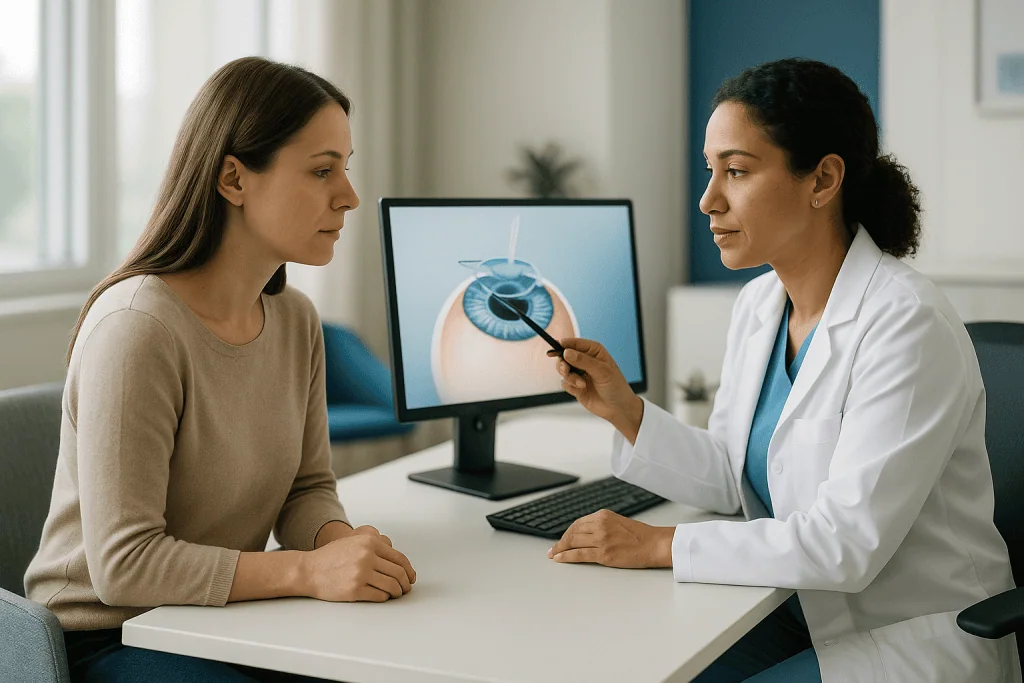
The procedure itself is brief. Mayo Clinic describes it as usually taking about 30 minutes or less for both eyes. Numbing drops are placed first. A small holder keeps the eyelids open, and a suction ring steadies the eye, which produces a pressure sensation and a brief dimming of vision. A thin hinged flap is then created in the outer cornea, using either a fine blade called a microkeratome or a femtosecond laser, which cuts with extremely short pulses of light.
The flap is folded back. A second laser, the excimer laser, removes microscopic amounts of tissue from the corneal bed beneath, following a pattern calculated from your measurements. In a wavefront- or topography-guided treatment, that pattern is drawn from the detailed maps described earlier rather than from your spectacle prescription alone. You may notice a faint clicking and a smell during this step; both are expected.
The flap is then laid back into place. No stitches are used. It adheres through natural suction and, over the following hours, the surface cells at its edge knit across the seam. That sealing process is the reason the first evening is so important, and the reason every set of instructions repeats the same two words: don’t rub.
Who is usually offered LASIK, and who is asked to wait
Suitability is decided by measurement, not by enthusiasm. Mayo Clinic lists a stable glasses prescription, generally in adults aged 18 or older, as a basic requirement, because a cornea reshaped for a prescription that then drifts will need correcting again. Prescriptions often continue changing through the late teens and early twenties, so younger candidates are commonly asked to return after a year or more of stability.
Corneal thickness and shape matter enormously. A cornea that is thin, or shows early signs of an irregular bulge called keratoconus, may not tolerate a flap and laser reshaping safely, and surgeons will often steer such patients toward surface-based or lens-based alternatives instead. Mayo Clinic also flags severe dry eye, unstable or poorly controlled diabetes, autoimmune conditions that slow healing, and pregnancy or breastfeeding, when hormonal shifts can temporarily change the prescription, as reasons to postpone or reconsider.
Very large pupils in dim light, a very high prescription, and jobs or sports with a high risk of eye impact can all shift the balance toward waiting or toward a different procedure. People over about 40 should also hear a plain explanation of presbyopia, the age-related stiffening of the eye’s lens that makes reading harder; LASIK reshapes the cornea and does not stop that process.
None of these factors is a verdict you can apply to yourself from an article. They are the reasons your pre-operative visit involves corneal mapping, tear testing and a dilated examination. The surgeon weighs the results together, and if the answer is “not yet” or “not this procedure”, that is a safety decision rather than a rejection.
The burning hours and the blurry evening: why they happen
The numbing drops wear off within roughly an hour of surgery, and what follows is the phase people remember. Mayo Clinic describes eyes that itch, feel gritty, burn and water, along with blurred vision and light sensitivity, typically most intense in the first few hours. The mechanism is straightforward. The cornea carries one of the densest concentrations of nerve endings in the body, and the flap edge has just cut across them. Disturbed surface cells send the same signal the eye uses when a lash gets trapped: something is wrong, flood it with tears, shut the lids.

Listen to that instinct. Keeping your eyes closed for several hours, ideally asleep, lets the surface cells seal the flap edge without the friction of blinking or the temptation to rub. Dark glasses help with the light sensitivity. The plastic shields you are given are not decorative; they stop an unconscious hand from reaching your eye in your sleep.
Then comes the evening, and with it a specific worry: the world is soft, doubled at the edges, and streetlights bloom into smears. Three things combine here. The cornea holds extra fluid immediately after surgery, and swelling scatters light. The tear film is uneven over a surface that is still settling. And as the room darkens, your pupils widen, so more light enters through the outer cornea where the optics are least stable on day one.
Mayo Clinic notes that vision is often noticeably clearer by the following morning as swelling subsides, though it may still fluctuate for weeks. A blurry first evening is expected, not a sign that something has gone wrong; increasing pain, by contrast, is a different matter, covered in the red-flag section later.
Super LASIK recovery day by day: a realistic timeline
Recovery is easier to live through when you know which phase you are in. The ranges below are drawn from Mayo Clinic, the NHS and Cleveland Clinic patient guidance and describe what is typical; your own timeline may run faster or slower, and your surgeon’s instructions take precedence.
| Phase | What is usually happening | What most people notice |
|---|---|---|
| First 4–6 hours | Numbing fades; surface cells begin sealing the flap edge | Burning, watering, grittiness, strong light sensitivity |
| First evening | Corneal swelling and an uneven tear film | Blur, haze, halos around lights in dim rooms |
| Day 1 | Swelling eases; first follow-up check | Often a marked improvement in clarity; residual dryness |
| Week 1 | Flap edge healed on the surface; inflammation settling | Fluctuating sharpness through the day; dryness; mild glare |
| Weeks 2–4 | Nerve regrowth begins; drops usually being tapered | Steadier vision; night glare fading; dryness persists |
| Months 2–3 | Refraction stabilising | Vision generally settled; this is when any residual error is assessed |
| Up to 6 months | Tear production recovering | Dryness resolving for most; ongoing lubricant use for some |
Two figures anchor this table. Mayo Clinic states that the eye typically takes about two to three months to heal and for vision to stabilise, and describes a temporary drop in tear production that lasts for roughly the first six months. The NHS adds that full recovery can take several weeks, and that vision may fluctuate during that time.
Notice what the table implies about expectations. The dramatic gain arrives early; the fine tuning arrives late. Judging your result at day three, whether with delight or disappointment, is judging an unfinished process.
How many days should I rest after LASIK, and what are the everyday rules?
Rest, in the LASIK sense, means protecting the flap rather than lying in a darkened room for a week. MedlinePlus and Mayo Clinic both describe most people returning to desk-based work within a day or two, once the day-one check confirms the flap is in place. Driving is different: you should not drive until your surgeon has confirmed your vision meets the legal standard, which usually happens at that first follow-up rather than on your own judgement.
The daily rules that follow are less about strictness than about mechanics. Water carries bacteria to a flap edge that is still sealing, so showering is fine but soap and spray should be kept out of the eyes for about a week. Mayo Clinic advises avoiding swimming pools and hot tubs for one to two weeks, and holding off on eye makeup for roughly the same period, since particles and applicators near the lash line are a common route for irritation.
Screens do not damage the flap. What they do is suppress blinking, which dries a tear film that is already struggling. Short sessions with deliberate blinks and lubricating drops nearby are reasonable from day one; long sessions in the first few days simply feel unpleasant. Reading follows the same logic.
Exercise splits into two categories. Walking and light gym work are generally acceptable within days, sweat kept out of the eyes. Contact sports, martial arts and anything with a ball or elbow heading toward your face are usually deferred for several weeks, because a blow can shift the flap. Dusty or smoky environments, gardening and DIY that throws debris all warrant protective eyewear for the first weeks. Sleep with the shields for as long as your team specifies.
How long after LASIK can I see clearly, and when does 20/20 arrive?
“20/20” is a benchmark, not perfection: it means reading at 20 feet what a typical eye reads at 20 feet. Plenty of people see better or worse than that in glasses, and the same spread applies after surgery.
For many patients, functional clear vision arrives faster than they expect. Mayo Clinic describes vision that is often noticeably better by the morning after surgery, good enough for many everyday tasks once the surgeon confirms it. Sharpness at that stage tends to swing through the day, clearer after drops and blurrier when the eyes dry out, and crisper in daylight than under streetlights.
The line you eventually settle on the chart is decided later. Mayo Clinic puts stabilisation at roughly two to three months, which is why no reputable surgeon judges a result, or plans a touch-up, in the first weeks. Higher starting prescriptions, significant astigmatism and drier eyes tend to take longer to settle. Night vision quality, where customised profiles are meant to help most, typically lags daytime clarity by weeks.
Some people do not reach the target with the first treatment. Mayo Clinic lists under-correction, over-correction and residual astigmatism among recognised outcomes, and a second procedure, called an enhancement, may be discussed once the refraction has been stable. This article will not quote a percentage for how many people reach 20/20, because such figures vary widely with prescription and technique and are misleading as a single number; your surgeon can give you an estimate based on your own measurements.
What you can reasonably expect is a trajectory: rapid early gains, weeks of fluctuation, then a plateau. Whether that plateau sits exactly where you hoped is a conversation for the three-month visit, not the third day.
LASIK follow-up appointments: what each visit is really checking
Follow-up visits are the part of recovery that is easiest to skip and hardest to justify skipping. Mayo Clinic describes a first check one to two days after surgery, followed by regular visits over about the first six months. The exact schedule varies between practices, but the purpose of each stage is consistent.
The day-one visit is a safety check. Under the slit lamp, a microscope with a bright angled beam, the surgeon confirms the flap is lying flat with no folds or debris underneath, that the surface cells have covered the edge, and that there is no early sign of infection or excessive inflammation. Vision is measured for the first time and the driving question is usually answered here.
The one-week visit looks at healing and dryness. Inflammation should be settling, and the team will often adjust the anti-inflammatory drops at this point. Because steroid-class drops can raise the pressure inside the eye in some people, eye pressure is commonly measured whenever they are still in use.
Visits around one and three months turn toward outcome. Vision is refracted precisely, the tear film is examined, and the surgeon judges whether the prescription has stabilised. Any discussion of enhancement belongs here or later, never earlier, for the reasons covered in the previous section. A visit around six months to a year often closes the formal schedule, though anyone with ongoing dryness or night-vision complaints should be seen for as long as they need.
Two practical notes. Bring every bottle you have been given so the team can see exactly what you are using. And if you had surgery away from home, arrange these checks with a local ophthalmologist before you travel, with a copy of your operative record in hand, rather than assuming a phone call will do.
Eye drops after LASIK: what each class does and why the schedule matters
Most people leave surgery with three kinds of drops and a schedule. Understanding what each one is for makes the schedule far easier to keep, and makes it obvious why stopping early or improvising is a bad idea. Nothing here replaces the instructions from your prescriber, who sets the frequency and duration.
Antibiotic drops are usually the shortest course. Their job is to keep bacteria off the flap edge while the surface cells close it, a window of days rather than weeks. Infection after LASIK is uncommon but serious, and this is the drop that guards against it.
Corticosteroid drops dampen the inflammatory response that laser reshaping triggers in the corneal bed. Too much inflammation can cloud the cornea or interfere with how the flap settles, so these are typically continued longer and then tapered, meaning reduced in steps, according to the surgeon’s plan. Because steroids can raise eye pressure in some people, the team checks pressure while you are on them. Stopping abruptly or extending them on your own both carry risks, which is why this is the drop people are most firmly told not to adjust.
Lubricating drops, often called artificial tears, are the long-haul companion. They replace a tear film thinned by cut corneal nerves, and many people use them for months. When drops are used many times a day, preservative-free formulations are commonly suggested because preservatives can irritate a healing surface; ask your team which type they prefer.
Technique matters as much as timing. Wash your hands, tilt the head back, pull the lower lid down gently and drop into the pocket without touching the bottle tip to lashes or eye. Space different drops apart so one does not wash out the other, and never share bottles between eyes if told to keep them separate.
Dry eyes after LASIK, halos and glare: the side effects that outlast the burning
The burning is over within hours. Dryness is the symptom that lingers, and it deserves a clear explanation rather than reassurance alone.
Creating the flap severs a large proportion of the nerves running through the outer cornea. Those nerves do two things: they sense dryness and trigger blinking, and they signal the tear glands to produce tears. With the signal muted, you blink less and produce less, even though the eye is drier than usual. Mayo Clinic describes this reduction in tear production as temporary, typically improving over about the first six months as the nerves regrow. Cleveland Clinic notes that dryness is one of the most common complaints in the weeks after surgery, and that people with dry eye beforehand tend to notice it more.
Management sits with your team, but the tools are well established: lubricating drops, warm compresses and lid hygiene to support the oily layer of the tear film, humidifiers in dry rooms, and screen breaks. For dryness that persists, ophthalmologists may discuss tiny plugs placed in the tear drainage ducts, or prescription anti-inflammatory drops of a different class. Those are decisions for the follow-up chair.
Glare, halos around lights and starbursts belong to a different mechanism. They come from residual corneal swelling, an uneven tear film and the edge of the treated zone catching light when pupils widen at night. Mayo Clinic describes these as typically lasting days to weeks. They fade for most people as the surface smooths, and customised profiles are designed partly with them in mind. Where they persist beyond the stabilisation window, they are worth raising specifically, because they can point toward a residual prescription that is measurable and sometimes addressable.
What happens 10 years and 20 years after LASIK?
This is one of the most searched questions about the procedure, and the honest answer has two parts: what LASIK does is permanent, and what age does continues regardless.
The reshaping of the corneal bed does not wear off. Tissue removed by the excimer laser does not grow back. What can change is the prescription around it. Mayo Clinic notes that vision can drift back toward the original error over time, a phenomenon called regression, particularly after correction of higher degrees of short-sightedness. Some people whose eyes were still subtly changing at the time of surgery also find a small prescription reappearing years later. Neither means the procedure failed; both may be measured at a routine eye examination and addressed, if at all, in the ordinary ways.
The bigger changes at the ten- and twenty-year marks are usually unrelated to the cornea. Presbyopia, the stiffening of the eye’s internal lens that makes close reading harder, arrives for nearly everyone in their forties, and reading glasses after LASIK are a sign of normal ageing rather than a complication. Cataract, a clouding of that same lens, becomes common later still. When cataract surgery is eventually needed, calculating the replacement lens is more complex in an eye that has had LASIK, so keeping a copy of your pre-operative measurements is a genuinely useful habit.
Two long-term concerns deserve plain mention. Corneal ectasia, a progressive thinning and bulging of the cornea, is rare and is the main reason candidates with thin or irregular corneas are screened out beforehand; when it occurs it usually declares itself within the first few years. And while dry eye improves for most people, a minority report ongoing symptoms years later, which is why anyone with significant dryness before surgery is counselled carefully.
The practical upshot: keep having routine eye examinations. LASIK changes how you see, not the need to have your eyes checked.
What people often get wrong about super LASIK recovery
Most recovery worries come from a handful of misunderstandings. Correcting them early spares a lot of anxious evenings.
“The word super means it heals faster.” It does not. Customised laser profiles change the shape of the correction; they leave the flap, the nerves and the surface cells to heal on the same schedule described by Mayo Clinic and the NHS for any LASIK.
“Clear vision on day one means I’m healed.” The day-one clarity is real, and the flap edge is still knitting. Mayo Clinic’s two-to-three-month stabilisation figure describes the actual healing window, which is why protective rules run for weeks after you feel fine.
“One rub won’t matter.” In the first days it can, because friction across a sealing edge is exactly how a flap shifts. This is the reason for the shields and the reason to keep hands busy elsewhere when the eyes itch.
“If my eyes feel good, I can stop the drops.” Anti-inflammatory drops are tapered for a reason, and antibiotic courses are short for a reason. Neither is calibrated to how you feel. Changing them without asking the prescriber is the most common self-inflicted setback.
“Screens will damage my eyes.” They will not touch the flap. They will dry a tear film that is already short, which is unpleasant but not dangerous.
“LASIK wears off after a decade.” The reshaping is permanent. What arrives later is ordinary ageing: presbyopia, possible regression in high prescriptions, and eventually cataract.
“I’ll never need glasses again.” Some people do, for reading in their forties, or for a small residual prescription. That is a possibility to discuss beforehand, not a betrayal to discover afterwards.
“Pain means something went wrong.” Burning in the first hours is expected. Pain that worsens after the first day, rather than fading, is the signal that needs a same-day call.
Questions to ask your care team before and after surgery
Good questions turn a follow-up visit from a formality into a genuine check on your own recovery. Write them down; day-one vision is not reliable for reading a phone screen.
Before surgery, it is reasonable to ask which laser profile is being used and why it suits your measurements, what your corneal thickness and shape showed, whether your prescription has been stable long enough, how your tear film tested, and what the surgeon considers a realistic outcome for someone with your prescription. Ask directly how presbyopia is likely to affect you if you are approaching or past 40.
On the day and at the first visit, useful questions include: Is the flap sitting exactly where it should? When may I drive? Which drop is which, how long is each planned to continue, and how will the anti-inflammatory drop be tapered? What should I do if I miss a dose or accidentally rub my eye? Who do I contact out of hours, and what number do I call?
At the later visits, ask whether your refraction has stabilised yet and what it measures, whether the dryness you are noticing is in the expected range or needs a change of approach, whether your eye pressure has been normal while on steroid-class drops, and what the plan is if a small residual prescription remains once everything has settled.
Finally, ask for a copy of your pre-operative measurements and operative record. It costs nothing to request and may be useful to an ophthalmologist decades from now.
You are entitled to clear answers to every one of these. A team that welcomes the questions is telling you something reassuring about how it will handle the answers.
When to call your doctor: red-flag signs after LASIK
The burning, watering and first-evening blur described earlier are expected. The signs below are not, and each warrants a same-day call to your surgical team, or a visit to an emergency department if the team cannot be reached out of hours.
- Pain that increases after the first day instead of fading, or pain that returns after it had settled.
- A sudden drop in vision, or vision that worsens after having improved, in either eye.
- A sensation that something has shifted or is caught under the lid, especially after rubbing, a bump to the eye or waking without your shields. This can indicate a displaced flap and is treatable when seen promptly.
- Redness that spreads or deepens rather than fading, particularly with discharge, swelling of the lids or a cloudy patch on the cornea. These can be signs of infection or significant inflammation.
- Light sensitivity that intensifies after the second day rather than easing.
- New floaters, flashes of light or a shadow or curtain across part of your vision. These are retinal warning signs unrelated to the flap itself; people with high short-sightedness carry a higher baseline risk, and the symptoms need urgent assessment regardless of when they appear.
- Any direct injury to the eye in the first weeks, even if vision seems unaffected.
Do not wait for the next scheduled appointment if any of these occur, and do not stop or change your drops on your own initiative while you wait to be seen. Mayo Clinic describes serious complications after LASIK as uncommon, but early treatment is what keeps them that way, and the threshold for calling should be low. Your surgeon would far rather examine an eye that turns out to be fine than hear about a problem a week late.
Keep the out-of-hours number somewhere you can find without reading glasses.
Frequently asked questions
How many days should I rest after LASIK eye surgery?
Most people are back at desk work within a day or two, according to Mayo Clinic and MedlinePlus, once the day-one check confirms the flap is in place. Rest in the first afternoon means keeping your eyes closed as much as possible. Driving waits for your surgeon’s confirmation, swimming and eye makeup for about one to two weeks, and contact sports for several weeks.
How long does it take to get 20/20 vision after LASIK?
Vision is often noticeably clearer by the morning after surgery, but Mayo Clinic describes stabilisation taking about two to three months, with fluctuation in between. Whether you settle on the 20/20 line depends on your starting prescription, astigmatism and healing; some people need an enhancement once the refraction is stable. Your surgeon can give you a personal estimate from your own measurements.
What happens 10 years after LASIK?
The corneal reshaping is permanent, so most people still see much as they did once healing finished. Two things can change: a small prescription may return, called regression, more often after high short-sightedness, and anyone reaching their forties will develop presbyopia and may need reading glasses. Neither is a failure of the procedure. Routine eye examinations remain important.
What happens 20 years after LASIK?
By twenty years, ordinary ageing dominates: presbyopia is established, and cataract, a clouding of the eye’s internal lens, becomes more common. Cataract surgery is entirely possible after LASIK, but calculating the replacement lens is more complex, so keep a copy of your pre-operative measurements. Rare long-term issues such as corneal ectasia usually appear within the first few years rather than decades later.
Is super LASIK recovery time shorter than regular LASIK recovery?
No. Customised wavefront- or topography-guided profiles change the pattern of the correction, not the healing. The flap, the cut corneal nerves and the surface cells recover on the same schedule that Mayo Clinic and the NHS describe for standard LASIK: hours of burning, a blurry evening, days of fluctuation and two to three months to stabilise. Claims of faster healing should be treated as marketing unless a source is offered.
How long after LASIK can I see clearly enough for daily life?
Many people find their vision good enough for most everyday tasks by the day after surgery, once the surgeon confirms it at the first follow-up. Sharpness typically swings through the day for the first weeks, clearer after lubricating drops and blurrier when the eyes dry, and night vision usually lags daytime clarity. Full stability takes about two to three months per Mayo Clinic.
How many LASIK follow-up appointments will I have?
Mayo Clinic describes a first check one to two days after surgery and regular visits over about the first six months. A common pattern is day one, one week, one month, three months and six to twelve months, though practices vary. Each visit has a purpose, from confirming flap position to measuring eye pressure while on steroid drops to judging whether your prescription has stabilised. Attend all of them.
Why are my eyes so dry after LASIK, and how long does it last?
Creating the flap cuts many of the corneal nerves that trigger blinking and tear production, so the eye makes fewer tears and blinks less even while drying out. Mayo Clinic describes this as temporary, improving over roughly the first six months as nerves regrow. Lubricating drops, lid hygiene and screen breaks help; persistent cases can be discussed with your team, who may consider other options.
Can I use my phone or computer the day after LASIK?
Yes, in short sessions. Screens do not harm the flap, but they suppress blinking and dry a tear film that is already reduced, which makes vision blurry and eyes uncomfortable. Blink deliberately, keep lubricating drops nearby and take breaks. Long sessions in the first few days tend to feel unpleasant rather than dangerous, so let comfort set the limit.
When can I swim, exercise or wear eye makeup after LASIK?
Mayo Clinic advises avoiding swimming pools and hot tubs for one to two weeks and holding off eye makeup for about the same period, because water and particles carry bacteria to a healing flap edge. Light exercise with sweat kept out of the eyes is generally fine within days. Contact sports and anything with a risk of a blow to the face are usually deferred for several weeks; follow your surgeon’s specific timings.
References
- NHS: Laser eye surgery and lens surgery
- MedlinePlus: LASIK eye surgery
- Cleveland Clinic: LASIK eye surgery
- Cleveland Clinic: Dry eye
This article is for general information only and is not a substitute for professional medical advice. Please consult a qualified doctor about your individual situation.

More from the Blog

Smart Lens Is Not a Gadget: Common Misconceptions About Lens Replacement Surgery
A so-called smart lens is not an electronic device. It is a fixed artificial intraocular lens, usually a multifocal, trifocal or extended-depth-of-focus design, implanted…

Robotic vs Conventional Eye Surgery: Where Computer Assistance Helps and Where It Does Not
Robotic and laser-assisted eye surgery hand certain cutting and measuring steps to a computer-guided device, while the surgeon still plans and completes the operation.…

Life After LASEK: Sunglasses, Screens and Why Surface Healing Deserves Extra Patience
After LASEK surgery, sun protection means wearing UV-blocking, preferably wraparound, sunglasses outdoors from the first day, keeping them on through the weeks when the…
What to Expect From an Intraocular Lens: Distance, Near and the Glasses You May Still Need
An intraocular lens replaces the eye's natural lens, usually after cataract removal, and is set to focus at a chosen distance. Most people see…

Straight Lines Suddenly Look Wavy: Why Macular Degeneration Patients Get Same-Week Reviews
Sudden distortion in macular degeneration, where straight lines bend or ripple over hours to days, can signal that the dry form has converted to…
What Happens During a Retinal Injection Appointment: Numbing, the Injection and Aftercare
During a retinal injection appointment, your vision and eye pressure are checked, the eye is numbed with anesthetic drops or gel, the surface is…