

Laser Eye Surgery (LASIK) Step by Step: Drops, the Flap, the Laser and the Minutes It Takes

Key Takeaways
- The excimer laser that reshapes the cornea usually fires for well under a minute per eye, while the whole two-eye procedure typically takes about 30 minutes or less.
- Nobody is asleep for LASIK: numbing drops remove sharp sensation from the cornea, so what people feel is pressure from the lid holder and suction ring, plus a few seconds of dimmed vision.
- Contact lens wearers are usually asked to switch to glasses for a few weeks before both the measurements and the surgery, because lenses temporarily mold the cornea.
- Discomfort peaks in the first few hours after surgery as the drops wear off, and a follow-up examination is normally scheduled within one to two days.
- Vision often improves within a day or two, but the cornea keeps settling for two to three months and dry-eye symptoms can persist into the first six months for some people.
- LASIK does not stop the eye from aging, so presbyopia in the forties and cataract later in life arrive on their usual timetable whether or not you have had surgery.
LASIK reshapes the cornea to reduce dependence on glasses or contacts. After numbing drops, a suction ring steadies the eye, a thin corneal flap is lifted with a blade or femtosecond laser, an excimer laser removes a precise amount of tissue over seconds, and the flap is smoothed back without stitches. Most visits last under 30 minutes, and your surgeon decides whether it suits your eyes.
The first thing most people notice on the morning of laser eye surgery is how ordinary the waiting room looks. Someone is reading a paperback with the book held close to their face. Someone else is squinting at a phone. Nobody looks like they are about to have an operation, and that, in a sense, is the point: the whole appointment often fits inside a lunch hour.
What happens in that hour is worth understanding properly, because the words attached to it can sound alarming. A flap. A laser. Suction. Strip those words down to what they physically mean and the picture becomes far calmer, and far more interesting.
This article walks through the LASIK procedure step by step, from the drops that numb the surface of the eye to the seconds when the laser actually fires, and then through the days and weeks that follow. It also names the questions worth asking before you agree to anything.
How does LASIK actually work? The cornea explained in plain language
Start with the front of the eye. The cornea is the clear, dome-shaped window that sits over the colored iris, and it does roughly two thirds of the eye’s focusing work before light ever reaches the lens behind it. It is a little more than half a millimeter thick at its center, about the thickness of five sheets of paper stacked together.
Blurred distance vision, blurred near vision and astigmatism are, at heart, focusing problems. A refractive error simply means the shape or length of the eye bends light so that it lands slightly in front of, behind, or unevenly across the retina, the light-sensing layer at the back. Glasses and contact lenses fix that by adding a corrective curve in front of the eye. LASIK changes the curve of the cornea itself.
The acronym stands for laser-assisted in situ keratomileusis, which translates roughly as reshaping the cornea in place with a laser. The reshaping is done by an excimer laser, an ultraviolet laser that removes microscopic amounts of tissue without heat, one tiny pulse at a time. For nearsightedness the laser flattens the central cornea; for farsightedness it steepens it by removing a ring of tissue around the center; for astigmatism it evens out an oval curve into a rounder one.
The distinctive feature of LASIK, compared with other laser techniques, is that the laser does not work on the very surface. Instead the surgeon creates a thin hinged flap in the outer cornea, folds it aside, treats the tissue underneath, and lays the flap back. Because the surface layer is preserved rather than removed, early comfort and visual recovery tend to be faster than with surface-based methods, according to Mayo Clinic and the NHS.
Before the day: what the LASIK consultation measures and why it matters
The single most important part of LASIK happens days or weeks before any laser is switched on. A thorough evaluation decides whether your eyes are reasonable candidates and, just as importantly, how much tissue can safely be removed.
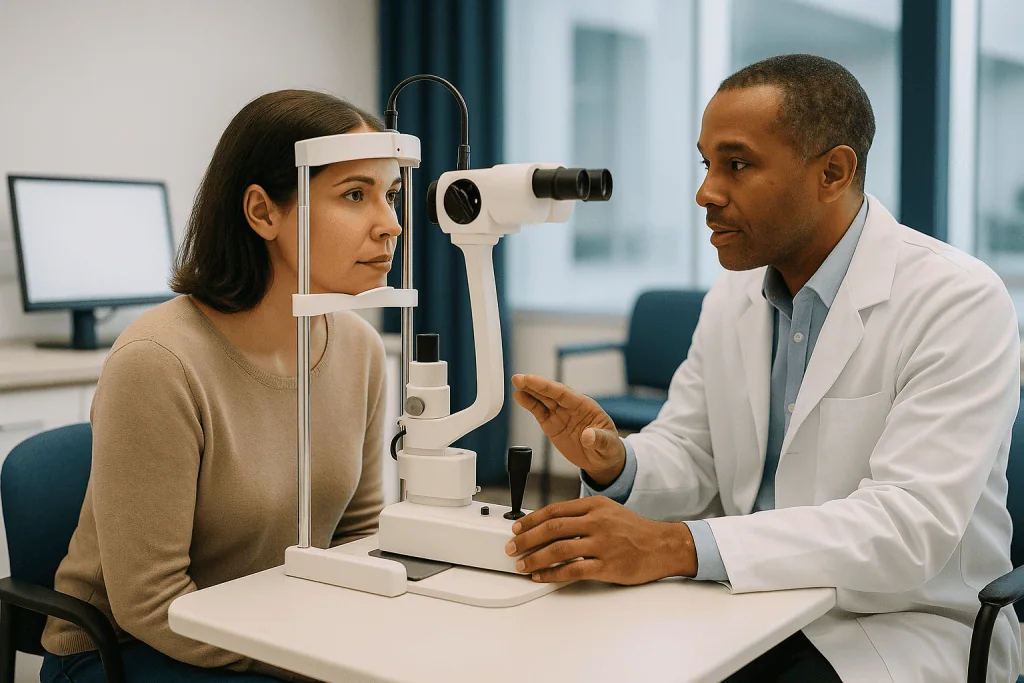
Expect a full eye examination, a careful check of your current prescription and its stability, and a set of imaging tests. Corneal topography maps the surface curve of the cornea in fine detail, like a contour map of a hillside. Pachymetry measures corneal thickness, because every laser pulse removes tissue and the cornea must keep enough structural depth afterward. Pupil size is measured in dim light, since large pupils are linked with more glare and halos at night after surgery. Your tear film is often assessed too, because pre-existing dry eye is one of the most common reasons surgeons advise caution.
If you wear contact lenses, you will usually be asked to switch to glasses for a period before both the evaluation and the surgery. Contact lenses subtly mold the cornea, and measurements taken on a molded cornea would be wrong. Mayo Clinic notes this break commonly runs to a few weeks, and it is longer for rigid lenses than for soft ones; your surgeon will give you the exact timing for your lens type.
You will also be asked about your medical history. Autoimmune conditions, uncontrolled diabetes, certain medicines that affect healing, pregnancy and breastfeeding all change the conversation. None of these questions are box-ticking. The evaluation exists precisely so that people whose corneas or health make LASIK a poor fit are steered toward something safer, and Cleveland Clinic describes it as the stage where many decisions are really made.
Who is LASIK usually for, and who is usually asked to wait?
LASIK is designed for adults with a stable prescription and healthy eyes. That sentence carries more weight than it looks.
Stability comes first. Prescriptions typically keep shifting through the late teens and sometimes into the early twenties, so surgeons generally want to see little or no change over a sustained period before treating. The NHS describes a prescription that has stayed about the same for around two years as a common expectation, and Mayo Clinic notes that people under 18 are not normally considered. Reshaping a cornea to fit a prescription that is still moving would be like tailoring a suit for someone who has not finished growing.
Healthy eyes come second. Corneas that are thin, irregular or showing early signs of keratoconus, a condition in which the cornea gradually bulges into a cone shape, are generally not treated with LASIK because removing tissue could weaken them further. Significant dry eye, active eye infection or inflammation, glaucoma, cataract and certain retinal conditions also shift the calculation.
Timing sometimes matters more than eligibility. People who are pregnant or breastfeeding are usually asked to wait, because hormonal changes can alter both the prescription and the tear film. Someone whose diabetes is not yet well controlled, or who is taking medicines known to affect wound healing, may be asked to revisit the question later rather than being turned away outright.
There is a softer category too: expectations. LASIK is best suited to people who understand that it aims to reduce reliance on correction, not to guarantee a particular line on an eye chart, and who accept that reading glasses in midlife remain likely regardless. The treating surgeon weighs all of this together, and a recommendation to wait is not a rejection; it is the safety system working as intended.
The LASIK procedure step by step, part one: arriving, the drops and the numbing
Nobody is put to sleep for LASIK. You arrive awake, you leave awake, and most of the appointment is preparation rather than lasering.
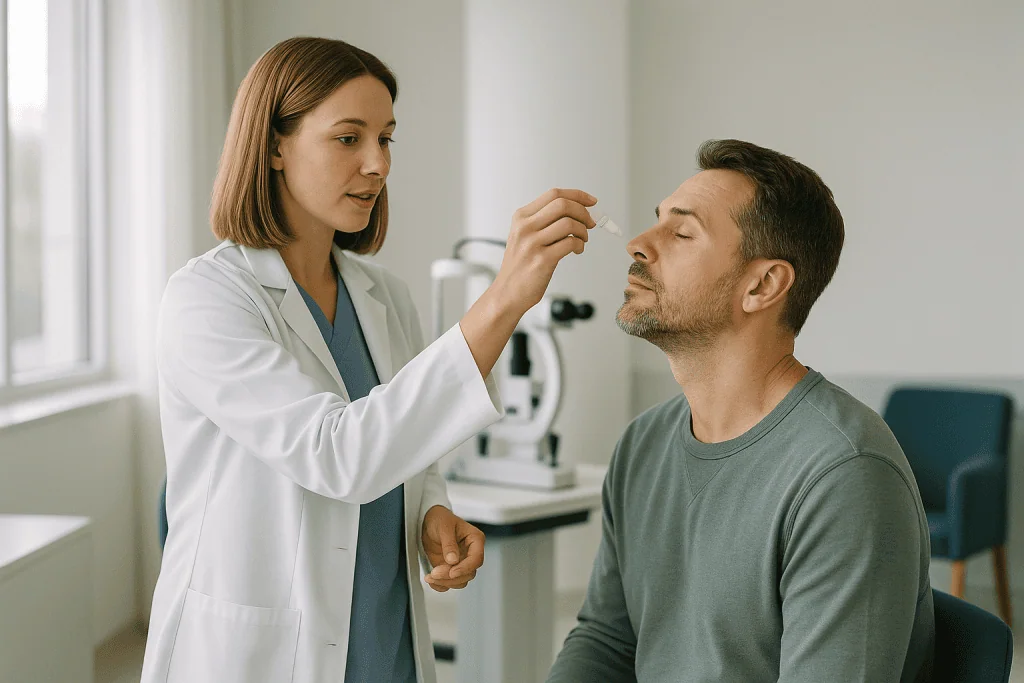
After checking in, the team usually re-confirms your prescription and the treatment plan, then marks which eye is being done first if both are scheduled. Some people are offered a mild oral sedative to take the edge off nerves; whether that is appropriate, and what it involves, is a decision for the surgical team rather than something to request or expect.
The numbing is done entirely with eye drops. Topical anesthetic drops switch off the pain-sensing nerves in the corneal surface within a minute or two, so the eye itself feels nothing sharp during the procedure. You will still be aware of touch and pressure, and you will still see light and shapes, because the drops do not affect the retina or optic nerve. The skin around your eye is cleaned, and you lie back on a reclining chair positioned under the laser.
A small device called a lid speculum is placed to hold the eyelids open. Most people describe it as strange rather than painful, a bit like trying to blink and finding the blink politely declined. Your other eye is covered so you are not tempted to use it.
Then you are asked to look at a target light. That light is doing more than giving you something to focus on. Modern excimer systems track the eye many times per second and pause if it drifts too far, so fixating on the light helps the laser stay centered over the pupil. At this point the surgeon is ready for the part most people worry about, which is covered next.
LASIK procedure step by step, part two: the suction ring, the flap and the laser
The flap comes first. A suction ring is placed on the surface of the eye to hold it perfectly still. When suction is applied, pressure inside the eye rises briefly and your vision in that eye typically dims or goes dark for a few seconds. Mayo Clinic describes this as a sensation of pressure rather than pain, and it is normal, expected and temporary.
With the eye steadied, the surgeon creates a thin, hinged flap in the outer cornea. There are two tools for this. A microkeratome is a very fine oscillating blade that glides across the cornea in a controlled arc. A femtosecond laser is an infrared laser that fires ultra-short pulses to create a layer of microscopic bubbles at a precise depth, separating the tissue without cutting from the outside. Either way the flap stays attached at one edge, like the cover of a book, so it can be folded back and later returned to exactly the same place.
The suction ring is removed and the flap is gently lifted. Your view becomes very blurred at this moment, which is expected: you are looking through a cornea with its top layer folded aside.
Now the excimer laser does its work. You hear a rapid clicking or ticking as pulses fire, and many people notice a faint smell, which is a normal by-product of the laser interacting with tissue and not something burning. Each pulse removes a sliver of tissue far thinner than a human hair, and the total pattern has been calculated from your measurements in advance. The treatment itself usually lasts well under a minute per eye, according to Cleveland Clinic and Johns Hopkins Medicine.
Finally the surgeon floats the flap back into position, smooths out any tiny folds and lets it settle. No stitches are needed; the cornea’s own suction and cell layer hold the flap while it begins to heal. Then, if both eyes are scheduled, the same steps are repeated on the other side.
How long does LASIK take? The minutes, honestly counted
People search for this question in two different ways, and they deserve two different answers.
The laser time, meaning the seconds during which tissue is actually being removed, is startlingly short. For most prescriptions it is measured in tens of seconds per eye, and longer prescriptions simply require a few more pulses. Cleveland Clinic and Johns Hopkins Medicine both describe the laser portion as lasting less than a minute for each eye.
The procedure time, meaning the interval from lying down under the laser to sitting up again with both eyes treated, is longer because it includes positioning, drops, the suction ring, flap creation and repositioning. Mayo Clinic gives a typical figure of about 30 minutes or less for the whole procedure on both eyes.
Then there is the appointment time, which is what actually shapes your day. Check-in, final measurements, any sedative taking effect, the procedure, a short rest, a first look at the flap under a microscope and the discharge conversation can stretch the visit to a couple of hours. Plan for that, and plan for a companion to drive you home, because your vision will be hazy and your eyes light-sensitive when you leave.
| Phase | What is happening | Typical duration |
|---|---|---|
| Numbing and positioning | Anesthetic drops, lid speculum, fixation light | A few minutes per eye |
| Suction and flap | Suction ring, microkeratome or femtosecond laser | Under a minute, with seconds of dimmed vision |
| Excimer laser | Corneal tissue reshaped pulse by pulse | Well under a minute per eye |
| Flap repositioning | Flap floated back, smoothed, checked | A minute or two |
| Whole procedure, both eyes | All of the above | About 30 minutes or less |
Timings are typical ranges drawn from Mayo Clinic, Cleveland Clinic and Johns Hopkins Medicine, not promises. Your surgical team will tell you what to expect for your own eyes.
Is LASIK painful? What people actually feel, moment by moment
The honest answer is that LASIK is generally described as uncomfortable in a few specific moments rather than painful, and that the discomfort peaks after you get home rather than on the table.
During the procedure, the numbing drops remove sharp sensation from the corneal surface. What remains is pressure. The lid speculum feels like an insistent stretch. The suction ring, in Mayo Clinic’s description, produces a feeling of pressure and a brief dimming of vision. The excimer laser itself is not felt at all; you hear it and may smell it, but the cornea has very few sensors that respond to it once numbed. Many people report that the anticipation was far worse than the event.
In the first hours afterward, as the anesthetic drops wear off, the picture changes. Burning, itching, a gritty feeling as if there is an eyelash in the eye, watering and a strong sensitivity to light are all common and expected. Mayo Clinic advises against rubbing the eye during this period because the flap is still settling, and most surgeons suggest a few hours of rest with eyes closed. The NHS describes this early discomfort as typically easing within a day or so.
Pain that is severe, worsening after the first day, or accompanied by a sudden drop in vision is a different matter and belongs in the section on when to call your doctor. The distinction matters: expected discomfort is dull, scratchy and improving; concerning pain is sharp, escalating or paired with new visual symptoms.
Any medicine given for comfort, whether lubricating drops, anti-inflammatory drops or antibiotic drops to reduce infection risk, will be prescribed and scheduled by your surgeon. How they work and roughly how long you use them is fair to discuss; what to take and when is entirely theirs to decide.
LASIK vs PRK vs SMILE: how the main laser options compare
LASIK is the best-known laser technique, but it is not the only one, and understanding the alternatives makes the LASIK conversation itself clearer. All three methods below use a laser to change the cornea’s curve; they differ in how the laser reaches the tissue it needs to treat.
PRK, or photorefractive keratectomy, removes the cornea’s outermost cell layer entirely rather than lifting a flap, then applies the excimer laser directly to the surface. That surface layer regrows over several days. PRK avoids flap-related complications and is often preferred for thinner corneas or for people in contact sports or occupations where a flap could be dislodged, but early recovery is slower and more uncomfortable, as the NHS and Mayo Clinic both note.
SMILE, or small-incision lenticule extraction, uses a femtosecond laser to carve a thin lens-shaped disc of tissue inside the cornea, which the surgeon then removes through a small keyhole opening. There is no flap, and surface disruption is smaller than with LASIK. Its availability varies, and it is used mainly for nearsightedness with or without astigmatism rather than farsightedness.
| LASIK | PRK | SMILE | |
|---|---|---|---|
| How the laser reaches the tissue | Hinged flap lifted, then replaced | Surface cell layer removed, regrows | Small keyhole incision, disc removed |
| Early comfort | Mild discomfort for hours | More discomfort for several days | Generally mild |
| Early visual recovery | Usually within a day or two | Slower, over days to weeks | Usually within days |
| Flap-related risks | Yes | None | None |
| Often considered when | Adequate corneal thickness, stable prescription | Thinner corneas, higher trauma risk | Nearsightedness, some astigmatism |
Beyond lasers, there are lens-based options: an implantable lens placed inside the eye in front of the natural lens, or refractive lens exchange, which replaces the natural lens and is more often discussed for older adults with early cataract changes. Glasses and contact lenses remain the least invasive alternative of all. Which route fits your eyes is a clinical judgment for your surgeon.
The first 24 hours after LASIK: what the rest of the day looks like
You will walk out seeing, but not clearly. Vision immediately after LASIK tends to look like a window that has been breathed on: shapes are there, edges are soft. Light feels too bright. Sunglasses help even indoors, and many people wear them home.
Someone else must drive. Beyond the blur, your judgment of distance and glare tolerance are both off for the rest of the day, and Mayo Clinic advises not driving until your eye care specialist has confirmed at a follow-up visit that your vision meets the legal standard.
The best thing you can do in the first few hours is very little. Closing your eyes and resting, ideally sleeping, lets the flap settle and reduces the urge to blink hard or rub. Surgeons commonly provide clear plastic shields to tape over the eyes at night for the first few nights, precisely so that a hand thrown across the face in sleep cannot disturb the flap.
Discomfort follows a predictable arc. Burning, grittiness and watering are usually most noticeable in the first few hours and ease through the evening. Any drops prescribed by your team, typically a combination to reduce infection risk, calm inflammation and lubricate the surface, are started on the schedule they set. Screens, reading and television are not dangerous, but they tend to reduce blinking and dry the eye, so short sessions with frequent breaks feel better than a long binge.
Keep water away from the eyes for the first day. That means no showers aimed at the face, no splashing, and no eye makeup. A follow-up examination is normally scheduled within one to two days, according to Mayo Clinic, so that the surgeon can check the flap under magnification, measure your vision and confirm that healing is on track. Most people are surprised by how much clearer things look by the time they arrive at that visit.
LASIK recovery time: the following days, weeks and months
Recovery from LASIK runs on two clocks. The fast clock governs comfort and everyday function; the slow clock governs how the final result settles.
On the fast clock, most people notice a marked improvement in vision within a day or two and can return to desk work and routine activities once the surgeon confirms this at the first follow-up, as both Mayo Clinic and the NHS describe. Light sensitivity fades over the first few days. Fluctuating focus, where vision is sharp one hour and slightly filmy the next, is common in the first weeks and usually reflects a tear film that has not yet recovered.
On the slow clock, the cornea continues remodeling for weeks. Mayo Clinic notes that it can take two to three months for the eye to heal and for vision to stabilize, and that dry eye symptoms may persist across the first six months for some people before easing. Night glare and halos, the starbursts around headlights that many people notice early, tend to diminish over the same period, though not for everyone.
Activity restrictions taper in stages. Rubbing the eyes is discouraged for weeks. Swimming pools, hot tubs and lakes are typically off-limits for a few weeks because of infection risk to a healing surface, and contact sports that could deliver a blow to the eye are usually held back for around a month, according to Mayo Clinic. Eye makeup generally waits a week or two. Your own team will give you their specific timeline.
Follow-up visits usually continue at intervals over the first several months. These are where any residual prescription is measured, where persistent dryness is managed, and where the question of enhancement, a second smaller laser treatment to refine an undercorrected result, might be raised. Whether an enhancement is appropriate, and when, is a decision for the surgeon based on stability, corneal thickness and your symptoms, never something to plan on in advance.
What are the risks and side effects of LASIK, in plain clinical terms?
Every operation carries risk, and the most useful way to understand LASIK’s is to sort its problems into the common and temporary, the uncommon and treatable, and the rare and serious.
Common and temporary: dry eye is the most frequent side effect. Creating the flap cuts some of the corneal nerves that signal the eye to produce tears, and it takes months for those nerves to regrow. Glare, halos and reduced contrast in dim light are also common early on and usually improve, though Mayo Clinic notes that for some people night vision does not fully return to what it was. Fluctuating vision in the first weeks belongs here too.
Uncommon and treatable: undercorrection, overcorrection and regression, meaning the prescription drifts partway back over time, can leave residual blur. Some people need glasses for certain tasks or are offered an enhancement. Flap problems, such as small wrinkles, debris under the flap, or in-growth of surface cells beneath the edge, can occur and are generally managed by lifting and repositioning the flap. Inflammation of the flap interface in the first days is another recognized event that surgeons watch for at early follow-ups.
Rare and serious: infection under the flap, and corneal ectasia, a progressive weakening and bulging of the cornea that can appear months or years later, particularly in eyes that were thinner or more irregular than ideal. Severe, permanent loss of vision from LASIK is very rare, as the NHS and Mayo Clinic both state, but it is not zero, which is exactly why the pre-operative screening described earlier is so exacting.
Two facts frame all of this. First, LASIK does not stop the natural aging of the eye, so cataract and presbyopia, the loss of near focus in midlife, arrive on their usual schedule. Second, the informed-consent conversation with your surgeon should cover each of these categories for your specific eyes, and you are entitled to ask how your own measurements affect them.
What people often get wrong about LASIK
Myths about laser eye surgery tend to travel faster than the evidence. A few deserve correcting.
The laser does not go into the eye. Every pulse stops at the cornea, which is the outermost layer. The retina, lens and optic nerve are never touched, and the eye-tracking systems built into modern excimer lasers pause treatment if the eye moves out of range. The fear of a laser piercing something deep is understandable and simply not how the procedure works.
Blinking or moving will not ruin the result. The lid speculum makes blinking physically impossible, the suction ring steadies the eye during the flap, and the tracker follows small movements during the laser. You are asked to look at the light because it helps, not because the outcome hinges on your nerve.
LASIK is not permanent in the way people imagine. The reshaping of the cornea is lasting, but the eye keeps aging. Nearly everyone develops presbyopia in their forties and needs help with near tasks, and some prescriptions drift over years. The NHS and Mayo Clinic both make this plain. A result that stays excellent for distance while reading glasses arrive on schedule is the expected course, not a failure.
Everyone does not end up with identical vision. Outcomes depend on the starting prescription, corneal shape, healing response and tear film. Advertising language that promises a particular line on the chart for all comers is not supported by guideline-level evidence, and any conversation that frames results as guaranteed should raise questions.
The flap does not simply fall off. It heals in place within hours and grows steadily stronger, and the shields and no-rubbing rules exist for the early window when it is most vulnerable. Displacement is a recognized but uncommon problem, usually linked to significant direct trauma.
Finally, being told to wait is not a rejection. Unstable prescriptions, pregnancy, dry eye and thin corneas are reasons to pause, and pausing is the system protecting you.
Questions to ask your care team before agreeing to LASIK
A good consultation should leave you feeling that you understand your own eyes better than when you walked in. These questions help get there, and none of them are rude.
- Based on my corneal thickness and shape, am I a straightforward candidate, a borderline one, or better suited to a different procedure such as PRK or a lens-based option?
- Is my prescription stable enough, and how did you judge that?
- Did my tear film testing show any dry eye, and how would that affect my recovery?
- What size are my pupils in dim light, and does that change my risk of night glare or halos?
- Which method will be used to create the flap, and why that one for my eyes?
- What will I be able to see and feel at each stage on the day, and how long should I expect the whole appointment to last?
- Which drops will I use afterward, roughly how long for, and what is each one doing?
- How many follow-up visits are planned, over what period, and who do I contact between them?
- What is your policy if my result is under- or overcorrected? When would an enhancement be considered, and when would it not be safe?
- Given my age, how soon should I expect to need reading glasses, and does that influence which eye or which target you would choose?
- What symptoms would you want to hear about urgently, and what number do I call at night or on a weekend?
Write the answers down, or bring someone who will. The evaluation involves a lot of numbers, and the point is not to memorize them but to be sure the person operating has explained them to your satisfaction. If any answer amounts to a guarantee, or dismisses a risk you have read about in mainstream sources, ask again. The decision to proceed, to choose a different technique or to wait rests with your treating team, but it should be a decision you fully understand.
When to call your doctor after LASIK: red-flag signs that should not wait
Most of what you feel in the first day is expected: scratchiness, watering, light sensitivity, soft vision that sharpens hour by hour. The signs below are different, and Mayo Clinic, the NHS and Cleveland Clinic all describe them as reasons to contact your surgical team promptly rather than waiting for the next scheduled visit.
- Pain that is severe, sharp, or getting worse rather than better after the first day, especially if it wakes you or is not eased by the comfort measures you were given.
- A sudden drop in vision, new blur in an eye that had become clearer, or vision that is noticeably worse than at your first follow-up.
- A blow, poke or rub to the eye in the early weeks, even if it does not hurt much, because the flap can shift.
- Increasing redness, a thick or colored discharge, or an eye that feels hot, all of which can signal infection under the flap.
- A sensation that something is stuck in the eye that persists or intensifies, together with light sensitivity that worsens instead of fading.
- New flashes of light, a curtain or shadow across part of your vision, or a sudden shower of floaters, which are not typical of LASIK healing and need urgent assessment regardless of cause.
If you cannot reach your surgical team, go to an emergency department or urgent eye service and tell them you have recently had laser eye surgery, including the date and which eyes were treated. Take the list of drops you have been using. Early flap problems and infections are far more manageable when they are seen within hours, and no surgeon would rather hear from you a day late than an hour early.
Everything in this article describes typical experiences drawn from mainstream sources. Your own surgeon knows your measurements, your healing and your risks, and their instructions take precedence over anything written here.
Frequently asked questions
How long does LASIK take from start to finish?
The procedure on both eyes typically takes about 30 minutes or less, according to Mayo Clinic, while the laser reshaping itself lasts well under a minute per eye. The whole appointment is longer, often a couple of hours, once check-in, final measurements, a short rest and the discharge conversation are included. Plan for someone else to drive you home, since vision is hazy and light-sensitive for the rest of the day.
Is LASIK painful during the procedure?
LASIK is generally described as uncomfortable in specific moments rather than painful. Anesthetic drops numb the corneal surface, so the laser itself is not felt. The lid holder produces a stretching sensation and the suction ring creates pressure and a few seconds of dimmed vision. Burning, grittiness and watering are common in the first hours afterward as the drops wear off, and usually ease within about a day.
What is the lasik recovery time before I can work and drive?
Many people return to desk work and routine activities within a day or two, once the surgeon confirms at the first follow-up that vision has improved sufficiently. Driving should wait until your eye care specialist verifies that your vision meets the legal standard. Full stabilization takes longer: Mayo Clinic describes two to three months for the eye to settle, with dry-eye symptoms sometimes lasting into the first six months.
What is the difference between LASIK vs PRK?
Both use an excimer laser to reshape the cornea; they differ in how the laser reaches the tissue. LASIK lifts a thin hinged flap, treats underneath and lays the flap back, giving faster early recovery. PRK removes the cornea’s outer cell layer entirely and treats the surface, so there is no flap but several days of greater discomfort while the surface regrows. PRK is often preferred for thinner corneas or high-contact occupations.
Will I be awake during LASIK, and what if I blink or move?
Yes, you are awake throughout, though a mild sedative is sometimes offered at the surgeon’s discretion. Blinking is prevented by a small lid holder, the eye is steadied by a suction ring during flap creation, and modern excimer lasers track eye position many times per second and pause if the eye drifts out of range. You are asked to look at a fixation light to help the laser stay centered.
Why do I have to stop wearing contact lenses before LASIK?
Contact lenses subtly mold the shape of the cornea, and LASIK is planned from precise maps of that shape. Measurements taken on a molded cornea would lead to an inaccurate treatment. Mayo Clinic notes that surgeons commonly ask for a break of a few weeks in glasses before the evaluation and the surgery, with longer breaks for rigid lenses than for soft ones. Your surgeon will specify the timing for your lens type.
Can the LASIK flap come loose after surgery?
Flap displacement is a recognized but uncommon problem, most often linked to significant direct trauma or vigorous rubbing in the early period. The flap begins adhering within hours and strengthens over weeks, which is why surgeons provide protective shields for sleep and advise against rubbing, swimming and contact sports for set periods. A blow to the eye in the early weeks warrants a prompt call to your surgical team even if it does not hurt.
Does LASIK stop me from needing reading glasses later?
No. LASIK reshapes the cornea to address current distance, near or astigmatic error, but it does not stop presbyopia, the age-related stiffening of the eye’s internal lens that reduces near focus from around the forties onward. The NHS and Mayo Clinic both note that reading glasses are still likely with age. Some surgeons discuss targeting one eye for near vision, a trade-off that should be weighed carefully with your team.
What are the most common side effects of LASIK?
Dry eye is the most frequent, because creating the flap cuts some corneal nerves that trigger tear production, and it typically improves over months as nerves regrow. Glare, halos and reduced night contrast are common early and usually diminish, though not always completely. Fluctuating vision in the first weeks is also expected. Less common issues include under- or overcorrection, flap irregularities and, rarely, infection or corneal weakening.
Who is usually told to wait before having LASIK?
People whose prescription is still changing, which is common through the late teens and early twenties, are usually asked to wait until it has been stable for a sustained period. Pregnancy and breastfeeding, uncontrolled diabetes, active eye inflammation or infection, and significant untreated dry eye are also common reasons to postpone. Thin or irregular corneas may lead a surgeon to recommend a different procedure entirely rather than a delay.
References
- NHS: Laser eye surgery and lens surgery
- Cleveland Clinic: LASIK Eye Surgery
- MedlinePlus: LASIK eye surgery
This article is for general information only and is not a substitute for professional medical advice. Please consult a qualified doctor about your individual situation.

More from the Blog

Scar Treatment Side Effects: Temporary Darkening, Redness and What to Report to Your Doctor
Most scar treatment side effects are temporary and expected: redness, swelling, tenderness, mild crusting or peeling, and sometimes a patch of darker skin called…

What to Avoid Before Dermal Fillers: Alcohol, Blood Thinners and Supplements That Bruise
Before dermal fillers, most injectors ask you to avoid alcohol for about a day, to swap aspirin or ibuprofen taken for minor aches for…

Tissue Expansion Timeline: Weekly Fills, the Stretching Phase and Second-Stage Reconstruction
A tissue expander timeline usually runs in three phases. The expander is placed in a first operation; once the incision has healed over the…

How Long Do Mesotherapy Results Last and Why Sessions Are Spaced Weeks Apart
Mesotherapy results are temporary. Small studies and practice protocols generally describe visible skin changes lasting a few weeks to a few months after a…

What Buccal Fat Removal Is: The Procedure, Who It Suits and What to Expect
Buccal fat removal is a cosmetic surgery that takes out part of the buccal fat pad, a pocket of deep fat in the lower…
Before Mole Removal: Why Bleeding History and Past Scars Matter to Your Dermatologist
Before mole removal, tell your doctor about any bleeding tendency, past heavy bleeding after cuts or dental work, every blood thinner, antiplatelet medicine or…