

Life After a Pneumothorax: Diving, Altitude, Exercise and the Activities to Clear First

Key Takeaways
- Rising from 10 meters of seawater to the surface halves the surrounding pressure and doubles the volume of any trapped air, which is why a leak at depth is so dangerous.
- The CDC's travel health guidance lists a history of spontaneous pneumothorax among conditions that generally rule out scuba diving, with reassessment possible only in specific circumstances.
- Aircraft cabins are typically pressurized to the equivalent of 6,000–8,000 feet, and most guidance asks for roughly one to three weeks after imaging confirms full re-expansion before flying.
- Recurrence after a first spontaneous pneumothorax is common, with mainstream estimates spanning roughly one in five to one in two people over the following few years, highest in the first year.
- Pleurodesis lowers recurrence on the treated side by fusing the lung to the chest wall, but blebs are often present on both lungs, so the untreated side still matters.
- Aerobic exercise does not alter chest pressure the way diving or altitude does, so return to running or cycling is limited by wound healing rather than by physics.
Diving after a pneumothorax is usually advised against, because trapped gas expands as a diver ascends and a second collapse underwater can be life-threatening; most mainstream guidance treats a spontaneous pneumothorax as a lasting contraindication unless definitive surgical treatment has been done and a diving medicine specialist re-evaluates. Flying, high altitude and strenuous exercise typically need shorter, imaging-confirmed waits, decided case by case by the treating team.
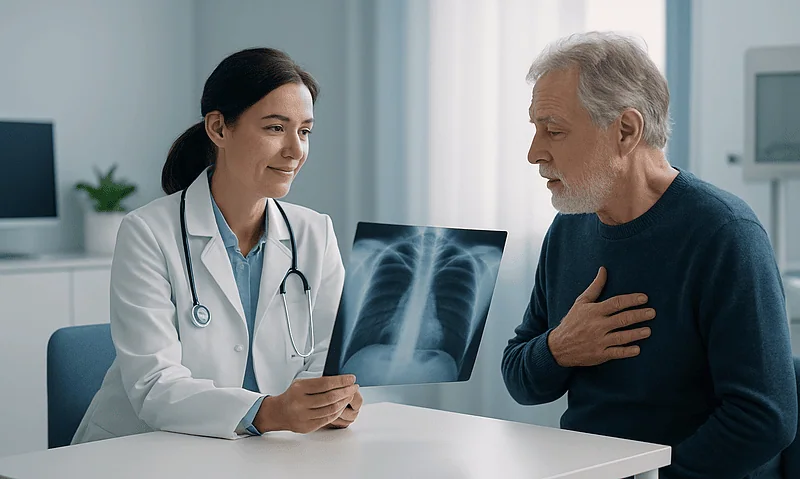
The follow-up appointment is almost over when the real question comes out. The chest X-ray looks clear, the drain site has healed to a pale line, and the person in the chair leans forward: the dive trip was booked months ago, the training course is paid for, and the group leaves in three weeks. Can they go?
It is one of the most common questions after a collapsed lung, and one of the hardest to answer in a sentence. A pneumothorax, air leaking into the space between the lung and the chest wall, heals in a matter of days to weeks for most people. Yet the pressure changes of scuba diving obey physics that do not care how good the X-ray looks. Diving after pneumothorax sits in a category of its own, while flying, mountain travel, lifting and running each follow different rules.
This explainer walks through what the evidence actually shows for each activity, why the answers differ, and which questions are worth bringing back to the clinic before you commit to anything.
What a pneumothorax actually is, and why gas pressure matters afterward
Each lung sits inside a thin double-layered sac called the pleura. Normally the two layers glide against each other with almost no space between them. A pneumothorax happens when air gets into that space, either from a tear in the lung surface or from a wound in the chest wall. The air pushes on the lung from the outside, and because the lung is elastic, it partially or fully deflates (MedlinePlus).
Where does the leak come from? In spontaneous cases, the usual culprit is a small blister-like weak spot on the lung surface called a bleb, which bursts without warning. Tall, thin young adults and people who smoke are overrepresented, and underlying lung disease such as COPD or cystic fibrosis raises the odds in later life (Mayo Clinic). Traumatic cases follow a rib fracture, a penetrating injury or a medical procedure such as a lung biopsy or a central line.
Treatment ranges from watchful waiting for a small leak, through needle aspiration or a chest drain to let the air out, up to surgery for people whose lung will not stay up or whose pneumothorax has come back (Cleveland Clinic).
The reason gas pressure matters afterward comes down to a school physics law. Boyle’s law says that when pressure on a gas drops, its volume rises. Descend 10 meters in seawater and the pressure roughly doubles; rise back to the surface and any pocket of trapped gas doubles in volume. Climb to a mountain pass or sit in an aircraft cabin and the surrounding pressure falls by roughly a quarter. A tiny pocket of air that would be harmless at sea level can therefore become a large one in exactly the settings this article covers. Everything that follows builds on that single mechanism.
Can you go diving after a pneumothorax?
For most people the honest answer is no, or at least not without a very specific pathway. The CDC’s travel health guidance lists a history of spontaneous pneumothorax among the conditions that generally rule out scuba diving, and diving medicine bodies worldwide take a similar line (CDC Yellow Book, scuba diving). The concern is not the healed episode itself. It is the chance of a second leak while breathing compressed gas at depth.

Picture the sequence. A bleb ruptures at 20 meters. The diver notices sharp chest pain and shortness of breath, feels understandably alarmed, and begins to ascend. As the surrounding pressure falls, the air already in the pleural space expands, squeezing the lung further and pushing on the heart and great vessels. By the surface that pocket may have grown several-fold. This is the scenario of a tension pneumothorax developing during ascent, with no chest drain and no clinician within reach. Even a diver with no symptoms at depth can surface with a dangerous collapse if a small leak began during the dive.
Why is a spontaneous pneumothorax treated as a lasting rather than temporary bar? Because the underlying tendency, blebs or fragile lung tissue, persists even after the visible collapse has resolved, and recurrence is common (Mayo Clinic). A traumatic pneumothorax from a single injury, with no underlying lung disease, is viewed somewhat differently, and some people in that group are eventually assessed as fit to dive once imaging and lung function have fully normalized. That assessment belongs with a physician trained in diving medicine, not with a dive shop questionnaire.
Freediving and snorkeling at the surface involve far smaller pressure swings than scuba, but breath-hold diving to depth still compresses and re-expands the lungs and is not risk-free. Ask specifically about each activity rather than assuming one answer covers all of them.
Why diving after pneumothorax is treated so differently from other sports
People are often puzzled that a clinician will happily sign them off for marathon training yet refuse to discuss a beginner’s dive course. The difference lies in what happens if the lung leaks again.
On land, a recurrent pneumothorax is unpleasant and needs prompt care, but the person can stop, sit down, call for help and reach an emergency department while breathing normal air at normal pressure. The gas in the pleural space stays roughly the same size until it is drained or reabsorbed. Time is on their side.
Underwater, three things stack against the diver at once. First, the pressure change itself enlarges any leaked air during ascent, as described above. Second, compressed gas is being breathed under pressure, so a leak can deliver more air into the pleural space more quickly than it would on land. Third, the environment is hostile: help is minutes to hours away, and the natural instinct to rush to the surface is the very action that makes the problem worse. A controlled ascent with a partially collapsed lung, while panicking, is difficult even for experienced divers.
There is a further wrinkle. Some people who have had one pneumothorax carry blebs on the other lung too, which imaging may or may not show. A clear X-ray after recovery is reassuring about the episode that happened, but it cannot promise that no weak spot remains.
For this reason diving medicine treats the question as one of risk tolerance under unforgiving conditions rather than of current fitness. A person can be fully recovered, athletic and symptom-free, and still be reasonably advised not to dive. That is not overcaution; it is a judgment about where a second event would be survivable and where it might not.
Who is usually asked to wait, and who may be reconsidered
Clearance conversations tend to sort people into broad groups, although the treating team will always weigh the individual picture.

Those usually advised to avoid scuba diving long term include anyone with a primary spontaneous pneumothorax (one arising without injury in otherwise healthy lungs) who has not had definitive surgical treatment, and anyone with a secondary spontaneous pneumothorax linked to underlying lung disease such as COPD, emphysema, cystic fibrosis or certain connective tissue disorders (Mayo Clinic; CDC Yellow Book). Underlying disease means the lung remains structurally vulnerable regardless of how the last episode was managed.
People who may be reconsidered, on a case-by-case basis, generally fall into two categories. The first is a single traumatic pneumothorax, for example after a rib fracture or a medical procedure, in someone with otherwise normal lungs, once healing is complete and lung function testing and imaging are normal. The second is a person who has undergone surgical treatment on the affected side, typically removal of blebs combined with pleurodesis (a procedure that makes the lung surface stick to the chest wall so air cannot collect between them). Some diving medicine specialists will consider clearance in this group after a full assessment, often including a CT scan of the chest. The unoperated opposite lung remains a discussion point.
For flying, altitude travel and exercise, the waiting group is almost everyone in the early weeks, and the reconsidered group is almost everyone after imaging confirms the lung has re-expanded and stayed up. Those timelines are covered in their own sections below.
Wherever you fall, the decision is not a form to be ticked. It rests with the team that treated you, ideally with input from a clinician who understands the specific environment you want to enter.
Flying after pneumothorax: how long should you wait before boarding?
Commercial aircraft cabins are pressurized, but not to sea level. Typical cabin altitude sits at the equivalent of 6,000 to 8,000 feet, where the surrounding pressure is roughly three-quarters of what it is at the ground (CDC Yellow Book, air travel). Any air trapped in the pleural space would expand by around a quarter to a third during the climb.
For that reason a current, untreated pneumothorax is a contraindication to flying, and most guidance asks people to wait a period after imaging confirms the lung has fully re-expanded. The CDC and airline medical departments commonly cite a wait of about one to two weeks after radiographic resolution, with some guidelines extending to three weeks or advising a repeat chest X-ray shortly before travel (CDC Yellow Book, air travel). The waiting period exists because small residual leaks can reopen in the first days after a drain is removed, and an X-ray taken on the day of discharge does not show what the lung is doing a week later.
What about a pneumothorax that was treated surgically? Recovery from thoracic surgery adds its own considerations, including wound healing and a longer period during which strenuous activity is limited, so the surgical team will usually set a date rather than a rule of thumb.
Once cleared, ordinary long-haul precautions apply. Sitting still for many hours raises the risk of blood clots in the legs, particularly after recent illness or surgery; getting up regularly, moving the calves, and staying hydrated are basic, sensible steps (CDC Yellow Book, air travel). Travelers should also know how to reach care at their destination and carry a copy of their discharge summary and recent imaging report. If you are due for follow-up, arrange it for either side of the trip rather than letting it lapse.
Is high altitude after pneumothorax safe, and what about mountain travel?
Mountain trips raise the same physics as a flight, minus the pressurized cabin. At 2,500 meters, roughly the height of many ski resorts, air pressure is about three-quarters of sea level; at 4,000 meters it is closer to 60 percent. The gas expansion argument that applies to aircraft applies here too, and the wait after full re-expansion is usually treated as at least as long as for flying (CDC Yellow Book, air travel and high-elevation guidance).
Two features make altitude different from a flight, in opposite directions. On one hand the pressure change is gradual over hours or days of travel, giving the body time to adjust and giving the traveler time to notice symptoms and descend. On the other hand mountain environments combine lower oxygen, cold, exertion and distance from medical care. A person who is still recovering, whose lung capacity is temporarily reduced, may feel more breathless than companions and may find it harder to distinguish ordinary altitude breathlessness from something more serious.
Driving over a high pass is usually less demanding than trekking to the same height, since exertion is minimal and descent is quick. Trekking, climbing and backcountry skiing deserve a specific conversation, especially if the plan involves multiple days above 2,500 meters or remote terrain.
Ordinary altitude illness prevention still matters: ascend gradually, allow rest days, avoid heavy exertion on arrival, and know the signs of altitude sickness such as headache, nausea, poor sleep and unusual breathlessness (CDC Yellow Book). Anyone with a history of pneumothorax who develops sudden one-sided chest pain and breathlessness at altitude should treat it as a possible recurrence and seek care and descent rather than pushing on. Discuss the trip with your team well before departure, and ask whether a repeat X-ray shortly beforehand makes sense.
Exercise after pneumothorax: when can you run, lift and train again?
Here the news is more encouraging. Ordinary aerobic exercise does not change the pressure around the lung in the way that diving or altitude does, and there is no evidence that walking, cycling or jogging causes a healed pneumothorax to recur. Guidance therefore focuses on comfort, healing of any drain or surgical wound, and avoiding the specific maneuvers that spike pressure inside the chest.
The first days are about gentle movement. Walking is encouraged from early on, both for lung expansion and to reduce the risk of clots. Most people are advised to hold off on strenuous activity for a few weeks after discharge, and longer after surgery, with the exact timing set by the treating team (Cleveland Clinic; MedlinePlus). Pain around a drain site is common and usually settles over one to two weeks.
The activities that draw particular caution are those involving the Valsalva maneuver, which is the forced exhalation against a closed throat that people do instinctively when straining. Heavy lifting, maximal squats, pushing a stalled car and playing high-resistance wind instruments all raise pressure inside the chest sharply. Whether this truly triggers recurrence is uncertain; the concern is plausible rather than firmly proven, and mainstream references advise avoiding heavy straining during the healing window rather than forever.
Contact sports raise a different issue: a direct blow to the chest can cause a traumatic pneumothorax in anyone, and a recently healed chest wall or surgical site is more vulnerable to pain and injury. A return to rugby, martial arts or hockey is usually staged after the surgical or medical team is satisfied with healing.
Listen to breathlessness. Feeling more winded than usual in the first weeks is expected; sudden new breathlessness or sharp one-sided pain during a workout is not, and should stop the session.
Activity clearance at a glance: what usually needs a check first
The table below summarizes how mainstream guidance tends to approach each activity after a pneumothorax. It is a starting point for a conversation, not a substitute for one, and the ranges shown are typical waits after imaging confirms full re-expansion, drawn from the references cited in this article. Your team may set different timings based on cause, treatment and any underlying lung condition.
| Activity | Main concern | Typical approach in mainstream guidance |
|---|---|---|
| Walking and light daily activity | Comfort, clot prevention | Encouraged from the first days once stable (MedlinePlus) |
| Aerobic exercise (jogging, cycling, swimming at surface) | Healing of drain or surgical site | Usually a wait of a few weeks, longer after surgery, then gradual return (Cleveland Clinic) |
| Heavy lifting and straining | Pressure spikes inside the chest | Avoided during the healing window; timing set by the team |
| Contact sports | Chest wall injury | Staged return after clinical review |
| Commercial flying | Gas expansion at cabin altitude | Commonly 1–3 weeks after radiographic resolution, some advise a repeat X-ray first (CDC Yellow Book) |
| High-altitude travel above 2,500 m | Gas expansion plus lower oxygen, remoteness | At least as long as flying; individual review for trekking or climbing (CDC Yellow Book) |
| Scuba diving | Recurrence at depth with expansion on ascent | Generally contraindicated after spontaneous pneumothorax; possible reassessment after definitive surgery or an isolated traumatic case, by a diving medicine physician (CDC Yellow Book) |
| Freediving to depth | Lung compression and re-expansion | Not well studied; individual specialist assessment |
Two patterns stand out. Activities that change ambient pressure carry the longest waits and the firmest restrictions. Activities that merely make you breathe hard are limited by healing, not by physics, and return far sooner. Keeping that distinction in mind makes it easier to understand why the answers you receive differ so much from one question to the next.
What the first days and weeks after a pneumothorax usually look like
Recovery has a recognizable shape, although the pace varies with how large the collapse was and how it was treated.
For a small pneumothorax managed with observation, the body reabsorbs the trapped air on its own over days to a couple of weeks. People are typically seen again with a repeat X-ray to confirm progress, and told to avoid flying and strenuous activity in the meantime (Mayo Clinic). Chest discomfort fades steadily; a persistent ache when taking a deep breath is common early on.
Where a chest drain was placed, the tube usually stays in for a few days until the lung has re-expanded and the leak has stopped. After removal, the small wound is dressed and heals over one to two weeks. Soreness and a pulling sensation around the site are expected. A follow-up X-ray after drain removal checks that the lung has stayed up, and this is often the point at which the flying and travel clock starts (Cleveland Clinic).
After surgery, whether keyhole removal of blebs with pleurodesis or a more extensive operation, recovery is longer. Pain from the pleurodesis itself can be significant for the first week or two, since the procedure works by deliberately irritating the pleural surfaces so they fuse. Surgeons usually set restrictions on lifting and driving and schedule a specific review before clearing sport or travel.
Across all pathways, breathing exercises and regular walking are commonly encouraged to keep the lung fully expanded and to reduce the risk of chest infection. Fatigue is normal and can linger for several weeks. Many people describe a heightened awareness of every twinge in the chest during this period; that anxiety is understandable and usually eases as time passes without incident.
Pneumothorax recurrence rate: how likely is it to happen again?
The single fact that shapes almost every activity decision is that a pneumothorax often comes back. Having had one is the strongest predictor of having another, and the risk is highest in the first one to two years before tapering (Mayo Clinic; MedlinePlus).
Exact figures vary with the population studied and the treatment given. Mainstream references describe recurrence after a first spontaneous pneumothorax managed without surgery as common, with reported estimates spanning roughly one in five to one in two people over the following few years (Mayo Clinic). The wide range reflects real differences: people with underlying lung disease relapse more often than those with otherwise healthy lungs, and continued smoking raises the odds substantially.
Recurrence can happen on either side. Blebs are frequently present on both lungs, so a second episode on the opposite side is not unusual, which is one reason a surgical procedure on one lung does not fully close the diving question.
Surgical treatment sharply lowers the chance of the same side collapsing again. Pleurodesis, whether performed mechanically during surgery or chemically through a drain, creates adhesions between the lung and chest wall so that air cannot accumulate in the space. Recurrence after surgical pleurodesis is uncommon compared with observation or drainage alone, which is why it is typically offered after a second episode, after a first episode in high-risk occupations such as pilots, or when the first episode did not resolve with a drain (Cleveland Clinic). Precise post-surgical recurrence percentages differ between series, and the treating surgeon is best placed to quote figures relevant to the technique used.
None of this predicts what will happen to any one person. It does explain why clinicians talk about probabilities rather than promises when they answer the question of what you can safely do.
Does surgery or pleurodesis change what you are allowed to do?
Yes, in some respects, and less than people hope in others.
The clearest change is in the risk of recurrence on the treated side, as covered above. Because the lung is anchored to the chest wall, a new bleb rupture on that side is far less likely to produce a significant collapse. For everyday life this is reassuring, and it is the main reason surgery is recommended for people whose work or lifestyle makes a recurrence especially dangerous.
For diving, surgery moves a person from the group who are almost always advised against it into the group who may be individually reassessed. Diving medicine specialists who consider clearance after surgery usually look for several things: a definitive procedure that addressed the underlying blebs, not just chemical pleurodesis through a drain; a normal CT scan of the chest, including the opposite lung; normal lung function tests; and a sufficient interval since surgery for healing. Even then, the assessment is individual, and some specialists remain cautious about the untreated side. Nobody should assume that having had an operation automatically reopens diving.
For flying and altitude, surgery lengthens the early wait because of the operation itself, but once healing is complete these activities are generally approached in the usual way.
For exercise, surgical patients face a longer initial period of restricted lifting and contact sport, typically several weeks, set by the surgical team. After that, there is no evidence that a pleurodesed lung limits athletic performance; the lung expands normally against the chest wall and gas exchange is unaffected.
The decision to have surgery is a separate one, weighed by the treating team against the risks of an operation, and the desire to dive alone is rarely the sole reason to proceed.
What people often get wrong about life after a collapsed lung
Misunderstandings cluster around a handful of themes, and correcting them makes the rest of the picture clearer.
A clear X-ray means the problem is over. A normal chest film confirms the lung has re-expanded. It says nothing about blebs that may remain, which are often too small to see without CT and sometimes invisible even then. That is why the diving restriction outlasts the recovery.
Flying and diving carry the same risk. They share a mechanism but not a magnitude. A cabin at 8,000 feet involves a pressure drop of about a quarter; surfacing from 10 meters involves a halving. And a recurrence in the air happens with the person breathing ordinary air at rest, with cabin crew and a landing option, not underwater breathing compressed gas.
Snorkeling is basically the same as scuba. Floating at the surface breathing through a tube involves negligible pressure change. Breath-hold diving to depth does not. The two deserve separate questions.
Exercise caused it, so exercise will cause it again. Many spontaneous pneumothoraces happen at rest or during sleep. Exertion at the moment of rupture is coincidence more often than cause, and there is no good evidence that a return to aerobic training raises recurrence risk once healing is complete (Mayo Clinic).
Surgery makes diving fine. It makes diving discussable. The untreated lung, the type of procedure and the specialist’s judgment all still matter.
Smoking is irrelevant now that it has happened. Continued smoking is one of the strongest modifiable drivers of recurrence and of underlying lung damage (Cleveland Clinic). Stopping is the most effective step a person can take on their own to change the odds, and support for quitting is available through most primary care services.
Questions to ask your care team before you book anything
Clearance conversations go better when the person asking knows what information the clinician needs and what answers to press for. These questions are a reasonable starting list, whether you are hoping to fly next month or dive next year.
- Was my pneumothorax spontaneous or traumatic, and if spontaneous, was it primary (no underlying disease) or secondary? This single classification shapes almost every later answer.
- Did imaging show any blebs or other abnormalities, and were both lungs looked at? Ask whether a CT scan was done and what it showed.
- What was the date of the X-ray that confirmed full re-expansion, and is a repeat film needed before I travel?
- For my situation, what is the earliest reasonable date to fly, and does that differ for a long-haul flight or a mountain destination above 2,500 meters?
- When can I return to aerobic exercise, and is there a separate timeline for heavy lifting or contact sport?
- Is scuba diving something I should regard as permanently off the table, or is there a pathway to reassessment? If so, who does that assessment and what would it involve?
- Does my case meet the usual criteria for surgical treatment, and what would that change about my recurrence risk and my activity options?
- What symptoms should make me stop an activity or seek care, and what should I carry with me when traveling in case a recurrence happens away from home?
- Are there occupational implications, for example for commercial diving, aviation or work at altitude, that I should raise with an employer or licensing body?
Write the answers down. Recollection of a ten-minute conversation is unreliable, and the specifics, especially dates and classifications, are what a dive medical examiner or airline medical service will ask for later. If you see more than one clinician, bring the same list so that advice stays consistent, and if answers conflict, ask the team to resolve the difference rather than choosing the one you prefer.
When to call your doctor: red-flag signs after a pneumothorax
Most recoveries are uneventful, but a recurrence or complication can develop quickly, and knowing the warning signs matters more than usual for anyone planning travel or sport.
Call emergency services immediately if you develop sudden sharp chest pain on one side together with new or rapidly worsening shortness of breath, particularly if you also notice a racing heartbeat, lightheadedness, bluish lips or fingertips, or a feeling of impending collapse. These can indicate a recurrent pneumothorax, and a tension pneumothorax in which pressure builds and compresses the heart is a medical emergency (MedlinePlus; Mayo Clinic). Do not drive yourself, and if you are at altitude or in a remote location, begin descent and summon help at the same time.
Contact your care team the same day if you have milder but new one-sided chest pain or breathlessness that does not settle within minutes, increasing pain or redness, swelling or discharge at a drain or surgical site, a fever, a persistent cough with colored sputum, or breathlessness that seems to be getting worse rather than better over several days.
Raise at your next appointment ongoing fatigue, anxiety about recurrence that is affecting daily life, or uncertainty about any activity restriction. These are common and legitimate topics for follow-up.
If you are traveling, keep your discharge paperwork and imaging report accessible, know how to reach emergency care where you are, and tell a companion what to watch for. A recurrence treated promptly is generally very manageable; one that is ignored on a long flight, a mountain trail or a dive boat is a different matter. When in doubt, seek assessment. Nobody on your treating team will regret an X-ray that turns out to be normal.
Frequently asked questions
Can I ever go scuba diving after a spontaneous pneumothorax?
In most cases mainstream guidance advises against it for life, because the underlying tendency to leak persists and a recurrence at depth can expand dangerously on ascent. Some people who have had definitive surgery including bleb removal and pleurodesis are individually reassessed by a diving medicine physician, usually with a CT scan and lung function tests, but clearance is never automatic and the decision rests with that specialist.
How long after a pneumothorax is flying safe?
Guidance commonly cited by the CDC and airline medical services asks for about one to two weeks after a chest X-ray confirms the lung has fully re-expanded, with some sources extending this to three weeks or advising a repeat film before travel. Anyone with a current or incompletely resolved pneumothorax should not fly. Your treating team sets the actual date based on cause, treatment and follow-up imaging.
Is high altitude after pneumothorax more dangerous than flying?
It can be, depending on the trip. The pressure drop at 2,500 to 4,000 meters is similar to or greater than an aircraft cabin, and mountain travel adds exertion, lower oxygen and distance from medical care. Driving over a pass is usually low risk once cleared for flying; multi-day trekking or climbing above 2,500 meters deserves a specific conversation with your team before departure.
When can I start exercise after pneumothorax treatment?
Gentle walking is encouraged from the first days. Most people are advised to avoid strenuous activity and heavy lifting for a few weeks after a drain is removed, and longer after surgery, with the timing set by the treating team. Aerobic exercise does not change pressure around the lung, so once healing is complete there is no evidence it raises recurrence risk.
What is the pneumothorax recurrence rate after a first episode?
Mainstream references such as Mayo Clinic and MedlinePlus describe recurrence as common, with reported estimates spanning roughly one in five to one in two people over the following few years, highest in the first year or two. Risk is greater with underlying lung disease and continued smoking, and lower after surgical pleurodesis, which fuses the lung to the chest wall on the treated side.
Is snorkeling safe after a collapsed lung?
Snorkeling at the surface involves negligible pressure change and is generally viewed very differently from scuba diving. Breath-hold diving to depth, however, compresses and re-expands the lungs and has not been well studied after pneumothorax. Ask your team about each activity separately rather than assuming one answer covers both, and wait until healing and follow-up imaging are complete before any water activity.
Does pleurodesis mean I can dive again?
Not automatically. Surgery that removes blebs and performs pleurodesis sharply lowers recurrence on the treated side and moves a person into the group who may be individually reassessed. Diving medicine specialists typically want a definitive surgical procedure, a normal chest CT including the other lung, normal lung function and adequate healing time, and some remain cautious because the untreated lung may also carry blebs.
Can heavy lifting cause a pneumothorax to come back?
It is uncertain. Straining raises pressure inside the chest sharply, which is why heavy lifting and forceful maneuvers are commonly avoided during the healing window. Firm evidence that lifting triggers recurrence in a healed lung is lacking, and many spontaneous pneumothoraces occur at rest. Mainstream advice is to avoid heavy straining for the period your team specifies, then return gradually.
What should I carry when traveling after a pneumothorax?
A copy of your discharge summary and the report of the X-ray that confirmed full re-expansion, contact details for your treating team, and a clear idea of how to reach emergency care at your destination. On long flights, move your legs regularly and stay hydrated to reduce clot risk. Tell a travel companion which symptoms, especially sudden one-sided chest pain and breathlessness, should prompt an urgent call for help.
Does a traumatic pneumothorax carry the same diving restrictions as a spontaneous one?
Usually not as strictly. A single pneumothorax caused by injury or a medical procedure, in someone with otherwise normal lungs, does not imply an ongoing tendency to leak, and some people in this group are eventually assessed as fit to dive once imaging and lung function are fully normal. That assessment should be made by a diving medicine physician, not by a general fitness questionnaire.
References
This article is for general information only and is not a substitute for professional medical advice. Please consult a qualified doctor about your individual situation.

More from the Blog

Do Antibiotics Help Acute Bronchitis? Why Most Cases Are Viral and What Treatment Looks Like
Antibiotics usually do not help acute bronchitis, because the large majority of cases are caused by viruses that antibiotics cannot touch. Pooled trials suggest…

Which Chest Conditions Suit Robotic Thoracic Surgery? Lung Nodules, Mediastinal Tumors and More
Robotic thoracic surgery is most often considered for small lung nodules and early-stage lung cancer needing a wedge resection, segmentectomy or lobectomy, for tumors…
Does Acute Bronchitis Need a Chest X-Ray? How Doctors Rule Out Pneumonia
Most people with acute bronchitis do not need a chest X-ray. Doctors usually diagnose it from the story of the illness and a physical…

Questions to Ask Your Cystic Fibrosis Team: Lung Function, Infections and Nutrition Goals
Useful questions to ask a cystic fibrosis team fall into three groups: lung function (what my FEV1 is, how it has changed, what a…

How Long Does Lung Abscess Treatment Take? Why Antibiotic Courses Run for Weeks
Lung abscess treatment usually takes several weeks, not days. Published reviews describe antibiotic courses of roughly three to six weeks, sometimes extended to eight…

What Pulmonary Rehabilitation Offers People With Bronchiectasis: Realistic Expectations
Pulmonary rehabilitation for bronchiectasis is a supervised program of exercise training, airway clearance coaching, and education that usually runs for several weeks. Evidence from…