

Life After Bladder Removal Surgery: Urinary Diversion Options and Daily Adjustments

Key Takeaways
- A cystectomy leaves the kidneys working normally; a urinary diversion only gives urine a new exit, usually built from a segment of small intestine.
- An ileal conduit drains continuously into an external pouch, so nothing depends on timing or muscle control, while the stoma shrinks and needs remeasuring over the first 6–8 weeks.
- A neobladder has no sensation or reflex, so emptying is done by the clock and night-time leakage is common in the first year.
- Bowel lining in the urinary tract reabsorbs salts and loses vitamin B12 absorption, which is why blood chemistry and B12 are checked for years after surgery.
- Bacteria in diversion urine are expected; clinicians generally treat symptomatic infections, not positive tests alone.
- Systematic reviews find overall quality of life broadly similar between conduit and neobladder once the first year has passed, with adaptation and nurse support mattering more than diversion type.
After bladder removal (cystectomy), urine must leave the body by a new route called a urinary diversion: an ileal conduit draining into an external pouch, an internal neobladder emptied through the urethra, or a continent pouch emptied with a catheter. Most people return to work, travel and exercise over several weeks to months, with ongoing checks of kidney function, stoma or continence, and vitamin B12.
The folder arrives before the surgery date does. Inside are diagrams of a stoma, a sketch of a pouch sewn from intestine, and a page of words a person did not expect to be learning at sixty-two: conduit, neobladder, catheterize. The cancer conversation was hard enough. Now the harder question is quieter, asked at the kitchen table rather than in the clinic: what will ordinary life actually feel like afterward?
That question deserves a straight answer, and the honest one is that life after cystectomy urinary diversion is both more normal and more effortful than most people expect. More normal, because people with every type of diversion swim, work shifts, travel and sleep through the night. More effortful, because the body no longer stores urine for free; something, whether a pouch, a schedule or a catheter, now does that job on purpose.
This guide walks through what the operation removes, the three main ways urine is rerouted, what recovery typically looks like week by week, and the daily adjustments that matter most according to mainstream evidence rather than hearsay.
What a cystectomy actually removes, and why urine needs a new route
A cystectomy is the surgical removal of the urinary bladder, the muscular bag that stores urine until it is convenient to pass it. A radical cystectomy, the operation most often done for muscle-invasive bladder cancer, also removes nearby lymph nodes and, depending on anatomy, the prostate and seminal vesicles, or the uterus, ovaries and part of the vaginal wall. When the prostate is removed at the same time, the combined operation is called a cystoprostatectomy (Mayo Clinic).
The kidneys keep working exactly as before. Each one filters blood continuously and sends urine down a tube called a ureter. The problem after surgery is simply that the ureters now point at empty space. A urinary diversion is the surgeon’s answer: a reconstruction that gives urine somewhere to go and a way to leave the body.
Almost every diversion borrows a piece of the intestine. The small bowel is long, well supplied with blood, and can be isolated with its own blood vessels intact and then reconnected so digestion continues. That borrowed segment becomes either a short tube to the skin or a sewn-together reservoir inside the pelvis. Bowel lining, however, was built to absorb, not to store urine, which explains several of the long-term issues covered later, from mucus production to shifts in blood chemistry.
Surgeons perform the operation through an open incision or with laparoscopic or robot-assisted techniques. The diversion itself is the same in principle whichever approach is used, and the choice of approach is made by the treating team based on the cancer, your anatomy and their experience. What changes your daily life afterward is not the size of the scar but which diversion was built.
The three main urinary diversion options after bladder removal, compared
Three reconstructions account for nearly all diversions performed today. Each stores and empties urine differently, and each trades one kind of effort for another. The table summarizes how they work in daily life; the sections that follow go deeper on each.

| Diversion | Where urine collects | How it is emptied | What daily life involves |
|---|---|---|---|
| Ileal conduit (urostomy) | External pouch over a stoma on the abdomen | Pouch drained via a tap several times a day; bag changed every few days | Stoma and skin care; night drainage bag optional |
| Orthotopic neobladder | Internal reservoir made from bowel, connected to the urethra | By relaxing the pelvic floor and pressing on the abdomen, on a timed schedule | Bladder retraining; possible night leakage; catheter if emptying is incomplete |
| Continent cutaneous reservoir | Internal reservoir with a small valved stoma, often near the navel | Self-catheterization through the stoma on a schedule | Catheter technique; regular flushing of mucus |
The ileal conduit is the simplest to build and the one with the longest track record, so it is the default in many centers and the usual choice when health, kidney function or cancer location makes a reservoir unwise (NHS). A neobladder restores urination through the natural route but asks the person to relearn how to empty without the nerves and sensation of a real bladder. The continent reservoir avoids an external pouch while leaving the urethra out of the picture, at the price of lifelong catheter use.
No option is universally better. The right one depends on the tumor, the kidneys, the bowel, hand dexterity, and honest conversation about which kind of effort you would rather live with.
Ileal conduit: what a urostomy bag in daily life actually involves
For an ileal conduit, the surgeon detaches a short segment of the ileum, the final part of the small intestine, sews the ureters into one end and brings the other end through the abdominal wall as a stoma. A stoma is a small, moist, pink opening with no nerve endings, so it does not hurt to touch. Urine trickles from it constantly, drop by drop, which is why a pouch is worn at all times (MedlinePlus).
The pouch system has two parts: an adhesive baseplate shaped around the stoma, and a bag with a tap at the bottom. The bag is drained into a toilet whenever it is about a third full, typically several times a day, and the whole system is replaced on a routine of every few days as guided by your stoma nurse (MedlinePlus). Most people learn the change in the hospital and are reasonably confident within a few weeks at home.
Skin care is the daily discipline that matters most. Urine sitting against skin causes irritation, so a well-fitting baseplate and a flat, dry surface around the stoma are the goals. The stoma itself shrinks over the first 6–8 weeks after surgery, so the template cut for the baseplate needs remeasuring during that period (Mayo Clinic).
At night, many people connect the pouch to a larger drainage bag hung beside the bed so they are not woken to empty it. Clothing rarely needs to change; the pouch sits below the waistband and under ordinary shirts. Showering with the pouch on or off is both fine, since water does not harm a stoma. Swimming is possible once the wound has healed and the team agrees.
The practical upside of a conduit is that nothing depends on timing or muscle control. The trade-off is a visible appliance and a body that looks different, something addressed in the body-image section below.
Neobladder: how learning to urinate again really works
An orthotopic neobladder is a reservoir sewn from a longer segment of small bowel, opened and reshaped into a sphere, then attached to the ureters above and the urethra below. Orthotopic simply means in the original position. Because the urethra and its surrounding sphincter muscle are kept, urine leaves the body the ordinary way (Mayo Clinic).
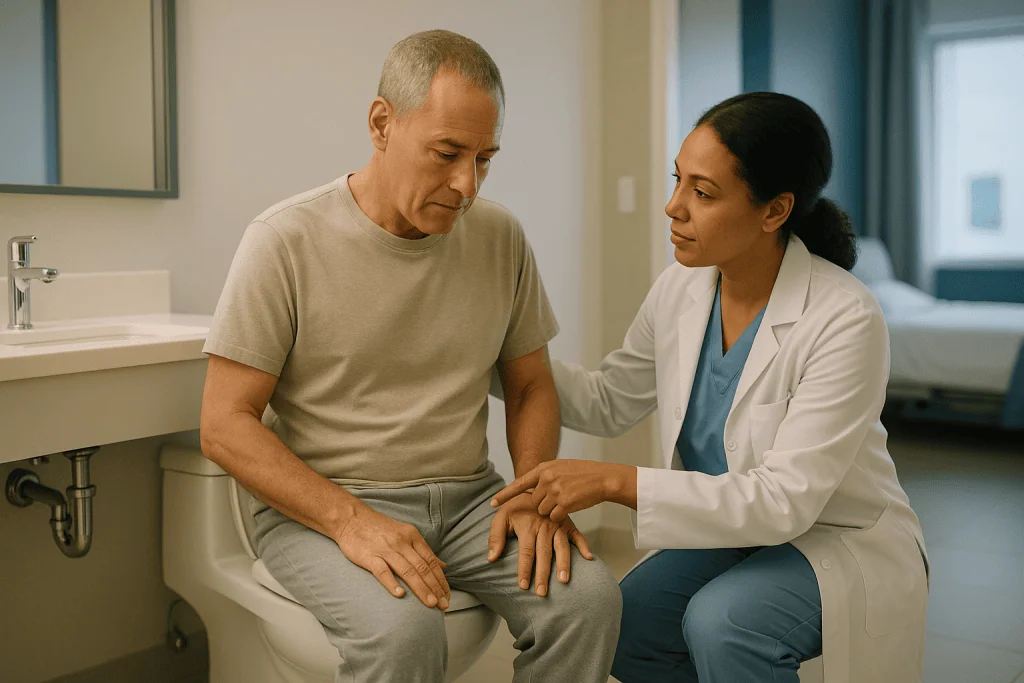
What is missing is sensation. A natural bladder tells the brain when it is full and contracts on command. A neobladder does neither. Emptying is learned: you sit, relax the pelvic floor, and press gently on the lower abdomen so the reservoir drains by pressure. In the early weeks the new reservoir is small and stiff, so teams usually ask people to empty on a strict clock, roughly every 2–3 hours at first, stretching the interval over several months as the pouch gradually expands (NHS).
Daytime continence improves steadily for most people as the reservoir enlarges and pelvic floor strength returns. Night-time is different. Asleep, the pelvic floor relaxes and the fullness cues that a healthy bladder provides are absent, so leakage at night is common in the first year and persists for some people long term. Setting an alarm to empty once or twice overnight is a standard part of the plan, not a sign of failure (Mayo Clinic).
Two further realities come with the territory. Bowel lining produces mucus, which appears in the urine and can occasionally block flow, so good fluid intake matters. And a minority of people do not empty completely, which raises infection risk; they are taught to pass a catheter through the urethra to drain the pouch. Teams screen for this with ultrasound measurements of leftover urine during follow-up.
Continent cutaneous reservoir: emptying with a catheter on a schedule
The continent cutaneous reservoir is the least common of the three but suits a specific group well: people who want to avoid an external pouch but whose urethra has been removed or is not suitable for reconnection. The surgeon builds a reservoir from bowel, as for a neobladder, but connects it to the skin through a narrow channel fitted with a one-way valve. The small, flat stoma is often tucked into the navel where it is barely noticeable (Mayo Clinic).
Instead of a bag, the person passes a thin catheter through the stoma into the reservoir to drain it, then removes the catheter and covers the opening with a small dressing. This is done on a clock, typically every few hours by day and usually once overnight in the early months, with the interval lengthening as the reservoir stretches (NHS).
The technique is not difficult, but it does demand reliable hands and eyesight, a willingness to carry catheters, and consistent timing. Letting the reservoir overfill risks stretching the valve, which can lead to leakage or difficulty passing the catheter. Mucus accumulates inside the pouch, so periodic flushing with sterile saline is part of the routine, taught before discharge.
Compared with a conduit, there is no appliance, no skin irritation from urine and nothing to show under clothes. Compared with a neobladder, there is no relearning of urination and no night-time leakage through the urethra. The costs are a lifelong catheter habit, a higher chance of needing a revision procedure on the valve over the years, and the same metabolic and vitamin considerations that apply to any bowel reservoir (NHS).
Teams tend to offer this option after a candid talk about daily reliability rather than as a first suggestion.
Who is usually offered which diversion, and who is asked to wait
The choice begins with the cancer. If the tumor involves the urethra or the bladder neck, or if the margin closest to the urethra shows cancer cells during surgery, a neobladder is generally ruled out because the urethra must be removed too. Tumor location can therefore settle the question before preferences enter the room (NHS).
Kidney and liver function come next. A bowel reservoir keeps urine in contact with absorbing tissue for hours, so some salts are reabsorbed into the blood. Healthy kidneys correct that quietly; impaired kidneys may not, and a conduit, which drains continuously, is usually recommended instead. Significant bowel disease, previous pelvic radiation that has damaged the intestine, or a short bowel also push toward the simplest reconstruction (Mayo Clinic).
Then come the practical questions. Can you reliably follow a timed schedule, including at night? Are your hands and vision suited to catheterization? Do you have support at home in the early weeks? Age by itself is not a barrier, but overall fitness and the ability to manage a routine are weighed carefully.
Who is asked to wait? People receiving chemotherapy before surgery, which is standard for many with muscle-invasive disease, have the operation scheduled after that course finishes and blood counts recover (NIH National Cancer Institute). Active urinary infection, uncontrolled diabetes, recent heart events or very low body weight may prompt a delay for optimization, because surgical complications track closely with nutrition and cardiovascular fitness.
The decision is made jointly between you, the urologic surgeon, the stoma or continence nurse and, often, an oncologist. It helps to meet someone living with each type of diversion before deciding; many teams can arrange this.
How long does recovery after radical cystectomy or urostomy surgery take?
Radical cystectomy is major abdominal surgery, and recovery is measured in weeks and months rather than days. Patient guidance from mainstream sources describes a hospital stay of roughly one to two weeks, with the shorter end more typical for a conduit and for people on enhanced-recovery pathways, and the longer end when complications arise (Mayo Clinic; NHS).
In the hospital, the first priorities are walking early, restarting eating as the bowel wakes up, and learning the basics of your diversion. Thin tubes called ureteric stents, placed during surgery to protect the new joins, are usually removed before discharge or at an early clinic visit. People with a neobladder typically go home with a catheter in place for around two to three weeks while the reservoir heals, and may be taught to flush it to clear mucus (Mayo Clinic).
The following table gives a typical shape to recovery. It is a pattern, not a schedule; your team’s milestones take priority.
- Weeks 1–2: fatigue, a tender abdomen, loose or irregular bowel movements, first pouch changes or catheter care with nurse support.
- Weeks 3–6: walking distances increase; appetite returns; neobladder catheter removed and timed emptying begins; stoma size settles.
- Weeks 6–12: most people resume driving, desk work and light exercise with the team’s agreement; heavy lifting is still restricted (NHS).
- Months 3–12: energy returns to near baseline; neobladder capacity expands; night-time continence keeps improving.
Recovery from cystoprostatectomy follows the same arc, with the additional adjustments to sexual function described later. People who had chemotherapy beforehand often start from a lower energy baseline and should expect the timeline to stretch accordingly. Honest expectation-setting here does more for morale than any single tip.
The first weeks at home: eating, drinking and moving with a new diversion
The kitchen is where most daily adjustments happen. Fluid intake is the single most important habit with any diversion, because dilute urine flows better, carries less mucus and gives bacteria less chance to multiply. Unless a heart or kidney condition means your team has set a limit, aim for urine that stays pale through the day (MedlinePlus).
Appetite often lags for weeks after bowel surgery. Small, frequent meals tend to sit better than three large ones. Because a length of intestine has been removed, some people notice looser stools for a while as the remaining bowel adapts. This usually settles; persistent diarrhea or weight loss should be raised with your team, since both affect wound healing and energy (NHS).
Movement is medicine in the literal sense. Walking several times a day lowers the risk of blood clots, keeps the lungs clear and nudges the bowel back to a rhythm. The limit in the early weeks is on lifting and straining, not on walking. Most teams advise avoiding anything heavier than a light bag of groceries for about six weeks so the abdominal wall heals without a hernia forming (Mayo Clinic).
Sleep is often fragmented at first. Conduit users adjust to the night drainage bag; neobladder users set alarms to empty. Both improve with routine. Fatigue in the afternoon is normal and tends to lift gradually across the first three months.
Finally, expect a learning curve with equipment. Pouch leaks in the first weeks are common while the stoma is still shrinking and templates are being refined. A leak is a fitting problem to be solved with your stoma nurse, not a personal failing, and nurses expect to adjust the system more than once.
What are the complications of cystectomy with an ileal conduit, and of other diversions?
Complications fall into two groups: those of any major pelvic operation, and those specific to living with bowel in the urinary tract. In the first group are infection, bleeding, blood clots, a slow-to-recover bowel (ileus), and wound problems. These are most likely in the first month and are the reason early walking, breathing exercises and good nutrition are emphasized (Mayo Clinic).
Ileal conduit-specific problems tend to appear over months to years. The stoma can narrow (stenosis), retract below skin level, or prolapse outward, each of which complicates pouch fitting. A parastomal hernia, a bulge of bowel beside the stoma through the weakened abdominal wall, is common over the long term and is one reason lifting limits matter early on. Skin irritation from urine contact is frequent but usually manageable with fitting changes (MedlinePlus). The junction where the ureters join the bowel can scar and narrow, backing urine up toward the kidney; this is why kidney imaging continues for years.
Urinary tract infections are more frequent with all diversions, because bowel mucosa is colonized by bacteria and because urine may sit longer than it should. Not every positive urine test needs treatment; the presence of bacteria without symptoms is expected and is generally left alone, a decision for the treating clinician (NHS).
Neobladder complications include incontinence, incomplete emptying requiring catheterization, and mucus blockage. Continent reservoirs can develop valve leakage or difficulty catheterizing. Any reservoir allows the bowel lining to reabsorb acids and salts, which can shift blood chemistry over time; this is checked with blood tests. The terminal ileum also absorbs vitamin B12, so removing part of it can lead to deficiency years later, which is why periodic B12 checks are part of standard follow-up (NHS).
Ileal conduit vs neobladder: what the evidence says about long-term quality of life
People choosing between a conduit and a neobladder often assume the internal option must mean a better life. The research is less tidy than that. Systematic reviews of quality-of-life studies have repeatedly found that overall wellbeing scores are broadly similar between the two groups once people are through the first year, with each option scoring better on some domains and worse on others (NIH National Cancer Institute).
Conduit users tend to report fewer worries about leakage and night waking, and a simpler routine. Neobladder users tend to report better body image and fewer concerns about appliances, balanced against incontinence, especially at night, and the demands of timed emptying. Much of the measured difference washes out because people adapt remarkably well to whichever system they have, a pattern seen across many surgeries that change body function.
What the evidence does not support is any claim that one diversion makes people happier or healthier in general. Selection effects also muddy comparisons: people offered neobladders are, on average, younger and fitter, so better scores in that group partly reflect who they were before surgery rather than what the surgery did.
The more useful question is therefore personal rather than statistical. Which kind of effort would you rather own: a visible pouch with a predictable routine, or an invisible reservoir with a clock and some uncertainty at night? Which would fit your job, your sleep, your hands and your household?
One finding is consistent and worth holding onto: structured support, including a specialist nurse available by phone in the first months, is associated with better coping regardless of diversion type. Ask whether that support exists before surgery rather than after (NHS).
Sex, intimacy and body image after cystectomy
Radical cystectomy runs through the pelvis, where the nerves and blood vessels that serve sexual function live. For men, removal of the prostate and seminal vesicles means ejaculation no longer occurs, and erections depend on whether the nerves alongside the prostate could be preserved. Nerve-sparing is attempted when the cancer allows, but erectile function commonly declines after surgery and may take many months to recover partially or not at all. Medicines in the class that increase blood flow to the penis, vacuum devices and other options exist; whether and when any is appropriate is a decision for the treating urologist (Mayo Clinic).
For women, removal of the uterus and part of the vaginal wall can shorten or narrow the vagina and reduce lubrication, and the ovaries, if removed before menopause, stop producing estrogen. Vaginal-sparing techniques are used when oncologically safe. Discomfort with penetration, changes in sensation and altered orgasm are reported, and pelvic floor physiotherapy and dilator programs are often part of the plan (NHS).
Body image is the quieter issue, and it affects people with every diversion. A stoma changes how the body looks; a neobladder changes how it behaves. Partners frequently cope better than the person expects, and the fear of a partner’s reaction is often larger than the reaction itself. Practical steps help: emptying the pouch or reservoir before intimacy, using a pouch cover or a smaller pouch, choosing positions that keep weight off the stoma.
Desire is also affected by fatigue, grief and the cancer itself. Teams that include a specialist nurse or sexual health counselor can help; it is reasonable to ask for that referral, and reasonable to raise the subject even if no one else does.
Work, travel, sleep and exercise with a urinary diversion
Returning to work depends more on the job than on the diversion. Desk-based roles are often resumed within about six to eight weeks; physically heavy work waits until the abdominal wall is sound and the team agrees, which may be closer to three months (NHS). Conduit users usually want a private place to empty and a small kit of spare supplies at work; neobladder users need bathroom access on a schedule, which most employers accommodate once asked.
Travel is entirely possible. Carry supplies in hand luggage rather than checked bags, pack more than you expect to use, and keep a short clinician’s letter explaining the diversion and any catheters or medications for security staff. In hot climates, fluid needs rise and pouch adhesives can soften, so changes may be needed more often. On long flights, walk the aisle regularly and keep hydrated, which lowers clot risk after any recent surgery (Mayo Clinic).
Exercise helps recovery and long-term health. Walking is encouraged from day one. Swimming, cycling and gym work can follow once wounds have healed and lifting restrictions are lifted. Contact sports and heavy core loading deserve a conversation about hernia risk and, for conduit users, stoma protection. Supportive garments designed for stomas are widely used by active people.
Sleep settles into a routine. Conduit users decide between a night bag and emptying once overnight; neobladder and continent reservoir users use an alarm until the interval lengthens. A wedge pillow and a protective sheet reduce worry in the first months. Within a year, most people describe sleep as close to what it was.
Diet rarely needs restriction beyond good fluid intake, though some people find certain foods change urine odor or produce more mucus; that is harmless and individual.
What people often get wrong about life after cystectomy urinary diversion
A stoma means the end of swimming, travel and intimacy. It does not. Pouches are waterproof, airlines are used to medical supplies, and intimacy continues for most couples with some practical adjustments. The limits people imagine before surgery are usually larger than the ones they meet.
A neobladder gives you your old bladder back. It gives you urination through the natural route, but without sensation, without a reflex, and with a real chance of night-time leakage. Treating it as a bladder rather than a reservoir to be emptied by the clock leads to over-stretching and infections (Mayo Clinic).
Bacteria in the urine always need antibiotics. Bowel-lined systems are colonized by bacteria as a matter of course. Treating every positive sample without symptoms drives resistance and does not help; teams generally treat infections, not test results. That judgment belongs to the clinician (NHS).
Odor is inevitable. Properly fitted pouches are odor-proof. Noticeable smell usually signals a leak, a fitting problem or concentrated urine, each of which has a fix.
Once recovered, follow-up stops. Kidney imaging, blood chemistry, vitamin B12 levels and cancer surveillance continue for years, because the long-term complications of diversions develop slowly and silently (NHS).
Diversion type decides your quality of life. The research says adaptation and support decide more than plumbing does, and that satisfied people exist in every group.
Leaks mean you are doing it wrong. Early leaks are a fitting issue while the stoma shrinks, and nurses expect to adjust systems several times.
It is too late to ask questions once the decision is made. Preferences can be revisited up to surgery, and some people later change diversion type if circumstances allow.
Questions to ask your care team before and after bladder removal
Bring these to the pre-operative visit, and keep the list for follow-up appointments; the answers change as recovery unfolds.
- Which diversion options are open to me given my tumor location, kidney function and bowel, and which would you not recommend and why?
- If a neobladder is planned, what happens if the urethral margin shows cancer during surgery? Will a conduit be made instead, and have we discussed that possibility?
- What is the typical hospital stay and recovery timeline in your experience for someone with my health profile?
- Will I meet a stoma or continence nurse before surgery, and how do I reach them after discharge, including evenings and weekends?
- Can I speak with someone who lives with each type of diversion?
- What is the plan for night-time continence with a neobladder, and when would catheterization be taught?
- How will my kidneys, blood chemistry and vitamin B12 be monitored, and how often?
- What lifting and activity limits apply, for how long, and what signs would suggest a hernia?
- What are the chances of needing a further procedure on the stoma, valve or ureteric joins over the years?
- How will sexual function be affected, is nerve- or vaginal-sparing possible for me, and who can I talk to about it?
- What follow-up schedule for cancer surveillance applies to my stage, and which scans or urine tests does it include?
- Which symptoms should prompt me to call the same day, and which can wait for the next appointment?
Write down the answers or bring someone to listen. A second appointment to go over the decision is reasonable to request; the choice is yours together with the team, and it deserves time.
When to call your doctor after cystectomy and urinary diversion
Most recovery problems are minor and are fixed with a fitting tweak or a change in fluids. A few need prompt attention because they can signal infection, blockage or kidney involvement. Contact your surgical team or seek urgent care the same day for any of the following (Mayo Clinic; MedlinePlus):
- Fever, chills or shaking, especially with back or flank pain, which may indicate a kidney infection or blocked ureter.
- Urine output falling sharply, or no urine from the stoma or reservoir for several hours despite drinking.
- Cloudy, foul-smelling urine together with feeling unwell, rather than bacteria on a test alone.
- Blood in the urine that is more than a faint tinge, or clots.
- A stoma that turns dark red, purple, grey or black, or becomes very swollen or sunken; healthy stoma tissue stays pink and moist.
- Severe or worsening abdominal pain, a swollen hard abdomen, persistent vomiting, or no bowel movements with cramping.
- Redness, warmth, pus or opening of the wound.
- A new bulge beside the stoma that is painful, cannot be pushed back or comes with nausea.
- Calf pain or swelling, chest pain or sudden breathlessness, which can indicate a blood clot and are an emergency.
- Inability to pass a catheter into a neobladder or continent reservoir when you need to empty it.
- Skin around the stoma that is raw, bleeding or weeping despite adjusting the appliance.
In the long term, report persistent fatigue, numbness or tingling in the hands and feet, or memory changes, since these can accompany vitamin B12 deficiency or electrolyte shifts and are checked with blood tests (NHS). Keep follow-up appointments even when you feel well; many of the slow complications of diversion are found on imaging before they cause symptoms. When in doubt, call: teams would far rather hear about a small problem early than a large one late.
Frequently asked questions
What is life like after a cystectomy?
Life after cystectomy is largely normal in its activities and different in its routines. People work, travel, exercise and have relationships with every diversion type, but each day includes emptying a pouch, catheterizing on a schedule or urinating by the clock. Fatigue is common for three months or more, follow-up continues for years, and the first weeks of learning equipment are the hardest part for most people.
How long does it take to recover from urostomy surgery?
Patient guidance describes a hospital stay of about one to two weeks and a return to light activities and desk work over roughly six to eight weeks, with heavy lifting restricted longer to protect the abdominal wall. Energy levels typically take several months to return to baseline, and the stoma itself keeps changing size for the first six to eight weeks, so pouch fitting is refined during that time.
How long does it take to recover from a cystoprostatectomy?
Recovery from cystoprostatectomy follows the same arc as any radical cystectomy: a hospital stay of roughly one to two weeks, lifting limits for about six weeks, and a gradual return of energy over three to twelve months. Removing the prostate adds adjustments to sexual function, including loss of ejaculation and often reduced erections, which may improve slowly if nerves were preserved. Your surgeon will tailor expectations to your situation.
What are the potential complications of cystectomy with an ileal conduit?
Early complications include infection, bleeding, blood clots, slow bowel recovery and wound problems. Later, conduit-specific issues include stoma narrowing or retraction, parastomal hernia, skin irritation, scarring where the ureters join the bowel, recurrent urinary infections and kidney function changes. Because a segment of ileum is used, vitamin B12 absorption can fall over years. Regular imaging and blood tests are designed to catch these early.
Ileal conduit vs neobladder: which gives a better quality of life?
Neither consistently wins. Reviews of quality-of-life studies find overall scores broadly similar after the first year. Conduit users report simpler routines and less worry about leakage; neobladder users report better body image but more incontinence, especially at night, and a timed-emptying routine. The better fit depends on your anatomy, kidney function, hands, job and preferences, and should be discussed with your team.
What is a urostomy bag like in daily life?
A urostomy bag sits flat against the lower abdomen under clothing and is drained into a toilet through a tap several times a day. The whole system is replaced every few days as advised by a stoma nurse. It is waterproof and odor-proof when fitted well, so showering and swimming are fine once healed. Many people attach a larger night bag to avoid waking to empty.
What are the main neobladder complications to know about?
The most common are urinary incontinence, particularly at night, and incomplete emptying, which can require passing a catheter. Mucus from the bowel lining can block flow, so good fluid intake matters. Infections are more frequent than with a native bladder. Over time the bowel lining can reabsorb acids and salts, and vitamin B12 levels can fall, both monitored with blood tests at follow-up.
Can you live a normal life with a urinary diversion?
Yes, in the sense that work, travel, sport, relationships and sleep all continue for most people. Normal does change shape: there is equipment to manage or a schedule to keep, and follow-up appointments continue for years. Research shows people adapt well to whichever diversion they have, and that early access to a specialist nurse is linked with better coping in the first months.
Do you need antibiotics every time bacteria are found in diversion urine?
Usually not. Urine that passes through bowel-lined systems routinely contains bacteria, and treating every positive test without symptoms encourages resistance without clear benefit. Clinicians generally treat infections that cause symptoms such as fever, flank pain or feeling unwell. Whether treatment is needed in a particular situation is a decision for the treating team, who weigh symptoms and kidney risk.
Will I need follow-up tests for life after bladder removal?
Long-term follow-up is standard. It typically includes imaging of the kidneys to check for blockage, blood tests for kidney function, electrolytes and vitamin B12, and cancer surveillance scans scheduled according to your stage. Stoma or continence reviews continue as needed. The exact schedule is set by your team and often becomes less frequent over time if results remain stable.
References
This article is for general information only and is not a substitute for professional medical advice. Please consult a qualified doctor about your individual situation.

More from the Blog

Surgery or Radiation for Prostate Cancer? How Specialists Compare the Two Paths
For localized prostate cancer, surgery and radiation therapy are both standard treatments, and the largest long-term randomized trial found deaths from prostate cancer were…

How Is HIPEC Performed? Tumor Removal Followed by Heated Chemotherapy Inside the Abdomen
HIPEC is performed in two stages during a single operation. Surgeons first carry out cytoreductive surgery, removing every visible tumor deposit from the abdominal…
TURBT for Bladder Cancer: How the Endoscopic Tumor Removal Is Performed
A TURBT (transurethral resection of bladder tumor) removes a bladder growth through the urethra with a thin telescope and an electrified wire loop, so…

Getting a Second Opinion on a Melanoma Diagnosis: Pathology Review and Plan Questions
A second opinion on a melanoma diagnosis usually has two parts: a fresh read of the original biopsy slides by a pathologist who specializes…
Eating After Colon Cancer Surgery: How Diet Is Rebuilt With Your Care Team’s Guidance
Diet after colon cancer surgery is rebuilt in stages guided by your surgical team and dietitian: clear liquids in the first day or two,…
Colonoscopy Surveillance After Colon Cancer: Why Follow-Up Continues After Treatment Ends
Colonoscopy surveillance after colon cancer continues because the remaining colon can grow new polyps or a second cancer, and the surgical join can occasionally…