

Living With Glaucoma: Drop Routines, Regular Pressure Checks and Everyday Habits That Help
Key Takeaways
- Optic nerve fibers lost to glaucoma do not regrow, so every treatment aims to prevent further loss rather than restore vision.
- About half of the roughly 3 million Americans with glaucoma do not know they have it, because the common open-angle form causes no symptoms until damage is advanced.
- Closing the eye for one to two minutes and pressing the inner corner after each drop keeps more medicine on the eye and less in the bloodstream.
- If you use two different drops, waiting at least 5 minutes between them stops the second from washing out the first.
- Sleeping with the head raised about 20 degrees and avoiding drinking a quart or more of fluid at once are two small habits linked to lower eye pressure.
- Sudden severe eye pain with a red eye, halos around lights and nausea can signal acute angle-closure glaucoma and needs same-day emergency care.
Living with glaucoma means protecting the sight you still have, because vision already lost to the disease does not return. In practice that comes down to three habits: taking prescribed pressure-lowering drops every day at the same times, keeping every scheduled pressure and visual field check, and telling your eye care team quickly about side effects or any sudden change in vision.
The alarm on Ray’s phone goes off at 9 p.m., a soft chime his grandchildren call “the eye bell.” He tips his head back in the kitchen, pulls down his lower lid, and lands one drop in each eye without looking at the bottle anymore. Two years ago he needed a mirror, a steady hand and three tries. The drop stung. He forgot it on weekends. Then his ophthalmologist showed him the printout of his visual field test, a grey smudge creeping in from the edge of the left eye, and something clicked.
That is the quiet reality of living with glaucoma. There is no dramatic operation on day one, no visible wound to heal. There is a bottle, a calendar, and a nerve at the back of the eye that cannot repair itself. The people who do well are rarely the ones with the mildest disease. They are the ones who turn a diagnosis into a routine.
This guide walks through that routine honestly: how the drops work, why the pressure checks matter even when your eyes feel fine, which everyday habits have evidence behind them, and which popular ideas do not.
What is actually happening inside the eye when you have glaucoma?
Glaucoma is a group of conditions that damage the optic nerve, the bundle of more than a million fibers that carries images from the retina to the brain. In most cases the damage is linked to pressure inside the eye, called intraocular pressure. The eye continuously makes a clear fluid, aqueous humor, that fills the front chamber and then drains out through a spongy ring of tissue called the trabecular meshwork. When drainage falls behind production, pressure rises, and over months and years the optic nerve fibers at the back of the eye are lost.
Think of a garden hose left running into a sink with a partly blocked drain. The water does not overflow at once. It rises slowly, and you may not notice until it is high. The optic nerve is similar: the earliest fibers to go usually serve peripheral, or side, vision, so the brain fills in the gaps and the person sees nothing wrong. According to the National Eye Institute, about 3 million Americans have glaucoma and roughly half do not know it.
Two features make this disease different from most others you will read about. First, nerve fibers do not regrow, so vision that is gone is gone. Second, pressure is not the whole story. Some people develop optic nerve damage with pressures inside the range usually called normal, roughly 10 to 21 millimeters of mercury, and others tolerate higher pressures without damage. That is why your care team tracks the nerve and the visual field, not just the number on the pressure gauge. Lowering pressure remains the only treatment shown to slow the disease, which is why nearly everything that follows comes back to it.
Can a person with glaucoma live a normal life?
For most people, yes, with one honest qualification: a normal life that now includes a permanent appointment with a bottle and a clinic. The NHS describes glaucoma as a condition that can usually be controlled with treatment, and that early diagnosis and treatment can prevent serious sight loss in most cases. The word to notice is “prevent.” Treatment does not restore what has been lost; it protects what remains.

What “normal” looks like depends heavily on how much nerve damage existed at diagnosis. Someone found through a routine eye test with a slightly raised pressure and a healthy-looking nerve may go decades noticing nothing beyond the drop routine. Someone diagnosed after peripheral vision has already thinned may need to adjust how they drive at night, navigate stairs or read in dim light. Both people are living with glaucoma; the disease simply arrived at different points on its timeline.
Where the word “normal” earns its place is in what glaucoma does not do. It does not cause pain in its common open-angle form. It does not spread to other parts of the body. It does not stop most people from working, travelling, exercising, reading or using screens. The Mayo Clinic advises people with glaucoma to keep exercising, keep to a healthy diet and simply build the drops and check-ups into the day.
The realistic goal, then, is not a life unchanged but a life in which glaucoma is managed in the background rather than dictating the foreground. That takes the same kind of unglamorous consistency that people with high blood pressure or diabetes learn: a routine you barely think about, interrupted by occasional appointments where a clinician tells you whether the plan is holding.
What is the best thing you can do to stop glaucoma from getting worse?
Use your prescribed treatment every day exactly as directed, and turn up for every scheduled check. It sounds almost too plain to be the answer, yet clinicians consistently point to missed drops and missed appointments as the two largest avoidable threats to sight. The NHS is explicit that glaucoma treatment needs to be taken as prescribed, even though most people notice no symptoms, because the drops lower pressure only while they are being used.
The reason this matters so much is the shape of the disease. Damage accumulates silently. Each stretch of untreated pressure, a forgotten week here, a lapsed prescription there, adds a small amount of nerve loss that never comes back. No single missed drop is a disaster. A pattern of them is. The visual field test in the clinic is the only place that pattern becomes visible, and by then the damage is done.
The second most useful thing is to make the routine easy to keep. That means anchoring drops to something you already do at fixed times, using phone reminders, storing bottles where you will see them, and asking your team about simpler regimens if you are juggling several bottles. It also means being candid at appointments. Clinicians can only adjust a plan if they know it is not being followed. Telling them “I miss it about twice a week” is far more useful than nodding.
Everything else in this article, from exercise to sunglasses to sleep position, is a supporting act. The evidence for those habits ranges from modest to thin. The evidence for lowering eye pressure with prescribed treatment and monitoring the result is the foundation of every major guideline on the disease.
How do glaucoma eye drops work, and why do they need a routine?
Every glaucoma drop lowers pressure in one of two broad ways: it slows the eye’s production of aqueous humor, or it helps that fluid drain out more easily. Some do both. The names sound forbidding, so here is the plain version of the main classes described by the Mayo Clinic and the NHS.
- Prostaglandin analogs increase fluid outflow through a secondary drainage route. They are typically used once daily, often in the evening, and are among the most commonly prescribed first choices.
- Beta blockers reduce fluid production. Because a little of the drop is absorbed into the bloodstream, clinicians ask about breathing conditions and heart rhythm before prescribing them.
- Alpha-adrenergic agonists reduce production and modestly increase outflow.
- Carbonic anhydrase inhibitors reduce production and are available as drops or, less commonly, tablets.
- Rho kinase inhibitors act on the trabecular meshwork itself to improve drainage.
- Combination drops pair two of these in one bottle to reduce the number of bottles a person manages.
The routine matters because these medicines have no lasting effect once they wear off. A once-daily drop is working on a roughly 24-hour cycle; a twice-daily drop on a 12-hour one. Skipping a dose leaves the pressure unopposed for that window, and there is no way to feel it happening.
Side effects are class-specific and worth knowing so you can report them rather than quietly stop. Prostaglandin analogs can darken the iris, lengthen lashes and redden the eye. Beta blockers can slow the heart rate or worsen asthma. Several classes cause stinging or a bitter taste as the drop drains into the throat. Which drop, at what time, and whether to change it are decisions for the prescribing clinician; your job is to use it as directed and describe what you notice.
How to put in glaucoma eye drops properly: the drop routine that actually reaches the eye
A drop that lands on the cheek does nothing for the optic nerve. Technique is not fussiness; it is the difference between treating and appearing to treat. The Mayo Clinic and MedlinePlus describe a straightforward sequence.
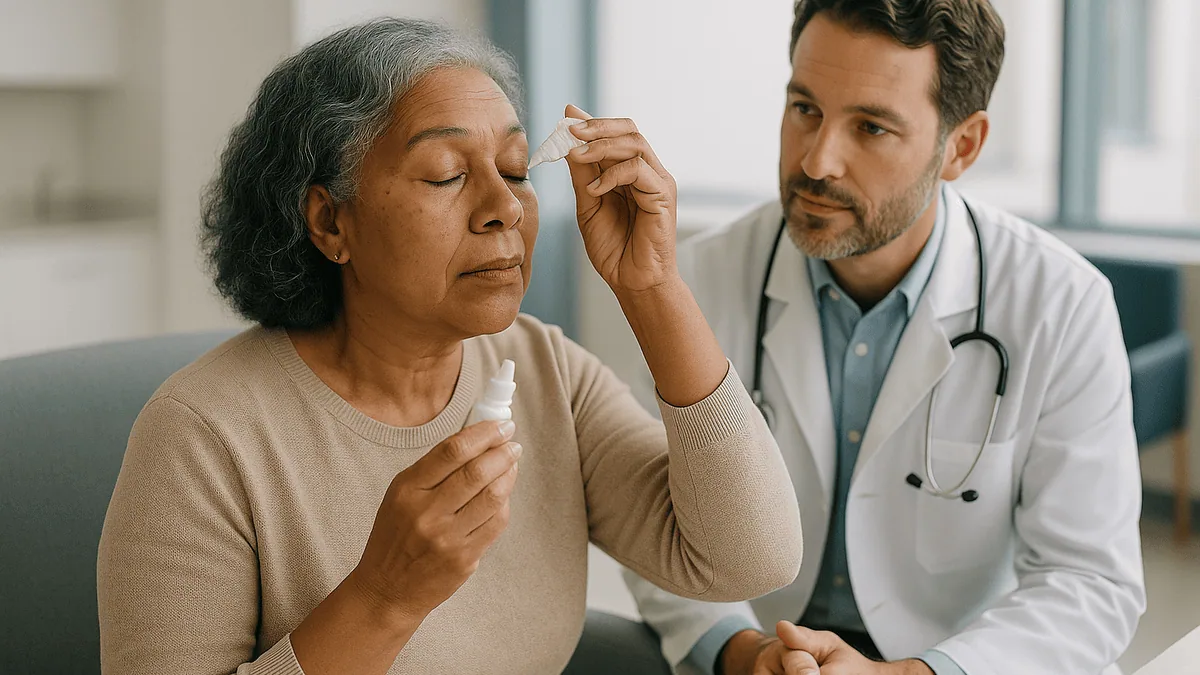
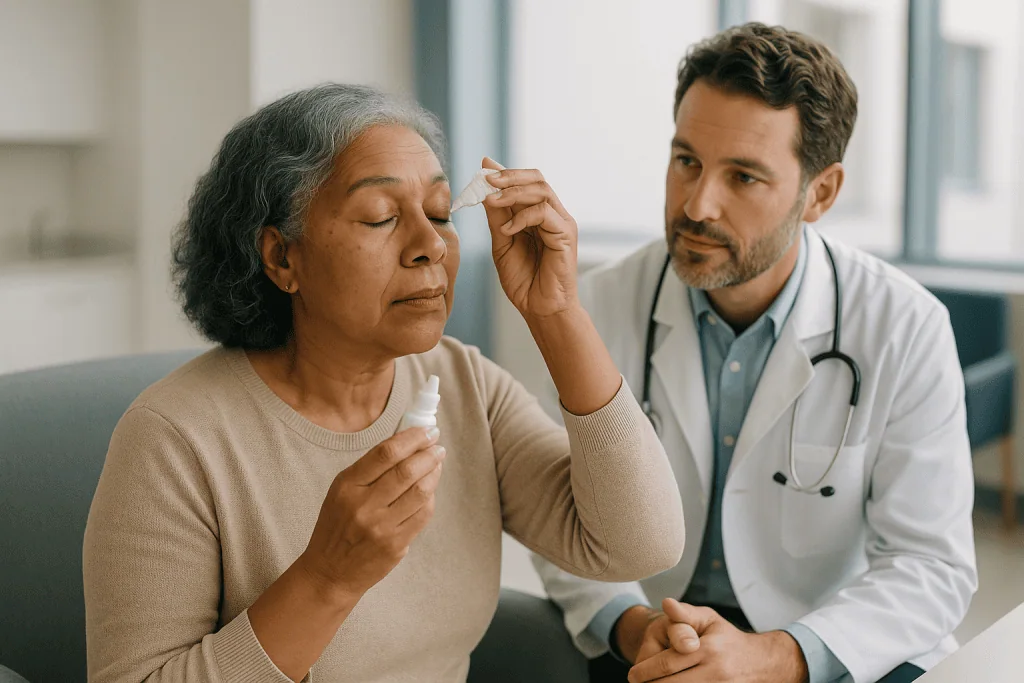
Wash your hands. Tilt your head back or lie down. Pull the lower lid down gently to make a small pocket. Hold the bottle above the eye without touching the lashes or the eye itself, since touching contaminates the tip. Squeeze one drop into the pocket. Then close the eye, without blinking hard or squeezing, for one to two minutes, and press lightly with a fingertip on the inner corner of the eye where the lid meets the nose. That spot is the tear duct. Pressing it, known as punctal occlusion, keeps the medicine on the eye longer and reduces how much drains into the nose and throat, which is where whole-body side effects begin.
If you use more than one kind of drop, wait several minutes between them. MedlinePlus advises at least 5 minutes so the second drop does not wash out the first. If you wear contact lenses, ask your team whether to remove them beforehand; many drops contain preservatives that lenses absorb.
People who struggle with aim have options. Bracing the hand holding the bottle against the bridge of the nose steadies it. Aiming for the inner corner with eyes closed, then opening, lets the drop roll in. Small plastic guides that fit over the bottle and rest on the face can help those with tremor or arthritis. Anchor the drop to an existing habit: brushing teeth, a nightly TV program, a phone alarm. Keep a spare bottle before the current one runs out, and note the date you opened it, since many bottles are meant to be discarded a set number of weeks after opening. Your pharmacist can tell you the interval for yours.
How often should eye pressure be checked when you have glaucoma?
The interval is set by your care team and depends on how stable the disease appears, so treat any number here as a range, not a rule. The NHS says people with glaucoma need regular appointments to monitor the condition and check that treatment is working, and that the frequency depends on the type and severity. In practice, newly diagnosed people or those whose treatment has just changed are often seen within weeks to confirm the pressure has responded, while people whose disease has been stable for years may be seen every several months to a year.
Each visit typically includes more than a pressure reading. Here is what the tests are actually measuring.
- Tonometry measures intraocular pressure, either with a gentle puff of air or a small instrument that briefly touches the numbed cornea.
- Visual field testing maps your side vision by asking you to press a button when you see faint lights. It is the test that shows whether nerve damage is advancing, and it is compared against your own earlier results rather than a single threshold.
- Optical coherence tomography (OCT) is a painless scan that measures the thickness of the nerve fiber layer at the back of the eye, often picking up thinning before the visual field changes.
- Gonioscopy uses a mirrored lens to view the drainage angle and tell open-angle from angle-closure disease.
- Dilated examination lets the clinician look directly at the optic nerve head.
Pressure varies through the day, often highest in the early morning, so a single reading is a snapshot. Your clinician may deliberately schedule visits at different times or ask about your drop timing relative to the appointment. For people without glaucoma but at higher risk, the Mayo Clinic cites recommendations for a comprehensive eye exam every 1 to 2 years from age 65, more often if advised. Relatives of someone with glaucoma should ask about their own screening; a family history raises risk.
Who is usually started on treatment straight away, and who is asked to wait and watch?
Not every raised pressure reading leads to a prescription. Clinicians weigh three things: how high the pressure is, whether the optic nerve and visual field already show damage, and how likely damage is to develop given age, family history, corneal thickness and other risk factors.
People with confirmed glaucoma, meaning pressure plus evidence of nerve damage or visual field loss, are usually started on pressure-lowering treatment promptly, because each year without it carries a risk of further loss. Those with more advanced damage at diagnosis, or with disease progressing despite drops, are often considered earlier for laser or surgery.
People with ocular hypertension, raised pressure without any sign of nerve damage, sit in a greyer zone. Some are treated to reduce the chance of ever developing glaucoma; others are monitored with regular pressure checks, visual fields and OCT scans and treated only if changes appear. The NHS notes that ocular hypertension may or may not need treatment depending on the individual’s risk of developing glaucoma. “Glaucoma suspect” describes someone whose nerve looks suspicious but whose tests do not yet confirm disease; these people are also commonly observed rather than treated.
Who is asked to pause or change treatment? Those with troublesome side effects, such as breathing symptoms on a beta blocker or severe allergy to a preservative, may be switched rather than left untreated. Pregnancy prompts a review of which drops are appropriate. Certain drops are unsuitable for people with specific heart or lung conditions, and the tablet forms of some medicines are avoided in kidney disease or sulfa allergy.
Angle-closure glaucoma follows a different logic altogether. Because the drainage angle is physically narrowed, laser treatment to open a pathway is often the first step rather than long-term drops. Which category you fall into, and what that means for timing, is a conversation to have with the ophthalmologist who has seen your scans.
Glaucoma treatment options at a glance
Most people start with drops, but the toolkit is wider than that, and the order in which options are offered varies by glaucoma type, severity and local guidelines. The table summarizes what each approach does and what patients commonly ask about it, drawing on the NHS and Mayo Clinic descriptions. It is not a ranking, and none of these options is superior for everyone.
| Option | How it lowers pressure | Typically considered when | What people commonly ask |
|---|---|---|---|
| Eye drops | Reduce fluid production or improve drainage | Usual first step for open-angle glaucoma and treated ocular hypertension | Side effects, how many bottles, what if I forget |
| Oral medicines | Reduce fluid production | Short-term bridge, or when drops are insufficient | Tingling fingers, tiredness, kidney stones |
| Laser trabeculoplasty (SLT) | Low-energy laser stimulates the drainage meshwork to work better | Alternative or addition to drops in open-angle disease | Is it painful, how long does it last, will I still need drops |
| Laser iridotomy | Makes a tiny opening in the iris to relieve a narrow angle | Angle-closure glaucoma or narrow angles at risk of closure | Will I see a line of light afterwards |
| Trabeculectomy | Creates a small surgical drainage channel under the upper lid | Progression despite drops and laser | Recovery time, scarring, lifelong checks of the drainage site |
| Drainage implants (tubes) | A small tube shunts fluid to a plate under the conjunctiva | Complex or previously operated eyes | Can I feel it, what if it blocks |
| Minimally invasive glaucoma surgery (MIGS) | Tiny stents or channels improve outflow, often during cataract surgery | Mild to moderate disease, especially alongside cataract removal | Does it replace drops, how does it compare with older surgery |
Laser and surgery do not repair the optic nerve any more than drops do; they change the plumbing so pressure stays lower. Some people still need drops afterwards. Every option carries risks, from temporary pressure spikes after laser to infection or excessive pressure drop after surgery, and the balance of benefit and risk is individual. The decision about which path, and when, rests with the treating team.
What do the first weeks after a glaucoma diagnosis usually look like?
The first week is often the hardest, not because anything happens to the eye but because a lot happens in the mind. Many people learn they have glaucoma at a routine eye test, feeling perfectly well. The gap between “I see fine” and “you have a disease that damages sight” takes time to close. It helps to know that the treatment plan for the common open-angle form is measured in years, not days.
Typically the ophthalmologist confirms the diagnosis with the tests described earlier, explains the type of glaucoma, and prescribes a drop or refers for laser. You leave with a bottle, instructions on timing, and a follow-up appointment. In those first days the drop may sting, the eye may look pink, and you may taste it at the back of the throat. These are common and usually settle; report them rather than stopping.
A follow-up visit is commonly arranged within a few weeks to measure whether the pressure has come down as intended. The NHS explains that treatment aims to lower pressure to a level the clinician judges safe for your nerve, sometimes called a target pressure, and that the plan is adjusted if that target is not reached. If the first drop does not lower pressure enough, or is not tolerated, a different class or a second drop may be tried. This is normal and not a sign of failure.
Over the following months the routine settles. A second visual field test gives a baseline to compare against, since the first attempt is often unreliable while people learn the test. By the end of the first year most people have a rhythm: drops at fixed times, a check every few months, and a growing familiarity with what the clinician is looking for. The disease is still there. It has simply moved from crisis to maintenance.
Everyday habits for living with glaucoma: exercise, sleep, caffeine and sunglasses
Once drops and check-ups are in place, people naturally ask what else they can do. The evidence here is real but modest, and none of it substitutes for treatment.
Exercise. The Mayo Clinic notes that regular moderate exercise may help lower eye pressure. Walking, cycling and swimming are sensible choices. Two cautions: some head-down yoga positions and heavy straining lifts raise eye pressure temporarily, so people with advanced disease are often advised to avoid them, and anyone starting a new program should mention glaucoma to their clinician.
Sleep position. Pressure tends to be higher lying flat. The Mayo Clinic suggests sleeping with the head raised by about 20 degrees, for instance with a wedge pillow, which has been shown to reduce nighttime pressure. Ask before making the change if you have neck or breathing problems.
Fluids and caffeine. Drinking a large volume quickly, a quart or more over a short time, can cause a temporary rise in pressure according to the Mayo Clinic; spreading drinks through the day avoids this. Large amounts of caffeine may also nudge pressure upward. Moderate coffee or tea has not been shown to cause harm for most people.
Sunglasses. Do glaucoma patients need to wear sunglasses? Not to control the disease. Sunglasses do not lower eye pressure. They do help with glare, which many people with glaucoma find harder to cope with as contrast sensitivity falls, and they protect against ultraviolet light in general. Polarized or wraparound lenses can make bright days more comfortable. Some drops also make eyes more light sensitive.
Screens and reading. Neither damages the optic nerve. Fatigue and dry eye from long screen sessions are separate issues; good lighting, larger fonts and regular breaks address them.
Smoking and blood pressure. Smoking harms blood vessels supplying the nerve, and both very low and poorly controlled blood pressure have been linked with glaucoma progression. Managing them is good for the eye and everything else.
What are the best eye supplements for glaucoma? Sorting evidence from hope
This is one of the most searched questions about the disease and one of the most disappointing to answer honestly: no supplement has been shown in robust trials to slow glaucoma or lower eye pressure meaningfully. The Mayo Clinic states that ginkgo biloba, vitamins and other supplements have not been proven to be effective for glaucoma and should not be used in place of proven treatment.
The confusion often comes from a different eye disease. Age-related macular degeneration has a well-studied supplement formula, tested in large NIH-funded trials, that slows progression in people with intermediate disease. Those results do not transfer to glaucoma; the two conditions damage different structures for different reasons. Marketing that borrows the phrase “eye vitamins” rarely makes the distinction.
What about individual nutrients? Small studies have looked at ginkgo, omega-3 fatty acids, nicotinamide (a form of vitamin B3), and antioxidants such as vitamins C and E. Some show intriguing changes in blood flow or short-term test scores; none has demonstrated protection of the visual field over years in a large, well-controlled trial. Nicotinamide is the subject of ongoing research, which is different from being an established treatment. If your clinician mentions a trial, that is worth discussing. If a website promises it will “reverse” glaucoma, that claim has no support.
There is one practical concern. Supplements can interact with other medicines, and high doses of some vitamins carry their own risks. Ginkgo, for example, can increase bleeding tendency, which matters if surgery is being considered. Tell your eye team and pharmacist about anything you take.
A diet rich in leafy greens, colorful vegetables and fish is reasonable for general eye and vascular health, and observational studies have linked such diets with lower glaucoma risk. That is a sensible habit, not a treatment. The bottle that protects your nerve is the one on prescription, not the one on the supplement shelf.
Driving, work and staying independent with glaucoma vision changes
Glaucoma rarely takes central vision until late, which is why many people keep reading, working and driving for years. Its early effects are subtler: missing a step at the edge of vision, bumping a door frame, finding night driving more tiring, losing objects in dim rooms. Because the brain fills in blind spots, you may not notice them at all, which is why the visual field test in the clinic matters more than your own impression.
Driving is the question that carries the most weight, and the rules are legal as well as medical. In the United States, requirements for visual field and acuity vary by state, and many states require reporting of conditions that affect vision. In the UK, the NHS notes that you must tell the licensing authority if glaucoma affects both eyes. Your ophthalmologist can tell you whether your current fields meet the standard where you live. Being honest about it protects you and others; a formal field test is the objective measure, not how confident you feel behind the wheel.
At work, most people need no adjustments. Where vision has changed, useful ones include better task lighting, higher contrast screen settings, larger fonts and, for those with significant field loss, screen-reading or magnification software. Disability law in many countries entitles employees to reasonable adjustments, and occupational health services can advise.
At home, small changes prevent falls, which are a real risk when side vision narrows. Good lighting on stairs and in hallways, contrasting tape on step edges, uncluttered floors and a nightlight on the route to the bathroom all help. Low vision services, often reached through your eye clinic, can assess practical needs and recommend aids. Asking for that referral early, before difficulties mount, is a mark of good planning rather than decline.
What people often get wrong about glaucoma
“My eyes feel fine, so the drops must be working.” Or the flip side: “My eyes feel fine, so I can skip them.” Neither follows. Open-angle glaucoma produces no symptoms until damage is advanced. Only the clinic tests show whether pressure is controlled and the nerve stable.
“If my pressure is normal, I cannot have glaucoma.” Normal-tension glaucoma damages the nerve at pressures inside the usual range. The diagnosis rests on the nerve and the visual field, not the pressure alone.
“Treatment will bring my sight back.” It will not. The NHS is clear that treatment aims to prevent further loss; damage already done is permanent. That is the single most important reason to start and keep going.
“Glaucoma only affects older people.” Risk rises with age, but the disease occurs at every age, including in infants and young adults, particularly with a family history or certain other eye conditions.
“It runs in my family, so there is nothing I can do.” Family history raises risk, which is exactly why relatives should be screened earlier and more often. Early detection is the one thing that reliably changes the outcome.
“Reading, screens or doing close work makes it worse.” There is no evidence for this. Eye strain is uncomfortable but does not damage the optic nerve.
“Surgery means the drops failed and it is too late.” Laser and surgery are tools in the same kit, sometimes offered early. Moving to them is a change of strategy, not a verdict.
“Once treated, I do not need check-ups.” Pressure can drift, drops can lose effect, and the nerve can progress despite treatment. Monitoring is lifelong precisely so that changes are caught while they are still small.
Questions to ask your care team about your glaucoma plan
Appointments are short and the tests take most of the time, so it pays to arrive with questions written down. These are the ones that tend to change how people manage their condition day to day.
- What type of glaucoma do I have, and how much damage is there already?
- What target pressure are you aiming for in each eye, and where am I now?
- What exactly does each drop do, and what time of day should I use it?
- If I miss a dose, what should I do? If I miss several days, should I tell you?
- Which side effects should I report straight away, and which are expected to settle?
- Could my drops interact with my other medicines or conditions?
- Is there a preservative-free or combination option if I struggle with the current regimen?
- Would laser be an option for me, now or later, and what would it involve?
- How often will I need pressure checks, visual fields and OCT scans?
- How will you know if the disease is getting worse, and what would happen then?
- Do my visual fields currently meet the driving standard where I live?
- Should my siblings and children be screened, and from what age?
- Is there anything about my sleep, exercise or other health conditions I should change?
- Who do I contact between appointments if something changes, and how quickly?
Bring a list of every medicine and supplement you take, including over-the-counter items. Mention new diagnoses elsewhere in your health, such as asthma, heart rhythm problems or planned surgery, since these can affect which glaucoma medicines are suitable. If English is not your first language, or if you find the visual field test difficult, say so; instructions can be adapted.
None of these questions second-guesses the clinician. They make you a better partner in a plan that will run for many years, and they turn a passive prescription into something you understand and can defend against the small daily temptation to let it slide.
When to call your doctor
Most of living with glaucoma is calm and scheduled. A few situations are not, and knowing them in advance matters because the eye gives little warning in the common form of the disease and sharp warning in the rare acute form.
Seek emergency care the same day if you develop sudden severe eye pain, a red eye, blurred or hazy vision, halos or rainbow rings around lights, headache, nausea or vomiting. The NHS and Mayo Clinic describe these as signs of acute angle-closure glaucoma, in which the drainage angle blocks abruptly and pressure rises within hours. Untreated, it can cause permanent loss of sight quickly, and it is treatable when caught early.
Contact your eye clinic promptly if you notice any sudden change in vision in either eye, new dark patches or missing areas, a sudden shower of floaters or flashes of light, or increasing pain and redness after a laser procedure or operation. After glaucoma surgery, worsening pain, discharge, a very soft or hard feeling eye, or vision that deteriorates rather than steadies are reasons to call the surgical team the same day.
Call within a day or two about side effects that are stopping you from using your drops: persistent stinging, swelling, itching or crusting of the lids, breathlessness or wheeze, a slow or irregular heartbeat, unusual tiredness or dizziness. Do not simply stop the drop; the clinic can usually offer an alternative.
Tell the team, without embarrassment, if you have run out of drops, missed more than a few doses, or are finding the routine impossible to keep. That information changes the plan more usefully than any test.
Everything in this article is general medical evidence, not a substitute for the person who has examined your eyes. When in doubt about whether something is urgent, phone the clinic and let them decide.
Frequently asked questions
Can a person with glaucoma live a normal life?
Most people can, provided the condition is detected before major damage and treated consistently. The NHS notes that early diagnosis and treatment can prevent serious sight loss in most cases. Daily drops and regular pressure checks become part of the routine, much as blood pressure treatment does. Where vision has already changed, adjustments to lighting, driving and home safety help preserve independence.
What is the best thing you can do to stop glaucoma from getting worse?
Use your prescribed pressure-lowering treatment every day as directed and attend every monitoring appointment. Lowering eye pressure is the only intervention shown to slow glaucoma, and the drops only work while they are being used. Because the disease is silent, the visual field and OCT tests at the clinic are the only way to confirm the plan is holding.
How do I build a glaucoma eye drops routine I will actually keep?
Anchor each drop to something you already do at a fixed time, such as brushing your teeth, and set a phone reminder as backup. Keep the bottle where you will see it, order the next one before the current one runs out, and ask your clinician about combination or once-daily options if you are managing several bottles. Tell the team honestly about missed doses so the plan can be adjusted.
How can I slow glaucoma progression beyond taking drops?
Supporting habits have modest evidence and never replace treatment. The Mayo Clinic notes that regular moderate exercise may lower eye pressure, that sleeping with the head raised about 20 degrees can reduce nighttime pressure, and that drinking large volumes quickly or consuming a lot of caffeine may raise it temporarily. Not smoking and managing blood pressure support the blood supply to the optic nerve.
Do glaucoma patients need to wear sunglasses?
Not to control the disease; sunglasses do not lower eye pressure or slow nerve damage. They are still useful because glaucoma often reduces contrast sensitivity and increases glare, and some drops make eyes more light sensitive. Polarized or wraparound lenses on bright days improve comfort and protect against ultraviolet exposure, which is sensible for general eye health.
What are the best eye supplements for glaucoma?
None has been shown to slow glaucoma or lower eye pressure in robust trials. The Mayo Clinic states that ginkgo, vitamins and other supplements have not been proven effective for glaucoma and should not replace treatment. The well-known eye vitamin formula studied for macular degeneration does not apply to glaucoma. Tell your clinician about any supplement, since some, such as ginkgo, affect bleeding before surgery.
How often should eye pressure be checked if you have glaucoma?
The interval is set by your ophthalmologist and depends on type, severity and stability. People newly diagnosed or whose treatment has changed are commonly reviewed within weeks to confirm the pressure has responded; those with long-stable disease may be seen every several months to a year. Visits usually include visual field testing and OCT scans, not pressure alone.
What happens if I forget my glaucoma drops for a few days?
Pressure returns toward its untreated level during the gap, though a short lapse rarely causes measurable harm. Restart as directed rather than doubling up, and mention the missed days at your next visit, or sooner if they are frequent. Repeated lapses are the most common reason disease progresses despite a good prescription, so the clinic would rather know than assume.
Can I still drive with glaucoma?
Many people can, particularly in early disease, but the answer depends on formal visual field testing rather than how you feel. In the United States requirements vary by state; in the UK you must inform the licensing authority if both eyes are affected. Ask your ophthalmologist directly whether your current fields meet the standard where you live and how often that should be rechecked.
Does laser or surgery mean the drops have failed?
No. Laser trabeculoplasty and surgery are tools within the same treatment plan, and some guidelines offer laser early rather than as a last resort. They lower pressure by changing how fluid drains, not by repairing the nerve, and some people still use drops afterwards. Moving to them is a change of strategy chosen by the treating team, not a sign it is too late.
References
- NHS: Glaucoma (overview, symptoms, treatment)
- National Eye Institute (NIH): Glaucoma
- MedlinePlus: Glaucoma
This article is for general information only and is not a substitute for professional medical advice. Please consult a qualified doctor about your individual situation.

More from the Blog

Blood Thinners, Prostate Medicines and Cataract Treatment: What Your Surgeon Checks First
Most people do not need to stop blood thinners for routine cataract surgery, because the operation uses a small incision and usually topical anesthetic,…
How Eye Angiography Is Done: Dilating Drops, the Dye Injection and the Photo Sequence
Eye angiography is done in three stages. First, drops widen the pupils so the camera can see the back of the eye. Next, a…

What Makes Super LASIK Personalized: Wavefront Maps and Custom Corneal Reshaping
Super LASIK is a marketing label some providers use for wavefront-guided LASIK. An instrument called an aberrometer measures how light is distorted as it…

How Long Does LASIK Take? The Flap, the Laser Seconds and the Waiting Room Before
LASIK usually takes about 30 minutes or less for both eyes, and the excimer laser reshapes each cornea in well under a minute. Most…

Astigmatism That Is Not Simple: Why Irregular Corneas Are Treated Differently
Irregular astigmatism happens when the cornea is warped unevenly, most often from keratoconus, scarring, or earlier eye surgery, so ordinary glasses cannot fully sharpen…
LASIK Complications Explained Honestly: Flap Problems, Dry Eye and Night Vision Changes
LASIK complications are uncommon but real. The most frequent are dry eye, which often improves over several months, and night-vision changes such as glare…