

Living With Permanent Brachytherapy Seeds: Contact With Children, Pets and Partners

Key Takeaways
- Permanent seeds emit low-energy radiation that is mostly absorbed within millimeters of tissue, so adults in ordinary contact are not considered at risk.
- Body fluids after a seed implant are not radioactive; the only radioactive object is a physically passed seed, which should be collected without touching and returned to the team.
- Iodine-125 has a half-life of roughly 60 days and palladium-103 about 17 days, which is why precaution periods differ between patients with different isotopes.
- Restrictions apply to prolonged pelvis-level contact with young children and pregnant women for a defined period, not to hugs, shared rooms or non-pregnant partners.
- Sensitive radiation detectors at borders can register a fresh implant for months, so the wallet card from your team is worth carrying when you travel.
- A temporary PSA rise after brachytherapy, often called a PSA bounce, is a recognized pattern and does not by itself mean the cancer has returned.
Permanent brachytherapy seeds give off low-energy radiation that is mostly absorbed within a few millimeters of surrounding tissue, so everyday contact such as sharing a room, hugging or shaking hands is generally considered safe. Most care teams do ask patients to limit prolonged close contact with young children and pregnant women for a period that depends on the isotope used, often several weeks to a few months, and to follow specific instructions about intimacy and any passed seeds.
The procedure took less than two hours. The questions started in the car on the way home. His daughter was due in the spring, the youngest grandchild liked to fall asleep on his chest during cartoons, and the terrier had slept at the foot of the bed for nine years. Nobody had told him the seeds would change any of that. Nobody had told him they wouldn’t, either.
This is the gap that many people fall into after a permanent seed implant. The clinical part is finished, the printout of brachytherapy seeds precautions is folded in a coat pocket, and ordinary life is suddenly full of small negotiations about laps, beds and doorways.
The good news is that the physics here is well understood and reassuring. The honest part is that the rules are not identical everywhere, and the sheet from your own team is the one that counts. What follows explains where those rules come from, so that you can follow them with confidence rather than anxiety.
What permanent brachytherapy seeds actually do inside the body
Brachytherapy is radiation treatment delivered from a source placed inside or right next to a tumor, rather than aimed in from outside. The permanent version uses seeds: sealed metal capsules about the size of a grain of rice, each holding a small amount of a radioactive isotope, which is simply an unstable form of an element that releases energy as it decays. Mayo Clinic and Cleveland Clinic both describe these seeds as staying in place for life once the radiation has faded.
The seeds are placed with thin needles, usually through the skin between the scrotum and the anus, guided by ultrasound so that the team can see each one land. Prostate cancer is by far the most common use, and the rest of this article is written mainly with that in mind.
Two features of the seeds explain almost every precaution you will be given. First, the isotopes used, most often iodine-125 or palladium-103, emit low-energy photons. Low energy means the radiation is absorbed quickly by the first tissue it meets, which is the prostate itself and the tissue immediately around it. A very small fraction escapes the body, and that fraction falls off steeply with distance, so a person across the room receives a negligible amount compared with someone pressed against your lower abdomen for hours.
Second, the source decays. Every day the seeds are a little weaker than the day before, and eventually they become inert metal that shows up on X-rays and does nothing else. The treatment works because the tumor cells, sitting right beside the seeds, receive a large cumulative amount of radiation over those weeks, while everything else receives far less.
Understanding that geometry, close and prolonged versus distant and brief, makes the rest of the advice feel less arbitrary.
Is it safe to be around someone with radiation seeds?
For almost everyone, yes. Sharing a sofa, a kitchen, a car or a conversation with someone who has seeds is not considered a health risk by any major medical source. The National Cancer Institute notes that people with permanent implants may be asked to limit time around others for a short period, and Mayo Clinic frames the same point specifically around children and pregnant women. Neither suggests isolation.
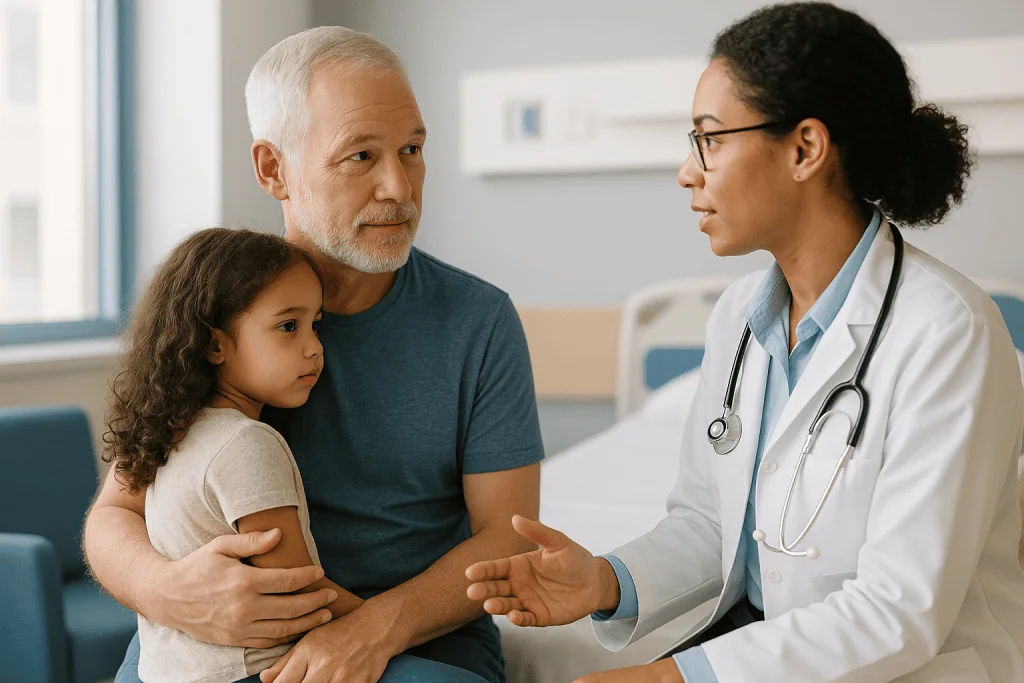
It helps to be clear about what kind of radiation this is. After external beam radiotherapy, a patient is not radioactive at all; the machine switches off and nothing lingers. After radioactive iodine treatment for thyroid disease, the isotope circulates in the blood and is present in saliva, sweat and urine, which is why those patients follow rules about cutlery and bathrooms. Seeds are different from both. The isotope is sealed inside titanium. Your saliva, sweat, urine and stool are not radioactive. Your towels, dishes, laundry and toilet seat need no special handling. The only exception is a seed itself, if one is passed, which is covered further down.
So why any precautions at all? Radiation safety works on a principle called ALARA, as low as reasonably achievable. Even when the calculated exposure to a bystander is tiny, professionals reduce it further when the cost of doing so is small. Asking a toddler not to nap on your lap for a few weeks is a small cost. The groups singled out, small children and developing pregnancies, are simply the ones whose fast-dividing tissues are most sensitive, so the margin of caution is applied there.
Put plainly: the precautions exist because they are easy, not because your family is in danger.
How long are brachytherapy seeds radioactive?
The honest answer is: for a long time, but at a level that matters for a much shorter time. Radioactive decay is measured in half-lives, the time it takes for activity to fall by half. Iodine-125, the isotope most often used for permanent prostate seeds, has a half-life of roughly 60 days. Palladium-103 decays faster, with a half-life of about 17 days, and cesium-131 faster still, at around 10 days. Your team’s documentation will tell you which isotope you received.
Half-lives stack. After two half-lives, a quarter of the original activity remains; after three, an eighth; after ten, less than a tenth of one percent. For iodine-125 that tenth-of-a-percent point arrives close to two years after implantation. For palladium-103 it comes within about six months. This is why Cleveland Clinic and Mayo Clinic describe the seeds as gradually losing their radioactivity rather than switching off on a date.
Here is the part that surprises people. Precaution periods are much shorter than those decay figures, because what matters for other people is not whether any radiation remains but whether the amount reaching them could be meaningful. The output that escapes the body is already small on day one. Combine a small starting point with steady decay and, for most centers, the window for the strictest advice around children and pregnancy lands somewhere between a few weeks and a few months, with iodine-125 at the longer end and palladium or cesium at the shorter end.
Individual teams set their own dates using the actual measured activity of your implant. Treat the calendar you were given as specific to you. If two people at a support group compare notes and find different timelines, both may well be correct.
Brachytherapy seeds precautions with children and pregnant women
This is the advice families ask about most, and it is easy to overshoot in either direction. The principle from Mayo Clinic and Cleveland Clinic is to limit the amount of time spent in close contact with young children and pregnant women while the seeds are at their most active. Notice the two words doing the work: time and close.
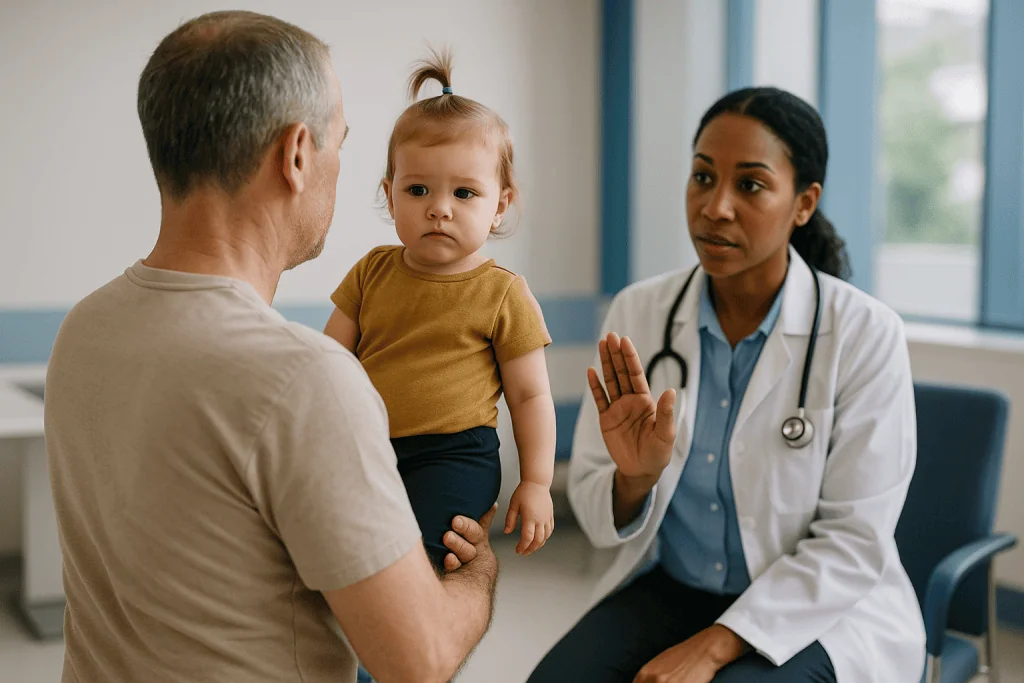
Close means roughly within arm’s reach of your pelvis, and especially against it. A child sitting on your lap, a baby held against your lower abdomen, a grandchild sharing your bed. Brief close contact is a different matter. A hug at the door, lifting a child into a car seat, a kiss goodnight: these last seconds, and the exposure involved is trivial.
Prolonged means an extended stretch, not a passing moment. Many centers translate this into practical suggestions for the first weeks, such as:
- letting children sit beside you rather than on you for long periods, with a cushion or a chair arm between you
- holding an infant at chest height for feeding or comfort rather than against your lower body, and passing them to someone else for long cuddles
- avoiding sharing a bed with a young child or a pregnant partner for the period your team specifies, since sleep is the longest close contact most people have
- sitting across the table rather than side by side when a pregnant family member visits
The period varies with the isotope, as explained above. Where iodine-125 is used, a figure of around two months is commonly quoted; palladium-based implants often carry a shorter window. Your own sheet supersedes anything written here.
What you do not need to do: leave the house, stop seeing grandchildren, or explain the science to a four-year-old. Most families find a simple story works, something like a sore tummy that needs a little space for a while.
Do you have to stay away from people after brachytherapy? Partners, beds and intimacy
No, and this misunderstanding causes more unnecessary loneliness than any other part of the process. Adult partners who are not pregnant are not usually asked to sleep apart, keep a distance or change daily routines. Cleveland Clinic and Mayo Clinic reserve their limits for children and pregnancy; a partner sitting beside you on the couch is not on any list.
Intimacy is a separate question with its own practical points. Sexual activity can generally resume once the soreness from the procedure has settled and the team has given the go-ahead, which for many people is a matter of a couple of weeks. Two things are commonly advised in the early period. Semen may look brown, black or blood-tinged for the first several ejaculations; this is old blood from the needle tracks and settles on its own. A condom is often recommended for those first ejaculations because, rarely, a seed can be expelled in semen. If one appears, it should not be handled with bare fingers (see the section on passed seeds).
Partners sometimes worry about receiving radiation during sex. The exposure involved is very small and brief, and no major source advises abstinence on those grounds once the immediate recovery is over. The exception, again, is pregnancy: if your partner is pregnant or may become pregnant, tell the team so that their advice can be specific.
Erection changes are a possible side effect of prostate brachytherapy, as the NHS notes in its overview of prostate cancer treatment. They may appear gradually. Medicines that improve blood flow to the penis exist, and whether one is appropriate is a conversation for your prescribing clinician, not a decision to make alone.
If there is one message for couples, it is this: touch is not the hazard. Silence about worries is the bigger risk.
Brachytherapy and pets: lap dogs, cats and the foot of the bed
Pets rarely appear in official guidance, which leaves families improvising. The physics does the work for us here. An animal cannot become radioactive by sitting near you, cannot carry radiation to other people, and will not fall ill from a few weeks of proximity. The calculation is the same one applied to humans: how close, and for how long.
A large dog lying at your side or at the end of the bed is at a comfortable distance from your pelvis and needs no special rules. A cat that spends four hours a day curled on your lap, directly over the implant, is in the same position as a child on your lap. Many teams therefore suggest applying the same common-sense courtesy to small lap animals as to young children during the initial weeks: encourage them to settle beside you rather than on your lower abdomen, and give them a blanket on the next cushion.
There is no evidence that this level of exposure harms a pet, so this is a precaution taken out of consistency rather than documented risk. If your dog ignores the new arrangement and climbs onto your lap anyway, nobody is in danger; simply move them along when you notice.
One pet-related point deserves more attention than it usually gets. In the first days after implantation, a seed can occasionally pass in urine. Dogs and cats investigate the floor with their mouths. Straining urine as instructed, and cleaning up promptly if you have an accident before reaching the toilet, removes any chance of an animal swallowing a seed. If you ever suspect a pet has eaten one, contact both your care team and a veterinarian; the seed will most likely pass through unharmed, but the team will want to know.
Litter trays, feeding bowls and grooming are unaffected.
A summary table of typical brachytherapy seeds precautions
The table below collects the advice that appears most consistently across major sources and clinical practice. It is a reading aid, not a substitute for your own instructions, which may differ in timing depending on the isotope and the measured activity of your implant.
| Situation | Typical advice in the early period | Why |
|---|---|---|
| Adults who are not pregnant | No restrictions on proximity, sharing a bed, meals or bathrooms | Sealed source; low-energy photons absorbed in tissue |
| Young children | Limit prolonged lap or bed sharing; brief hugs fine | Developing tissues are more sensitive; caution costs little |
| Pregnant women | Avoid prolonged close contact and bed sharing for the specified period | Same sensitivity principle applied to the developing pregnancy |
| Small pets | Encourage sitting beside rather than on the lower abdomen | Consistency with the child guidance; no documented harm |
| Sexual activity | Resume when comfortable and cleared; condom for first ejaculations | Rare passage of a seed in semen; discolored semen expected |
| Urination | Strain urine for the period specified | Rare passage of a seed in urine |
| A passed seed | Do not touch with fingers; collect in a container; call the team | The seed itself is the only radioactive object |
| Travel | Carry the wallet card; expect possible detector alerts | Sensitive security detectors can register low-level radiation |
Two patterns stand out. Every restriction involving other people concerns extended, pelvis-level contact, never ordinary company. And every restriction has an end date that your team will have written down, typically measured in weeks to a few months rather than years, as Mayo Clinic and Cleveland Clinic describe when they note that the seeds gradually stop giving off radiation.
Prostate seed implant precautions: what to do if a seed comes out
Seeds are placed in tissue, not glued there, and a small number can migrate. The most common route is into the urethra and out with urine in the first days, which is why teams ask patients to pass urine through a strainer, or a piece of gauze over the toilet bowl, for a defined period. A seed can also appear in semen, and occasionally one travels through the bloodstream to the lungs, where it usually causes no symptoms and is spotted on a later chest X-ray.
Finding a seed is unsettling, but it is a known event with a simple plan:
- Do not pick it up with your fingers. Use a spoon, tweezers or a piece of tissue.
- Place it in a small container with a lid, or wrap it in foil and put it in a jar.
- Keep it away from where children or pets can reach it.
- Do not flush it or throw it in the trash.
- Call your care team and follow their instructions for returning it.
A single lost seed almost never changes the treatment plan. Implants are designed with many seeds distributed through the gland precisely so that no one seed carries the outcome. The team may review the post-implant scan, usually done in the first month, to confirm coverage remains adequate. That decision belongs to them and depends on where the seed was and how many were placed.
What if a seed is passed unnoticed into a toilet? It happens, and it is not dangerous to the water system in any meaningful way. Mention it at your next appointment so the count can be updated.
The urine-straining period is usually short. After it ends, continued vigilance is not expected, although if you ever notice something metallic later on, the same steps apply.
Who is usually offered permanent seeds, and who is usually asked to wait
Permanent seed brachytherapy is most often offered for prostate cancer that appears confined to the gland and falls into lower- or intermediate-risk groups on the basis of biopsy findings, PSA level and imaging, as the NHS overview of prostate cancer treatment describes. It is sometimes combined with a shorter course of external beam radiotherapy for higher-risk disease. Seeds have also been used at other sites, but the prostate accounts for the large majority of implants.
Several factors lead teams to suggest a different approach or to ask a patient to wait. A very large prostate can make it difficult to place seeds evenly and may increase the chance of urinary trouble afterward; in some cases hormonal treatment is used first to shrink the gland. Significant pre-existing urinary symptoms, such as a weak stream or frequent night waking, are a common reason for caution, because brachytherapy tends to worsen these temporarily. A previous operation to widen the prostate channel can make placement technically harder. Cancer that has spread beyond the gland is generally treated with other strategies.
Alternatives exist for most people who are candidates. Active surveillance, meaning close monitoring without immediate treatment, is standard for many low-risk cancers. Surgery to remove the prostate, external beam radiotherapy alone, and temporary high-dose-rate brachytherapy, where a source is placed for minutes and then withdrawn, are all established options. Each carries a different pattern of side effects on urinary, bowel and sexual function, and none is universally superior.
Which path fits you depends on the specifics of your cancer, your other health conditions, your priorities and, frankly, the expertise available where you are being treated. That weighing is the treating team’s job, done with you, and no article can replace it.
What the first days and weeks usually look like
Most people go home the same day or after one night, according to Mayo Clinic and Cleveland Clinic. The implant is done under a general or spinal anesthetic, so the day itself is a blur of pre-operative checks, a short procedure, and waking up with some soreness between the legs and, often, a urinary catheter that is removed before discharge.
The first week brings bruising and tenderness in the perineum, the area between the scrotum and anus, along with blood in the urine that clears over a few days. Urinary symptoms then take center stage: burning, urgency, a slower stream and more trips at night. These come from swelling in the prostate, which sits around the urethra like a ring around a straw. A class of medicines called alpha blockers, which relax muscle at the bladder outlet to ease flow, is often prescribed for this phase; whether you take one, and for how long, is a decision for your prescribing clinician. Anti-inflammatory medicines may also be suggested.
Urinary symptoms typically build over the first several weeks and then ease gradually over the following months as the seeds decay and swelling subsides. Bowel irritation is less common with seeds than with external radiotherapy but can occur. Fatigue is usually mild.
A CT scan is normally done within the first month to map where the seeds settled and confirm the intended coverage. PSA blood tests begin a few months later and continue for years. Expect the PSA to fall slowly rather than plummet, and be prepared for the possibility of a temporary rise, sometimes called a PSA bounce, which is well recognized after brachytherapy and does not by itself indicate the cancer has returned.
Throughout this stretch, the contact precautions run in parallel and then quietly expire on the date your team gave you.
Airports, security scanners, cremation and other long-term questions
Seeds outlast the precaution period by a long way, and a few practical issues arise from that.
Border crossings and some public buildings use radiation detectors sensitive enough to register a fresh implant, particularly with iodine-125. Cleveland Clinic advises carrying a card from your care team stating what you have received, when, and a contact number. Most teams issue one routinely; ask if yours has not. Detector alerts become unlikely after several months but can occur for longer, and the card resolves the conversation quickly.
The seeds are made of titanium and are generally compatible with MRI scanning. They appear on X-rays and CT scans as bright dots, which occasionally puzzles a radiologist who does not know your history. Make sure the implant is recorded in any new medical file, and mention it before scans, surgery or any procedure on the pelvis.
Nobody removes the seeds later. Once decayed, they are inert and cause no problems. If the prostate is ever removed or biopsied in the future, the pathology team simply notes their presence.
Cremation is the question people find hardest to raise, and it deserves a straight answer. Because the seeds retain measurable activity for a period after implantation, many jurisdictions and crematoria have guidance about a waiting interval, or about informing the crematorium so that appropriate handling can be arranged. The specifics vary by location and isotope. Your care team can tell you the interval that applies to your implant and can provide documentation for a funeral director. Raising it once, early, spares families a distressing scramble later.
Finally, if you ever need radiation treatment again for any reason, the previous implant will shape the planning. It is part of your permanent medical story, and worth a line in any record you carry.
What people often get wrong about living with radiation seeds
Myths gather around anything invisible. These are the ones that come up most often in clinic, with what the evidence actually says.
“I’m radioactive, so my body fluids are too.” They are not. The isotope is sealed inside a metal capsule. Urine, sweat, saliva and stool carry no radiation. Only a physically passed seed does. Separate dishes, towels or bathrooms are unnecessary.
“I have to stay away from everyone.” The advice from Mayo Clinic and Cleveland Clinic concerns prolonged close contact with young children and pregnant women for a limited period. Adults, older children and casual contact are not restricted.
“A quick hug from my grandchild is dangerous.” Exposure depends on both distance and time. A few seconds of contact delivers a negligible amount. The guidance targets hours on a lap, not moments at the door.
“My pet will get sick.” There is no evidence of harm to animals from proximity to a person with seeds. Any suggestion to keep lap pets off your lower abdomen is about consistency with the child guidance, not documented risk.
“The seeds get taken out once they’ve finished.” They stay permanently. Once decayed, they are inert.
“When the radiation is gone, the treatment is over.” The biological effect unfolds over months and PSA falls slowly. Follow-up runs for years, and a temporary PSA rise afterward is a recognized pattern rather than a failure signal.
“If my partner is exposed, they could get cancer.” The amounts reaching a partner in ordinary life are far below levels associated with measurable harm. Pregnancy is the one situation where teams apply extra caution, and they will say so specifically.
The pattern in every one of these is the same: seeds are treated as a spreading contamination, when they are a fixed, sealed, fading point source. Once that picture replaces the other, most of the fear drains away.
Questions to ask your care team before you go home
Discharge conversations happen when you are groggy and eager to leave. Writing questions down beforehand, and bringing someone who can take notes, gets better answers. These are the ones that tend to matter most for daily life:
- Which isotope did I receive, and what is its half-life?
- What exact date do the precautions around children and pregnant women end?
- Is there anyone in my household you would advise me to sleep apart from, and for how long?
- Do you apply the same guidance to small pets, and if so, for how long?
- How long should I strain my urine, and what should I do with a seed if I find one?
- When can sexual activity resume, and for how many ejaculations should I use a condom?
- What changes in urine flow, pain or bleeding are expected, and which ones should prompt a call?
- Will I be given a wallet card for travel and security screening?
- When is my post-implant scan, and when will PSA monitoring begin?
- What is your guidance on cremation, and can you provide written documentation for my family?
- Who do I call out of hours if I cannot pass urine or develop a fever?
Two habits make these conversations more useful. First, ask for the reasoning, not just the rule. A team that explains why children on the lap are the concern, and why adults on the sofa are not, gives you a principle you can apply to the situations they did not think to mention. Second, tell them about your actual life: the pregnant daughter, the toddler who naps on you, the cat with no respect for boundaries. Generic advice becomes personal advice only when the team knows what your days contain.
Keep the written answers with your card. Family members tend to ask the same questions weeks later, and a sheet in your own handwriting settles them faster than memory.
When to call your doctor
Most of the recovery from a seed implant is uncomfortable rather than dangerous, and most contact questions can wait for the next appointment. A few situations should not.
Call your care team promptly, or seek urgent care, if you experience:
- inability to pass urine, or passing only tiny amounts with a painfully full bladder, which can signal a blockage from swelling
- fever, chills or shaking, which may indicate infection after the procedure
- heavy or increasing bleeding in urine, especially with clots that make urination difficult, rather than the light pink tinge that fades over the first days
- sudden chest pain or breathlessness, which needs emergency assessment for a blood clot or, rarely, a migrated seed
- severe or worsening pain in the perineum, pelvis or lower back that pain relief does not touch
- swelling, redness or discharge at the needle sites
- a seed passed in urine or semen, once you have collected it safely
Some questions are urgent for emotional rather than physical reasons and still deserve a same-day call: a partner who has just learned she is pregnant, a young child who slept on you all night before you remembered the guidance, or an unexpected contact with a pregnant relative. None of these is likely to have caused harm, and the team can give you a specific answer rather than leaving you to worry through a weekend.
Keep the out-of-hours number on the card in your wallet and on the fridge. The time to find it is not the middle of the night when the bladder will not empty.
Everything in this article describes typical guidance; your treating team knows the activity of your implant, your anatomy and your household, and their instructions take precedence over any general explanation, including this one.
Frequently asked questions
Is it safe to be around someone with radiation seeds?
Yes, for almost everyone. The seeds are sealed sources of low-energy radiation that is mostly absorbed by the surrounding tissue, so sharing a home, meals, a car or a couch is not considered a risk. The only groups given specific limits are young children and pregnant women, and the limits concern extended close contact for a set period rather than any contact at all.
How long are brachytherapy seeds radioactive?
They fade gradually rather than switching off. Iodine-125 seeds have a half-life of about 60 days and reach a negligible level after roughly two years; palladium-103 seeds decay in about a third of that time. Precaution periods are far shorter, usually weeks to a few months, because the amount that ever escapes the body is small to begin with. Your team’s dates are specific to your implant.
Do you have to stay away from people after brachytherapy?
No. Adults who are not pregnant need no distance rules, and you can continue normal social and family life. Guidance from major medical centers focuses on limiting prolonged close contact, such as lap sitting or bed sharing, with young children and pregnant women during the early period. Brief hugs and time in the same room are fine throughout.
What precautions should I take during brachytherapy?
Typical instructions include straining urine for a short period in case a seed passes, not handling any passed seed with your fingers, using a condom for the first several ejaculations, limiting long close contact with young children and pregnant women until the date your team gives you, and carrying a wallet card for travel. None of these involves separate dishes, bathrooms or laundry, because body fluids are not radioactive.
Radiation seeds and pregnancy: what if my partner or daughter is pregnant?
Tell your care team, because their advice will be specific to your isotope and household. The usual guidance is to avoid prolonged close contact and bed sharing with a pregnant person during the early precaution period, while short visits, conversation and sitting across a table are unrestricted. A single accidental night of proximity is very unlikely to cause harm, but it is worth a call for reassurance.
Can my grandchild sit on my lap?
Brief moments are fine at any stage. During the early precaution period, most teams advise against extended lap sitting or napping on you, because that puts a child directly over the implant for a long stretch. Sitting beside you, holding hands, short hugs and being lifted briefly are not restricted. After the date your team gives you, all of this returns to normal.
Brachytherapy and pets: can my dog or cat still sleep on the bed?
In most cases, yes. An animal at your feet or by your side is at a comfortable distance from the implant. Small pets that spend hours curled directly on your lap or lower abdomen are the one situation where some teams suggest applying the same courtesy as for young children in the first weeks. Pets cannot become radioactive or carry radiation to other people.
Seed brachytherapy sexual activity: when can we have sex again?
Usually once soreness has settled and your team has cleared it, which for many people is a couple of weeks. Semen may look brown or dark for the first several ejaculations; this is old blood and clears on its own. A condom is often advised early on because, rarely, a seed can pass in semen. Exposure to a partner during sex is small and brief, and pregnancy is the only reason for extra caution.
Do the seeds ever get removed?
No. Permanent seeds stay in place for life. Once the isotope has decayed, they are inert titanium capsules that cause no symptoms and need no attention. They remain visible on X-rays and CT scans as small bright dots, which is why the implant should be recorded in your medical history and mentioned before future scans, surgery or any pelvic procedure.
Will I set off airport security scanners?
You might, particularly in the first months and especially with iodine-125 seeds. Radiation detectors at borders and some public buildings are sensitive enough to register a fresh implant, although standard metal detectors usually do not react to the tiny seeds. Carry the card your care team provides stating the implant, date and a contact number; it resolves the situation quickly.
References
This article is for general information only and is not a substitute for professional medical advice. Please consult a qualified doctor about your individual situation.

More from the Blog
When Is a Stem Cell Transplant Part of Acute Lymphocytic Leukemia Treatment?
A stem cell transplant is usually considered for acute lymphocytic leukemia when chemotherapy alone is unlikely to keep the disease away: high-risk genetic features,…
What Is Normal After TURBT? The Catheter, Burning, Blood in the Urine and Returning to Routine
After a TURBT, it is usually normal to have a urinary catheter for hours to a few days, mild burning or urgency when passing…
How Do You Prepare for Head and Neck Cancer Surgery? Biopsy Review, Scans and Quitting Smoking
Preparing for head and neck cancer surgery usually means a second look at your biopsy by a specialist pathologist, staging scans such as CT,…
When Is Radioiodine Treatment Chosen for an Overactive Thyroid Over Tablets or Surgery?
Radioiodine is usually chosen for an overactive thyroid when antithyroid tablets have not kept the condition controlled, when hyperthyroidism returns after a course of…
Why Surgeons Remove a Margin of Healthy Skin in Wide Local Excision for Melanoma
Surgeons remove a rim of healthy-looking skin around a melanoma, usually between 0.5 and 2 centimeters wide depending on how thick the tumor is,…

What Happens During a Lutetium-177 PSMA Therapy Session: Infusion, Fluids and Monitoring
A lutetium-177 PSMA treatment session is an outpatient visit of several hours in which a radioactive medicine is given through an intravenous line, usually…