

Lymphedema After Breast Cancer Treatment: How It Is Monitored and Managed Long Term
Key Takeaways
- A systematic review of 72 studies found roughly one in five people treated for breast cancer develops arm lymphedema, with the risk about four times higher after axillary dissection than after sentinel node biopsy.
- Stage 0 lymphedema is real but invisible, which is why a pre-surgery baseline measurement and periodic re-measurement can catch it before a tape measure alone would.
- Complete decongestive therapy pairs light manual drainage with compression, exercise and skin care; the components lose much of their effect when used separately.
- Diuretics are generally not recommended for lymphedema because the trapped fluid is protein-rich and returns quickly once the water is removed.
- Supervised, slowly progressive weight training did not increase swelling in randomized trials and reduced flare-ups in women who already had lymphedema.
- Each episode of cellulitis can worsen lymphatic damage, so redness, warmth and fever in a treated limb warrant same-day medical contact rather than a wait-and-see approach.
Lymphedema after breast cancer treatment is persistent swelling of the arm, hand, breast or chest wall caused by damage to lymph nodes and vessels from surgery or radiation. It is monitored with regular limb measurements, ideally starting before surgery, and managed long term with complete decongestive therapy: skilled manual drainage, compression, exercise and skin care. Early detection and steady self-care usually keep it controlled; surgery is considered only for selected people.
The first clue is often small enough to dismiss. A watch strap that needs a new hole. A ring that has to be twisted off at night. Eighteen months after her last radiation session, one woman described to her oncology nurse a sleeve that had started to “grip” her forearm by mid-afternoon, and a dull heaviness that lifted only when she lay down. Nothing hurt. Nothing looked dramatic. Yet that quiet tightness is exactly how lymphedema after breast cancer treatment tends to announce itself.
Many people finish active treatment expecting the hard part to be over, then discover that a late side effect can arrive with no calendar warning. The good news, and it is genuinely good, is that the swelling behaves far more predictably when it is caught early and worked on consistently.
This explainer walks through what is actually happening under the skin, how care teams keep watch for it, what the standard treatment involves, and where the evidence is solid, thin or still being written.
What is lymphedema after breast cancer treatment, in plain terms?
Picture the lymphatic system as the body’s quiet drainage network. Lymph is a clear fluid, rich in protein and immune cells, that leaks out of tiny blood vessels into the tissues and must be collected and returned to the bloodstream. Lymph vessels do the collecting; lymph nodes, small bean-shaped filters clustered in the armpit, groin and neck, sit along the route. In a healthy arm, fluid moves out as fast as it moves in.
Breast cancer treatment can interrupt that flow in two ways. Surgeons remove nodes from the armpit to check whether cancer has spread, either a few (sentinel node biopsy, which takes the first one to three nodes that drain the breast) or many (axillary dissection, which clears a larger group). Radiation to the armpit or chest wall can then scar the remaining vessels and nodes. Mayo Clinic describes the result as a traffic jam: fluid keeps arriving but has fewer exits, so it pools in the arm, hand, breast or chest wall on the treated side.
Pooling is only the first step. Because lymph is protein-rich, stagnant fluid draws in more water and, over months to years, prompts the tissue to lay down fat and fibrous scar, according to the National Cancer Institute’s patient summary. That is why early lymphedema feels soft and can be pushed back with elevation, while long-standing lymphedema becomes firmer and harder to reverse. The timing matters clinically: treatment aimed at moving fluid works best before the tissue itself has changed.
One more point of vocabulary. Lymphedema that follows treatment is called secondary lymphedema, to distinguish it from the rarer primary form present from birth or adolescence. Everything in this article concerns the secondary type.
How common is lymphedema after breast cancer treatment, and who is most at risk?
Roughly one in five people treated for breast cancer develops arm lymphedema, a figure drawn from a systematic review and meta-analysis of 72 studies published in The Lancet Oncology and indexed in PubMed. That same review found the risk was about four times higher after axillary lymph node dissection than after sentinel node biopsy alone, which is a major reason surgeons now remove as few nodes as the cancer allows.
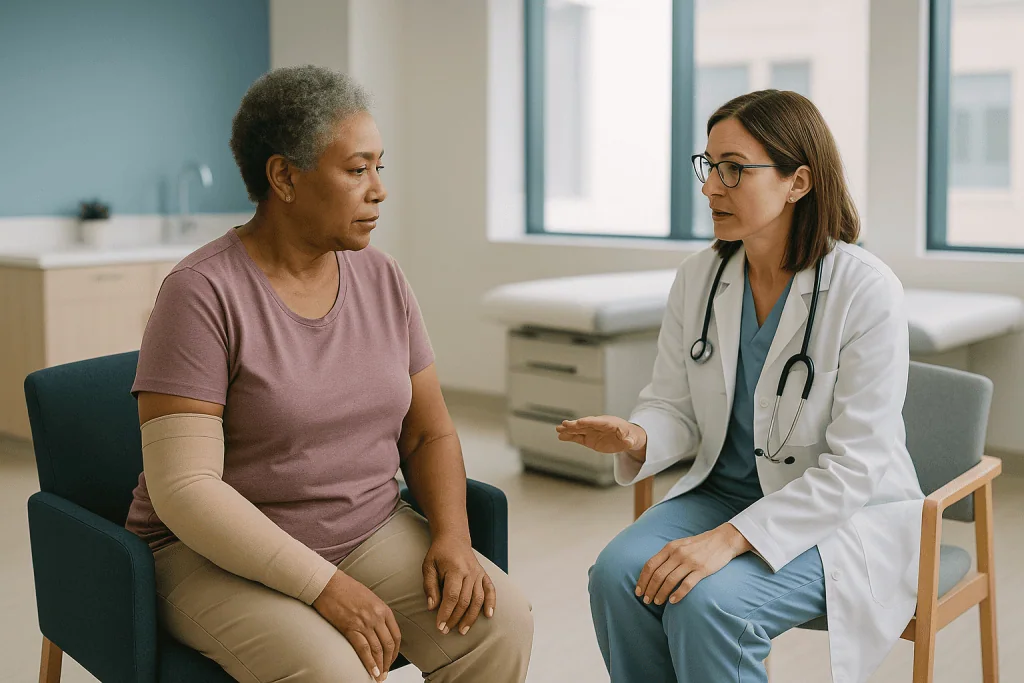
Surgery is not the only driver. The National Cancer Institute lists radiation to the armpit, a higher body weight, infection or injury in the treated arm, and certain chemotherapy drugs in the taxane class as factors that raise the odds. Some of these are fixed by the time treatment ends; others, such as weight and skin care, remain partly within reach.
Timing is often misunderstood. Most cases appear within the first three years after surgery, according to the National Cancer Institute, but Mayo Clinic notes that lymphedema can surface months or even years later, sometimes after a trigger such as a cut, a sunburn or an insect bite that tips an already strained system over its limit. This is why monitoring does not stop at the one-year anniversary.
It also helps to know what the numbers do not say. A one-in-five average blends people who had extensive node surgery and radiation with people who had a single sentinel node removed and no radiation at all. Your personal risk sits somewhere on that spectrum, and your surgical and radiation notes are the place your care team will start when estimating it. Ask them where you fall; the answer shapes how closely you should be watched.
What are the early signs of lymphedema in the arm, and what should be reported?
Early lymphedema is more often felt than seen. People describe a sense of fullness or heaviness, a tightness in the skin, or an ache that builds through the day and eases overnight. Jewelry, watches and sleeves that fit yesterday feel snug. The elbow or wrist may bend a little less freely. Mayo Clinic lists these sensations alongside visible swelling, but in practice the sensations frequently come first, sometimes by weeks or months.
The point of knowing this is not to diagnose yourself. Swelling in a treated arm has several possible causes, and two of them, a blood clot in a deep vein and a skin infection called cellulitis, need prompt medical attention rather than a compression sleeve. A clinician can tell them apart; a mirror cannot. The right response to any new or changing sensation is a call to the oncology or lymphedema team, not a wait-and-see approach and not a search for a garment online.
Symmetry is a useful mental anchor. The National Cancer Institute’s summary describes comparing the treated side with the other arm at the same points, which is exactly what clinicians do with a tape measure. If one wrist or forearm is noticeably fuller than the other, or if a hand looks puffy across the knuckles when the other does not, that is worth reporting even if it comes and goes.
Breast and chest wall lymphedema deserve a mention because it is easy to overlook. After lumpectomy with radiation, the breast itself can feel heavy, warm without infection, or develop a dimpled skin texture. The same principle applies: report it, let the team assess it.
How is lymphedema monitored after breast cancer surgery?
Modern monitoring rests on one idea: measure before there is a problem, then measure again. A baseline taken before surgery lets a clinician spot a small change on the treated side that would otherwise be lost in the natural difference between a dominant and non-dominant arm. Many cancer centers build this into the pre-operative visit, and it is worth asking whether yours did.
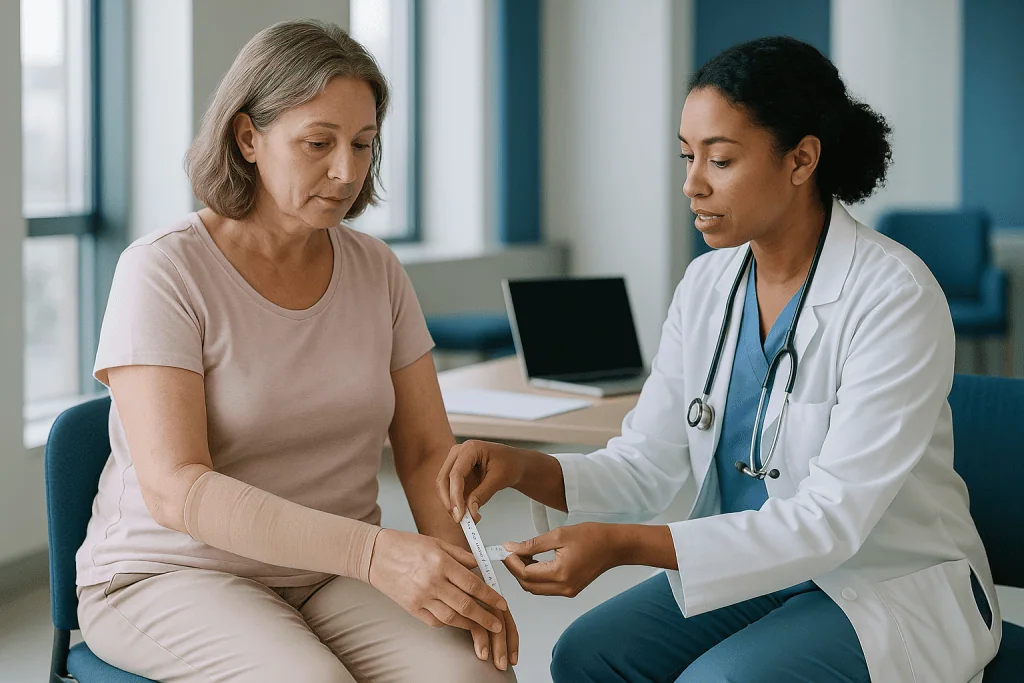
The oldest tool is still the most common. Circumference is measured with a tape at fixed points from hand to shoulder and compared with the other arm. The National Cancer Institute’s summary describes thresholds commonly used in research and clinics, such as a difference of about 2 cm in circumference or roughly 10% in limb volume, while noting that smaller changes can matter when a baseline exists.
Two newer methods add precision. Perometry uses an infrared light frame to calculate limb volume in seconds. Bioimpedance spectroscopy passes a tiny, painless electrical current through the arm and measures how easily it travels; because extracellular fluid conducts current well, a rising reading can flag fluid accumulation before any tape measure would. Both are described by Mayo Clinic among the tests used to assess lymphedema.
When the picture is unclear, imaging steps in. Lymphoscintigraphy injects a small amount of radioactive tracer that is followed as it moves through the lymph channels, showing where flow is slow or blocked. Ultrasound or other scans may be ordered to rule out a clot or a mass.
How often you are checked is a decision for your team, weighed against your surgery type, radiation field and any early readings. What matters more than the interval is that the schedule exists and that you know how to trigger an extra check between visits.
What do the stages of lymphedema mean?
Clinicians grade lymphedema with a four-step staging system, from stage 0 to stage 3, described by both the National Cancer Institute and Cleveland Clinic. The stage reflects how the tissue is behaving, not just how big the arm looks, and it guides how aggressive treatment needs to be.
| Stage | What is happening | What a person typically notices |
|---|---|---|
| 0 (latent) | Lymph transport is impaired but fluid has not yet accumulated visibly | Heaviness or tightness with no measurable swelling; often detected only by baseline comparison or bioimpedance |
| 1 (mild) | Protein-rich fluid pools; tissue is soft and pits when pressed | Swelling that improves or disappears with overnight elevation |
| 2 (moderate) | Fluid persists; early fat deposition and fibrosis begin | Swelling no longer resolves with elevation; tissue feels firmer, pitting may fade |
| 3 (severe) | Marked fibrosis and fat; skin thickens and changes | Large, hard limb; skin folds, warty or leathery patches; higher infection risk |
Two lessons fall out of this table. First, stage 0 exists, which is the whole argument for pre-operative baselines and prospective surveillance: a problem can be real before it is visible. Second, the shift from stage 1 to stage 2 is the point at which the arm stops being purely a fluid problem and becomes partly a tissue problem. Fluid can be moved with drainage and compression; fibrosis and fat cannot, or not easily. The clinical goal, stated plainly across the sources above, is to intervene while the swelling is still reversible.
Staging is done by a trained clinician, usually a lymphedema therapist or physician, and can change in either direction over time.
Who is usually offered decongestive therapy, and who is asked to wait?
Anyone with confirmed lymphedema, at any stage, is a candidate for complete decongestive therapy, the structured program described in the next section. People with stage 0 findings or a small but rising volume difference are often started on a lighter version: a fitted compression garment, an exercise plan and closer surveillance, with a view to escalating if measurements climb. The National Cancer Institute’s summary and Mayo Clinic both frame treatment as most effective when begun early.
Several situations lead a team to pause or delay parts of the program rather than skip it altogether. An active skin infection in the limb is the most common: cellulitis needs antibiotic treatment first, and manual drainage over infected tissue is avoided until the infection settles. A suspected or newly diagnosed blood clot in the arm changes the picture completely, because compression and massage are held until the clot has been assessed and treated. Uncontrolled heart failure, where the body is already struggling to handle fluid shifts, and active cancer in the treated region that has not yet been evaluated are two further reasons a clinician may want more information before starting.
None of these is a permanent bar. They are sequencing decisions, and they sit with the treating team, who can weigh the swelling against everything else in your medical record.
Access matters too. Complete decongestive therapy is delivered by therapists with specific training, and availability varies by region. If your team recommends it, ask who provides it locally, how referrals work and what you can begin doing at home in the meantime. Skin care and gentle movement need no referral at all.
What is the treatment protocol for post-mastectomy lymphedema?
The standard of care carries a long name and a simple structure. Complete decongestive therapy, sometimes called decongestive lymphatic therapy in NHS materials, combines four elements that work together and lose much of their effect when used alone.
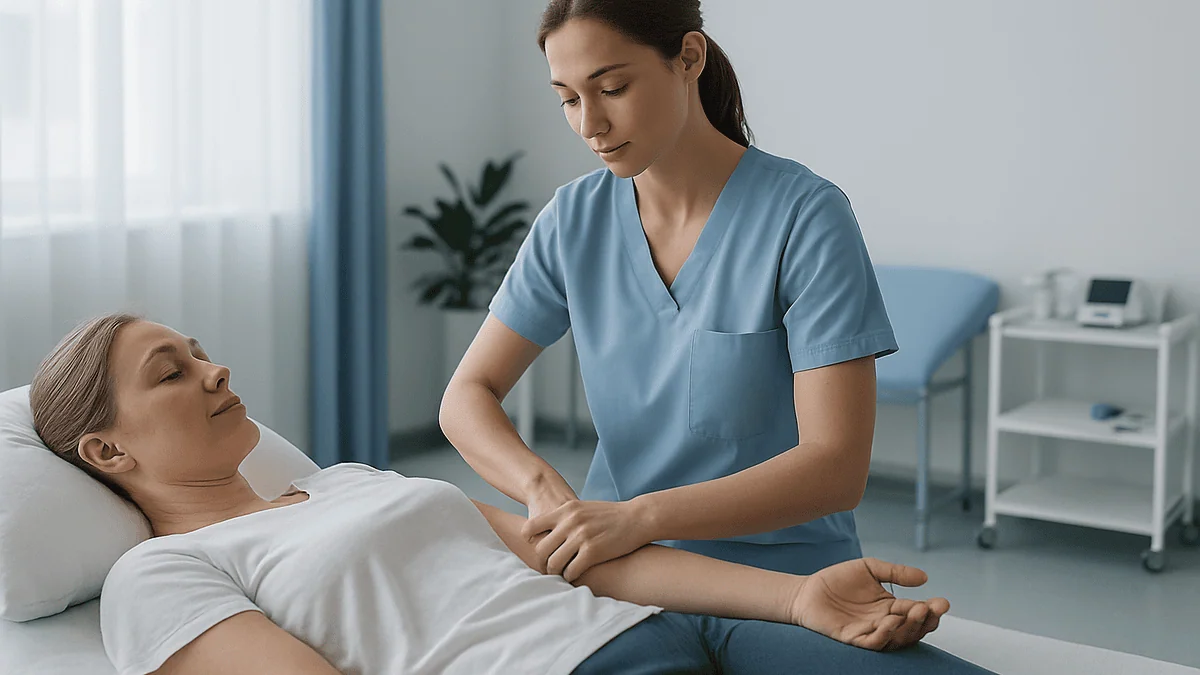
Manual lymphatic drainage is a gentle, skin-stretching hand technique that encourages fluid toward healthy lymph vessels and nodes. It is nothing like a deep-tissue massage; the pressure is light and the rhythm slow, and it is performed by a trained therapist who also teaches a simplified version for home use.
Compression is the workhorse. In the early, intensive phase it takes the form of multi-layer bandaging that is worn almost around the clock; once the limb has shrunk as far as it will, a fitted compression sleeve, and often a glove, takes over for daily wear. Compression works by providing an external counter-pressure that limits how much fluid can seep back into the tissue and helps muscle contractions pump lymph along.
Exercise, done in the garment, uses those muscle contractions deliberately. Skin care, the fourth element, prevents the cracks and infections that can set the whole process back.
Pneumatic compression pumps, inflatable sleeves that squeeze the arm in a programmed sequence, are sometimes added as an adjunct at home, Mayo Clinic notes, but they supplement rather than replace the program.
Medicines play a small part. Diuretics, the “water tablets” used for other kinds of swelling, are generally not recommended for lymphedema because the fluid is protein-rich and tends to return quickly, according to the National Cancer Institute. No drug has been shown to reverse the condition, and supplements marketed for lymphatic health have not been established as effective. Any medicine decision belongs to the prescribing clinician.
What do the first weeks of treatment usually look like?
The intensive phase is demanding, and it helps to know that going in. The NHS describes it as a period of frequent therapist visits, often daily or close to it, lasting several weeks, during which the arm is drained by hand, re-bandaged and measured. Bandages stay on between sessions, including overnight, and are removed only for washing and the next treatment. Most people find the first week awkward: sleeves do not fit over bandages, cooking is clumsy, and the arm feels strange. By the second week, routines form.
Progress is tracked by the tape measure or perometer rather than by feel. Volume typically drops fastest in the first days as free fluid moves, then more slowly as the tissue adjusts. When measurements level off across a few visits, the therapist judges that the limb has reached its plateau for this phase and arranges garment fitting.
Fitting is a skill in its own right. A compression sleeve must be snug enough to hold the reduction but not so tight that it pinches at the elbow or wrist, which can trap fluid in the hand. Custom or off-the-shelf options exist, and the therapist chooses based on arm shape and skin condition. Garments lose their elasticity with washing and wear, so periodic replacement is part of the long-term plan; your therapist will tell you how to spot a sleeve that has stopped doing its job.
The maintenance phase then begins. Daytime compression, a home exercise routine, self-drainage as taught, and disciplined skin care become the daily framework, with periodic check-ins to re-measure. Some people are also fitted for a night garment. The NHS and Mayo Clinic both describe this second phase as ongoing rather than time-limited, which is the honest way to think about it.
Does lymphedema go away, and how long does it last after breast cancer?
Here is the answer most articles soften: once lymphedema is established, the underlying damage to the lymphatic system does not repair itself. Mayo Clinic and the NHS both describe lymphedema as a long-term condition that is controlled rather than eliminated. That is different from saying the arm will always be swollen. It means the capacity to swell remains, and the work of management is to keep fluid from exploiting it.
What people actually experience varies by stage. Stage 1 lymphedema treated promptly can shrink to the point where the arm looks and feels almost like its partner, with a garment worn to keep it that way. Stage 2 and 3 limbs improve with treatment but rarely return to baseline because fibrosis and fat have taken up residence. This is the practical case for early action.
A separate phenomenon causes confusion. In the weeks right after surgery, many people have transient swelling of the arm or breast that settles on its own as the tissues heal, a pattern the National Cancer Institute’s summary distinguishes from true lymphedema. Early swelling that resolves within weeks is not the same as lymphedema that arrives later and stays, and only measurement over time can tell the two apart.
Duration, then, is best framed as a question about control rather than an end date. With consistent compression, movement and skin care, many people report long stretches with a stable arm and only occasional flares, typically triggered by infection, injury or heat. Without those habits, swelling tends to creep upward. Your therapist can show you your own measurements over time, which is the most reliable answer to “how am I doing” that exists.
Is exercise safe with lymphedema after breast cancer treatment?
For years survivors were told to avoid lifting anything heavier than a handbag with the treated arm. That advice has been overturned. The National Cancer Institute’s summary describes randomized trials in which women with, and at risk of, breast cancer-related lymphedema followed a slowly progressive, supervised weight-lifting program and did not experience more swelling than women who did not lift; those who already had lymphedema had fewer flare-ups. Mayo Clinic now lists exercise as a core part of management rather than a hazard.
The mechanism makes sense. Lymph has no pump of its own; it moves when surrounding muscles contract and when breathing changes pressure in the chest. Working the arm, especially in a compression garment, pushes fluid along the very channels that need help.
The qualifiers in those trials matter as much as the headline. Progression was gradual, starting with light loads and adding weight in small steps only when the previous level felt easy. Participants were supervised early on and taught to watch for changes in the arm. If a session left the limb heavier or tighter for more than a day, the load was reduced. That structure, not the lifting itself, appears to be what keeps exercise safe.
Aerobic activity carries no such caveats. Walking, cycling and swimming are encouraged; water in particular provides gentle all-over compression while the limb moves. Stretching helps preserve shoulder range after surgery and radiation.
Where the evidence thins is at the extremes. Prolonged heat exposure, such as saunas and very hot baths, is often advised against because heat dilates vessels and increases fluid leakage into tissue, but formal trials are limited. A physiotherapist or lymphedema therapist can tailor a starting program to your arm and your goals.
What about surgery for lymphedema: bypass, node transfer and liposuction?
Surgical options attract headlines, and it is worth separating what they do from what has been proven. Mayo Clinic lists three broad approaches. Lymphovenous bypass, also called lymphaticovenular anastomosis, uses a microscope to connect tiny lymph vessels directly to nearby small veins, giving trapped fluid a new exit. Vascularized lymph node transfer moves a cluster of healthy nodes with their blood supply from another part of the body, such as the groin or neck, into the armpit in the hope they will grow new drainage connections. Liposuction is different in purpose: it removes the fat that has accumulated in long-standing, stage 2 or 3 lymphedema, which no amount of drainage can shift.
A fourth approach is preventive. In some centers, surgeons performing an axillary dissection now reconnect cut lymph vessels to veins at the time of the original operation. Early studies are encouraging but the technique is still under evaluation.
What does the evidence show? Mostly small, single-center series and cohort studies with encouraging reductions in limb volume and infection episodes, and few large randomized trials with long follow-up. That is not a reason to dismiss surgery; it is a reason to describe it accurately. Outcomes vary with stage, surgeon experience and how much fibrosis is present, and most people continue to need compression afterward, sometimes at a lower level.
Who is considered? Typically people whose lymphedema remains troublesome despite a well-delivered course of decongestive therapy, or those with recurrent infections. The assessment usually includes lymphatic imaging to see whether functioning vessels remain to bypass. As with every decision in this article, the recommendation, and the choice, rest with the treating team, who can lay out risks, alternatives and realistic expectations for your particular arm.
Why skin care and infection prevention matter so much
Cellulitis is a bacterial infection of the skin and the tissue beneath it, and it is the complication that lymphedema therapists worry about most. Stagnant, protein-rich fluid is an ideal environment for bacteria, and a limb with impaired drainage cannot clear them efficiently. The result, described by Mayo Clinic, is that even a minor break in the skin can turn into a spreading, painful infection, and each episode of cellulitis can further damage lymph vessels, leaving the arm more swollen than before. The relationship runs in both directions.
Prevention is unglamorous and effective. Moisturizing daily keeps the skin supple and less prone to cracks. Cuts, scratches and insect bites are washed promptly and covered. Gloves go on for gardening, washing dishes and handling pets. Sunscreen and long sleeves prevent burns, which inflame tissue and increase fluid leakage. Nails are cut carefully; cuticles are left alone. Manicures and pedicures, if wanted, are done with clean tools and no cutting of the skin.
Foot care is irrelevant for an arm, but hand care is not, and the same logic extends to breast and chest wall lymphedema: keeping the skin under the breast dry and intact, and treating rashes early, reduces infection risk there too.
When cellulitis does occur, it is treated with antibiotics chosen by a clinician, and drainage therapy over the affected area pauses until the infection has resolved. For people who suffer repeated episodes, the NHS notes that a doctor may consider a longer course of preventive antibiotics; that is a prescribing decision weighed against individual risks and is not something to start or stop independently.
Knowing the early signs of infection, covered in the section on when to call your doctor, is arguably the single most protective piece of knowledge a person with lymphedema can hold.
What people often get wrong about lymphedema after breast cancer
“Never let anyone take blood pressure or draw blood on that arm, ever.” This is the most repeated rule in lymphedema folklore, and the evidence behind it is weak. The National Cancer Institute’s summary acknowledges that the precaution is widely advised but that studies have not clearly shown blood pressure cuffs or needle sticks cause lymphedema. Using the other arm when it is convenient is reasonable; treating an emergency IV in the treated arm as a catastrophe is not. Discuss your own situation with your team.
“Water tablets will bring the swelling down.” Diuretics pull water out of the bloodstream, but lymphedema fluid sits in the tissue and is held there by protein. The National Cancer Institute notes diuretics are generally not recommended and can leave the remaining fluid more concentrated.
“Swelling means the cancer is back.” Lymphedema is a treatment side effect, not a recurrence. That said, sudden new swelling, especially with a lump or skin change, is always assessed by the team, because occasionally recurrence in the armpit can block drainage.
“It only happens after mastectomy.” Lumpectomy with node surgery or radiation carries risk too, and lymphedema of the breast itself is common enough to have its own name.
“Compression will make the arm weak.” Garments support, they do not immobilize; muscle works normally inside them.
“Manual lymphatic drainage is just a nice massage.” The technique is specific, light and directional; ordinary deep massage over a lymphedematous limb can increase fluid leakage.
“Once it is under control, I can stop the garment.” Control depends on the routine; the underlying drainage deficit has not changed. Adjustments to how much compression you wear are conversations with your therapist, not solo decisions.
Questions to ask your care team about long-term lymphedema management
Consultations are short and the questions that matter tend to arrive in the car park afterward. Taking a written list changes that. These are the ones lymphedema therapists say they wish more people asked.
- Was a baseline measurement of my arms taken before surgery, and if not, can we record one now to compare against later?
- How many lymph nodes were removed, was my armpit in the radiation field, and where does that put my personal risk?
- How often will my arm be measured, which method will be used, and how do I request a check between scheduled visits?
- If my measurements change, what is the threshold at which you would start treatment rather than watch?
- Who provides complete decongestive therapy locally, how do I get referred, and what should I be doing at home in the meantime?
- Do you recommend a compression garment for exercise or flying at my level of risk, and who fits it?
- What exercise program is appropriate for me now, and how should I progress it?
- What is your advice on blood pressure cuffs and blood draws on the treated side, given my specific history?
- Which symptoms should prompt a same-day call, and which number do I use out of hours?
- If I develop recurrent cellulitis, what would the options be?
- At what point, if ever, would you consider referring me for surgical assessment, and what would that involve?
- Is there a survivorship or lymphedema support service I can join?
Write the answers down or ask permission to record them. If English is not your first language, request an interpreter; the details in these answers are precise enough to be worth hearing exactly. And if the responses leave you unsure, it is entirely reasonable to ask for a referral to a therapist who specializes in lymphedema for a second conversation.
When to call your doctor
Most lymphedema care is routine, but a few situations call for a same-day conversation with your team, and a smaller number for urgent care.
Treat the following as urgent, meaning contact your team immediately or seek emergency care if you cannot reach them: a sudden increase in swelling combined with redness, warmth or a rash spreading over the arm, breast or chest; fever, chills or feeling generally unwell alongside those skin changes, which together suggest cellulitis; new pain and swelling with a bluish or purplish tinge to the hand or arm, which can indicate a blood clot in a deep vein; and any area of skin that has broken down, is weeping fluid or shows a wound that will not heal. Mayo Clinic and the NHS both describe these as reasons not to wait for a scheduled visit.
Call within a day or two for changes that are less dramatic but still meaningful: swelling that has clearly grown over a week and is not settling overnight; a garment that has become tight or is leaving deep marks; new heaviness or tightness in an area that was previously fine, including the breast or chest wall; reduced movement at the shoulder, elbow or fingers; or a new lump, thickening or dimpling anywhere in the treated region. Mayo Clinic also notes that, very rarely, long-standing severe lymphedema can be associated with a soft-tissue cancer of the lymph vessels; a purple or reddish raised patch on a chronically swollen limb should always be examined.
Call as well if your usual routine has become impossible, whether because of cost, access to a therapist, worn-out garments or simply exhaustion. Teams can often adjust a plan, but only if they know it is slipping. None of the guidance here replaces that conversation; every decision about your monitoring and treatment sits with the clinicians who know your history.
Frequently asked questions
What are the symptoms of lymphedema after breast cancer treatment?
Early lymphedema is usually felt before it is seen: heaviness, tightness, aching or a sense of fullness in the arm, hand, breast or chest wall on the treated side. Rings, watches and sleeves may feel snug, and the elbow or wrist may bend less freely. Visible swelling comes later. Because a blood clot or infection can cause similar changes, any new sensation should be assessed by your care team rather than self-diagnosed.
How long does lymphedema last after breast cancer?
Established lymphedema is a long-term condition because the damaged lymph vessels and nodes do not regrow. With consistent compression, exercise and skin care, many people keep the arm stable for long stretches with only occasional flares. Brief swelling in the first weeks after surgery is different and often settles as tissues heal; only measurement over time distinguishes it from true lymphedema.
Does lymphedema go away completely?
The underlying drainage problem does not go away, but the swelling can be controlled, and stage 1 lymphedema treated early can shrink to near the size of the other arm. Later stages, where fat and fibrosis have accumulated, improve with treatment but rarely return fully to baseline. Management is ongoing rather than a one-time fix, which is why early detection is emphasized so strongly.
What is the treatment protocol for post-mastectomy lymphedema?
The standard protocol is complete decongestive therapy, delivered by a trained therapist in two phases. An intensive phase combines manual lymphatic drainage, multi-layer bandaging, exercise and skin care over several weeks; a maintenance phase then relies on a fitted compression garment, home exercise, self-drainage and skin care. Pneumatic pumps may be added. Medicines play little role, and surgery is considered only for selected people.
Do I have to wear a compression sleeve for lymphedema every day?
Daytime compression is the backbone of the maintenance phase for most people with established lymphedema, because it limits fluid re-accumulation and helps muscles pump lymph. How many hours, whether a glove is needed, and whether a night garment is worthwhile depend on your stage and measurements, and are decisions for your therapist. Garments also lose elasticity over time and need periodic replacement.
Can I lift weights or exercise with lymphedema in my arm?
Yes, with a gradual approach. Randomized trials described by the National Cancer Institute found that slowly progressive, supervised weight training did not increase swelling and reduced flare-ups in women who already had lymphedema. The key is starting light, adding load in small steps, wearing a garment if advised, and easing off if the arm feels heavier for more than a day. Walking, cycling and swimming are encouraged.
Is it true I can never have blood pressure taken on my treated arm?
The evidence behind that rule is weak. Studies have not clearly shown that blood pressure cuffs or needle sticks cause lymphedema, though many clinicians still suggest using the other arm when it is convenient as a sensible precaution. In an emergency, an IV in the treated arm is not a catastrophe. Ask your own team what they recommend for your level of risk.
Can lymphedema develop years after breast cancer treatment?
Yes. Most cases appear within about three years of surgery, according to the National Cancer Institute, but Mayo Clinic notes it can develop months or years later, often after a trigger such as a cut, a burn, an infection or an insect bite that overloads an already strained lymphatic system. This is why surveillance and skin care continue well beyond the end of active treatment.
Does swelling in my arm mean the cancer has come back?
Usually not. Lymphedema is a side effect of surgery and radiation, not a sign of recurrence. However, sudden new swelling, particularly with a lump, skin thickening or a change in the armpit, should always be checked promptly, because in some cases recurrent disease in the axilla can block lymph drainage. Your team can distinguish the causes with examination and, if needed, imaging.
Is surgery for lymphedema proven to work?
Procedures such as lymphovenous bypass, vascularized lymph node transfer and liposuction have shown reductions in limb volume and infections in mostly small studies, but large randomized trials with long follow-up are limited. Results depend on stage, remaining vessel function and surgeon experience, and most people still need some compression afterward. Surgery is generally considered when well-delivered decongestive therapy has not controlled the swelling.
References
This article is for general information only and is not a substitute for professional medical advice. Please consult a qualified doctor about your individual situation.

More from the Blog
Infection Risk After a Stem Cell Transplant: Protective Isolation, Masks and When to Call
Infection risk after a stem cell transplant is highest in the first few weeks, when conditioning treatment has wiped out white blood cells and…
Who May Benefit From Cancer Rehabilitation: Fatigue, Weakness and Limb Swelling
Cancer rehabilitation is usually considered for anyone whose cancer or its treatment has left them with persistent fatigue, muscle weakness, limb swelling (lymphedema), stiffness,…
How Engraftment After a Stem Cell Transplant Shows Up in Your Blood Counts Week by Week
Engraftment after a stem cell transplant is the point when transplanted stem cells settle in the marrow and begin producing new blood cells. Counts…
When Is Radiation Chosen Over Surgery for Vulvar Cancer, and When Are Both Used?
Surgery is usually the first treatment for vulvar cancer that can be removed with a clear margin of healthy tissue while preserving bladder, bowel…
What Is Normal Healing After Vulvar Cancer Surgery and What Needs a Prompt Call
After vulvar cancer surgery, mild swelling, bruising, thin pinkish drainage, numbness and soreness that eases week by week are usually part of normal healing.…
Targeted Therapy for Chronic Myeloid Leukemia: How Daily Treatment and Monitoring Work
Targeted therapy for chronic myeloid leukemia uses daily oral tyrosine kinase inhibitors (TKIs) that block BCR-ABL1, the abnormal enzyme driving the disease. Treatment is…