

Managing Hypertension Day to Day: Salt, Weight, Exercise and a Reading Log Your Doctor Can Use

Key Takeaways
- Blood pressure falls by roughly 1 mmHg for every kilogram of excess weight lost, according to Mayo Clinic summaries of the evidence.
- About three-quarters of the salt most people eat is already inside bought food, so cooking from scratch does more than emptying the shaker.
- Around 150 minutes a week of moderate activity is associated with a systolic drop of about 5 to 8 mmHg in people with hypertension.
- Home readings are judged against a lower threshold than clinic readings in UK guidance (135/85 versus 140/90 mmHg) because people relax at home.
- A useful log records two readings, one minute apart, morning and evening, with a note on sleep, alcohol, exercise or missed doses.
- A reading above 180 and/or 120 mmHg with chest pain, breathlessness, weakness, speech or vision changes is an emergency, not a wait-and-see.
Living with hypertension means treating blood pressure as a number you manage rather than a label you carry. Guidelines point to four everyday levers: keeping salt to roughly a teaspoon a day, losing excess weight gradually, moving for about 150 minutes a week, and measuring at home the same way each time. A simple reading log, taken to appointments, lets your doctor adjust care based on real data instead of a single clinic number.
The appointment lasted eleven minutes. Somewhere in the middle of it a cuff inflated, a nurse read out two numbers, and a phrase was said, almost in passing, that would follow the patient out to the parking lot: a bit on the high side. A leaflet came with it. So did a suggestion to buy a monitor and come back in a month with some readings.
That is how living with hypertension begins for most people: not with a dramatic event, but with an ordinary Tuesday, an unfamiliar word, and a set of instructions that sound vague precisely because they are meant to fit everyone. Eat less salt. Lose a little weight. Move more. Keep an eye on it.
The vagueness is the problem. Behind each of those instructions sits a surprisingly specific body of evidence about how many millimeters of mercury a change is worth, how long it takes, and what your doctor actually needs from you to make good decisions. This article lays that out plainly.
What is actually happening when you're living with hypertension?
Blood pressure is simply the force of blood pushing against the walls of your arteries. It is written as two numbers: the systolic figure, the pressure when the heart squeezes, and the diastolic figure, the pressure between beats when the heart refills. Both are measured in millimeters of mercury (mmHg), a unit left over from the era of glass-column gauges.
Hypertension means that force stays too high, too often. The word often gets confused with tension in the emotional sense, and that misunderstanding does real harm. You can be perfectly calm and still have high blood pressure; you can be frantic and have normal readings. The pressure comes from a mismatch between the volume of blood being pumped and the stiffness or narrowness of the vessels receiving it.
Why does that matter if you feel fine? Because arteries are living tissue. Years of extra force thicken and stiffen their walls, encourage fatty deposits to form, and strain the small vessels in the kidneys, eyes and brain. The NHS describes hypertension as a condition that rarely causes noticeable symptoms but raises the risk of heart attack, stroke, kidney disease and vascular dementia over time. The damage is quiet and cumulative, which is exactly why day-to-day management, rather than occasional alarm, is what changes outcomes.
The encouraging part of the same physiology is that arteries respond to what you do. Lower the volume by reducing salt and fluid retention; improve vessel flexibility with exercise; ease the load with weight loss. Each lever moves the number by a measurable amount, and the sections that follow put figures to each one.
What do the blood pressure numbers mean?
Two sets of thresholds circulate, and knowing which one your clinician uses saves confusion. The American Heart Association (AHA) divides readings into categories that start counting hypertension at 130 systolic or 80 diastolic. The NHS uses a clinic threshold of 140/90 mmHg, or 135/85 mmHg for readings taken at home, where people tend to be more relaxed. Neither is wrong; they reflect different national guideline committees weighing the same trials.
| Category (AHA) | Systolic (mmHg) | Diastolic (mmHg) |
|---|---|---|
| Normal | Below 120 | and below 80 |
| Elevated | 120 to 129 | and below 80 |
| Hypertension, stage 1 | 130 to 139 | or 80 to 89 |
| Hypertension, stage 2 | 140 or higher | or 90 or higher |
| Hypertensive crisis | Above 180 | and/or above 120 |
A few things the table cannot show. First, a single reading diagnoses nothing. Pressure swings with posture, caffeine, a full bladder, a hurried walk from the car, even the act of being measured. Clinicians look for a pattern across several days or a 24-hour ambulatory recording before applying a label.
Second, the systolic number tends to carry more weight in people over about 50, because arteries stiffen with age and the top figure climbs while the bottom one may drift down. Your doctor will interpret both together with your age, kidney function, cholesterol and history rather than reading the chart in isolation.
Third, the crisis row is the one to memorize. A reading above 180 and/or 120, especially with symptoms, is covered in the final section of this article.
How much does salt really raise blood pressure?
Salt is sodium chloride, and it is the sodium that matters. Extra sodium pulls water into the bloodstream, raising the volume the heart has to push, and over time it also stiffens vessel walls. The Mayo Clinic notes that even a modest reduction in sodium can lower systolic pressure by about 5 to 6 mmHg in people with hypertension, a change in the same range as some single medicines.
The NHS advises adults to keep total salt to no more than about one level teaspoon a day (6 g). The catch is where that teaspoon comes from. According to the NHS, roughly three-quarters of the salt most people eat is already inside food when they buy it: bread, breakfast cereal, cheese, cured meat, sauces, soups, ready meals and restaurant dishes. The shaker on the table is a small part of the story.
This reframes the task. Cooking from scratch a few more nights a week does more than any amount of restraint at the table. Reading labels helps, particularly on foods that do not taste salty, such as sweet baked goods and cereals. Rinsing canned beans, choosing unsalted nuts, and asking for sauces on the side in restaurants each remove a little.
Your palate resets faster than most people expect. Taste receptors adapt within weeks, and heavily salted food that once seemed normal starts to taste oversalted. Herbs, citrus, vinegar, garlic, chili and black pepper fill the gap without affecting pressure.
One caution: salt substitutes built on potassium are not suitable for everyone, particularly people with kidney disease or on certain medicines. Ask before switching rather than after.
Weight and blood pressure: what each kilogram is worth
Extra body weight raises blood pressure through several routes at once. More tissue needs more blood, so the heart pumps a larger volume. Fat around the abdomen releases signals that tighten vessels and encourage the kidneys to hold sodium. Excess weight also drives sleep apnea, a condition in which breathing repeatedly pauses during sleep, and apnea pushes pressure up overnight and into the morning.

The arithmetic is unusually direct. The Mayo Clinic summarizes the evidence this way: blood pressure falls by roughly 1 mmHg for each kilogram (about 2.2 pounds) lost. That means a person who loses 5 kg can expect, on average, a drop of about 5 mmHg systolic, comparable to the effect of cutting salt or adding regular exercise, and the three add up.
Waist measurement matters as much as the scale. Mayo notes that risk rises noticeably in men with a waist above 40 inches (102 cm) and women above 35 inches (89 cm), though thresholds vary by ethnic background, and your clinician can tell you which applies to you.
What the evidence does not support is crash dieting. Rapid loss followed by regain tends to leave pressure where it started and can worsen it. Guidelines favor gradual change: a slightly smaller plate, fewer liquid calories, more vegetables and legumes, and a walking habit that becomes as automatic as brushing your teeth.
The DASH eating plan, developed through NIH-funded research, is the diet most often recommended because it addresses weight, sodium and potassium together. Mayo reports that following it can lower systolic pressure by up to about 11 mmHg in people with hypertension. It is not a brand or a product; it is a pattern built on vegetables, fruit, whole grains, low-fat dairy, beans, nuts and lean protein, with limited sweets and red meat.
How much exercise lowers blood pressure, and what kind?
Exercise lowers blood pressure in two phases. In the hours after a session, vessels stay dilated and pressure dips. Over weeks of repetition, the heart becomes a more efficient pump, the lining of the arteries produces more of the chemicals that keep vessels relaxed, and resting pressure settles lower. Stop for a couple of weeks and much of the benefit fades, which is why consistency beats intensity.
The figure to anchor on comes from the AHA and Mayo Clinic: about 150 minutes a week of moderate activity, roughly 30 minutes on most days, can lower systolic pressure by about 5 to 8 mmHg in people with hypertension. Moderate means you can talk but not sing: brisk walking, cycling on the flat, swimming, dancing, mowing the lawn with some effort.
Strength training belongs in the plan too. Mayo suggests resistance exercise at least two days a week. The old worry that lifting spikes pressure dangerously applies mainly to breath-holding during heavy maximal lifts; controlled sets with normal breathing are considered safe for most people with controlled hypertension, though anyone with very high or unstable readings should ask their clinician first.
Short bouts count. Three ten-minute walks spread across a day produce a similar effect to one thirty-minute session, and for a person restarting after years of inactivity they are far easier to keep up. Stairs instead of the elevator, parking at the far end of the lot, standing during phone calls: none of these alone changes a reading, but they lower the bar for the walk that does.
If you have been sedentary, have heart disease, or are over 60 and starting something new, a brief conversation with your care team about how to begin is sensible.
How to lower high blood pressure from stress
Stress raises blood pressure acutely. Adrenaline speeds the heart and narrows small vessels, and a reading taken mid-argument or during a work deadline can be 10 or 20 mmHg above your baseline. What the evidence does not clearly show, as the Mayo Clinic points out, is that chronic stress by itself causes long-term hypertension. The stronger link runs through behavior: stressed people sleep less, drink more, eat worse, exercise less and skip medicines.
That distinction is practical rather than academic. It means the most effective stress strategies for blood pressure are often the ones that protect the other levers. A daily walk lowers cortisol and meets the exercise target at the same time. A regular bedtime, with screens off and the bedroom cool and dark, protects both mood and pressure; Mayo notes that regularly sleeping fewer than six hours is linked to higher readings.
Slow breathing has a modest but real acute effect. Sitting quietly and breathing out for longer than you breathe in for a few minutes activates the nervous system’s calming branch and can lower a reading by a few millimeters in the moment. It is a useful habit before measuring, and a reasonable tool in a hard week, but it is not a substitute for the structural changes above.
Alcohol deserves a mention here because so many people use it to unwind. Mayo reports that limiting intake to no more than one drink a day for women or two for men is associated with a fall of about 4 mmHg systolic, while heavier drinking raises pressure and blunts the effect of medicines. Smoking pushes pressure up for several minutes after every cigarette and stiffens arteries over years; stopping is one of the highest-value changes available.
How to measure blood pressure at home the right way
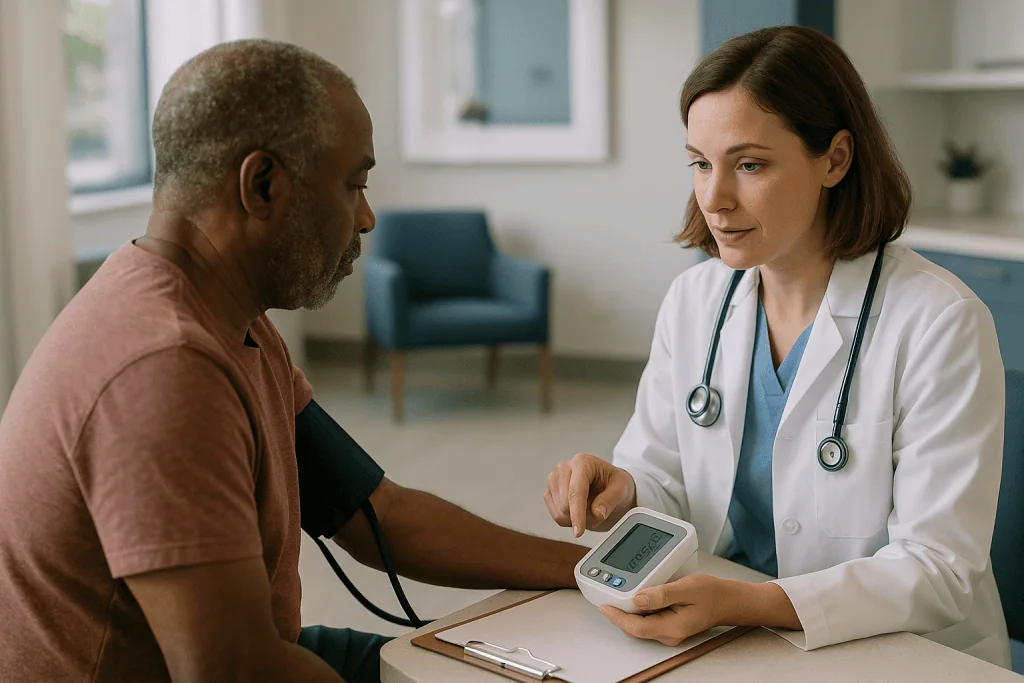
Home readings are now considered more useful than clinic readings for guiding treatment, because they are more numerous and taken in ordinary life. But they are only as good as the technique. The AHA and Mayo Clinic agree on a routine, and it is worth doing exactly.
Use an automatic, cuff-style monitor that fits on the upper arm. Wrist and finger devices are less reliable. Measure your arm circumference and check the cuff size on the box; a cuff that is too small reads high. Bring the device to an appointment so your clinician can compare it with theirs.
Before each reading, avoid caffeine, exercise and tobacco for 30 minutes and empty your bladder. Sit in a chair with your back supported and both feet flat on the floor, legs uncrossed. Rest for five minutes without talking or scrolling. Place the cuff on bare skin, with your arm resting on a table so the cuff sits at heart level. Then take two or three readings one minute apart and record them all.
Timing matters. The AHA recommends measuring in the morning before eating or taking any medicine, and again in the evening, at the same times each day. UK guidance, reflected on the NHS site, asks for readings twice daily over several days when a diagnosis is being confirmed or treatment is being adjusted.
Resist the urge to measure repeatedly when a number looks alarming. Anxiety about the reading raises the reading, and a spiral of ten measurements in twenty minutes tells nobody anything. Take your two or three, write them down, and step away.
How to keep a blood pressure log for your doctor to actually use
Ask any clinician what makes a home log useful and the answer is consistency, not volume. A page of readings taken at random times, with no context, is hard to act on. A tidy week of paired readings, morning and evening, with a note of anything unusual, can settle a treatment decision in a single appointment.
A workable format looks like this:
| Day | Morning (two readings) | Evening (two readings) | Notes |
|---|---|---|---|
| 1 | 138/86, 134/84 | 131/82, 129/80 | Slept poorly |
| 2 | 132/83, 130/82 | 127/79, 126/80 | Walked 35 min |
| 3 | 135/85, 133/84 | 130/81, 128/80 | Ate out, salty meal |
Record every reading, not just the ones you like. The pattern is the point, and a doctor who sees only your best numbers will make decisions on false information. Note the arm you used and stick with it. Add a brief word on sleep, exercise, alcohol, a missed dose or a stressful event, because these explain outliers and stop them from being treated as trends.
Many monitors store readings and some export to a phone app. That is convenient, but a paper copy or a printed summary is still what most clinics can read quickly in the room. Bring the whole record, not a verbal summary.
Before an appointment, calculate a simple average of the second readings from each session over the past week. UK guidance suggests discarding the first day, when people are still adjusting to the device. A single number, plus the log behind it, gives your clinician exactly what they need.
Who is usually asked to try lifestyle changes first, and who isn't
Not everyone with a high reading starts on the same path, and understanding why helps people feel less singled out by the plan they are given.
People with readings in the elevated or stage 1 range, no diabetes or kidney disease, and a low estimated risk of heart attack or stroke over the next decade are commonly asked to work on salt, weight, exercise and alcohol for a period of months, with home monitoring, before medicine is considered. The AHA and NHS both describe this approach. The logic is that the expected benefit from a tablet is small when baseline risk is low, while lifestyle changes help every other aspect of health as well.
Others are usually offered medicine alongside lifestyle change from the start. This typically includes people with stage 2 readings, those whose home average stays above threshold despite good effort, and anyone whose overall risk is high because of diabetes, established heart disease, kidney disease, a previous stroke, or evidence that pressure has already affected the eyes, kidneys or heart. Here the arithmetic flips: the benefit of lowering pressure promptly is large enough that waiting costs more than it saves.
Some groups are handled with particular care. Pregnant people, those over about 80, people with a history of falls or fainting, and people with very variable readings are assessed individually, because the balance between treating and over-treating is finer.
None of this is a verdict on effort or character. It is risk arithmetic, and it is revisited at every review. Someone started on medicine who then loses weight and cuts salt may find their doctor able to simplify treatment later; someone on lifestyle alone whose numbers drift may be offered medicine. The decision stays with the treating team, informed by your log.
How blood pressure medicines work and how long they usually take
If medicine becomes part of your plan, it helps to know what it does, because people who understand a tablet’s purpose are more likely to keep taking it when they feel no different.
Four main classes are used first-line, according to the NHS and AHA. Angiotensin-converting enzyme (ACE) inhibitors and angiotensin receptor blockers (ARBs) both quiet a hormone system that narrows vessels and makes the kidneys retain salt. Calcium channel blockers relax the muscle in artery walls so vessels widen. Thiazide-type diuretics help the kidneys remove extra sodium and water, lowering volume. Beta blockers, which slow the heart, are used in specific situations rather than routinely.
Which class a person is offered depends on age, ethnic background, other conditions and side-effect profile. The NHS notes, for example, that different first choices are recommended for people under and over 55 and for people of Black African or Caribbean family origin, because response patterns differ on average.
Timelines are gradual. Most of these medicines begin working within days, but the full effect, and the point at which a clinician can judge whether the choice is right, typically takes a few weeks. The NHS describes a period of follow-up after any change, and an annual review once pressure is stable. Feeling nothing is normal and is not a sign the medicine is failing; the log tells that story, not your sensations.
Two rules from every guideline. Do not stop a medicine because your readings look good; the readings look good because of the medicine. And report side effects rather than tolerating or abandoning treatment silently, because there is nearly always an alternative. Any adjustment is a decision for the prescribing clinician.
What the first weeks of living with hypertension usually look like
The first fortnight is mostly about measurement. You are learning a device, finding a time of day that fits, and discovering that your numbers wander more than you expected. That variability is normal and is the reason clinicians want a week of paired readings rather than one.
Around the same time the food changes begin, and this is when most people notice how much salt was hiding in their week. Bread, cheese and sandwich meat turn out to be the main culprits rather than crisps. Expect two or three weeks of everything tasting a little flat before your palate adjusts, as described in the NHS salt guidance.
If exercise is new, weeks two to four are the fragile period. The novelty has worn off, the habit has not yet formed, and weather or work provides a reason to skip. Short, scheduled walks survive this stretch better than ambitious gym plans.
By weeks four to eight, if lifestyle changes are working, the log usually starts to show it: the morning average drifts down, the outliers become less extreme. Mayo’s figures suggest that the combined effect of sodium reduction, regular activity and modest weight loss can reach double digits in mmHg over this kind of horizon, though individuals vary widely and some people see less.
If medicine was started, this is also the window in which your clinician will typically want to see you or your readings again to judge the response and check for side effects, per NHS follow-up guidance.
Emotionally, the arc is common: alarm, then a burst of effort, then a plateau where the diagnosis becomes background noise. The plateau is where good management lives. A reading log kept quietly for years does more than any dramatic month.
Can you live a normal life with hypertension, even for 20 years or more?
This is the question underneath most of the others, and the honest answer from the evidence is yes, with a condition attached: controlled hypertension and uncontrolled hypertension are very different conditions to carry.
Hypertension is common. The CDC estimates that nearly half of US adults have it, which means the person next to you at work, your neighbor, and possibly your doctor are living with it too. The same CDC data show that only around one in four adults with hypertension have it under control, and that gap, not the diagnosis itself, is where the excess heart attacks and strokes come from.
The large trials behind every guideline show that lowering pressure reduces the risk of stroke, heart failure, heart attack and kidney disease substantially, and that the benefit continues for as long as control is maintained. No guideline gives an individual a number of years, and none should; your outlook depends on your pressure, your cholesterol, whether you smoke, your blood sugar, your family history and a good deal of ordinary luck. What the evidence supports is that a person whose pressure is well controlled and who does not smoke has a risk profile far closer to someone without hypertension than to someone whose pressure runs high untreated.
Normal life, in practice, means very few restrictions. Travel, work, sport, sex, pregnancy with appropriate monitoring, caffeine in moderation: the NHS and AHA place no blanket bans on any of them. What changes is a set of habits that most people find they would have been better off with anyway, and a small daily task with a cuff.
The people who do best over decades are rarely the most anxious ones. They are the ones who made the plan boring and kept it.
What people often get wrong about high blood pressure
“I’d know if it was high; I’d feel it.” The NHS is blunt on this: hypertension rarely causes symptoms, and the only reliable way to know is to measure. Headaches and flushing are far more often caused by other things, and their absence proves nothing.
“My reading was normal today, so I’m fine.” One reading is weather; a week of readings is climate. Pressure varies through the day and from day to day, which is why guidelines base decisions on averages.
“I don’t add salt, so salt isn’t my problem.” Roughly three-quarters of dietary salt is already in purchased food, according to the NHS. The shaker is the smallest part.
“Once I’m on tablets I can stop worrying about lifestyle.” The two work together. Weight loss, exercise and sodium reduction each lower pressure by a few mmHg on top of medicine, and can allow a clinician to simplify treatment later.
“My numbers are good now, so I can stop the medicine.” The numbers are good because of the medicine. Stopping without a plan usually returns pressure to where it was, sometimes abruptly. Any change belongs with your prescriber.
“Stress caused this, so relaxing will fix it.” Stress raises pressure in the moment, but the long-term drivers are salt, weight, inactivity, alcohol, genetics and age. Relaxation helps; it does not replace the rest.
“Wine is good for the heart.” Current evidence, summarized by the Mayo Clinic, shows that alcohol raises blood pressure and that the apparent benefits of light drinking seen in older studies do not hold up. Less is better for pressure.
“Supplements can replace treatment.” No supplement has evidence approaching that of the four lifestyle levers or standard medicines. Some interact with prescribed drugs. Mention anything you take to your care team.
Questions to ask your care team
Appointments are short, and the questions that matter tend to arrive in the car afterward. Writing a few down beforehand changes the conversation. These are the ones that tend to unlock the most useful answers.
- Which threshold are you using for me, and what home average are we aiming for?
- Is my monitor accurate compared with yours, and is the cuff the right size for my arm?
- How many days of readings do you want before our next review, and would you like them emailed or brought in on paper?
- Based on my overall risk, are we trying lifestyle changes first, or medicine alongside them, and why?
- Of salt, weight, exercise and alcohol, which do you think is worth the most effort in my case?
- If I am starting a medicine, what does it do, what side effects should I report, and when will you judge whether it is working?
- Should I check my kidney function, cholesterol or blood sugar as part of this, and how often?
- Are there any activities, foods or over-the-counter products I should avoid or ask about first?
- What reading would you want me to call about the same day, and what should send me to emergency care?
- When is my next review, and who do I contact between reviews if the log looks wrong?
Two habits make these questions land. Bring the log, not a memory of it. And if an answer is unclear, ask for it to be written on the summary you take home. The plan that works for years is the one both you and your clinician can state in a sentence.
When to call your doctor
Most of living with hypertension is unhurried, but a few situations need a same-day call or emergency care, and knowing them in advance removes the guesswork.
Seek emergency care immediately, by calling your local emergency number, if a reading is above 180 systolic and/or above 120 diastolic and you have any of the following: chest pain or pressure, shortness of breath, a sudden severe headache, sudden weakness or numbness on one side, difficulty speaking or understanding speech, sudden vision changes, confusion, or a seizure. The AHA calls this a hypertensive emergency. These symptoms can signal stroke or heart damage and are time-critical whatever the cuff says.
If a reading is above 180 and/or 120 but you feel well, the AHA advises waiting five minutes, sitting quietly, and measuring again. If it remains that high, contact your doctor or an urgent care service the same day rather than waiting for a routine appointment.
Call your doctor within a day or two, without alarm, if your home average has climbed clearly above your agreed target over a week despite taking medicine as prescribed; if you develop dizziness or light-headedness on standing, a persistent dry cough, ankle swelling, or another new symptom after starting or changing a medicine; if readings are unusually low and you feel faint; or if you are pregnant and notice any rise in your readings, swelling of the face or hands, or headaches.
Also make contact if you have run out of, or are struggling to take, a prescribed medicine, so a plan can be made rather than a gap left. Never adjust treatment on your own; the decision sits with your treating team, and a phone call is always the right first step.
Frequently asked questions
Can you live a normal life with hypertension?
Yes, for the great majority of people. Well-controlled hypertension places no blanket limits on work, travel, exercise, sex or pregnancy with monitoring, according to NHS and AHA guidance. What changes is a handful of habits around salt, weight, movement and alcohol, plus a regular home reading. The real risk comes from pressure that stays high untreated, which is why control, not the diagnosis itself, is what shapes long-term health.
What are high blood pressure symptoms?
Usually there are none, which is why hypertension is often called silent. The NHS notes that most people find out only through a routine check. Headaches, flushing or feeling stressed are not reliable indicators either way. Symptoms do matter at very high readings, above 180 and/or 120 mmHg, where chest pain, breathlessness, severe headache, weakness or vision changes signal an emergency. Otherwise, the only dependable way to know your pressure is to measure it.
Can you live 20 years with high blood pressure?
Many people live for decades with hypertension, and no guideline gives an individual a number of years. The evidence shows that keeping pressure controlled substantially lowers the risk of stroke, heart attack, heart failure and kidney disease, and that the benefit lasts as long as control does. Your outlook depends on pressure, cholesterol, smoking, blood sugar and family history together, which is why your care team looks at overall risk rather than one figure.
How to lower blood pressure naturally without medicine?
The four changes with the strongest evidence are cutting salt to about a teaspoon a day, losing excess weight gradually, being moderately active for around 150 minutes a week, and limiting alcohol. The Mayo Clinic estimates each is worth roughly 4 to 8 mmHg systolic, and a DASH-style eating pattern up to about 11 mmHg. Whether these alone are enough depends on your readings and overall risk, a judgment your clinician makes using your home log.
How to lower high blood pressure from stress?
Stress raises pressure in the moment, but the lasting damage runs through behavior: poor sleep, alcohol, inactivity and missed medicine. The most effective approach protects those habits. A daily walk, a consistent bedtime, and cutting back on alcohol each lower pressure directly and ease stress. Slow breathing for a few minutes before a reading calms an acute spike. The Mayo Clinic notes that chronic stress alone has not been shown to cause long-term hypertension.
How often should I check my blood pressure at home?
When a diagnosis is being confirmed or treatment adjusted, guidance reflected on the NHS site asks for two readings, one minute apart, morning and evening, over several days, ideally a week, discarding the first day. Once pressure is stable, many clinicians suggest a week of readings before each review rather than daily checks indefinitely. Constant measuring feeds anxiety and raises readings. Agree a schedule with your care team and follow it consistently.
What is the best time of day to take blood pressure?
The AHA recommends morning, before eating or taking medicine, and evening, at the same times each day. Consistency matters more than the exact hour, because pressure follows a daily rhythm and comparing like with like is what makes a log useful. Avoid caffeine, exercise and tobacco for 30 minutes beforehand, empty your bladder, and sit quietly for five minutes with your back supported and feet flat before starting.
Why is my home blood pressure lower than at the doctor's office?
Because you are calmer at home. The effect is common enough that UK guidance uses a lower threshold for home readings, 135/85 mmHg, than for clinic readings at 140/90 mmHg. Walking in from the car, waiting, and being measured all nudge pressure upward. This is one reason clinicians increasingly rely on home logs and 24-hour monitoring. Bring your monitor to an appointment so it can be checked against the clinic device.
Does drinking more water lower blood pressure?
Not in any meaningful way for most people. Adequate hydration is sensible, and severe dehydration can cause pressure to swing, but there is no good evidence that drinking extra water lowers chronically high blood pressure. The fluid-related lever that does work is sodium: less salt means the body retains less water in the bloodstream. Focus on the changes with proven effect, and ask your clinician about fluid if you have kidney or heart conditions.
Will I have to take blood pressure medicine for life?
Often, but not always, and the decision rests with your prescriber. Hypertension is usually a lifelong condition, so many people remain on treatment long term. Some who lose significant weight, cut salt and become active find their clinician able to simplify or reduce treatment under supervision. Never stop or change a medicine on your own because readings look good; they look good because of the treatment, and unplanned stopping can return pressure abruptly.
References
This article is for general information only and is not a substitute for professional medical advice. Please consult a qualified doctor about your individual situation.

More from the Blog

Liver Enzymes Explained: ALT, AST and GGT: What Raised Numbers Mean
Liver enzymes such as ALT, AST and GGT are proteins that leak into the blood when liver cells are stressed or injured. Mildly raised…

How Advanced Mapping and Imaging Guide the Catheter During an Ablation Procedure
During cardiac ablation, a 3D mapping system tracks the catheter tip using weak magnetic fields or small electrical signals sensed through patches on the…

How Coronary Artery Disease Progresses and Why Treatment Starts With Risk Assessment
Atherosclerosis is treated in proportion to a person's estimated risk of a future heart attack or stroke. Clinicians first combine blood pressure, cholesterol, blood…

Who Is Referred to Cardiac Rehab After a Heart Attack, Stent, Surgery or Heart Failure
Cardiac rehab is routinely recommended for anyone who has had a heart attack, a coronary stent, bypass or heart valve surgery, a heart transplant,…

Life With a Permanent Pacemaker: What Regular Device Checks Confirm About Battery and Pacing
Regular pacemaker device checks confirm four things: how much battery remains and roughly how many years it should last, whether the leads are intact,…

Saturated Fat: Where the Evidence Actually Stands in 2026
Saturated fat raises LDL cholesterol, and randomized trials show that replacing it with unsaturated fat lowers the risk of cardiovascular events by roughly 17…