

Microdermabrasion vs Chemical Peel: Mechanical Exfoliation Compared With Acid Exfoliation
Key Takeaways
- Microdermabrasion removes only the dead outer cell layer, while chemical peels can be set to reach the epidermis, upper dermis or deep dermis depending on the acid used.
- Light peels and microdermabrasion overlap almost entirely in what they change; the Mayo Clinic attributes improvement in wrinkles and acne scars mainly to medium and deep peels.
- Typical recovery runs from hours of pinkness after microdermabrasion to about one to seven days of flaking after a light peel and seven to fourteen days after a medium peel.
- People with medium-to-deep skin tones face a higher risk of post-inflammatory dark marks after any resurfacing, and deep phenol peels are generally avoided in darker skin because of permanent lightening.
- Microdermabrasion can lift the tops of shallow blackheads through suction, but salicylic acid works inside the oily pore lining and is the more logical chemical fit for congestion.
- Recent oral isotretinoin, active cold sores, a history of abnormal scarring, active acne and pregnancy are common reasons clinicians ask people to postpone either procedure.
Microdermabrasion buffs away the outermost dead skin layer with a fine abrasive stream or diamond tip, while a chemical peel uses an acid solution to loosen and shed skin to a controlled depth. Microdermabrasion is gentler, suits mild dullness and needs repeated sessions; peels range from light to deep and can address pigmentation and shallow scarring, with more downtime as depth increases.
The two brochures sit side by side on the counter. One shows a wand gliding over a cheek; the other, a brush painting something clear onto a forehead. The person holding them has spent months catching their reflection in the office elevator and wondering when their skin started looking tired. Now they have a consultation booked and a single question they cannot quite settle: microdermabrasion vs chemical peel, which one is actually right for skin like theirs?
The honest answer is not a coin flip. These two procedures share a goal, removing worn-out surface cells so fresher skin can show through, but they get there by opposite routes. One is physics: friction, suction, a controlled sanding. The other is chemistry: an acid chosen and timed to reach a particular layer and no further.
Understanding that difference matters more than any before-and-after photo, because it explains who benefits from each, what recovery looks like, and why a clinician might steer you toward one, the other, or neither.
What does microdermabrasion do to the skin?
Picture the skin’s outer layer as a wall of tightly stacked tiles that are constantly being replaced from beneath. The very top row, the stratum corneum, is made of flattened dead cells that protect everything under them but also scatter light, which is why skin looks dull when that layer thickens or piles up unevenly.
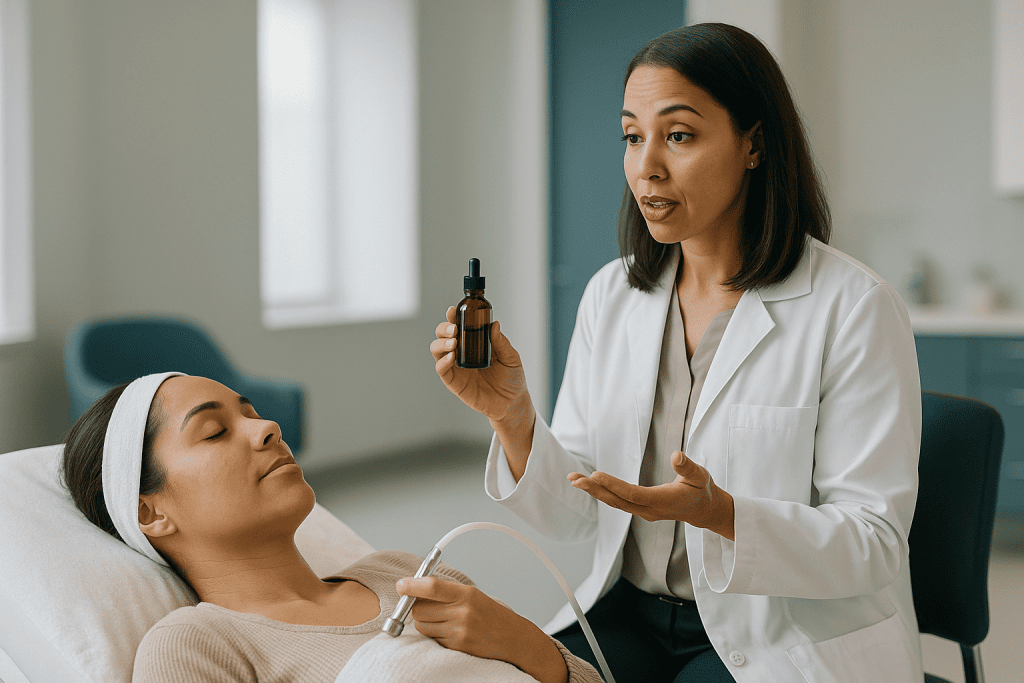
Microdermabrasion is a minimally invasive procedure that mechanically removes part of that top row. A handheld device either sprays very fine crystals across the skin and vacuums them back up along with loosened cells, or drags a diamond-tipped wand across the surface while gentle suction lifts debris away. According to the Cleveland Clinic, a facial treatment typically takes about half an hour to an hour, needs no anesthetic, and most people describe the sensation as a light scratching or a small vibrating vacuum rather than pain.
Two things are happening at once. The abrasion physically sands off dead cells. The suction tugs at the skin, which is thought to briefly increase local blood flow and may nudge the deeper dermis into producing a little more collagen over time, although the evidence for meaningful collagen remodeling from a superficial treatment is modest and mostly short term.
What microdermabrasion does not do is reach below the epidermis, the thin outermost living layer of skin. That is the whole point of its safety profile and also the ceiling on what it can change. Deeper wrinkles, scars that dip below the surface and pigment sitting in the dermis are simply out of range for a tool that works on the top few cell layers.
Because the effect is superficial and the skin replaces its outer layer continuously, results fade as new dead cells accumulate, which is why the Cleveland Clinic describes microdermabrasion as a series of treatments rather than a single event.
How does a chemical peel work, layer by layer?
A chemical peel is a procedure in which an acid solution is applied to the skin to intentionally injure it to a chosen depth, so that the damaged layers separate and shed and new skin grows in their place. The word “peel” is literal: over the following days the treated skin flakes or sheets off.
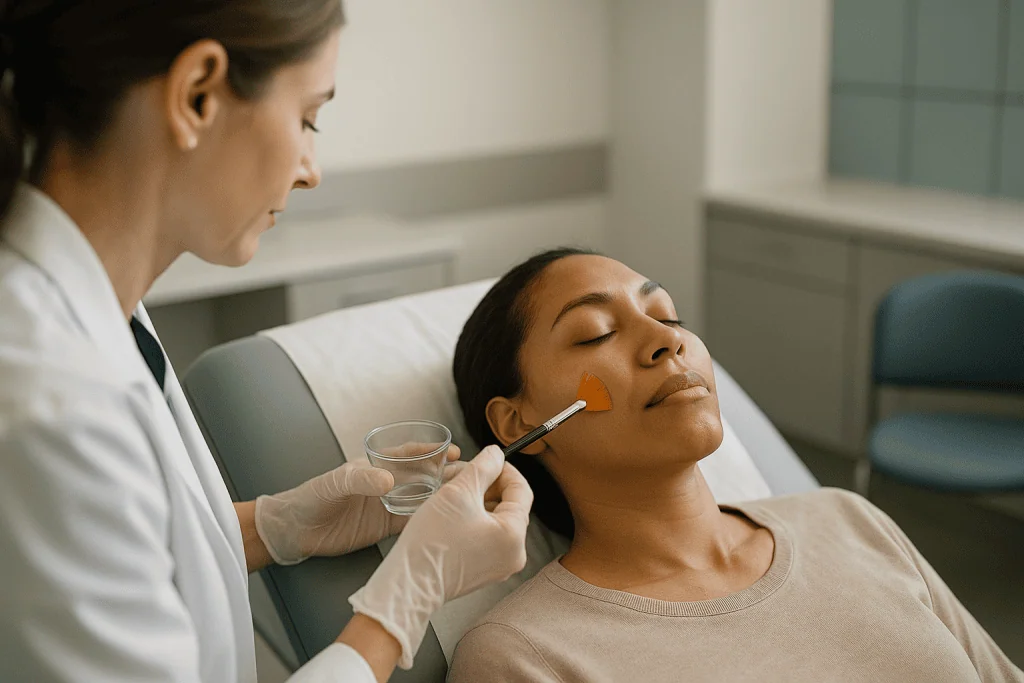
Depth is the organizing idea. The Mayo Clinic describes three broad categories. A light or superficial peel removes only the epidermis and typically uses milder acids such as alpha hydroxy acids (the family that includes glycolic and lactic acid) or a low-strength beta hydroxy acid like salicylic acid. A medium peel reaches into the upper portion of the dermis, the thicker living layer beneath the epidermis, and often uses trichloroacetic acid, sometimes combined with glycolic acid. A deep peel penetrates further into the dermis and is usually performed with phenol, a potent agent that requires careful monitoring because it can affect the heart, kidneys and liver if absorbed in quantity.
The acid does two jobs. It dissolves the protein bonds that hold dead cells together, and, at medium and deep levels, it creates a controlled wound that triggers the skin’s repair machinery: inflammation, then new collagen and reorganized elastic fibers. That wound-healing response is where changes to texture, fine lines and pigmentation actually come from.
Clinicians control depth through the acid chosen, its concentration, how long it stays on before being neutralized or self-limiting, and how the skin was prepared beforehand. During a light peel most people feel stinging that eases within minutes. Medium and deep peels can be genuinely uncomfortable, and the Mayo Clinic notes that deep peels are performed with sedation and local anesthetic, usually only once, given the recovery involved.
Microdermabrasion vs chemical peel: the real difference is control of depth
Reduced to one sentence, the microdermabrasion vs chemical peel comparison comes down to this: microdermabrasion works at a single, shallow depth, while a chemical peel can be dialed from barely there to profoundly resurfacing. Everything else, downtime, risk, who is a candidate, what improves, follows from that.
The mechanical approach has real strengths. Because it removes only surface cells, it does not depend on how a particular skin type reacts to a particular acid, and it is unlikely to trigger the deeper inflammation that can leave lasting dark marks. It is also uniform in a way that is easy to see: the operator watches the skin as they work and can spend more or less time on an area.
The chemical approach has a different kind of strength. A light peel and microdermabrasion overlap almost entirely in what they can achieve, both refreshing texture and brightness at the epidermal level. Step up to a medium peel and the acid is now doing something microdermabrasion cannot: reaching pigment and collagen in the upper dermis. That is why the Mayo Clinic lists medium peels for wrinkles, acne scarring and uneven skin tone, and superficial procedures for mild discoloration and rough texture.
There is a cost to that reach. Deeper injury means more redness, swelling and peeling, a longer window of sun sensitivity, and a higher chance of complications such as infection, scarring or pigment changes. The gentler tool is gentler precisely because it cannot go where the problems often live.
So the question is rarely “which is better” in the abstract. It is “how deep does this concern sit, and how much recovery and risk is reasonable for me right now?” That is a conversation for your treating clinician, who can examine the skin rather than a description of it.
Microdermabrasion vs chemical peel at a glance
Sometimes the clearest way to hold two procedures in mind is a plain comparison. The figures below are typical ranges described by the Mayo Clinic and Cleveland Clinic, not promises, and individual plans vary with skin type, the specific agent and the clinician’s judgment.
| Feature | Microdermabrasion | Light chemical peel | Medium chemical peel |
|---|---|---|---|
| How it exfoliates | Abrasive crystals or diamond tip plus suction | Mild acid (AHA or low-strength BHA) dissolves cell bonds | Stronger acid (often TCA) creates a controlled wound |
| Depth reached | Outer dead cell layer only | Epidermis | Upper dermis |
| Typical session length | Roughly 30 to 60 minutes | Minutes of application | Longer, with cooling and monitoring |
| Anesthesia | None | None | Pain relief, sometimes sedation |
| Usual recovery | Mild pinkness for hours to a day | Flaking for about 1 to 7 days | Redness, swelling and peeling for about 7 to 14 days |
| Concerns most often targeted | Dullness, rough texture, mild sun damage | Uneven tone, fine lines, mild acne, dryness | Deeper fine lines, acne scars, pigmentation |
| Repeat pattern | Series of sessions, maintenance ongoing | May be repeated every 2 to 5 weeks | May be repeated every 3 to 9 months |
Deep phenol peels sit off this table for a reason. The Mayo Clinic describes them as a one-time procedure with weeks of visible healing and months of residual redness, generally reserved for pronounced sun damage, deeper wrinkles or precancerous growths, and unsuitable for many skin tones because of the risk of permanent lightening. Very few people weighing microdermabrasion against a peel are actually candidates for that end of the spectrum.
Read across the rows and a pattern appears: as you move right, capability rises and so does everything you have to tolerate to get it.
Which is better for fine lines, dullness and sun spots?
Start with dullness, because it is the complaint that brings most people to either treatment and the one where the two are closest to interchangeable. Dull skin is largely an optical problem: a thickened, uneven layer of dead cells scatters light instead of reflecting it evenly. Any effective exfoliation, mechanical or chemical, addresses that, and the improvement is visible within days. It also fades within weeks as the layer rebuilds, which is why both treatments are framed as maintenance rather than repair.
Fine lines are a different matter. The faint creases around the eyes and mouth come from a mix of surface dryness, thinning of the epidermis and loss of collagen and elastin in the dermis. MedlinePlus describes how aging skin becomes thinner and less elastic as connective tissue changes. Microdermabrasion can soften the appearance of very fine lines by smoothing the surface and temporarily plumping it with mild swelling, but it does not reach the dermis where structural change happens. A light peel does about the same. The Mayo Clinic attributes improvement in wrinkles primarily to medium and deep peels, where the acid reaches the upper dermis and provokes collagen production during healing.
Sun spots, the flat brown patches sometimes called solar lentigines, hold pigment at the base of the epidermis and sometimes deeper. Microdermabrasion removes cells above them and can lighten very superficial discoloration modestly over a series. Chemical peels, particularly at medium depth, are more directly suited to pigment because the acid reaches the layer where it sits. That is the trade-off again: more reach, more recovery, and a higher stake on getting skin-type assessment right.
Neither procedure treats the cause of sun damage, and any pigment gains are undone quickly without daily sun protection. A clinician will also want to rule out that a changing spot is something other than a benign lentigo before any exfoliation is planned.
Chemical peel vs microdermabrasion for acne scars
Acne scars are where the depth conversation becomes decisive, so it helps to know what kind of mark you are looking at. Dermatologists broadly separate three things. Post-inflammatory marks are flat red or brown discolorations left after a spot heals; they are not true scars and often fade on their own over months. Atrophic scars are indentations where tissue was lost, ranging from shallow, soft-edged “rolling” scars to narrow, deep “ice pick” pits. Raised scars are thickened tissue and behave differently again.
Microdermabrasion works on the surface, so its realistic contribution is to flat discoloration and to the texture around very shallow depressions. It cannot fill a pit or lift a rolling scar, because the missing tissue is in the dermis. The Mayo Clinic lists microdermabrasion among options for mild scarring and notes it is not usually a solution for deeper marks.
Chemical peels span more ground. Light peels behave like microdermabrasion for discoloration. Medium peels reach the upper dermis and can improve shallow atrophic scars by stimulating collagen during healing, which is why the Mayo Clinic includes acne scarring among the indications for medium-depth peels. Deep ice pick scars generally respond poorly to any resurfacing that works from the top down, and clinicians often turn to other techniques for those.
Two cautions matter more here than anywhere else in the comparison. Active inflammatory acne is usually a reason to wait, because exfoliating over open or infected lesions can spread bacteria and worsen inflammation. And people with medium-to-deep skin tones have a higher risk that any resurfacing, mechanical or chemical, leaves new dark marks in place of the old ones, a problem discussed in its own section below. For acne scars, a clinician’s assessment of scar type and skin type is the first step, and the choice of procedure follows from that rather than the other way around.
Does microdermabrasion pull out blackheads?
This is one of the most searched questions about microdermabrasion, and the honest answer is partly. A blackhead is a pore plugged with a mixture of oil and dead skin cells whose exposed tip has darkened on contact with air, not with dirt. The plug sits in the pore’s opening and extends down into its neck.
Microdermabrasion’s suction does exert a gentle pulling force on the skin, and its abrasion removes the dead cells around the pore’s rim. For blackheads that are small and sitting near the surface, that combination can lift the top of the plug and make pores look cleaner for a while. What it does not reliably do is extract a deeper plug intact. The suction is calibrated to lift debris and loosened cells, not to perform the focused pressure an aesthetician uses during manual extraction, and treating a blackhead-prone area repeatedly with abrasion can irritate the skin and encourage more oil.
Chemical exfoliation approaches the same problem from inside the pore. Salicylic acid, a beta hydroxy acid, is oil-soluble, which means it can travel into the pore lining and loosen the cells that form the plug rather than working only on the surface. That is why salicylic acid peels are often discussed for oily, congested skin, and why some clinicians consider a light BHA peel a more logical fit for blackheads than a mechanical treatment. Evidence here is largely from small trials and clinical experience rather than large systematic reviews, so it is reasonable to frame this as a plausible mechanism with supportive practice, not proof.
Whatever the method, blackheads recur because the pore keeps producing oil. Any procedure is a reset, not a fix, and long-term management usually rests on daily routines a dermatologist can advise on. If a spot that looks like a blackhead is tender, growing or does not shift with ordinary care, that is worth a clinical look rather than more exfoliation.
Who is usually a candidate, and who is usually asked to wait?
Both procedures are elective, which means the bar is not “is this allowed” but “is this sensible for this person right now.” Clinicians tend to ask the same set of questions before either.
Microdermabrasion is generally considered for adults with mild concerns: dullness, rough texture, faint lines, light sun damage and superficial discoloration. Because it stays in the epidermis, the Cleveland Clinic notes it is used across a wide range of skin types, and it is often the entry point for people who want the least downtime and are willing to return regularly.
Light chemical peels overlap heavily with that group. Medium peels are generally reserved for people whose concerns visibly sit deeper, who understand a week or two of peeling and redness, and whose skin type has been assessed for pigment risk. Deep peels are considered only for a narrow group, and the Mayo Clinic notes they are generally not recommended for people with darker skin because of the risk of permanent lightening.
Reasons to postpone are shared and worth knowing in advance. The Mayo Clinic lists a history of keloid or abnormal scarring, active cold sores or other skin infection, recent use of oral isotretinoin (a retinoid medicine used for severe acne) within roughly the past six months, and a tendency to pigment darkly after minor injury. Active inflammatory acne, open wounds, sunburn, recent waxing or laser treatment on the same area, and pregnancy or breastfeeding are common reasons a clinician suggests waiting, since several peeling agents have not been well studied in pregnancy. People taking topical retinoid creams are often asked to pause them for a period beforehand, on the prescriber’s instruction, because they thin the outer layer and can make the skin react more strongly.
None of these is a permanent no. They are timing signals, and the treating clinician weighs them against what you hope to change.
Skin tone, melanin and the risk of dark marks after exfoliation
If there is one topic that deserves more airtime than it gets in most microdermabrasion vs chemical peel comparisons, it is this one. The skin’s pigment cells, melanocytes, respond to injury and inflammation by producing more melanin. In people with medium-to-deep skin tones, that response is more pronounced and can leave patches darker than the surrounding skin for months, a condition called post-inflammatory hyperpigmentation. The opposite can also happen after deeper injury: patches that heal lighter and, in the case of deep peels, sometimes permanently so.
The Mayo Clinic flags both outcomes among the risks of chemical peels and singles out darker skin as more prone to hyperpigmentation, especially after medium and deep treatments. The Cleveland Clinic makes a similar point about microdermabrasion being used across skin types precisely because it stays shallow and provokes less inflammation.
This does not mean people with deeper skin tones cannot have peels. It means the choice of agent, depth and preparation matters more, and that experienced clinicians often start conservatively, use agents with a gentler inflammatory footprint, and sometimes prescribe pre-treatment routines aimed at calming pigment cells before the procedure. Those routines are individual and belong to the prescribing clinician, not to a magazine article.
Sun exposure after any exfoliation multiplies the risk for everyone. Fresh skin has less protective pigment and a thinner barrier, and ultraviolet light is the most powerful trigger for melanocytes. Diligent daily sun protection in the weeks afterward is not a cosmetic nicety; it is part of the treatment.
A practical way to raise this in consultation is simply to ask: “How does my skin type change your recommendation, and what have you seen in patients with skin like mine?” A thoughtful answer to that question tells you a great deal about the care you are about to receive.
What the following days and weeks usually look like
Recovery is where the two procedures diverge most visibly, and knowing the typical arc helps you plan and, just as importantly, recognize when something is off.
After microdermabrasion, the skin is usually pink and feels tight or slightly wind-burned for a few hours, occasionally into the next day. Light flaking can follow as loosened cells finish shedding. The Cleveland Clinic describes it as a treatment with essentially no downtime; most people return to normal activities immediately, using gentle moisturizer and sunscreen and avoiding harsh actives for a short spell. Because effects are temporary, sessions are commonly spaced a couple of weeks apart in a series, then continued less often for maintenance.
After a light chemical peel, expect redness, dryness and mild irritation, followed by fine flaking that the Mayo Clinic places at roughly one to seven days. Skin may look slightly blotchy as new cells emerge. Makeup can usually be worn within a day or so, on the clinician’s advice.
A medium peel is a different week. Redness and swelling build over the first two days, sometimes with blistering; the skin then darkens, tightens and peels in sheets. The Mayo Clinic describes healing over about seven to fourteen days, with redness that can linger for weeks to months and strict sun avoidance throughout. Follow-up visits are typical.
Across all of these, the skin is more vulnerable than it looks. Picking at flakes can leave marks and open the door to infection. Heat, saunas, strenuous sweating and swimming pools are usually off the table until healing is complete. And because the outer layer is new, the routine you return to matters: bland moisturizer, sunscreen every morning, and no exfoliating acids or retinoid creams until the treating clinician says so.
Do dermatologists recommend microdermabrasion or chemical peels?
People ask this as though there were a professional verdict, and there is not one, at least not in the form of a guideline that anoints a winner. What dermatology does have is a consistent way of thinking about resurfacing, and it explains why both procedures remain in everyday use.
Chemical peels have the longer clinical track record and the broader evidence base. They appear in the Mayo Clinic’s treatment discussions for wrinkles, acne, acne scarring, uneven tone and sun damage, and clinicians value them because depth can be matched to the problem. The evidence is strongest for superficial and medium peels improving texture and pigmentation; results for scarring are real but more variable and depend heavily on scar type.
Microdermabrasion is generally viewed as a safe, low-risk option for mild concerns. Published reviews tend to find modest, temporary improvements in skin texture and brightness with a very low complication rate, and less convincing evidence for lasting change in wrinkles or scars. Many dermatologists see it as a reasonable maintenance treatment or a gentle starting point, particularly for people who cannot accept downtime or whose skin type raises the stakes of deeper resurfacing.
What clinicians consistently do not endorse is either procedure as a substitute for medical evaluation. A changing brown patch, a persistent rough spot that will not heal, or acne that is scarring actively are reasons for diagnosis first. Exfoliating over an unrecognized skin cancer or an untreated inflammatory condition delays care.
So the practical answer is that dermatologists recommend matching the tool to the depth of the problem and the person’s skin type, recovery tolerance and goals. In one consultation that may be microdermabrasion, in another a peel, and in a third neither, with a suggestion to address the underlying cause, whether that is sun exposure, hormones or a skin condition, before polishing the surface.
What works better than microdermabrasion?
“Better” only means something once you name the target, so it is worth walking through the alternatives by what they reach.
For the same shallow layer, light chemical peels are the most direct comparison and, for some concerns like congested pores or uneven tone, may be a more logical fit because the acid works chemically rather than by friction. Over-the-counter exfoliating products containing alpha or beta hydroxy acids do a milder version of the same job at home and, used consistently, account for much of the everyday brightness people credit to in-office treatments.
For pigment and fine lines in the upper dermis, medium chemical peels are the established step up. Laser and light-based resurfacing, including fractional lasers that treat a grid of tiny columns while sparing skin between them, occupy similar territory with a different mechanism and its own recovery and skin-type considerations.
For indented scars and deeper wrinkles, the tools change again. Microneedling uses fine needles to create controlled micro-injuries that stimulate collagen. Dermabrasion, the older and far more aggressive cousin of microdermabrasion, uses a rapidly rotating instrument to remove skin down to the dermis; the Mayo Clinic describes it as a procedure requiring anesthesia and weeks of healing, used for deeper scars and wrinkles. Injectable fillers can lift some depressed scars from beneath, and surgical techniques exist for the narrowest pits.
For the underlying causes, none of these compete with prevention and medical management. Daily broad-spectrum sun protection slows the photoaging that all of these procedures chase. Prescription retinoid creams, a class of vitamin A derivatives that speed cell turnover and support collagen over months of use, are among the best-studied topical treatments for fine lines and uneven tone, though they belong to the prescribing clinician’s judgment.
The point is not that microdermabrasion is inferior. It is that it sits at one end of a spectrum, and moving along it means trading safety and convenience for reach.
What people often get wrong about microdermabrasion and chemical peels
Some misunderstandings show up in almost every consultation, and clearing them saves disappointment.
“If it is not peeling, it is not working.” Visible sheets of skin are a sign of a medium or deep peel, not of effectiveness in general. Light peels and microdermabrasion often produce little visible flaking yet still remove the dead outer layer; the improvement in brightness comes from what was taken off, not from how dramatic the shedding looks.
“Chemical means harsher.” A light lactic acid peel is gentler on many skins than aggressive mechanical abrasion. The agent’s depth and concentration, not the category, determine harshness, and the Mayo Clinic’s own tiering runs from barely perceptible to a surgical-level event.
“Microdermabrasion removes scars.” It smooths the surface around very shallow marks and can fade flat discoloration. It cannot replace tissue that is missing from the dermis. Expecting a pitted scar to vanish after a series sets up a letdown.
“One session and done.” Both microdermabrasion and light peels are maintenance treatments whose effects fade as the outer layer rebuilds. The Mayo Clinic notes light peels may be repeated every few weeks and medium peels every several months; only deep peels are framed as one-time.
“Deeper is always better.” Deeper means more collagen stimulation but also more risk of scarring, infection and pigment change, and a longer period of vulnerability. For someone with a deep skin tone or a tendency to dark marks, a conservative approach is often the wiser one.
“I can skip sunscreen for a few days.” Freshly exfoliated skin has a thinner barrier and less protective pigment. Unprotected sun exposure in the weeks after either procedure is the most common preventable cause of new discoloration.
“Results at a spa equal results in a clinic.” Superficial treatments overlap, but medium and deep peels involve wound creation and medical monitoring. Where a procedure is performed and by whom is a safety question, not a snobbery one.
Questions to ask your care team before choosing
A good consultation is a two-way exchange, and arriving with specific questions turns a sales pitch, if that is what you encounter, back into a clinical conversation. These are the ones that tend to surface the information that actually matters.
- Looking at my skin, what is the main concern you see, and how deep does it sit? Is it in the outer layer, the epidermis, or the dermis beneath?
- Given that depth, which procedure matches it, and what would each realistically change and not change?
- How does my skin tone and my history of dark marks after spots or cuts affect your recommendation?
- If you suggest a peel, what agent and what depth, and why that one for me?
- What is the typical recovery in your experience for this depth, day by day, and how long until I can wear makeup, exercise and be in the sun?
- What should I stop, pause or start in the weeks before, and who decides about any prescription creams or medicines I am already using?
- How many sessions are usually involved, how far apart, and what does maintenance look like afterward?
- What complications have you seen with this procedure, how often, and what would you do if one happened to me?
- Who performs the procedure, what is their training, and who do I contact if something worries me at night or on a weekend?
- Is there anything on my skin you would want to examine or diagnose before doing any resurfacing at all?
- What alternatives, including doing nothing for now or focusing on sun protection and a prescription routine, would you consider reasonable for me?
Notice that none of these asks “which is best.” They ask the clinician to reason out loud, which is the fastest way to tell whether the recommendation is built around your skin or around a treatment menu. The decision, and the responsibility for it, sits with the person who will be examining and treating you.
When to call your doctor
Most people recover from microdermabrasion and light peels with nothing more than temporary pinkness and flaking, and medium peels follow a predictable if uncomfortable arc. The signs below are the ones that fall outside that pattern and warrant a same-day call to the clinician who treated you, or urgent care if they cannot be reached.
- Pain that worsens after the first day or two rather than easing, or pain out of proportion to the depth of treatment.
- Spreading redness, warmth, swelling or streaks extending beyond the treated area, which can signal infection.
- Yellow or green discharge, crusting that reappears after being cleaned, or a foul smell from the skin.
- Clusters of small blisters or sores, especially if you have a history of cold sores, since the herpes virus can reactivate across freshly treated skin and spread quickly.
- Fever, chills or feeling generally unwell in the days after a procedure.
- Skin that turns gray, white or very dark in patches, or areas that feel unusually firm or numb, which may indicate a deeper injury than intended.
- After a phenol peel specifically, palpitations, an irregular heartbeat, dizziness or shortness of breath during or after the procedure, because phenol can affect heart rhythm and requires immediate assessment.
- Any new raised, thickened or rope-like scar forming in the weeks afterward.
- Eye pain, vision change or acid contact with the eye, which needs immediate rinsing and urgent care.
- Swelling of the lips, tongue or throat, hives spreading beyond the face, or difficulty breathing, which suggest an allergic reaction and need emergency care.
It is also reasonable to call about the slower worries: pigmentation that is darkening rather than fading several weeks on, or redness that has not begun to settle in the timeframe your clinician described. Early review gives the treating team the most options. Never try to correct a complication with more exfoliation at home; let the people who know what was done to the skin decide what comes next.
Frequently asked questions
Is microdermabrasion better than a chemical peel?
Neither is better in the abstract; each suits a different depth of concern. Microdermabrasion is gentler, has almost no downtime and works on dullness and rough texture in the outer layer. Chemical peels range from equally light to much deeper, and medium peels can reach pigment and shallow scarring that microdermabrasion cannot. The right choice depends on what your clinician sees in your skin, your skin type and how much recovery you can accept.
Microdermabrasion or chemical peel first, if I want both?
Clinicians generally do not combine them on the same day, because stacking two exfoliations raises irritation and pigment risk. Some use microdermabrasion to prepare skin before a light peel over a course of weeks, while others move directly to the peel. The order and spacing depend on your skin’s tolerance and should be set by the treating clinician rather than chosen from a menu.
Do dermatologists recommend chemical peels?
Yes, chemical peels are a long-established dermatologic tool, and the Mayo Clinic discusses them for wrinkles, acne, acne scars, uneven tone and sun damage. Dermatologists recommend them when the depth of the peel can be matched to the problem and the person’s skin type, and they weigh pigment risk carefully in darker skin. They are not recommended over undiagnosed spots or active infection.
Do dermatologists recommend microdermabrasion?
Many do, for mild concerns such as dullness, rough texture and light sun damage, and as a low-risk maintenance treatment. Published reviews describe modest, temporary improvements with a very low complication rate. Dermatologists are more cautious about promising results for wrinkles or indented scars, since microdermabrasion does not reach the dermis where those problems originate.
Does microdermabrasion pull out blackheads?
Partly. The suction and abrasion can lift the darkened tips of shallow plugs and clear dead cells around pore openings, so pores may look cleaner for a while. It does not reliably extract deeper plugs. Salicylic acid peels are oil-soluble and can loosen the plug from inside the pore, which many clinicians consider a more direct approach for congested skin. Blackheads recur because oil production continues.
What works better than microdermabrasion for acne scars?
For indented scars, options that reach the dermis are generally more effective: medium chemical peels for shallow rolling scars, microneedling, fractional laser resurfacing, and fillers or minor surgical techniques for narrow pits. Microdermabrasion mainly helps flat discoloration and surface texture. A dermatologist will classify your scar type first, because the type determines which tool is realistic.
How long do results from a chemical peel or microdermabrasion last?
Both are maintenance treatments at the light end. The outer skin layer continually renews, so brightness from microdermabrasion or a superficial peel fades over weeks, which is why the Mayo Clinic notes light peels may be repeated every two to five weeks. Medium peels produce longer-lasting change and may be repeated every several months. Sun protection largely determines how long pigment improvements hold.
Can I have a chemical peel or microdermabrasion if I have darker skin?
Often yes, with care. Microdermabrasion is used across skin types because it stays shallow. Light and some medium peels can be performed in deeper skin tones, but the risk of post-inflammatory dark marks is higher, so agent choice, depth and preparation matter. Deep phenol peels are generally avoided in darker skin because of the risk of permanent lightening. Ask how your skin type changes the plan.
What should I avoid before and after either procedure?
Before, clinicians commonly ask you to avoid sunburn, waxing and harsh exfoliants on the area, and may ask you to pause topical retinoid creams on the prescriber’s instruction. Recent oral isotretinoin is a usual reason to delay. Afterward, avoid picking at flaking skin, heat, saunas, swimming and exfoliating actives until healed, and use sunscreen daily. Follow the specific instructions from your treating clinician.
Are chemical peels safe during pregnancy?
Most clinicians ask pregnant or breastfeeding people to postpone chemical peels, because several peeling agents have not been adequately studied in pregnancy and hormonal changes make pigment reactions less predictable. Microdermabrasion is sometimes considered, but many practitioners still advise waiting. Discuss any planned procedure with both your obstetric provider and the treating clinician before going ahead.
References
This article is for general information only and is not a substitute for professional medical advice. Please consult a qualified doctor about your individual situation.

More from the Blog
Why Skin Grafts Sometimes Fail: Pressure, Infection, Smoking and the Signs Your Team Watches
Skin grafts fail most often because something separates the graft from the wound bed before new blood vessels can grow into it: a pocket…
Caring for the Skin After Cryotherapy: Dressings, Showering and Leaving the Crust Alone
After cryotherapy, keep the treated spot clean, let any blister flatten on its own, and leave the crust in place until it separates by…

Questions to Ask Before Your First Botulinum Toxin (Botox) Treatment: Goals and Repeat Timing
Before a first botulinum toxin (Botox) treatment, ask what result is realistic for your face, who will perform the injections and their medical qualifications,…

Reconstructive Surgery Recovery: Drains, Dressings and the Weeks of Swelling Explained
Recovery after reconstructive surgery moves in stages: drains usually come out within the first one to three weeks once output falls, dressings are reduced…
Dermabrasion Risks Explained: Pigment Changes, Scarring and Infection Signs to Report
Dermabrasion risks include temporary redness and swelling, changes in skin color that can be lasting in deeper skin tones, scarring when treatment goes deep,…

Facial Reconstruction After Trauma: How Bone, Nerve and Soft-Tissue Repairs Are Sequenced
Facial trauma reconstruction surgery is sequenced by priority, not by appearance. Life-threatening problems come first: the airway, bleeding, the brain and the neck. Sight-threatening…