

Mini Gastric Bypass vs Standard Gastric Bypass: One Connection or Two, and Why It Matters

Key Takeaways
- The only structural difference between the two operations is that the mini gastric bypass uses one intestinal join and a long tubular pouch, while the Roux-en-Y uses two joins and a small rounded pouch.
- In the YOMEGA randomized trial, weight loss at two years was not inferior with the mini bypass, but nutritional complications and diarrhea were markedly more frequent than after the Roux-en-Y.
- Bile reflux is the signature risk of the single-join design because bile reaches the pouch directly, and it does not respond to the acid-suppressing medicines used for ordinary heartburn.
- Internal hernia is the signature late risk of the Roux-en-Y and remains possible for life, which is why sudden severe abdominal pain years later must never be ignored.
- Neither operation removes the bypassed stomach, so both are technically reversible, and the most common revision of a mini bypass is conversion to a Roux-en-Y.
- Both operations require lifelong vitamin and mineral supplements and regular blood tests, with the stakes of missed follow-up higher after the more malabsorptive mini version.
A mini gastric bypass (one anastomosis gastric bypass) joins a long, narrow stomach pouch to the small intestine with a single connection, while a standard Roux-en-Y gastric bypass uses two connections. Trials suggest similar weight loss at two years, but the mini version carries more risk of bile reflux and nutritional problems, and the standard version more risk of internal hernia. The right choice depends on your anatomy, reflux history, and your surgical team's judgment.
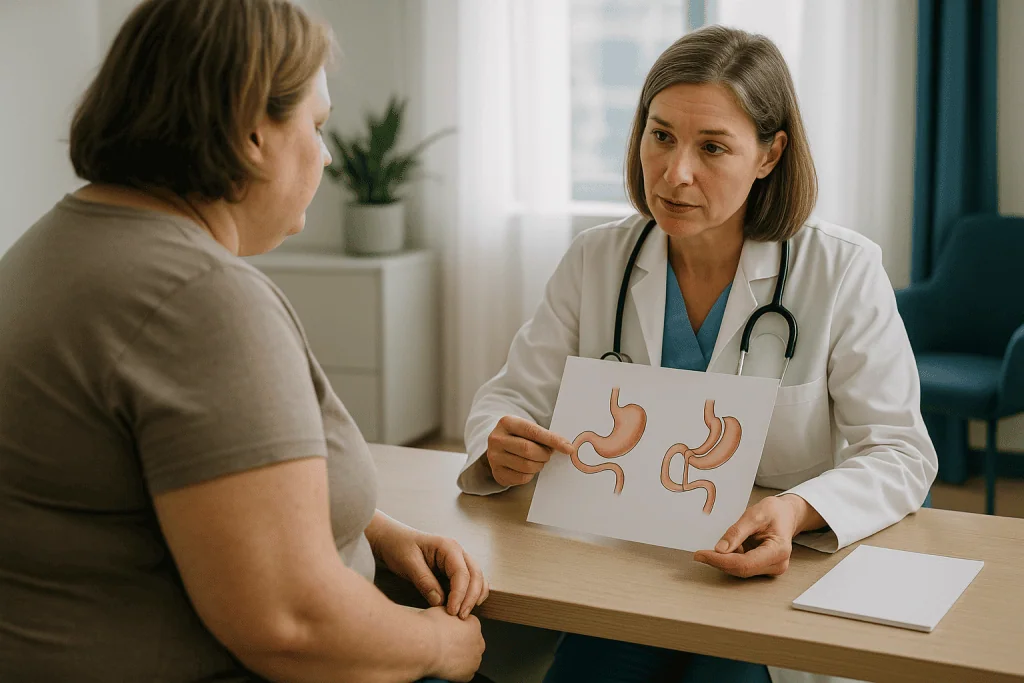
Two diagrams sit side by side on the consultation-room screen. On the left, a small stomach pouch with two neat intestinal joins drawn in red. On the right, a longer, tube-shaped pouch with only one. The surgeon asks which one you have questions about, and the honest answer is: both, because they look almost the same and apparently are not.
That single missing connection is the heart of the mini gastric bypass vs gastric bypass debate. One join instead of two sounds like a shortcut, and in some ways it is: a shorter operation, one fewer place for a leak to occur. But it also reroutes bile and digestive juices differently, and that has consequences for reflux, nutrition, and how the operation can be revised later.
Neither drawing is the obviously better one. Each trades one set of risks for another, and the trade only makes sense in the context of a specific person: their reflux history, their diabetes, their body, and the follow-up they can realistically keep up for life.
Mini gastric bypass vs gastric bypass: what is actually different on the operating table?
Both operations are versions of the same idea. A bypass shrinks the working part of the stomach so you feel full sooner, then reroutes food past a section of small intestine so fewer calories and nutrients are absorbed. A surgical connection between two parts of the gut is called an anastomosis, and the number of these joins is the defining difference.
In the standard operation, known as the Roux-en-Y gastric bypass, the surgeon creates a stomach pouch roughly the size of an egg, cuts the small intestine, and brings one end up to the pouch (the first join). The other end, which carries bile and pancreatic juice from the bypassed stomach, is then reattached further down the intestine (the second join). Seen from above, the rerouted bowel forms a Y, which is where the name comes from.
In the mini gastric bypass, the pouch is made long and narrow rather than small and round, and the surgeon simply loops a length of small intestine up to it and attaches it with a single join. No second cut, no second connection. Food and digestive juices meet at that one point.
The mechanical differences that follow are modest but real:
- One join means one fewer staple line that can leak, and typically a shorter operation under anesthesia.
- The longer bypassed segment in the mini version tends to increase malabsorption, meaning less of what you eat is taken up by the body.
- A single loop leaves no free-floating cut end of bowel, which changes the pattern of later complications such as internal hernia.
Everything else in this article flows from those three facts, so it is worth holding them in mind.
Why is it called a one anastomosis gastric bypass, and where does the food go?
Most surgical societies now prefer the term one anastomosis gastric bypass, often shortened to OAGB, because ‘mini’ undersells what happens inside. The operation is not smaller in effect; it is simpler in construction.

Picture the stomach as a tall room. The surgeon builds a partition running most of its height, creating a narrow corridor along one side that food will travel down. The larger room behind the partition is sealed off from food but keeps producing acid and stays connected to the duodenum, the first part of the small intestine, where bile and pancreatic enzymes arrive. That larger room is not removed. It is left in place, functioning, just no longer on the route.
At the bottom of the corridor, a loop of small intestine is stitched on. Food exits the corridor and enters this loop, joining the stream of bile and enzymes that have already traveled down through the bypassed stomach and duodenum. Digestion and absorption then happen along the remaining intestine.
Because the bypassed segment before that join is usually longer than in the standard operation, a greater stretch of intestine is taken out of the absorption process. The NHS explains that gastric bypass works both by restricting how much you can eat and by reducing how much is absorbed; the mini version leans slightly harder on the second mechanism.
The key anatomical point for later sections is this: in a single-loop design, bile reaches the join right beside the stomach pouch. There is nothing diverting it away. In some people it stays where it should. In others it washes back up into the pouch or esophagus, which is why bile reflux is the concern surgeons raise first when discussing this operation.
How does the standard Roux-en-Y gastric bypass work by comparison?
The Roux-en-Y has been performed for decades and is the operation most patients picture when they hear ‘gastric bypass.’ The Mayo Clinic describes it as the most commonly performed type of bypass in the United States, and much of the long-term safety data for bypass surgery in general comes from it.
The pouch here is small and rounded rather than a long tube. It holds a very limited volume of food, so fullness arrives quickly and stays. Attached to the bottom of that pouch is a length of small intestine called the Roux limb, named after the Swiss surgeon who first described the configuration. Food travels down this limb without meeting any digestive juices.
Meanwhile, the sealed-off stomach, duodenum, and the first section of small intestine, together known as the biliopancreatic limb, carry bile and enzymes down separately. The two streams merge only at the second join, some distance below the pouch. From that meeting point onward, absorption proceeds normally along what is called the common channel.
This separation is the Roux-en-Y’s design advantage. Bile has to travel down its own limb and then up the Roux limb against gravity and gut motion to reach the pouch, so bile reflux is uncommon. Acid reflux also tends to improve, because the small pouch produces little acid. Surgeons often favor this operation for people with established reflux disease, a point the Cleveland Clinic and Mayo Clinic both make.
The cost of that elegance is complexity. Two joins mean two staple lines, and the cut ends of bowel create small gaps in the supporting membrane through which loops of intestine can occasionally slip. That complication, internal hernia, appears in the next sections because it is the standard operation’s characteristic long-term risk rather than the mini’s.
Mini gastric bypass vs gastric bypass: side-by-side comparison
Tables flatten nuance, so treat this one as a map rather than a verdict. Every row is discussed in more detail elsewhere in the article, with the evidence behind it.
| Feature | Mini (one anastomosis) gastric bypass | Standard Roux-en-Y gastric bypass |
|---|---|---|
| Number of intestinal joins | One | Two |
| Stomach pouch shape | Long, narrow tube | Small, rounded pouch |
| Bypassed stomach | Left in place, still produces acid | Left in place, still produces acid |
| Operating time | Generally shorter | Generally longer |
| Main mechanism | Restriction plus greater malabsorption | Restriction plus moderate malabsorption |
| Weight loss at two years | Similar to standard in randomized comparison | Similar to mini in randomized comparison |
| Bile reflux risk | Higher | Lower |
| Internal hernia risk | Lower | Higher |
| Nutritional deficiency risk | Higher | Present, generally lower |
| Diarrhea and loose stools | More frequently reported | Less frequently reported |
| Effect on existing acid reflux | May worsen or persist | Often improves |
| Reversal or conversion | Possible; usually converted to Roux-en-Y | Possible but complex |
| Length of published follow-up | Shorter | Longer |
Two rows deserve emphasis. Weight loss, the outcome most people fixate on, is the one where the operations look most alike. The rows on reflux and nutrition, which patients tend to ask about less, are where they diverge and where a surgeon’s recommendation is usually anchored.
The final row matters too. A procedure with a longer track record is not automatically safer, but it does mean rarer late problems have had more time to surface and be counted.
Who is each operation usually for, and who is usually asked to wait?
Eligibility for bypass surgery of either kind rests on the same foundation. The NHS sets out the usual thresholds: a body mass index (BMI, a ratio of weight to height) of 40 or more, or a BMI of 35 to 40 together with a weight-related condition such as type 2 diabetes or high blood pressure that surgery could help. Candidates are expected to have tried structured lifestyle approaches first and to commit to lifelong follow-up.
Choosing between the two designs then comes down to individual factors that a surgical team weighs together:
- Reflux history. Someone with established acid reflux, a hiatal hernia, or Barrett’s esophagus (precancerous change in the lining of the esophagus) is often steered toward the Roux-en-Y, because the single-loop design can leave reflux untreated or introduce bile reflux.
- Diabetes. Both operations affect blood sugar control quickly, often before much weight is lost, through hormonal changes in the gut. Neither has a clear advantage established in guidelines.
- Previous abdominal surgery or dense scarring. A simpler operation with one join may be technically easier, which can tip a decision.
- Ability to maintain supplements and follow-up. Greater malabsorption in the mini version raises the stakes of missed vitamins and blood tests.
Some people are asked to wait rather than refused outright. Uncontrolled psychiatric illness, active substance use, untreated eating disorders, pregnancy or plans for pregnancy within the next year or so, and unmanaged conditions that make anesthesia risky are typical reasons for a pause. These are not judgments; they are attempts to line up the surgery with the point at which it is most likely to help and least likely to harm.
The NHS also notes that assessment involves a team, commonly including a dietitian and psychologist, not a surgeon alone. That breadth is a feature. It is meant to catch the reasons a particular operation might not suit you before the operation, not after.
What are the downsides of a mini gastric bypass procedure?
Fewer joins does not mean fewer problems, only different ones. Three stand out.
Bile reflux comes first. Bile is the digestive fluid made by the liver to break down fat, and in the single-loop design it arrives at the join directly beside the pouch. If it flows upward, it irritates the lining of the pouch and esophagus. Unlike acid reflux, bile reflux responds poorly to the acid-suppressing medicines many people know, because acid is not the culprit. Symptoms can include burning, a bitter taste, and nausea. Whether long-standing bile exposure raises the risk of cellular changes in the esophagus over decades is a genuine unknown; the evidence to answer it does not yet exist, and honest surgeons say so.
Nutritional shortfall comes second. A longer bypassed segment means less iron, calcium, vitamin B12, vitamin D, and protein is absorbed. In the YOMEGA randomized trial comparing the two operations, nutritional complications were substantially more common in the one-anastomosis group over two years, alongside more diarrhea. The NHS describes lifelong vitamin and mineral supplements as a requirement after any bypass; after the mini version, the margin for skipping them is narrower.
Loose stools and malnutrition come third. Excess malabsorption can produce persistent diarrhea, fatty stools, and in a minority of people protein deficiency serious enough to need surgical revision. Surgeons adjust the length of the bypassed limb to reduce this, and technique has evolved, but it remains the reason some centers are cautious.
Shared risks apply as well. Marginal ulcers, which are sores at the join where pouch meets intestine, occur after both operations and are strongly linked to smoking and anti-inflammatory painkillers. Leaks, bleeding, and blood clots are early risks of any bypass. The mini version does not remove these; it changes the arithmetic around them.
What are the downsides of the standard gastric bypass?
The Roux-en-Y’s problems are the mirror image: it solves the bile question by adding complexity, and complexity has its own bill.
Internal hernia is the signature late complication. When the bowel is cut and rerouted, small openings are created in the mesentery, the fan of tissue that carries blood vessels to the intestine. Years later, sometimes after significant weight loss has loosened that tissue, a loop of bowel can slip through one of these openings and become trapped. The result is sudden, severe cramping abdominal pain, often with vomiting. It is a surgical emergency, and it is one reason people who have had a Roux-en-Y are told never to shrug off unexplained abdominal pain, even a decade on. The single-loop design creates fewer such openings, which is its main structural advantage.
Dumping syndrome is more strongly associated with the Roux-en-Y, though it can follow either operation. The term describes what happens when sugary or rich food passes too quickly from the small pouch into the intestine: cramping, sweating, racing heartbeat, diarrhea, and sometimes a later dip in blood sugar. MedlinePlus lists it among the expected adjustments after bypass surgery. Most people learn to manage it through eating patterns, and it tends to ease with time, but it can be miserable in the first year.
Two joins also mean two potential leak sites in the early days, and a longer time under anesthesia. Whether that translates into a measurable difference in early complications is debated; large series show both operations are performed safely in experienced hands, and randomized comparison did not find a clear early-safety winner.
The Roux-en-Y shares the mini’s exposure to marginal ulcers, vitamin deficiencies, gallstones during rapid weight loss, and the psychological adjustment that any major bariatric operation demands. Its list is not shorter. It is simply weighted differently.
What does the evidence actually show when the two are compared head to head?
Most of what is written online about this comparison comes from single-center case series, where the surgeons reporting the results are also the surgeons who chose the operation. That does not make the data worthless, but it makes it optimistic. Randomized trials are the corrective.
The largest randomized comparison to date is the YOMEGA trial, a multicenter study in which adults eligible for bypass were assigned by chance to either a one-anastomosis or a Roux-en-Y procedure and followed for two years. Its headline finding was non-inferiority: the mini bypass produced weight loss, measured as loss of excess BMI, that was not worse than the standard operation. Improvements in blood sugar and other metabolic markers were broadly comparable.
The secondary findings were less flattering. Nutritional complications, including deficiencies and diarrhea-related problems, were markedly more frequent after the one-anastomosis procedure, and a small number of participants needed conversion to a Roux-en-Y because of severe malnutrition or intolerable bile reflux. The trialists concluded that the mini version was an acceptable alternative on weight and metabolic grounds but flagged the nutritional signal as a reason for caution and for careful follow-up.
What the evidence cannot yet tell you is what happens at ten or twenty years. The Roux-en-Y has decades of observational follow-up; the one-anastomosis design has considerably less. Questions about long-term esophageal health after chronic bile exposure remain open, not because the answer is known to be bad, but because the time has not passed.
Honest summary: for weight and diabetes, the two operations look similar over the medium term. For side-effect profile, they differ in ways that are predictable from their anatomy. For the very long term, one has data and the other has extrapolation.
Is mini gastric bypass reversible, and what does revision usually involve?
Yes, in the sense that the bypassed stomach is still there and the rerouting can be undone. No, in the sense that reversal is a major operation with its own risks, and it is rarely done simply because someone changes their mind.
Because nothing is removed in either type of bypass, both are technically reversible. The staple partition in the stomach can be reconnected and the intestinal join taken down. In practice, surgeons reserve full reversal for serious complications: severe protein malnutrition that does not respond to nutritional support, intractable bile reflux, or persistent hypoglycemia (low blood sugar) that cannot be managed medically. The NHS notes that bariatric operations should be regarded as permanent when deciding whether to have them, and that framing is deliberate.
More common than reversal is conversion. The most frequent revision after a mini gastric bypass is to convert it into a Roux-en-Y, adding the second join so bile is diverted away from the pouch. This resolves bile reflux in most people who undergo it and can reduce excess malabsorption if the limb lengths are adjusted at the same time. The single-loop anatomy makes this conversion relatively straightforward, which some surgeons count as a point in the mini’s favor: if it goes wrong, the fix is a known operation.
Revising a Roux-en-Y is a different matter. Options include lengthening or shortening limbs, repairing the pouch, or in rare cases reversing entirely, and each is technically demanding because of the scar tissue and altered blood supply left by the first surgery.
For someone weighing the two designs, the practical implication is this: the mini bypass is not a trial run, but it is an operation whose commonest failure mode has an established remedy. That is a small comfort, not a reason to expect revision.
Mini bypass vs gastric sleeve: how does the single-join bypass compare with the sleeve?
People searching this comparison often end up asking a broader question: why have any bypass at all when the sleeve exists? The sleeve gastrectomy removes roughly the outer three-quarters of the stomach, leaving a banana-shaped tube, and reroutes nothing. It has become the most frequently performed bariatric operation in many countries, according to the NIDDK.
The sleeve’s appeal is simplicity. No intestinal join, no malabsorption, lower rates of vitamin deficiency, no internal hernia risk, and no dumping syndrome. Its drawbacks are that it is irreversible, because the removed stomach cannot be put back, and that it can worsen or trigger acid reflux in a meaningful minority of people, since the remaining tube is high-pressure and holds acid against the lower esophagus.
Set against that, either bypass generally produces somewhat greater weight loss and stronger effects on type 2 diabetes in observational and trial data, at the price of nutritional complexity. The mini bypass, with its greater malabsorption, sits at the far end of that trade: potentially the largest metabolic effect of the three, and the most demanding to live with nutritionally.
Reflux often decides between them. Someone with troublesome acid reflux is frequently advised against a sleeve and toward a Roux-en-Y. Someone with no reflux, a very high BMI, and diabetes may be offered a mini bypass or Roux-en-Y as a first operation. Someone who prioritizes the lowest nutritional burden and has no reflux may be well matched to a sleeve.
The question ‘what is better, sleeve or mini bypass?’ therefore has no general answer. It has a personal one, and the person best placed to give it is the surgeon who has seen your endoscopy results.
What do the days and weeks after either bypass usually look like?
The two operations feel almost identical from the patient’s side in the first month. Both are performed laparoscopically, through several small incisions, and the NHS describes a typical hospital stay of a few days, with some centers discharging sooner when recovery is uneventful.
The first days are about walking, sipping, and breathing. Getting out of bed early reduces the risk of blood clots in the legs, which is why nurses will have you moving within hours. Pain is usually managed with oral medicines by the time you go home. Nausea is common and generally settles.
Eating follows a staged pattern that the NHS outlines in broad terms: clear fluids first, then thicker liquids and purees, then soft foods, working toward ordinary textures over about six weeks. Portions are tiny, because the pouch is tiny, and the habit of eating slowly and stopping at the first sign of fullness has to be learned deliberately. Vomiting after eating too fast or too much is a frequent early lesson.
Most people return to desk-based work within a few weeks; the NHS suggests planning for several weeks off, longer for physically demanding jobs. Heavy lifting is usually restricted for around six weeks to let the incisions heal.
Differences between the two operations start to show after this window. Loose stools and urgency are reported more often after the mini bypass as the intestine adapts to its new workload. A bitter taste or burning that does not respond to acid reducers can signal bile reflux and should be reported. After a Roux-en-Y, dumping symptoms after sweet or fatty foods tend to surface as the diet widens.
Weight falls fastest in the first six months after either operation and slows thereafter, a curve the Mayo Clinic describes as typical for bypass surgery in general.
What does long-term follow-up involve, and why does it matter more after a mini bypass?
Bypass surgery is not an event; it is the start of a relationship with a clinical team that is meant to last for life. The NHS is explicit that people who have had weight-loss surgery need lifelong follow-up and lifelong vitamin and mineral supplements. The reasons are mechanical, not motivational.
A bypassed stomach and duodenum are where much of the body’s iron, calcium, and vitamin B12 absorption normally happens. Route food past them and those nutrients come up short regardless of how well you eat. Deficiencies build quietly: anemia that shows up as fatigue, bone thinning that shows up years later as a fracture, B12 shortage that shows up as numbness or memory problems. Blood tests at regular intervals, usually more frequent in the first two years and then annually, are how these are caught before they cause harm.
After a mini gastric bypass, the longer bypassed limb means more of the small intestine is out of action, so deficiencies can develop faster and run deeper. Protein malnutrition, uncommon after a Roux-en-Y, is a recognized concern after the one-anastomosis design and is one of the main reasons for conversion surgery. Teams following mini-bypass patients often monitor protein levels and weight loss trajectory closely to spot excessive malabsorption early.
Follow-up also covers the things no blood test catches. Adjustment to a body that changes shape quickly, the return of hunger after the first year, alcohol handling (which changes markedly after bypass), and the gradual creep of weight regain in some people all belong in these appointments.
What supplements you take, at what strength, and how often you are tested are decisions for your prescribing team based on your results. The principle that applies to everyone is simpler: the operation reroutes your gut permanently, so the monitoring has to be permanent too.
What people often get wrong about mini gastric bypass vs gastric bypass
Several ideas circulate so widely that they deserve direct correction.
‘Mini means a smaller or gentler operation.’ It means one fewer join. The pouch is longer, the bypassed intestine is usually longer, and the malabsorptive effect is stronger. Recovery time is similar, and the nutritional demands afterward are greater, not smaller.
‘Fewer connections means fewer complications overall.’ Fewer joins do reduce certain risks, notably internal hernia and possibly early leak. They increase others, chiefly bile reflux and nutritional deficiency. The total burden shifts rather than shrinks.
‘The bypassed stomach is removed.’ In both operations the larger part of the stomach stays inside the body, still making acid, still connected to the duodenum. This is why both are theoretically reversible and why the excluded stomach can occasionally be the site of problems that are hard to examine by endoscopy.
‘The mini bypass is new and experimental.’ The one-anastomosis design has been performed for many years and is recognized by major bariatric societies as an accepted procedure. What it lacks is the multi-decade follow-up of the Roux-en-Y, which is a different thing from being unproven.
‘Acid reflux medicines will control bile reflux.’ They will not, because bile is not acid. Persistent bitter reflux after a mini bypass needs assessment, not a stronger acid reducer.
‘You can choose the operation the way you choose a phone.’ Patient preference matters, but the anatomy found on your endoscopy, your reflux history, and your surgeon’s experience with each technique properly shape the recommendation. A surgeon who performs one operation far more often than the other is likely to achieve safer results with it, and that is legitimate information to ask for.
‘Weight loss is the whole story.’ Over two years the two operations produce comparable weight loss. The decision is really about which side-effect profile you would rather live with.
Questions to ask your care team before choosing
A consultation is short and the decision is permanent, so it helps to walk in with a list. These questions are designed to surface the factors that actually distinguish the two operations for you.
- Have I had an endoscopy, and did it show reflux damage, a hiatal hernia, or Barrett’s esophagus? How does that finding shape your recommendation?
- Which of the two operations do you perform more often, and what is your own experience with each?
- If you recommend the mini bypass, how will bile reflux be monitored, and what would prompt a conversion to Roux-en-Y?
- If you recommend the Roux-en-Y, what symptoms of internal hernia should I know for the rest of my life?
- How long a segment of intestine do you plan to bypass, and how do you decide that for an individual patient?
- What blood tests will I have, how often, and who follows the results if I move or change doctors?
- What does the dietitian’s follow-up look like at one, two, and five years?
- How would either operation affect a future pregnancy, and how long would you advise waiting?
- Which medicines that I currently take might be absorbed differently after each operation?
- What would make you choose a sleeve gastrectomy for me instead of either bypass?
Write down the answers. Ask for them in plain language if they arrive in jargon. A team that welcomes these questions is telling you something about how it will handle the follow-up years, which is where most of the long-term difference between these two operations is actually managed.
The final choice rests with your treating team, informed by your preferences. Your job is to make sure they know what you fear most and what you can realistically maintain.
When to call your doctor after a mini or standard gastric bypass
Most recovery days are uneventful. A small number are not, and the difference between a complication managed early and one managed late can be large. The NHS and Mayo Clinic both advise contacting your surgical team without delay if any of the following appear.
In the first weeks, seek urgent care for:
- Fever, chills, or a racing heart, which can signal a leak at a staple line or join.
- Worsening abdominal pain, especially with a rigid or swollen abdomen.
- Persistent vomiting or inability to keep fluids down for more than a day, which risks dehydration.
- Redness, warmth, or discharge from an incision.
- Calf pain or swelling in one leg, or sudden breathlessness or chest pain, which can indicate a blood clot.
- Black or bloody stools, or vomiting blood.
At any point after surgery, including years later, contact your team for:
- Sudden severe cramping abdominal pain, particularly after a Roux-en-Y, since internal hernia is a surgical emergency.
- Burning or bitter reflux that does not settle with the measures your team advised, particularly after a mini bypass.
- Persistent diarrhea, fatty stools, or unexplained rapid weight loss beyond what your team expects.
- Numbness, tingling, unusual fatigue, or hair loss, which may reflect vitamin or protein deficiency.
- Episodes of shakiness, sweating, or confusion after meals, which may indicate low blood sugar.
- Low mood, changes in alcohol use, or a return of disordered eating patterns.
Anyone who has had bypass surgery should also tell every clinician they meet about it, including emergency staff. Some medicines are absorbed differently, some imaging is interpreted differently, and a doctor who does not know your anatomy has been rerouted may miss the diagnosis that matters.
When in doubt, call. Surgical teams would far rather hear about a symptom that turns out to be nothing than learn about one late.
Frequently asked questions
Is a mini gastric bypass worth it?
It can be a reasonable choice for the right person, but ‘worth it’ depends on which risks you would rather carry. Randomized data show weight loss comparable to a standard bypass over two years, with a shorter operation and lower internal hernia risk, set against more bile reflux, diarrhea, and nutritional deficiency. Someone with no reflux who can commit to lifelong supplements and monitoring may find the balance favorable; someone with reflux disease usually will not.
Can a mini gastric bypass be reversed?
Yes, technically, because the bypassed stomach is left in place and the single join can be taken down. In practice full reversal is reserved for serious problems such as severe malnutrition or intractable bile reflux. Far more common is conversion to a Roux-en-Y bypass, which adds a second join to divert bile away from the pouch. Both are major operations, so the mini bypass should be approached as permanent.
What are the downsides of a mini gastric bypass procedure?
The main downsides are bile reflux, greater vitamin and protein malabsorption, and more frequent loose stools, all consequences of a single join placed beside the pouch and a longer bypassed segment of intestine. Shared bypass risks such as marginal ulcers, leaks, and gallstones also apply. Long-term data on the effects of chronic bile exposure on the esophagus are still limited compared with the standard operation.
What is better, gastric sleeve or mini bypass?
Neither is better in general; they suit different people. The sleeve removes part of the stomach and reroutes nothing, so nutritional risk is lower but it is irreversible and can worsen acid reflux. The mini bypass produces stronger metabolic effects and somewhat greater weight loss in most series, at the cost of malabsorption and bile reflux risk. Reflux history, BMI, diabetes, and your surgeon’s experience usually decide between them.
Does the mini gastric bypass cause less weight loss than the standard bypass?
No. In the largest randomized comparison, weight loss measured as excess BMI loss at two years was not inferior after a one-anastomosis bypass compared with a Roux-en-Y, and improvements in blood sugar were broadly similar. Longer-term comparisons are still accumulating. Individual results vary widely with either operation and depend heavily on diet, activity, and follow-up rather than on the number of joins alone.
Why does the one anastomosis gastric bypass cause bile reflux?
Because the single loop of intestine attached to the pouch also carries bile and pancreatic juice from the bypassed stomach and duodenum. With nothing diverting that stream away, bile can wash upward into the pouch and esophagus. In the Roux-en-Y, bile travels down a separate limb and meets food only further along, so it rarely reaches the pouch. Bile reflux is not relieved by acid-reducing medicines.
Is the mini gastric bypass safer than the standard gastric bypass?
Not clearly. It has one fewer staple line and a lower risk of internal hernia, and the operation is generally shorter. It carries higher risks of bile reflux and nutritional complications. Randomized comparison found no decisive early-safety advantage for either design. Overall safety depends heavily on the surgical team’s experience with the specific technique and on how well follow-up is maintained afterward.
How long is recovery after a mini gastric bypass compared with a Roux-en-Y?
Early recovery is nearly identical. Both are keyhole operations with a hospital stay of a few days, a staged diet progressing from liquids to normal textures over about six weeks, and several weeks away from work. Differences emerge later: loose stools and bile reflux are more often reported after the mini version, while dumping syndrome is more typical after a Roux-en-Y as the diet broadens.
Do I need vitamins for life after either type of gastric bypass?
Yes. Both operations route food past the parts of the gut where iron, calcium, and vitamin B12 are normally absorbed, so supplements and regular blood tests are lifelong requirements according to the NHS. The mini bypass bypasses a longer intestinal segment, so deficiencies can develop faster and protein malnutrition is a recognized concern. Which supplements and how often you are tested are decisions for your prescribing team.
Is the mini gastric bypass a new or experimental operation?
No. The one-anastomosis gastric bypass has been performed for many years and is recognized as an accepted bariatric procedure by major surgical societies. What it lacks is the multi-decade follow-up data that exist for the Roux-en-Y, which has been performed far longer. Shorter follow-up means rarer late complications have had less time to be counted, not that the operation is unproven.
References
- NHS: Weight loss surgery: overview
- NHS: Weight loss surgery: risks
- MedlinePlus: Gastric bypass surgery
- NIH NIDDK: Types of weight-loss surgery
This article is for general information only and is not a substitute for professional medical advice. Please consult a qualified doctor about your individual situation.

More from the Blog

Long-Term Obesity Management: How Follow-Up Visits Keep Lifestyle Changes on Track
Long term obesity management works best as ongoing care rather than a single push. Regular follow-up visits let a care team track weight, waist…

Gastric Bypass vs Gastric Sleeve: Why Reflux, Diabetes and Eating Habits Shape the Choice
For people with established acid reflux, gastric bypass is usually favored over a gastric sleeve, because the small pouch produces little acid and the…

Recovery After Robotic Bariatric Surgery: Walking, Sipping Fluids and the Staged Diet
Robotic bariatric surgery recovery time is usually similar to conventional laparoscopic (keyhole) surgery: a hospital stay of about one to two days, walking within…

Which Symptoms After Bariatric Surgery Are Expected and Which Mean Calling Your Surgeon?
After bariatric surgery, incision soreness, shoulder-tip gas pain, fatigue, mild nausea and changing bowel habits are expected and usually ease over the first weeks.…

Eating With a Gastric Balloon: From Liquids to Regular Meals Under Dietitian Guidance
Eating with a gastric balloon follows a staged plan: clear liquids for roughly the first day, full liquids through the first week, then pureed…

Can Metabolic Syndrome Be Reversed? What Realistic Progress Looks Like at Follow-Up Visits
Metabolic syndrome can often be reversed in the sense that matters clinically: when enough of its five measures return to a healthy range, a…