

PAO Recovery Timeline: Crutches, Partial Weight-Bearing and the Physical Therapy Phases

Key Takeaways
- A periacetabular osteotomy repositions your own hip socket over the femoral head and holds it with screws, so bone must heal before the hip can carry full weight.
- Protected weight-bearing on two crutches typically lasts around six to eight weeks, with progression decided by X-ray evidence of healing rather than by how the hip feels.
- Physical therapy follows a fixed sequence, protect, then load, then strengthen, then return to impact, and skipping the middle steps is what leaves people with a limp a year later.
- The worst pain is usually the first one to two weeks at home; by the third or fourth week most people report pain mainly with movement rather than at rest.
- Numbness over the outer thigh after PAO comes from a sensory nerve in the incision area and does not affect movement, though it can persist for months.
- Hip-replacement precautions such as a ninety-degree bending limit generally do not apply after PAO, because the joint itself is not dislocated during the operation.
A typical PAO recovery timeline runs in phases: a hospital stay of several days, protected weight-bearing on crutches for roughly six to eight weeks while the cut pelvic bone knits, a gradual return to full weight and normal walking over the following months, and strengthening that often continues toward the one-year mark. Exact timing depends on bone healing seen on X-ray and on the surgeon's protocol.
The night before surgery, most people are not thinking about the hip at all. They are thinking about the stairs to their bedroom, the dog that needs walking, the car with a manual gearbox, and the calendar they have quietly cleared without knowing how many squares to cross off. That is the real question behind almost every message in a hip dysplasia forum: not whether a periacetabular osteotomy works, but what the weeks afterward actually feel like.
The honest answer is that the pao recovery timeline is long, unglamorous and surprisingly predictable. Bone heals at bone’s pace, not at the pace of motivation. Crutches stay longer than most people expect, and physical therapy is less about heroics than about relearning how to stand on one leg without a limp.
What follows is the version a seasoned orthopedic physical therapist might sketch on a whiteboard for you: the phases, the milestones, the numbers that have evidence behind them, and the parts nobody warns you about.
What a periacetabular osteotomy actually does to the hip
Hip dysplasia means the socket of the hip, the acetabulum, is too shallow to cover the ball of the femur properly. Picture a golf ball resting on a saucer instead of sitting in a cup. Because less of the socket’s surface shares the load, the cartilage along the rim carries far more pressure than it was built for, and over years that edge wears and the labrum, the ring of cartilage sealing the joint, can tear. The Mayo Clinic describes this shallow-socket anatomy and its link to early joint wear in adults.
A periacetabular osteotomy, usually shortened to PAO, is an operation that cuts the pelvic bone around the socket so the socket itself can be rotated into a position that covers the ball more completely. “Osteotomy” is simply the medical word for a controlled surgical cut in bone. The surgeon makes a series of cuts around the acetabulum, leaving the back of the pelvis intact so the pelvic ring remains stable, then tilts and swings the freed socket into its new orientation and fixes it there with screws.
Two things about that description drive the entire recovery. First, the socket is now held by screws, not by healed bone, so those cuts have to fill in before the hip can safely take full body weight. Second, several muscles and tendons around the front of the hip are moved aside or released to reach the bone, which is why the early weeks feel more like recovering from a deep muscle injury than from a joint replacement. The joint surfaces themselves are not replaced; the goal is to reposition a person’s own socket over their own femoral head so the cartilage that remains is protected for as long as possible.
Is PAO considered a major surgery?
Yes, by any reasonable clinical definition. A PAO is performed under general or regional anesthesia, involves cutting the pelvis in several places, carries a meaningful risk of blood loss, and typically requires an inpatient stay measured in days rather than hours. Academic orthopedic centers such as Johns Hopkins describe it as a major reconstructive procedure reserved for hips where the cartilage is still healthy enough to be worth preserving.
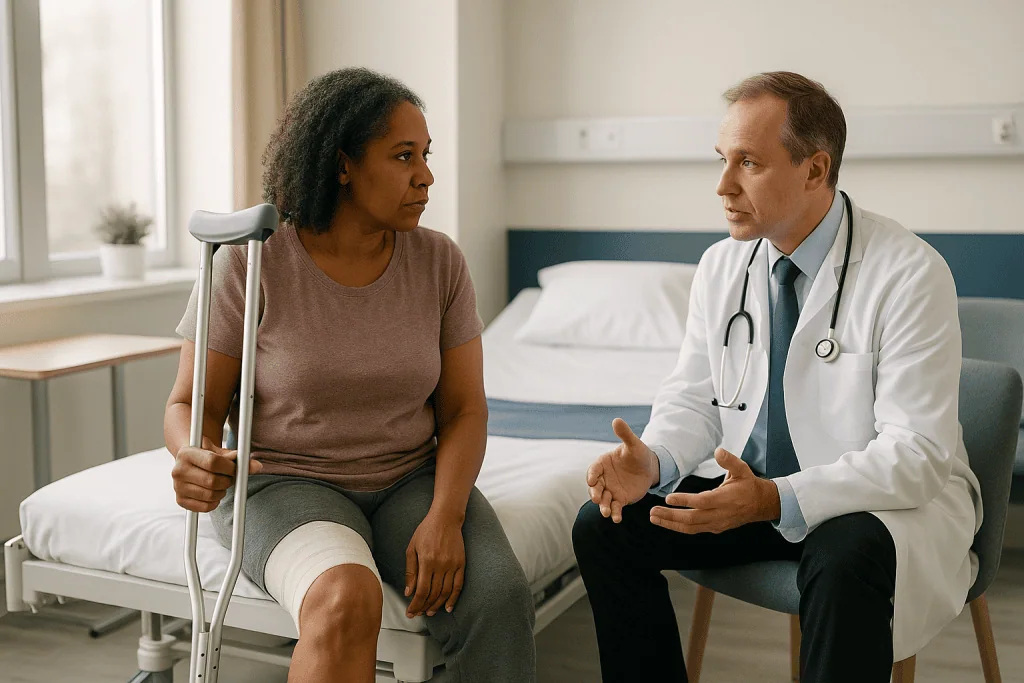
It helps to place it on a familiar scale. Arthroscopy, a keyhole procedure with small incisions, sends most people home the same day. A total hip replacement is also major surgery, but the bone around a modern implant is designed to take weight within a day or two, so people often walk with a frame almost immediately. A PAO sits in a different category: the hardware is holding freshly cut bone in a new position, so protected weight-bearing is not a comfort measure, it is a structural requirement.
Calling something major surgery is not fear-mongering. It sets expectations for the anesthetic risks that apply to any long operation, for the possibility of a blood transfusion, and for the nerve stretch, deep vein thrombosis and wound problems that any pelvic surgery can involve. The NHS and the CDC both note that immobility after major orthopedic surgery is one of the strongest risk factors for blood clots, which is why early movement, calf pumps and clot-prevention measures are built into every PAO pathway.
The practical upshot for planning: expect to organize the sort of help you would arrange after any major abdominal or pelvic operation, including someone at home during the first week or two, sleeping arrangements that avoid stairs if possible, and time off work that is counted in weeks.
Who is usually offered PAO, and who is asked to wait or consider something else
The ideal candidate, in guideline-level terms, is a skeletally mature adolescent or adult with symptomatic acetabular dysplasia whose joint still has good cartilage. “Skeletally mature” means the growth plates have closed, which is why the operation is not done in young children, whose dysplasia is managed with braces, casting or different pelvic procedures described by MedlinePlus and the NHS.
Surgeons look at three things when deciding. The first is symptoms: groin pain with activity, a feeling of the hip giving way, or a limp that has not settled with physical therapy. The second is imaging: standing X-rays that measure how much of the femoral head the socket covers, and often MRI to assess cartilage and the labrum. The third is the state of the joint surface. If X-rays already show narrowing of the joint space or bone spurs, the Mayo Clinic notes that repositioning the socket is less likely to help, because the cartilage the operation is meant to protect has already worn away.
People commonly asked to wait or take a different path include:
- Those whose symptoms are mild and controlled with strengthening, activity changes and time, where surveillance is reasonable.
- Those whose imaging shows moderate to advanced arthritis, for whom hip replacement may be the more predictable option.
- Those with medical conditions that raise anesthetic or clotting risk until those are optimized.
- Those who smoke, because nicotine slows bone healing and many surgeons ask for a period of abstinence first.
Age is a factor but not a cutoff. Younger patients tend to have healthier cartilage, but decisions rest on the joint, not the birthday. None of these criteria are rules a patient can apply alone; they are the questions the treating team weighs together, and a second opinion is a normal part of the process.
The PAO recovery timeline at a glance
Every surgeon publishes a slightly different protocol, and the ranges below are drawn from patient information published by academic orthopedic programs and from the broad literature on bone healing. Treat them as a map, not a schedule. Your own timeline is set by X-rays, pain, strength and your surgeon’s judgment.

| Phase | Typical window | What usually defines it |
|---|---|---|
| Hospital stay | About 2 to 5 days | Pain controlled with oral medicine, safe transfers, stairs with crutches if needed at home |
| Protected weight-bearing | Roughly 6 to 8 weeks | Two crutches, only the surgeon’s permitted percentage of body weight through the operated leg |
| Progression to full weight | Weeks 6 to 12 | X-ray shows bone filling the cuts; one crutch, then a cane, then none |
| Strength and gait retraining | Months 3 to 6 | Limp fades, single-leg balance returns, stairs feel normal |
| Return to higher-impact activity | Often 6 to 12 months | Symmetrical strength, surgeon clearance for running or sport |
Two patterns are worth noticing. The phases overlap rather than switch cleanly, and the middle of the table, the crutch-to-cane transition, is where most people feel stuck because progress becomes gradual rather than dramatic. Johns Hopkins and similar centers describe full recovery as commonly taking most of a year, which surprises anyone who assumed that leaving the crutches behind meant being done.
The other pattern is that the early markers are about safety and the late markers are about quality. Nobody is checking whether you can jog at week eight; they are checking whether the bone is strong enough to trust. Only later does the conversation turn to how well you move.
The first days: what the hospital stay usually looks like
Most people wake from a PAO with the operated leg feeling heavy and strange rather than sharply painful, because a regional anesthetic block or an epidural is often used alongside the general anesthetic. As that wears off over the first day, the deep ache in the front of the hip and the outer thigh settles in. This is the period when pain is managed with a combination of approaches, described in more detail below, and when the team is watching blood counts, because PAO can involve significant blood loss and some patients receive a transfusion.
Physical therapy usually begins on the first day after surgery, sometimes within hours. That sounds alarming until you learn what it involves: sitting on the edge of the bed, standing with a frame or two crutches, and taking a few steps with strict instructions about how much weight the operated foot may take. The Cleveland Clinic and Johns Hopkins both describe this early mobilization as routine, partly because it lowers the risk of blood clots and lung complications and partly because learning the weight-bearing rule is easier when a therapist is standing beside you.
Common features of these first days include:
- Compression stockings or calf pumps and, frequently, a blood-thinning medicine to reduce clot risk.
- A urinary catheter for the first day or so if an epidural was used.
- Practicing toilet transfers, getting into a car seat and, if your home needs it, stairs on crutches.
- Numbness or tingling over the outer thigh, from the skin nerve that runs through the surgical field.
Discharge is not tied to a fixed day. It comes when pain is controlled with oral medicine, when bowel function is returning, and when the therapist is satisfied you can move safely at the permitted weight. For most people that lands within the first week, but a slower start is not a sign that something has gone wrong.
How long on crutches after PAO, and why the answer is about bone, not willpower
The most common frustration in PAO recovery is that crutches stay far longer than intuition suggests, usually around six to eight weeks on two crutches, with a gradual wean afterward. Some protocols are shorter and some longer, but almost none allow unrestricted walking in the first month.
The reason is mechanical. Bone heals in stages: a blood clot forms in the cut, soft callus of cartilage-like tissue bridges the gap over the first weeks, and only then does that callus mineralize into hard bone strong enough to share load with the screws. Until the callus hardens, every full-weight step is asking a handful of screws to carry the entire body through a repositioned block of pelvis. The screws are strong, but they are not designed to do that job indefinitely, and loss of position or hardware failure is a recognized complication of loading too early.
Crutches also protect the soft tissue. The muscles at the front of the hip were moved or released to reach the bone, and asking them to stabilize the pelvis at full stride before they have reattached invites a painful, persistent limp.
Practical crutch realities people wish they had known:
- Forearm or underarm crutches both work; the choice is about comfort and hand strength, and your therapist will fit them.
- Palms and wrists get sore. Padded grips help, and MedlinePlus offers a plain-language guide to crutch technique.
- Stairs go “good leg up, bad leg down,” with the crutches moving alongside the operated leg.
- The transition off crutches is a staircase, not a jump: two crutches, then one on the opposite side, then a cane, then nothing.
The date you drop the second crutch is decided by X-rays and by whether you can walk without a limp, not by the calendar or by how good you feel on a sunny morning.
Partial weight-bearing: what the instruction means and how to actually do it
“Partial weight-bearing” means putting only a specified fraction of your body weight through the operated leg, with crutches carrying the rest. Surgeons phrase the instruction differently. Some say a percentage, some say a rough weight, and some use terms such as “toe-touch” or “foot-flat,” where the foot rests on the floor for balance but is not meant to push. Ask which one applies to you and write it down, because it is the single most important rule of the first phase.
The hard part is that people are poor at judging load by feel. A therapist will often stand you with the operated foot on a bathroom scale and the other foot on a book of the same height, so you can see what the permitted load feels like and rehearse it. The sensation most people describe is “pressing down as if testing whether the floor is wet.”
Why does it matter so precisely? Bone responds to load in both directions. Too little and healing is slower and muscles waste; too much and the callus cracks or the screws work loose. Controlled partial loading is the compromise that lets the cut bone experience the gentle stress that stimulates healing without threatening the fixation.
Everyday situations that quietly break the rule include stepping into a bathtub, pivoting to close a car door, catching yourself when you stumble, and the half-asleep trip to the bathroom at night. Sit down to dress, keep a night light on, and clear rugs and cables before surgery rather than after. A single stumble rarely undoes a PAO, but a habit of cheating on the load does add up.
Hip precautions from replacement surgery, such as strict bans on bending past ninety degrees, usually do not apply after PAO because the joint itself was not opened or dislocated. Your surgeon will tell you which movements to avoid, typically active hip flexion against resistance and deep stretching in the early weeks.
The PAO physical therapy protocol, phase by phase
Physical therapy after PAO is deliberately unexciting early and progressively demanding later. Protocols differ in detail, but almost all follow the same arc, tied to bone healing and to what the muscles can safely do.
Phase one, roughly the first six weeks. The goals are protection, swelling control, gentle range of motion and keeping the rest of the body strong. Expect ankle pumps, quadriceps and gluteal squeezes, heel slides to keep the knee and hip moving, and stationary cycling without resistance once the incision allows. Therapists avoid exercises that make the hip flexor muscles at the front of the hip pull hard, because those were disturbed during surgery and tend to become irritated.
Phase two, roughly weeks six to twelve. Once X-rays show the cuts filling in, weight-bearing is advanced and the real work begins: weight shifting, standing balance, step-ups onto a low box, bridges, side-lying hip abduction and gait drills in front of a mirror. The limp that everyone develops on crutches is addressed here, before it becomes a habit. Pool walking is common where available because water unloads the joint while allowing a normal stride.
Phase three, months three to six. Strength becomes the priority: squats to a chair, lunges, single-leg stance, resistance bands, then a slow build of the gluteal and core muscles that keep the pelvis level when you stand on one leg.
Phase four, six months onward. Return to impact and sport is graded, starting with brisk walking and elliptical work, then jogging intervals, then sport-specific drills, always with the surgeon’s clearance that bone has fully consolidated.
Frequency varies from weekly to several sessions a week, with a home program in between. The evidence base for one exact protocol over another is thin; what the literature and academic center guidance agree on is the sequence, protect, then load, then strengthen, then return, and that skipping the middle steps is what produces the lingering limp people complain about a year later.
How painful is PAO recovery, honestly?
People searching this question deserve a straight answer: the first one to two weeks are hard, the ache is deep and constant rather than sharp, and it improves in a stepwise way rather than day by day. Most describe the worst period as the first several days at home, when hospital-grade pain relief has stopped and every movement in bed requires planning. By the third or fourth week, many report that pain at rest has largely gone and discomfort is mainly with movement or at the end of a long day.
The pain has a few different sources, which is why treatment is layered:
- Bone pain from the cuts, which fades as callus forms over the early weeks.
- Muscle pain and spasm from the tissue moved aside during surgery, felt in the front of the hip and thigh.
- Nerve irritation, often a burning or numb patch on the outer thigh, from the sensory nerve that crosses the surgical field. This can persist for months and sometimes permanently.
- Referred pain at the knee, the sacroiliac joint or the low back as gait changes shift load elsewhere.
Pain control typically combines several mechanisms rather than relying on one medicine. Anti-inflammatory drugs reduce the chemical signals that drive swelling; acetaminophen acts centrally on pain perception; opioid medicines are used for the shortest possible period for the most severe early pain, with the prescribing team tapering them as bone pain settles; muscle relaxants may be used briefly for spasm; and ice, elevation and positioning do more than people expect. Which of these you receive, in what combination and for how long, is a decision for your surgical and anesthetic team, and any changes should go through them.
What patients rarely hear is that pain and progress are only loosely linked. A rough week does not mean the bone is failing, and a good week does not mean it is safe to load more. The X-ray, not the pain diary, decides that.
PAO surgery recovery time for walking, driving, work and sleep
The milestones people actually plan around are rarely the ones in the surgical protocol. Here is how they typically fall, with the usual caveat that your surgeon’s clearance overrides any range on this page.
Walking. You will walk, with crutches and at restricted weight, within a day or two of surgery. Walking without any aid usually arrives somewhere between two and three months, once X-rays confirm healing and the limp has been trained out. Walking a mile comfortably tends to follow a few weeks after that.
Driving. Two rules govern this. You must not be taking sedating medicine, and you must be able to perform an emergency stop without hesitation. For a right-sided PAO with an automatic transmission, that generally means waiting until weight-bearing is unrestricted and the hip can move quickly; for a left-sided PAO with an automatic, some surgeons permit earlier driving. A manual gearbox delays either side. Ask specifically, and check your insurer’s conditions.
Work. Desk-based roles are often resumed part-time within a few weeks, ideally from home, because commuting on crutches is exhausting. Jobs involving standing, lifting or driving usually wait for the full-weight phase, commonly around three months, and heavy manual work may wait longer.
Sleep. Sleeping on the back with a pillow under the knees is the default early on. Lying on the operated side is uncomfortable for weeks, and lying on the other side needs a pillow between the knees to stop the operated hip dropping inward. Broken sleep for the first month is common and improves as night pain fades.
Sitting. Firm, higher chairs are easier than soft sofas. Long sitting stiffens the hip flexors, so a timer to stand every half hour or so, within your weight-bearing rules, pays off.
The through-line is that everyday life returns in the middle phase, months two to four, not in the first weeks and not only at the end.
Is PAO the hardest orthopedic surgery to recover from?
This question turns up constantly in patient forums, and the truthful answer is: it is among the more demanding recoveries a generally healthy young adult is likely to face, but “hardest” is not a category medicine uses, and the label does more harm than good.
What makes PAO feel harder than, say, a hip replacement is a combination of factors. The typical patient is young and active, so the contrast between normal life and eight weeks on crutches is stark. The restricted weight-bearing phase is long because bone must heal before the hip can be trusted, whereas an implant is designed to be loaded almost immediately. The soft tissue disruption at the front of the hip produces a slow-to-fade limp. And the goal is preservation rather than replacement, so improvement is gradual and the finish line is months away rather than weeks.
Set against that, the recovery is highly structured, complications are well understood, and the majority of the difficulty is front-loaded into the first two months. Compared with spinal fusion, complex trauma reconstruction or multi-ligament knee surgery, many therapists would describe PAO as demanding but predictable.
A more useful frame than “hardest” is “longest quiet stretch.” The first month is about pain and logistics. The second and third months are about patience, because the bone is healing invisibly while you feel ready for more. The months after that are about rebuilding strength you did not realize you had lost. Knowing which stretch you are in, and that each one ends, matters more for morale than any ranking of surgeries.
Where the evidence is honest about limits: PAO does not restore a normal hip, and it does not guarantee that a replacement will never be needed. It aims to relieve symptoms and slow wear in a joint that still has cartilage worth protecting, and outcomes are discussed case by case with the treating surgeon.
What people often get wrong about the PAO recovery timeline
Recovery forums are generous and well-meaning, but a few myths circulate that deserve correcting with what the evidence and mainstream guidance actually say.
“If I feel fine, I can put more weight on it.” Pain is not a reliable gauge of bone strength in the first two months. The nerve block, the medicines and the gradual fading of muscle pain all make the hip feel more ready than the X-ray shows. Weight-bearing progression is a surgical decision based on imaging.
“Off crutches means recovered.” Dropping the last crutch marks the end of the protection phase, not the end of recovery. Strength deficits and a subtle limp commonly persist for months and respond to targeted therapy, which is why academic centers describe recovery as often lasting most of a year.
“The numb patch on my thigh means nerve damage that will get worse.” Numbness over the outer thigh comes from stretching or bruising of a purely sensory nerve that runs through the incision area. It does not affect movement, often improves over months, and even when permanent is a nuisance rather than a danger.
“I should avoid bending past ninety degrees.” That precaution comes from hip replacement, where the joint was dislocated during surgery. After PAO the joint stays in place, and the restrictions are usually about active hip flexor work and deep stretching, not about a fixed angle.
“Screws always need to come out.” Screw removal is optional and done for irritation, not routinely; many people keep theirs indefinitely.
“Both hips will need this.” Dysplasia is often bilateral, but surgery is only considered for hips that are both symptomatic and structurally suitable. Many people with two dysplastic hips have one operation or none.
The correction that matters most is the first one. Almost every serious setback in PAO recovery traces back to loading too early, not too late.
Risks, setbacks and the alternatives your team may have weighed
Neutral language matters here, because both catastrophizing and minimizing distort decisions. The recognized complications of PAO fall into a few groups that guidance from academic centers and the published literature consistently list.
Early risks include bleeding severe enough to need transfusion, wound infection, and blood clots in the leg or lung, which is why early mobilization and clot-prevention measures are standard. Nerve-related problems range from the common outer-thigh numbness described above to rarer injury to the nerves that power the leg, which can cause weakness. Delayed union or nonunion, where a cut in the pelvis heals slowly or not at all, occurs in a minority of cases and is the reason weight-bearing is restricted. Heterotopic ossification, bone forming in soft tissue where it should not, can cause stiffness. Loss of correction or hardware problems are uncommon but are the direct consequence of loading before the bone has healed. Over- or under-correction of the socket position can produce new symptoms of impingement or persistent instability.
Setbacks that are not complications but feel like them include a plateau in the third month, a flare of hip flexor pain when strengthening begins, and low mood during the long middle stretch, which the NHS and Harvard Health both recognize as common after major surgery and worth mentioning to your team.
Alternatives that a surgeon weighs against PAO depend on the joint. Supervised physical therapy and activity modification remain the first step for mild symptoms. Hip arthroscopy can address a labral tear but does not correct a shallow socket, and on its own may leave the underlying instability. Total hip replacement becomes the more predictable option once arthritis is established, and it is also the operation many PAO patients eventually have years later, which is discussed openly at the outset. The right sequence for any individual is a decision that sits with the treating team, ideally with a second opinion if anything feels unclear.
Questions to ask your care team before and after surgery
Good questions do more than gather information; they reveal which parts of the plan are fixed and which are individual to you. Bring a list, and bring someone to take notes, because the first consultation after a big decision is rarely remembered accurately.
Before surgery, consider asking:
- What does my X-ray show about socket coverage and cartilage, and what makes me a candidate rather than someone you would ask to wait?
- What is your specific weight-bearing instruction after surgery, expressed in a way I can practice on a scale at home?
- How long do your patients usually stay in hospital, and what are your discharge criteria?
- Which medicines will I go home with, who manages tapering them, and who do I contact about side effects?
- What clot-prevention measures will I use, and for how long?
- Will my labrum be repaired at the same time, and does that change the therapy plan?
- What equipment should I have at home before I return: crutches, a shower chair, a raised toilet seat?
After surgery, at each follow-up:
- What does today’s X-ray show about healing, and what changes in my weight-bearing because of it?
- Which exercises should I add, and which are still off limits?
- When can I drive, return to my specific job, and sleep on my side?
- Is the numbness or pain I am describing expected at this stage?
- What would make you want to see me sooner than the next scheduled visit?
One more, often skipped: ask whether your physical therapist and surgeon communicate directly. Recovery goes more smoothly when the person adjusting your exercises has seen the same X-ray as the person who fixed the bone.
When to call your doctor
Most of PAO recovery is uncomfortable but uneventful. A small number of symptoms, however, need same-day advice from your surgical team or urgent care, because they can signal a complication that is far easier to treat early.
Contact your surgical team the same day if you notice:
- Calf pain, swelling, warmth or tenderness in either leg, which can indicate a deep vein thrombosis.
- Fever, chills, or a wound that becomes increasingly red, hot, swollen or leaks fluid or pus.
- A sudden increase in hip or groin pain, a new grinding or shifting sensation, or a clear loss of the ability to bear your permitted weight after you had been managing it.
- New weakness in lifting the foot or straightening the knee, or numbness spreading beyond the outer thigh patch you were told to expect.
- Inability to pass urine, or persistent vomiting that stops you keeping medicines or fluids down.
- A fall onto the operated hip, even if it feels fine afterward.
Call emergency services immediately for sudden shortness of breath, chest pain, coughing up blood, or fainting, which the CDC lists as warning signs of a clot that has traveled to the lungs. Do the same for heavy bleeding from the wound or signs of a severe allergic reaction to a new medicine.
Less urgent but still worth a message within a day or two: constipation that has not responded to the measures you were given, persistent nausea, low mood that is affecting sleep or appetite, or pain that is clearly rising rather than plateauing in the second week. Your team would rather field a call about a non-problem than miss the early hours of a real one. Every decision about investigation and treatment rests with them, and this list is meant to help you know when to pick up the phone, not to diagnose anything yourself.
Frequently asked questions
How long after PAO surgery can I walk?
You will take your first crutch-assisted steps within a day or two of surgery, but only at the restricted weight your surgeon specifies. Walking without any aid usually arrives between roughly two and three months, once X-rays confirm the pelvic cuts are healing and a therapist has trained out the limp. Longer walks and uneven ground come later in the strengthening phase.
How painful is PAO recovery compared with other hip operations?
The first one to two weeks are widely described as the hardest, with a deep constant ache from the bone cuts and the muscles moved during surgery. Pain at rest usually fades by the third or fourth week, leaving discomfort mainly with movement. Because the recovery is longer than a hip replacement’s, it feels more demanding overall, though the intensity is front-loaded.
Is PAO considered a major surgery?
Yes. It involves several cuts through the pelvis under general or regional anesthesia, carries a real risk of blood loss and clots, and requires an inpatient stay of days rather than hours. Academic orthopedic centers describe it as major reconstructive surgery, so planning should include help at home and weeks off work.
How long will I be on crutches after PAO?
Most protocols keep patients on two crutches for about six to eight weeks, followed by a gradual wean to one crutch, then a cane, then none. The timing depends on X-rays showing bone filling the cuts and on your ability to walk without limping, so your surgeon may extend or shorten it.
What is the PAO physical therapy protocol like in the first six weeks?
Early therapy is deliberately gentle: ankle pumps, gluteal and quadriceps squeezes, heel slides for range of motion, and stationary cycling without resistance once the incision allows. Therapists avoid loading the hip flexor muscles at the front of the hip, which were disturbed during surgery. The aim is protecting the repair while keeping the rest of the body moving.
What is the typical PAO surgery recovery time before returning to work?
Desk-based work is often resumed part-time within a few weeks, ideally from home, because commuting on crutches is tiring. Jobs that involve standing, lifting or driving usually wait for unrestricted weight-bearing, commonly around three months, and heavy manual work may take longer. Your surgeon’s clearance and your employer’s requirements set the actual date.
Is PAO the hardest orthopedic surgery to recover from?
There is no clinical ranking, but PAO is among the more demanding recoveries for otherwise healthy young adults because weight-bearing is restricted for weeks and full strength takes months. Many therapists describe it as hard but predictable, with most of the difficulty concentrated in the first two months rather than spread across the year.
Why is my outer thigh numb after PAO?
A sensory nerve that supplies skin on the outer thigh crosses the surgical field and is often stretched or bruised during the operation. The resulting numbness or tingling does not affect muscle strength and frequently improves over months, though in some people a patch remains permanently. Spreading numbness or new weakness should be reported to your team.
Will I need my PAO screws removed?
Not routinely. Screws are removed only if they irritate soft tissue or cause pain over the front of the pelvis, and many people keep them indefinitely without problems. If removal is considered, it is a much smaller procedure than the original surgery, and the decision rests with your surgeon after the bone has fully healed.
Can I sleep on my side after PAO?
Sleeping on the non-operated side with a pillow between the knees is usually comfortable within a few weeks and helps stop the operated hip dropping inward. Lying on the operated side often takes longer, sometimes a couple of months, because the incision and the moved muscles remain tender. Back-sleeping with a pillow under the knees is the common early default.
References
- MedlinePlus – Using crutches
- NHS – Developmental dysplasia of the hip
- CDC – About Venous Thromboembolism (Blood Clots)
This article is for general information only and is not a substitute for professional medical advice. Please consult a qualified doctor about your individual situation.

More from the Blog

After Trauma Surgery: Circulation and Nerve Checks, Infection Signs and When to Call
After trauma surgery, check the operated limb several times a day for changes in color, warmth, sensation and movement, and look at the wound…

Driving, Typing and Lifting After Upper Limb Surgery: When Everyday Tasks Return
Driving after upper limb surgery is usually allowed only when you can steer, brake and react without a sling, without impairing pain medicine, and…

Knee Replacement Alternatives: What Genuinely Helps Before Surgery
The best-supported knee replacement alternatives are structured exercise and physical therapy, weight management, activity pacing, walking aids or an unloader brace, and short-term pain…

NHS Knee Replacement Waiting Times: Your Realistic Options in 2026
In England, the NHS standard is that treatment should start within 18 weeks of referral, but that target has not been met nationally since…

What Bunion Pain Feels Like, What Bunions Look Like, and Whether They Are Hereditary
Bunion pain usually feels like a deep, throbbing ache or burning soreness at the base of the big toe, worse in snug shoes and…

Allograft Bone Grafting Risks: Infection, Graft Non-Union and Signs to Report Early
Allograft bone grafts use processed donor bone to fill or rebuild a defect, and their main complications are surgical site infection, graft non-union or…