

Papules: What These Small Skin Bumps Mean and When to Have Them Checked
Key Takeaways
- A papule is a solid raised bump under about one centimeter with no visible fluid, if it has a white head of pus, it is a pustule, not a papule.
- Acne papules hurt more than whiteheads because inflammation is trapped under pressure beneath intact skin, and squeezing pushes that inflammation deeper, raising scar risk.
- There is nothing inside a papule to extract, which is why popping one cannot work even in theory and often trades a two-week bump for months of dark marks.
- Keratosis pilaris, the rough papules on upper arms sometimes called chicken skin, is harmless, runs in families, and affects roughly four in ten adults.
- On brown and Black skin, inflamed papules often look brown, purple, or gray rather than red, and post-inflammatory dark marks last longer, making early gentle care more valuable.
- A pearly papule that persists beyond four to six weeks, bleeds easily, or cycles between scabbing and reopening is the classic early sign of basal cell carcinoma and warrants a skin exam.
Papules are small, solid, raised skin bumps, usually under a centimeter across, that contain no visible fluid or pus. Most come from common, harmless causes such as acne, clogged hair follicles, insect bites, or keratosis pilaris, and many fade on their own. Have a papule checked if it grows, bleeds, changes color, does not heal within about a month, or appears with fever or a spreading rash.
You feel it before you see it: a firm little bump along the jawline, discovered by an absent-minded fingertip during a video call. In the bathroom mirror it looks unremarkable, no white head, nothing to squeeze, just a raised dot that is slightly tender when pressed. So you do what most of us do. You press it anyway, and then you search your symptoms at midnight.
Dermatologists have a precise word for that bump: a papule. It is one of the most common findings on human skin, and one of the most misunderstood. A papule can be a young acne blemish, a mosquito’s calling card, a harmless texture quirk on the upper arms, or, far less often, an early clue worth showing to a doctor.
The difference lies in the details: how the bump feels, how long it stays, and what it does over time. Here is how to read those details with evidence rather than guesswork.
What Are Papules, Exactly?
In medical language, a papule is a solid, elevated skin lesion smaller than about one centimeter, roughly the width of a pencil eraser or less. The word comes from the Latin papula, meaning pimple, which tells you how long people have been noticing these bumps. According to MedlinePlus, the defining features are simple: the bump is raised, you can feel a distinct edge, and it contains no visible fluid.
That last point matters, because dermatology sorts bumps by what is inside and how deep they sit. A flat spot of color change is a macule. A fluid-filled blister is a vesicle. A pus-topped bump is a pustule. A larger or deeper lump, bigger than a centimeter, or rooted well below the surface, is a nodule. Papules occupy the small, solid, shallow corner of that map.
What creates the bump varies. Sometimes it is inflammation: immune cells and fluid crowding into a small patch of skin, the way they do around a clogged follicle or a bug bite. Sometimes it is a buildup of cells, as with warts or keratosis pilaris. Sometimes it is a tiny growth in the skin itself. The papule is the shape; the cause underneath is the real story, and it is the cause, not the bump, that determines whether anything needs to be done.
One practical upshot: because a papule is solid, there is nothing inside to drain. That single fact explains why squeezing one is so consistently disappointing, a point we will return to.
What Do Papules on Skin Look and Feel Like?
Run a clean fingertip over a papule and you will notice it is firm, not squishy. Most are dome-shaped, though shape can be a clue in itself: lichen planus classically produces flat-topped papules, warts feel rough like a tiny cauliflower, and molluscum contagiosum bumps often have a small central dimple, like a doughnut with a shallow well.

Color depends heavily on your baseline skin tone. On lighter skin, inflamed papules on skin typically look pink or red. On brown and Black skin, the same inflammation often reads as deep brown, purple, or gray, and redness may be hard to see at all, which means texture and tenderness become more reliable signals than color.
Sensation varies with the cause:
- Tender or sore suggests inflammation, as in acne papules or folliculitis.
- Itchy points toward bites, eczema, contact dermatitis, or lichen planus.
- No sensation at all is typical of keratosis pilaris, warts, molluscum, and many benign growths.
Distribution helps too. Dozens of tiny rough papules scattered symmetrically on the upper arms tell a different story than one solitary pearly bump on the nose that has been there for two months. Doctors read papules the way detectives read scenes, one clue rarely settles it, but the pattern usually does. Noticing size, feel, color, and location before an appointment gives your clinician a genuine head start.
What Causes Papules?
The honest answer is that dozens of conditions can produce a papule, because it is a shape rather than a diagnosis. Still, a handful of causes account for the vast majority of bumps people actually find on themselves.
Clogged and inflamed follicles lead the list. Acne papules form when oil and dead skin cells block a pore and the immune system responds; the Mayo Clinic describes these as small, red, tender bumps. Folliculitisirritation or infection of a hair follicle, often after shaving or hot-tub use, produces similar bumps around hairs.
Reactions come next. Insect bites, contact dermatitis from an irritating soap or a nickel watch buckle, and flares of eczema can all raise itchy papules within hours.
Viral growths are common, especially in children. Warts are caused by human papillomavirus; molluscum contagiosum, caused by a poxvirus, produces clusters of firm, pearly papules and, per the NHS, usually clears on its own within about 18 months.
Texture conditions such as keratosis pilaris create fields of tiny rough papules where keratin plugs the follicles: Cleveland Clinic notes it affects a large share of teenagers and roughly four in ten adults.
Benign growths of adulthood, including cherry angiomas and seborrheic keratoses, often begin as small papules and accumulate with age.
Rarely, a papule is the first visible sign of a skin cancer such as basal cell carcinoma. That possibility is uncommon, but it is the reason a solitary bump that persists, grows, or bleeds deserves professional eyes rather than home experiments.
Papule vs. Pustule: How to Tell Them Apart
These two get confused constantly, partly because in acne one often becomes the other. The distinction is worth learning, because it changes what sensible home care looks like.
| Papule | Pustule | |
|---|---|---|
| Appearance | Solid raised bump; pink, red, brown, or purple depending on skin tone; no visible center | Raised bump with a visible white or yellow head of pus |
| Contents | Inflamed tissue, no drainable fluid | Pus (white blood cells, debris, sometimes bacteria) |
| Feel | Firm, often tender to pressure | Softer at the center, tender around the edge |
| Typical stage in acne | Earlier inflammatory stage | Later stage; may develop from a papule |
| Squeezing | Nothing to extract; pressure worsens inflammation | Still discouraged, risks spreading bacteria and scarring |
In practical terms: if there is no head, there is nothing to pop. A papule is inflammation sealed under intact skin. When the immune response ramps up and white blood cells collect near the surface, the bump may evolve into a pustule over a day or two, which is why last night’s sore red bump sometimes greets you at breakfast wearing a white cap.
Neither form benefits from fingernails. But the papule vs pustule distinction does help you predict the bump’s behavior, and it gives you accurate vocabulary if you end up describing the problem to a pharmacist or clinician: a small thing that genuinely speeds up good advice.
Acne Papules: Why They Hurt More Than Whiteheads
Acne is far and away the most common source of facial papules. The NHS estimates that about 95% of people between 11 and 30 experience acne to some degree, so the sore red bump on your chin has plenty of company.
The mechanism is a chain reaction. A follicle becomes plugged with sebum and dead skin cells. Bacteria that normally live peacefully on skin, particularly Cutibacterium acnesmultiply in the trapped oil. The immune system notices and floods the area with inflammatory cells. The follicle wall may rupture below the surface, spilling its contents into surrounding tissue. The result is a papule: swollen, firm, and often tender, because inflammation is happening under pressure inside a small space.
That pressure explains why papules tend to hurt more than whiteheads or blackheads, which are non-inflamed clogs sitting quietly in the pore. It also explains why they resist quick fixes. There is no plug to extract and no pus to release: the problem is a biological process, not a blockage you can clear mechanically.
Hormonal shifts, which increase oil production, are why acne papules cluster during adolescence, before menstrual periods, and sometimes during pregnancy. Friction and occlusion play a role too: bumps along the jaw where a chin strap or phone rests, or across the back under a tight backpack, are common enough that dermatologists have a name for friction-driven acne, acne mechanica. Identifying and removing that kind of trigger is one of the few genuinely fast wins in acne care.
Beyond Acne: Other Common Conditions That Look Like Papules
Not every small bump is a blemish, and mistaking one condition for another leads to months of the wrong routine. Four non-acne causes come up constantly in clinics.
Keratosis pilaris is the sandpapery scatter of tiny papules on the upper arms, thighs, or cheeks, sometimes called chicken skin. Keratin, the protein that makes skin tough, plugs the follicle openings. Cleveland Clinic notes it is harmless, often runs in families, and tends to improve with age. It is a texture, not a disease.
Molluscum contagiosum produces firm, pearly, dome-shaped papules with a dimpled center, most often in children. It spreads by skin contact and shared towels, and the NHS advises that it typically resolves without treatment within around 18 months, though scratching can spread it.
Warts are rough, sometimes speckled with tiny dark dots (thrombosed capillaries, not seeds). They are caused by human papillomavirus and can linger for months to a couple of years before the immune system clears them.
Lichen planus is less common but distinctive: intensely itchy, flat-topped, purple-toned papules, often on the wrists or ankles. It deserves a professional diagnosis because it can also affect the mouth and nails.
Adults over 40 accumulate their own catalog, cherry angiomas (small bright-red papules) and seborrheic keratoses (waxy, stuck-on-looking growths): that are benign but easy to worry about. When in doubt, a clinician with a dermatoscope can usually sort these categories in minutes, which beats months of self-diagnosis by search engine.
Is It Okay to Pop Papules?
No, and with papules specifically, the case against popping is unusually strong, because the attempt cannot succeed even in theory.
A pustule at least contains pus near the surface; squeezing it is unwise but mechanically possible. A papule contains no drainable material at all. It is inflamed tissue under intact skin. When you squeeze it, the pressure has nowhere useful to go, so it pushes the inflammatory contents sideways and downward, deeper into the dermis. Mayo Clinic and other mainstream sources warn that this can convert a bump that would have faded in a week into a deeper, longer-lasting lesion, and it meaningfully raises the risk of two lasting problems.
The first is scarring. Pressure that ruptures the follicle wall deeper in the skin can damage collagen, leaving pitted or raised scars that outlast the acne by decades.
The second is discoloration. Trauma to inflamed skin triggers post-inflammatory hyperpigmentation, flat dark marks that can linger for many months. This risk is highest on medium and deep skin tones, where a two-week papule can leave a two-year souvenir.
There is also a bacterial argument: fingernails carry microbes, and broken skin invites them in, occasionally turning a sterile inflammatory bump into an actual infection.
What helps instead? Hands off, gentle cleansing, and patience, plus a cool compress if the bump throbs. If a papule is painful enough that you are tempted to attack it, that is a reasonable moment to ask a pharmacist or clinician about evidence-based options rather than improvising.
Do Skin Papules Go Away on Their Own?
Most do, but the timeline depends entirely on the cause, and knowing the expected clock helps you decide when waiting stops being reasonable.
- Insect bites: typically settle within a few days to a week, faster if you resist scratching.
- Acne papules: individual bumps usually resolve within days to a few weeks, though new ones may keep arriving as long as the underlying process continues.
- Folliculitis: mild cases often clear within one to two weeks once the trigger, a dull razor, tight clothing, a hot tub, is removed.
- Molluscum contagiosum: months; the NHS cites up to about 18 months for full clearance, and that is normal, not a failure.
- Warts: highly variable, many disappear within two years as immunity develops, but some persist longer.
- Keratosis pilaris: chronic, waxing and waning for years, often improving in summer and with age.
- Benign adult growths (cherry angiomas, seborrheic keratoses): generally permanent unless removed, and removal is optional.
The pattern worth memorizing is this: bumps caused by inflammation or infection tend to change: they flare, evolve, and fade. Bumps that simply sit there, unchanged or slowly enlarging, month after month, belong to a different category and deserve evaluation. A useful personal rule: photograph any bump you are watching, with a coin beside it for scale, and compare at four weeks. Skin changes are hard to judge from memory, and a photo settles the question honestly.
How Can I Get Rid of a Papule?
Here is the honest version, which is less exciting than the internet’s version: there is no proven overnight fix for a papule, because you cannot extract inflammation. What you can do is avoid making it worse and support the skin while it resolves.
For an inflamed acne-type papule, the evidence-backed basics are modest and genuinely effective over time. Wash the area twice daily with a gentle, non-abrasive cleanser and lukewarm water, scrubbing inflames inflamed skin further. Skip heavy, pore-clogging products; look for labels that say non-comedogenic. A clean, cool compress for a few minutes can ease throbbing. Then leave the bump alone, which is the single hardest and single most useful step.
Pharmacies stock well-studied over-the-counter acne treatments; a pharmacist can point you to appropriate ones for your skin type and explain realistic timelines, most take weeks of consistent use, not days, to show results. If bumps are frequent, painful, scarring, or wearing on your mood, a clinician can offer prescription approaches with stronger evidence behind them. Both the NHS and Mayo Clinic emphasize that earlier treatment of inflammatory acne reduces the chance of permanent scarring, which is the outcome most worth preventing.
For non-acne papules, getting rid of the bump means addressing its cause: moisturizing and gentle exfoliation soften keratosis pilaris; removing a friction or irritant trigger settles folliculitis and contact dermatitis; warts and molluscum often simply need time. And popular hacks, toothpaste, undiluted essential oils, DIY extraction tools, have no good evidence and a real record of irritation and post-inflammatory dark marks. Skip them.
Everyday Habits That Actually Help Prevent Papules
Prevention claims in skin care range from solid to pure folklore, so it is worth separating them.
Well supported: Wash your face twice a day and after heavy sweating, using fingertips rather than rough cloths. Remove makeup before sleep. Choose moisturizers, sunscreens, and cosmetics labeled non-comedogenic. Replace razor blades regularly and shave in the direction of hair growth to reduce folliculitis. Wash pillowcases and anything that presses against breakout-prone skin, helmet straps, phone screens, on a regular schedule. Keep hands off your face; touching transfers oil and pressure all day long.
Reasonably supported: Managing friction and occlusion prevents acne mechanica, and loose, breathable fabrics help during exercise. Moisturizing consistently keeps keratosis pilaris smoother, even though it does not cure the underlying keratin plugging.
Uncertain, stated plainly: Diet is the murkiest area. Some studies associate high-glycemic eating patterns and, in some people, certain dairy products with more acne, but the evidence is inconsistent and does not support strict elimination diets. Mayo Clinic characterizes the diet-acne link as an area where research continues rather than a settled fact. Stress does not create acne from nothing, but hormonal stress responses can plausibly worsen existing breakouts: a reason to treat sleep as skin care.
Folklore: Chocolate as a universal acne cause, dirt as the root problem (acne is not about being unclean), and aggressive scrubbing as a solution. That last one deserves special mention because it actively backfires, mechanical irritation inflames follicles and can multiply the very papules it was meant to prevent.
How Papules Look Different Across Skin Tones
Most textbook photographs of papules show pink or red bumps on light skin, and that gap in imagery has real consequences: people with brown and Black skin sometimes miss, or are told they cannot have, conditions that simply look different on them.
On deeper skin tones, the redness of inflammation is masked by melanin. An inflamed acne papule may appear dark brown, violet, or gray rather than red. Lichen planus, already purple-toned on light skin, can look nearly black. Keratosis pilaris often shows as skin-colored or slightly darker rough dots rather than the pink stippling seen on pale arms. Because color is less informative, texture, tenderness, warmth, and change over time become the more reliable clues.
The bigger practical difference is what happens after the papule heals. Melanin-rich skin responds to inflammation by producing more pigment, so post-inflammatory hyperpigmentation, flat dark marks left behind by resolved bumps, is both more common and longer-lasting. Many people find the marks more distressing than the original breakout. Two implications follow. First, the hands-off rule carries extra weight: picking a papule on deeply pigmented skin trades a two-week bump for a mark that can persist a year or more. Second, treating inflammatory acne early and gently is the best-evidenced way to limit those marks, since less inflammation means less pigment response.
Daily broad-spectrum sun protection also matters here, and not only for lighter skin: ultraviolet exposure darkens existing hyperpigmentation on all skin tones, slowing its fade.
Could a Papule Be Something Serious?
Usually not, and it is worth saying that clearly before discussing the exceptions, because the exceptions are the reason persistent bumps deserve attention.
Basal cell carcinoma, the most common form of skin cancer, frequently begins as exactly the kind of bump this article describes: a small, pearly or translucent papule, sometimes with fine visible blood vessels across its surface, most often on sun-exposed areas such as the face, ears, scalp, or neck. On brown and Black skin it may look brown or glossy black rather than pearly. Mayo Clinic describes the telltale behavior: the bump persists, may bleed with minor friction, scabs, seems to heal, and then breaks down again in a repeating cycle. Basal cell carcinoma grows slowly and very rarely spreads to distant parts of the body, but it does not go away on its own, which is precisely what separates it from the everyday papules that do.
Melanoma less commonly appears as a papule, but a new firm bump that is growing quickly, is oddly colored (including pink or colorless, in the case of amelanotic melanoma), or looks unlike every other spot on your body warrants an exam.
Two other scenarios deserve prompt attention rather than watchful waiting: a papule with spreading redness, warmth, and increasing pain, which suggests skin infection; and any widespread bumpy rash accompanied by fever or feeling significantly unwell, which needs same-day medical advice.
None of this calls for anxiety about every bump. It calls for one habit: noticing which bumps behave normally, flare, fade, finish, and which ones quietly refuse to follow that script.
When to See a Doctor About Papules
Most papules never need an appointment. These situations do.
- It will not heal. A single papule that persists beyond four to six weeks, or that bleeds, crusts, and re-forms in a cycle, should be examined: this is the classic pattern of an early basal cell carcinoma.
- It is changing. Growth, color change, irregular borders, or a bump that looks different from everything else on your skin.
- It looks infected. Expanding redness or darkening, warmth, worsening pain, swelling, or pus, especially with fever.
- It arrived with illness. Any new widespread papular rash accompanied by fever, sore throat, joint pain, or feeling generally unwell deserves same-day advice.
- It itches beyond reason. Intense, sleep-disrupting itch, as in lichen planus or scabies, is diagnosable and manageable; suffering through it is unnecessary.
- Acne is leaving marks. If papules are frequent, painful, scarring, or affecting your confidence or mood, earlier medical treatment reduces long-term scarring, per both NHS and Mayo Clinic guidance. Emotional impact alone is a legitimate reason to seek care.
- You are immunocompromised. New or spreading skin bumps in anyone with a weakened immune system warrant a lower threshold for evaluation.
A useful default for anything ambiguous: photograph it today, and if it has not clearly improved in a month, book the appointment. Skin problems are among the most visual in all of medicine, which makes them unusually quick for a trained clinician to assess, often in a single short visit.
What to Expect When You Have a Papule Checked
Skin appointments tend to be brisk and low-drama, which surprises people who spent weeks dreading them.
Expect questions first: when the bump appeared, whether it has changed, whether it itches or hurts, what products or medications you use, your sun exposure history, and whether anything similar runs in your family. Honest answers about picking and home remedies help rather than embarrass, clinicians have heard everything.
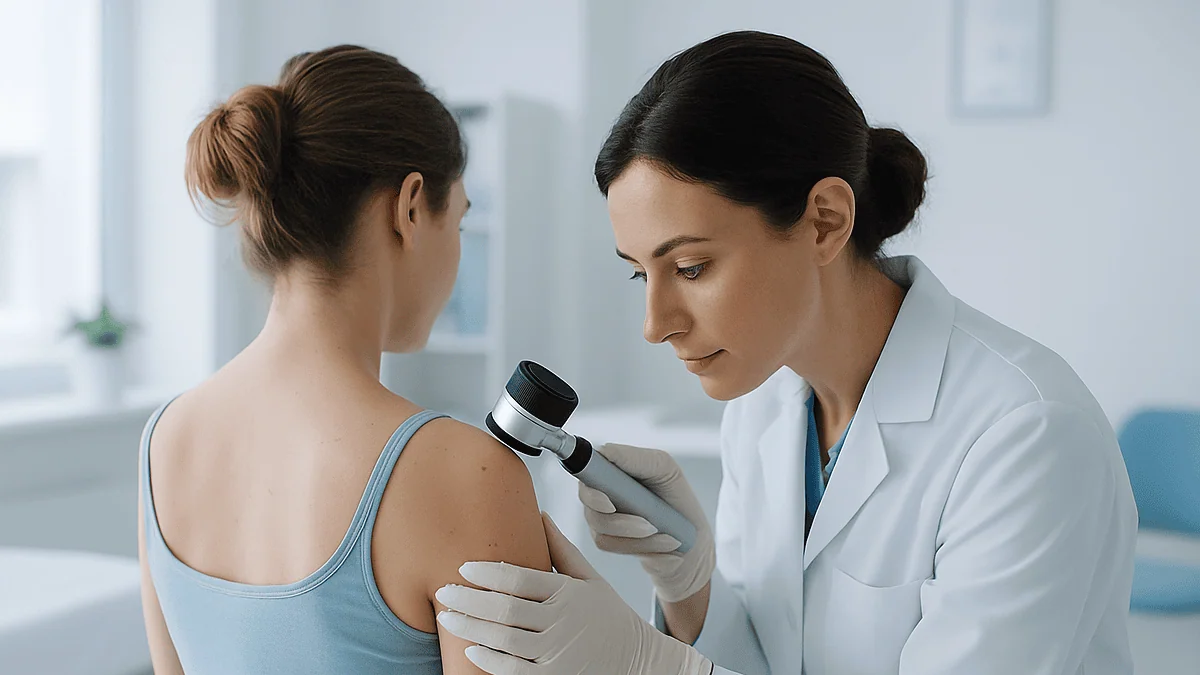
The exam itself is mostly looking. Many clinicians use a dermatoscope, a small handheld magnifier with polarized light that reveals structures beneath the surface, pigment patterns, blood vessels, follicle openings, invisible to the naked eye. For a large share of papules, history plus dermatoscopy settles the diagnosis on the spot.
When it does not, the next step is usually a biopsy: numbing the area and removing part or all of the bump for laboratory examination. The word sounds ominous, but the procedure typically takes minutes, and requesting one is a routine way to replace uncertainty with an answer, not a signal that anything sinister is suspected.
You can make the visit more productive with three small preparations. Bring dated photos showing how the bump has evolved. List every product you have applied to it, since treated skin can look different from its natural state. And arrive with your questions written down: the two most useful being what should this do over the next month and what change would mean I should come back. Leaving with a clear watch-and-return plan is a perfectly good outcome; not every papule needs intervention, but every persistent one deserves a name.
Frequently asked questions
What causes papules?
The most common causes are inflamed clogged pores (acne), irritated hair follicles (folliculitis), insect bites, and allergic or irritant skin reactions. Viral conditions such as warts and molluscum contagiosum also produce papules, as do harmless texture conditions like keratosis pilaris. In adults, benign growths such as cherry angiomas often start as small papules. Rarely, a persistent papule is an early skin cancer, which is why bumps that will not heal deserve an exam.
How can I get rid of a papule?
You cannot remove a papule instantly, because it contains inflamed tissue rather than anything drainable. Wash the area gently twice daily, use non-comedogenic products, apply a cool compress if it throbs, and leave it untouched, most acne papules fade within days to a few weeks. Pharmacists can recommend well-studied over-the-counter acne treatments, and clinicians can offer stronger evidence-based options if papules are frequent, painful, or leaving marks.
Is it okay to pop papules?
No. A papule has no head and no pus to release, so squeezing only forces the inflammation deeper into the skin. That prolongs healing and raises the risk of permanent scarring and post-inflammatory dark marks, which last longest on medium and deep skin tones. Fingernails also introduce bacteria through broken skin. If a papule is painful enough to tempt you, that is a good cue to ask a pharmacist or clinician instead.
Do skin papules go away on their own?
Most do, on timelines set by their cause. Insect bites settle within days, acne papules within days to a few weeks, and folliculitis within a week or two once the trigger is removed. Molluscum contagiosum can take up to about 18 months, and warts often take months to a couple of years. A papule that sits unchanged or slowly grows for more than four to six weeks should be checked rather than watched indefinitely.
What is the difference between a papule and a pustule?
A papule is a solid raised bump with no visible fluid; a pustule is a bump topped with a white or yellow head of pus. In acne, a papule is often the earlier inflammatory stage, and it may evolve into a pustule as white blood cells collect near the surface. Neither should be squeezed, but the distinction matters: a papule contains nothing that can be extracted, so popping attempts only deepen the inflammation.
Can a papule be skin cancer?
Rarely, but it happens, which is why persistence is the key warning sign. Basal cell carcinoma, the most common skin cancer, often begins as a pearly or translucent papule on sun-exposed skin that bleeds easily, scabs, and re-forms instead of healing. On darker skin it may look brown or glossy black. Ordinary papules flare and fade within weeks; any bump that lasts beyond four to six weeks or keeps changing deserves a professional skin exam.
Why do I have small papules on my upper arms?
Rough, painless papules scattered across the upper arms are most often keratosis pilaris, a harmless condition in which keratin plugs the hair follicle openings. It commonly runs in families, affects a large share of teenagers and roughly 40% of adults, and tends to improve with age and in humid summer weather. Regular moisturizing and gentle exfoliation soften the texture, while harsh scrubbing usually makes the bumps look angrier.
Are papules contagious?
Only some. Papules caused by viruses, warts and molluscum contagiosum, spread through skin contact and shared items such as towels and razors, which is why scratching molluscum bumps spreads them across the body. Acne papules, keratosis pilaris, insect bites, eczema, and benign adult growths are not contagious at all. If bumps are appearing in clusters after contact with another person’s skin or belongings, a viral cause is worth considering.
How long does an acne papule last?
An individual acne papule typically resolves within a few days to a few weeks, depending on how deep the inflammation runs. Squeezing or picking reliably extends that timeline and can leave dark marks that persist for months, often far longer than the papule itself. If new papules keep replacing old ones, treating the underlying acne process, rather than chasing individual bumps, is what actually shortens the overall course.
Can stress cause papules?
Stress does not create acne on its own, but it can plausibly worsen existing breakouts. Stress hormones influence oil production and inflammation, and many people notice flares during exams, deadlines, or poor sleep. Stress also increases unconscious face-touching and picking, which aggravates papules directly. The evidence supports treating stress management and adequate sleep as helpful supporting habits, not as a replacement for a consistent, gentle skin care routine.
References
- MedlinePlus Medical Encyclopedia: Papule
- NHS: Acne
- Cleveland Clinic: Keratosis Pilaris
- NHS: Molluscum Contagiosum
This article is for general information only and is not a substitute for professional medical advice. Please consult a qualified doctor about your individual situation.

More from the Blog

Is Hepatitis B Curable, and Does It Go Away?
Hepatitis B is not yet curable in the way many infections are, but it often goes away on its own. Most healthy adults who…

Is Ulcerative Colitis Hereditary or Autoimmune?
Ulcerative colitis is both: it has a hereditary component and it is driven by an immune system attacking the lining of the colon. Genes…

Dry Mouth: Causes, Fixes and Why It Matters More Than Comfort
Dry mouth most often comes from medication side effects, dehydration, mouth breathing, tobacco or alcohol use, or underlying conditions such as diabetes and Sjögren's…

What Happens If You Swallow Gum? The Seven-Year Myth, Settled
If you swallow gum, the sweeteners and flavorings are digested but the rubbery gum base is not. It does not stick inside your stomach;…
Metallic Taste in Your Mouth: The Everyday Causes and the Ones Worth a Visit
A metallic taste in the mouth most often comes from ordinary causes: gum disease, dry mouth, sinus infections, pregnancy, certain medicines, or multivitamins containing…

How Long Does It Take to Digest Food? A Journey Measured in Hours
Most food takes about 24 to 72 hours to travel from mouth to toilet. A typical meal spends two to five hours in the…