

Plantar Fasciitis Stretches: Morning First-Step Pain, Managed
Key Takeaways
- The morning first-step stab happens because the fascia shortens overnight and is abruptly stretched under full body weight, stretching before your feet touch the floor targets that mechanism directly.
- Around 90 to 95 percent of people with plantar fasciitis recover with conservative care alone, stretching, supportive shoes, and activity changes, without ever needing surgery.
- The plantar fascia–specific stretch (pulling the toes back toward the shin, held 10–30 seconds, several times daily) has outperformed calf stretching alone for morning pain in randomized research.
- The calf is two muscles: stretch it once with the knee straight (gastrocnemius) and once with the knee bent (soleus), 30 seconds each, three repetitions, twice a day.
- The 'sock trick' is a DIY night splint that holds the foot flexed overnight; trial evidence is mixed but leans helpful for symptoms lasting over six months, treat it as a two-to-four-week experiment.
- Shoe cushioning loses meaningful shock absorption around 300–500 miles, and going barefoot on hard floors at home is one of the most common ways people quietly sabotage their own recovery.
Quick Answer
Stretching is the first-line treatment for plantar fasciitis, and most people improve with it. The most useful moves target the plantar fascia itself (pulling the toes back toward the shin) and the calf muscles, held about 30 seconds and repeated several times daily. Combined with supportive shoes and easing off aggravating activity, roughly 9 in 10 people recover without surgery, typically within several months.
There’s a specific dread that comes with the alarm clock when you have plantar fasciitis. It isn’t the day ahead. It’s the six feet between the bed and the bathroom: the knowledge that the first step will land like a bruise on a stone, sharp under the heel, forcing that odd tiptoe hobble until things loosen up.
That morning stab is so characteristic that clinicians treat it almost as a signature. And it hides a useful clue: while you sleep, the plantar fascia, the thick band running from heel to toes, tightens in a shortened position. The first steps stretch irritated tissue abruptly, and it protests.
The clue points to the fix. If shortened, irritated tissue is the problem, controlled lengthening is a big part of the answer. The stretches below aren’t a wellness ritual; they’re the treatment mainstream medicine reaches for first, and the evidence behind them is genuinely encouraging.
Why does the first step in the morning hurt so much?
The plantar fascia is a tough, fibrous band, closer to a ligament than a muscle, that runs along the sole from the heel bone to the base of the toes. Its job is structural: it supports the arch and absorbs load every time your foot strikes the ground. With every step, it stretches and recoils like a bowstring.
Plantar fasciitis develops when that band accumulates more stress than it can repair. Despite the “-itis” suffix, research suggests the problem is often less classic inflammation and more tissue degeneration and micro-tearing near where the fascia anchors to the heel. That distinction matters, because degenerated tissue responds to gradual loading and lengthening, not just rest.
The morning pain has a mechanical explanation. Overnight, with your foot relaxed and pointed slightly downward, the fascia and calf muscles rest in a shortened position. Small healing efforts begin in that shortened state. Then you stand, your full body weight flattens the arch, and the tissue is yanked to length in a fraction of a second. The result is that unmistakable first-step stab, which usually eases within minutes as the tissue warms and lengthens, only to return after long sitting, for the same reason.
You’re in large company. Plantar fasciitis is among the most common causes of heel pain, and by some estimates about 1 in 10 people will deal with it at some point. Runners, people who stand for long shifts, and adults between roughly 40 and 60 see it most often, according to Mayo Clinic.
Can you actually fix plantar fasciitis with stretching?
Mostly, yes, with two honest caveats: it takes weeks, and stretching works best as part of a package rather than a lone hero.
The evidence here is unusually reassuring for a musculoskeletal condition. Mainstream sources including Mayo Clinic and the NHS report that the large majority of people with plantar fasciitis, commonly cited as around 90 to 95 percent, recover with conservative care alone: stretching, supportive footwear, activity modification, and time. Surgery is a rarity reserved for stubborn cases that fail many months of proper treatment.
Within that conservative package, stretching carries real weight. Studies comparing approaches have found that a plantar fascia–specific stretch (pulling the toes back to tension the band directly) can outperform calf stretching alone for morning pain, particularly in the first weeks. Calf stretching still matters, though, because tight calf muscles are one of the best-documented risk factors: a tight calf limits how far the ankle bends, and the fascia gets recruited to make up the difference with every step.
What stretching probably does, physiologically, is threefold: it restores length to tissue that has adapted to a shortened position, it reduces the strain the fascia experiences during walking, and, done consistently, it may stimulate the gradual tissue remodeling that degenerated fascia needs. None of that happens in a weekend. Most people notice meaningful improvement within a few weeks of daily stretching, but full recovery often takes several months. That timeline frustrates people, and it’s exactly where many give up too early.
Stretch before your feet touch the floor
If you change only one habit, make it this: stretch before the first step, not after. The whole logic of first-step pain, shortened tissue yanked abruptly to length, argues for lengthening it gently while you’re still horizontal, so the tissue meets your body weight already warmed and elongated.
Two moves work well from bed:
- The towel (or strap) stretch. Sit up with your leg extended. Loop a towel, belt, or long sock around the ball of your foot and gently pull the foot toward you, keeping the knee straight, until you feel a stretch through the calf and the sole. Hold about 30 seconds, relax, and repeat two or three times.
- Ankle circles and toe pulls. Slowly flex your foot up and down 10 times, then use your hand to pull the toes back toward the shin, holding 15 to 30 seconds. This tensions the fascia directly.
Then, and this is the underrated part, don’t step straight onto a cold hardwood floor barefoot. Keep supportive slippers or cushioned sandals at the bedside. A bare heel on a hard surface concentrates force exactly where the fascia is most irritated, and it can undo the good your two-minute stretch just did.
The same principle applies after any long stretch of sitting: a desk workday, a movie, a flight. Thirty seconds of toe pulls before you stand costs nothing and spares the fascia another abrupt jolt.
The plantar fascia–specific stretch: the one with the best evidence for morning pain
If the research crowned a single move for first-step pain, this would be it. A randomized trial published in the orthopedic literature found that patients doing this fascia-specific stretch reported better improvement in morning pain than those doing standard calf stretchesenough that it’s now a fixture in clinical guidance.
Here’s the technique, done sitting down:
- Cross the affected foot over your opposite knee, ankle resting on the thigh.
- With the hand on the same side, grasp the base of your toes and pull them back toward your shin until you feel a firm stretch along the arch. You should be able to feel the fascia tighten like a cable if you press gently along the sole with your other thumb: that tension confirms you’re in the right place.
- Hold for 10 to 30 seconds. Repeat 10 holds of 10 seconds, or 3 holds of 30: the total time under stretch matters more than the exact scheme.
- Do the set three times a day: before your first steps in the morning, and before standing after any long sit.
The stretch should feel like firm pulling, not sharp pain. A little discomfort along the arch is expected; a stabbing sensation at the heel means back off the intensity.
Why it beats generic stretching for morning symptoms: it isolates the fascia itself rather than relying on ankle position, so the irritated tissue gets a direct, controlled dose of lengthening, precisely the stimulus a degenerating attachment point seems to need to remodel.
Don’t skip the calf: two stretches, two muscles
The calf connects to your heel through the Achilles tendon, and the Achilles and plantar fascia function almost as one continuous tension system around the heel bone. When the calf is tight, the ankle can’t bend far enough during walking, so the fascia absorbs extra strain step after step. Tight calves are one of the most consistently identified risk factors for plantar fasciitis, which is why every credible protocol, from the NHS to Cleveland Clinic, includes calf work.
The catch is that “the calf” is really two muscles, and they need slightly different stretches:
- Gastrocnemius (straight-knee) stretch. Stand facing a wall, hands on it, injured leg stepped back. Keep that back knee straight and the heel flat on the floor, then lean your hips toward the wall until you feel the stretch high in the calf. Hold 30 seconds; repeat 3 times.
- Soleus (bent-knee) stretch. Same position, but bring the back foot in slightly and bend the back knee, keeping the heel down. The stretch drops lower, toward the Achilles. Hold 30 seconds; repeat 3 times.
Do both, twice daily. The bent-knee version is the one people skip, and it’s arguably the more relevant of the two: the soleus does much of the work in slow walking and standing, the exact activities that aggravate plantar fasciitis.
One form note: keep the back foot pointing straight ahead, not angled outward. Letting the foot turn out lets the arch collapse and quietly steals most of the stretch.
Strengthening: the half of the routine most people skip
Stretching lengthens; strengthening builds capacity. The small muscles inside the foot, the ones that support the arch alongside the fascia, tend to be weak in people with plantar fasciitis, and building them up shifts load off the irritated band. Research on heel-raise loading programs suggests that progressive strengthening may speed improvement compared with stretching alone, though stretching remains the foundation.
Four exercises cover the territory:
- Towel curls. Sit with a small towel flat under your bare foot. Scrunch it toward you using only your toes, then push it back out. Two sets of 10 to 15 curls. Add a small weight (a book) on the towel as it gets easy.
- Marble pickups. Place 10 to 20 marbles (or similar small objects) on the floor and pick them up one at a time with your toes, dropping each into a cup. Tedious, effective, oddly satisfying.
- Toe raises against the wall. Stand and lift all ten toes off the floor while keeping the balls of your feet down, spread them, then lower slowly. Ten repetitions. This wakes up muscles that shoes have kept idle for years.
- Heel raises with a towel under the toes. Once acute pain settles, stand with a rolled towel under your toes (which pre-tensions the fascia), rise slowly onto the balls of your feet over 3 seconds, hold, and lower over 3 seconds. Start with two feet, 8 to 12 slow reps, every other day.
Save the heel raises for when morning pain has begun to ease, loading too aggressively too early tends to flare symptoms. Strengthening is the phase-two work that helps keep the problem from coming back.
The frozen water bottle roll (and whether rolling actually helps)
Fill a water bottle, freeze it, and roll your bare arch over it for 5 to 10 minutes while you sit, evening is a natural slot, after the day’s accumulated standing. It’s the rare home remedy that does two evidence-plausible things at once: the cold blunts pain signals in the irritated tissue, and the rolling pressure mobilizes the fascia and the tight structures around it.
Set the honest expectations first. Rolling is symptom relief, not tissue repair. No amount of massage “breaks up” scar tissue or lengthens fascia in any lasting structural sense: that’s a persistent myth. What it does do is reduce pain and stiffness for hours afterward, which matters for two reasons: it makes daily life more tolerable, and it makes it easier to do the stretches and strengthening that drive actual recovery.
A few refinements:
- Roll with moderate pressure, enough to feel firm massage, not enough to make you wince. Grinding hard into an irritated heel attachment can inflame it further.
- Concentrate on the arch, not the heel itself. The heel attachment is usually the sorest spot and the least tolerant of direct pressure.
- A tennis ball, lacrosse ball, or golf ball works when you don’t want cold, golf ball for precision, tennis ball for comfort. Keep one under your desk.
- Cap cold exposure around 10 to 15 minutes and keep a thin layer (a sock) between skin and ice if your skin is sensitive.
Think of rolling as the recovery drink of this program: pleasant, mildly useful, and no substitute for the workout.
What is the sock trick for plantar fasciitis?
The “sock trick” circulating online is a homemade version of a legitimate medical device: the night splint. The DIY version involves wearing a long sock (or a sock with a strap rigged to it) to bed, positioned to hold your foot gently flexed upward, toes toward the shin, overnight. The commercial versions are night splints and “sock splints,” soft or rigid devices that do the same job more reliably.
The logic is sound and connects directly to why mornings hurt. Overnight, the relaxed foot points slightly downward, letting the fascia and calf shorten. A splint keeps the tissue at length while you sleep, so the first step of the morning doesn’t deliver a sudden yank.
What does the evidence say? Genuinely mixed, but leaning helpful for the right person. Some trials show night splints reduce morning pain, particularly in people whose symptoms have lasted more than six months; others show modest or no benefit. Mainstream sources such as Mayo Clinic list night splints as a reasonable option within conservative care: a supporting actor, not the lead.
Practical honesty is warranted here: many people abandon night splints because sleeping with a foot held at 90 degrees is uncomfortable, and a flimsy sock rig often slips out of position by 2 a.m. If you try the trick, treat it as a two-to-four-week experiment. If your morning pain noticeably drops, keep it. If you’re just sleeping worse, drop it without guilt: the daytime stretching program carries far more of the therapeutic load anyway.
What not to do for plantar fasciitis
Half of managing this condition is subtraction. The fascia heals when its daily stress budget finally runs a surplus, and a handful of common habits quietly keep it in deficit:
- Walking barefoot on hard floors. Tile and hardwood transmit force straight into the irritated heel attachment. Supportive slippers or sandals indoors, from the first step of the day, is one of the highest-value changes you can make.
- Pushing through a run or workout that sharpens the pain. Soreness that eases as you warm up is one thing; pain that escalates during or after activity means the tissue is losing ground. Swap impact for cycling, swimming, or rowing until symptoms settle.
- Wearing dead shoes. Cushioning midsoles lose meaningful shock absorption somewhere around 300 to 500 miles of use. Flat, unsupportive footwear, worn flip-flops, thin ballet flats, ancient sneakers, is a classic contributor.
- Stretching aggressively into sharp pain. A firm pull is productive; stabbing pain means micro-trauma. More force is not more progress.
- Ignoring it for months. The single best predictor of a slow recovery is a long delay before starting treatment. Fascia that has been irritated for a year is measurably harder to settle than fascia treated at six weeks.
- Sudden training jumps. Rapid increases in running mileage, standing time, or hill work are among the most common triggers, and re-triggers during recovery.
None of this means immobilizing yourself. Complete rest lets the calf tighten further and the foot muscles weaken. The goal is modified activity: keep moving in ways that don’t provoke the heel.
What is the quickest way to heal plantar fasciitis? (An honest answer)
There isn’t a shortcut, and the sources selling one are worth your skepticism. What exists instead is a fastest realistic path, and it’s built on stacking several modest interventions rather than hunting for one dramatic fix.
The combination with the best evidence looks like this: fascia-specific and calf stretching daily, supportive cushioned footwear worn essentially all waking hours, temporary swaps away from high-impact activity, ice or rolling for symptom relief, and, once pain begins settling, progressive foot strengthening. Over-the-counter arch supports or heel cups can help distribute pressure; studies suggest prefabricated inserts perform comparably to expensive custom ones for most people, which is a rare bit of good financial news in healthcare.
Two factors genuinely speed things up. The first is starting early: symptoms treated within the first weeks tend to resolve in a couple of months, while symptoms ignored for a year can take a year or more to fully calm. The second is consistency. A 30-second stretch done five times daily beats a heroic 20-minute session done twice a week, because the fascia re-shortens between sessions and frequent dosing keeps it at length.
For cases that stall despite months of diligent conservative care, clinicians have further optionsphysical therapy programs, various injection and shockwave approaches, and rarely surgery, with varying levels of evidence, and those decisions belong in an exam room. But the base of the pyramid is the same for everyone, and most people never need to climb above it. Mayo Clinic notes most recover within several months of consistent conservative treatment.
A realistic daily routine (about 15 minutes, total)
Programs fail when they demand a dedicated hour. This one is designed to bolt onto moments that already exist in your day, waking up, standing after a desk session, watching TV in the evening. Here’s the full schedule:
| When | What | How much | Why then |
|---|---|---|---|
| Before getting out of bed | Towel stretch + toe pulls | 2–3 holds × 30 sec | Lengthens overnight-shortened tissue before it bears weight |
| After breakfast | Fascia-specific stretch + both calf stretches | 3 × 30 sec each | Full stretching dose while tissue is warm |
| Before standing after long sitting | Fascia-specific stretch | 1–2 holds × 30 sec | Prevents the “post-sitting first step” flare |
| Lunchtime | Toe raises + towel curls | 2 sets of 10–15 | Strength work spread through the day |
| Evening | Frozen bottle or ball roll | 5–10 min | Eases the day’s accumulated soreness |
| Bedtime | Calf stretches (± night splint) | 3 × 30 sec | Foot enters the night at length, not shortened |
Expect a rhythm to the recovery, not a straight line. Many people notice the morning stab softening within two to three weeks, with occasional bad days sprinkled through, often traceable to a long day on hard floors or a skipped session. Track mornings, not moments: if this week’s first steps hurt less than last week’s, the program is working, even if Tuesday was rough.
Shoes, standing, and the load your fascia carries all day
Stretching addresses the fascia for a few minutes a day. Footwear and habits address it for the other sixteen waking hours, and that arithmetic explains why shoes deserve as much attention as exercises.
What to look for is simpler than shoe marketing suggests: a cushioned sole with meaningful shock absorption, a modest heel-to-toe drop (a slightly elevated heel reduces tension on both the Achilles and the fascia), decent arch support, and a firm heel counter, the cup around the back of the heel, that doesn’t collapse when you squeeze it. What to avoid: completely flat shoes, thin flexible soles you can fold in half, and anything you’ve been wearing daily for over a year.
Three habits multiply the benefit:
- Wear support all day, indoors included. People often buy excellent walking shoes and then pad around barefoot at home for five hours each evening. A pair of supportive recovery sandals or slippers by the door closes that gap.
- Break up standing. If your job keeps you on your feet, a cushioned anti-fatigue mat plus a brief sit or a 30-second calf stretch every hour reduces cumulative fascia strain considerably. Standing still, counterintuitively, loads the fascia more relentlessly than walking, which at least varies the stress.
- Return to impact gradually. When you resume running or court sports, increase volume by no more than about 10 percent a week, and treat any return of morning symptoms as a signal to hold, not quit.
Body weight also factors into the load equation, higher weight means higher force through the fascia with every step, which is one reason low-impact conditioning during recovery pays double dividends.
When to see a doctor about heel pain
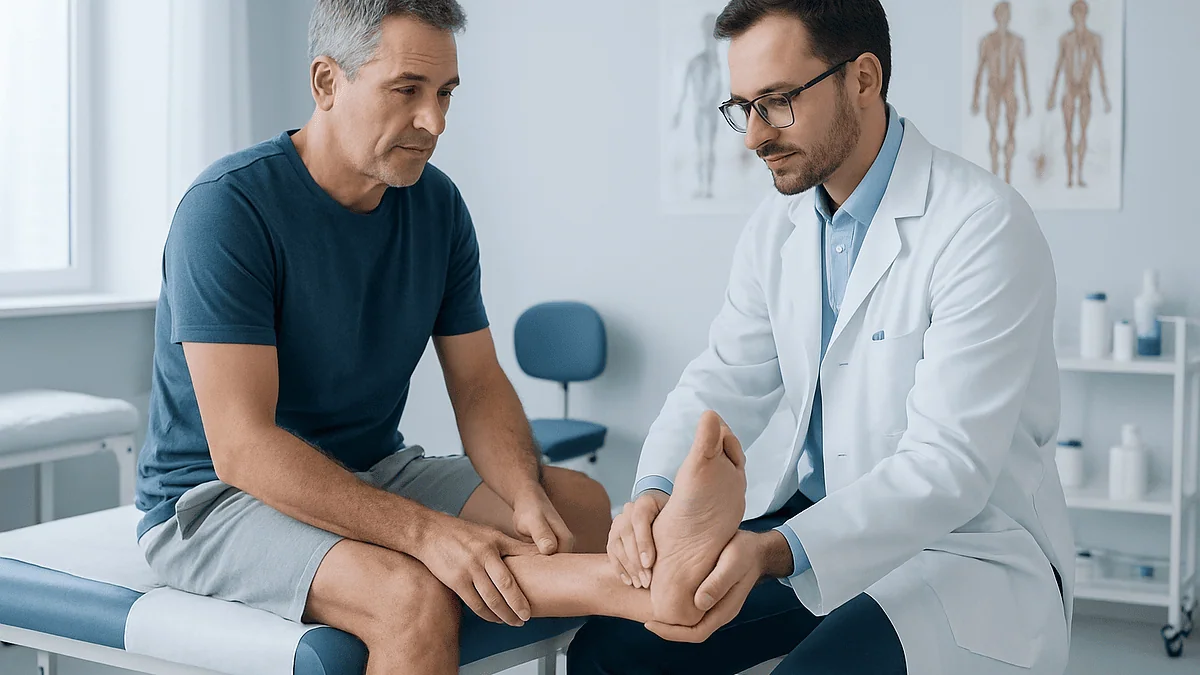
Most plantar fasciitis can be managed at home, but some heel pain shouldn’t be self-diagnosed, and some situations call for professional eyes even when the diagnosis seems obvious. Book an appointment if:
- Pain hasn’t meaningfully improved after two to three weeks of consistent home careor hasn’t largely resolved within a few months. A clinician can confirm the diagnosis and add options like structured physical therapy or imaging if the picture doesn’t fit.
- The pain began suddenly with a pop or during a specific incident. That pattern suggests a fascia rupture or another acute injury rather than gradual-onset fasciitis.
- The heel is swollen, hot, red, or you have a fever. Those signs point toward infection or inflammatory conditions that need prompt evaluation.
- You can’t bear weight on the foot, or the pain is severe even at rest and at night. Stress fractures of the heel bone can mimic fasciitis but demand very different treatment.
- You have numbness, tingling, or burning in the foot, nerve entrapment and nerve-related conditions produce heel-area pain that stretching won’t fix.
- You have diabetes or reduced circulation. Foot pain in these situations warrants a lower threshold for professional assessment across the board, per NHS guidance.
It’s also worth knowing that heel pain has a long list of impersonators: Achilles problems, heel pad atrophy, arthritis-related conditions, nerve compression, and one of the most valuable things a clinician provides is simply confirming you’re treating the right diagnosis. Weeks of diligently stretching a fascia that isn’t the problem helps no one.
Once you’re better: keeping the morning stab from coming back
Plantar fasciitis has an unfortunate habit of returning, usually because the conditions that produced it, tight calves, weak foot muscles, worn shoes, sudden training spikes, quietly reassemble once the pain stops enforcing discipline. Prevention isn’t a second full-time program; it’s a skeleton crew of the habits that got you better.
Keep three things running indefinitely:
- Calf flexibility, a few times a week. The 30-second wall stretches after a walk or workout take two minutes and address the single best-documented risk factor. Calves tighten again with remarkable speed, especially in runners and people who sit most of the day.
- Foot strength, once or twice a week. Toe raises and slow heel raises maintain the arch’s muscular support so the fascia isn’t carrying the load alone. Barefoot balance work, standing on one foot while brushing your teeth, is a zero-cost supplement.
- Footwear vigilance. Replace running and walking shoes on mileage, not appearance; midsole cushioning dies invisibly, long before the upper looks worn. If you stand for a living, rotate between two pairs so each gets recovery time.
Respect the early warning system, too. The condition rarely returns overnight: it announces itself with a faint morning stiffness that fades in a step or two. That whisper is the moment to resume the full stretching routine for a couple of weeks, not the moment to hope it goes away. Caught at the whisper stage, a recurrence usually settles in days. Ignored until it’s the familiar stab, you’re back on the months-long clock, and nobody wants to renegotiate with that first step twice.
Frequently asked questions
Can you fix plantar fasciitis with stretching?
For most people, yes, stretching is the core of first-line treatment, and roughly 9 in 10 cases resolve with conservative care alone. The fascia-specific stretch (toes pulled back toward the shin) plus straight-knee and bent-knee calf stretches, done daily for weeks, has solid trial support. Stretching works best combined with supportive footwear and easing off aggravating activity; expect noticeable improvement within a few weeks and full recovery over several months.
What is the sock trick for plantar fasciitis?
It’s a homemade night splint: wearing a long sock rigged to hold your foot flexed gently upward while you sleep, so the fascia and calf can’t shorten overnight. That’s why some people wake with less first-step pain. Trial evidence on night splints is mixed, some studies show benefit, especially for symptoms lasting over six months, others show little. Try it for a few weeks; keep it only if mornings clearly improve.
What should you not do for plantar fasciitis?
Avoid walking barefoot on hard floors, pushing through activities that sharpen the pain, wearing flat or worn-out shoes, stretching aggressively into stabbing pain, and making sudden jumps in running mileage or standing time. Also avoid the opposite extreme, total rest, which tightens the calf and weakens the foot. The most costly mistake is delay: fascia irritated for a year takes far longer to settle than fascia treated at six weeks.
What is the quickest way to heal plantar fasciitis?
There’s no shortcut, but the fastest realistic path is stacking modest interventions consistently: daily fascia-specific and calf stretching, supportive cushioned shoes worn nearly all waking hours, temporary swaps away from high-impact exercise, ice or rolling for symptom relief, and gradual foot strengthening once pain eases. Starting early matters most, cases treated within the first weeks typically resolve in a couple of months, while long-neglected cases can take a year.
How long does it take for stretching to work?
Most people notice the morning stab softening within two to three weeks of consistent daily stretching, but full recovery commonly takes several months. Progress is rarely a straight line, expect occasional bad days, often traceable to long hours on hard floors or skipped sessions. Judge your trend week to week rather than day to day, and see a clinician if there’s no meaningful improvement after two to three weeks of diligent effort.
Should I stretch before getting out of bed?
Yes: it’s arguably the highest-value moment of the entire day. Overnight the fascia and calf shorten, and the first step stretches irritated tissue abruptly under full body weight, producing the classic stab. A towel stretch and gentle toe pulls done while still in bed lengthen the tissue before it’s loaded. Then step into supportive slippers rather than onto a bare hard floor, which concentrates force on the sore heel.
Is walking good or bad for plantar fasciitis?
Moderate walking in supportive, cushioned shoes is generally fine and better than total rest, which stiffens the calf and weakens the foot. Warm up with a brief calf stretch first, since the initial steps are the harshest. Bad signs are pain that escalates during the walk or clearly worsens afterward: that means the current distance or surface is too much. Shorter, more frequent walks on softer surfaces usually work better during recovery.
Can I keep running with plantar fasciitis?
Usually not at your normal volume, running loads the fascia with several times body weight per stride, and continuing to train through worsening pain is one of the most reliable ways to prolong the condition. Most runners do better switching temporarily to cycling, swimming, or rowing, then returning gradually, increasing mileage no more than about 10 percent weekly, once morning pain has largely settled. Returning morning symptoms mean hold the current volume.
Do heel spurs cause plantar fasciitis pain?
Usually not, despite the enduring myth. Heel spurs show up on X-rays in many people who have no heel pain at all, and plenty of people with severe plantar fasciitis have no spur. Current evidence points to the fascia itself, degeneration and micro-tearing near its heel attachment, as the pain source. That’s also why treatment targets the fascia with stretching and load management rather than the spur, which typically needs nothing done to it.
Does rolling your foot on a frozen water bottle help?
It helps symptoms, and that’s worth having: the cold blunts pain while the rolling pressure eases stiffness in the arch, typically for hours afterward. What it doesn’t do is repair or ‘break up’ tissue; rolling is relief, not treatment. Use moderate pressure for 5 to 10 minutes in the evening, focus on the arch rather than grinding directly into the sore heel, and pair it with the stretching and strengthening that drive actual recovery.
References
- Plantar fasciitis (NHS)
- Plantar Fasciitis (Cleveland Clinic)
- Plantar fasciitis (MedlinePlus Medical Encyclopedia)
This article is for general information only and is not a substitute for professional medical advice. Please consult a qualified doctor about your individual situation.

More from the Blog

DOMS: Why Muscles Hurt Two Days Later and What Actually Speeds Recovery
DOMS, or delayed onset muscle soreness, is muscle pain that peaks 24–72 hours after unfamiliar or intense exercise, especially movements that lengthen a muscle…
How to Do a Pull-Up: A Progression That Works for Beginners
To do a pull-up, hang from a bar with palms facing away and hands slightly wider than your shoulders, pull your shoulder blades down…

Calisthenics: How Bodyweight Training Builds Strength, and Where It Hits a Ceiling
Calisthenics builds strength by loading muscles with your own body weight and progressing through harder leverage, such as moving from incline push-ups to full…

Romanian Deadlift Form: The Hip Hinge That Protects Your Back When Done Right
A Romanian deadlift is a hip-hinge exercise: you hold a barbell or dumbbells, keep knees slightly bent and back neutral, and push your hips…

Walking Pads and Incline Walking: What Desk-Walking Does for Steps, Blood Sugar and Backs
A walking pad is a slim, low-speed treadmill built for slow walking under a standing desk. Used consistently, it adds real steps and light…

Zone 2 Cardio: The Easy-Pace Training Everyone Suddenly Swears By
Zone 2 cardio is steady, easy-pace aerobic exercise done at roughly 60 to 70 percent of your maximum heart rate: a pace where you…