

Plexr Recovery Day by Day: The Grid of Crusts, Swelling and When Makeup Can Return

Key Takeaways
- Plexr recovery follows the biology of a superficial burn: the outer skin layer regrows beneath protective crusts over roughly one to two weeks, the same window Mayo Clinic and Johns Hopkins describe for resurfacing.
- Swelling peaks around day two or three and is heaviest at the eyelids because that skin is thin and sits over loose tissue with almost no fat to buffer fluid.
- Makeup is typically held until every crust has fallen away and the surface is closed, most often between day seven and day fourteen, with eye makeup on treated lids usually last to return.
- Picking crusts early restarts the wound clock and is a recognized route to lingering dark or pale spots, particularly in deeper skin tones.
- Ultraviolet exposure during healing is the strongest trigger for pigment change, which is why broad-spectrum SPF 30 or higher on closed skin, and shade before that, is the one non-negotiable aftercare rule.
- Long-term evidence for plasma devices is thinner than for lasers, so any figures on how much tightening occurs or how long it lasts should be treated as practitioner experience rather than established fact.
Plexr recovery usually follows a predictable arc: a grid of tiny brown carbon crusts forms within hours, swelling peaks around the second or third day (especially near the eyes), and crusts lift on their own over roughly one to two weeks. Most clinicians ask patients to keep makeup off treated skin until every crust has fallen away and the surface is fully closed. Pinkness can linger for weeks. Your treating team sets your personal timeline.
The mirror on the morning after is where most people have their moment of doubt. Overnight, a neat lattice of dark specks has appeared across the upper eyelid, the lid itself looks puffier than it did at bedtime, and the reassuring words from the consultation room suddenly feel very far away. A quiet question forms: is this what it is supposed to look like?
Almost always, yes. Plexr recovery is one of the more visible healing processes in facial aesthetics, precisely because the treatment works by creating hundreds of small, deliberate injuries to the skin surface. The dots are not damage gone wrong; they are the plan working. What matters is knowing which changes belong to a normal week, which ones belong to a phone call, and how to protect the new skin underneath while it does its slow, unglamorous work.
This explainer walks through that week and the weeks that follow, day by day, with the evidence where it exists and honest gaps where it does not.
What actually happens to the skin during a Plexr treatment
Plexr is one brand name for a category of hand-held devices that use plasma, in this case a small electrical arc that ionizes the gas in the air, to deliver a brief pulse of heat to the very top of the skin without the tip ever touching it. The technical term is sublimation: the outermost layer of skin is turned directly from solid into vapor at each point of contact. The result is a pinpoint wound rather than a cut, with a tiny carbonized crust sitting on top like a scab in miniature.
The device is worked across the treatment area in a pattern of dots, most often on the upper eyelids, around the eyes, or over fine lines on the upper lip. The dots are spaced a few millimeters apart so that untouched skin between them can act as a reservoir of healing cells. Below the surface, the heat is meant to prompt fibroblasts, the cells that manufacture collagen, to lay down new fibers over the following weeks, which is the mechanism behind the tightening effect practitioners describe.
In clinical terms, this is a controlled superficial burn. That framing is useful, not alarming. The Mayo Clinic describes ablative resurfacing procedures, which remove the outer skin layer with heat, as leaving skin raw, swollen and itchy while it re-epithelializes, meaning grows a fresh surface layer, and notes that healing of the outer layer typically takes one to two weeks. Plasma devices are shallower than fully ablative lasers, but the biology of the wound is the same family, and so is the recovery logic: protect the crusts, keep the area clean, avoid heat and sun, and let the skin decide the pace.
Robust long-term evidence for plasma devices specifically remains thinner than for lasers, which have decades of study behind them. Where this article gives timelines, they lean on published resurfacing guidance and on how superficial burns heal, not on any manufacturer’s claims.
Plexr recovery day by day: what the first week usually looks like
Every face heals on its own schedule, and eyelid skin behaves differently from lip skin, but the broad shape of the first week is consistent enough to sketch. The table below summarizes what patients commonly report, with the caveat that your treating clinician’s instructions always override a general guide.
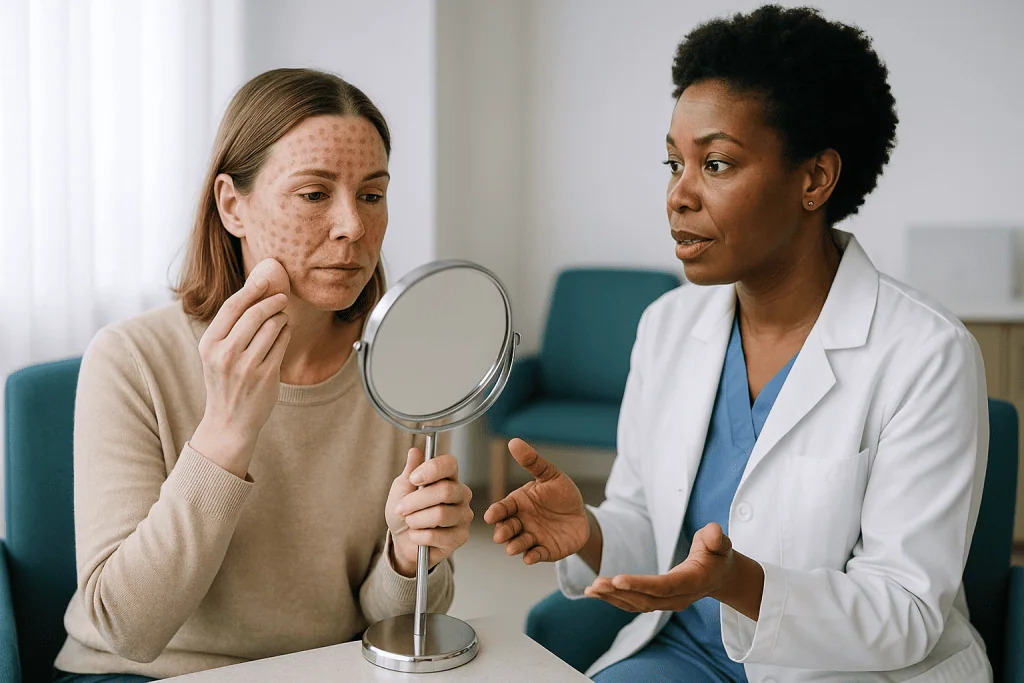
| Day | What you typically see | What usually helps |
|---|---|---|
| Day 0 (treatment day) | Grid of small brown or black dots; warmth and stinging like a sunburn; mild swelling begins | Cool compresses through clean gauze; sleeping propped up |
| Days 1 to 3 | Swelling peaks, most noticeably at the eyelids; crusts darken and feel tight; skin between dots may look pink | Gentle cleansing as instructed; no rubbing, no heat, no sun |
| Days 4 to 7 | Swelling settles; crusts begin loosening from the edges and fall away on their own | Continue moisturizing if advised; hands off the crusts |
| Days 7 to 14 | Remaining crusts lift; fresh pink or slightly darker dots visible underneath | Sun protection becomes the priority; makeup only once the surface is closed |
The ranges match how superficial skin wounds close. Johns Hopkins Medicine notes that after ablative laser resurfacing, skin may take one to two weeks to heal before normal skincare resumes, and that redness can persist well beyond that. The Mayo Clinic gives the same one-to-two-week window for the surface and adds that swelling is expected, and that the eye area swells most. Plasma treatment tends to sit at the milder end of these ranges because it works shallower, but the pattern of peak, plateau and release is the same.
What the table cannot show is how strange the middle days feel. The dots are prominent, the eyelids may look heavier before they look lighter, and the temptation to hurry things along is real. Day three is often the low point emotionally and the turning point physically.
Why the grid of crusts forms, and why picking sets you back
Each crust is a tiny cap of carbonized tissue and dried serum sitting over a pinpoint wound. Think of it as a biological bandage the body fitted for itself. Underneath, new skin cells are migrating in from the untouched skin at the edges to close the gap, a process MedlinePlus describes in its guidance on minor burns as the outer layer regrowing beneath a protective scab.
Lifting a crust early does three unhelpful things. It reopens the wound, so the clock restarts. It exposes tissue that has not finished building its pigment-regulating cells, which raises the odds of a lingering dark or pale spot. And it invites bacteria into a space the body had already sealed. Practitioners who see poor cosmetic outcomes after plasma treatment frequently trace them to picking, scrubbing, or steaming the crusts off in a hot shower.
The crusts are meant to fall away on their own, and they usually do so unevenly. A few will drop on day four, a cluster around day six or seven, and stragglers may hang on past day ten, particularly on the thicker skin of the upper lip. Uneven is normal. What matters is that the skin beneath a shed crust looks pink and smooth rather than open, weeping or raw.
Two practical points come up constantly. First, cleansing: most aftercare protocols allow gentle rinsing with lukewarm water and a mild, fragrance-free cleanser, patting dry with a clean disposable towel rather than a bathroom hand towel that the whole household shares. Second, moisture: some clinicians recommend a thin layer of a bland barrier ointment to keep crusts supple; others prefer the area kept dry. Both approaches have supporters, and the evidence does not clearly favor one for plasma treatment specifically. Follow the instruction sheet you were given, and ask before changing anything.
How long does plasma fibroblast swelling last, especially around the eyes?
Swelling is the part of plexr recovery that surprises people most, and the eyelids are the reason. Eyelid skin is among the thinnest on the body, sits over loose connective tissue with almost no fat to buffer it, and drains fluid slowly when you lie flat. Heat from the plasma arc triggers the ordinary inflammatory response, meaning blood vessels widen and leak fluid into the tissue, and that fluid pools where there is room for it, which is exactly the eyelid.

The typical arc is swelling that begins within hours, is worst on the morning of day two or three, and eases steadily through the rest of the week. The Mayo Clinic notes that swelling after resurfacing of the eye area is expected and that sleeping with the head elevated and using cool compresses can reduce it. Some people wake on day two with lids so puffy that opening the eyes fully takes a moment; this is uncomfortable but, on its own, within the expected range.
Several factors push swelling toward the heavier end:
- Treating both upper and lower lids in a single session
- Lying flat overnight rather than propped on two or three pillows
- Salt-heavy meals and alcohol in the first days, which encourage fluid retention
- Heat exposure, including hot showers, saunas or vigorous exercise
A short course of an anti-inflammatory or a brief oral corticosteroid is sometimes discussed by prescribers for patients with pronounced eyelid swelling. Whether that is appropriate depends on your medical history and is entirely a decision for the treating clinician; this article deliberately gives no guidance on what or how much.
Swelling that keeps increasing after day three, that affects only one side sharply, or that comes with spreading redness, heat and pain belongs in the red-flag section later in this article, not in the normal-range column.
When can makeup return after plasma fibroblast treatment?
The straightforward answer most clinicians give is: not until the last crust has gone and the skin surface is fully closed, which for many people means somewhere between day seven and day fourteen. The Mayo Clinic advises that after ablative resurfacing, makeup can be applied once the skin has healed, typically about two weeks, and Johns Hopkins gives a similar one-to-two-week window before returning to a normal skincare routine. Plasma treatment is often at the shorter end of that range, but the principle is identical.
The reason is not vanity policing. Makeup applied over an open pinpoint wound introduces pigments, preservatives and whatever lives on your brushes into tissue that has no barrier yet. Removing it means rubbing, and rubbing lifts crusts. Even a mineral powder, often marketed as gentle, is a physical particle that can lodge in a healing dot.
Once the surface is closed, a sensible order of return looks like this:
- Start with a bland moisturizer and a broad-spectrum sunscreen for a day or two to confirm the skin tolerates products without stinging.
- Introduce a light, fragrance-free foundation or tinted sunscreen next, applied with clean fingers or a freshly washed brush.
- Delay eye makeup on treated lids, particularly waterproof formulas and anything requiring firm removal, until the pink dots have flattened, which may be later than the rest of the face.
- Replace mascara and any liquid product that touched the treated area during the healing window, since these can harbor bacteria.
Green-tinted color correctors are popular for masking the pink phase once the surface is sealed; that is reasonable, provided removal stays gentle. Retinoids, acids and exfoliating scrubs are a separate conversation and are typically held for several weeks, again on your clinician’s schedule rather than a general one.
Who plasma treatment is usually offered to, and who is usually asked to wait
Plasma skin tightening is generally discussed for people with mild to moderate skin laxity in small areas, most commonly hooded upper eyelids, fine lines beneath the eyes, or crepe-like texture on the upper lip, who prefer a non-surgical option and accept that results are more modest than surgery. It is not a substitute for blepharoplasty, the surgical removal of excess eyelid skin, when there is a large amount of loose tissue.
Clinicians typically ask people in the following situations to wait or to consider a different route:
- Active skin infection, cold sores or eczema in the treatment area, since a fresh wound over inflamed skin heals poorly
- A history of keloid or hypertrophic scarring, where the body over-produces scar tissue
- Recent isotretinoin use, which many practitioners regard as a reason to postpone resurfacing of any kind
- Pregnancy or breastfeeding, largely because safety data are absent rather than because harm is proven
- Uncontrolled diabetes or conditions that impair wound healing
- Recent heavy sun exposure or a planned holiday in strong sun during the healing window
- Pacemakers or implanted electronic devices, given the device’s electrical arc
The NHS guidance on cosmetic procedures stresses that any non-surgical treatment should be delivered by a trained, insured practitioner in a clean environment, with a proper consultation, a cooling-off period and clear aftercare, and that you should feel able to ask about qualifications and complication management. Those points matter more for plasma than for many treatments because the operator’s technique, spacing of dots and energy setting directly shape how the skin heals.
A frank pre-treatment conversation should also cover realistic expectations. Practitioners commonly describe the visible tightening as developing gradually over weeks and often suggest that more than one session may be discussed; how many, if any, is a clinical judgment rather than a promise anyone can make in advance.
Skin tone, pigmentation and why it changes the recovery conversation
The single most important variable in how a plasma treatment heals is not the device. It is the skin’s melanin response. Any heat injury to the skin can prompt melanocytes, the pigment-producing cells, to overproduce during healing, leaving flat brown marks known as post-inflammatory hyperpigmentation. The opposite, patches that heal lighter than the surrounding skin, can also occur and is harder to reverse.
Both risks rise with deeper skin tones and with sun exposure during recovery. This is well documented for laser resurfacing; the Mayo Clinic lists changes in skin color as a recognized risk of ablative procedures and notes it is more likely in people with darker skin. Plasma devices deliver less total heat than fully ablative lasers, which is why some practitioners treat a broader range of skin tones, but the evidence base for safety across tones is limited and mostly comes from small case series rather than large trials. Anyone telling you the risk is zero is stepping ahead of the data.
What does a cautious approach look like in practice? Many clinicians perform a small test patch behind the ear or at the hairline weeks before a full treatment, so the skin’s pigment response can be seen. Some ask patients with a tendency to pigment to use a prescribed lightening preparation for a period beforehand; that is a prescribing decision, not one to make on your own. Almost all insist on strict, daily broad-spectrum sun protection for the treated area for weeks to months afterward, since ultraviolet light is the strongest trigger for healing skin to darken.
If a dark dot does appear where a crust used to be, it does not always mean permanent change. Post-inflammatory pigment often fades over months with rigorous sun avoidance, though it can take longer in deeper skin tones. Let your treating clinician see it early rather than reaching for over-the-counter brightening products that may irritate skin still finishing its repair.
Plexr aftercare the evidence actually supports
Aftercare instructions vary between practitioners more than they should, and the internet adds its own confident opinions. Stripped back to what wound-healing evidence supports, the essentials are short.
Keep it clean, not sterile. A twice-daily gentle rinse with lukewarm water and a mild cleanser, followed by patting dry with a clean disposable towel, mirrors the standard advice MedlinePlus gives for minor burns and abrasions. Antibacterial soaps, alcohol and hydrogen peroxide are unnecessary and can slow healing by damaging new cells.
Keep it cool. Heat widens blood vessels and drives swelling, so hot showers directed at the face, saunas, steam rooms, hot yoga and hard exercise are commonly held for the first week. Cool compresses through clean gauze in the first two days are the one intervention that most reliably eases discomfort.
Keep it out of the sun. This is the non-negotiable. Harvard Health’s guidance on sunscreen explains that broad-spectrum protection with an SPF of at least 30, reapplied every two hours outdoors, blocks the ultraviolet exposure most responsible for pigment change; the Mayo Clinic makes protection from the sun a central instruction after resurfacing. Before the surface has closed, sunscreen should not go onto open dots; a wide-brimmed hat and large sunglasses do that job. Once closed, daily sunscreen for several months is standard advice.
Keep your hands off. No picking, no scratching, no exfoliating, no face masks, no active ingredients such as retinoids or acids until cleared.
Things that circulate as aftercare but lack good evidence for plasma healing include applying essential oils, aloe from the plant, honey, or so-called healing creams containing fragrance and botanicals. Simple, bland and boring is the standard the evidence rewards. If your instruction sheet recommends a specific barrier product, use that rather than improvising.
Plasma fibroblast healing time beyond the first two weeks
Once the last crust has gone, the skin looks finished but is not. Beneath the new surface, the deeper repair phase is only beginning, and this is where the tightening effect practitioners describe is meant to develop.
Weeks two to four typically show pink or slightly darker dots where each crust sat. The dots flatten and fade gradually; they are more noticeable on fair skin as pink and on deeper tones as brown. Mild dryness, tightness and occasional itching are common as the new surface matures and the oil glands recover. Sunscreen is now applied daily, and most people have returned to their normal makeup routine, with the exception of aggressive eye makeup removal.
Weeks four to twelve are the remodeling window. Fibroblasts continue laying down and reorganizing collagen, which is why any visible firming is described as gradual rather than immediate. The Mayo Clinic notes that after ablative resurfacing, redness can persist for months and that the full result may not be apparent until the skin has completed this longer phase. Plasma treatment usually produces less prolonged redness than fully ablative laser, but individual variation is wide.
Beyond twelve weeks, the skin should look and behave normally. Any dots still visible at this point, whether pale or dark, deserve a review with your treating clinician rather than a wait-and-see approach, since persistent lightening in particular is best assessed early.
Two honest caveats belong here. First, the evidence on how long any tightening lasts, and on how many sessions produce what degree of change, remains limited and comes mainly from small studies and practitioner experience rather than large randomized trials. Second, individual healing depends on age, smoking status, sun habits and genetics as much as on the device. A friend’s timeline is an anecdote, not a forecast.
Risks of plasma skin tightening, and how a normal course differs from a worrying one
Because plasma treatment creates real, if small, wounds, its risk profile is that of any superficial resurfacing procedure. Reading it calmly is more useful than reading it fearfully.
Expected and self-limiting: stinging and warmth on the day, a grid of crusts, swelling that peaks around day two or three, pink or brown dots after crusts shed, and dryness for a few weeks. None of these need intervention beyond good aftercare.
Recognized complications, described for ablative resurfacing by both the Mayo Clinic and Johns Hopkins and applicable here:
- Post-inflammatory hyperpigmentation, more likely with deeper skin tones and sun exposure
- Hypopigmentation, meaning patches that heal paler, which can be long-lasting
- Infection, bacterial or viral, particularly reactivation of cold-sore virus around the mouth
- Scarring, including pitted marks where dots were placed too densely or too deep
- Prolonged redness lasting months
- Uneven texture or a visible grid pattern that persists
Eyelid treatment adds specific considerations. The eye itself must be protected from the arc during treatment, and heavy swelling can temporarily interfere with lid closure. Any change in vision, eye pain or a gritty foreign-body sensation after treatment should be reported the same day.
How does a normal course differ from a worrying one? Normal swelling peaks then recedes; worrying swelling keeps climbing after day three. Normal crusts are dry and dark; worrying crusts sit in yellow-green fluid or on skin that is hot, shiny and spreading in redness. Normal discomfort is a sunburn sting that fades; worrying pain builds. Normal healing is symmetrical between sides; a sharp one-sided change is not.
People with a history of cold sores are often asked to tell their clinician beforehand, since a preventive antiviral is sometimes prescribed for treatments near the mouth. Whether that applies to you is the prescriber’s call.
How plexr recovery compares with laser, microneedling and surgery
Recovery is often the deciding factor between options that address similar concerns, so a neutral side-by-side is worth having. None of these comparisons favors one approach; each trades downtime against depth of change, and the right fit depends on the individual assessment your treating team makes.
| Approach | How it works | Typical visible recovery | Notes on evidence |
|---|---|---|---|
| Plasma skin tightening | Plasma arc sublimates pinpoints of surface skin | Crusts roughly 1 to 2 weeks; pink dots for weeks | Small studies and case series; limited long-term data |
| Ablative laser resurfacing | Laser removes the outer skin layer across the area | Raw, swollen skin 1 to 2 weeks; redness for months (Mayo Clinic) | Decades of published evidence |
| Non-ablative laser or radiofrequency | Heats deeper skin without removing the surface | Redness and swelling for hours to days (Mayo Clinic) | Well studied; more gradual, subtler change |
| Microneedling | Fine needles create controlled micro-injuries | Redness for 1 to 3 days | Good evidence for texture; less for laxity |
| Blepharoplasty (eyelid surgery) | Surgical removal of excess skin | Bruising and swelling 1 to 2 weeks; sutures removed within the first week | Long-established; addresses larger laxity |
The pattern is clear enough. Plasma sits between microneedling and ablative laser in visible downtime, is confined to small areas by design, and is the option with the least mature evidence base. Surgery remains the reference standard when excess skin is substantial.
The Johns Hopkins overview of laser resurfacing makes a point that applies across this table: the right choice depends on skin type, the specific concern, tolerance for downtime and medical history, and it should emerge from a consultation rather than a search results page. Marketing that frames one modality as categorically superior to another is describing a sales position, not a clinical finding.
What people often get wrong about Plexr recovery
Myths around plasma treatment tend to grow in comment sections. Here are the ones that cause the most trouble, corrected.
“If the crusts come off fast, I’m healing fast.” Crusts that fall away early because they were picked, steamed or scrubbed off leave a wound that has not finished closing. Early shedding is a risk factor for pigment change, not a sign of vigor. Crusts that fall on their own between roughly day five and day fourteen are on schedule.
“No swelling means it didn’t work.” Swelling reflects how much fluid your particular tissue holds after heat, not how many fibroblasts were stimulated. Some people barely swell and heal identically.
“The results are visible once the crusts are gone.” What you see at two weeks is a healed surface, not a remodeled one. Collagen reorganization continues for weeks, which is why resurfacing guidance from the Mayo Clinic describes final appearance emerging over months.
“Mineral makeup is safe on open dots.” Any particle applied to an unhealed wound is a foreign body. The label “mineral” describes the pigment source, not wound safety.
“Sunscreen on day two protects the dots.” Sunscreen belongs on closed skin. Before that, shade, a hat and sunglasses do the protecting.
“It’s a laser without the downtime.” Plasma is a different energy with a shallower reach, but it produces a genuine one-to-two-week visible healing phase. Anyone promised zero downtime was not fully informed.
“Darker skin can’t have it” and “any skin tone is fine.” Both overstate. Risk of pigment change rises with melanin; careful practitioners manage that with test patches and strict sun protection, and the evidence across tones remains limited.
“One session replaces surgery.” Plasma addresses mild to moderate laxity in small areas. Substantial excess eyelid skin remains a surgical question.
Questions to ask your care team before and after treatment
A good consultation leaves you with fewer questions than you arrived with. If yours did not, or if you are already in recovery and something feels unclear, these are the questions worth putting to your treating team. The NHS guidance on cosmetic procedures explicitly encourages patients to ask about training, insurance, complication management and aftercare, and to walk away from any practitioner who is reluctant to answer.
Before treatment:
- What training and experience do you have with plasma devices specifically, and how do you handle complications?
- Will you do a test patch first, and how long before the full treatment?
- Given my skin tone and history, what is my realistic risk of pigment change, and how will we reduce it?
- Which days of recovery will look worst, and what would you consider outside the normal range for me?
- Do I have any medical reason to postpone, including recent medications, sun exposure or a history of cold sores?
- What is the alternative if this is not the right fit for the amount of laxity I have?
During recovery:
- Should I keep the crusts moist or dry, and with what?
- When exactly may I start sunscreen, then moisturizer, then makeup on this area?
- At what point should I stop waiting on a dark or pale spot and come back for review?
- How can I reach you or a colleague outside clinic hours if I notice a red-flag sign?
- When will you review the result, and how will we decide together whether anything further is appropriate?
Write the answers down. Recovery instructions given in the relaxed minutes after a treatment have a way of blurring by day two, and a written sheet you can re-read beats a memory you are second-guessing at midnight.
When to call your doctor during Plexr recovery
Most plexr recovery passes without needing anyone’s help beyond the aftercare sheet. A small number of situations should prompt a same-day call to your treating clinician or, where the eye or breathing is involved, urgent medical care.
Call the same day for:
- Redness spreading outward from the treated area, with heat, throbbing pain or skin that looks shiny and tight, which can signal a bacterial skin infection
- Yellow or green discharge, crusts sitting in pus, or a foul smell
- Fever, chills or feeling generally unwell in the days after treatment
- Clusters of small fluid-filled blisters, especially near the mouth, which may indicate cold-sore virus reactivation
- Swelling that keeps increasing after the third day, or sudden severe one-sided swelling
- Pain that builds rather than fades
Seek urgent or emergency care for:
- Any change in vision, eye pain, a gritty sensation as if something is in the eye, or inability to close the eyelid
- Swelling of the lips, tongue or throat, wheezing or difficulty breathing, which could indicate a serious allergic reaction to a product applied to the skin
Book a routine review, rather than an urgent one, for dots that remain noticeably darker or paler than surrounding skin beyond about eight to twelve weeks, for a persistent visible grid pattern, for any raised or thickened areas suggestive of scarring, or simply for reassurance if the healing does not match what you were told to expect. MedlinePlus lists spreading redness, increasing pain, pus and fever as the standard warning signs of wound infection, and they apply here exactly as they would to any skin injury.
Every decision about treating a complication, from whether an antibiotic or antiviral is needed to whether a pigment change warrants prescription therapy, rests with the clinician who examines you. A general article cannot make that call, and neither can a forum.
Frequently asked questions
How long does plasma fibroblast healing time usually take from crusts to normal skin?
The surface typically closes within one to two weeks, matching the window Mayo Clinic and Johns Hopkins give for ablative resurfacing, while pink or slightly dark dots can take several more weeks to fade. Deeper remodeling continues for up to about three months. Individual healing depends on age, skin tone, sun habits and smoking, so your treating clinician’s estimate for your skin outranks any general range.
Is it normal for the crusts to fall off at different times?
Yes, uneven shedding is expected. Crusts on the thin skin of the eyelid often lift earlier, while those on the thicker upper lip may hang on past day ten. What matters is that the skin beneath each shed crust looks pink and smooth rather than open or weeping. Crusts that fall early because of picking, scrubbing or steam are the ones associated with pigment problems.
What is the best way to reduce plasma fibroblast swelling around the eyes?
Cool compresses applied through clean gauze during the first two days, sleeping propped on two or three pillows, and avoiding heat, alcohol and salty food are the measures most consistently recommended and align with Mayo Clinic advice after eye-area resurfacing. Some prescribers discuss short anti-inflammatory courses for pronounced swelling; whether that suits you is entirely their decision based on your history.
Can I wear makeup after plasma fibroblast treatment if I use mineral powder?
Not until the surface has fully closed. Mineral powder is still a physical particle that can lodge in an open dot, and removing it means rubbing crusts. Once every crust has gone, usually between day seven and fourteen, a light fragrance-free foundation or tinted sunscreen can be introduced first, with eye makeup on treated lids delayed until the pink dots have flattened.
When should I start sunscreen as part of plexr aftercare?
Sunscreen goes onto closed skin, not open dots. Before the crusts have fallen away, a wide-brimmed hat and large sunglasses provide the protection. Once the surface has sealed, daily broad-spectrum SPF 30 or higher, reapplied every two hours outdoors as Harvard Health advises, is standard for several months because ultraviolet light is the main trigger for healing skin to darken.
Why do I have pink or brown dots after the crusts have fallen off?
The dots are new skin that has not finished maturing. On fair skin they usually appear pink; on deeper tones they can look brown. Most flatten and fade over several weeks with strict sun protection. Dots still clearly darker or paler than surrounding skin after roughly eight to twelve weeks should be reviewed by your treating clinician rather than treated with over-the-counter brightening products.
Can I exercise during plexr recovery?
Most practitioners ask patients to avoid vigorous exercise, hot showers directed at the face, saunas and steam rooms for the first week. Heat and raised blood flow widen vessels and drive swelling, and sweat on open dots is a hygiene concern. Gentle walking is generally fine. Your own instruction sheet, and the clinician who wrote it, decide when you can return to your usual routine.
Does plasma treatment work for darker skin tones?
It is offered across a range of skin tones, but the risk of post-inflammatory hyperpigmentation and of paler patches rises with melanin, as documented for heat-based resurfacing generally. Careful practitioners use a test patch, strict sun protection and sometimes prescribed preparation before treatment. Evidence on safety across skin tones remains limited to small studies, so an honest consultation about your individual risk matters more than any blanket reassurance.
How is plexr recovery different from recovery after eyelid surgery?
Plasma treatment produces a grid of crusts and swelling that resolves over one to two weeks with no incisions or sutures, whereas blepharoplasty involves surgical removal of skin, bruising and swelling over a similar period, and suture removal within the first week. Plasma addresses mild to moderate laxity in small areas; surgery addresses substantial excess skin. Which is appropriate is a clinical judgment, not a downtime preference.
What signs mean my plasma treatment site is infected?
Redness spreading outward from the treated area, increasing rather than fading pain, warmth, yellow or green discharge, a foul smell, fever or feeling unwell are the standard warning signs of wound infection listed by MedlinePlus. Clusters of small blisters near the mouth can indicate cold-sore virus reactivation. Any of these warrant a same-day call to your treating clinician, who decides whether treatment is needed.
References
This article is for general information only and is not a substitute for professional medical advice. Please consult a qualified doctor about your individual situation.

More from the Blog

How to Choose Among Non-Surgical Cosmetic Procedures: Matching Concern to Treatment
Choosing among non-surgical cosmetic procedures starts with naming the specific concern rather than the treatment. Lines that appear with expression usually point toward botulinum…

Preparing for Cryoablation: Fasting, Blood Thinner Adjustments and the Anesthesia Review
Preparing for cryoablation usually involves three steps set by your treating team: fasting for a defined window before sedation or anesthesia, a planned review…
Laser, Injections or Minor Surgery for Scars: Comparing the Main Treatment Routes
No single scar treatment suits every scar. Lasers reshape scar texture, color and surface by delivering controlled heat or light; corticosteroid injections soften and…
After a Suture Suspension Lift: Why Chewing, Massage and Face-Down Sleep Are Limited
After a suture suspension (thread) lift, chewing hard foods, facial massage and face-down sleep are usually limited for roughly the first one to two…

Reconstruction After Burns: How Contractures Form and Why Repairs Are Often Staged
Reconstructive surgery after burns is a planned series of operations that release tight scar tissue (contractures), replace it with grafted or moved skin, and…
Is Microdermabrasion Suitable for Your Skin? Sensitivity, Rosacea and Active Acne Considered
Microdermabrasion generally suits people with calm, intact skin and surface concerns such as dull texture, fine lines, mild sun damage or faint acne marks.…