

POEM for Achalasia Step by Step: The Endoscopic Tunnel, the Myotomy and the Overnight Stay
Key Takeaways
- POEM cuts the lower esophageal sphincter from inside the esophagus through a submucosal tunnel, so there are no external incisions and the only opening in the lining is closed with clips on the way out.
- Achalasia is caused by nerve damage in the esophageal wall that no current treatment reverses, so every durable option, POEM included, works by weakening the valve rather than restoring normal contractions.
- In a randomized trial indexed on PubMed, acid injury to the esophageal lining at two years was seen in roughly 44 percent of people after POEM versus about 29 percent after Heller myotomy with a partial wrap, and much of it caused no heartburn.
- Mayo Clinic notes that POEM usually involves an overnight hospital stay, largely so that a morning swallow study can confirm the internal closure is sealed before you drink.
- Because the esophagus moves food by gravity after a myotomy, eating upright, chewing thoroughly and finishing meals well before lying down remain useful habits for life.
- POEM can extend the muscle cut higher up the esophagus than a Heller myotomy performed from the abdomen, which is why it is often considered for spastic (type III) achalasia.
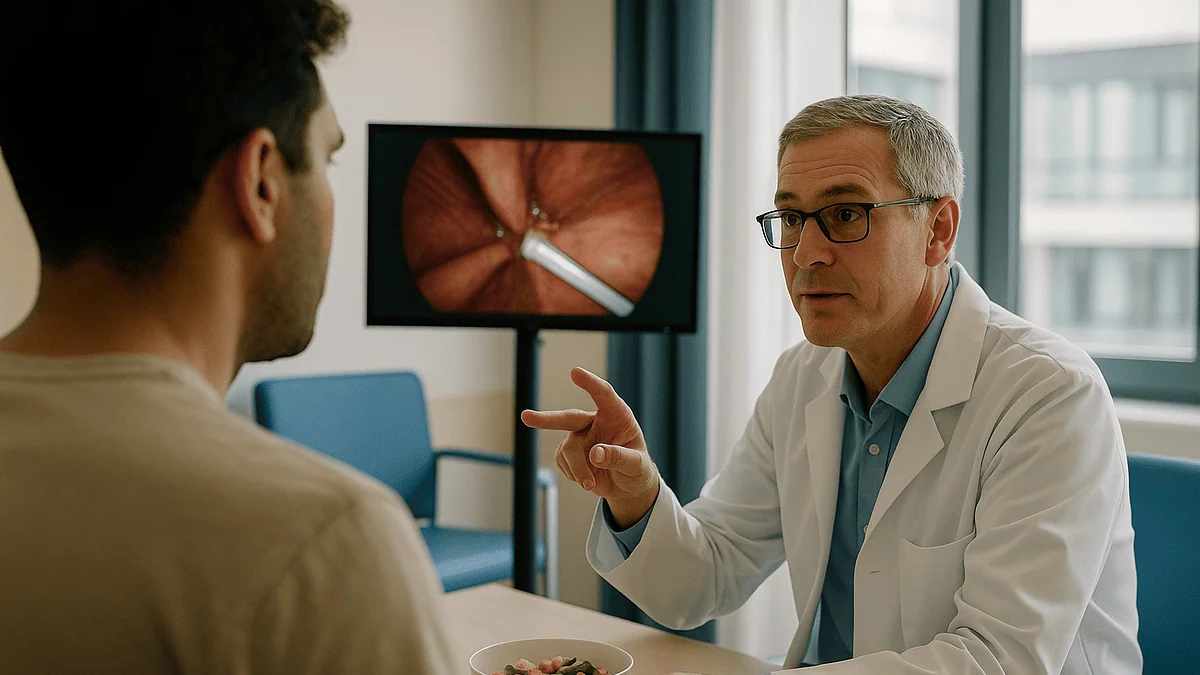
The POEM procedure for achalasia (peroral endoscopic myotomy) is a minimally invasive treatment done through the mouth with a flexible endoscope. The doctor creates a small tunnel inside the esophageal wall, then cuts the tight muscle fibers of the lower esophageal sphincter so food can pass into the stomach. It leaves no external incisions, usually involves one night in hospital, and is chosen with a specialist team after swallowing tests.
The cup of water is the tell. Most of us swallow without thinking; someone with achalasia watches a sip travel down slowly, stall, and sometimes come back up minutes later. Dinners get longer. Bread becomes a negotiation. By the time a gastroenterologist mentions the POEM procedure for achalasia, many people have already spent years quietly re-engineering how they eat.
What they are being offered is unusual. There is no cut on the skin. The whole operation happens from inside the esophagus, through a tunnel the endoscopist builds within the wall of the organ itself, then closes on the way out. That sounds either brilliant or alarming depending on how you first hear it, and the truth sits somewhere in the middle: it is a well-studied procedure with real benefits and a real trade-off.
This explainer walks through the tunnel, the muscle cut, the overnight stay and the weeks that follow, using the evidence rather than the brochure version.
What is the POEM procedure for achalasia, in plain language?
POEM stands for peroral endoscopic myotomy. Take the words one at a time. Peroral means through the mouth. Endoscopic means done with an endoscope, a thin flexible tube with a camera and tiny instruments at its tip. Myotomy means a cut through muscle. Put together, it is a procedure in which a doctor passes a scope down the throat and divides the ring of muscle at the bottom of the esophagus without opening the chest or the abdomen.
The target is the lower esophageal sphincter, the muscular valve between the esophagus and the stomach. In healthy swallowing, this valve relaxes at exactly the right moment to let food drop through. In achalasia it does not relax properly, and the muscle of the esophagus above it loses its coordinated squeezing. Food pools. The esophagus gradually stretches. Mayo Clinic describes achalasia as rare and notes that the nerve damage behind it is not reversible, which is why treatment focuses on mechanically loosening the valve rather than restoring the nerves.
POEM was developed as an endoscopic answer to a surgical operation that already existed, the Heller myotomy, in which surgeons reach the same muscle from outside through small abdominal incisions. The idea behind POEM is simple: if the problem is a tight muscle, and you can reach that muscle from inside, you can cut it without any external wound.
Two things POEM is not. It is not a way to repair the nerves, and it is not a diagnosis; it is offered only after tests have confirmed achalasia. Both points come up again later, because the first shapes expectations and the second protects people from an unnecessary procedure.
Why does achalasia need a myotomy at all?
Pills would be easier. The reason muscle-cutting procedures dominate achalasia treatment is that the alternatives address the valve only weakly or briefly.

Consider what has gone wrong. According to MedlinePlus, achalasia involves damage to the nerves in the esophageal wall that normally tell the muscle to contract in sequence and tell the sphincter to open. Without that signaling, the valve stays clamped and the tube above it stops propelling. No medicine repairs those nerves. Muscle-relaxing drug classes such as calcium channel blockers or nitrates can lower pressure in the sphincter for a few hours, and Mayo Clinic lists them as options for people who cannot have other treatments, but their effect fades and side effects such as headache and low blood pressure limit long-term use. Botulinum toxin injected into the sphincter during an endoscopy can relax the muscle, yet Mayo Clinic notes the effect wears off and repeat injections are typically needed; it is generally reserved for people who are not candidates for more durable treatments.
Everything more lasting works by physically weakening the valve. Pneumatic dilation inflates a balloon inside the sphincter to stretch and partially tear the muscle. Heller myotomy cuts it surgically. POEM cuts it endoscopically. Each trades a controlled injury to the muscle for easier passage of food.
That framing matters for realistic expectations. A myotomy does not give someone back the peristalsis they lost; the esophagus still relies on gravity more than a healthy one does. What it removes is the obstruction, and for most people that is the difference between eating a meal and managing one. Whether, when and how to weaken that muscle is a decision your treating team makes with you, using your symptoms, your test results and your overall health.
How the POEM procedure for achalasia works, step by step: building the tunnel
The procedure happens under general anesthesia, so you are fully asleep with a breathing tube in place. Cleveland Clinic describes the whole sequence as done through an endoscope passed via the mouth, with no external incisions. Here is what the endoscopist is doing while you sleep.
Step one: mapping. The scope goes down and the doctor measures. They locate the tight sphincter and decide how far above it the tunnel should start, typically several centimeters up the esophagus.
Step two: lifting the lining. A small volume of fluid, often tinted blue so the layers are easy to see, is injected just beneath the innermost lining of the esophagus, the mucosa. This raises a cushion between the lining and the muscle underneath.
Step three: the doorway. A short cut is made in that raised lining. This is the only opening in the mucosa for the entire operation, and it becomes the entrance to the tunnel.
Step four: the tunnel. The tip of the scope slips through the doorway and into the space between the lining and the muscle. Working with a fine electrosurgical knife and repeated small injections of fluid, the endoscopist separates the layers, advancing a submucosal tunnel down the esophagus, across the sphincter and a short distance into the upper stomach. The lining stays intact above; the muscle stays intact below. It is a bit like sliding a hand between a jacket and its lining without tearing either.
The precision here is the whole point. Because the tunnel is created in a layer that normally has no nerve endings for sharp pain and few large blood vessels, it can be built with minimal bleeding. Carbon dioxide rather than room air is used to inflate the space, because it is absorbed by the body far faster if any escapes.
The myotomy itself: what gets cut, and how the tunnel is closed
With the tunnel complete, the scope is now sitting inside the wall of the esophagus, looking directly at the muscle fibers that have been failing to relax. This is where the myotomy happens.

The esophageal muscle has two layers. The inner circular layer wraps around the tube like rings; the outer longitudinal layer runs lengthwise. The endoscopist divides the circular fibers along the length of the tunnel, extending the cut across the lower esophageal sphincter and onto the stomach side. Some teams also divide part of the longitudinal layer, a variation sometimes called a full-thickness myotomy. The length of the cut is tailored: for the most common type of achalasia it is kept relatively short, while for the spastic type, in which the esophageal body itself clenches, a longer cut higher up the esophagus may be planned. Which variant you receive is a judgment your endoscopist makes from your manometry results, the swallowing pressure test that classifies achalasia into subtypes.
Once the muscle is divided, the scope withdraws back up the tunnel to the doorway. The small opening in the lining is then closed, most often with several endoscopic clips, occasionally with sutures placed through the scope. Closure matters enormously. The intact lining is what separates the inside of the esophagus, with its bacteria and food, from the tunnel and the mediastinum beyond. A well-sealed doorway is the reason POEM can be done without an external wound.
Nothing is removed from the body. No implant is left behind apart from the clips, which typically fall off on their own and pass unnoticed over the following weeks. What changes is functional: a valve that used to stay shut now opens under the modest pressure of a swallow.
How long does POEM take, and what does the overnight stay involve?
Consumer health sources such as Cleveland Clinic describe POEM as typically lasting one to a few hours in the procedure room, with the time depending on the length of the tunnel, the anatomy of the esophagus and how dilated it has become. Your team will give you a range for your case, and it is worth asking, because family members waiting outside tend to imagine the worst when an hour becomes two.
Preparation begins before that. Because a stretched achalasia esophagus can hold food and liquid for hours, most people are asked to follow a liquid-only diet for a day or two beforehand and then to fast, so that the esophagus is empty and the airway is protected during anesthesia. Your team will tell you exactly how long; follow their instructions rather than a general rule.
Afterward you wake in recovery with a sore throat and often a sensation of pressure in the chest. Both are expected. Nothing passes the mouth on the day of the procedure, not even water, while the closure clips settle.
The overnight stay is the safety check. Mayo Clinic notes that people having POEM usually stay in hospital overnight. During that time nurses monitor temperature, heart rate and pain, and many centers perform an imaging study the next morning, commonly a swallow X-ray with contrast, to confirm that the lining is sealed and no fluid is leaking outside the esophagus. If that looks clean, you are typically started on clear liquids and, once you tolerate them, allowed home the same day.
Bring loose clothing, someone to drive you, and low expectations for the first meal. It will be a drink.
Who is POEM usually for, and who is usually asked to wait?
POEM is offered to people with a confirmed diagnosis of achalasia. Confirmed is the operative word. The symptoms of achalasia, food sticking, regurgitation, chest pain, weight loss, overlap with strictures, reflux disease and occasionally cancer at the junction of the esophagus and stomach. Mayo Clinic describes the standard work-up as an upper endoscopy to look directly at the lining, a barium swallow X-ray to see the shape of the esophagus, and esophageal manometry to measure pressures and confirm the sphincter is not relaxing. Manometry is the test that clinches it.
Within achalasia, POEM has a particular reputation for the spastic subtype, often called type III, because the endoscopist can extend the myotomy higher up the esophagus than a surgeon working from the abdomen can easily reach. It is also frequently considered for people whose earlier balloon dilation or Heller myotomy has stopped working, since the tunnel can be built on a side of the esophagus that avoids scar tissue.
Some people are asked to wait or steered elsewhere. Anyone who cannot safely undergo general anesthesia is not a candidate. Active severe esophagitis or a lining that will not lift cleanly can make the tunnel unsafe, so the procedure may be postponed while the lining heals. People taking blood thinners need a plan agreed between the endoscopist and the prescribing clinician; never adjust those medicines on your own. Pre-existing severe reflux weighs in the discussion, for reasons the next sections make clear. A very dilated, sigmoid-shaped esophagus makes any myotomy less predictable, and in a small number of people with end-stage disease the team may talk about surgical removal of the esophagus instead.
Whether POEM, balloon dilation or surgery fits you best is a decision made with the treating team, weighing your subtype, your history and what you value most.
POEM vs Heller myotomy vs pneumatic dilation: how the main options compare
Three durable treatments compete for the same job. A randomized trial of POEM against laparoscopic Heller myotomy, published in the New England Journal of Medicine and indexed on PubMed, found the two produced similar relief of symptoms at two years; the trade-off appeared in reflux, discussed in the next section. Balloon dilation is the oldest of the three and often needs repeating. The table below summarizes what each involves, drawing on Mayo Clinic and NHS descriptions.
| Feature | POEM | Laparoscopic Heller myotomy | Pneumatic dilation |
|---|---|---|---|
| How the sphincter is loosened | Muscle cut from inside via a submucosal tunnel | Muscle cut from outside through small abdominal incisions | Muscle stretched and partly torn by an inflated balloon |
| External incisions | None | Usually several small ones | None |
| Anesthesia | General | General | Sedation or general |
| Anti-reflux step included | Not routinely | Often combined with a partial wrap of the stomach (fundoplication) | No |
| Typical hospital stay | Overnight (Mayo Clinic) | Short stay, commonly one to two nights | Usually same-day |
| Repeat sessions | Generally single procedure | Single operation | Often needs to be repeated over time (Mayo Clinic) |
| Reach for spastic (type III) disease | Cut can extend high up the esophagus | Limited to the lower esophagus | Treats the sphincter only |
None of these columns declares a winner. Heller myotomy’s built-in anti-reflux wrap is its main advantage; POEM’s reach and lack of incisions are its own. Dilation appeals to people who want to avoid anesthesia and accept repeat visits. The right column for you is the one your team recommends after looking at your manometry and your priorities.
What are the POEM procedure risks?
Any honest account of POEM has two lists: the things that can go wrong during and shortly after the procedure, and the one thing that commonly changes afterward. This section covers the first; reflux gets its own.
Because the tunnel is built inside the wall of the esophagus, gas can leak through the muscle into the chest cavity, the space around the heart or the abdomen. This is expected to some degree and is why carbon dioxide is used; the body reabsorbs it quickly. Rarely, enough collects to need a needle to release it during the procedure. Bleeding inside the tunnel is usually minor and controlled with the same electrosurgical knife.
The complication teams watch for most closely is a leak. If the lining is breached anywhere other than the intended doorway, or if the doorway closure fails, contents from inside the esophagus can reach the tunnel and the tissues beyond, leading to infection in the chest. This is uncommon but serious, and it is the reason for the overnight stay, the morning swallow study and the strict no-food rule on the first day. Injury to neighboring structures is rare with an experienced operator.
Anesthesia carries its own small risks, including aspiration of retained esophageal contents into the lungs, which is why the pre-procedure liquid diet and fasting instructions are not optional.
In the randomized trial indexed on PubMed comparing POEM with laparoscopic Heller myotomy, serious adverse events occurred in a small minority of patients in both groups, and were not more frequent after POEM. That does not make the procedure risk-free; it places the risk in the same general range as the established surgical alternative. Your team should walk you through the specific complication figures for their own practice.
Reflux after POEM: the trade-off nobody should skip over
Here is the part that deserves the most candid conversation. The lower esophageal sphincter that POEM weakens is also the body’s main barrier against stomach acid washing upward. Cut the valve open for food, and you open it for acid too.
The numbers are not subtle. In the randomized trial published in the New England Journal of Medicine and indexed on PubMed, esophagitis seen at endoscopy, meaning visible acid injury to the lining, was present at two years in roughly 44 percent of the POEM group compared with about 29 percent of those who had a Heller myotomy with a partial fundoplication. Many people with esophagitis on camera felt no heartburn at all, which is why guidelines do not rely on symptoms alone to judge reflux after POEM.
Why the difference? The Heller operation is almost always paired with a fundoplication, in which the top of the stomach is partly wrapped around the lower esophagus to rebuild a barrier. POEM, working from inside, does not include that step. Endoscopic anti-reflux techniques are being studied but are not yet standard.
What this means in practice is that long-term follow-up is part of the POEM package. Many people are placed on acid-suppressing medicines in the class known as proton pump inhibitors, which reduce acid production in the stomach; whether you take one, and for how long, is decided by your gastroenterologist based on your symptoms and, often, a follow-up endoscopy or acid test months later. Untreated acid injury over years can lead to Barrett’s esophagus, a change in the lining that itself needs surveillance.
Reflux is manageable for most people. It is still a real change, and anyone weighing POEM against Heller myotomy should have it laid out plainly before deciding.
POEM surgery recovery time: what the first days and weeks usually look like
Recovery from POEM is fast by the standards of operations on the esophagus, but it is not nothing. Cleveland Clinic describes most people returning to normal activities within about a week. The texture of that week is worth knowing.
Day one, in hospital. Sore throat, chest tightness, sometimes shoulder or neck ache from residual gas. Pain is usually controlled with medicines your team chooses; you take nothing by mouth until the morning imaging confirms the closure.
Days one to three. Clear liquids, then full liquids. Many people notice immediately that a sip goes down without stalling; others feel swollen and tight for several days as the tunnel heals. Both are normal. Low-grade discomfort behind the breastbone is common. A fever, worsening chest pain or difficulty breathing is not, and belongs in the red-flag section below.
First two weeks. Diet advances from liquids to soft, moist foods. Most people are told to avoid heavy lifting and strenuous exercise for about two weeks while the clips and the doorway heal. Desk work is often possible after a few days; jobs involving exertion need a longer pause your team will specify.
Weeks three to six. Gradual return to a normal diet, eaten slowly and upright. Because the esophagus above the myotomy still lacks coordinated squeezing, food moves by gravity. Eating at a table rather than on the couch, staying upright for a couple of hours after meals and finishing dinner well before bed remain useful habits for life, not just for recovery.
Follow-up typically includes a clinic visit and, later, an assessment for reflux. Ask your team when they expect to see you and what tests they plan.
Eating after POEM: how the diet usually progresses and why the rules exist
The diet plan after POEM is not about nutrition in the first week; it is about protecting a small seal inside the esophagus while it heals. Every stage has a reason.
Nothing by mouth on day one exists because swallowing pushes liquid against the freshly clipped doorway. Clear liquids come next because they pass easily and, if a leak were present, would cause the least harm. Full liquids such as smooth soups, yogurt drinks and nutritional shakes follow. Soft foods, scrambled eggs, mashed vegetables, flaked fish, well-cooked pasta, are introduced as the days pass. Bread, tough meat, raw vegetables and anything that forms a dense bolus are usually the last to return.
Two behaviors matter more than any particular food. Chew thoroughly. Sit upright. A healthy esophagus can move a poorly chewed mouthful along with its own contractions; an achalasia esophagus, even after a perfect myotomy, cannot. Small mouthfuls, sips of water between them and an unhurried pace do the work the muscle no longer does.
Carbonated drinks tend to produce uncomfortable bloating in the early weeks and many teams suggest avoiding them for a while. Alcohol can irritate the healing lining and worsen reflux. Very hot or very cold liquids sometimes trigger chest spasm in people with achalasia and are often reintroduced gradually.
Weight is a quieter concern. Many people arrive at POEM underweight after years of restricted eating. Rapid gain afterward is common and welcome up to a point; your team or a dietitian can help you aim for a healthy trajectory rather than a rebound. If any food that once passed easily starts sticking again months later, that is a reason to report back, not to push through.
What people often get wrong about POEM
Some misunderstandings surface in almost every consultation. Correcting them early prevents disappointment later.
Myth: POEM fixes the esophagus. It fixes the valve. The loss of coordinated contractions above the valve, which MedlinePlus describes as part of the underlying nerve damage, does not come back. Food moves by gravity afterward. People who expect to eat lying down or to bolt a sandwich are often surprised; people who understand the mechanics adapt well.
Myth: no incision means no risk. The absence of a skin wound reduces some risks and hides others. A leak from the internal closure is more dangerous than a wound infection on the abdomen would be, which is why the overnight monitoring exists.
Myth: POEM is experimental. It has been performed for well over a decade, has been compared head to head with surgery in randomized trials indexed on PubMed, and is listed by Mayo Clinic among standard treatments for achalasia. It is newer than Heller myotomy, not unproven.
Myth: if you feel fine, you have no reflux. The trial evidence shows acid injury to the lining is frequently silent after POEM. Follow-up testing is how it is found, not heartburn.
Myth: POEM is a one-and-done event. The procedure is usually a single session, but the relationship with your gastroenterology team is long. Symptoms can recur years later; reflux needs monitoring.
Myth: it works the same for everyone. Achalasia subtype, degree of esophageal dilation and previous treatments all influence outcomes. Averages from studies describe populations, not individuals, and no clinician can promise how your esophagus will respond.
Questions to ask your care team before agreeing to POEM
A good consultation leaves you knowing why this procedure, why now and what happens if it does not go to plan. These questions help get there. Bring them written down; the answers are yours to keep.
- Which subtype of achalasia do my manometry results show, and does that make POEM, balloon dilation or Heller myotomy a better fit for me?
- How many POEM procedures does this team perform, and what are its own rates of leak, bleeding and conversion to another procedure?
- How long a myotomy do you plan, and will it be a circular-only or full-thickness cut?
- What is your plan if you cannot safely complete the tunnel once you have started?
- How will you check for reflux afterward, when, and what happens if acid injury is found?
- Which of my current medicines, especially any blood thinners, need adjusting before the procedure, and who will manage that?
- What exactly should I eat and drink in the two days beforehand, and when should I stop completely?
- What symptoms in the first week should make me call, and what number do I call at night?
- When can I return to work, drive and exercise, given what my job involves?
- If my swallowing symptoms come back in a few years, what are the options then?
One more question is worth asking of yourself rather than the team: what matters most to you, avoiding incisions, avoiding lifelong acid medication, avoiding repeat procedures, or getting the most complete relief for a spastic esophagus? Different people weigh these differently, and the honest answer shapes which treatment is right. Whatever you decide, the final plan is made together with the treating team, who can see your test results in a way no article can.
When to call your doctor after POEM: red-flag signs
Most discomfort after POEM is dull, steady and improves day by day. The signs below are different in character, and each one needs a same-day call to your team or, if severe, emergency care.
- Fever or shaking chills, especially in the first week, which can signal infection from a leak at the tunnel closure.
- Chest pain that is sharp, worsening or spreading to the neck, back or shoulder, rather than the expected mild tightness that eases over days.
- Shortness of breath, rapid breathing or pain when you breathe in, which can indicate gas or fluid collecting around the lungs or heart.
- Vomiting blood or passing black, tarry stools, signs of bleeding in the esophagus or stomach.
- Swelling of the neck or face, or a crackling feeling under the skin, suggesting gas has tracked upward from the chest.
- Inability to swallow even liquids, or saliva pooling that you cannot clear, after initially managing fluids.
- A rapid heartbeat, dizziness or fainting, which can accompany bleeding, infection or dehydration.
Call sooner rather than later. The complications of POEM are rare, but the serious ones are far easier to manage when caught in the first hours. Your team would much rather hear from you about a fever that turns out to be nothing than learn about it two days on.
In the months and years afterward, different signals matter. Recurrent food sticking, unexplained weight loss, persistent heartburn or acid taste, or waking at night coughing or choking should all be reported to your gastroenterologist. They may point to returning obstruction or to reflux that needs assessment. If you are in doubt about whether a symptom counts, the answer is to ask; the decision about what to do next always sits with the team that knows your case.
Frequently asked questions
How serious is POEM surgery?
POEM is a major procedure done under general anesthesia inside the wall of the esophagus, so it is taken seriously, but it is minimally invasive with no skin incisions. The most important complication is a leak at the internal closure, which is uncommon and is the reason for the overnight stay and morning imaging. In a randomized trial indexed on PubMed, serious adverse events were no more frequent after POEM than after laparoscopic Heller myotomy.
What is peroral endoscopic myotomy, exactly?
Peroral endoscopic myotomy is a treatment for achalasia in which a flexible endoscope passed through the mouth is used to tunnel beneath the lining of the esophagus and cut the tight muscle of the lower esophageal sphincter. Peroral means through the mouth, endoscopic means using a camera scope, and myotomy means cutting muscle. The entrance to the tunnel is closed with clips at the end, leaving no external wound.
How long does it take to recover from POEM surgery?
Most people leave hospital the day after the procedure and, according to Cleveland Clinic, return to normal activities within about a week. Diet advances from clear liquids to soft foods over one to two weeks, with a fuller diet resuming over the following weeks as your team advises. Strenuous exercise and heavy lifting are usually paused for about two weeks. Follow-up for reflux continues for months.
What is the POEM surgery recovery time compared with Heller myotomy?
Both are short-stay procedures. Mayo Clinic describes POEM as usually requiring one night in hospital, while laparoscopic Heller myotomy commonly involves one to two nights and small abdominal incisions that need to heal. Return to everyday activity is typically quicker after POEM, though the difference is measured in days rather than weeks. Your own timeline depends on your health, your job and how your esophagus responds.
POEM vs Heller myotomy: which is better for achalasia?
Neither is better for everyone. A randomized trial indexed on PubMed found similar symptom relief at two years, but more acid injury to the esophageal lining after POEM, because Heller myotomy is usually paired with a partial stomach wrap that guards against reflux. POEM avoids incisions and can treat spastic achalasia higher up the esophagus. The choice depends on your subtype, prior treatments and priorities, decided with your treating team.
What are the main POEM procedure risks?
The main risks are gas escaping into the chest or abdomen during the procedure, bleeding within the tunnel, and, rarely, a leak from the internal closure that can cause infection in the chest. General anesthesia carries its own small risks, including aspiration if the esophagus is not empty. Longer term, reflux is the most common consequence, which is why follow-up testing is part of standard care.
Is the POEM procedure covered by Medicare or insurance?
Coverage for POEM varies by insurer, plan and country, and it can depend on documentation that achalasia has been confirmed by tests such as manometry. Rather than relying on general statements, ask your care team’s scheduling or financial office to confirm authorization requirements with your specific plan before the procedure. This article does not provide cost or coverage figures, because they differ widely and change over time.
How long does G-POEM surgery last, and is it the same as POEM?
G-POEM is a related but different procedure. It applies the same tunneling technique to the pylorus, the muscular outlet of the stomach, to treat gastroparesis, a condition in which the stomach empties too slowly. It is not used for achalasia. Procedure times are broadly similar to esophageal POEM, generally an hour or more, but the evidence base for G-POEM is still developing and your team can explain where it stands.
Will I need acid-reducing medicine for life after POEM?
Many people are advised to take a proton pump inhibitor, a medicine class that reduces stomach acid production, at least for a period after POEM, because the weakened valve lets acid rise more easily. Whether you need it, and for how long, is decided by your gastroenterologist based on symptoms and follow-up endoscopy or acid testing. Do not start, stop or change any medicine without that guidance.
Can achalasia symptoms come back after POEM?
Yes, swallowing difficulty can return months or years later in some people, because the underlying nerve damage remains and the esophagus can continue to change shape. If food starts sticking again, your team may repeat imaging or manometry and consider options such as balloon dilation, a repeat myotomy on a different side of the esophagus, or surgery. Reporting new symptoms early gives the most options.
References
- Achalasia – NHS
- Achalasia – MedlinePlus Medical Encyclopedia
- Achalasia: Symptoms, Causes, Diagnosis & Treatment – Cleveland Clinic
This article is for general information only and is not a substitute for professional medical advice. Please consult a qualified doctor about your individual situation.

More from the Blog

Before a Hemorrhoid Procedure: Blood Thinners, Bowel Preparation and Fasting Instructions
Preparing for hemorrhoid surgery usually means three things: a plan for any blood-thinning medicine made with the prescribing clinician, never on your own; a…

What to Expect After Appendicitis Surgery: Scars, Energy Levels and the Return of Appetite
After appendix removal, most people go home within a day or two and feel close to normal within about two weeks after keyhole surgery,…

Recovery After Achalasia Treatment: Liquids First, Then Advancing Your Diet as Advised
Recovery after achalasia treatment usually begins with clear liquids for the first day or so, then full liquids and pureed or very soft foods…

Robotic Hernia Surgery Technology: How the Magnified 3D Camera Guides Mesh Placement
Robotic hernia repair technology is a form of minimally invasive keyhole surgery in which the surgeon controls small wristed instruments from a console while…

Can Antibiotics Treat Uncomplicated Appendicitis Without Surgery? How Doctors Weigh Both Paths
Yes, for carefully selected patients. Large randomized trials show that an antibiotic-first approach is a reasonable option for uncomplicated appendicitis, meaning an inflamed appendix…

Robotic vs Laparoscopic Gallbladder Removal: Does the Robot Change Your Recovery?
Robotic and laparoscopic gallbladder removal are both keyhole operations, and current evidence does not show that the robot shortens recovery, reduces pain, or lowers…