

Postpartum Hair Loss: Why It Happens, When It Peaks and When It Is Something Else

Key Takeaways
- Postpartum shedding is telogen effluvium, a temporary release of hairs whose follicles paused together, and the follicles themselves are undamaged.
- Because the resting phase lasts about three months, the shed begins two to four months after delivery, peaks around month three to four, and usually settles by six to twelve months.
- Breastfeeding does not cause the shed; the trigger is the drop in estrogen at delivery, which happens regardless of feeding method.
- Iron deficiency and postpartum thyroiditis, which affects an estimated 5 to 10 percent of women in the first year, can prolong shedding and are both detectable with simple blood tests.
- High-dose biotin has no demonstrated benefit for hair in people who are not deficient and can distort thyroid and cardiac laboratory tests.
- Smooth round bald patches, a steadily widening part, scalp redness or scaling, or shedding still heavy at twelve months point to a different diagnosis and warrant a clinical examination.
Postpartum hair loss is a temporary shedding, called telogen effluvium, that usually begins two to four months after delivery, peaks around month three to four, and settles within six to twelve months as the hair cycle resets. It is driven by the drop in pregnancy hormones, not by breastfeeding or poor care. Shedding that lasts beyond a year, appears in patches, or comes with fatigue or other symptoms deserves a clinical review.
The video has a familiar shape: a new parent tilts the phone toward the shower drain, lifts a fist-sized clump of hair, and mouths a single word. The comments fill with rosemary oil recipes, collagen powders, and a dozen confident diagnoses. As of September 2026, that genre is having another surge, partly because of a wave of hair-supplement marketing aimed squarely at people in the first year after birth, and partly because low-dose oral minoxidil keeps making headlines as a hair treatment. Postpartum hair loss is suddenly a product category.
The medicine underneath it is calmer than the feed suggests. What most people are watching is telogen effluvium, a predictable shedding pattern that dermatologists have described for decades and that resolves on its own in the large majority of cases. The trick is telling that ordinary shed from the smaller number of situations where something else is going on.
This piece walks through the mechanism, the timeline, what the evidence does and does not support, and the signs that should move you from patience to a phone call.
What is postpartum hair loss, and is it really hair loss at all?
Strictly speaking, the hair is not lost. It is released on a delayed schedule. The medical name is telogen effluvium, which means a large number of hair follicles have shifted at the same time into their resting phase and are now letting go of the strands they were holding. Nothing has happened to the follicle itself; the factory is intact, it has simply paused production and cleared the shelf.
That distinction matters because the word “loss” implies something permanent. Scarring alopecias, where inflammation destroys the follicle, are permanent. Female pattern hair loss, a gradual miniaturization of follicles driven by genetics and androgens, is progressive without treatment. Postpartum shedding belongs to neither group. Cleveland Clinic describes it as a normal and expected phase, and the American Academy of Dermatology uses the phrase “excessive shedding” rather than hair loss precisely to lower the temperature.
The numbers help frame it. A typical scalp carries roughly 100,000 hairs and sheds 50 to 100 a day without anyone noticing. In telogen effluvium, the proportion of follicles resting climbs from the usual 10 to 15 percent to 30 percent or higher, so daily shedding can triple or more. On a shower drain or a pillow that looks dramatic. Across the whole scalp it usually amounts to a diffuse thinning that a stranger would struggle to see, though the person living in that scalp sees it in every mirror.
One more piece of vocabulary before moving on. Dermatologists call shedding that happens on a set delay after a trigger “acute telogen effluvium.” Childbirth is the textbook trigger, alongside major surgery, high fever, crash dieting, and severe emotional stress. The pattern is the same regardless of cause: a lag of two to four months, a peak, then recovery.
How the hair growth cycle works in plain terms
Every follicle on the scalp runs its own private cycle, and the reason a healthy head never goes bald is that these cycles are staggered. Picture a hundred thousand tiny clocks, each set to a slightly different time.
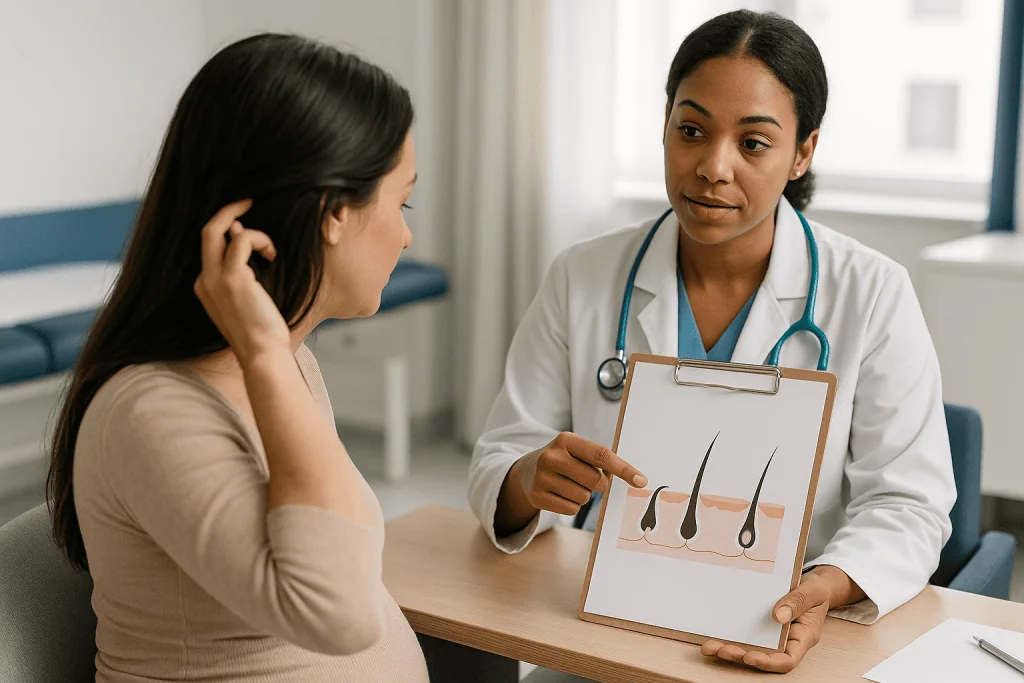
The long phase is anagen, the active growth period, which lasts anywhere from two to seven years and produces about a centimeter of hair a month, roughly half an inch. Next comes catagen, a brief transition of two to three weeks during which the follicle shrinks and detaches from its blood supply. Then telogen, the resting phase, holds the hair in place for around three months while a new hair begins forming underneath. Finally, in a stage some researchers separate out as exogen, the old strand is shed and the cycle restarts.
On an ordinary day about 85 to 90 percent of scalp hairs sit in anagen, a small fraction in catagen, and the rest in telogen. The daily shed of 50 to 100 hairs is just the telogen population reaching the end of its three-month wait.
Telogen effluvium disrupts the staggering. A body-wide signal, in this case the hormonal shift after delivery, pushes a large fraction of follicles out of anagen and into telogen at once. Because telogen lasts about three months, the shed does not begin immediately; it arrives on schedule roughly a quarter of a year after the trigger. That built-in delay is why so many people feel blindsided. The baby is three months old, the worst of the early recovery seems behind them, and then the hair starts coming out in handfuls. The follicles, though, are already working on the replacement hair. The shed and the regrowth are two sides of the same event.
Why pregnancy makes hair thicker first, and why that sets up the shed
Ask anyone who has been pregnant about their hair in the third trimester and you often get a wistful answer. It looked fuller. It felt heavier. Fewer strands turned up on the brush. That was not imagination.
Estrogen rises steadily through pregnancy and, among its many effects, appears to prolong anagen. Follicles that would normally have moved into their resting phase stay in growth mode instead. The result is a scalp with an unusually high proportion of hairs in anagen and an unusually low daily shed. Cleveland Clinic and Mayo Clinic both describe this as the reason pregnancy hair seems thicker: the same number of follicles are simply holding on to more hair at once.
Then delivery happens. Within days, estrogen and progesterone fall back toward pre-pregnancy levels, and the signal that was holding follicles in anagen disappears. Thousands of follicles that had been artificially delayed now enter telogen together. Three months later, give or take, they shed together. What feels like losing extra hair is largely the return of the hair that would have fallen out gradually across nine months, plus a catch-up correction.
This is also why the experience varies. Someone whose hair grew dramatically fuller during pregnancy has more delayed hairs waiting to shed and may notice a heavier drop. Someone whose pregnancy hair changed little may barely register the postpartum phase. Neither pattern says anything about health or about how well the pregnancy or recovery went.
Other physiological shifts join in. Blood volume, which expanded by up to half during pregnancy, contracts. Iron stores that were drawn down to build a placenta and a baby may sit low, particularly after significant bleeding at delivery. Sleep fragments. Any of these can nudge additional follicles toward rest, which is one reason the shed sometimes feels out of proportion to the hormonal story alone.
When does postpartum hair loss peak, and when does it stop?
The single most common question, and fortunately one with a fairly consistent answer. Most people first notice increased shedding two to four months after delivery. The heaviest phase typically arrives around month three to four. By month six the drain is usually calmer, and by nine to twelve months the majority of people describe their hair as back to its pre-pregnancy baseline, or close to it.

The shedding stops when the follicles that emptied together begin releasing their new hairs on a normal, staggered rhythm again. Because a new hair was already forming beneath each shed strand, regrowth is happening the whole time, even during the worst weeks. It is simply short and fine at first and easy to miss.
The visual recovery lags the biological one. If hair grows about a centimeter a month, a strand that started in month three reaches chin length only well into the second year. What people notice around months six to nine is the halo of short new growth along the hairline and part, sometimes nicknamed baby hairs. Those are the recovery, not a new problem.
A few caveats deserve honesty. The timeline shifts if a second trigger stacks on top of the first: a significant illness, a very restrictive diet, iron deficiency, or a thyroid disturbance can extend or re-start the shed. Shedding that is still heavy at twelve months, or that never truly began to ease, is no longer well explained by pregnancy alone and is the point at which most dermatology guidance suggests looking for another cause.
People who plan a subsequent pregnancy within the year sometimes ask whether the cycle repeats. It can. Each pregnancy resets the same hormonal clock, so a second shed after a second birth is common and equally temporary.
What changed recently
The biology has not changed. The surroundings have, and three shifts explain why this topic is trending again.
First, low-dose oral minoxidil. Minoxidil was approved decades ago as a blood pressure tablet and, in topical form as Rogaine, as an over-the-counter hair regrowth treatment. Beginning around 2022, coverage of dermatologists prescribing the oral tablet off-label for hair loss spread widely, and searches have climbed every year since. Oral minoxidil remains unapproved for hair loss in the United States. The evidence for it comes largely from observational case series in pattern hair loss, not from randomized trials in postpartum shedding, and whether it is appropriate for any individual, including anyone breastfeeding, is a decision that belongs to a prescribing clinician.
Second, biotin. In 2017 the US Food and Drug Administration issued a safety communication, updated in 2019, warning that high-dose biotin supplements can interfere with common laboratory tests, including troponin tests used to diagnose heart attacks and some thyroid assays. The NIH Office of Dietary Supplements fact sheet on biotin now carries that caution and notes that evidence for biotin improving hair in people who are not deficient is lacking. That matters postpartum because thyroid testing is one of the checks a clinician may order for prolonged shedding.
Third, rosemary oil. A single 2015 randomized trial comparing rosemary oil with topical minoxidil in men with pattern baldness found similar hair counts at six months. That one study, in a different population and a different condition, has been stretched across social media into a universal cure. It has not been replicated in postpartum telogen effluvium.
The mainstream references have held steady through all of this. Cleveland Clinic, Mayo Clinic, and the NHS continue to describe postpartum shedding as self-limiting and to reserve treatment discussions for cases that persist or point to another diagnosis.
What the evidence actually says, graded honestly
Hair research has a candor problem: a lot of what circulates is opinion dressed as data. Sorting claims by the strength of evidence behind them is more useful than another list of tips.
Strong and consistent (clinical consensus plus decades of observational data): childbirth triggers telogen effluvium; onset is delayed by roughly three months; the condition resolves spontaneously in most people within a year. This has never needed a randomized trial because the natural history is so reproducible, and every major reference, from MedlinePlus to the NHS, describes it the same way.
Moderate (observational and mechanistic): iron deficiency and thyroid dysfunction are associated with diffuse shedding and can prolong recovery. Correcting a documented deficiency is reasonable and standard. What is less established is whether iron helps hair when ferritin is merely on the lower side of normal; studies conflict, and expert opinion varies.
Weak (small trials in other populations, or questionnaire studies): topical minoxidil shortens telogen effluvium. Minoxidil is well supported by randomized trials for pattern hair loss, but trials specifically in postpartum shedding are scarce. Cross-sectional surveys asking new parents what made their shedding worse are useful for generating hypotheses and nothing more; self-reported hair loss is notoriously unreliable.
Very weak or absent: biotin, collagen, and most “hair, skin and nails” blends improving hair in people without a deficiency; rosemary oil in postpartum shedding; scalp massage devices; special shampoos. The NIH Office of Dietary Supplements states plainly that the evidence for biotin in hair growth is limited to deficiency states.
The honest summary is that the best-supported intervention for ordinary postpartum shedding is time, and the best-supported action when shedding is unusual is a clinical evaluation. Everything else lives in the space between hopeful and unproven.
Hair loss after pregnancy vs. something else: how the patterns differ
Postpartum shedding has a signature. Learning it makes the exceptions easier to spot. Ordinary telogen effluvium is diffuse, meaning it thins the whole scalp roughly evenly rather than carving out a patch or a widening part. The hairs that come out have a small white bulb at the root, which is the sign of a hair that finished its cycle normally. The scalp itself looks healthy: no redness, no scale, no tenderness. And the timeline follows the arc described above.
The table below sets it beside the conditions most often confused with it.
| Feature | Postpartum telogen effluvium | Female pattern hair loss | Alopecia areata | Thyroid or iron related shedding |
|---|---|---|---|---|
| Pattern | Diffuse, whole scalp | Widening part, crown thinning, hairline preserved | Smooth round bald patches | Diffuse, similar to telogen effluvium |
| Onset | 2 to 4 months after delivery | Gradual over years, may unmask postpartum | Sudden, sometimes days | Variable, may follow postpartum thyroiditis |
| Scalp appearance | Normal | Normal, hairs progressively finer | Normal skin, occasional exclamation-mark hairs | Normal |
| Other clues | Thicker hair during pregnancy | Family history | Nail pitting in some people | Fatigue, cold or heat intolerance, palpitations, pale skin |
| Typical course | Resolves in 6 to 12 months | Progressive without treatment | Often regrows, can recur | Improves when the underlying condition is treated |
Two patterns catch people out. Female pattern hair loss can be unmasked by a postpartum shed: the diffuse loss recovers, but the part stays wider than before because an underlying genetic tendency was already there. And alopecia areata, an autoimmune condition, occasionally appears for the first time after pregnancy, when the immune system is recalibrating. A round, completely smooth patch is not telogen effluvium and warrants prompt assessment.
Iron, thyroid and the postpartum labs worth asking about
If shedding is heavier or longer than the usual arc, two systems deserve attention before anything else, because both are common after birth and both are correctable.
Iron first. Pregnancy roughly doubles iron requirements, and blood loss at delivery draws stores down further. The NIH Office of Dietary Supplements notes that iron deficiency is among the most common nutritional deficiencies in pregnant and postpartum women worldwide. Hair follicles are among the fastest-dividing tissues in the body and are sensitive to iron supply, which is why diffuse shedding, along with fatigue, breathlessness on stairs, and unusual paleness, can signal a low ferritin. Ferritin is the protein that stores iron and is the blood test that best reflects reserves. A clinician can check it alongside a full blood count. The debate over what ferritin level counts as “enough” for hair is unresolved; correcting a true deficiency is standard, while supplementing without measuring is not recommended because excess iron carries its own risks.
Thyroid second. Postpartum thyroiditis is an inflammation of the thyroid gland that affects an estimated 5 to 10 percent of women within the first year after birth. It often runs in two acts: a few weeks or months of overactive thyroid, sometimes mistaken for anxiety or the general intensity of new parenthood, followed by an underactive phase that can bring fatigue, weight gain, feeling cold, low mood, and diffuse hair shedding. The test is a thyroid stimulating hormone level, abbreviated TSH, usually with a free thyroxine measurement. Because biotin supplements can distort these assays, telling the clinician about any supplement use before a blood draw is worthwhile.
Beyond these, a clinician may consider vitamin D, zinc, or a broader review depending on diet and symptoms. What none of the references support is ordering a panel on your own or interpreting borderline results in isolation. The pattern of symptoms, the timing, and the numbers together tell the story.
Does breastfeeding cause hair loss, or make it worse?
The belief is widespread and the guilt it produces is real: if only I stopped nursing, my hair would come back. The evidence does not bear this out.
The shed is triggered by the hormonal drop at delivery, which happens whether or not a person breastfeeds. Cleveland Clinic states that breastfeeding does not cause postpartum hair loss and that hair returns on the same schedule regardless of feeding method. Prolactin, the hormone that drives milk production, has been proposed as a factor because it can suppress estrogen and delay the return of periods, and some laboratory work suggests prolactin influences follicle cycling. Translating that into a meaningful clinical effect has not been achieved; the observational studies that exist are small and inconsistent.
What breastfeeding does change is the nutritional math. Milk production adds several hundred calories a day to energy needs and increases demand for iron, iodine, protein, and several vitamins. A parent who is exhausted, skipping meals, and running on coffee is more likely to slip into a mild deficiency, and that, rather than lactation itself, is the plausible link to prolonged shedding. The practical response is regular meals with adequate protein and iron-rich foods, not weaning.
The breastfeeding question also shapes treatment conversations. Topical minoxidil has minimal systemic absorption, but safety data during lactation are limited and manufacturers advise consulting a clinician. Oral minoxidil has essentially no safety data in breastfeeding for hair indications. Many dermatologists therefore suggest waiting until the natural recovery window has passed, and until nursing has ended or a clinician has weighed the specifics, before considering any medicine. That is a shared decision with the prescribing clinician, informed by how the shed is behaving and what else is going on.
Stopping breastfeeding to rescue hair is a trade with no demonstrated benefit on one side.
What is the best remedy for postpartum hair loss? An honest answer
The most searched question deserves the least evasive reply: for typical postpartum shedding, no remedy has been shown to beat waiting. Every major reference, from the NHS to Mayo Clinic, describes the condition as self-limiting and lists treatment as optional rather than necessary.
That is not the same as saying nothing helps you feel better while it runs its course. A few measures have sound reasoning behind them even where trial evidence is thin.
Eating adequately sits at the top. Hair is built from protein; a body that is short on protein, iron, or overall energy will prioritize organs over follicles. A varied diet with protein at each meal, iron-rich foods such as legumes, red meat, fortified cereals, and leafy greens, and enough total food to support recovery and any breastfeeding is a legitimate hair intervention. It works by removing a second trigger, not by adding a stimulant.
Gentle handling comes next. Wet hair stretches and breaks more easily; a wide-tooth comb, air drying when possible, and skipping tight ponytails and heavy extensions during the shedding months reduce mechanical loss. This does not change how many follicles are resting, but it stops breakage from adding to the shed.
Scalp care is about comfort more than growth. Volumizing shampoos and lightweight conditioners can make thinning less visible. None have been shown to alter the cycle, and claims that a shampoo “stops shedding” should be read as marketing.
Medicines and supplements are addressed in the next section. The short version: they have a place when shedding persists or when another diagnosis is made, and that place is defined by a clinician, not a comment thread.
The remedy, in the end, is the one nobody wants to sell: the follicles are already growing the replacement, and the calendar is on your side.
Minoxidil, supplements and the rosemary oil question
These three come up in nearly every conversation about postpartum shedding, and each deserves an evidence-based, dose-free look.
Minoxidil, sold over the counter as Rogaine and as generics, is the only topical medicine approved in the United States for hair regrowth. Randomized trials support it in female pattern hair loss, where it is thought to prolong anagen and enlarge miniaturized follicles. In telogen effluvium the picture is different: the follicles are not miniaturized, and the condition resolves on its own, so trial data are sparse. Some dermatologists use it when shedding drags past the expected window or when pattern loss has been unmasked. Oral minoxidil for hair is off-label and unapproved for that purpose; the supporting evidence is observational and comes from pattern hair loss populations, not postpartum shedding. Whether either form is appropriate, including during breastfeeding, is a question for the treating clinician who knows the individual history.
Supplements are where marketing runs furthest ahead of science. The NIH Office of Dietary Supplements is unambiguous that biotin has not been shown to improve hair in people who are not deficient, and biotin deficiency is rare. Collagen peptides have no randomized evidence for scalp hair. Multi-ingredient “hair vitamins” typically combine biotin, zinc, and botanicals; the trials behind them are small, often industry-funded, and rarely conducted in postpartum populations. Where a real deficiency exists, replacing that specific nutrient is standard care. Blanket supplementation is not, and high-dose biotin can distort thyroid and cardiac blood tests.
Rosemary oil rests on one 2015 randomized trial in men with pattern baldness that found results comparable to topical minoxidil at six months. It was a single small study in a different condition and has not been repeated in women with telogen effluvium. Rosemary oil is generally well tolerated on the scalp, and using it is unlikely to cause harm, but describing it as proven for postpartum shedding overstates what exists.
Can postpartum hair loss be reversed, and what does regrowth look like?
In the ordinary case, the question answers itself: the shedding reverses because the follicle was never damaged. Reversal is the default outcome, not something that has to be achieved.
Regrowth has a look that people rarely recognize as progress. Around four to six months after delivery, a fringe of short, fine, sometimes lighter hairs appears along the front hairline and temples. Because they are only a few centimeters long, they stick up, refuse to lie flat, and are frequently mistaken for breakage or for more thinning. They are the new anagen hairs emerging. Over the following months they lengthen, darken, and blend in. By the first birthday most people describe their density as back to normal, even though the newest hairs are still far shorter than the rest.
Texture can shift temporarily. Some people report their new growth is wavier, straighter, or slightly different in color. This is documented anecdotally in dermatology practice but poorly studied; the leading explanation is that a follicle restarting after a long pause can produce a hair with slightly different shape for the first cycle. It usually normalizes.
Where reversal does not fully happen, the reason is almost always a second diagnosis. Female pattern hair loss that pregnancy unmasked will leave the part wider than before, and that component is progressive without treatment. Untreated iron deficiency or hypothyroidism will keep follicles cycling into rest. Alopecia areata follows its own unpredictable course. Scarring alopecias, which are rare in this setting, cause permanent loss and typically come with scalp symptoms such as burning, itching, or visible redness.
This is the practical value of the twelve-month marker. If density has not meaningfully recovered by then, the postpartum explanation has run out, and the productive next step is an examination rather than another product. A dermatologist can often distinguish the diagnoses with a scalp examination and a few blood tests, and each of those conditions has its own evidence-based path.
Should I cut my hair if I have postpartum hair loss?
Cutting hair does nothing to the follicles. It cannot speed regrowth, reduce shedding, or make new hair come in thicker; the idea that trimming stimulates growth is a durable myth with no anatomical basis, since the growing part of the hair is buried in the scalp and never meets the scissors.
What a haircut can do is change how the shed looks and feels, and that is a legitimate reason to consider one. Long hair shows shedding more dramatically: a hundred long strands on the floor look like a catastrophe, while a hundred short ones vanish into the carpet. Long hair is also heavier, which pulls at the roots and flattens volume at the crown, making thinning more visible. Layers or a shorter cut can redistribute weight and give the impression of density. Many people find that a cut to around shoulder length in the heavy shedding months is a psychological relief as much as a cosmetic one.
Bangs or face-framing layers can disguise the temple recession that telogen effluvium sometimes produces and blend in the short regrowth as it comes through. A stylist who has seen postpartum hair before will know these tricks without being asked.
What to avoid is easier to define than what to choose. Tight ponytails, buns, braids, and heavy extensions worn for long periods can cause traction alopecia, which is hair loss from repeated pulling on the follicle. During the months when hair is already shedding, adding mechanical stress is unhelpful. Chemical services such as bleach or relaxers do not affect the follicle but do weaken the shaft, so breakage adds to the visible loss. Neither is dangerous; both are worth timing thoughtfully.
The decision to cut is personal. The evidence simply says it is neutral for regrowth and potentially positive for how the process feels.
The emotional side of hair loss after pregnancy
Dermatology references tend to describe postpartum shedding in a sentence and move on. People living through it often describe something heavier. Hair is tied to identity in a way that makes losing it, even temporarily, feel like a loss of self at exactly the moment self has already been rearranged by a new baby.
Naming that is not indulgent. The first year after birth is a period of elevated risk for anxiety and depression. The CDC estimates that roughly one in eight women experience symptoms of postpartum depression, and the physical changes of recovery, including hair, skin, and body shape, are frequently cited as contributors to distress. A clump of hair in the drain does not cause depression, but it can be the visible thing a person fixes on when the invisible things feel unmanageable.
A few practical points help. Shedding is worst in the shower and on the brush, which are also the moments of solitude in a day that has few. Some people find it easier to comb over a dark towel and discard the hair without inspecting it, or to wash hair less frequently so each session feels less alarming. Photographs taken monthly from the same angle often show far less change than the mirror suggests and can be reassuring around month six when regrowth is real but hard to see day to day.
Where hair distress starts to feel out of proportion, where it comes with persistent low mood, loss of interest, trouble sleeping beyond what the baby demands, intrusive worries, or a sense of hopelessness, it is worth raising with a midwife, obstetrician, or family clinician at any visit. These are treatable conditions, and the conversation is one clinicians are trained to have. Hair is a reasonable door to walk through if it is the one that feels openable.
Common myths about postpartum hair loss, corrected
A few of the claims circulating most widely, set against what the evidence supports.
“Breastfeeding is making my hair fall out.” The shed is triggered by the hormonal drop at delivery and happens regardless of feeding method. Cleveland Clinic states directly that breastfeeding does not cause it. Nutritional shortfalls that sometimes accompany the demands of nursing are a separate, correctable issue.
“Biotin will regrow it.” The NIH Office of Dietary Supplements finds no convincing evidence that biotin improves hair in people who are not deficient, and deficiency is rare. High-dose biotin can also interfere with thyroid and cardiac blood tests.
“Rosemary oil works as well as minoxidil.” That claim comes from one small 2015 trial in men with pattern baldness. It has not been tested in postpartum telogen effluvium.
“If I cut my hair it will grow back thicker.” Scissors never touch the follicle. A cut can make thinning look better; it cannot change growth.
“Losing this much hair means I will go bald.” Telogen effluvium is diffuse and self-limiting. Complete baldness is not a feature of it. Patchy or progressive loss points to a different diagnosis and is worth assessing, but the ordinary shed, however dramatic, does not lead there.
“Washing hair makes it fall out faster.” Washing dislodges hairs that have already finished their cycle and would come out anyway. Skipping washes just means they collect on the brush instead. Frequency of washing has no effect on how many follicles are resting.
“Everyone gets it, so it can never be anything serious.” Most people do experience some shedding, and most of it is benign. That is exactly why the exceptions, listed in the next section, are worth knowing.
When to see a doctor about postpartum hair loss
For most people, the right response to postpartum shedding is patience and a good conditioner. A smaller number should book an appointment, and the signs are specific enough to recognize.
- Shedding that has not begun to ease by around twelve months after delivery, or that seems to be getting heavier rather than lighter after month six.
- Round or oval patches of completely smooth scalp, or loss that is clearly asymmetrical rather than evenly spread. This pattern suggests alopecia areata or another distinct condition.
- A part that keeps widening or a crown that keeps thinning even as the rest of the hair recovers, particularly with a family history of hair thinning, which may indicate female pattern hair loss.
- Scalp symptoms alongside the shedding: itching, burning, tenderness, redness, flaking, pustules, or scarring. Telogen effluvium leaves the scalp looking normal.
- Symptoms that suggest thyroid disturbance, such as persistent fatigue out of proportion to sleep loss, feeling unusually cold or hot, palpitations, unexplained weight change, or low mood that does not lift.
- Signs of iron deficiency: breathlessness on mild exertion, pale skin or inner eyelids, dizziness, brittle nails, or a history of heavy bleeding at delivery.
- Hair loss elsewhere on the body, including eyebrows or eyelashes, or changes to the nails such as pitting.
- Distress about hair that is affecting mood, sleep, or daily functioning, or any symptoms of postpartum depression or anxiety.
A family clinician, obstetrician, or midwife is a reasonable first stop and can arrange blood tests for iron and thyroid function. A dermatologist can examine the scalp, sometimes with a handheld magnifier, and distinguish between the diagnoses in the comparison table above. Bringing a list of any supplements taken is genuinely useful, both because some interfere with lab tests and because the clinician can advise on what is worth continuing.
Any decision about treatment, including whether a medicine such as topical minoxidil is appropriate and whether it is compatible with breastfeeding, rests with that clinician. The role of a reader is to notice the pattern and make the call.
Frequently asked questions
When do you stop losing hair postpartum?
Most people see the shedding ease noticeably by about six months after delivery and return to their normal daily shed of 50 to 100 hairs by nine to twelve months. The heaviest phase is typically around month three to four. Regrowth is happening underneath the whole time, so short new hairs along the hairline often appear before the shedding fully stops. Shedding still heavy at twelve months deserves a clinical review.
What is the postpartum shedding timeline month by month?
Months one to two are usually quiet because the follicles that shifted into rest have not yet released their hairs. Shedding begins around month two to three, peaks in months three to four, and gradually declines through months five and six. Short regrowth becomes visible around months four to six. By nine to twelve months density is generally back to baseline, though the newest hairs remain shorter than the rest well into the second year.
What is the best remedy for postpartum hair loss?
For ordinary postpartum shedding, no remedy has been shown to beat time, because the follicles are already growing replacement hair. Eating enough protein and iron, handling wet hair gently, and avoiding tight styles reduce breakage and remove secondary triggers. Supplements such as biotin have no demonstrated benefit without a deficiency. Medicines such as topical minoxidil are considered only when shedding persists, and that decision belongs to a clinician.
Can postpartum hair loss be reversed?
Yes, in the typical case it reverses on its own because the follicles were never damaged, only paused. New hairs emerge as short, fine growth around four to six months after birth and lengthen over the following year. When density does not recover by about twelve months, the likely explanation is a second condition such as iron deficiency, thyroid dysfunction, or unmasked female pattern hair loss, each of which has its own evidence-based path once diagnosed.
Should I cut my hair if I have postpartum hair loss?
Cutting does not affect the follicle, so it cannot speed regrowth or make hair thicker. It can, however, make the shed less visible and less distressing: shorter hair shows fewer strands on the floor, weighs less on the roots, and blends with short regrowth. Layers or bangs can disguise temple thinning. The choice is cosmetic and personal; the evidence simply says it is neutral for growth and often positive for how the months feel.
Is hair loss while breastfeeding worse than for parents who bottle-feed?
Not according to the available evidence. The shed is triggered by the hormonal drop at delivery, which occurs regardless of feeding method, and Cleveland Clinic states directly that breastfeeding does not cause postpartum hair loss. Nursing does raise nutritional needs for iron, protein, and total energy, so a parent who is under-eating may shed longer, but that is a diet issue rather than a lactation one and is corrected by eating adequately, not by weaning.
What does postpartum telogen effluvium look like compared with pattern hair loss?
Telogen effluvium thins the whole scalp evenly, leaves the scalp skin normal, produces shed hairs with a small white bulb at the root, and follows a clear timeline that resolves within a year. Female pattern hair loss concentrates at the part and crown, spares the front hairline, progresses gradually over years, and produces hairs that become finer over time. A postpartum shed can unmask pattern loss, so a part that stays wide after recovery is worth assessing.
Does biotin help with hair loss after pregnancy?
The NIH Office of Dietary Supplements finds no convincing evidence that biotin improves hair growth in people who are not deficient, and biotin deficiency is rare in people eating a normal diet. High-dose biotin can also interfere with common blood tests, including thyroid and troponin assays, which matters because thyroid testing is one of the checks a clinician may order for prolonged shedding. Mention any supplements before a blood draw.
Can postpartum thyroid problems cause hair loss?
Yes. Postpartum thyroiditis, an inflammation of the thyroid gland affecting an estimated 5 to 10 percent of women in the first year after birth, often moves from a brief overactive phase into an underactive one, and the underactive phase can bring diffuse hair shedding alongside fatigue, feeling cold, weight gain, and low mood. A thyroid stimulating hormone blood test, usually with free thyroxine, identifies it, and hair typically improves as the thyroid is managed.
Does washing or brushing hair more often make postpartum shedding worse?
No. Washing and brushing dislodge hairs that have already completed their cycle and would come out within days anyway; skipping washes simply means they accumulate on the brush or pillow instead. The number of follicles in the resting phase is set by the hormonal shift, not by grooming. Gentle handling still matters because wet hair breaks more easily, so a wide-tooth comb and minimal tension help reduce visible loss from breakage.
References
This article is for general information only and is not a substitute for professional medical advice. Please consult a qualified doctor about your individual situation.

More from the Blog

Ahead of a Reproductive System Consultation: Cycle Timing, Records and Questions to Bring
To prepare for a gynecologist appointment, note the first day of your last period and your usual cycle length, bring a list of every…

When to See a Specialist About Reproductive System Concerns: Cycle Changes, Pain and Fertility
See a reproductive specialist if you have tried to conceive for 12 months without a pregnancy, or 6 months if you are 35 or…

Cycle Syncing and Seed Cycling: What the Trends Claim and What the Evidence Shows
Seed cycling (eating flax and pumpkin seeds in the first half of the menstrual cycle, then sesame and sunflower seeds in the second half)…

Spotting After Embryo Transfer: What Is Usually Normal and When to Call Your Clinic
Light spotting after embryo transfer is common and usually not a sign that something has gone wrong. Pink or brown streaks can come from…

Who Is ICSI Recommended For? Male-Factor Infertility, Prior Fertilization Failure and More
ICSI is usually recommended when sperm are unlikely to fertilize an egg on their own: severe male-factor infertility such as very low sperm count,…

GIFT (Gamete Intrafallopian Transfer) Step by Step: Eggs, Sperm and the Laparoscopic Placement
GIFT, or gamete intrafallopian transfer, is an assisted reproduction technique in which eggs are collected after ovarian stimulation, mixed with prepared sperm, and placed…