

Posture Correctors: Do They Work, or Weaken the Muscles That Should Hold You Up?
Key Takeaways
- Small trials show posture correctors reduce shoulder rounding while worn, but no randomized trial has shown lasting posture change or back pain relief after the device comes off.
- No study has documented muscle weakening from consumer correctors used for short daily periods; the real risk is skipping the strengthening exercises that actually change posture.
- Tingling or numbness in the hands during wear points to pressure on the nerve bundle under the armpit and means the strap is too tight or worn too long.
- A normal upper back curves forward by roughly 20 to 45 degrees on an X-ray, so a flat, military-straight spine is neither achievable with elastic nor a healthy goal.
- Slouching raises pressure inside the abdomen and can worsen acid reflux, which is why staying upright after meals is standard advice, but claims that posture devices improve gut health have no evidence.
- A rounded upper back that appears quickly in an adult over 50, or an uneven shoulder or waist in a teenager, needs medical assessment rather than a posture corrector.
A posture corrector can work as a short-term reminder that gently pulls the shoulders back, and small studies show people slouch less while wearing one. There is no strong trial evidence that it produces lasting posture change or relieves back pain on its own, and no solid evidence that brief, sensible use weakens muscles. Strengthening exercises and regular movement breaks have better support.
The clip runs eleven seconds. A singer walks off stage, a thin black strap visible under her jacket, and the caption asks whether this is the secret to her famously upright carriage. Within a week the same strap, or something very like it, was sold out in three colors, and the search phrase “posture corrector” had climbed past most other fitness queries. As of October 2025, that curiosity has split into two camps: people who swear the strap retrained them in a fortnight, and people who insist it turns the back muscles into passengers.
Both camps are partly right and mostly loud. What has actually changed is quieter: physiotherapists and spine specialists have spent the last decade walking back the old command to sit up straight, replacing it with a less tidy message about variety, strength and movement. A device that holds you still sits awkwardly inside that message.
So here is the honest version, graded by how good the evidence really is, with the celebrity question answered rather than dodged.
What changed recently in posture advice
Three shifts explain why a strap that has existed in some form since Victorian corsetry suddenly feels new.
The first is a change in professional tone. The National Health Service’s current guidance on common posture mistakes frames slouching, swayback and forward head positions as problems you train out with specific strengthening and stretching routines, not something you buy your way out of. Harvard Health’s guidance takes a similar line: years of slumping can contribute to an exaggerated rounding of the upper back, called kyphosis, and the recommended response is strengthening the muscles between the shoulder blades and improving flexibility. Cleveland Clinic’s own explainer on posture correctors describes them as a tool for awareness rather than a correction in themselves. As of October 2025, none of the major public health bodies cited in this article recommends a posture corrector as a stand-alone treatment for neck or back pain.
The second shift is technology. The newest generation of devices does not pull on anything. A coin-sized sensor sticks to the upper back or clips to a collar and vibrates when you slump. These products borrow a legitimate idea from rehabilitation, called biofeedback, which simply means giving the body real-time information about something it normally does without noticing.
The third shift is social media, where posture has become a visual proxy for confidence and discipline. That cultural pressure, more than any trial result, is driving the current wave of purchases. It also explains why so many of the claims circulating are about appearance rather than pain, and why the evidence base, which is mostly about pain and function, maps so poorly onto what buyers are hoping for.
What is a posture corrector, and what does it actually do?
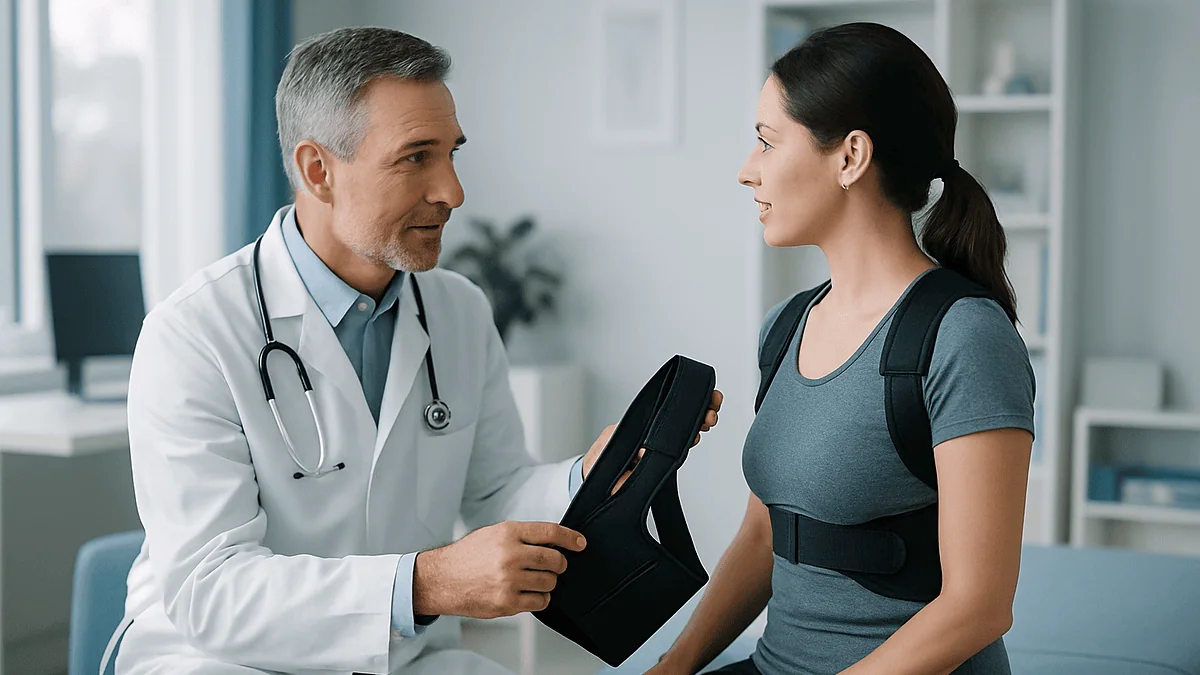
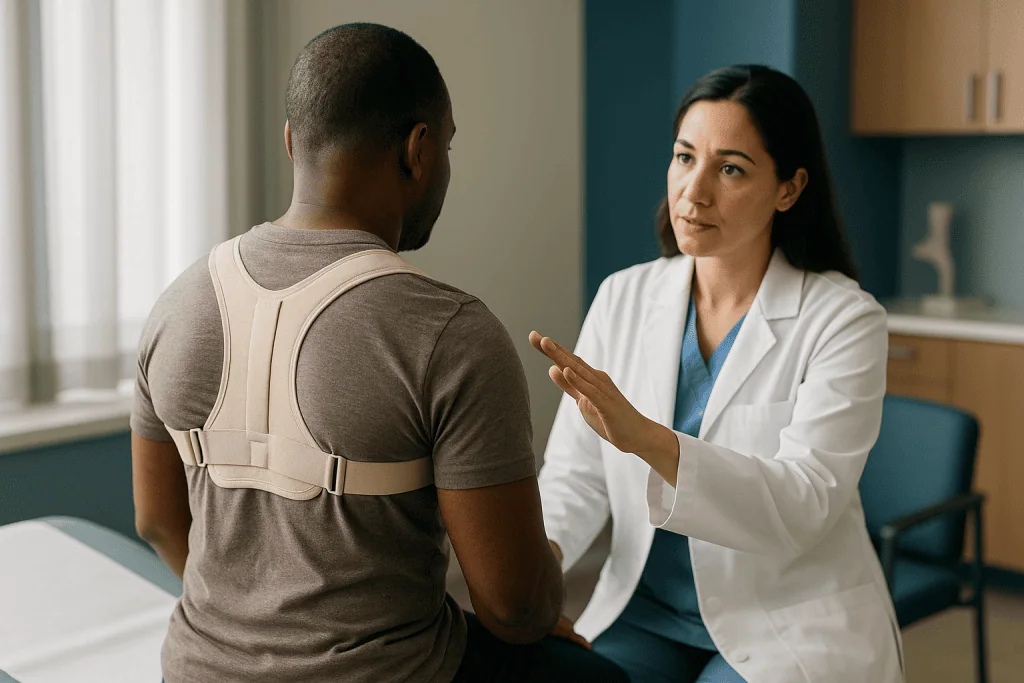
A posture corrector is any wearable device designed to hold the shoulders back and the upper spine straighter than you would otherwise sit. Most consumer versions are a figure-eight of elastic straps that loop under each armpit and cross between the shoulder blades. Tighten them and the shoulders are drawn backward and slightly down; the upper back, known clinically as the thoracic spine, flattens a little.
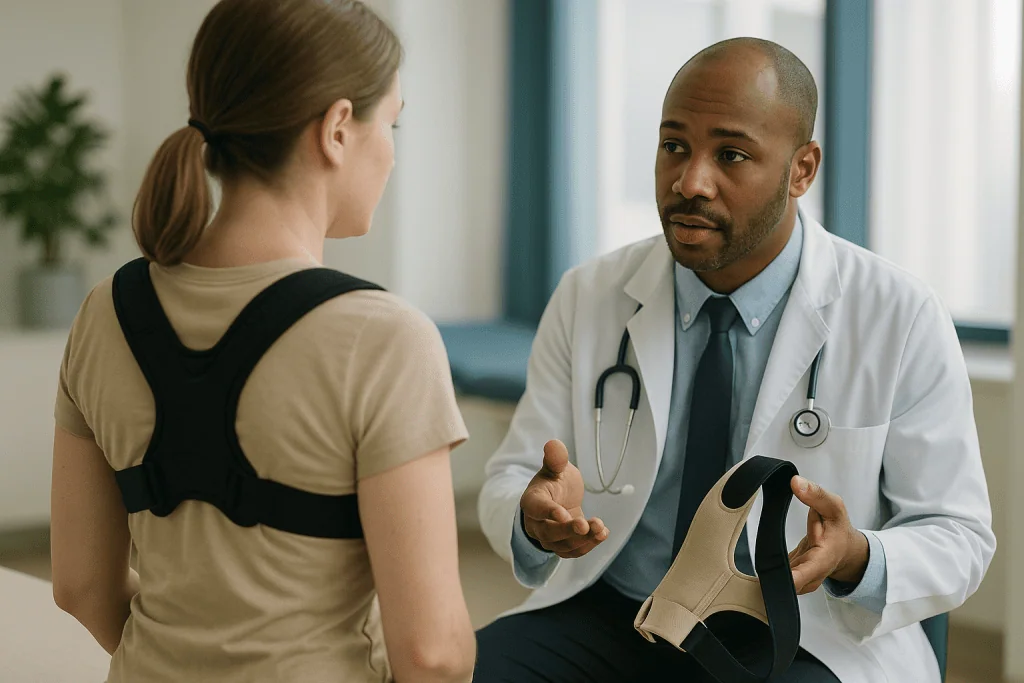
Mechanically, two things happen at once. The strap applies a small external force that reduces how far forward the shoulders can roll. Less obviously, the pressure on the skin acts as a constant cue. The nervous system registers the tug and, for a while, you adjust before the strap has to do any real work. Physiotherapists describe this as improving proprioception, the body’s sense of where its parts are in space. Both effects are real, and both are temporary. Take the strap off and the force disappears immediately; the heightened awareness fades over hours or days.
What a corrector does not do is change the length or strength of any muscle. It cannot lengthen a tight chest muscle, and it cannot strengthen the mid-back muscles that fatigue during a long afternoon at a desk. Those are the two tissue-level reasons people slouch, and a strap addresses neither.
It also does not treat the underlying curve in structural conditions. A fixed kyphosis from vertebral fractures, or the sideways curve of scoliosis, involves bone shape and ligament length that elastic cannot reach. For those, medical braces prescribed and fitted by a clinician are an entirely different category of device, used for different reasons and monitored over months.
Do posture correctors work? What the evidence actually says
Graded honestly, the evidence sits in three tiers.
The strongest claim a corrector can support is that posture improves while the device is on. Several small trials and laboratory studies have measured the angle of the shoulders or head in people wearing posture garments or shoulder taping, and most found a measurable reduction in forward rounding during wear. These are randomized or crossover studies, which means participants were compared with and without the device under controlled conditions, but they typically involve a few dozen people and last minutes to weeks. Evidence strength: moderate for the immediate effect, weak for anything beyond the session.
The second claim, that wearing a corrector reduces neck or back pain, has far thinner support. A handful of short trials in office workers report small improvements in discomfort with posture shirts or taping, but effect sizes are modest, follow-up is short, and the studies rarely blind participants, which matters when the outcome is how someone says they feel. Larger, longer trials simply do not exist. Evidence strength: low, and largely indirect.
The third claim, that a corrector produces lasting posture change after you stop wearing it, has essentially no trial evidence behind it. What exists is expert opinion, which is consistent across Cleveland Clinic, Harvard Health and NHS guidance: lasting change comes from strengthening and from moving more often, with a device serving at most as a reminder during the learning phase.
Put plainly, a randomized trial has never shown that a strap alone fixes posture or treats back pain. That is not the same as saying it is useless. It is saying the thing it does well, prompting awareness, is also the thing you can learn to do without it.
Do posture correctors weaken the muscles that should hold you up?
This is the counter-claim driving half the current debate, and it deserves the same scrutiny as the marketing.
The worry is based on a sound principle. Muscles adapt to demand, and a muscle relieved of its job will, over time, lose some strength and endurance. That is why a limb emerges thinner from a plaster cast and why patients in rigid spinal braces are given exercise programs alongside them. If a posture corrector did the full work of holding the shoulders back for eight hours a day, every day, for months, some de-conditioning of the mid-back muscles would be a reasonable expectation.
Here is what the evidence actually shows. No trial has demonstrated measurable muscle weakening from consumer posture correctors used as their makers suggest, meaning short daily periods over a few weeks. Studies that measure muscle activity with surface sensors during wear give mixed results: some show slightly reduced activity in the upper trapezius, the muscle that runs from the neck to the shoulder, which many clinicians would consider a good thing in a slouched office worker, while others show little change. None has followed people long enough to measure strength loss.
So the fair summary is this: the weakening claim is plausible in theory, unproven in practice, and largely preventable in any case. Elastic straps are not rigid; they let you move and still require your own muscles to do most of the holding. The real risk is behavioral rather than physiological. Someone who treats the strap as a solution may skip the strengthening that would actually help, and after six months has a dependent habit rather than a weaker back. The muscles were never the problem. The missing exercise was.
Would a posture corrector work for you? Who tends to benefit
Think of the device as a training aid with a narrow sweet spot. It tends to help a specific kind of person at a specific stage, and it tends to disappoint everyone else.
The person it suits best already knows what good alignment feels like but forgets to hold it. A desk worker who sits well for the first twenty minutes of every hour and then melts toward the screen is a classic example. The strap interrupts the melt. For this person, a corrector worn during the two or three most sedentary hours of the day, for a few weeks, can speed up the habit-building that exercises are doing in the background. Expert opinion supports this use; trials do not contradict it.
It suits less well the person whose shoulders genuinely cannot sit back because the chest muscles are short and tight. The strap will fight that tightness all day, often uncomfortably, and lose. Stretching the pectoral muscles and strengthening the opposing muscles between the shoulder blades addresses the cause; the strap only argues with the symptom.
It is a poor fit for anyone whose posture reflects a medical condition. A visible, fixed hump in an older adult can signal vertebral compression fractures from osteoporosis, the bone-thinning condition. A curve that is clearly sideways, or a shoulder that sits higher than the other in a teenager, raises the question of scoliosis. Pain that radiates into an arm or leg, or that wakes you at night, is not a posture problem. In each of these cases, a consumer strap can mask what needs assessing.
And it rarely suits the person hoping for a cosmetic transformation. The strap changes how you look while it is on. The muscle work changes how you look when it is off.
Posture corrector types compared: strap, shirt, tape or sensor
The word covers several quite different products, and the evidence differs for each. The table summarizes what each type does and how well the research supports it.
| Type | How it works | What studies show | Evidence strength | Practical role |
|---|---|---|---|---|
| Elastic figure-eight strap | Pulls shoulders back and down; pressure acts as a cue | Less rounding during wear; no lasting change shown | Low to moderate, short-term only | Reminder during sedentary hours for a few weeks |
| Rigid clavicle brace | Firm support that limits forward shoulder movement | Used clinically after collarbone injury; little posture research | Expert opinion for posture use | Clinician-guided situations, not casual wear |
| Posture shirt or compression top | Elastic panels across the upper back give gentle resistance | Small trials: modest reduction in slouch, mixed effect on discomfort | Low | Comfortable all-day cue; no muscle training |
| Kinesiology taping | Stretchy tape on skin provides sensory feedback | Short-term improvements in shoulder position in several small trials | Low to moderate, days at most | Short course alongside physiotherapy |
| Wearable sensor | Vibrates when the upper back tilts beyond a set angle | Pilot studies: more frequent self-correction while in use | Low, early data | Awareness training with no external force |
Two patterns stand out. Nothing in the table has long-term evidence. And the products that apply no force at all, the tape and the sensor, achieve roughly the same awareness benefit as the strap without any theoretical risk to muscle work. If the goal is a nudge, a nudge is enough.
What is the best back brace posture corrector?
Search engines are full of ranked lists answering this question, and almost all of them rank on comfort, price and star ratings rather than on anything a clinician would measure. A more useful answer starts with what the device needs to do and then describes the features that let it do that without causing harm.
For the awareness role that the evidence supports, the best design is the least forceful one that still registers. A strap you can comfortably forget for an hour is better than one you count the minutes in. Wide, padded straps spread pressure across the armpit and reduce chafing and nerve irritation, which are the two most common complaints. Breathable fabric matters in warm weather because skin maceration under elastic is a real problem for people who wear devices for long stretches. Adjustability lets you start loose and increase the cue gradually rather than yanking the shoulders back on day one.
Rigidity is not a virtue here. A stiff brace with metal or plastic stays prevents movement, and movement is precisely what the upper spine needs. Rigid braces have legitimate medical uses after fractures or surgery, prescribed and fitted by specialists, and they come with exercise plans and follow-up. A rigid brace bought casually for slouching imports the restriction without the supervision.
A fairer question than “which is best” is “what am I pairing it with.” The honest answer from physiotherapy practice is that the brace is the least important item in the plan. A rowing movement with a resistance band, a doorway stretch for the chest, and a timer that gets you out of the chair every half hour will do more than any strap, and they keep working after the strap is in a drawer.
How long to wear a posture corrector each day
There is no trial-derived schedule, so what follows is the consensus pattern from physiotherapists and the guidance published by major clinics, offered as general information rather than a prescription.
Start short. Fifteen to thirty minutes is enough for the first few sessions, long enough to notice how an upright position feels and short enough to avoid skin and nerve irritation under the straps. Over a week or two, many people extend to one or two hours, ideally during the stretch of the day when they slouch most. Longer than that adds little; the awareness effect peaks early and the discomfort climbs steadily.
Wear it while doing something that normally pulls you forward: typing, reading, driving short distances if it does not interfere with the seat belt. Do not wear it during exercise. Lifting, running and swimming all need free shoulder movement, and the strap will either restrict the movement or ride up and dig in.
Do not sleep in it. The arguments against are practical and physiological. You cannot adjust the tension unconsciously, straps can tighten with turning, and the mid-back muscles do not need training at night; they need rest. Nothing is gained, and pressure sores and numb arms are possible.
Plan an exit. The most sensible approach is to treat the strap like training wheels, with a date a few weeks ahead when you take it off and rely on the exercises you have been doing alongside. If you reach that date and cannot sit upright without it, the strap has not taught you anything; it has simply held you. That is a signal to focus harder on strengthening, or to ask a physiotherapist to look at what is actually limiting the position.
Posture corrector side effects to watch for
For a low-risk product, posture correctors generate a surprising range of complaints, almost all of them from wearing one too tight or too long.
Skin irritation leads the list. Elastic under the arms traps sweat, and friction over a few hours produces red, raw patches, especially in people with sensitive skin or eczema. Breaks every hour and a thin cotton layer under the straps prevent most of this.
Tingling or numbness in the hands or fingers is the symptom to take most seriously. The straps pass over the armpit, where the bundle of nerves that supplies the arm, called the brachial plexus, runs close to the surface. Enough pressure for long enough can irritate it. Pins and needles that appear during wear and resolve within minutes of loosening the strap are a sign to loosen or stop. Numbness that persists after removal is a reason to see a clinician.
Neck and shoulder aching is common in the first week and usually reflects muscles that are being asked to hold a new position. It should feel like post-exercise stiffness, not sharp pain, and it should fade as the muscles adapt. Pain that worsens over days rather than settling is a sign the position is wrong for you or the device is too tight.
Overcorrection is a quieter problem. Pulling the shoulders hard back and the chest forward exaggerates the inward curve of the lower back and can produce lower back ache. Good alignment is relaxed, with the breastbone lifted and the ribs still soft, not braced like a sentry.
Finally, a corrector can delay a diagnosis. Persistent pain, a rapidly developing hump, or any one-sided change in shoulder height deserves assessment before a strap gets anywhere near it.
Posture brace vs exercises: which actually fixes slouching?
If a trial pitted the two head to head over six months, the exercise group would be expected to win, and the reason is mechanical rather than moral.
Slouching usually involves two muscle imbalances. The muscles across the chest and the front of the shoulder shorten with hours of reaching forward. The muscles between the shoulder blades, which retract the shoulders, and the deep neck muscles that keep the head over the spine, lose endurance. A brace addresses neither imbalance; it only moves the body despite them. Exercise addresses both.
The movements clinicians reach for are ordinary. Rows with a resistance band, pulling the elbows back and squeezing the shoulder blades together, train retraction. Chin tucks, drawing the head straight back over the shoulders, train the deep neck muscles. A doorway stretch, forearms on the frame and a gentle lean, lengthens the chest. Harvard Health adds strengthening of the core and back extensors, and the NHS guidance pairs specific stretches with each common posture fault. Yoga and Pilates classes rehearse much of this under supervision.
Evidence for exercise in neck and back pain is considerably stronger than for any device, with multiple randomized trials and systematic reviews supporting supervised strengthening programs for reducing pain and improving function. Evidence for exercise changing measured posture angles is smaller but consistent in direction.
The two approaches are not rivals in practice. The most defensible use of a brace is as a short bridge: it reminds you to use the position while the exercises build the capacity to hold it. The mistake is treating the bridge as the destination.
Can posture affect digestion?
Slumping over a plate feels wrong for reasons that turn out to be partly real and partly folklore, so it is worth separating the two.
The anatomical argument is straightforward. The stomach and intestines sit in a space whose size depends on how the rib cage and pelvis are positioned. Folding forward reduces that space and raises pressure inside the abdomen. Higher abdominal pressure is a recognized contributor to acid reflux, the backward flow of stomach contents into the food pipe, because it pushes against the valve at the top of the stomach. This is why guidance from major clinics for people with reflux includes staying upright after meals and avoiding lying down for a couple of hours afterward.
Beyond reflux, the evidence thins quickly. Small studies have reported that a slumped sitting position slightly slows the emptying of the stomach and increases the sensation of bloating in some people, but these are short laboratory experiments with few participants. Claims that posture changes how nutrients are absorbed, or that a strap improves gut health, have no evidence behind them at all.
Constipation is a separate story with slightly better support. The angle of the hips during a bowel movement affects how easily the rectum empties, which is why a footstool that raises the knees is a common and reasonable suggestion. That is toilet posture, not standing posture, and no posture corrector is involved.
So the fair answer is yes, posture can influence digestion, mainly through reflux and the comfort of a full stomach, and the fix is to sit upright at meals and move afterward rather than to buy anything. Persistent heartburn, difficulty swallowing, unexplained weight loss or blood in stools are problems for a clinician, not for a change of chair.
Common myths about posture correctors, including the celebrity claims
The viral version of this topic rests on a handful of claims that collapse under modest pressure.
Myth: a celebrity’s posture proves the device works. The clip that sparked the current wave shows a strap and nothing else. No reputable source has confirmed what any particular performer uses, and a visible strap tells you nothing about the years of dance training, strength work and professional coaching behind a stage carriage. A single clip of a single person is an anecdote, not evidence, however many times it is shared.
Myth: two weeks of wear permanently retrains the spine. Posture is a habit layered on top of muscle capacity, and habits can change in weeks. The strap, though, changes the habit only while it is on. The trials that exist measure effects during wear, and none has documented a lasting change after the device is removed.
Myth: correctors inevitably weaken the back. As set out above, the principle is sound but the evidence is absent for the short daily periods actually used. The risk is skipping exercise, not atrophy.
Myth: there is one correct posture. Mainstream guidance has quietly abandoned the military ideal. The thoracic spine is supposed to curve forward; a normal curve is roughly 20 to 45 degrees when measured on an X-ray, and flattening it is neither possible with elastic nor desirable. The healthiest posture is the one you change often.
Myth: forward head position adds a fixed number of pounds per inch to the neck. The widely quoted figures come from biomechanical models, not from measurements in people, and they describe estimated load on a simplified lever. The real message, that long periods with the head forward tire the neck muscles, survives without the dramatic arithmetic.
Is perfect posture even a real thing? What neutral spine means
Spend an hour reading posture advice and you will meet the phrase “neutral spine” repeatedly, usually without definition. It means a position in which the three natural curves of the spine, inward at the neck, outward at the upper back, inward at the lower back, are present but not exaggerated, so that the head sits over the shoulders and the shoulders over the hips. The ears, shoulders and hips line up roughly vertically when viewed from the side. That is the alignment MedlinePlus and Mayo Clinic describe in their guides to healthy sitting and standing.
Neutral is a target, not a cage. The most important finding from recent research on sitting is that the duration of any single position matters more than the position itself. People who sit beautifully for three hours report as much stiffness as people who slump for three hours. The muscles that hold any posture fatigue, blood flow to the discs between the vertebrae depends on movement, and the nervous system habituates to a fixed input. Many physiotherapists now say the best posture is the next posture.
This reframing matters for the device question. A corrector that holds a single position, however correct, works against the principle that variety protects the spine. A sensor that buzzes when you have been in one place too long is closer to the science than a strap that keeps you there.
It also matters for guilt. Slouching briefly is not damaging. Years of unvarying slouching, combined with weak supporting muscles and little exercise, is associated in observational studies with more neck and back discomfort and, in older adults, with a greater forward curve. Association is not proof of cause, but the pattern is consistent enough to act on, and the action is movement and strength, not stillness.
When to see a doctor about posture, back pain or a brace
Most slouching is a habit, not a disease, and most people experimenting with a posture corrector will come to no harm. A short list of situations changes that picture, and in each of them the right move is an appointment rather than a tighter strap.
See a clinician promptly if back or neck pain comes with any of the following: numbness, tingling or weakness in an arm or leg; pain that travels down a limb; loss of control of the bladder or bowels, or numbness around the groin or inner thighs; fever, unexplained weight loss or a history of cancer; pain that follows a fall or other injury; pain that is worse at night or wakes you; or pain that has not improved after a few weeks of ordinary activity. Mayo Clinic lists most of these as reasons to seek care rather than wait, and the bladder and bowel symptoms in particular need same-day assessment.
See a clinician about posture itself if a rounded upper back has developed quickly or is increasing, especially after age 50 or in anyone with osteoporosis, because compression fractures of the vertebrae can produce exactly that shape and need bone health treatment rather than a strap. A visible sideways curve, one shoulder blade sticking out further than the other, or an uneven waist in a child or teenager should be assessed for scoliosis.
Ask before using any brace if you have osteoporosis, a known spinal condition, a previous spinal surgery, a pacemaker or other implanted device near the straps, a skin condition in the strap area, or if you are pregnant. Stop and seek advice if a corrector causes numbness that persists after removal, chest tightness or breathlessness, or pain that escalates rather than settles. Whether a brace, a physiotherapy referral or an imaging test is right for you is a decision for your treating clinician, who can examine the spine that an article cannot.
Frequently asked questions
Would a posture corrector work for an office worker who slouches?
It can help as a short-term reminder, particularly if you already know what upright feels like and simply forget to hold it. Small studies show less slouching while the strap is on, but no lasting change afterward. Pair it with band rows, chin tucks and a chest stretch, limit wear to an hour or two during your most sedentary stretch, and plan to stop after a few weeks.
What did Taylor Swift use to correct her posture?
No reputable source has confirmed what any particular performer uses, and the viral clips show a strap without any medical context. A stage performer’s carriage reflects years of dance and strength training far more than any device. Treat celebrity posture claims as anecdotes, not evidence, and base your own choices on the trial data and clinical guidance described in this article.
Do posture correctors work for text neck?
Only partially. Most straps act on the shoulders, not the head, and the forward head position behind so-called text neck comes from where the eyes are pointing. Raising the screen to eye level, taking breaks every 20 to 30 minutes and practising chin tucks addresses the cause directly. A corrector may remind you to lift the chest, which indirectly helps the head sit back, but it will not do the job alone.
What are the main posture corrector side effects?
Skin chafing under the arms, pins and needles in the hands from strap pressure on the nerve bundle in the armpit, and aching shoulders in the first week are the common ones. Overtightening can also arch the lower back and cause ache there. Loosen or remove the device if tingling appears, and see a clinician if numbness persists after taking it off.
How long should I wear a posture corrector each day?
There is no trial-based schedule, but clinical consensus favours short sessions: 15 to 30 minutes to start, building to one or two hours during the part of the day you slouch most. Longer wear adds little benefit and more skin and nerve irritation. Do not wear it during exercise or sleep, and set a date a few weeks ahead to stop and rely on strengthening.
Posture brace vs exercises: which should I choose?
Exercises, if you can only choose one. Supervised strengthening programs have randomized trial support for reducing neck and back pain, while braces have only short-term evidence for changing position during wear. The brace cannot lengthen tight chest muscles or strengthen the muscles between the shoulder blades, which are the usual reasons people slouch. Used together, the brace is a temporary reminder while the exercises build capacity.
What is the best back brace posture corrector to buy?
The least forceful one you can comfortably forget for an hour. Look for wide, padded, adjustable straps and breathable fabric, and avoid rigid designs with stays, which restrict the movement your upper back needs. Rigid braces belong in clinician-supervised care after fractures or surgery. Whatever you choose, it should be the least important part of a plan built on strengthening and regular movement breaks.
Can posture affect digestion and bloating?
Yes, modestly. Slumping compresses the abdomen and raises pressure inside it, which can worsen acid reflux and make a full stomach feel more uncomfortable; small studies also suggest slightly slower stomach emptying when slouched. Sitting upright at meals and moving afterward is the practical fix. Claims that posture devices improve nutrient absorption or gut health have no supporting evidence.
Do spine surgeons recommend posture correctors?
Generally not as a treatment. Major clinics describe consumer correctors as awareness tools rather than fixes, and no major public health body recommends them as a stand-alone treatment for back or neck pain. Surgeons and physiotherapists prescribe medical braces for specific conditions such as fractures or scoliosis, with fitting and follow-up, which is a different situation from casual use for slouching.
Can I sleep in a posture corrector to fix my posture faster?
No. Sleeping in a strap offers no training benefit because your muscles are not actively holding a position at night, and it carries real risks: tension changes as you turn, pressure builds on the nerves under the arm, and skin can break down. The upper back muscles need rest overnight. Use the device for short daytime sessions and let sleep be sleep.
References
This article is for general information only and is not a substitute for professional medical advice. Please consult a qualified doctor about your individual situation.

More from the Blog

SI Joint Pain: The Often-Missed Cause of Low Back and Buttock Pain
SI joint pain comes from the sacroiliac joints, the two joints that connect the base of the spine to the pelvis. It usually causes…

Heel Pain: Plantar Fasciitis, Achilles or Something Else: How to Tell
Heel pain is most often plantar fasciitis, which causes a sharp pain under the heel with the first steps of the morning. Pain at…

Anterior Hip Replacement: How the Front Approach Differs, and for Whom
Anterior hip replacement reaches the hip joint through the front of the thigh, working between muscles rather than detaching them. Research suggests modestly less…
Is My Cast Too Tight? Numbness, Color Changes and Fracture Warning Signs to Report
A cast may be too tight if the pain keeps climbing despite elevation and prescribed pain relief, if fingers or toes turn pale, blue…

When a Broken Shoulder Is Replaced Rather Than Repaired: Shoulder Prosthesis After Fracture
A shoulder prosthesis for fracture is an artificial ball, or ball and socket, implanted when the top of the upper arm bone has shattered…

Aesthetic Foot Surgery Results: What Toe Shortening and Foot Narrowing Realistically Change
Aesthetic foot surgery results are usually modest and structural: toe shortening removes a small segment of bone so a long toe sits level with…