

Preparing for a Pulmonology Consultation: Scans, Breathing Tests and Records to Bring

Key Takeaways
- Pulmonologists read CT and X-ray images directly, so bring the picture files on disc or via portal access, not just the written radiology reports.
- Spirometry reports two key numbers, FVC and FEV1, and their ratio helps distinguish narrowed airways from stiff or shrunken lungs.
- The NHS advises avoiding smoking for 24 hours and alcohol, heavy meals and vigorous exercise for a few hours before spirometry.
- Only withhold inhalers before a breathing test if the lab explicitly instructs you to, and tell the technician the time of any reliever dose you needed.
- Pack-years, the packs smoked per day multiplied by years smoked, feed directly into decisions such as CT screening eligibility, so give exact numbers.
- A dated symptom diary covering good and bad days for one to two weeks gives the specialist more reliable information than recollection in the consulting room.
To prepare for a pulmonology appointment, gather your actual chest X-ray and CT images (not only the written reports), any previous spirometry or lung function results, a current list of medicines and inhalers, and a short timeline of your breathing symptoms. Note smoking history, job and home exposures, sleep quality and family lung history. Ask the clinic in advance whether to hold inhalers before testing, and bring your questions written down.
The referral letter arrived on a Tuesday, and by Wednesday the folder on the kitchen table had grown to three envelopes, a pharmacy printout and a scribbled note that said only: cough since spring. That folder is, in a quiet way, the whole task. Working out how to prepare for a pulmonology appointment is mostly about turning a year of scattered symptoms, scans and prescriptions into something a specialist can read in the twenty minutes you will have together.
Lung clinics run on history. The stethoscope and the breathing machine matter, but the story of when the breathlessness started, what makes it worse and what was already tried often carries more diagnostic weight than any single test. A patient who arrives with images on a disc, a dated symptom timeline and an honest smoking history hands the pulmonologist a head start that no amount of clinical skill can manufacture on the spot.
This guide walks through what to collect, what to leave alone, and what the weeks afterward tend to look like.
What to expect at a pulmonologist first visit: how the consultation actually works
A pulmonologist is a physician who specializes in diseases of the lungs and the airways that carry air to them. A first consultation usually unfolds in four movements, and knowing the order helps you decide what to bring.
The longest part is the conversation. Expect questions about when symptoms began, how they have changed, what triggers them, what treatment has been tried and how you responded. The clinician will also ask about smoking, work, pets, travel, sleep and family history, because many lung conditions declare themselves through exposure patterns rather than through a single dramatic sign.
Next comes the physical examination: listening to the chest, checking the fingers and ankles, watching how you breathe at rest, and often clipping a small sensor to a fingertip to measure oxygen saturation, which is the percentage of hemoglobin in the blood carrying oxygen.
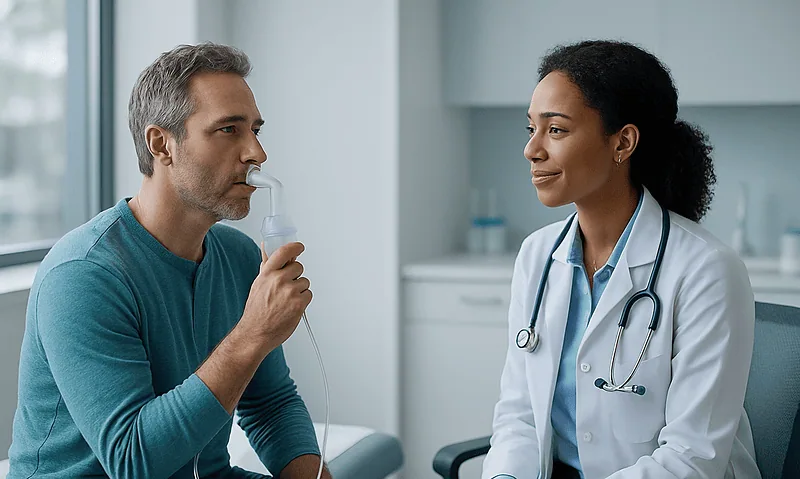
Third, the specialist reviews whatever objective data exists. That means scrolling through your CT images, reading past spirometry printouts and comparing dates. Spirometry is a breathing test in which you blow forcefully into a tube so a machine can measure how much air you move and how fast. Many clinics perform office spirometry during the first visit, so the equipment may appear before you leave the room.
Finally, the plan. This may include further testing, a working diagnosis, a change to be discussed with whoever prescribes your medicines, or reassurance that a watch-and-wait approach is reasonable. Each of those decisions belongs to the treating team, informed by what you bring. The better organized your folder, the more of that last movement can happen on day one rather than at a second appointment weeks later.
Who is usually referred to a pulmonologist, and who is usually asked to wait
Referral patterns vary between health systems, but a few situations recur in almost every lung clinic waiting room.
A cough that has outlasted the infection that seemed to cause it. Breathlessness that has crept up over months, so that stairs or a brisk walk now demand a pause where they once did not. Wheeze or chest tightness that primary-care treatment has not settled. An unexpected shadow or nodule on a chest X-ray or CT scan performed for another reason. Abnormal spirometry results. Repeated chest infections. Loud snoring with daytime sleepiness. A family history of an inherited lung condition. Long smoking histories, which is one reason chronic obstructive pulmonary disease, or COPD, a group of conditions that permanently narrow the airways, accounts for so many referrals; the CDC estimates that almost 16 million Americans have been diagnosed with it.
Who is asked to wait? Usually not the people worrying most. A single chest infection that is clearing, mild seasonal symptoms that respond to a first treatment, or a cough of a few weeks in a non-smoker with a normal examination is often observed in primary care first, because many of these resolve or become clearer with time. Some clinics also ask that basic spirometry and a chest X-ray be completed before the specialist visit, since a consultation without either can end in nothing but a request for tests.
The other group asked to wait is, paradoxically, those who should not wait at all. Sudden severe breathlessness, chest pain, coughing blood or blue lips are emergencies. An outpatient slot, however soon, is the wrong door for them, and the final section of this article covers those signs in detail.
What scans should I bring to a pulmonology appointment?
Bring the pictures, not just the paragraph about the pictures. This is the single most common gap in a first-visit folder.
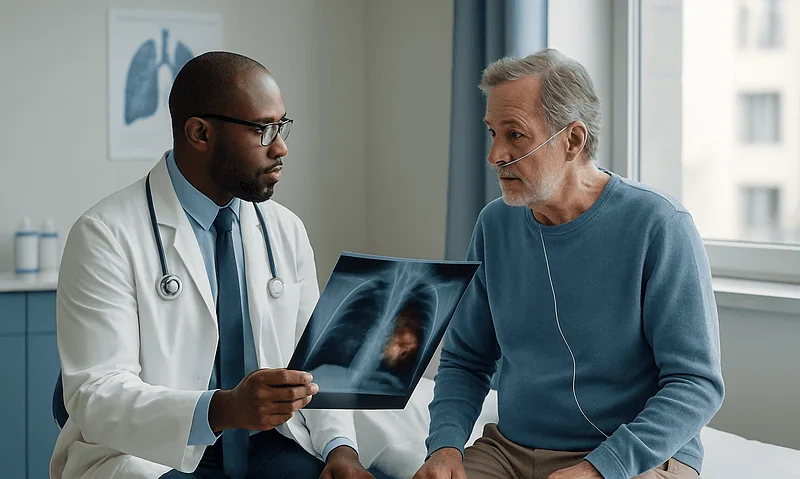
A radiology report is one clinician’s written interpretation of an image. It is valuable, but it is a summary. Pulmonologists read lung CT scans for themselves, scrolling slice by slice through the images to judge the texture of the tissue, the width of airways, the pattern of any scarring and the shape of a nodule. A report that says a small opacity is present tells them far less than the image showing exactly where and how it sits.
A CT scan, short for computed tomography, combines many X-ray images taken from different angles into cross-sectional pictures of the chest; MedlinePlus describes it as producing detailed views of the lungs, airways and surrounding structures that a plain X-ray cannot match. If you have had one, ask the imaging department or your primary-care office for the full image set. It usually comes as a disc, a download link or access through a patient portal. Many hospitals can also transfer images directly between systems if you ask well before the appointment.
Older scans matter too. A nodule that has not changed in size over several years is interpreted very differently from one that has appeared recently. Comparison over time is often the whole point, so gather every chest image you can find, including X-rays taken for unrelated reasons, with the date each was performed.
Avoid repeating scans on your own initiative simply because the last one is old. Whether a new image is needed, and which type, is a decision for the specialist, who will weigh the question being asked against the radiation and cost of another study.
Which breathing tests might already be in your file, and what they measure
Lung function tests have a vocabulary of their own. Knowing the handful of terms that appear on most printouts helps you recognize what you already have.
Spirometry is the foundation. Two numbers dominate the report: FVC, the forced vital capacity, meaning the total volume of air you can blow out after a full breath in; and FEV1, the volume you exhale in the first second of that effort. The ratio between them helps the clinician tell airway narrowing, as in asthma or COPD, from conditions that stiffen or shrink the lungs. Results are compared with reference values for your age, sex, height and ancestry, so a percent-of-predicted figure often sits beside each raw number.
Full pulmonary function testing goes further. Lung volume measurement, sometimes performed in a sealed glass booth called a body plethysmograph, captures the air left in the lungs after you exhale as far as you can. A diffusing capacity test, abbreviated DLCO, measures how easily gas passes from the air sacs into the bloodstream and is particularly informative in scarring conditions. Cleveland Clinic groups these under the umbrella of pulmonary function testing and notes they are used both to diagnose and to track lung disease over time.
You may also have a fractional exhaled nitric oxide test, which estimates a particular type of airway inflammation from your breath, a peak-flow diary kept at home, overnight oxygen readings or a walking test that measures distance covered in six minutes.
Bring every printout, even partial ones, and note whether any test was done during or shortly after a chest infection, since illness can temporarily lower results and the specialist will want to know.
Pulmonary function test preparation: should you stop your inhaler first?
This is the question most patients hesitate to ask, and the honest answer is that it depends, and it is not yours to decide alone.
Some breathing tests include a step where you blow into the machine, inhale a fast-acting bronchodilator, a medicine that relaxes airway muscle, and then blow again. The difference between the two efforts helps show whether your airway narrowing is reversible. For that comparison to mean anything, the lab may ask you not to use certain inhalers for a set period beforehand. The interval differs by medicine type, and the NHS spirometry guidance states plainly that you might be told not to use bronchodilator inhalers before the test, with specifics coming from the clinic.
The key word is told. Do not withhold a prescribed inhaler on your own guess about what the lab wants. If no instructions arrive with the appointment letter, telephone and ask. If you become wheezy or breathless while waiting for the test and need your reliever, use it, then tell the technician the time you took it; the result can still be interpreted or rescheduled. Bring all your inhalers with you regardless.
Other preparation is simpler. The NHS advises avoiding smoking for 24 hours before spirometry and avoiding alcohol, vigorous exercise and large meals for a few hours beforehand, since each can alter the numbers. Wear loose clothing that does not restrict your chest. Loose-fitting dentures may need to come out for the mouthpiece to seal.
Mayo Clinic notes that spirometry itself typically takes about 15 minutes, though a full pulmonary function session with several test types runs longer. Expect to feel briefly lightheaded or tired after repeated maximal breaths; that is ordinary and passes quickly.
What to bring to the pulmonologist: the documents that change the conversation
Not everything in the folder carries equal weight. The table below ranks what tends to matter most and the form in which it is most useful.
| Item | Why it matters | Best format |
|---|---|---|
| Chest CT and X-ray images | Specialist reads the pictures directly; comparison over time is often decisive | Disc, download link or portal access, plus the written reports and dates |
| Spirometry and lung function printouts | Objective baseline; shows pattern and trend | Original printouts or scanned copies, with test dates and whether you were unwell |
| Medicine and inhaler list | Reveals what has and has not helped; avoids interactions | Pharmacy printout or a handwritten list with names and how you actually use them |
| Symptom timeline | The history drives diagnosis | Half a page, dated, with triggers and what changed |
| Previous letters and discharge summaries | Shows prior thinking and any hospital stays | Paper or portal copies |
| Blood test results | Some, such as eosinophil counts, shape lung decisions | Most recent printouts |
| Sleep study or oximetry reports | Sleep-disordered breathing overlaps with lung disease | Full report, not the one-line summary |
| Work and exposure notes | Occupational and environmental causes are easy to miss | A list of jobs, hobbies, pets, home damp and dust |
Two additions are worth the small effort. First, note your vaccination history for influenza, pneumococcal disease and COVID-19, since lung specialists routinely ask. Second, write down the name and contact details of every clinician involved in your care so the consultation letter reaches the right people.
If a document cannot be found, say so rather than guessing at what it showed. A clinician can request records; a clinician cannot un-hear a half-remembered result that later proves wrong.
How do you describe breathlessness so the doctor can actually use it?
Breathlessness is a sensation, and sensations resist measurement. The trick is to anchor it to things that can be measured: distances, tasks and dates.
Start with time. When did you first notice a change, even a small one? Did it arrive over days, weeks or years? Has it been steady, stepwise or fluctuating? Patients often date the onset to a particular trip, illness or season, and that landmark is more useful than an estimate in months.
Then translate the feeling into activity. Clinicians commonly use a simple grading tool that asks whether breathlessness appears only with strenuous exertion, when hurrying on level ground, when walking at your own pace with people your age, after roughly a hundred yards, or when dressing. You do not need to know the scale; you need to describe the stairs you now stop on, the shopping bag you no longer carry, the dog walk that got shorter.
Describe company. Does the breathlessness come with cough, and is the cough dry or productive? What color is the sputum, and has that changed? Is there wheeze, a whistling sound on breathing out, or a tight band across the chest? Does lying flat make things worse? Do your ankles swell by evening? None of these is a checklist for self-diagnosis; together they are the raw material the specialist sorts.
Finally, describe the good days and the bad ones honestly. People tend to present their average, but the range tells the clinician about variability, which distinguishes some conditions from others. A short diary kept for a week or two before the visit, noting activity, symptoms and any reliever use, is worth more than an hour of recollection in the consulting room.
Why the pulmonologist asks about smoking, jobs and hobbies in such detail
Few questions provoke more discomfort than the smoking history, and few are more important to answer precisely. The clinician is not keeping score. They are calculating exposure.
Smoking is often summarized in pack-years: the average number of packs smoked per day multiplied by the number of years smoked. Someone who smoked one pack daily for 25 years and half a pack daily for another 10 has 30 pack-years. That figure feeds directly into decisions. The CDC, summarizing national screening recommendations, describes annual low-dose CT screening for lung cancer as being for adults aged 50 to 80 with at least a 20 pack-year history who currently smoke or quit within the past 15 years. Whether that applies to you is for the specialist to weigh, but the arithmetic requires your honest numbers, including when you stopped.
Vaping, cannabis, cigars and pipes count too, as does heavy secondhand exposure in childhood or at work.
Occupation opens a second door. Dust from stone, coal, silica or asbestos; fumes from welding or spray painting; grain, flour and animal dander in agriculture and baking; isocyanates in car body shops; the list is long, and exposures decades old can still matter. Write down every job you have held, roughly how long, and what you breathed there.
Home and hobby exposures round it out. Birds, feather bedding, damp walls, indoor hot tubs, humidifiers, woodworking and metalworking can each provoke or worsen lung inflammation in susceptible people. Travel to regions where certain fungal or mycobacterial infections are common is also relevant.
None of this is about blame. It is about narrowing a very wide field of possible causes to the few worth testing for first.
Sleep, snoring and daytime tiredness: the questions that surprise people
Patients referred for a daytime cough are sometimes startled to be asked how loudly they snore. The lungs, however, work around the clock, and the specialty covers breathing during sleep as well.
Obstructive sleep apnea is a condition in which the upper airway repeatedly narrows or closes during sleep, interrupting breathing and fragmenting rest. It frequently coexists with COPD, asthma and heart disease, and it can amplify daytime breathlessness and fatigue in ways that are easy to attribute to the lungs alone. Because the person who snores rarely hears it, the most useful witness is a bed partner or family member. Ask them before the appointment whether you snore, pause in your breathing, gasp or kick, and how often.
Bring what you know about your own sleep too: usual bedtime and waking time, how refreshed you feel, whether you doze off in quiet situations such as reading or as a passenger, and whether you wake with headaches or a dry mouth. Clinicians sometimes use a short sleepiness questionnaire; you do not need to complete one in advance, but rough answers save time.
Nocturnal symptoms of other kinds are equally relevant. Waking short of breath, needing extra pillows, coughing that is worst around three in the morning, or heartburn at night each point the clinician in a different direction.
If you have already had a sleep study, bring the full report rather than the summary line. If you use a positive airway pressure device, bring the machine’s usage data or the download from its app, because how many hours it is actually used is part of the clinical picture. Decisions about whether a sleep study is needed, or whether existing settings are right, sit with the team who see the data.
What the weeks after a first pulmonology consultation usually look like
A first visit rarely ends in a final answer, and it helps to expect that.
The most common next step is more measurement. If only office spirometry has been done, you may be booked for full pulmonary function testing in a dedicated lab, sometimes on the same site, sometimes elsewhere. A chest CT may be requested if none exists or the last one is old, occasionally with contrast, a dye injected into a vein to highlight blood vessels. Blood tests may look for allergy markers, inflammation, inherited enzyme deficiencies or infection. A six-minute walk test, an overnight oxygen recording or a home sleep study are ordered when the history points that way.
Each test generates its own scheduling, and the clinic should tell you the expected interval to results and how they will reach you: portal message, letter, telephone call or a follow-up appointment. If no one mentions it, ask before you leave. The return visit is where results are pulled together into a diagnosis or a working plan, and it is reasonable to ask for that appointment to be booked at the time the tests are requested rather than afterward.
Some patients leave the first visit with a change in treatment to discuss with their prescriber; others leave with a diagnosis of a condition that needs monitoring rather than intervention; some leave reassured. Between visits, keep the symptom diary going, note any chest infections or steroid courses, and keep the folder growing with each new result.
If symptoms worsen sharply while you wait, the outpatient timetable is not binding. Contact the clinic or your primary-care team, or use urgent care as described in the final section.
Practical preparation on the day: clothes, company and the small things that go wrong
The clinical documents are the main event, but a handful of practical details decide whether the appointment feels calm or chaotic.
Dress for the examination and the breathing test. A top that can be lifted or unbuttoned makes chest auscultation easy; a tight waistband or restrictive bra can reduce how deeply you can breathe into the spirometer. Comfortable shoes matter if a walking test is possible.
Bring a second pair of ears. A relative or friend can hold the folder, catch details you miss and remind you of the question you meant to ask. If you prefer to come alone, a small notebook or your phone’s voice memo, with the clinician’s permission, serves a similar purpose.
Plan for oxygen. If you use supplemental oxygen, bring enough for the journey, the wait and the visit itself, plus a margin, and tell the clinic in advance so they can have a supply available if yours runs low.
Small necessities: glasses for reading forms, hearing aids with fresh batteries, dentures, a list of allergies, your insurance or identification documents, and the names of your other doctors. If you need an interpreter, request one when booking; most clinics can arrange it, and family members should not be the only bridge for medical detail.
Arrive early enough to complete questionnaires without rushing. If the appointment is by video, test the camera and microphone beforehand, sit in good light where the clinician can see your face and chest movement, and have your inhalers, home oximeter readings and documents within reach so you can hold them to the camera.
Lastly, eat something light. Fasting is not required for a lung consultation unless a specific test demands it, and low blood sugar makes a long afternoon harder.
What people often get wrong about preparing for a lung appointment
Misunderstandings cluster around a few themes, and each costs time at the visit.
The report is enough. It is not. A written CT report without images means the specialist is reading someone else’s description of a picture they cannot see. Bring the disc or the portal access.
Skipping my inhaler shows the doctor how bad I really am. Some tests do require withholding certain medicines, but only on the lab’s explicit instruction. Stopping a preventer inhaler on your own can trigger a flare and make you unsafe on the day; it does not make the test more accurate.
My scan was normal, so my lungs are fine. Many airway conditions, including asthma and early COPD, show nothing on a CT. Breathing tests, not images, reveal them. The reverse also holds: an abnormal scan does not automatically mean serious disease, and many nodules are followed rather than treated.
One good day means the problem has gone. Lung symptoms fluctuate. The clinician needs the range across weeks, which is why a diary beats memory.
Rounding down the smoking history is harmless. Screening eligibility and diagnostic thinking depend on real numbers. Clinicians have heard every history; they need yours accurately.
Breathing tests are dangerous or exhausting. They demand effort and can leave you briefly lightheaded, but they are safe for the vast majority of people, and the technician stops if you struggle. Mayo Clinic describes spirometry as a common, low-risk office test.
Searching online for a checklist of symptoms will tell me what I have. It will tell you what you fear. Describe what you feel and let the pattern emerge from the data the team gathers.
Questions to ask a pulmonologist at your first visit
A written list does two things: it stops the important question evaporating when the consultation moves fast, and it signals that you want to be a partner in the decisions. Choose the five or six that matter most to you; there will be other visits.
- Based on what you have seen today, what are the leading possibilities, and what would each mean for me?
- Which tests are you ordering, what does each one measure, and how will the results change the plan?
- Do I need to hold any of my medicines before those tests, and for how long? Who gives me those instructions in writing?
- How and when will I hear the results, and will there be a follow-up appointment?
- Is there anything in my scans that needs monitoring over time, and at what interval would you expect to repeat imaging?
- Are my current inhalers or other medicines appropriate for what you suspect, and should anything be reviewed with my prescriber?
- Can someone check my inhaler technique today?
- Which of my exposures, at work or at home, would you want reduced, and is there anyone who can help assess that?
- Is pulmonary rehabilitation, a supervised exercise and education program, something that might apply to me now or later?
- Which vaccinations do you recommend I keep up to date?
- What symptoms should prompt me to contact you before the next appointment, and how do I reach the team?
- Is there a nurse specialist, pharmacist or written material I can turn to between visits?
Ask, too, for a copy of the consultation letter. Reading the clinician’s own summary of your history is the fastest way to spot anything you forgot to mention or that was misunderstood, and it becomes the first page of the folder for next time.
When to call your doctor: red flags that should not wait for the appointment
Referral waiting times are designed around conditions that develop slowly. Some lung symptoms do not respect that timetable, and preparing for a consultation should never mean enduring something dangerous in the meantime.
Call emergency services or go to the nearest emergency department if you experience sudden, severe shortness of breath, particularly if it comes with chest pain or a feeling of pressure; if you are struggling to speak in full sentences or breathe while sitting still; if your lips or fingertips look blue or gray; if you cough up more than a streak of blood; if you feel faint, confused or unusually drowsy; or if a reliever inhaler that normally helps is not working. The NHS lists sudden or severe breathlessness, chest pain and a rapid or irregular heartbeat among the signs that need urgent attention rather than a routine visit.
Contact your primary-care team or the referring clinic within a day or two, rather than waiting for the specialist slot, if breathlessness has worsened noticeably over a week; if you develop fever with a productive cough or a change in the color or volume of sputum; if you notice new ankle swelling or cannot lie flat without becoming breathless; if you have lost weight without trying; if you have new pain on breathing; or if you are using your reliever inhaler far more often than usual.
People already living with a known lung condition may have a written action plan for flare-ups. Follow it, and let the specialist clinic know a flare occurred, since it becomes part of the history they will review.
None of these signs is a diagnosis. They are the moments when the folder can wait and the phone cannot.
Frequently asked questions
What should I bring to a pulmonologist appointment?
Bring your chest CT and X-ray images with their reports and dates, every spirometry or lung function printout you have, a current list of medicines and inhalers, previous clinic letters or discharge summaries, recent blood tests and any sleep study report. Add a half-page dated symptom timeline and a list of jobs, hobbies, pets and home exposures. If you use oxygen, bring enough for the whole visit.
What happens at a pulmonologist first visit?
The visit usually starts with a detailed conversation about your symptoms, exposures, treatments and sleep, followed by a chest examination and a fingertip oxygen reading. The specialist then reviews your scans and breathing tests, often performing office spirometry on the spot. It ends with a plan, which may involve further tests, a working diagnosis, a treatment discussion with your prescriber, or monitoring.
Do I need to stop my inhaler before a pulmonary function test?
Only if the testing lab tells you to. Some tests compare breathing before and after a bronchodilator, and certain inhalers may need to be withheld beforehand for the comparison to be meaningful. The interval depends on the medicine, so wait for written instructions or telephone the clinic to ask. Never stop a prescribed inhaler on your own guess, and bring all inhalers with you.
How do I prepare for pulmonary function tests on the day?
Wear loose clothing that does not restrict your chest, and follow the NHS advice to avoid smoking for 24 hours and alcohol, large meals and strenuous exercise for a few hours beforehand. Remove loose dentures if asked, arrive rested, and expect to repeat forceful breaths several times. Spirometry alone typically takes around 15 minutes according to Mayo Clinic; a full session runs longer.
Is the CT report enough, or do I need the actual images?
The images matter more. A report is one radiologist’s summary, while the pulmonologist wants to scroll through the slices to judge tissue texture, airway width and the exact appearance of any nodule. Comparing older images with newer ones is often the deciding factor, so request the full image set on disc or through a portal and bring the reports alongside it.
How do I describe my breathlessness accurately?
Anchor it to dates and tasks. Note when it began and whether it arrived over days, weeks or years, then describe the activities it now limits, such as a flight of stairs or a specific walk. Mention accompanying cough, sputum color, wheeze, chest tightness, night symptoms and ankle swelling, and be honest about the range between your best and worst days.
Why does the pulmonologist need my exact smoking history?
Because exposure drives both diagnosis and screening decisions. Smoking is summarized in pack-years, and the CDC describes lung cancer screening recommendations for adults aged 50 to 80 with at least 20 pack-years who smoke or quit within 15 years. The clinician is calculating risk, not judging you, and vaping, cannabis and heavy secondhand exposure are relevant too.
Why am I asked about snoring at a lung appointment?
Breathing during sleep falls within the specialty, and obstructive sleep apnea, where the upper airway repeatedly narrows overnight, often coexists with asthma, COPD and heart disease. It can worsen daytime fatigue and breathlessness. Ask a bed partner about snoring, pauses or gasping before the visit, and bring any sleep study report or positive airway pressure device data you already have.
What are good questions to ask a pulmonologist?
Ask what the leading possibilities are, which tests are being ordered and what each measures, whether any medicines must be held before testing and who will confirm that in writing, how and when results will arrive, whether anything on your scans needs follow-up imaging, whether your inhaler technique can be checked, and which symptoms should prompt contact before the next visit.
What symptoms mean I should not wait for my pulmonology appointment?
Seek emergency care for sudden severe breathlessness, chest pain or pressure, inability to speak in full sentences, blue or gray lips, coughing up more than a streak of blood, or a reliever inhaler that is not working. Contact your primary-care team within a day or two for worsening breathlessness over a week, fever with changed sputum, new ankle swelling or unexplained weight loss.
References
- NHS: Spirometry
- Cleveland Clinic: Pulmonary Function Testing
- MedlinePlus: Chest CT
- NHS: Shortness of breath
This article is for general information only and is not a substitute for professional medical advice. Please consult a qualified doctor about your individual situation.

More from the Blog
What Does Daily Cystic Fibrosis Treatment Involve? Airway Clearance, Inhalers and Nutrition
Daily cystic fibrosis treatment usually combines airway clearance to loosen and cough out thick mucus, inhaled medicines that open the airways, thin secretions or…

Is It Bacterial or Viral Pneumonia? How the Cause Changes Your Treatment Plan
Bacterial and viral pneumonia are treated differently because the cause decides which medicines can help. Bacterial pneumonia is usually treated with antibiotics chosen by…
Lung Abscess After Aspiration: Why Swallowing Problems Matter in Your Treatment Plan
A lung abscess after aspiration is a pus-filled cavity that forms when food, saliva or stomach contents slip into the lungs and infection destroys…

Does Every Pleural Effusion Need Draining? When Doctors Treat the Cause Instead
No. Most pleural effusions are treated by addressing what caused them, such as heart failure, pneumonia or low protein, and the fluid clears as…

Bronchitis Treatment When You Smoke: Why Quitting Is Part of the Plan
Bronchitis treatment for smokers follows the same core steps as for anyone: rest, fluids, easing the cough, and antibiotics only when a bacterial infection…

Recovering From a Mediastinoscopy: Neck Soreness, Wound Care and When to Resume Lifting
Most people go home the same day or the morning after a mediastinoscopy and feel close to normal within a few days. Neck soreness…