

Preparing for Transcranial Magnetic Stimulation: Medication List, Implants and First Mapping
Key Takeaways
- The two most important items to prepare are a complete medication and supplement list and full disclosure of any metal or electronic implant, because both feed directly into seizure and device safety.
- Metal roughly within 30 centimeters of the coil is the zone of concern, so aneurysm clips, cochlear implants and brain stimulators matter while hip or knee replacements do not.
- The first session is longer, about an hour according to the Mayo Clinic, because the team maps your motor threshold by finding the pulse strength that makes your hand twitch.
- Alcohol, sleep deprivation and excess caffeine all lower the seizure threshold, which is why avoiding alcohol the day before and sleeping normally are the core rules for what not to do before TMS.
- Scalp discomfort and headache are the common side effects and usually ease within the first one to two weeks as the scalp adapts, per Mayo Clinic descriptions.
- A standard course runs on weekdays for roughly four to six weeks, and mood improvement, where it occurs, often appears over several weeks rather than several sessions.
Preparing for TMS usually means three things: giving your care team a complete list of every prescription, over-the-counter medicine and supplement you take; disclosing any metal or electronic implant, especially in or near the head; and arriving at the first session rested, sober and with clean, product-free hair for the motor-threshold mapping. Your clinician confirms the exact steps, and any medication change is theirs to make, not yours.
The appointment letter is short, but the questionnaire behind it is not. Somewhere around page three, between a question about seizures and another about a cochlear implant, a person about to start transcranial magnetic stimulation stops and wonders whether the cough syrup from last winter counts, whether an old orthodontic retainer matters, and what exactly a technician will be doing to their head on day one.
Those are the right questions. Learning how to prepare for TMS is mostly about information, not restriction. There is no fasting, no anesthetic, no hospital gown. What the team needs is an honest inventory of your body and your bathroom cabinet, plus a little planning around the first session, which is longer and stranger than the rest.
This explainer walks through the medication list, the implant screen, the mapping visit and the weeks that follow, using what mainstream clinical sources actually say rather than what waiting-room folklore suggests.
How to prepare for TMS: what the first appointment is really for
Transcranial magnetic stimulation, usually shortened to TMS, is a non-invasive treatment that uses a magnetic coil held against the scalp to change activity in a small region of the brain. Nothing is implanted and no incision is made. The word that matters in that sentence is non-invasive, because it shapes everything about preparation: the risks are modest, so the screening is designed to catch the handful of situations where those risks rise.
The first appointment is therefore a conversation before it is a treatment. According to the Mayo Clinic, a clinician typically reviews your medical history, your current symptoms, any history of seizures and all the medicines you take, then performs a physical examination and sometimes a psychiatric evaluation before the coil is ever positioned. That review is not a formality. Certain medicines lower the seizure threshold, certain implants can be heated or moved by a magnetic pulse, and certain diagnoses change whether TMS is a reasonable next step at all.
Think of it the way you might think of a pre-flight checklist. A pilot does not skip the walk-around because the plane flew fine yesterday. The team asks about your ear implants and your headache history not because they expect trouble, but because the one time it matters, it matters a great deal.
Preparing well makes this visit faster and safer. Bring the medication list written down, know your surgical history, and bring a copy of any implant card you have been given. If a family member helps manage your prescriptions, ask them to help you assemble the list. The clinician makes every decision that follows; your job is to make sure they are deciding with the full picture.
What actually happens during a TMS session
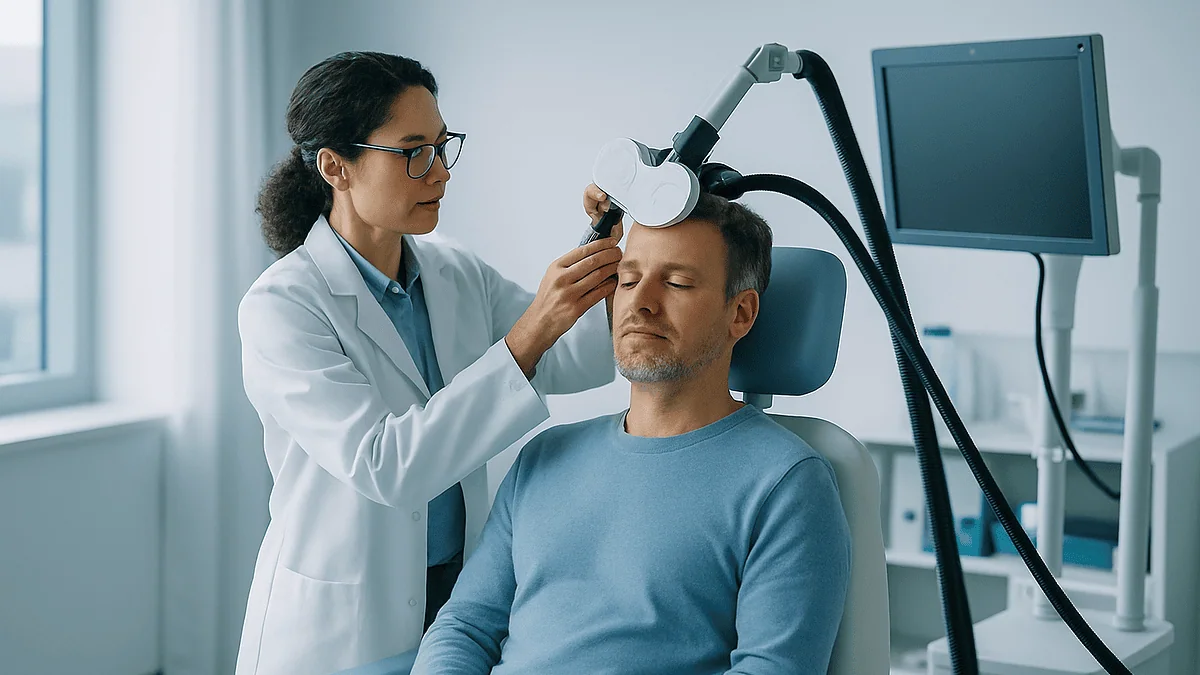
A TMS session looks, from the outside, remarkably ordinary. You sit in a padded chair that resembles one at a dental practice. A technician positions an electromagnetic coil, about the size of a large paddle, against a specific point on your scalp and holds it in place with an arm or a cap. When the machine runs, the coil produces brief magnetic pulses that pass painlessly through the skull and induce small electrical currents in the cortex just beneath it, the outer layer of brain tissue.
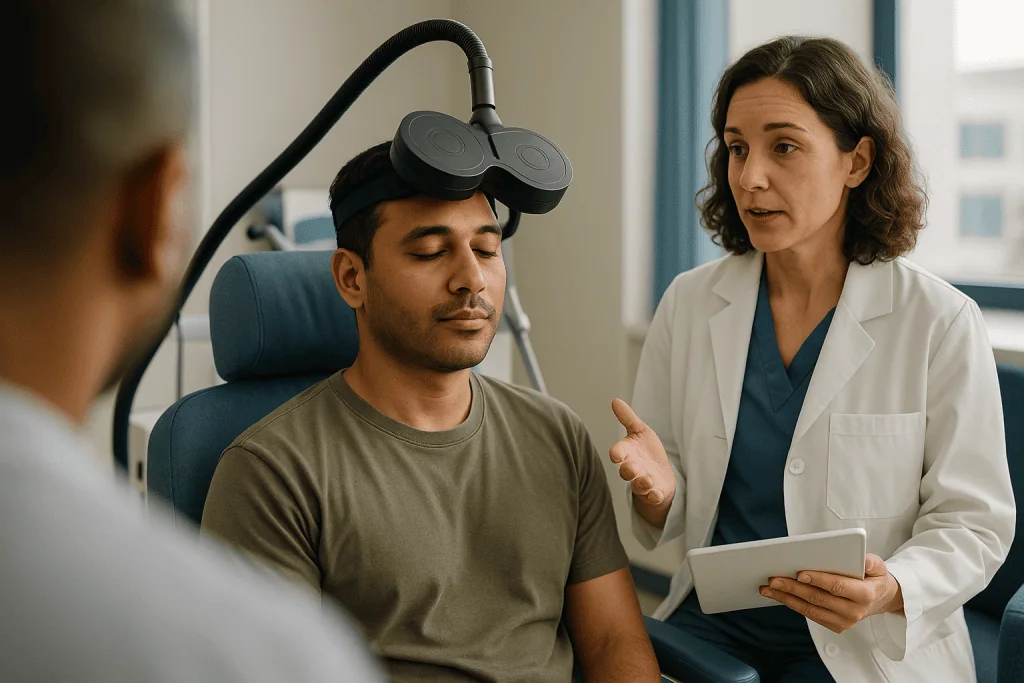
The mechanism is electromagnetic induction, the same principle that makes an induction cooktop heat a pan without a flame. A rapidly changing magnetic field creates a current in a nearby conductor; here the conductor is a cluster of neurons. Repeated pulses delivered in a set rhythm, called repetitive TMS or rTMS, are thought to nudge those neurons toward higher or lower activity, and over repeated sessions to shift the way a whole network communicates. In depression, the usual target is the left dorsolateral prefrontal cortex, a region behind the forehead that imaging studies have linked to mood regulation, as the National Institute of Mental Health describes.
What you notice is a loud clicking, like a woodpecker with a metronome, and a tapping sensation on the scalp. Earplugs are standard. You stay awake throughout, can talk between pulse trains, and walk out afterward to drive yourself home if you wish; the Mayo Clinic notes that no sedation is used and normal activities can resume immediately.
Sessions with standard protocols last roughly 20 to 40 minutes, according to the Cleveland Clinic, and a full course is delivered on weekdays over several weeks. Newer, shorter pulse patterns exist, and your team will explain which protocol applies to you.
Who TMS is usually for, and who is usually asked to wait
TMS is most established for adults with major depressive disorder whose symptoms have not improved enough with antidepressant medication and talking therapy. The Mayo Clinic describes it as an option when at least one standard treatment has not worked, and UK guidance summarized by the NHS lists repetitive TMS among the treatments a specialist may offer for depression that has not responded to other approaches. Regulators in several countries have also approved specific protocols for obsessive-compulsive disorder and for smoking cessation, and a single-pulse device for migraine with aura, as Mayo notes.
Being a candidate is not the same as being suitable right now. Teams commonly ask people to wait, or choose another route, in a few situations:
- An active seizure disorder, or a history of seizures, because the pulses can in rare cases provoke one.
- Non-removable metal or electronic devices in or near the head, discussed in detail below.
- A current pregnancy, where evidence on safety is limited and individual discussion is needed.
- Recent head injury, brain surgery or a neurological condition that has not yet been fully evaluated.
- Acute suicidal crisis, where more rapid treatments and a higher level of care usually take priority.
Age matters less than people expect. Older adults are treated routinely, and some jurisdictions approve treatment for adolescents with depression. Children and teenagers follow a pathway set entirely by their specialist team.
The honest framing is this: TMS sits fairly far along a treatment ladder. Someone with a first episode of mild depression is usually offered therapy and, if needed, medication first, not because TMS would fail but because simpler options carry less time commitment and equally good evidence at that stage. Where you sit on that ladder is a judgment your prescriber makes with you.
TMS contraindications: which metal implants and devices matter
The coil generates a strong, rapidly changing magnetic field. Anything ferromagnetic or electronic close to it can be pulled, heated or made to malfunction. That is why the implant screen is the single most important safety question in the whole preparation process, and why it deserves a full answer rather than a shrug.

The Mayo Clinic and Cleveland Clinic both flag the following as reasons TMS may be unsafe or need specialist review:
- Aneurysm clips or coils placed in blood vessels of the brain.
- Stents in the neck or brain.
- Deep brain stimulators, vagus nerve stimulators or other implanted brain electrodes.
- Cochlear implants, which sit in the skull behind the ear.
- Metal fragments, bullet shrapnel or facial tattoos with metallic ink near the eyes and forehead.
- Cardiac pacemakers, implantable defibrillators and medication pumps, which are farther from the coil but still electronic.
Distance is the deciding factor. Device manufacturers and clinical protocols generally treat metal within roughly 30 centimeters (about 12 inches) of the coil as the zone of concern. A hip replacement is not a problem. A titanium plate in the skull might be, depending on its position, and titanium is often but not always considered safe because it is not ferromagnetic. Dental fillings, crowns and fixed braces are generally acceptable, as Mayo notes, though a technician may adjust coil placement if you have extensive dental metal on one side.
Bring documentation. Implant cards, operation notes and imaging reports save your team from guessing. If you had surgery decades ago and cannot remember what was used, say so; a plain skull X-ray or a records request may settle it. Removable items such as hearing aids, earrings, hair clips, glasses and some retainers simply come off before each session.
Never assume something is too small to mention. The person reviewing your form would far rather hear about the forgotten metal earring stud than discover it under the coil.
Building your medication list: why every tablet and supplement counts
Your medication list is the second pillar of preparation, and it should be more thorough than the one you give a pharmacist. The reason is specific. The main serious risk of TMS is a provoked seizure, and a number of medicines lower the threshold at which a brain will seize. The team is not judging your prescriptions; they are calculating your margin of safety.
Write down everything, including:
- All prescribed medicines, including antidepressants, antipsychotics, mood stabilizers, anticonvulsants, stimulants and sleep medicines, with the name of the prescriber.
- Recent changes: anything started, stopped or adjusted in the past few weeks, since abrupt withdrawal from some sedatives or alcohol can itself raise seizure risk.
- Over-the-counter products, especially decongestants, antihistamines and cold remedies.
- Herbal and dietary supplements, which the NIH Office of Dietary Supplements reminds consumers are not inert and can interact with prescription drugs.
- Alcohol, cannabis and any recreational substances, described honestly.
Several classes are of particular interest. Some antidepressants, certain antipsychotics and stimulants have known effects on seizure threshold. Benzodiazepines, a class of sedatives, are the opposite case: they raise the threshold and may also blunt the brain’s response to stimulation, so the team wants to know if you take them and when. None of this means you will be asked to stop anything. Many people continue their antidepressant throughout a course of TMS, and the Cleveland Clinic notes it is often used alongside medication and psychotherapy rather than instead of them.
What you must not do is adjust a dose yourself in the hope of “cleaner” results. Stopping a mood stabilizer or a sedative abruptly is riskier than the treatment it was meant to prepare you for. Hand the list over, ask what the team wants changed, and let the prescriber make the call.
What not to do before TMS therapy: alcohol, sleep and caffeine
People search for what not to do before TMS therapy expecting a long list of prohibitions. The real list is short, and every item on it is about seizure threshold or comfort.
Alcohol comes first. Drinking heavily the night before, and especially withdrawing from regular heavy drinking, lowers the seizure threshold. Most teams ask people to avoid alcohol for at least the day before a session, and to be honest about their usual intake so the schedule can be planned safely. If you drink daily, tell the team; sudden abstinence is itself the risk and needs medical support, not willpower.
Sleep is second, and it is underrated. Sleep deprivation is one of the best-documented triggers for seizures in people who are susceptible, and a tired brain also makes the mapping process less reliable because muscle responses fluctuate. Aim for a normal night’s sleep before each session, particularly the first. If insomnia is part of your depression, say so; the team can schedule around your best hours.
Caffeine is third, and the advice is moderation rather than abstinence. A morning coffee is fine for most people. Multiple energy drinks or an unusually large intake can increase jitteriness, raise the chance of scalp muscle twitching and, in high amounts, nudge seizure risk. Keep your intake at your normal level rather than dosing up to stay awake.
Beyond those three, the practical rules are simple. Arrive with clean, dry hair free of gels, sprays or oils, which can interfere with coil contact and cap markings. Skip heavy makeup on the forehead. Eat normally, because there is no anesthetic and low blood sugar makes anyone feel worse in a chair for half an hour. Bring the medication list, your glasses case, and something to read.
What to expect at the first TMS session: finding your motor threshold
The first visit is different from every one that follows, and knowing why removes most of the anxiety. Before treating your mood target, the team has to calibrate the machine to your individual brain. That calibration is called motor threshold mapping, and it is the reason the Mayo Clinic describes the first session as lasting about an hour, compared with the shorter treatment sessions afterward.
Here is what happens. The technician places the coil over the motor cortex, the strip of brain that controls movement, on one side of your head. Single pulses are delivered while they watch your hand on the opposite side. When a pulse is strong enough, your thumb or fingers twitch involuntarily, a small flick you can feel but cannot stop. The technician adjusts position and intensity until they find the lowest pulse strength that produces a visible twitch about half the time. That value is your motor threshold, and treatment intensity is then set as a percentage of it.
Why the fuss? Skull thickness, scalp depth and individual cortical excitability vary widely between people. Setting intensity to a fixed number would overstimulate some brains and undertreat others. Mapping to your own threshold is what keeps the dose in the safe, effective window described in published safety guidelines.
The team then measures forward from that motor spot to locate the prefrontal treatment target, marks the position on a fitted cap or records it with a navigation system, and delivers the first full treatment. Expect a lot of measuring, some repositioning, and the odd feeling of your hand moving without your permission. None of it hurts in the way an injection does, though the pulses over the motor area can feel like a firm tap. Wear a top you can sit comfortably in, and remove earrings and hair accessories beforehand.
Does TMS hurt? Honest expectations for the scalp and jaw
The most common question before a first session is also the most reasonable one: how painful is TMS therapy? The honest answer is that it is uncomfortable for many people early on and rarely described as painful after the first week, though experience varies.
Each pulse causes a tapping or knocking sensation on the scalp and contracts the small muscles under the coil. Over the forehead, that means the eyebrow and eyelid may flicker and the jaw muscles may tighten in rhythm with the clicks. Some people compare it to a rubber band snapping lightly against the skin; others to someone drumming fingers on their head. The Mayo Clinic lists scalp discomfort at the stimulation site, headache, tingling or twitching of facial muscles and lightheadedness as the common side effects, and notes they tend to ease over the first week or two of treatment as the scalp accommodates.
Several things reduce discomfort, and you should ask about all of them:
- Gradual ramping of intensity across the first few sessions, which many teams use routinely.
- Small adjustments to coil angle, since a few millimeters can move the pulse off a sensitive nerve branch.
- An over-the-counter pain reliever before sessions, if your clinician agrees it is appropriate for you.
- Earplugs, because the noise itself is fatiguing over half an hour.
Headache afterward is usually mild and short-lived. If it is severe or lasts into the next day, tell the team rather than pushing through; it may signal that the intensity or position needs revisiting.
What TMS does not involve is any sensation inside the brain itself. The tissue has no pain receptors. Everything you feel is happening in the scalp, skull muscles and nerves, which is why it fades as those tissues adapt.
How to prepare for TMS week by week: a practical summary table
Preparation spreads across three phases: the weeks before, the day itself and the first session. The table pulls the guidance from the sections above into one place. Every item is a common clinical recommendation summarized by the Mayo Clinic and Cleveland Clinic; your own team’s instructions override anything here.
| When | What to do | Why it matters |
|---|---|---|
| One to two weeks before | Write a complete medication and supplement list; gather implant cards, surgical records and any brain imaging reports | Seizure-threshold review and implant safety screen |
| One to two weeks before | Tell the team about seizures, head injuries, hearing problems, pregnancy or plans to conceive | Identifies people who should wait or need modified protocols |
| Several days before | Arrange your schedule for weekday sessions over several weeks; sort out transport and work flexibility | Consistency of sessions supports the treatment course |
| Day before | Avoid alcohol; keep caffeine at your usual level; get a normal night’s sleep | All three affect seizure threshold and mapping reliability |
| Morning of | Eat a normal meal; wash hair and skip styling products; remove earrings, hair clips and hearing aids on arrival | Comfort, coil contact and metal safety |
| First session | Expect motor threshold mapping, hand twitches and about an hour in the chair; bring earplugs or use those provided | Calibrates intensity to your brain and sets the treatment target |
| After each session | Note headache, scalp soreness or mood changes in a simple diary; report anything unusual | Lets the team adjust early and track response objectively |
Two items deserve emphasis. The schedule question is not trivial: a standard course runs every weekday for roughly four to six weeks according to Mayo, so people with shift work, caring responsibilities or a long commute should raise the logistics before day one rather than discover the strain in week three. And the diary is worth keeping even if it feels fussy, because mood changes during TMS are often gradual and easier to see on paper than to feel.
What the following days and weeks usually look like
Once mapping is done, the course settles into a rhythm. You arrive, the cap or navigation marker confirms the target, the coil is positioned and the pulses run for the protocol’s duration. Then you leave and get on with your day. There is no recovery period in the surgical sense, and the Mayo Clinic notes that people typically return to normal activities immediately, including driving.
The first week is often the hardest physically. Scalp tenderness and headaches are most noticeable then and, for most people, fade as the tissues adapt. Some people feel tired after early sessions, others feel oddly alert. Both are common and usually settle.
Mood changes, when they come, tend to arrive quietly. People often describe noticing something indirect first: they slept through the night, they answered a text they had been avoiding, a piece of music landed the way it used to. The Cleveland Clinic notes that improvement, where it occurs, frequently becomes apparent after several weeks rather than several sessions, so a flat second week is not a verdict. Standard courses run roughly four to six weeks of weekday sessions per Mayo, sometimes followed by a tapering phase with fewer sessions per week.
Life around the sessions should stay as normal as possible. Continue your usual medicines unless the prescriber changes them. Keep psychotherapy appointments; the two approaches are routinely combined. Maintain the sleep and alcohol habits from the preparation phase throughout the course, since seizure threshold matters on day fifteen as much as day one.
Some people are offered maintenance sessions after the main course, spaced weeks or months apart, if symptoms begin to return. Whether that is appropriate, and how it is spaced, is a decision for your treating team based on how you respond, not a fixed rule.
What are the signs that TMS is working, and what isn't a sign
People understandably watch for evidence, and the trouble is that the evidence rarely looks the way they expect. Signs that TMS is working are usually functional rather than dramatic: getting out of bed at a reasonable hour without a fight, finishing a task that had sat untouched, feeling a flicker of interest in something, arguing back against a self-critical thought instead of accepting it. Clinicians track these using standard questionnaires repeated every week or two, and the trend across those scores matters more than any single day.
Sleep and appetite often shift before mood does. Energy may return before pleasure. Family members frequently notice a change before the person does, which is one reason many teams ask a partner or close friend to weigh in. A diary, as suggested earlier, turns vague impressions into something you can show the team.
What is not a reliable sign:
- Scalp discomfort, or its disappearance. Sensation on the skull has nothing to do with the brain network being targeted.
- Feeling strange, euphoric or emotional immediately after a session. Transient effects are common and do not predict the course.
- A single good or bad day. Depression fluctuates with or without treatment.
- Comparison with someone else’s timeline. Response varies widely between people.
One sign does need prompt attention. A sudden surge in energy paired with racing thoughts, reduced need for sleep and unusually elevated mood can, in people with an underlying bipolar tendency, indicate a hypomanic switch. It is uncommon, but it is a reason to call the team the same day rather than celebrate.
If scores have not moved by the end of a full course, that is information too. Your team may adjust the protocol, revisit the diagnosis or discuss other options. Absence of response is not a personal failure and does not close other doors.
Risks and alternatives in plain language
Every treatment explainer owes readers a level-headed account of what can go wrong and what else exists. For TMS, the serious risk list is short and the alternatives are well established.
The Mayo Clinic groups side effects as common and mild (scalp discomfort, headache, facial tingling or twitching, lightheadedness) and rare but serious (seizures, mania in people with bipolar disorder, and hearing loss if ear protection is inadequate). Seizure is the headline concern. It is described as rare across large clinical experience, and most reported cases have involved risk factors that a good screen is designed to catch: seizure-lowering medicines, alcohol withdrawal, sleep deprivation or pre-existing brain conditions. That is precisely why the medication list and lifestyle questions in this article are not optional extras.
Hearing protection deserves a plain word. The coil is loud, comparable to a loud clicking machine at close range, and earplugs are worn at every session for that reason. Anyone with existing hearing loss or ear implants should raise it before starting.
Alternatives depend on the condition. For depression not responding to initial treatment, the NHS lists options including switching or combining antidepressants, adding structured psychotherapy, and, for severe or life-threatening illness, electroconvulsive therapy (ECT), which is delivered under general anesthesia and carries different risks and a stronger evidence base for the most severe presentations. Newer medication approaches also exist for treatment-resistant depression and are prescribed under specialist supervision. For obsessive-compulsive disorder, exposure-based therapy and medication remain first-line, with TMS considered when those have not helped enough.
None of these is a competition. Many people use TMS alongside therapy and medication, and the right sequence is worked out with a prescriber who knows your history. Ask what the alternatives would be for you specifically, and what would make the team change course.
What people often get wrong about TMS
Waiting rooms and message boards generate their own mythology. A few corrections, grounded in what clinical sources actually say.
“It’s a kind of shock therapy.” It is not. Electroconvulsive therapy deliberately induces a controlled seizure under anesthesia; TMS is designed to avoid seizures entirely, requires no anesthesia and leaves you awake and talking. The two share a lineage in brain stimulation and nothing else in practice.
“You have to stop your antidepressant first.” Usually not. The Cleveland Clinic notes TMS is commonly combined with medication and therapy. Any change to your prescription is a decision for your prescriber, and stopping abruptly can raise seizure risk, which is the opposite of good preparation.
“If it hasn’t worked by week two, it isn’t going to.” Improvement, where it happens, frequently emerges later in the course, and early scalp discomfort can mask subtle gains. Teams assess response over the full course using repeated questionnaires, not a fortnight of impressions.
“Any metal anywhere rules you out.” Distance from the coil is what matters. A knee replacement is irrelevant; a clip in a brain artery is not. Dental work is generally acceptable. The screen exists to sort these cases, not to exclude everyone with a filling.
“More intensity means faster results.” Intensity is set as a proportion of your own motor threshold within a range defined by safety guidelines. Pushing higher raises seizure risk and scalp pain without evidence of extra benefit.
“It erases memories or changes personality.” Unlike ECT, TMS is not associated with memory loss in clinical descriptions from Mayo or Cleveland Clinic. People report feeling more like themselves, not less.
“It works for everyone, or for no one.” Both extremes are wrong. Response varies, guidelines support its use in specific situations, and the honest position is that it helps some people substantially, others partially and some not at all.
Questions to ask your care team before you start
A good consultation answers most of these unprompted, but a written list keeps you from remembering the crucial one in the parking lot. Bring it, and bring a pen.
About suitability and safety:
- Have you reviewed every item on my medication and supplement list, and is there anything you want the prescriber to adjust before I begin?
- Is there any implant, surgery or head injury in my history that changes the plan or needs imaging first?
- What is my personal seizure risk, and what should I avoid throughout the course to keep it low?
- Do I have any history that raises the chance of a manic switch, and how will you monitor for it?
About the treatment itself:
- Which protocol will I receive, how long is each session and how many weeks is the course expected to run?
- What happens at the mapping session, and will you re-map if my threshold seems to change?
- How will you measure whether I am responding, and how often?
- What will you do if I have significant scalp pain or headaches in the first week?
About the bigger picture:
- What are my alternatives if TMS is not right for me, or if it does not help?
- Should I continue psychotherapy and my current medicines during the course?
- Is maintenance treatment something you would consider, and on what basis?
- Who do I call, and at what number, if something feels wrong between sessions?
One more, which people rarely ask: what would make you stop the course early? A team that can answer that clearly has thought about your safety in advance. The answers to all of these belong to your treating clinicians; the point of asking is to make sure you understand the plan you are agreeing to.
When to call your doctor during a TMS course
Most people finish a course of TMS with nothing more troubling than a sore scalp. A small number of situations do need prompt attention, and knowing them in advance means you will not hesitate.
Seek emergency care immediately if any of the following occur during or after a session:
- A seizure: convulsive movements, loss of consciousness or a period of confusion you cannot account for.
- Sudden severe headache unlike any you have had before, especially with vomiting, stiff neck or vision changes.
- Sudden weakness, numbness, facial drooping or trouble speaking, which need urgent assessment regardless of cause.
- Thoughts of harming yourself or ending your life. Depression can worsen during any treatment, and this always warrants same-day contact with your team or emergency services.
Call your treating team the same day if you notice:
- A marked, sustained surge in energy with reduced need for sleep, racing thoughts or uncharacteristically impulsive behavior, which can signal a hypomanic switch.
- New or worsening hearing loss, ringing in the ears or ear pain after a session.
- Fainting or lightheadedness that does not settle within a few minutes of standing.
- Headache or scalp pain severe enough to interfere with sleep or daily life, or that persists into the following day.
- A change in any medicine made by another prescriber, or a new diagnosis, since either may alter your seizure risk.
Mention at your next session, without waiting: mild headaches, facial twitching, fatigue, or a sense that the coil position feels different from previous days.
The Mayo Clinic and Cleveland Clinic both describe serious events as rare, and the screening described throughout this article is what keeps them rare. Your care team should give you a direct contact number before the first session. If they have not, ask for one. Every decision about pausing, adjusting or continuing treatment rests with them, and calling early is never the wrong move.
Frequently asked questions
What not to do before TMS therapy?
Avoid alcohol for at least the day before, do not skimp on sleep, and keep caffeine at your normal level rather than increasing it, because all three affect seizure threshold. Do not stop or adjust any prescribed medicine on your own; hand the full list to your team and let the prescriber decide. Skip hair products and remove metal accessories before each session.
Can I take medication during TMS?
Usually yes; many people continue antidepressants and other prescriptions throughout a course, and the Cleveland Clinic notes TMS is often combined with medication and psychotherapy. Your team reviews every medicine for its effect on seizure threshold and may ask the prescriber to adjust something, but that decision is theirs. Never change a dose yourself in preparation.
What disqualifies you for TMS?
Non-removable metal or electronic devices in or near the head are the main exclusion: aneurysm clips, cochlear implants, deep brain stimulators and stents in the neck or brain. A history of seizures, an untreated neurological condition or some cardiac devices may also rule it out or require specialist review. Dental fillings and braces are generally acceptable.
How painful is TMS therapy?
Most people describe tapping or knocking on the scalp with twitching of the forehead and jaw muscles, uncomfortable rather than painful, and it usually eases over the first week or two. Headache afterward is common and typically mild. Gradual ramping of intensity and small coil adjustments reduce discomfort; tell your team if pain is severe or persists into the next day.
What are the signs that TMS is working?
Early signs are usually functional: better sleep, more energy, finishing tasks and a flicker of interest returning, often noticed by family before the person themselves. Clinicians track response with repeated questionnaires over the full course. Scalp sensations, a single good day or feeling unusual immediately after a session are not reliable indicators either way.
What should I expect at the first TMS session?
Expect about an hour, per the Mayo Clinic, most of it spent on motor threshold mapping: single pulses over the movement area of your brain until your hand twitches, which calibrates intensity to you. The team then locates and marks the treatment target and delivers the first full session. Bring your medication list and remove earrings and hair clips.
Do I have to stop antidepressants before TMS?
Not usually. Stopping abruptly can itself raise seizure risk and worsen symptoms, so no change should be made without the prescriber. The team reviews your list for medicines that lower the seizure threshold and, if anything needs adjusting, coordinates it with whoever prescribes for you. Continuing therapy and medication alongside TMS is common practice.
Are dental fillings or braces a problem for TMS?
Generally no. The Mayo Clinic notes that dental work is usually acceptable because fillings, crowns and fixed braces are small, mostly non-ferromagnetic and positioned away from the coil. Tell the team anyway so they can account for it; removable retainers and metal jewelry come off before each session. Facial tattoos with metallic ink near the forehead should be mentioned.
Can I drive myself home after TMS?
Yes, in almost all cases. No sedation or anesthesia is used, and the Mayo Clinic notes people typically return to normal activities immediately after a session. The exception is if you feel lightheaded or have a significant headache afterward; sit for a few minutes, tell the staff, and arrange alternative transport for that day if needed.
How long does a TMS course last?
A standard course involves sessions on weekdays over roughly four to six weeks, according to the Mayo Clinic, with individual sessions lasting about 20 to 40 minutes per the Cleveland Clinic. Some protocols are shorter and some teams add a tapering phase. Your treating team sets the schedule based on your protocol and response.
References
- Cleveland Clinic: Transcranial Magnetic Stimulation (TMS)
- National Institute of Mental Health: Brain Stimulation Therapies
- NHS: Depression in adults, treatment
This article is for general information only and is not a substitute for professional medical advice. Please consult a qualified doctor about your individual situation.

More from the Blog

How Does Recovery Differ After Brain Aneurysm Coiling and Clipping? Timelines Side by Side
After an unruptured brain aneurysm is treated, coiling recovery is usually shorter: most people go home within one to two days and ease back…
What Happens During Gamma Knife Radiosurgery: Frame or Mask, Planning and the Session Itself
During Gamma Knife radiosurgery, a lightweight head frame or a custom face mask holds the head still, detailed MRI or CT images are taken,…

Who Is a Candidate for TMS? Why Implants, Metal in the Head and Seizure History Matter
TMS is usually considered for adults with depression that has not improved after standard treatment, and for a few other approved conditions. Candidacy depends…

Everyday Life With Neurosarcoidosis: Infection Precautions While on Immunosuppression
People living with neurosarcoidosis who take corticosteroids or other immunosuppressive medicines carry a higher risk of infections, including some that a healthy immune system…

Is Alzheimer’s Disease Managed Differently When It Starts Before Retirement Age?
Yes, in practical ways. The disease biology, diagnostic tests and medicine classes are largely the same whether Alzheimer's begins at 52 or 82, but…

When Do Movement or Coordination Changes Call for a Huntington’s Disease Evaluation?
Movement or coordination changes call for a Huntington's disease evaluation when they are new, persistent and unexplained, especially involuntary fidgety or flowing movements, growing…