

PRP for Hair Loss Side Effects: Normal Scalp Tenderness vs Signs to Call Your Clinic About
Key Takeaways
- PRP is prepared from your own blood, so true allergic reaction to the plasma itself is unlikely; the risks come from needles, numbing agents and sterility, not the substance.
- Tenderness, redness, pinpoint bleeding and a tight, mildly swollen scalp are expected after scalp injections and, per Cleveland Clinic, generally ease over a few days.
- A healthy scalp sheds roughly 50 to 100 hairs a day according to MedlinePlus, and a temporary diffuse increase in the weeks after PRP has a plausible hair-cycle explanation.
- Infection announces itself by direction, not presence: redness that spreads and pain that builds after day two, especially with pus or fever, warrant a same-day call.
- Cleveland Clinic lists infection, nerve injury, tissue damage and bleeding as uncommon but recognized risks of PRP injections, and persistent numbness should always be reviewed.
- No shampoo has been shown to regrow hair in pattern hair loss, and the NIH Office of Dietary Supplements notes biotin helps mainly people who are actually deficient.
Common PRP for hair loss side effects are mild and short-lived: scalp tenderness, pinpoint bleeding, redness, slight swelling and a tight or bruised feeling that generally settles within a few days. Some people also notice a temporary increase in shedding in the following weeks. Spreading redness, worsening pain, pus, fever, or numbness that persists are not expected and warrant a prompt call to the treating clinic.
The evening after a first scalp session, most people do the same thing: stand in the bathroom mirror, part the hair with two fingers and press gently on a spot near the crown. It is sore. Not dramatic, just sore, the way a vaccination site feels the next morning. Then the questions start. Is this how it should feel? Is that tiny scab normal? Why does the forehead look a little puffy?
Nobody really warns you that the hardest part of PRP for hair loss side effects is not the discomfort itself but the not knowing. A clinic handout lists a few words, tenderness, redness, mild swelling, and leaves you to interpret your own scalp at 10 p.m.
This explainer is the longer conversation. It walks through what the procedure actually does to the skin, what a healing scalp normally feels like over the following days and weeks, why some people shed more before anything improves, and, most usefully, which signs are ordinary healing and which ones deserve a phone call.
What actually happens during a PRP scalp session
PRP stands for platelet-rich plasma, a portion of your own blood that has been concentrated so it holds more platelets than usual. Platelets are tiny cell fragments that help blood clot and, when activated, release growth factors, which are signaling proteins that tell nearby cells to repair, divide or build new blood supply.
The session begins like a routine blood test. A small volume is drawn from an arm vein into tubes, then placed in a centrifuge, a machine that spins the tubes fast enough to separate blood into layers by density. Red cells sink, plasma rises, and the platelet-rich fraction sits in between. That layer is drawn into syringes.
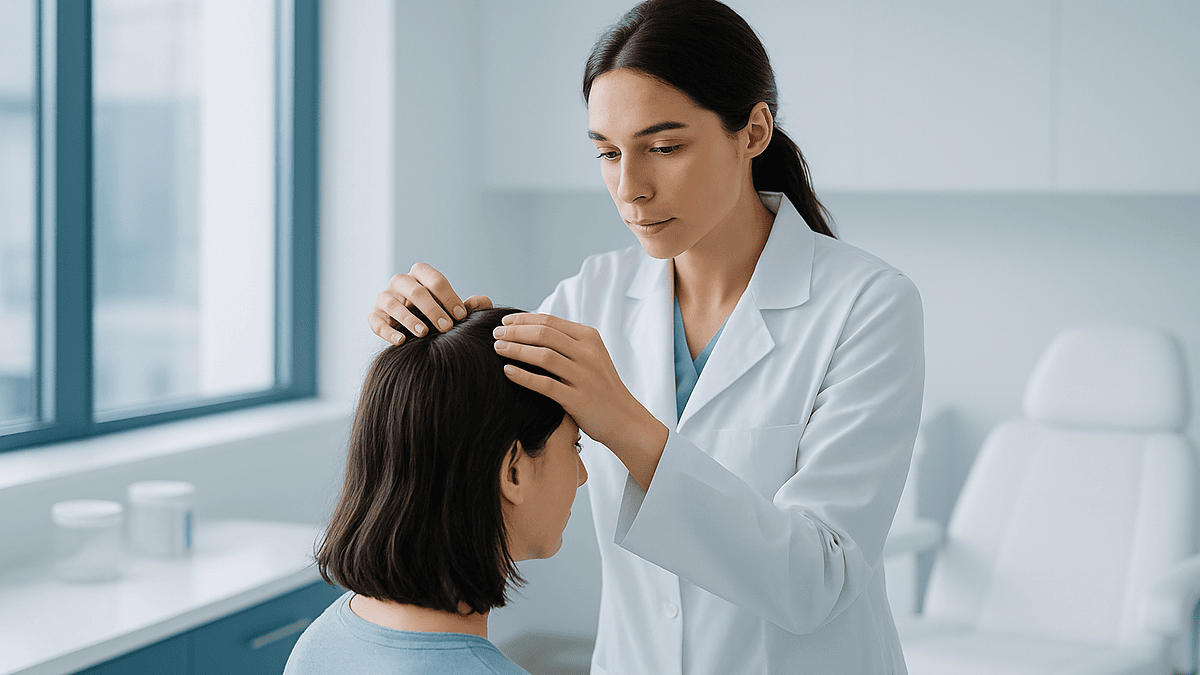
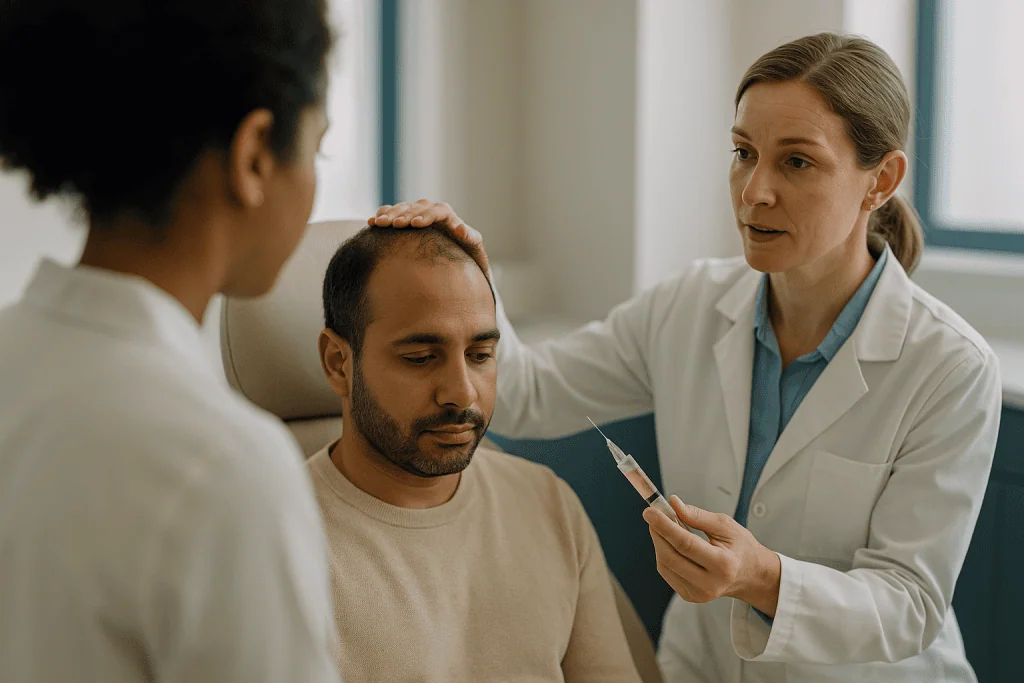
A clinician then injects it in a grid pattern across the thinning zones, usually with a fine needle and often after a numbing cream, cold air or ice. Dozens of small punctures are typical; the scalp is being seeded, not filled. The whole visit commonly runs under an hour, and treatment is usually planned as a series of sessions spread over months rather than a single appointment, according to Cleveland Clinic.
The proposed mechanism is that growth factors may coax resting hair follicles toward their growth phase and support the small vessels that feed them. Follicles are the skin pockets each hair grows from, and in pattern hair loss they shrink over time. Whether PRP reliably reverses that shrinkage remains under study, and the evidence base is made up of small trials with differing preparation methods.
Two things follow from this description. Because the material is your own blood, true allergic reaction to PRP itself is not the concern. And because the delivery involves many needle punctures into one of the most nerve- and vessel-rich areas of skin on the body, some soreness, redness and pinpoint bleeding are not complications at all. They are the expected footprint of the procedure.
Is PRP for hair loss safe? What the evidence actually shows
Safety and effectiveness are separate questions, and PRP illustrates the difference well. On safety, the picture is reassuring but not risk-free. Reported side effects are overwhelmingly local and temporary: pain at the injection points, redness, swelling and bruising. Cleveland Clinic lists the more serious possibilities as uncommon: infection, nerve injury, tissue damage and bleeding.
On effectiveness, the honest summary is that PRP is still being studied. Mayo Clinic describes it among approaches being investigated for hair loss rather than as an established treatment, and published trials vary in how the plasma is prepared, how much is injected, how often and in whom. That variability makes it hard to say what a typical result looks like, and it is why this article makes no promises about regrowth.
It also helps to understand the regulatory position. PRP is not a medicine approved for hair loss. It is produced at the bedside from your own blood using processing equipment, so oversight focuses on how the blood is handled and the device used, not on proof that hair grows back.
Where does that leave a cautious reader? The strongest safety lever is not the plasma but the setting. Sterile technique, single-use equipment, a clinician who knows scalp anatomy and a proper medical history that screens for bleeding disorders, active infection and medicines that affect platelets are what separate a low-risk procedure from an avoidable problem.
If pressed for an opinion, it is this: the risk most worth worrying about is not a rare complication but the opportunity cost of skipping a diagnosis. Hair loss has many causes, including thyroid disease, iron deficiency, medicines and autoimmune conditions, as the NHS and Mayo Clinic both note. A procedure aimed at pattern hair loss will not address any of those.
PRP for hair loss side effects: the normal list
Think of the healing scalp as a small patch of skin recovering from a controlled injury. Almost everything on the expected list is a direct consequence of needles, fluid volume and the body’s repair response.
- Tenderness and soreness, most noticeable when you touch the scalp, lie on a pillow or brush your hair. It is usually strongest in the first day and eases over the next few, per Cleveland Clinic guidance on PRP injections.
- Pinpoint bleeding and tiny scabs at individual injection points. These are the size of a pinhead and fall away as the skin closes.
- Redness across the treated area, sometimes with a warm feeling, from the inflammatory response that begins every wound repair.
- Mild swelling and a tight feeling. The scalp has little spare room beneath the skin, so even a small amount of injected fluid and healing swelling can make it feel stretched.
- Small bruises, particularly in people who bruise easily or take medicines that affect platelets.
- A dull headache on the day of treatment, which many people attribute to scalp tension.
- Itching a few days later as the skin heals.
- Lightheadedness during or just after the blood draw, which is a reaction to the needle and the sight of blood rather than to PRP.
Two patterns are worth knowing in advance. Swelling can drift downward with gravity, so people treated along the hairline sometimes wake with puffiness at the forehead or around the upper eyelids a day or two later. And the scalp often looks worse than it feels, or feels worse than it looks. Neither mismatch is a warning sign on its own.
What none of these should do is escalate. Normal effects peak early and fade. A side effect that is getting worse on day three rather than better is the pattern to watch, and the sections that follow explain why.
Why your scalp feels tender, tight or bruised for a few days
The scalp is unusual skin. It sits on a firm sheet of connective tissue called the galea, which lies over the skull, and it is packed with nerves and blood vessels; even a small cut there bleeds more freely than a cut on the arm. That anatomy explains most of what you feel after treatment.

Every needle pass creates a micro-injury. Within minutes, the body starts a repair sequence: blood vessels widen to bring in immune cells and nutrients, which produces redness and warmth; fluid leaks into the tissue, which produces swelling; and nerve endings become more sensitive, which produces tenderness. This is the same cascade that follows a graze or an insect bite. It is not inflammation gone wrong. It is inflammation doing its job.
The tight feeling has a mechanical cause. Because the galea leaves little room for tissue to expand, a small volume of injected plasma plus the fluid of healing has nowhere to go. The skin feels stretched, a little like a scalp sunburn. Over the following days the body reabsorbs that fluid, and the tightness fades along with it.
Bruising happens when a needle nicks one of the many tiny vessels beneath the skin. On the scalp, bruises are often hidden by hair and are noticed only at the temples or forehead.
Cleveland Clinic notes that soreness after PRP injections generally lasts a few days. Common comfort measures clinics describe include a cool compress wrapped in cloth, sleeping with the head slightly raised, avoiding hats that press on the area and postponing saunas, hot showers directed at the scalp and heavy exercise for the period your team specifies. If you want pain relief, ask the clinic which options they prefer; some medicines that ease pain also affect platelets, and the answer depends on your history.
Hair shedding after PRP: why it happens and what it usually means
Few things unsettle a person paying attention to their hair like finding more of it in the drain a few weeks after treatment. To make sense of it, you need the hair cycle.
Every follicle moves through three phases. Anagen is the growth phase, catagen a brief transition, and telogen the resting phase that ends when the old hair is pushed out by a new one starting underneath. Because follicles cycle independently, a healthy scalp loses roughly 50 to 100 hairs a day, according to MedlinePlus and Mayo Clinic. That baseline is worth remembering: a handful of hairs on a pillow is ordinary biology.
Shedding after PRP has a proposed explanation. If the treatment nudges resting follicles to restart growth, the hairs sitting in telogen are released a little earlier than they otherwise would have been. Clinicians often call this shock shedding, and it is described as temporary, with the same follicles expected to begin producing new hair. This mechanism is plausible and widely described, but it has not been rigorously measured in trials, so treat it as a reasonable explanation rather than a proven one.
Other explanations deserve equal weight. Pattern hair loss progresses on its own timeline regardless of treatment. Seasonal shedding is real for many people. Telogen effluvium, a diffuse shed triggered by illness, surgery, childbirth, crash dieting or a new medicine some weeks earlier, can coincide with a treatment course by chance. Iron deficiency and thyroid changes can do the same, as the NHS notes.
So when is shedding a call-the-clinic sign? When it arrives with scalp pain, scaling, broken hairs, or clearly patchy bald areas rather than diffuse thinning. Those patterns point to something other than a hair cycle reset and deserve examination.
PRP scalp injection risks that are rare but real
Most people finish a course of PRP with nothing more than a few tender days. The uncommon problems are still worth knowing, because recognizing them early is what keeps them minor.
Infection. Any procedure that breaks the skin carries a small risk of bacteria entering. On the scalp, infection tends to announce itself over one to several days with redness that spreads beyond the treated area, warmth, increasing rather than easing pain, pus or a bad smell, and sometimes fever. Cleveland Clinic lists infection among the recognized risks of PRP injections. Sterile technique and clean aftercare keep the risk low; ignoring the early signs is what turns a small problem into a larger one.
Nerve irritation. The scalp is supplied by several sensory nerves that run from the brow and the back of the head toward the crown. A needle passing close to one can cause brief tingling, an electric twinge or a patch of numbness. Most such sensations settle as the tissue calms. Numbness or altered sensation that persists for weeks is unusual and should be reviewed.
Bleeding and hematoma. A hematoma is a collection of blood under the skin, larger than a bruise and sometimes raised or firm. It is more likely in people taking anticoagulants, medicines that reduce clotting, or those with a low platelet count.
Tissue injury and lumps. Cleveland Clinic also mentions tissue damage. In practice this can mean a persistent firm nodule or, rarely, a small area of scarring at an injection site.
Reactions to numbing agents. When allergy does occur, it is usually to the local anesthetic or cleansing solution rather than to the plasma, which is your own.
Fainting. A vasovagal response to the blood draw is common enough that clinics have you sit or lie down. It is unpleasant, not dangerous, but let staff know if it has happened before.
Who PRP is usually for, and who is usually asked to wait
PRP is most often offered for androgenetic alopecia, the pattern hair loss that thins the crown and temples in men and the central parting in women. It is thought to work, if it works, by supporting follicles that are miniaturized but still alive. A completely smooth, shiny bald area has few follicles left to stimulate, which is why clinicians usually frame PRP for early to moderate thinning and sometimes as a companion to a hair transplant rather than a replacement for one.
The screening conversation matters as much as the procedure. People are commonly asked to postpone or reconsider PRP in situations such as:
- an active scalp infection, rash or open wound in the treatment area;
- a known bleeding disorder or a low platelet count, which raises both bleeding risk and questions about how the plasma will behave;
- anticoagulant or antiplatelet medicines, where the prescribing clinician needs to be involved before anything changes;
- pregnancy or breastfeeding, mainly because evidence in these groups is lacking;
- current chemotherapy or a recent serious illness;
- skin cancer or suspicious lesions at the site, which need diagnosis first;
- scarring alopecias, a group of inflammatory conditions that destroy follicles and require specific medical treatment rather than stimulation.
That last point is where a careful team earns its keep. Hair loss is a symptom, not a diagnosis. Mayo Clinic and the NHS list causes ranging from hereditary thinning to thyroid disease, iron deficiency, medicines, stress-related shedding and autoimmune alopecia areata. A clinician who examines the scalp, asks about medical history and, where appropriate, checks blood tests before recommending PRP is doing the part of the job that determines whether the procedure even fits.
The decision, in every case, sits with the treating team and the person in the chair. No article can substitute for that examination.
Normal healing vs signs to call your clinic: a side-by-side table
The most useful thing a patient can carry home is a clear sense of direction: normal side effects move toward better; concerning ones move toward worse or arrive late. The table below sets the two side by side. Timeframes reflect the general guidance on PRP injections described by Cleveland Clinic and standard wound-healing patterns; individual experiences vary.
| Sign | Usually normal | Call your clinic if |
|---|---|---|
| Tenderness | Sore to touch, easing over a few days | Pain increases after day two or becomes throbbing |
| Redness | Confined to the treated area, fading daily | Spreads outward, becomes hot, or appears as a streak |
| Swelling | Mild tightness; some forehead or eyelid puffiness | Rapid enlargement, a firm lump, or swelling that keeps growing |
| Bleeding | Pinpoint dots that stop quickly | Bleeding that soaks a cloth or restarts hours later |
| Bruising | Small, purple, fading over a week or so | Large, expanding or associated with a raised mass |
| Numbness or tingling | Brief, patchy, settling within days | Persists for weeks or is accompanied by weakness |
| Headache | Dull, on the day of treatment | Severe, with fever, stiff neck, vomiting or vision change |
| Shedding | Diffuse increase for a few weeks, then settles | Patchy bald areas, scaling, broken hairs or scalp pain |
| Itching | Mild, a few days after treatment | Intense, with blistering, crusting or hives |
| Fever | Not expected | Any fever, particularly with scalp redness or pus |
A practical way to use this list: on the evening of treatment and each morning for a week, ask yourself two questions. Is anything spreading? Is anything getting worse instead of better? If both answers are no, you are almost certainly in the normal column. If either answer is yes, the phone call is warranted, and no reasonable clinic minds being asked.
PRP hair treatment recovery: what the days and weeks usually look like
Recovery from a scalp PRP session is measured in days for the skin and months for the hair, and mixing up those two clocks causes most of the anxiety.
The day of treatment. The scalp is tender and may look flushed, with pinpoint dots where the needle went in. Clinics usually advise leaving the area alone for the rest of the day, avoiding heat, alcohol and strenuous exercise, and following their specific instructions on when to wash. Those instructions vary between teams; there is no universal rule.
Days one to three. Soreness is at its peak early and then eases. Any forehead or eyelid puffiness tends to appear on day one or two and resolves as fluid is reabsorbed. Tiny scabs form and are best left to fall away on their own. Cleveland Clinic describes post-injection soreness as generally lasting a few days.
The first week. Most people feel normal to the touch. Small bruises fade. Itching may come and go as the skin finishes healing. Gentle hair care is usually fine; harsh scrubbing and tight styles are typically discouraged until the scalp is comfortable.
Weeks two to eight. Nothing much appears to happen, which is the hardest stretch. Some people notice the increased shedding described earlier. There is no visible regrowth yet, and none should be expected. The hair cycle runs on a timescale of months, which is why the NHS explains that hair loss treatments generally need to be continued for several months before any effect can be judged.
Beyond three months. This is when clinicians usually begin assessing whether anything has changed, often with standardized photographs taken under the same lighting, since memory is a poor judge of hair density. Further sessions, if planned, follow the schedule your team sets. Whether to continue is a decision made together, based on what the photographs and examination show rather than on hope or disappointment alone.
Medicines, supplements and PRP: what to tell your care team beforehand
Platelets are the whole point of PRP, and a surprising number of everyday substances change how platelets behave. That makes the pre-treatment medication conversation more than a formality.
Aspirin and non-steroidal anti-inflammatory drugs, a class of pain relievers that includes several common over-the-counter options, reduce platelet stickiness. Clinics often ask whether you take them, both because of bruising and bleeding and because of a theoretical effect on the plasma itself. Fish oil, vitamin E, ginkgo and some other supplements are also thought to have mild antiplatelet effects. None of this means you should stop anything on your own. If a medicine has been prescribed, particularly an anticoagulant for a heart or clotting condition, the only safe path is a conversation between the clinic and the prescriber before your appointment. Stopping such medicines without medical guidance carries risks far more serious than a bruise.
Hair loss medicines are a separate discussion. Topical or oral minoxidil, which is thought to widen small blood vessels and prolong the growth phase, and finasteride, a 5-alpha-reductase inhibitor that lowers a hormone involved in follicle shrinkage, are established options for pattern hair loss described by Mayo Clinic and the NHS. Many clinicians continue them alongside PRP, but that is a case-by-case judgment for the prescribing team, not a rule.
Supplements deserve a word of realism. Biotin is heavily marketed for hair, yet the NIH Office of Dietary Supplements notes that evidence of benefit exists mainly in people who are actually deficient, which is uncommon. Iron and vitamin D are worth checking only if a clinician suspects a deficiency, not as blanket additions.
Bring a complete list to your consultation: prescriptions, over-the-counter products, herbal remedies and vitamins. It is one of the few parts of PRP safety you control entirely.
What people often get wrong about PRP side effects
“More pain means it is working harder.” Soreness reflects needle trauma and the inflammatory response, not the biological effect on follicles. A gentle session and a painful one are not delivering different results; pain that worsens rather than eases is a warning, not a bonus.
“Any swelling means infection.” Mild, early swelling and tightness are ordinary healing. Infection is suggested by the trajectory, redness that spreads and pain that builds over days, and by company: pus, warmth, fever. Swelling that shows up on day one and fades by day three is the normal kind.
“Shedding means it failed.” An increase in diffuse shedding during the following weeks has a plausible hair-cycle explanation and is commonly described by clinicians. It is not proof of success either. It is simply not the moment to judge anything.
“It is my own blood, so nothing can go wrong.” The plasma itself is unlikely to provoke an allergic reaction. The needles, the numbing agents, the handling of the sample and the sterility of the room can all go wrong, which is why the setting matters more than the substance.
“One session should show results.” PRP is generally delivered as a series, and hair grows on a months-long cycle. Expecting visible change within weeks sets you up for disappointment that has nothing to do with whether the treatment helps.
“It works for all kinds of hair loss.” The evidence, such as it is, concerns pattern hair loss. Alopecia areata, scarring alopecias, telogen effluvium and nutritional or thyroid-related loss are different conditions that need different approaches.
“You cannot wash your hair for a week.” Aftercare instructions vary widely between teams, and some allow gentle washing much sooner. Follow the instructions you were given rather than the internet’s.
“Side effects mean I should never do it again.” Ordinary tenderness is not a reason to abandon a planned course. A genuine complication is a reason to talk with your team before deciding anything.
New hair loss drugs, the best shampoo, and where PRP fits
Two questions arrive alongside almost every PRP consultation: what about the new hair loss drugs, and what shampoo should I use? Both deserve honest answers, because both are surrounded by marketing.
The genuinely new class of prescription medicines is the JAK inhibitors, which dampen a signaling pathway used by immune cells. They have been approved for severe alopecia areata, the autoimmune form of hair loss that produces smooth round patches, as Mayo Clinic describes. They are not treatments for pattern hair loss, and they carry their own monitoring requirements. For androgenetic alopecia, the established options remain minoxidil in topical or oral form and 5-alpha-reductase inhibitors such as finasteride, both requiring months of consistent use and both decisions for a prescribing clinician who knows your history. This article does not recommend starting, stopping or changing any of them.
On shampoo, the evidence-first answer is deflating. No shampoo has been shown to regrow hair in pattern hair loss. Shampoos are in contact with the scalp for a minute or two before being rinsed away, which limits what any ingredient can do. Where they help is with scalp health: antifungal shampoos, for example, treat seborrheic dermatitis, a flaky, itchy condition that can make thinning look worse and that the NHS notes is common. A comfortable, non-irritated scalp is a reasonable goal. Regrowth from a bottle is not.
Where does PRP sit among all this? As an option under study, usually considered for pattern hair loss when established treatments are unsuitable, insufficient or when someone wants to try an adjunct. It does not replace a diagnosis, and it does not cancel the need for the long, patient consistency that every hair treatment demands. A clinician who explains that framing plainly, rather than presenting PRP as a shortcut, is giving you accurate information.
Questions to ask your care team before your first session
A good consultation should leave you with fewer questions than you arrived with. If it does not, these are the ones worth asking directly. Write the answers down; post-procedure memory is unreliable when you are also nursing a sore scalp.
- What type of hair loss do you think I have, and how did you decide? Have you ruled out thyroid, iron or medicine-related causes?
- Why is PRP a reasonable option for my pattern specifically, and what would you expect if I chose not to have it?
- How do you prepare the plasma, and how do you keep the process sterile?
- Which of my medicines and supplements affect platelets or bleeding, and who will speak with my prescriber if anything needs to change?
- What side effects do you expect me to have, and for how long? What would you consider abnormal?
- How can I reach you after hours if something looks wrong, and what would you want me to do in the meantime?
- What are your specific aftercare instructions for washing, exercise, heat, hats and hair products?
- How many sessions are you planning, how far apart, and how will we decide together whether to continue?
- How will you measure change? Will you take standardized photographs, and can I see them?
- What should I do about the increased shedding some people notice, and when would you want to see me if it happens?
- Are there established treatments I should be using alongside this, and what do you think of the ones I am already on?
- If this does not help, what would the next conversation look like?
None of these questions is adversarial. A team confident in its process welcomes them, because a well-informed patient recognizes a genuine problem early and does not panic over an ordinary one. The final decision about whether, when and how to proceed belongs to you and the clinicians examining your scalp.
When to call your doctor
Ordinary PRP side effects share one trait: they get better. The signs below do not fit that pattern, and each one justifies contacting the clinic that treated you, or your usual doctor if the clinic cannot be reached. You are never wasting anyone’s time by asking.
Call the same day if you notice:
- redness that is spreading beyond the treated area, becoming hot, or forming a streak;
- pain that is increasing after the second day rather than easing, or that has become throbbing;
- pus, cloudy fluid, crusting that keeps returning, or a bad smell from the scalp;
- fever or chills, particularly alongside any of the above;
- swelling that keeps growing, feels firm, or forms a distinct lump;
- bleeding that soaks through a cloth or restarts hours after the procedure;
- numbness, tingling or altered sensation that persists beyond a few days;
- a rash, hives or blistering across the scalp or face;
- hair loss that is patchy, comes with scaling or scalp pain, or involves broken hairs.
Seek emergency care immediately for a severe headache with a stiff neck, vomiting, confusion or vision change; for swelling of the face, lips or tongue, difficulty breathing or a feeling of the throat closing, which can indicate a serious allergic reaction to a numbing agent or cleanser; or for facial weakness or drooping, which is not an expected effect of scalp injections and needs urgent assessment.
Between those extremes sit the judgment calls: a bruise that seems large, shedding that feels excessive, a tender spot that lingers. For these, a phone call or a message with a photograph is the right move. Clinicians would far rather review a normal scalp than miss an early infection, and they will decide what needs to be seen in person. Every decision about the next step, including whether to continue treatment, rests with the team that examines you.
Frequently asked questions
Is hair shedding after PRP normal?
A temporary increase in diffuse shedding during the weeks after PRP is commonly described and has a plausible explanation: resting hairs may be released earlier as follicles restart their growth cycle. It is not, however, proof that the treatment is working, and the mechanism has not been rigorously measured. Shedding that is patchy, comes with scaling, scalp pain or broken hairs points to something else and should be examined by your clinician.
Is PRP for hair loss safe?
PRP is generally well tolerated, with most reported side effects being local and short-lived: tenderness, redness, swelling and bruising. Cleveland Clinic lists infection, nerve injury, tissue damage and bleeding as uncommon risks. Safety depends heavily on sterile technique, proper screening for bleeding disorders and medicines, and a clinician who knows scalp anatomy. Whether it is effective for regrowth is a separate question that remains under study.
How long does scalp tenderness last after PRP injections?
Soreness is usually most noticeable on the day of treatment and the following morning, then eases over a few days, according to Cleveland Clinic guidance on PRP injections. Tenderness to touch and a tight feeling can linger slightly longer, especially where several injections were placed close together. Pain that increases after the second day, becomes throbbing or arrives with spreading redness or fever is not the expected pattern and should prompt a call to your clinic.
What are the main PRP scalp injection risks I should know about?
The recognized risks are infection at the injection sites, irritation of the sensory nerves that supply the scalp, bleeding or a hematoma under the skin, and, rarely, a persistent lump or small area of scarring. Allergic reactions, when they occur, are usually to the numbing agent or cleansing solution rather than to your own plasma. People on anticoagulants or with low platelet counts face higher bleeding risk and need their prescriber involved beforehand.
What does PRP hair treatment recovery look like week by week?
The skin recovers in days and the hair in months. Expect tenderness and possible forehead puffiness in the first two or three days, tiny scabs that fall away within a week, and then a quiet stretch of several weeks in which some people notice more shedding and nobody notices regrowth. Clinicians typically begin assessing change after around three months using standardized photographs, because the hair cycle, as the NHS explains, runs on a timescale of months.
Can I take a painkiller after PRP for hair loss?
Ask your clinic which pain relief they prefer before you need it, because the answer depends on your medical history. Some common pain relievers, including aspirin and non-steroidal anti-inflammatory drugs, reduce platelet stickiness and may increase bruising, so many teams have a preference. Never stop or alter a prescribed medicine, particularly an anticoagulant, without speaking to the clinician who prescribed it. Cool compresses and sleeping with the head raised are widely suggested comfort measures.
Why is my forehead or eyelid swollen after scalp PRP?
Swelling follows gravity. Fluid from the injections and the normal healing response can drift down from the hairline overnight and appear as puffiness at the forehead or upper eyelids a day or two after treatment. This is a well-recognized pattern and usually resolves within a few days as the fluid is reabsorbed. Swelling that keeps enlarging, feels firm, or is accompanied by spreading redness, heat or fever is different and warrants a call.
What is the best shampoo for hair loss?
No shampoo has been shown to regrow hair in pattern hair loss, because it stays on the scalp for only a minute or two before rinsing away. Shampoos help scalp health rather than density: antifungal formulas, for example, treat seborrheic dermatitis, a common flaky condition that can make thinning look worse. Choose one that leaves your scalp comfortable and non-irritated, and treat regrowth claims on the label with skepticism.
What are some new hair loss drugs, and do they replace PRP?
The newest prescription class is the JAK inhibitors, approved for severe alopecia areata, an autoimmune condition that causes smooth round patches; they are not treatments for pattern hair loss. For pattern thinning, the established medicines remain minoxidil and 5-alpha-reductase inhibitors such as finasteride, both needing months of consistent use. PRP is a separate option still under study. Which, if any, suits you is a decision for a prescribing clinician who has examined your scalp and history.
Who should not have PRP for hair loss, or should wait?
People are commonly asked to postpone PRP if they have an active scalp infection or open wound, a bleeding disorder or low platelet count, are taking anticoagulants without prescriber review, are pregnant or breastfeeding, are undergoing chemotherapy, or have an undiagnosed lesion or a scarring alopecia at the site. Because hair loss has many causes, including thyroid disease and iron deficiency, a proper diagnosis should come before any procedure, and the final decision rests with the treating team.
References
This article is for general information only and is not a substitute for professional medical advice. Please consult a qualified doctor about your individual situation.

More from the Blog
Why the Cause of Hair Loss Sets the Plan: Tests Before Non-Surgical Hair Restoration
Before non-surgical hair restoration, clinicians usually confirm the cause first: a history and scalp examination, a gentle pull test, magnified scalp imaging (trichoscopy), and…
Who Is a Candidate for Laser Hair Therapy? Early Thinning vs Long-Standing Bald Areas
A laser hair therapy candidate is usually an adult with early to moderate hereditary (pattern) thinning, where follicles have shrunk but are still alive,…
How Scalp Micropigmentation Is Done: Pigment Dots, Session Spacing and Matching Your Hair Shade
Scalp micropigmentation is a cosmetic tattooing technique in which a trained practitioner deposits thousands of tiny pigment dots into the upper layer of the…
Hair Transplant Repair for International Patients: Photo Review, Staged Sessions and Follow-Up
Hair transplant repair for international patients usually begins with a remote photo review, followed by an in-person examination that checks the donor area, scar…
Hair Transplants for a Receding Hairline: Timing, Design and Realistic Density
A hair transplant can restore a receding hairline by moving follicles from the back of the scalp, where hair is genetically resistant to balding,…

Norwood 5: Planning Coverage When the Bridge Is Going
Norwood 5 describes advanced male pattern hair loss in which the band of hair separating the receded hairline from the thinning crown, the so-called…