

Pulmonary Rehabilitation for COPD: What a Program Involves and What to Realistically Expect
Key Takeaways
- In a Cochrane review of 65 trials, pulmonary rehabilitation improved six-minute walk distance by an average of about 44 meters while lung-function tests stayed essentially unchanged.
- Eligibility depends on whether breathlessness limits daily activity, not on how severe spirometry looks, and people using oxygen or still smoking are generally eligible.
- A typical NHS program runs about six weeks at two sessions a week; US programs often last several weeks to months, and trials only counted programs of four weeks or more.
- Pursed-lip breathing works mechanically, holding narrowed airways open slightly longer on exhale so more trapped air leaves before the next breath.
- Completion is the strongest modifiable factor in benefit, and transport is the most common reason people drop out, which makes logistics a clinical issue to raise at the first assessment.
- Gains persist when exercise continues after the program and fade when it stops, so a maintenance plan should be settled before the final session.
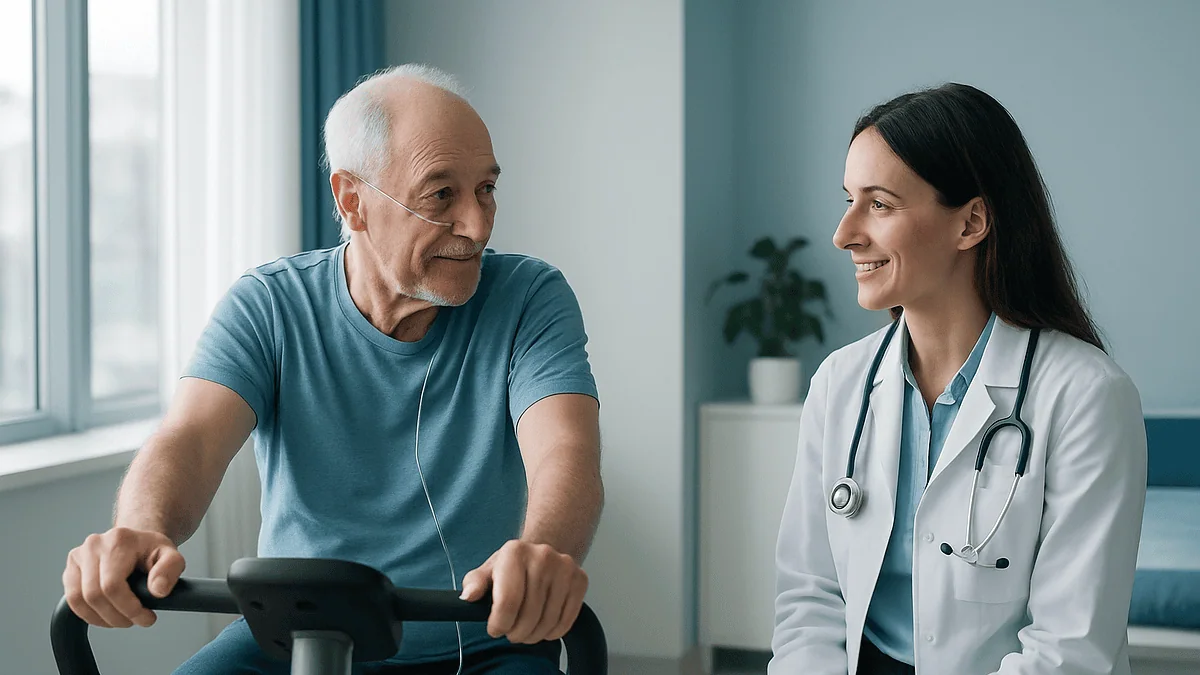
Pulmonary rehabilitation for COPD is a supervised program that combines individually prescribed exercise training, breathing techniques and education, usually delivered in small group sessions over several weeks. Good-quality trials show it typically improves breathlessness, walking distance and quality of life, although it does not repair lung damage or raise lung-function test numbers. Whether, when and in what format someone takes part is decided with the treating team.
The referral letter sits on the kitchen table for a week before anyone reads it twice. It says pulmonary rehabilitation, and the person it is addressed to has already decided what that means: a gym, a treadmill, and a room full of people who can breathe better than she can. She climbed eleven stairs this morning and stood at the top pretending to look for something so her son would not notice the pause.
That pause is exactly what pulmonary rehabilitation for COPD is designed to address. Not the damaged lung tissue, which no exercise program can rebuild, but the slow shrinking of a life that happens around it: the shorter walks, the errands handed to someone else, the bench that used to be halfway and is now the destination.
What follows is an honest account of what a program involves, what the trial evidence says it changes, what it cannot change, and how to tell the difference between an ordinary hard week and a reason to pick up the phone.
What is pulmonary rehabilitation for COPD, really?
Start with the condition. COPD, chronic obstructive pulmonary disease, is an umbrella term for lung damage, most often from smoking, that narrows the airways and traps stale air so that each breath delivers less than it should. The CDC counts nearly 16 million American adults with a diagnosis, and estimates many more are living with it unrecognized.
Pulmonary rehabilitation is not a drug, a device or a single technique. The National Heart, Lung, and Blood Institute describes it as a supervised program that combines exercise training, education about the disease, and support for the habits that shape daily life: breathing patterns, nutrition, activity pacing, and coping with the anxiety that so often travels with breathlessness. It is delivered by a team that usually includes respiratory therapists or physiotherapists, nurses, and often a dietitian or psychologist, working from a plan written for one person rather than a class.
Two confusions are worth clearing early. The word rehabilitation makes some people think of recovery from a stroke or from addiction; this is neither. It is closer to structured coaching for a body that has learned to avoid effort. And it is not the same as oxygen therapy, though people who use oxygen frequently take part.
Here is the opinion this article holds throughout, and it is grounded in the trial literature rather than enthusiasm: among all the things offered to someone with COPD, rehabilitation is the one most consistently shown to change how a day feels, and it is also the one most often declined, postponed or abandoned halfway. The gap between those two facts is where most of the avoidable loss in this condition sits.
Access almost always begins with a referral from the clinician who manages the COPD, which is why the letter on the kitchen table matters.
How does it work when the lungs themselves barely change?
Picture a cycle rather than a straight line. Breathlessness makes activity unpleasant, so activity is avoided. Muscles that are not used lose strength and, more importantly, efficiency: they demand more oxygen and produce more carbon dioxide for the same amount of work. That extra demand has to be met by lungs that were already struggling, so the next attempt at the same task feels harder still, and the loop tightens. Clinicians call this deconditioning, which simply means the body has adapted to doing less.
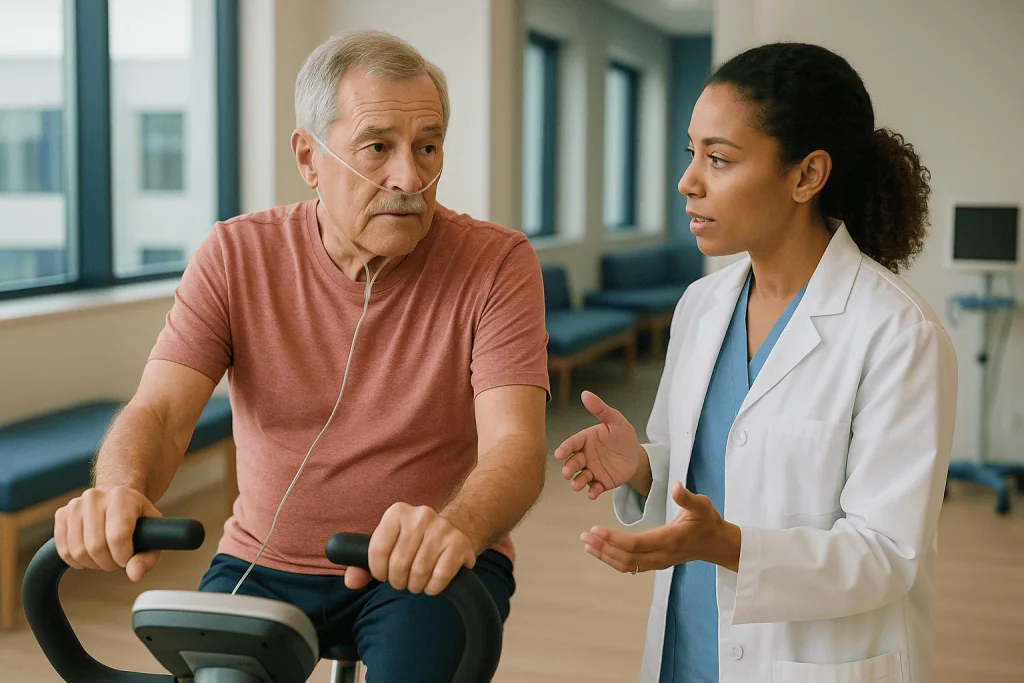
Rehabilitation attacks the loop from the muscle end. Trained leg and arm muscles extract oxygen more effectively and generate less waste gas, so the breathing system is asked to do less for a given task. The lungs have not improved; the load on them has fallen. A useful image is a car whose engine cannot be replaced, but whose tires are re-inflated, whose trunk is emptied and whose driver learns to shift gears earlier. Same engine, noticeably less strain.
The second mechanism is behavioral and is easy to underrate. Breathlessness is frightening, and fear itself speeds breathing and tightens chest muscles. Learning, under supervision and with an oxygen monitor on a fingertip, that a high level of breathlessness during exercise is uncomfortable but not dangerous changes what a person is willing to attempt at home. The Mayo Clinic and NHLBI both describe this growth in confidence and self-management as a core goal, not a pleasant side effect.
The third strand is skill: breathing techniques that reduce air trapping, pacing strategies that spread effort across a task, and recognizing early a flare-up that needs treatment before it needs a hospital. None of these adds lung tissue. Together they explain why trial participants walk farther and report less distress while their spirometry, the standard blowing test of lung function, stays roughly where it was.
Who is pulmonary rehabilitation usually for, and who is usually asked to wait?
The short answer, supported by NHS and NHLBI guidance, is broader than most people assume: anyone with COPD who is still limited by breathlessness despite their prescribed inhaled treatment is a potential candidate. Severity on paper is not the gatekeeper. People with moderate disease who have quietly stopped gardening benefit; so do people using oxygen around the clock. The measure that matters is functional, meaning whether symptoms are shrinking what a person can do.
Referral is especially common after a hospital admission for an exacerbation. An exacerbation, often called a flare-up, is a sustained worsening of cough, sputum or breathlessness beyond the usual day-to-day variation, and the weeks after one are a period of high risk and low fitness. Programs frequently accept people once they are medically stable again.
Who is asked to wait, or offered an adapted version? Assessment teams generally hold off when a heart problem is unstable, for example recent chest pain that has not been evaluated or a heart rhythm disturbance not yet controlled, because exercise testing would be unsafe until it is. A current exacerbation is another reason to pause; the person is enrolled once the acute episode has settled. Severe joint, back or balance problems do not exclude someone, but the exercise prescription is changed, sometimes to seated work. Cognitive impairment that prevents following safety instructions can limit participation in a group setting.
Current smokers are eligible. Programs typically weave in cessation support rather than making quitting a precondition, and the NHS is explicit that stopping smoking remains the single most effective step to slow the decline of lung function, which rehabilitation cannot do.
Every one of these judgments belongs to the assessing clinician, who sees the whole picture, including the other conditions that so often accompany COPD.
What exercises are done at pulmonary rehab?
Before anyone lifts anything, there is a baseline. The most common measure is the six-minute walk test: a person walks back and forth along a marked corridor for six minutes at their own pace, and the distance, heart rate, breathlessness rating and oxygen saturation are recorded. Oxygen saturation is the percentage of hemoglobin in the blood carrying oxygen, read from a small clip on the fingertip called a pulse oximeter. Breathlessness is usually scored on a simple numbered scale so that progress is not left to memory.
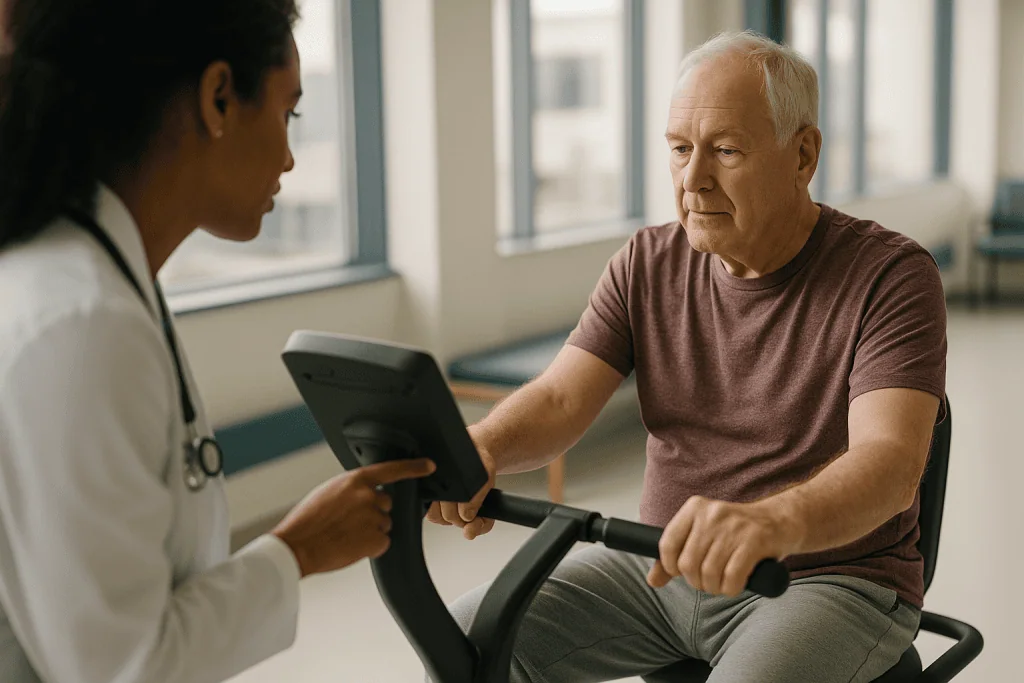
From those numbers the team writes a prescription. Pulmonary rehab exercises fall into a few recognizable groups.
- Endurance work forms the core: treadmill or corridor walking, stationary cycling, sometimes an arm cycle or rowing motion. Intensity is set to the individual and progressed week by week. Some programs use intervals, alternating harder and easier minutes, which allows people with severe breathlessness to accumulate more total work.
- Strength training targets the legs above all, because standing from a chair and climbing stairs are what people most often lose. Sit-to-stand repetitions, leg presses, step-ups and resistance bands are typical. Upper-limb work matters too: lifting the arms above the head fixes the chest muscles that help with breathing, which is why hanging washing or washing hair can feel disproportionately hard.
- Flexibility and balance round things out, since falls are more common in this group and stiff chest walls make breathing less efficient.
Throughout, staff watch the oximeter and the person. Feeling quite breathless during a session is expected and is not a sign something has gone wrong; falling oxygen readings, chest pain or dizziness are different, and are handled on the spot. Most programs also give a home plan for the days between sessions, because two supervised hours a week are a scaffold, not the whole building.
COPD breathing exercises and the classroom half of the program
Roughly half of each session in many programs is spent sitting down, and this is the half that newcomers tend to dismiss. That is a mistake, because it is where the techniques used at the top of the stairs are actually learned.
The best-known COPD breathing exercise is pursed-lip breathing: breathe in through the nose, then exhale slowly through lips shaped as if cooling soup, taking about twice as long to breathe out as in. The mechanism is mechanical rather than mystical. Narrowed airways in COPD tend to collapse during a fast exhale, trapping air; the gentle back-pressure from pursed lips holds them open a fraction longer, so more stale air leaves and the next breath has room. Diaphragmatic breathing, which encourages the belly rather than the shoulders to move, reduces the work done by the small, inefficient neck muscles. People also practice exhaling on the effortful part of a movement, sometimes called blow-as-you-go, and leaning forward with forearms on the thighs or a table, a position that lets the diaphragm work more easily.
For those who produce a lot of mucus, staff may teach airway clearance techniques, structured cycles of deep breaths and gentle huffs that move secretions toward the mouth with less coughing effort.
The education program covers what a person with COPD is expected to manage day to day: how to use their prescribed inhalers correctly, since poor technique is common and quietly undermines treatment; how to recognize the early signs of an exacerbation and what their written action plan says to do; how to eat when breathing makes meals tiring; how to pace tasks; how to sleep and travel with oxygen if they use it; and why the CDC recommends staying current with influenza and pneumococcal vaccination in this condition.
One honest caveat from the trial literature: education delivered alone, without the exercise, has much weaker evidence. The two halves are a package for a reason.
How long does a program last and how often do you go?
Length varies by health system, and the honest answer is a range rather than a number. The NHS describes a typical program as lasting about six weeks with two sessions a week. The Cochrane review discussed below only included programs of at least four weeks, reflecting a broad consensus that anything shorter is unlikely to retrain muscle meaningfully. The NHLBI, describing programs in the United States, says they may last several weeks or months, and many American programs run considerably longer than the British model, often with two or three visits a week.
Each visit is usually split between supervised exercise and an education session, with time built in for questions. Attendance is recorded, and for a practical reason: the benefit tracks closely with the number of sessions actually completed. The people who finish are the people who improve, which sounds obvious and is nonetheless the single most modifiable factor in the whole enterprise.
That makes the logistics clinical rather than trivial. Transport is the most common reason people drop out, followed by illness, competing caregiving duties and the plain discouragement of a bad week. Programs know this, and many can help with timing, transport options or a partly home-based format. Raising a barrier at the first assessment is far more useful than quietly stopping in week three.
Waiting lists exist in most systems. If a wait is long, the referring clinician can advise on what is safe to do in the meantime; general guidance from the NHS is that staying as active as symptoms allow is preferable to resting until the program starts.
What happens at the end is as structured as the beginning: the walk test and questionnaires are repeated, results are compared with baseline, and a maintenance plan is written. The program has a finish line; the exercise habit it is meant to build does not.
Does pulmonary rehabilitation for COPD work? What the evidence shows
Few treatments in respiratory medicine have been examined as thoroughly. The Cochrane review by McCarthy and colleagues pooled 65 randomized trials with 3,822 participants, comparing rehabilitation with usual care. Its conclusions, graded as moderate-quality evidence, are unusually consistent.
On breathlessness, participants improved by an average of 0.79 points on the dyspnea domain of a standard questionnaire, comfortably above the 0.5-point change that researchers regard as the smallest difference a person would actually notice. Fatigue, emotional wellbeing and the sense of control over the condition, which the questionnaire calls mastery, all improved beyond that same threshold. On a second widely used quality-of-life score, the improvement averaged about 6.9 points, again beyond the roughly 4-point change considered meaningful.
On function, the six-minute walk distance rose by an average of about 44 meters, close to half the length of a football field. That is an average; some people gain far more, some little.
The review’s authors went as far as to say that further trials comparing rehabilitation with no rehabilitation are no longer warranted, because the question is settled. Research effort has since shifted to which components matter most and how to deliver programs to more people.
Where the evidence is softer is on hospital admissions. Programs started soon after an exacerbation appeared, in earlier trials, to reduce readmissions, but later and larger studies showed smaller and less consistent effects, and the Mayo Clinic frames this benefit cautiously as possible rather than expected. Survival has not been convincingly shown to change. It is worth being clear about that, because rehabilitation does not need inflated claims. Walking farther, feeling less frightened and reclaiming ordinary tasks are the outcomes people came for, and those are the ones the trials most reliably deliver.
Can you improve lung function with COPD?
This question comes up in nearly every first assessment, and the answer has two parts that pull in different directions.
The first part is disappointing. Lung function in COPD is usually summarized by a spirometry value called FEV1, the volume of air a person can force out in the first second of a hard exhale. It reflects how narrowed the airways are and how much elastic recoil the lung has lost. Rehabilitation does not meaningfully change it. The air sacs that have been destroyed do not regrow, and the trials confirm that walking distance and quality of life improve while FEV1 stays essentially flat. Anyone who tells you exercise will rebuild your lungs is not describing the evidence.
The second part is more encouraging, and it is the part that gets lost. Almost everything that determines how a day with COPD feels is downstream of FEV1 rather than identical to it: muscle efficiency, breathing pattern, body weight, mood, fear of exertion, inhaler technique, how quickly a flare-up is recognized. Every one of those is trainable. People routinely finish a program with the same spirometry and a very different life.
What does alter the trajectory of lung function is stopping smoking. The NHS and Mayo Clinic both note that quitting slows the rate at which FEV1 declines, at any stage of the disease. Inhaled bronchodilators, a class of medicines that relax the muscle wrapped around the airways, can modestly improve measured airflow and reduce the frequency of flare-ups; how they are chosen, combined and reviewed is a matter for the prescribing clinician, and rehabilitation never replaces them.
Put together, the realistic message is this: you probably cannot make the number on the breathing test better, but you can make the number matter less.
What the first weeks usually feel like, and what happens after
The first session or two are mostly measurement and orientation: the walk test, questionnaires, a review of medicines and inhaler technique, a tour of the equipment, and a conversation about goals that should be concrete. Walking to a specific shop. Climbing the stairs without stopping. Holding a grandchild while standing. Vague goals cannot be measured, and the team will gently push for specific ones.
The early exercise sessions are commonly the hardest, not because the work is heavy but because it is unfamiliar. Muscle soreness in the thighs a day or two later is ordinary and tends to fade. Feeling markedly breathless on the bike while a therapist watches the oximeter and nods is a strange experience for someone who has spent years avoiding that sensation, and several people describe the emotional side of the first fortnight as tougher than the physical one.
Somewhere in the middle weeks, many participants notice a task at home that has quietly become easier: carrying shopping to the car, a flight of stairs with one pause instead of three. Loads are increased in small steps as this happens. Not everyone follows this arc; a cold, a bad-air week or a flare-up can flatten progress temporarily, and programs expect it.
In the final week the baseline tests are repeated. Comparing distances and scores side by side is often the moment the change becomes believable.
What follows matters as much as what preceded. The NHS advises continuing regular exercise after a program ends, and the pattern across studies is that gains erode when activity stops and persist when it continues. Some programs run maintenance classes; community exercise groups, home routines from the discharge plan, or supervised sessions at longer intervals are the usual options. The question to settle before the last session is not whether to continue but how.
Pulmonary rehabilitation at home versus a center-based program
Home-based and telehealth versions of rehabilitation exist, and the NHLBI notes that programs may be delivered in a hospital outpatient setting, a clinic or at home. The evidence base for center-based programs is far larger, since that is where most trials were run; home and video-supported formats have been studied more recently and appear promising in comparative trials, though the body of evidence is thinner. The table below sets the formats side by side without pretending one wins on every count.
| Feature | Center-based program | Home or telehealth program |
|---|---|---|
| Supervision during exercise | In person, continuous, oximeter monitored by staff | Remote, by phone or video; self-monitoring with guidance |
| Equipment | Treadmills, cycles, weights provided | Walking routes, stairs, bands, household items |
| Peer contact | Group setting; often cited as a major motivator | Limited, sometimes via group video calls |
| Travel burden | Two or more trips a week; the leading cause of drop-out | None |
| Initial assessment | Full in-person testing | Usually still requires at least one in-person assessment |
| Strength of trial evidence | Extensive, moderate-quality per Cochrane | Growing but smaller |
A distinction worth underlining: a home-based program is still a program. It begins with a clinical assessment, has a written prescription, includes scheduled contact with a professional, and is adjusted as the weeks pass. Downloading a set of exercises and doing them alone is not the same thing, and the safety screening at the start, particularly of the heart, is not a formality.
Which format suits a given person depends on the severity of their oxygen drop with exertion, their confidence, their home environment and what is available locally. That conversation belongs with the referring clinician and the program team.
Risks, setbacks and flare-ups during rehabilitation
Rehabilitation is regarded as safe in the guidance from the NHS, NHLBI and Mayo Clinic, with the qualifier that safety rests on the assessment done beforehand. Serious cardiac events during supervised exercise are rare, and the screening at intake exists precisely to identify the small number of people who need cardiac evaluation first.
The common problems are mundane. Muscle soreness for a day or two after early sessions. Feeling wiped out on the afternoon of a session, which tends to lessen as fitness builds. A transient fall in oxygen saturation during exercise, which staff watch for and manage, sometimes by adding or increasing supplemental oxygen during sessions for those who already use it. People with COPD have higher rates of osteoporosis, so resistance exercises are chosen and progressed with that in mind, and balance work is included because falls are more frequent in this group.
Flare-ups are the setback people fear most, and they are common enough that most programs have a standard response: pause the exercise component, treat the exacerbation according to the person’s action plan and their clinician’s advice, and resume once stable, often at a slightly reduced level. Missing sessions for this reason is not failure; abandoning the program because of it is the loss to avoid.
Drop-out is the real risk, and it is worth naming plainly. Across programs, a substantial minority of those who start do not finish, for reasons that are rarely medical: transport, weather, caregiving, discouragement, a sense of being the sickest person in the room. Every one of those is a conversation the team would rather have than a silent empty chair.
Alternatives, in neutral terms, are continuing usual care with inhaled treatment and general activity advice, or supervised community exercise without the education and clinical monitoring. Both leave more of the deconditioning cycle intact, which is what the trial comparisons show.
What people often get wrong about pulmonary rehab
Some misunderstandings keep people away from a referral, and others sabotage them once they arrive. The corrections below are drawn from the same guidance and trials cited throughout.
It is only for people with severe disease. Eligibility rests on symptoms limiting activity, not on how bad the spirometry looks. Waiting until the disease is advanced means waiting until there is less muscle left to train.
I am too breathless to exercise. This is the reasoning that closes the deconditioning loop. Programs are designed for people who are breathless; intensity starts where the person is, and interval formats and seated work exist for exactly this situation.
It is just walking on a treadmill, and I can do that at the mall. Walking is good, and the NHS encourages it. But the assessment, the individualized intensity, the strength component, the breathing techniques, the inhaler review and the education are what distinguished rehabilitation from usual care in the trials.
It will repair my lungs. It will not, and no reputable program claims otherwise. It changes what the lungs are asked to do.
People on oxygen cannot take part. They can and frequently do, with oxygen used during sessions.
Once I finish, I am done. The benefits are maintained by continued activity and fade without it. The end of the program is a handover, not a discharge from effort.
It means I can cut back on my inhalers. Rehabilitation sits alongside prescribed medicine, never in place of it. Any change to inhaled treatment is a decision for the prescribing clinician after review, not something to infer from feeling better on the bike.
Everyone gets the same result. The averages in the trials are averages. Some people gain a great deal, others less, and the reasons are not fully understood. What is consistent is that those who complete the program do better than those who do not start.
Questions to ask your care team before and during a program
A good program will welcome questions, and asking them early often uncovers problems that would otherwise surface as a missed session. The list below is not a script; take the ones that apply.
- Based on my assessment, is there anything about my heart, joints or oxygen levels that changes what I should do, and how will you monitor it?
- What do you want me to be able to do by the end that I cannot do now, and how will we measure it?
- How breathless should I expect to feel during exercise, and what sensations mean I should stop and tell someone?
- Should I use my reliever inhaler before sessions, and at what point during a session would you want me to use it? (The answer belongs to the prescriber and the program, not to a general article.)
- If I use oxygen, will the flow be adjusted during exercise, and who decides?
- What exactly should I do on the days between sessions, and how will I know if I am doing too much or too little?
- What happens to my place in the program if I have a flare-up or miss sessions for another reason?
- Can you review my inhaler technique with me, and is there a written action plan for a flare-up in my file?
- Is a home-based or partly remote version available, and would it be suitable for someone with my level of oxygen drop on exertion?
- What maintenance options exist locally after the program ends, and can you help me arrange one before the last session?
- Who do I contact between sessions if something worries me, and which symptoms mean I should not wait for the next appointment?
Bring a family member or friend to the first assessment if you can. The education content is easier to apply at home when someone else in the household has heard it, and people who exercise alongside a companion tend to keep going.
When to call your doctor
Ordinary rehabilitation days involve feeling breathless, tired and sometimes sore. The signs below are different in kind, and they are drawn from NHS and MedlinePlus guidance on COPD flare-ups and on symptoms that need urgent assessment.
Call emergency services or go to the nearest emergency department if you have severe breathlessness that does not ease with rest and your usual reliever inhaler, chest pain or pressure, lips or fingertips turning blue or gray, new confusion or drowsiness, or fainting. During a session, tell staff immediately; that is what they are there for.
Contact your doctor or COPD team the same day if breathlessness is clearly worse than your normal for more than a day or two, if you are coughing up more sputum than usual or it has changed color, if you have a fever, if you are coughing up blood, if your ankles are newly swollen, if you cannot sleep because of breathing, or if your home oxygen readings fall below the personal threshold your team set for you. Your written action plan may already tell you what to do; if it does, follow it and then make the call.
Mention at your next contact new dizziness during exercise, palpitations, unexplained weight loss, low mood that is affecting your ability to take part, or any doubt about whether an inhaler is working. None of these should be managed by adjusting your own medicines.
Two principles sit underneath all of this. First, waiting to see if a flare-up settles on its own is the pattern most associated with hospital admission, and early treatment is a core part of what the education sessions teach. Second, every decision about what to change, whether that is an inhaler, an oxygen setting or your place in the program, rests with the team treating you, who know your history and can examine you. This article can explain; it cannot assess.
Frequently asked questions
What is pulmonary rehabilitation for COPD?
It is a supervised program combining individually prescribed exercise training, breathing techniques and education about living with COPD, delivered by a team that usually includes respiratory therapists or physiotherapists and nurses. It is not a medicine or a device. Programs run for several weeks in a clinic, at home or by telehealth, and aim to reduce breathlessness, increase what a person can do and build confidence in managing the condition. A clinician’s referral is normally required.
What exercises are done at pulmonary rehab?
Endurance work such as treadmill or corridor walking and stationary cycling forms the core, alongside strength training focused on the legs, including sit-to-stand and step-up exercises, plus arm work with light weights or bands. Flexibility and balance exercises are usually added. Intensity is set from a baseline walk test and adjusted week by week while staff monitor oxygen saturation and symptoms. Most programs also prescribe a home routine for the days between sessions.
Does pulmonary rehab work for COPD?
Yes, for breathlessness, exercise capacity and quality of life, according to a Cochrane review of 65 randomized trials that graded the evidence as moderate quality and concluded further trials against usual care are unnecessary. Effects on hospital admissions are less consistent, and survival has not been convincingly shown to change. Results vary between individuals, and benefit depends heavily on completing the program and continuing to exercise afterward.
Can you improve lung function with COPD through exercise?
Not meaningfully. The standard measure, FEV1, reflects airway narrowing and lost elasticity, and rehabilitation trials show it stays essentially flat while walking distance and wellbeing improve. Destroyed air sacs do not regrow. What exercise changes is the efficiency of the muscles and the breathing pattern, so the lungs are asked to do less for the same task. Stopping smoking is the intervention shown to slow the decline in lung function.
Which COPD breathing exercises are taught in a program?
Pursed-lip breathing is the most common: a slow exhale through nearly closed lips, roughly twice as long as the inhale, which helps keep narrowed airways open and releases trapped air. Diaphragmatic breathing encourages the belly rather than the shoulders to move. People also learn to exhale during the effortful part of a movement and to use forward-leaning positions of ease. Those with a lot of mucus may be taught structured airway clearance techniques.
How long does a pulmonary rehabilitation program last?
The NHS describes a typical program as about six weeks with two sessions a week, while the National Heart, Lung, and Blood Institute says programs may last several weeks or months, and many US programs run longer with two or three visits weekly. Trials in the Cochrane review lasted at least four weeks. Each visit usually splits time between supervised exercise and education, and a home exercise plan covers the other days.
Can pulmonary rehabilitation at home replace going to a center?
Home-based and telehealth programs exist and appear promising in comparative studies, though the evidence base is smaller than for center-based programs. A genuine home program still starts with a clinical assessment, has a written prescription and includes scheduled professional contact. Whether it suits a particular person depends on how far their oxygen drops with exertion, their confidence and their home setup, and is decided with the referring clinician and program team.
Is pulmonary rehab safe if I use oxygen or still smoke?
People who use oxygen take part regularly, with oxygen used and sometimes adjusted during sessions by staff. Current smokers are generally eligible, and programs typically include cessation support rather than requiring quitting first. Safety rests on the initial assessment, which screens particularly for unstable heart conditions; anyone with unevaluated chest pain or an uncontrolled heart rhythm is usually asked to have that checked before starting.
What happens if I have a flare-up during the program?
Most programs pause the exercise component, ask you to follow your written action plan and your clinician’s advice for treating the exacerbation, then resume once you are stable, often at a slightly lower level for a session or two. Missing sessions for illness is expected and does not usually cost you your place, but it is important to tell the team rather than simply stop attending.
Do the benefits of pulmonary rehab last after the program ends?
They last as long as regular exercise continues and tend to fade when it stops, which is why programs finish with a maintenance plan. Options include maintenance classes run by the program, community exercise groups, a home routine from the discharge plan, or less frequent supervised sessions. The NHS advises continuing to exercise regularly after completion, and agreeing on how to do that before the final session is the practical step most worth taking.
References
- MedlinePlus: Pulmonary Rehabilitation
- NHS: Chronic obstructive pulmonary disease (COPD) – Treatment
- NIH National Heart, Lung, and Blood Institute: Pulmonary Rehabilitation
- CDC: Chronic Obstructive Pulmonary Disease (COPD)
This article is for general information only and is not a substitute for professional medical advice. Please consult a qualified doctor about your individual situation.

More from the Blog

Lung Abscess on a CT Scan: What the Images Show and How Sputum Cultures Guide Antibiotics
On a CT scan, a lung abscess usually appears as a rounded, thick-walled cavity inside the lung, often with an air-fluid level where pus…
After Pleural Effusion Drainage: Normal Soreness vs the Breathing Changes That Need Urgent Care
After thoracentesis, most people notice easier breathing within hours, along with a dull ache or pinching at the needle site that fades over one…

Pulmonary Edema: How the Heart, Lung or Kidney Cause Dictates the Treatment Plan
Pulmonary edema is fluid leaking into the lungs' air sacs. The most common cause is a heart that cannot pump or relax properly, which…
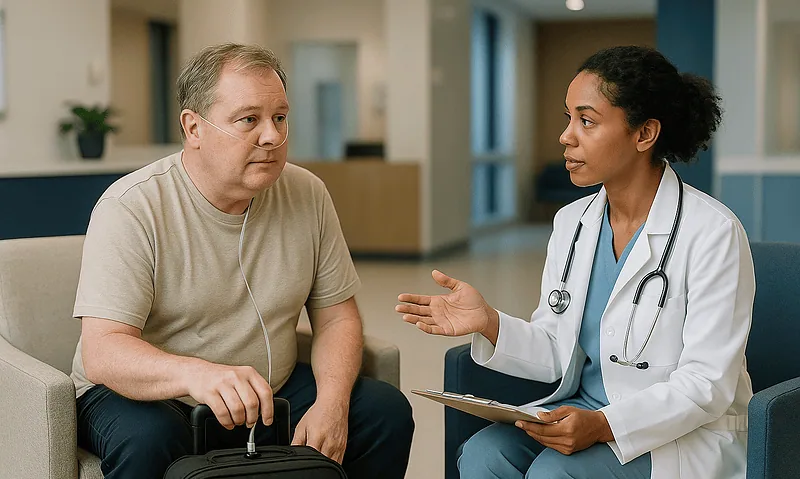
Traveling With Cystic Fibrosis: Flights, Therapy Equipment and Planning Care Away From Home
Most people with cystic fibrosis can travel, including by air, when their lung disease is stable and the trip is planned with their CF…

Which Tests Guide Cystic Fibrosis Care? Sweat Test, Genetic Testing and Sputum Cultures
Cystic fibrosis care relies on three kinds of tests. The sweat chloride test measures how much salt is in sweat and remains the main…

Who Benefits Most From a Structured Smoking Cessation Program? What Doctors Consider
A structured smoking cessation program tends to help most when nicotine dependence is strong, earlier quit attempts have not lasted, or a health condition…