

Reconstructive Surgery Abroad: Stay Length, Follow-Up and Flying Home Safely

Key Takeaways
- Travel-health guidance from the CDC advises deferring flights for roughly ten days after chest or abdominal surgery, partly because trapped air expands by about a third at cabin altitude.
- NHS guidance reports typical waits of about seven to ten days before flying after facial procedures, abdominoplasty or body lifts, and reconstructive flap cases usually need longer, set by the surgeon.
- Free-flap reconstruction is monitored most closely in the first 72 hours, when a clot in the reconnected vessels is most likely, so that window should pass under direct surgical observation.
- Recent surgery and long-haul travel are each recognized risk factors for deep vein thrombosis, and combining them within days multiplies the hazard rather than adding to it.
- Three events, not a calendar date, usually mark readiness to travel: drains removed, facial sutures removed or assigned to someone at home, and one post-dressing wound check by the surgeon.
- The CDC advises carrying the operative report, anesthesia record, implant details and medication list home, because a clinician who did not perform the surgery cannot manage complications without them.
After reconstructive surgery abroad, travel-health guidance advises staying near the operating team until wounds have been checked and any drains removed: often about a week for smaller facial procedures and around ten days or longer after chest, abdominal or flap operations. Flying soon after surgery raises blood-clot risk, so the surgeon sets the travel date, and follow-up at home should be arranged before departure.
The suitcase is open on the hotel bed, half packed, and the return ticket says Thursday. The dressing under the collar is dry, the swelling has started to settle, and the surgeon has said the words everyone wants to hear: healing well. Yet the question that keeps surfacing is not about the scar. It is about the seven hours of pressurized cabin between here and home, and about who will look at the wound next week.
People who choose reconstructive surgery abroad, whether to rebuild a jaw after a tumor, repair facial trauma or revise an old scar, tend to plan the operation carefully and the journey home loosely. That is backwards. The surgery lasts hours; the recovery lasts weeks, and most of it happens far from the operating team.
This explainer sets out what mainstream travel-health and surgical guidance actually says about stay length, clot risk in the air and follow-up, so the trip home is planned with the same seriousness as the operation.
What counts as reconstructive surgery abroad, and why it differs from cosmetic tourism
Reconstructive surgery is surgery that restores form or function to a part of the body changed by illness, injury, infection or earlier treatment. In the facial region that can mean rebuilding an eyelid after skin-cancer removal, repairing a fractured cheekbone, closing a cleft, replacing tissue lost to burns, or revising a scar that pulls on the mouth. The purpose is function first and appearance second, although the two are rarely separable on the face.
That purpose matters when the operation happens in another country. Cosmetic tourism marketing tends to describe a single event: fly in, operate, fly out. Reconstruction rarely fits that shape. Many procedures are staged, meaning they are deliberately planned as two or more operations months apart so that tissue can settle before the next step. A skin graft may need a secondary release; a tissue flap, which is a block of living tissue moved with its own blood supply, may need thinning once it has healed.
The CDC’s travel-health guidance on medical tourism makes a point that applies with particular force here: complications after surgery can appear days or weeks later, and care received abroad may be hard for a home physician to continue if records, imaging and the surgeon’s operative notes are not available. For a reconstructive patient, that continuity is not a courtesy. It is the treatment.
None of this means reconstruction cannot be done safely away from home. It means the decision to seek reconstructive surgery abroad is really three decisions: where to operate, how long to remain nearby while the riskiest healing window passes, and who will take clinical responsibility after landing. The sections that follow take those in turn, starting with what the body is actually doing while the patient waits for the all-clear to fly.
How reconstructive surgery actually works: grafts, flaps and the healing clock
Nearly every reconstructive operation relies on one of three strategies, and each runs on a different timetable.
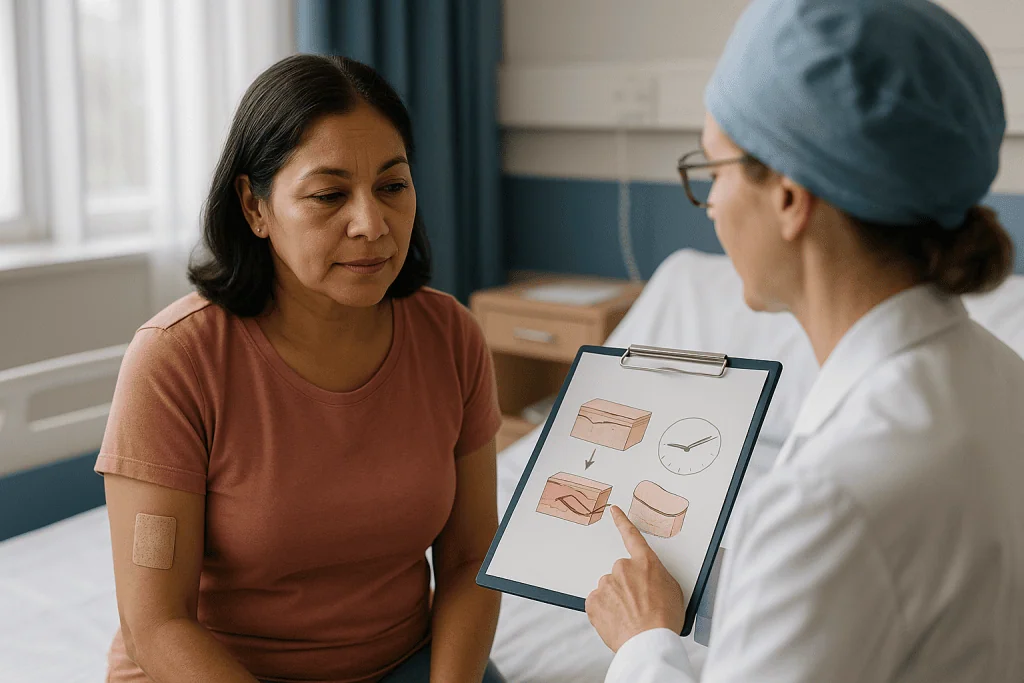
The first is direct closure: edges of healthy tissue are brought together and held with sutures while the body knits them. The second is a graft, which is tissue removed completely from one site, such as skin from behind the ear, and placed onto a prepared bed where it must grow a new blood supply from below. For the first few days a graft is essentially alive on credit; it survives by soaking up fluid until tiny vessels bridge into it. The third is a flap, where tissue is moved with its blood vessels still attached, or reconnected under a microscope in what is called free-tissue transfer. A flap arrives with its own circulation, which is why surgeons watch flap color, warmth and capillary refill so closely in the first 48 to 72 hours.
Underneath all three, wound healing moves through overlapping phases. Inflammation dominates the first few days: swelling, warmth and bruising are expected. Proliferation follows, when new collagen and vessels fill the wound. Remodeling then continues for months, which is why scars look their worst at around six weeks and improve for a year or more. MedlinePlus patient guidance on surgical wounds reflects this: stitches on the face are commonly removed within the first week or two, while deeper tissue strength builds for far longer.
The practical consequence for anyone considering reconstructive surgery abroad is that the moment of highest medical risk is not the operation itself. It is the stretch of days when a graft has not yet taken, a flap could still clot, a hematoma (a collection of blood under the skin) could still form, and an infection has had time to declare itself. Travel plans should be built around that window, not around the length of the procedure.
Who is usually suitable, and who is usually asked to wait
Suitability is a clinical judgment made by the operating team, and no article can substitute for it. Guideline-level principles are consistent, though, about who tends to do well and who is usually asked to pause.
Patients who commonly proceed are medically stable, have a clear diagnosis and imaging, do not smoke or have stopped well in advance, and have realistic expectations of a staged process. Smoking deserves a plain sentence: nicotine narrows small blood vessels, and grafts and flaps depend on exactly those vessels, so tobacco use is one of the most frequent reasons a surgeon postpones reconstruction. Blood sugar control in diabetes matters for the same reason, because poorly controlled glucose impairs wound healing and raises infection risk.
Patients who are usually asked to wait include those with an active infection, those whose cancer treatment such as radiotherapy is ongoing or recent enough that tissue has not recovered, those with uncontrolled blood pressure, and those with a recent clot or a known clotting disorder. Anyone taking medicines that affect bleeding, including anticoagulants or antiplatelet drugs, needs a plan from the prescribing clinician; the surgical team will advise, and no one should stop or adjust a prescribed medicine on their own.
There is a travel-specific layer as well. The NHS guidance on cosmetic surgery abroad notes that long-haul flights shortly after an operation increase clot risk, and a person who already carries risk factors, such as a previous deep vein thrombosis, obesity, hormone-based medicines or a family history of clots, is asked to discuss this before booking anything. For reconstruction, the team also weighs whether staged follow-up is realistically achievable from the patient’s home country.
The honest summary is that the ideal candidate for reconstructive surgery abroad is someone whose surgical need is clear, whose medical risks are controlled, and who can stay long enough and return often enough for the plan to be completed.
How long should you stay after reconstructive surgery abroad?
There is no single number, and anyone offering one without knowing the operation is guessing. What travel-health sources provide are typical ranges, and they are longer than most itineraries assume.

The CDC Yellow Book chapter on medical tourism advises that air travel be deferred after chest or abdominal surgery, with roughly ten days commonly cited, both because of clot risk and because cabin pressure changes can affect trapped air in body cavities. The NHS cosmetic surgery abroad page reports provider-level ranges of about five to seven days after breast surgery or liposuction and about seven to ten days after facial procedures, abdominoplasty or body lifts. Those figures describe cosmetic cases; reconstructive flap surgery and anything involving the airway or jaw usually requires longer, decided case by case.
| Type of reconstruction | What the team is watching for | Typical minimum stay reported in travel-health guidance |
|---|---|---|
| Small facial skin repair or graft | Graft take, infection, early scar check | About 7–10 days (NHS) |
| Jaw, cheek or orbital reconstruction | Airway swelling, hematoma, fixation stability | Often 10 days or more; surgeon decides (CDC) |
| Free-flap reconstruction | Flap circulation in first 72 hours, then donor-site healing | Longer than cosmetic ranges; individualized |
| Abdominal or chest wall reconstruction | Clot risk, drain output, wound tension | Around 10 days before flying (CDC) |
Three practical markers tend to matter more than a date on a calendar. Drains, which are thin tubes that remove fluid from under a wound, should be out. Sutures that need removal on the face should have been removed or a clear plan made for who removes them. And the surgeon should have examined the wound once after the initial dressing change, because that is when early infection or graft failure usually shows itself.
Build the trip around those three events, then add a buffer. A delayed flight costs an extra night; a flight taken two days too early can cost far more.
Flying after reconstructive surgery: what altitude does to a healing body
A commercial cabin is pressurized to roughly the equivalent of 6,000 to 8,000 feet, not to sea level. Two things follow from that, and both matter after an operation.
The first is oxygen. The partial pressure of oxygen falls at cabin altitude, and blood oxygen levels drop modestly in healthy passengers. Most people never notice. A patient with a fresh flap, where tissue is living on a freshly connected blood supply, has less margin, and anyone with lung disease or recent anesthesia-related breathing changes has less still. This is one reason surgeons prefer that the first days of flap healing happen on the ground.
The second is trapped gas. Gas expands as pressure falls, by roughly a third at cabin altitude. Air left inside a body cavity after surgery, whether in the sinuses after orbital or nasal reconstruction, in the chest after chest wall work, or in the abdomen after a laparoscopic step, will expand with it. The CDC Yellow Book’s guidance that flying should be delayed after chest or abdominal surgery rests partly on this mechanism. Facial reconstruction involving the sinuses or middle ear carries a similar caution, because pressure changes on descent can stress healing bone and soft tissue and cause pain or bleeding.
Then there is the simple matter of hours spent still. Cabin humidity is low, fluid intake is often poor, and a window seat invites immobility. Each of those pushes in the direction of clotting, which deserves its own section.
None of this makes flying after reconstructive surgery dangerous in itself once the team has cleared it. It explains why the clearance exists, and why a surgeon’s instruction to wait is not caution for its own sake. The physics of the cabin are predictable; the state of a wound on day four is not.
Blood clots: the risk that surgery and long flights have in common
A deep vein thrombosis (DVT) is a clot that forms in a deep vein, usually in the leg. The danger is that a piece breaks away and lodges in the lung, called a pulmonary embolism, which can be life-threatening. Surgery and long-haul travel are each recognized risk factors; stacking them within days of one another is precisely the situation travel-health guidance warns against.
The mechanism is old and reliable. Clots form when blood flow slows, when the vessel wall is injured, and when blood is more prone to clotting. Surgery supplies all three: tissue injury triggers clotting pathways, anesthesia and pain reduce movement, and dehydration thickens the blood. A long flight then adds hours of calf muscles that are not pumping blood back toward the heart.
The NHS and Mayo Clinic both list recent surgery, immobility and long journeys among the leading risk factors for DVT, alongside older age, obesity, pregnancy, hormone-containing medicines, cancer and a prior clot. A person with two or three of those should expect the surgical team to take a conservative view of travel dates.
Prevention basics are not complicated, and they sit entirely within a patient’s control once the surgeon has set the date. Walking the aisle every hour or so, flexing the ankles and calves while seated, drinking water rather than alcohol, and avoiding sleeping tablets that deepen immobility all reduce venous stasis. Graduated compression stockings are often suggested for passengers at higher risk; whether they are appropriate after a particular operation, and whether any clot-preventing medicine is warranted around the flight, is a decision for the surgical and prescribing team, not something to arrange independently.
Symptoms of a clot can appear during the flight or days afterward: a swollen, painful or warm calf, or sudden breathlessness and chest pain. Those belong in the red-flag section later in this article, and they warrant urgent care wherever the patient happens to be.
How soon can I fly after a tummy tuck or other body-contouring reconstruction?
This is one of the most searched questions in the whole field, and it is worth answering carefully because abdominoplasty, often called a tummy tuck, sits on the boundary between cosmetic and reconstructive surgery. After massive weight loss, after multiple pregnancies with separated abdominal muscles, or after trauma, the same operation is reconstructive in purpose.
The physiology makes it one of the operations most deserving of patience. The incision is long, the skin flap is wide and relies on blood supply from its edges, drains are common, and the patient spends the first days slightly bent at the hips to reduce tension on the wound. Each of those features raises clot risk: reduced mobility, a large tissue injury and often a longer anesthetic.
The NHS cosmetic surgery abroad page reports a commonly cited range of seven to ten days before flying after abdominoplasty or body lifts, and the CDC Yellow Book’s advice on waiting around ten days after abdominal surgery points the same way. Where muscle repair was performed or where the procedure was combined with hernia repair, surgeons frequently ask for longer, and the decision rests with them.
Before any flight, most teams want drains removed, no sign of fluid collection under the skin, the patient walking comfortably and able to stand reasonably upright, and a plan for who checks the wound within the first week at home. On the aircraft itself, the same clot-prevention habits apply, with one addition: a compression garment prescribed by the team is usually worn as instructed, and seatbelt placement should be discussed, since a lap belt sits directly over a fresh abdominal incision.
The frequent mistake is to treat the quoted ranges as a target rather than a floor. Ten days is the point at which many surgeons begin to consider flying reasonable, not a guarantee that it is.
Reconstructive surgery recovery time: what the first days and weeks usually look like
Recovery after facial reconstruction is less a straight line than a series of plateaus, and knowing the shape of it makes the waiting easier to tolerate.
Days one to three are the swelling days. Bruising spreads, the face feels tight, and a flap or graft is under its closest observation. Pain is usually managed with whatever the surgical team has prescribed; the plan belongs to them, and the only rule for the patient is to report pain that escalates rather than eases. Fluid output from drains is measured, and fever is taken seriously.
Days four to seven bring the first dressing change and, in many cases, the first honest look at the wound. This is the window in which early infection, a hematoma or a graft that has not taken typically reveals itself. MedlinePlus surgical wound guidance describes the signs clinicians look for: increasing redness spreading beyond the edges, warmth, cloudy discharge, a wound that opens, or fever. If the wound passes this check, the surgeon may begin discussing a date for travel.
Week two is when facial sutures are commonly removed and swelling noticeably declines. Energy returns unevenly. Many people feel well enough to underestimate how much healing remains.
Weeks three to six are the remodeling phase. Scars often redden and firm up before they soften; this is normal collagen behavior rather than a problem. Sun protection on a fresh scar matters for months, because ultraviolet light darkens immature scar tissue.
Beyond six weeks, most reconstructive patients are into the long tail: scar maturation that continues for a year, and in staged reconstruction, planning for the next operation. The CDC’s medical tourism guidance notes that complications can surface well after a patient has returned home, which is why the follow-up arrangement in the next section is not optional paperwork but part of the recovery itself.
Follow-up after surgery abroad: who examines the wound at week three?
Here is the gap that catches people. The operating surgeon is hundreds or thousands of miles away, the home physician did not perform the surgery and may never have seen the operative plan, and the wound is at the stage where small problems become large ones if ignored.
The CDC advises patients to arrange follow-up care before leaving home and to carry copies of all medical records, including the operative report, anesthesia record, implant or fixation details, medication list and discharge instructions, ideally in the home language. That advice reads as administrative until the moment a hometown clinician is trying to decide whether a swollen cheek is normal post-flap edema or a developing infection without any note of what was done.
A practical follow-up plan has four parts. First, a named clinician at home who has agreed in advance to see the patient within the first week after landing; a primary-care physician or, ideally, a local plastic or reconstructive surgeon. Second, a direct channel to the operating team for questions and photographs, with clarity on who responds and how quickly. Third, scheduled checkpoints: a wound review, a scar review at roughly six weeks, and, in staged reconstruction, a planning visit for the next phase. Fourth, a written statement of what counts as an emergency and where to go locally if one occurs.
The NHS guidance on surgery abroad is candid that aftercare and the management of complications are often the weakest part of overseas arrangements, and that the home health system may not be able to provide corrective surgery on the same terms as the original operation. That is not a judgment about any country; it is a description of how care is organized, and it belongs in the decision.
If a follow-up plan cannot be arranged in writing before the first flight out, the trip is not yet ready to take.
Is there a best country for plastic surgery? What the evidence can and cannot say
Lists ranking countries for plastic surgery are easy to find and easy to misread. They are usually built from procedure volumes, price, or survey responses, none of which measures the thing a patient actually wants to know: whether this surgeon, in this facility, with this follow-up arrangement, is likely to produce a safe result for this operation.
Public-health bodies do not rank countries, and for good reason. Surgical outcomes vary far more between facilities and surgeons than between national borders. The CDC’s travel-health guidance instead directs patients toward questions that can be answered: whether the surgeon is credentialed in the relevant specialty, whether the facility is accredited by a recognized body, whether infection-control standards are documented, what the complication rate is for the specific procedure and how complications are managed, and what happens if a patient needs readmission after the planned departure date.
Language deserves a separate line. Consent, discharge instructions and red-flag advice all depend on understanding and being understood. The CDC notes that communication barriers are a real source of harm in medical travel, and a professional interpreter is a reasonable expectation rather than a luxury.
Infection risk is another place where national generalizations mislead. Resistant organisms have been documented in outbreaks tied to specific facilities in many parts of the world, and the CDC’s medical tourism guidance records clusters of surgical-site infections after procedures abroad. The variable was the facility’s practice, not the flag on the building.
So the honest answer to the search query is that there is no evidence-based best country. There are better and worse arrangements, and the quality of a reconstructive arrangement is judged by the surgeon’s training for that operation, the facility’s standards, the realism of the stay, and the strength of the follow-up plan. Those can be excellent or poor anywhere.
What are the riskiest operations, and what actually drives surgical risk?
Another popular search asks for the three riskiest surgeries. The question assumes risk lives in the name of the operation. In reality it lives in the combination of the operation, the patient and the setting, which is why a straightforward procedure in a frail patient can be more dangerous than a complex one in a well-prepared patient.
Within reconstruction, certain features reliably raise the stakes. Longer anesthesia time increases clot and pulmonary risk. Operations near the airway, such as jaw and neck reconstruction, carry the possibility of swelling that compromises breathing in the first days. Free-flap surgery depends on microvascular connections that can clot, most often within the first 72 hours, which is why these patients are monitored in hospital rather than a hotel. Large body-surface procedures, including abdominoplasty and body lifts, combine wide tissue injury with reduced mobility.
Patient factors add to that. Smoking, poorly controlled diabetes, obesity, prior clots, bleeding disorders and recent radiotherapy to the operative field each worsen healing or raise complication risk. The surgical team will weigh them, and may ask for optimization, meaning a period of improving a modifiable factor, before proceeding.
Setting completes the picture, and it is where travel enters. Immediate access to the operating team in the days after surgery, the availability of intensive care, reliable sterile practice and a clear route for readmission all change the risk of the same operation. Combining a major procedure with a long flight a few days later, or with a schedule that leaves no room for delay, moves the risk in one direction only.
Rather than asking which three operations are riskiest, a more useful question for the consultation is: for this operation, in my body, with this travel plan, what are the specific risks, how often do they happen in your practice, and what is the plan when they do?
What people often get wrong about reconstructive surgery abroad
Correcting a handful of persistent myths removes most of the avoidable danger.
The first myth is that feeling well means being ready to fly. Clot risk, trapped gas and early infection do not announce themselves through energy levels. Patients commonly feel fine on day four and fine on the aircraft, with problems emerging after landing. The surgeon’s clearance, not comfort, sets the date.
The second is that the stay quoted by a package is a medical recommendation. A stay length built around a hotel booking is a commercial decision. Travel-health guidance from the CDC and NHS describes typical minimum ranges for a reason, and reconstructive cases often need longer than cosmetic ones.
The third is that a home physician can simply take over. Without the operative notes, imaging and the surgeon’s plan, a clinician who did not perform the surgery is working blind. Records travel with the patient, or follow-up does not really exist.
The fourth is that a scar looking angry at six weeks means something went wrong. Scars redden, thicken and itch during remodeling before they soften over a year. Change over time is expected; spreading redness with warmth, discharge or fever is not, and the difference is a clinical call.
The fifth is that staged reconstruction can be compressed to fit a single trip. Grafts and flaps need months to settle before revision. Rushing a second stage onto unhealed tissue risks losing what the first stage achieved.
The sixth is that a lower-risk operation needs no travel plan at all. Even a small facial skin graft has a window in which it can fail, and a flight home during that window removes the one person who can recognize it early.
Each of these has the same correction: plan the recovery, not just the operation, and let the treating team own the timetable.
Questions to ask your care team before you book anything
The quality of a consultation shows in how comfortably the team answers direct questions. These are the ones that matter most for anyone weighing reconstructive surgery away from home.
- Is this operation reconstructive or cosmetic in your assessment, and is it staged? If staged, how many trips does the full plan realistically require, and how far apart?
- What are your qualifications in reconstructive surgery specifically, and how often do you perform this exact procedure?
- What complications do you see with this operation, how often, and what is your protocol if one happens after my planned departure?
- What is the earliest date you would consider clearing me to fly, and what would delay it?
- Will drains and sutures be removed before I leave, or who removes them at home?
- What is my personal blood-clot risk for this operation combined with my flight length, and what prevention do you recommend during travel?
- Which of my current medicines need to change before or after surgery, and who manages that?
- What records will I take home, in which language, and how do I contact you with photographs or questions after I leave?
- Do I need to avoid flying for sinus, ear or airway reasons after this particular facial procedure?
- Is there any aspect of my health, including smoking, diabetes, weight or previous clots, that you would want improved before operating?
Two further points deserve asking without embarrassment. First, whether the facility is accredited and by whom, since the CDC advises checking accreditation and infection-control standards for any overseas care. Second, what happens to the plan if the patient is simply not ready on the departure date: whether extended care is available, and whether the team will communicate directly with a home clinician.
A team that welcomes these questions is already telling the patient something reassuring. One that deflects them is also telling the patient something.
When to call your doctor: red-flag signs after reconstructive surgery
Some symptoms after reconstruction are expected: swelling that peaks in the first days, bruising that migrates downward with gravity, tightness, mild warmth along an incision, and tiredness that lasts longer than seems fair. The signs below are different. They warrant contacting the surgical team or, where the patient has already traveled, seeking urgent local care without waiting for a scheduled follow-up.
Seek emergency care immediately for sudden breathlessness, chest pain, coughing up blood, or collapse; these can indicate a pulmonary embolism, which Mayo Clinic and the NHS both describe as a medical emergency. The same applies to difficulty breathing or swallowing after jaw, neck or airway reconstruction, to rapidly increasing swelling of the face or neck, and to heavy bleeding that soaks through dressings.
Call the surgical team or a local clinician the same day for a calf that becomes swollen, painful, warm or discolored on one side, which may indicate a deep vein thrombosis. Do the same for a fever, for redness spreading beyond the wound edges, for cloudy or foul-smelling discharge, for a wound that opens, or for pain that escalates rather than settles. A flap that changes color, turning pale, dusky or congested, or that becomes cold, is a surgical emergency in its own right because the window to restore circulation is short.
Other reasons to make contact rather than wait include new numbness or weakness that was not present after surgery, vision change after orbital or eyelid reconstruction, persistent vomiting that prevents fluid intake, and any medication reaction such as rash or swelling of the lips or tongue.
The principle underneath every item is the one the CDC gives all medical travelers: complications can appear after the trip home, and they are managed best when recognized early. Nobody is overreacting by calling about a wound. Decisions about what the symptom means, and what to do next, belong to the treating team.
Frequently asked questions
How long should I stay abroad after reconstructive surgery before flying home?
Long enough for the surgeon to confirm the wound is healing, drains are out and any early complication has had time to show, which in travel-health guidance means about seven to ten days for facial procedures and around ten days or more after chest, abdominal or flap surgery. The operating team sets the actual date based on the procedure and the patient’s clot risk.
How soon can I fly after a tummy tuck?
NHS guidance reports a commonly cited wait of seven to ten days before flying after abdominoplasty, and the CDC advises deferring air travel around ten days after abdominal surgery. Many surgeons ask for longer when muscle repair was performed. Clearance usually depends on drains being removed, no fluid collection under the skin and the patient walking comfortably.
Is flying after reconstructive surgery dangerous?
Flying too early carries real risks: blood clots from immobility after surgery, expansion of trapped air at cabin altitude, and lower oxygen levels that matter for fresh grafts and flaps. Once the surgical team has cleared travel and the patient follows clot-prevention basics such as walking the aisle and staying hydrated, the flight itself is generally considered reasonable.
What is the best country to go to for plastic surgery?
No public-health body ranks countries, because outcomes vary far more between individual surgeons and facilities than between nations. The CDC advises judging any overseas arrangement by the surgeon’s specialty credentials, the facility’s accreditation and infection-control standards, the realism of the stay, and the strength of the follow-up plan at home.
What are the top 3 riskiest surgeries?
Risk is not fixed to an operation’s name; it comes from the procedure, the patient and the setting together. Within reconstruction, long anesthesia times, operations near the airway, free-flap surgery with microvascular connections and large body-surface procedures raise the stakes, while smoking, diabetes, prior clots and a rushed travel plan raise them further.
How do I arrange follow-up after surgery abroad?
Before leaving home, identify a clinician who agrees to see you within the first week after return, confirm a direct channel to the operating team for questions and photographs, and carry full records including the operative report, implant details and medication list. The CDC specifically advises arranging follow-up in advance rather than after a problem appears.
What does reconstructive surgery recovery time usually look like?
Swelling peaks in the first three days, the first wound check around day four to seven reveals most early problems, facial sutures are commonly removed within two weeks, and scars redden and firm up over the following weeks before softening across a year. Staged reconstruction adds planning visits for later operations months apart.
How can I reduce blood-clot risk on the flight home after surgery?
Move: walk the aisle roughly every hour, flex ankles and calves while seated, drink water rather than alcohol, and avoid sedatives that deepen immobility. Compression stockings and any clot-preventing medicine are decisions for the surgical and prescribing team, who weigh your operation against personal risk factors such as prior clots or hormone-based medicines.
How many plastic surgery residency spots are there, and does it matter where my surgeon trained?
Residency numbers differ widely by country and change yearly, so a single figure is not meaningful for a patient. What matters is whether the surgeon completed recognized specialty training in plastic or reconstructive surgery, holds current certification, and performs your specific operation regularly. Those are questions to ask directly and to verify through the relevant professional body.
What signs after reconstructive surgery mean I should seek care immediately?
Sudden breathlessness, chest pain or collapse, difficulty breathing or swallowing after facial or neck surgery, heavy bleeding, and a flap that turns pale, dusky or cold are emergencies. A swollen painful calf, fever, spreading redness, discharge or a wound that opens warrant same-day contact with the surgical team or a local clinician.
References
This article is for general information only and is not a substitute for professional medical advice. Please consult a qualified doctor about your individual situation.
Add us as a Preferred Source to see more of our trusted health content across Google Search, AI Overviews and Discover.

More from the Blog

Cryotherapy for Children: Comfort, Preparation and Which Lesions Are Treated This Way
Cryotherapy for children is the controlled freezing of a skin lesion, usually with liquid nitrogen, to destroy wart tissue and trigger an immune response.…

Laser Resurfacing Recovery Timeline: Swelling, Peeling, Crusting and the Return of Makeup
After ablative laser resurfacing, the treated skin is typically raw, swollen and weeping for the first few days, then peels and crusts as new…
How a Carbon Peel Session Works: The Carbon Layer, the Laser Pass and the Feeling of Warmth
A carbon laser peel works in two steps. A thin layer of liquid carbon is painted onto cleansed skin, left to dry and settle…

The First Day After Masseter Botox: Why You Avoid Rubbing, Saunas and Lying Face Down
On the first day after masseter Botox, clinicians usually ask you to avoid rubbing or massaging the jaw, saunas and other strong heat, and…

Who Is a Candidate for Plexr Eyelid Tightening and Why Isotretinoin Use Changes the Plan
Plasma eyelid tightening, often searched as Plexr, usually suits adults with mild to moderate loose skin on the upper or lower eyelids, realistic expectations…

Life After Laser Eye Surgery: Eye Rubbing, Swimming, Makeup and Sports Explained
After LASIK, rubbing your eyes is discouraged because the corneal flap is held in place mainly by suction and a thin layer of healing…