

Reconstructive Surgery in Older Adults: How Age, Heart Health and Healing Are Weighed

Key Takeaways
- Chronological age is not a contraindication to reconstructive surgery; guidelines assess physiological reserve, heart function, medicines and frailty instead.
- Being able to climb two flights of stairs, roughly four METs, is the functional threshold the AHA/ACC perioperative guideline uses to judge that further heart testing is usually unnecessary.
- Most facial skin cancer reconstruction is performed under local anesthesia, which the AHA/ACC guideline classifies as low cardiac risk.
- Older skin is thinner and its vessels more fragile, so surgeons design flaps conservatively and choose sutures and dressings to avoid tearing.
- Blood sugar control, smoking and protein intake affect wound healing more than age itself, and all three can be improved in the weeks before surgery.
- Post-operative delirium is a temporary confusional state more common in older adults; local anesthesia and same-day discharge reduce the risk.
Reconstructive surgery in older adults is judged on overall health, not birth date. Surgical and anesthesia teams weigh heart and lung function, frailty, medicines, blood sugar, smoking, nutrition and how well skin and tissue are likely to heal. Many procedures, especially facial repairs after skin cancer, can be done under local anesthesia. The treating team decides, with the patient, whether to proceed, adapt or wait.
She is 84, walks a mile most mornings, and has a small bandage on her nose where a basal cell carcinoma was removed last week. The surgeon has explained that the wound is too large to simply stitch closed and that a flap of neighboring skin would give the best result. Her daughter’s first question, asked in the corridor outside, is the one almost every family asks: is she too old for this?
It is a fair question, and the honest answer is more interesting than yes or no. Reconstructive surgery in older adults has become routine in many departments, partly because skin cancers, falls and eyelid changes cluster in later life. What has changed is not the willingness to operate but the care taken in deciding how.
This article walks through what surgical teams actually weigh: the heart, the lungs, the medicine list, the skin itself, and the person’s day-to-day resilience. None of it replaces a conversation with the treating team, but it should make that conversation easier to follow.
What reconstructive surgery in older adults actually involves
Reconstructive surgery is surgery that restores the form or function of a body part after disease, injury or a previous operation. It differs from purely cosmetic surgery in its purpose, though the techniques overlap. In later life the most frequent reasons are repairing the defect left after a skin cancer is removed, closing wounds after a fall, correcting a drooping upper eyelid that blocks vision, and rebuilding tissue after cancer treatment elsewhere on the body.
The toolkit is graded by complexity. The simplest option is direct closure, where wound edges are brought together with stitches. Where the gap is too wide, a surgeon may use a skin graft, a thin sheet of skin lifted from one place and laid onto another, which then relies on the wound bed to grow new blood vessels into it. A local flap moves nearby skin together with its own blood supply, rotating or advancing it into the defect. Tissue expansion, where a small balloon is placed under the skin and gradually filled so that extra skin grows, is used less often in older patients because it takes months and several visits. The NHS describes each of these methods in plain language on its plastic surgery pages.
Which technique is chosen depends less on age than on the size, depth and location of the wound and on how robust the surrounding skin is. On the face, surgeons tend to favor flaps because they bring matching color and thickness, and because the face has an unusually rich blood supply that helps flaps survive.
Much of this work happens under local anesthesia in an outpatient setting. The patient is awake, numbed and often home within hours. That single fact reshapes the risk conversation, because many of the concerns associated with surgery in older adults relate to general anesthesia and hospital stays rather than to the operation itself.
Is surgery safe for elderly patients, or is age itself the risk?
Chronological age is a poor predictor of how someone will fare in an operating room. Two people who share a birth year can differ enormously in heart reserve, kidney function, muscle mass and the number of medicines they take. For that reason, anesthesia and surgical guidelines focus on physiological status, not the number on the chart.

Preoperative assessment, the structured check-up before an operation, exists to measure exactly this. The NHS outlines what it usually includes: a review of medical history and current medicines, a physical examination, blood tests and, where indicated, an electrocardiogram or other heart tests. The aim is to identify anything that would change the plan, such as poorly controlled blood pressure, anemia or an undiagnosed heart rhythm problem.
Age still matters, but as a flag rather than a verdict. Older bodies have less physiological reserve, meaning the margin for coping with blood loss, infection or a long anesthetic is narrower. Kidneys clear drugs more slowly. The immune response is a little blunted. Skin is thinner. Each of these shifts the balance toward shorter procedures, local anesthesia where feasible and closer monitoring afterward.
So the useful question is not whether an 80-year-old can have surgery. It is whether this particular person, with this particular heart, these medicines and this wound, is likely to be better off with the proposed repair than without it. Sometimes the answer is yes with no adjustments. Sometimes it is yes after a few weeks of preparation. Occasionally it is that a simpler procedure, or careful wound care alone, will serve the person better. All three are legitimate outcomes of a good assessment, and the decision rests with the treating team.
Heart check before surgery: what the cardiac assessment looks at
The heart check before surgery is less about finding disease for its own sake and more about estimating how the heart will cope with the stress of an operation. The American Heart Association and American College of Cardiology publish a joint guideline on perioperative cardiovascular evaluation, and its logic is worth understanding because it shapes most pre-surgical pathways.
The first step is to classify the operation. Low-risk procedures, which include most skin and superficial soft tissue surgery under local anesthesia, carry a small cardiac risk regardless of the patient’s history, and the guideline notes that further cardiac testing rarely changes management in this group. Larger reconstructions under general anesthesia sit higher on the scale.
The second step is to ask about functional capacity, usually expressed in METs, or metabolic equivalents. One MET is the energy used sitting quietly. Being able to climb two flights of stairs or walk briskly uphill without stopping corresponds to roughly four METs, and the AHA/ACC guideline treats this as a reassuring threshold: people who can manage it generally do not need additional heart testing before non-cardiac surgery. The morning walker in our opening example would clear this bar comfortably.
Where functional capacity is poor or unknown, or where there is known heart failure, significant valve disease, recent chest pain or a pacemaker, the team may request an electrocardiogram, an echocardiogram (an ultrasound of the heart) or a specialist opinion. The purpose is to optimize the patient, not to exclude them.
Blood pressure control, heart rhythm and any blood-thinning medicines are reviewed in the same conversation. The guideline is explicit that routine stress testing or coronary imaging before low-risk surgery is not recommended, which spares many older patients unnecessary delay.
How healing changes with age, and why that matters on the face
Wound healing follows the same sequence at any age: clotting, inflammation, new tissue formation and finally remodeling, where collagen fibers reorganize and the scar matures. What changes in later life is the pace and the margin for error.
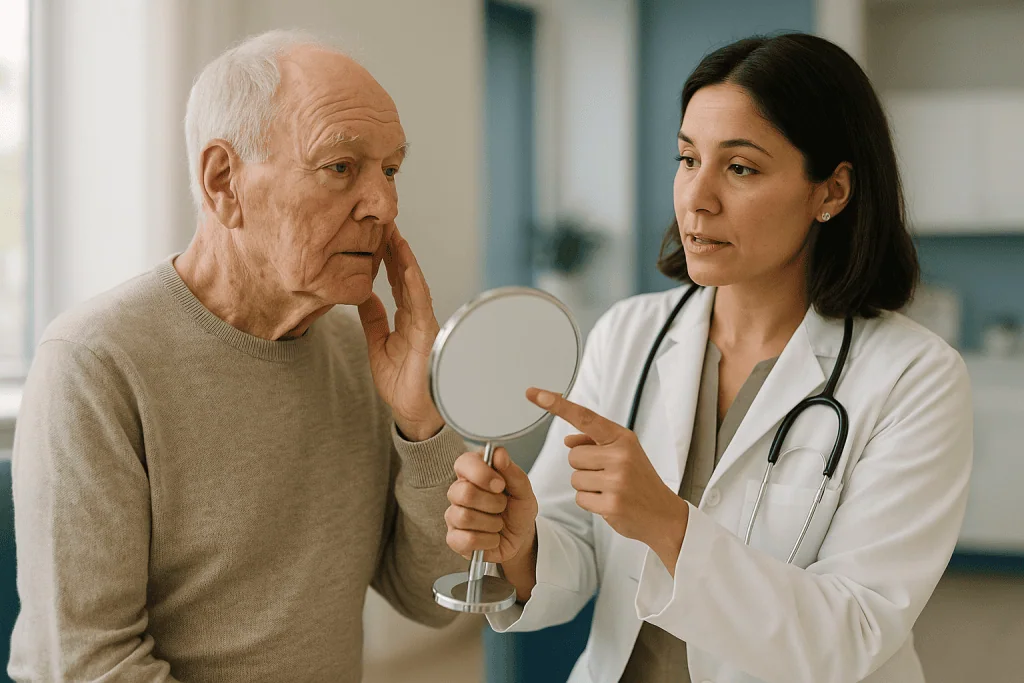
Skin itself alters measurably. MedlinePlus describes how the outer layer thins, the number of pigment cells falls, and the connective tissue beneath loses strength and elasticity. Blood vessels in the dermis become more fragile, which is why older skin bruises so easily and why minor knocks can tear it. The fat layer that cushions the face thins as well, so grafts and flaps sit on a less forgiving bed.
These changes have practical consequences for reconstructive surgery in older adults. Stitches need to be placed with care because thin skin tears under tension. Flaps are planned with generous blood supply because fragile vessels are less able to compensate. Dressings are chosen to avoid adhesive injury. None of this is unusual; it is the ordinary craft of operating on older skin.
Several factors beyond skin aging slow healing more than age does. Diabetes with high blood sugar impairs the immune cells that clear bacteria and the small vessels that deliver oxygen. Smoking narrows blood vessels and starves the wound edge of oxygen; the NHS advises stopping before any operation and notes that doing so reduces the risk of complications. Low protein intake, which is common when appetite fades, deprives the body of the building blocks for collagen. Long-term steroid use dampens the inflammatory phase that healing depends on.
The encouraging part is that most of these are modifiable in the weeks before surgery, and surgical teams routinely build that preparation into the plan.
Who is usually a candidate, and who is usually asked to wait
Most older adults referred for reconstructive surgery are suitable for it, often with no more preparation than a medicine review. The clearest candidates are those with a defined problem that surgery addresses well: a skin cancer defect that will not close on its own, an eyelid drooping into the line of sight, a wound that keeps breaking down.
Being asked to wait is not the same as being turned down. Teams commonly postpone when a modifiable factor can be improved first. Typical reasons include:
- Blood pressure or heart rhythm that has not yet been brought under control.
- Recent heart attack, stroke or unstable chest pain, where the AHA/ACC guideline advises deferring elective surgery until the condition has stabilized and been assessed.
- Blood sugar running high, because it undermines both infection resistance and healing.
- Active infection at or near the surgical site.
- Current smoking, when the procedure involves a flap or graft whose survival depends on blood flow.
- A recent change in anticoagulant therapy that needs coordinating with the prescribing clinician.
- Unexplained weight loss or poor nutrition that would benefit from dietitian input first.
A smaller group may be advised that surgery is not in their interest. This usually applies when the person is frail enough that the operation and recovery would cost more in function and comfort than the problem itself. For a slow-growing skin cancer in someone with limited life expectancy, for example, non-surgical treatment or careful monitoring may be preferred. The NHS notes that radiotherapy and topical treatments are options for some non-melanoma skin cancers. The decision is made jointly, and it is reasonable to ask the team to explain the alternatives in the same detail as the operation.
Facial reconstruction after skin cancer: the most common scenario
Ask a plastic or dermatologic surgeon what fills their older-adult clinic and the answer is usually skin cancer. Basal cell and squamous cell carcinomas, together called non-melanoma skin cancers, arise on sun-exposed skin and therefore favor the nose, cheeks, ears, scalp and lower eyelids. Decades of exposure mean they appear most often in later life.
Removing the cancer is step one. Mohs surgery, a technique in which thin layers of skin are removed and examined under a microscope one at a time until no cancer cells remain, is widely used on the face because it spares healthy tissue. Mayo Clinic describes it as a procedure done under local anesthesia, often completed in a single day, with the reconstruction either immediately afterward or shortly after.
Facial reconstruction after skin cancer is step two, and it is where the assessment described in this article comes into play. Small defects may be left to heal on their own or closed directly. Medium defects on the nose or cheek often need a local flap. Larger or deeper ones may require a graft, a staged flap performed in two sessions, or a combination.
Age shapes the plan in two opposing ways. Older skin is looser, which gives surgeons more slack to move and makes some closures easier than in a younger face. Yet that same skin is thinner and more fragile, so flaps are designed conservatively and sutures chosen with care. The surgeon also considers what the person wants. Some prioritize the quickest recovery; others prioritize the finest cosmetic result even if it takes two stages. Both are reasonable, and neither is dictated by age.
Local, sedation or general anesthesia: how the choice is made
Anesthesia choice is often the single biggest lever in making reconstructive surgery safer for an older person, and it deserves a dedicated conversation.
Local anesthesia numbs only the area being operated on. The patient stays awake, breathes unaided and can usually go home the same day. Most facial skin cancer reconstructions, eyelid procedures and minor wound repairs are performed this way. Because the heart and lungs are barely stressed, the AHA/ACC guideline classifies such operations as low cardiac risk, and the cascade of pre-surgical heart tests is rarely needed.
Sedation adds medicines given through a vein to reduce anxiety and awareness while the patient still breathes on their own. It can make a long or awkward procedure more tolerable but requires monitoring by an anesthesia clinician. Older adults are more sensitive to sedatives, so anesthetists use lower amounts and titrate slowly; the specifics are theirs to decide.
General anesthesia renders the patient fully unconscious with breathing supported. It is reserved for larger reconstructions, procedures in sensitive areas, or when the patient cannot stay still comfortably. It carries a greater physiological load and a higher chance of post-operative confusion in older people, which is discussed below.
The anesthetist weighs the procedure length, the patient’s heart and lung status, their medicines, any history of problems with previous anesthetics and the person’s own preference. Someone with significant heart failure may be steered toward a local anesthetic even for a moderately sized repair. Someone anxious about being awake may be offered light sedation. The NHS pre-operative pages encourage patients to raise these questions early, because the answers often shape the whole plan.
Medicines and the surgical plan: blood thinners, diabetes and more
The average older adult takes several regular medicines, and each is reviewed before surgery. The decisions about what to continue, pause or adjust belong to the prescribing clinician and the surgical team together; what follows explains why the questions arise, not what to do.
Anticoagulants and antiplatelet drugs reduce the blood’s tendency to clot. Warfarin blocks vitamin K-dependent clotting factors; the newer direct oral anticoagulants inhibit a single clotting enzyme; aspirin and similar agents make platelets less sticky. All of them increase bleeding under a flap or graft, and a collection of blood beneath a repair is one of the main threats to its survival. Yet stopping them carries its own risk of stroke or clot, which is why the AHA/ACC guideline frames this as a balance to be struck for each patient, often with cardiology input.
Diabetes medicines are reviewed because fasting before surgery changes blood sugar behavior, and because sustained high glucose impairs healing. Blood pressure medicines are generally continued, with certain classes sometimes held on the morning of surgery according to the anesthetist’s instructions.
Less obvious entries matter too. Long-term corticosteroids suppress the inflammatory response and thin the skin. Some over-the-counter supplements, including fish oil and high-dose vitamin E, have mild blood-thinning effects. Herbal products are easy to forget to mention and should be listed.
The NHS advises bringing a complete, current list of everything taken, including inhalers, creams and supplements, to the pre-assessment appointment. Any change to a prescribed medicine should come from the clinician who prescribes it, never from a leaflet or a well-meaning relative.
Frailty, memory and the risk of confusion after surgery
Frailty is a medical term for reduced reserve across several body systems, such that a relatively small stress, an infection or an operation, can tip someone into a disproportionate decline. It is not the same as age, nor as having several diagnoses. A fit 85-year-old may not be frail; a 70-year-old recovering from a long illness may be.
Surgical teams increasingly screen for it because it predicts how recovery will go. Slow walking speed, weak grip, unintentional weight loss, low activity and exhaustion are the classic markers. Someone who scores as frail is not excluded from reconstructive surgery, but the plan changes: shorter procedures, local anesthesia where possible, earlier mobilization and more support at home.
Memory and thinking are assessed for a related reason. Delirium is a sudden, fluctuating state of confusion that can follow surgery, infection or a change in medicines. MedlinePlus notes that it is more common in older adults and in people with existing dementia, and that it is often triggered by illness, surgery or drugs. Post-operative delirium is usually temporary, but it is distressing for families and can prolong recovery.
Known risk-reducing measures are simple. Keeping glasses and hearing aids in place, maintaining a normal sleep-wake cycle, having familiar faces nearby, staying hydrated, controlling pain and avoiding unnecessary sedatives all help. Procedures under local anesthesia with same-day discharge sidestep much of the risk, which is another argument in their favor for older patients.
Families are often the first to notice subtle changes, so telling the team about any baseline forgetfulness is genuinely useful rather than embarrassing.
What the team weighs: a summary of factors and how they shape the plan
The table below gathers the threads of the assessment into one view. It is a simplification; real decisions blend these factors rather than scoring them separately, and the treating team interprets them in the context of the individual.
| Factor | What the team looks at | How it typically changes the plan |
|---|---|---|
| Heart function | Functional capacity (around 4 METs as a reassuring marker), rhythm, recent events, valve disease | Low-risk local procedures proceed; larger operations may need ECG or specialist review first |
| Lungs | COPD, sleep apnea, recent chest infection | Favors local anesthesia; may delay general anesthesia until chest is clear |
| Blood thinners | Type, reason for taking, bleeding risk of the repair | Coordinated plan with prescriber; may continue, pause briefly or bridge |
| Blood sugar | Diabetes control over recent months | Optimize before surgery; closer monitoring on the day |
| Skin and tissue | Thinness, sun damage, prior radiotherapy, blood supply | Conservative flap design, gentler sutures and dressings |
| Smoking | Current use, especially with flaps or grafts | Stop beforehand; some procedures postponed until done |
| Nutrition | Weight trend, protein intake, albumin | Dietitian input; delay if significantly undernourished |
| Frailty and cognition | Walking speed, grip, weight loss, baseline memory | Shorter procedures, same-day discharge, delirium prevention measures |
| Social support | Who is at home, access to follow-up | Arrange help with dressings and transport before scheduling |
Two patterns stand out. First, most rows push toward the same solution: a shorter procedure under local anesthesia with good support afterward, which is exactly how most facial reconstruction is already done. Second, several factors are things a person can change in the weeks before surgery, which turns waiting time into useful preparation rather than lost time.
Recovery time after surgery in elderly patients: what the days and weeks look like
Recovery after facial reconstruction follows a recognizable arc, though the pace varies and the surgical team will give the timeline that applies to the specific repair.
The first two or three days are about protecting the repair. Swelling and bruising peak, especially around the eyes, where loose tissue collects fluid. Keeping the head raised, avoiding bending and heavy lifting, and leaving the dressing undisturbed unless told otherwise are the usual instructions. Mild discomfort is expected; the team will advise on pain relief, and it is worth asking in advance which over-the-counter options they prefer, since some thin the blood.
Toward the end of the first week, non-dissolving stitches on the face are often removed, and a graft or flap is checked for color and attachment. The NHS describes how a skin graft depends on new blood vessels growing into it over its first days, which is why the area must not be knocked or rubbed during this phase. A healthy graft turns from pale to pink; a flap should stay warm and its normal color.
Through weeks two to six, the wound strengthens and swelling steadily recedes. Scars often look their reddest and most raised around this time, which alarms people who expect steady improvement. It is a normal phase of remodeling.
Scar maturation continues for months. Sun protection on the healing area is strongly advised because new skin pigments unevenly, and because the person has already demonstrated sun-damaged skin. Older adults sometimes heal a little more slowly than younger ones, but the end result on the face is usually good, helped by its generous blood supply and by the natural creases that hide incision lines.
What people often get wrong about reconstructive surgery in older adults
Several beliefs recur in clinic, and most of them deserve gentle correction.
“At my age it’s not worth it.” For a skin cancer that will keep growing, or an eyelid that blocks half the visual field, the problem does not pause for age. Doing nothing is also a decision with consequences, and the assessment is designed to compare the two paths honestly.
“Surgery means going under.” Most facial reconstruction is done awake under local anesthesia. Many of the risks people fear belong to general anesthesia and overnight stays, which may not apply at all.
“They’ll want me to stop my blood thinner.” Sometimes they will, sometimes they will not, and sometimes they will plan around it. The AHA/ACC guideline treats this as an individualized balance between bleeding and clotting risk, decided with the prescribing clinician.
“Older skin can’t heal.” It heals, more slowly and with less margin, but it heals. Blood sugar, smoking and nutrition affect healing far more than age does, and all three can be addressed.
“The scar will be terrible.” The face has rich blood flow and natural creases, and scars that look angry at six weeks usually soften over the following months. No one can promise a specific result, but the trajectory is generally favorable.
“Confusion afterward means dementia.” Post-operative delirium is a temporary state triggered by stress, drugs or illness, as MedlinePlus explains. It is a reason for vigilance, not a diagnosis.
“Being asked to wait means they’ve given up on me.” Waiting is almost always about fixing something fixable first. It is a sign the team is taking the operation seriously.
Questions to ask your care team before agreeing to surgery
A good consultation leaves room for questions, and older patients and their families often hold back for fear of seeming difficult. The opposite is true: specific questions help the team tailor the plan. Consider bringing some of these.
- What exactly will be repaired, and what technique do you plan to use: direct closure, graft, flap or something staged?
- Will this be done under local anesthesia, sedation or general anesthesia, and what led you to that choice for me?
- What happens if we do nothing, or choose a less invasive option, and how do the risks compare?
- Which of my medicines need reviewing before surgery, and who will make those decisions with my prescribing doctor?
- Is there anything I can do in the next few weeks, such as stopping smoking, improving my blood sugar or eating more protein, that would improve my chances of healing well?
- How many visits will this involve, and how soon after surgery will the first check be?
- What will the wound look like at one week, one month and six months, and when should I worry?
- Who do I call if something seems wrong at night or over a weekend?
- What help will I need at home, and for how long?
- If I became confused after the operation, how would you manage it, and what can my family do to help prevent it?
It helps to write the answers down or to bring someone who can. The NHS recommends that patients attending pre-operative assessment bring their medicine list, details of past operations and anesthetics, and any questions in advance. Nothing on this list is unusual; experienced teams expect and welcome them.
When to call your doctor after reconstructive surgery
Most recoveries are uneventful, but a small number of problems need prompt attention, and older adults should have a low threshold for making the call. The surgical team will give its own contact instructions; these are the signs that generally warrant them.
Call the same day, or the out-of-hours number provided, if you notice:
- Bleeding that soaks through the dressing and does not stop with ten minutes of firm, gentle pressure.
- A flap or graft that turns dark purple, black or very pale, or that feels cold compared with surrounding skin.
- Rapidly increasing swelling or a tense, painful lump under the repair, which may indicate a collection of blood.
- Spreading redness, warmth, pus, a foul smell or increasing pain after the first few days, suggesting infection.
- Fever or shaking chills.
- New or worsening confusion, drowsiness or agitation, which in an older adult can signal delirium from infection, medicines or dehydration.
Seek emergency care immediately for chest pain, sudden breathlessness, weakness or numbness on one side, difficulty speaking, a sudden severe headache, or pain and swelling in one calf. These are not complications of the skin repair itself but can occur in the period around any surgery, and they are not to be waited out.
Eyelid and periorbital surgery has its own red flags: sudden severe eye pain, loss or blurring of vision, or a rock-hard swelling behind the eye need urgent review.
A useful principle for families is to compare against the person’s baseline. A grandparent who is a little tired after surgery is expected; one who cannot be roused properly or does not recognize the room is not. When in doubt, call. Teams would far rather hear about a false alarm than miss a real one.
Frequently asked questions
Is surgery safe for elderly people in their 80s or 90s?
Often, yes, but safety depends on overall health rather than age. Teams assess heart and lung function, medicines, blood sugar, frailty and the type of anesthesia needed. Many reconstructive procedures on the face are done awake under local anesthesia and carry low cardiac risk. The treating team decides case by case whether to proceed, adapt the plan or wait.
What does a heart check before surgery involve for an older adult?
It usually starts with questions about exercise tolerance, symptoms and heart history, followed by a physical examination and often an electrocardiogram. The AHA/ACC guideline uses the ability to manage about four METs, such as climbing two flights of stairs, as a reassuring marker. Further tests like an echocardiogram are reserved for those with known heart disease or poor functional capacity before higher-risk operations.
How is facial reconstruction after skin cancer usually done in older patients?
Most commonly the cancer is removed first, often by Mohs surgery, and the resulting defect is repaired the same day or soon after. Small wounds may be closed directly; larger ones need a local flap or skin graft. The procedure is typically done under local anesthesia in an outpatient setting, with the technique chosen by the wound’s size and location.
What is the typical recovery time after surgery in elderly patients having facial reconstruction?
Swelling and bruising usually peak in the first few days, stitches on the face are often removed around the end of the first week, and the repair strengthens over the following weeks. Scars tend to look reddest at several weeks and then soften over months. Older adults may heal somewhat more slowly, but the team will give a timeline specific to the repair.
Will I have to stop my blood thinner before reconstructive surgery?
Not necessarily. Anticoagulants raise the risk of bleeding under a flap or graft, but stopping them raises the risk of stroke or clot. Guidelines treat this as an individual balance decided by the surgical team together with the clinician who prescribes the medicine. Never pause or change a blood thinner on your own; ask the team what they advise for you.
Does older skin heal more slowly after a skin graft or flap?
Somewhat, yes. Older skin is thinner, less elastic and has more fragile blood vessels, so healing takes a little longer and the margin for error is smaller. Diabetes, smoking and poor nutrition slow healing much more than age does. The face heals comparatively well because of its rich blood supply, which helps flaps and grafts survive.
What is post-operative delirium and how likely is it?
Delirium is a sudden, fluctuating confusion that can follow surgery, infection or medicine changes. It is more common in older adults and in those with existing memory problems, and it is usually temporary. Procedures under local anesthesia with same-day discharge carry less risk. Keeping glasses and hearing aids in place, staying hydrated and having familiar people nearby all help.
Why might a surgeon ask an older patient to wait before reconstruction?
Usually because something modifiable can be improved first: uncontrolled blood pressure, a recent heart event, high blood sugar, active infection, current smoking before a flap, or poor nutrition. Waiting is a sign the team is taking the operation seriously, not a refusal. For slow-growing skin cancers, a brief delay to prepare rarely changes the outcome of the repair.
Can reconstructive surgery be done without general anesthesia?
Very often. Most facial skin cancer repairs, eyelid procedures and minor wound closures are performed under local anesthesia, with the patient awake and breathing normally. Sedation can be added for comfort during longer procedures. General anesthesia is reserved for larger reconstructions or when staying still is not possible. The anesthetist decides based on the procedure and the patient’s health.
What are the alternatives if surgery is not advised for an older adult?
For some non-melanoma skin cancers, options include radiotherapy, topical treatments or close monitoring, depending on the cancer type and location. For wounds, careful dressing care may allow healing by itself. For eyelid problems, non-surgical support measures exist. The treating team should explain each alternative with the same detail as the operation so the choice is informed.
References
- NHS: Having an operation (surgery) – Preparation
- NHS: Plastic surgery – What happens (skin grafts, flaps and tissue expansion)
- MedlinePlus: Aging changes in skin
- MedlinePlus: Delirium
This article is for general information only and is not a substitute for professional medical advice. Please consult a qualified doctor about your individual situation.

More from the Blog

RF Microneedling Downtime: Redness, Grid Marks and When You Can Wear Makeup Again
RF microneedling downtime is usually short. Redness and mild swelling typically peak in the first 24 hours and fade over one to three days,…

The Best Age for a Facelift: Why Anatomy Matters More Than Birthdays
There is no single best age for a facelift. Most patients are in their 40s through 60s, but surgeons evaluate anatomy, skin laxity, jowls,…
Split-Thickness vs Full-Thickness Skin Grafts: How Surgeons Choose the Graft Type
Surgeons choose between a split-thickness and a full-thickness skin graft mainly on wound size, location, and how much the graft may shrink. Split-thickness grafts…

When Can Acne Scar Treatment Begin? Why Active Acne Must Be Controlled First
Acne scar treatment usually begins only after active acne has been controlled for several months, because every new breakout can create a new scar…
Microdermabrasion Downtime: Why Most People Return to Normal Skincare Within Days
Microdermabrasion downtime is usually short: most people have mild redness, tightness, and a sunburn-like feel for about a day, then return to a gentle…
How Cryotherapy Freezes Skin Lesions: Liquid Nitrogen, Freeze Time and What You Feel
Cryotherapy treats skin lesions by applying liquid nitrogen, a liquid colder than minus 190 degrees Celsius, to a wart, actinic keratosis or similar growth…