

Reformer Pilates vs Mat Pilates vs Yoga: What Each Builds and Who It Suits

Key Takeaways
- A reformer's springs provide progressive resistance, meaning load increases as the spring stretches, so a joint carries the least weight at its most vulnerable point in the movement.
- The 2015 Cochrane review of ten randomized trials found low to moderate quality evidence that Pilates eases chronic low back pain more than minimal care, but no clear advantage over other exercise.
- Springs can remove load as well as add it, which is why beginners and people with joint limits often find the reformer easier to start on than the mat.
- Yoga has the stronger evidence base for flexibility, balance in adults over 60 and stress reduction; Pilates has the stronger base for trunk endurance and posture.
- Neither Pilates nor most yoga styles meets the American Heart Association's target of 150 weekly minutes of moderate aerobic activity, so they complement rather than replace cardio.
- People with osteoporosis are generally advised to avoid the repeated spinal flexion in classic Pilates, so a class must be deliberately adapted and agreed with a clinician first.
Reformer Pilates uses a sliding carriage and adjustable springs to add resistance and support to Pilates movements, so it tends to build more measurable strength and control than mat Pilates, which relies on body weight alone. Yoga emphasizes flexibility, balance, breathing and stillness. Evidence for back pain is moderate for all three; the best choice depends on your goals, joints and any medical conditions, so check with a clinician if unsure.
Watch a reformer class through a studio window and you will see something that looks half gym, half physical therapy: people lying on sliding carriages, feet pressed into a bar, springs clicking as they push away and glide back. As of March 2025, that scene is one of the most searched workouts online, driven less by any single trial than by a flood of short videos, celebrity routines and a lively argument over whether reformer Pilates beats mat Pilates or yoga.
The noise hides a genuinely useful question. These three practices share a floor and a vocabulary, yet they load the body in different ways and were built for different purposes. One began as rehabilitation equipment, one as a portable version of the same system, and one as a contemplative tradition thousands of years old.
What follows is an honest comparison: what each actually builds, what randomized trials do and do not show, who thrives in which room, and who should have a conversation with a clinician before booking.
What is reformer Pilates, and what does the machine actually do?
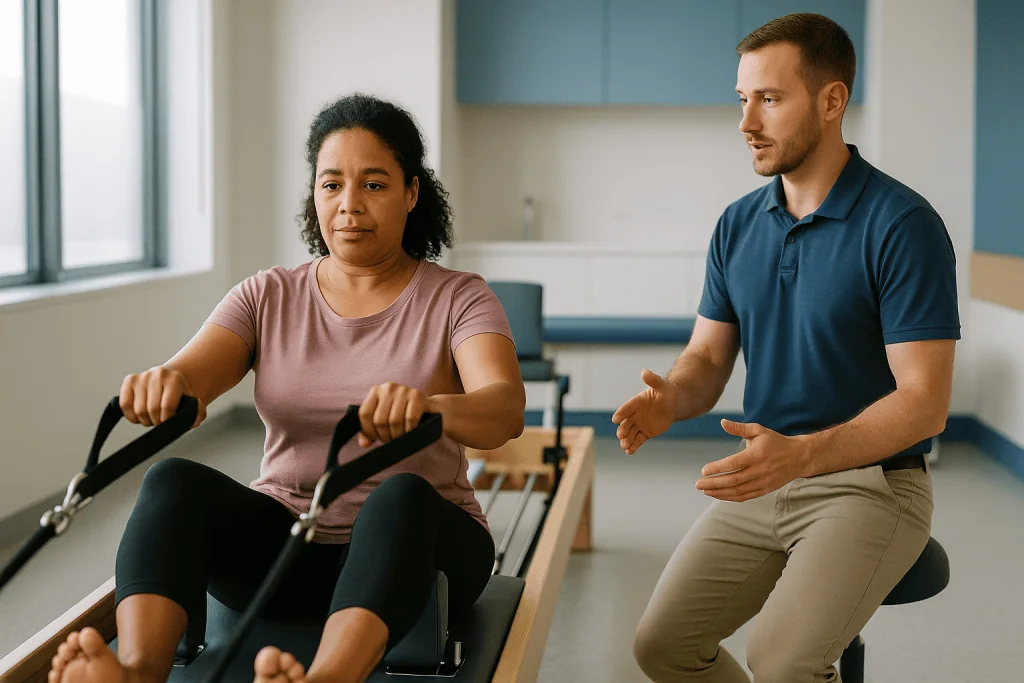
A reformer is a bed-shaped frame with a padded carriage that slides on rails, attached to a set of springs at one end. Straps with handles or loops hang from the other end, and a padded foot bar sits above the springs. That is the whole machine. Every exercise on it is some version of pushing or pulling the carriage against spring tension, or holding the carriage still while your limbs move.
The springs are the clever part. Unlike a dumbbell, which weighs the same at the top and bottom of a lift, a spring gets harder to stretch the further you pull it. Coaches call this progressive resistance. In practice it means the load is light where a joint is most vulnerable and heaviest where the muscle is strongest, which is one reason reformers grew up in rehabilitation settings before they reached boutique studios.
Springs also work in reverse. When you let the carriage return, the muscles lengthen under tension, a type of contraction called eccentric loading that builds strength and tendon resilience. And because the carriage moves on rails, it gives instant feedback: a wobbling carriage tells you a hip or shoulder is doing work it should not.
Reformer Pilates, then, is the Pilates method performed on this apparatus. The method itself is a system of roughly 30 to 50 core-based exercises that emphasize spinal alignment, controlled breathing and precision over repetition. Mayo Clinic describes Pilates as low-impact exercise focused on core strength, posture and flexibility, and the reformer is one way of delivering it, not a separate discipline.
What changed recently: why the reformer left the physio clinic
Nothing about the machine changed. The context did. For most of the twentieth century a reformer was something you met after a knee surgery or a stubborn back injury, usually one-on-one with a physiotherapist or a certified instructor. Group reformer classes with eight or twelve machines in a row are a development of the last decade, and social platforms turned them into a visual genre in the last two or three years.
The evidence base moved more slowly, and honestly. The most rigorous summary remains a 2015 Cochrane systematic review of Pilates for low back pain, which pooled ten randomized trials and concluded, with low to moderate quality evidence, that Pilates reduced pain and disability more than minimal intervention, while not clearly outperforming other forms of exercise. That review did not separate reformer from mat work, and it remains the anchor most clinicians cite.
Since then, smaller trials have tested reformer Pilates on its own in older adults, in people after breast cancer treatment and in office workers with neck pain. Most enrolled fewer than 60 participants and ran for 6 to 12 weeks. They tend to report improvements in strength, balance and self-reported function, but sample sizes are too small to settle whether the machine adds anything a good mat class would not.
On the yoga side, the NIH National Center for Complementary and Integrative Health updated its consumer summary to state that yoga has moderate evidence for easing low back pain and neck pain and some evidence for improving balance and mental well-being. Guidance in the NHS now lists Pilates and yoga alongside walking and swimming as reasonable activities for people with back pain. That quiet institutional acceptance, more than any viral clip, is the real shift.
Reformer Pilates vs mat Pilates: what is the real difference?
Same exercises, different physics. Mat Pilates is the method performed on the floor using body weight, gravity and sometimes small props such as a ring or a soft ball. Reformer Pilates performs many of the same movements with springs either adding load or taking it away.
That second point surprises people. Springs can make an exercise harder, but they can also make it easier. A plank on the mat asks your shoulders and trunk to hold your full body weight. On the reformer, feet in straps and a moderate spring, a version of the same movement removes part of the load and lets someone with a weak shoulder or a sore wrist practice the pattern with support. This is why instructors often call the reformer more scalable than the mat, in both directions.
Mat work has its own advantages. With nothing to lean on, the deep abdominal and spinal stabilizers have to do everything, which is why many experienced teachers consider the mat repertoire the harder test of true core control. It also costs nothing beyond a mat, travels anywhere and can be done daily at home.
Where the reformer clearly wins is in measurable progressive overload. You can add a spring, change the foot bar height or shift a strap and know exactly how the load changed week to week. Progressive overload, the gradual increase in demand that muscle needs in order to adapt, is harder to quantify on the floor.
The research does not yet crown a winner. Trials comparing the two head to head are few, short and small. A fair reading is that both improve trunk endurance and flexibility, the reformer is friendlier to beginners and to people with joint limits, and the mat is the more portable and self-reliant practice.
Pilates vs yoga: same room, different goals
Yoga is older by roughly two millennia and was never designed as exercise. It is a practice of physical postures, breathing techniques and meditation that developed in India, and the fitness-style classes most Americans attend represent one branch of a much larger tradition. Pilates was devised in the early 1900s as a physical conditioning system and has always been about the body first.
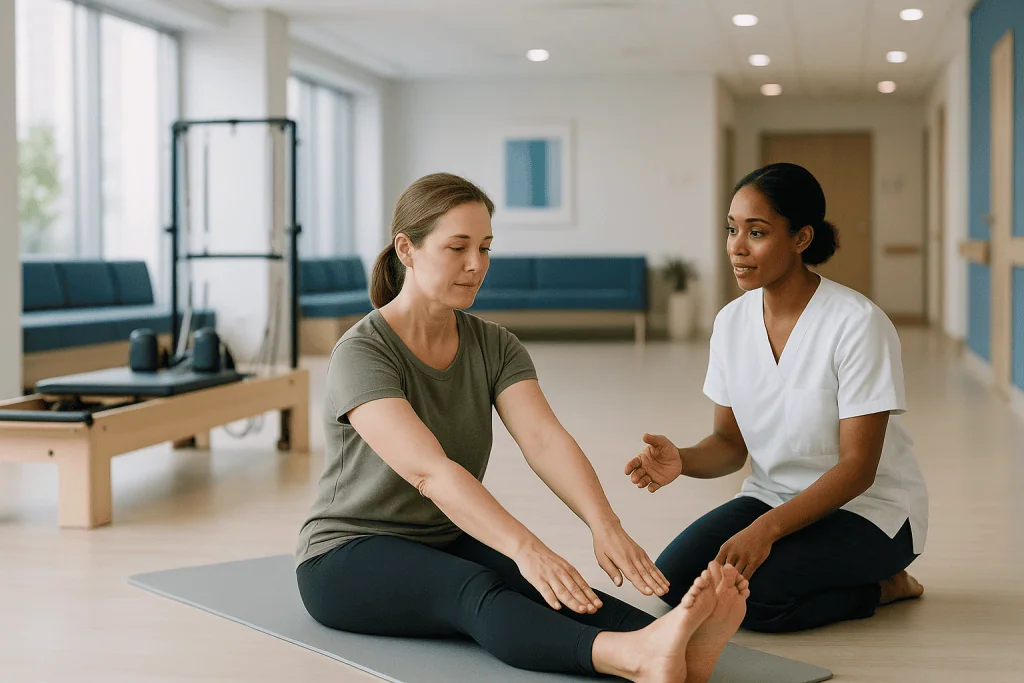
That difference in intent shows in the movements. Yoga holds positions. A warrior pose or a forward fold may last five to ten breaths, training the muscles to sustain a shape, stretching connective tissue and asking the nervous system to settle. Pilates rarely holds; it flows through controlled repetitions with the spine and pelvis kept in specific alignment, so the emphasis is on stabilizing while limbs move.
Breathing splits the two as well. Most Pilates cues use lateral thoracic breathing, which means expanding the ribcage sideways so the abdominal wall can stay engaged. Many yoga styles teach diaphragmatic breathing that softens the belly and slows the exhale, a pattern linked in small studies to lower heart rate and calmer mood.
Harvard Health summarizes yoga’s best-supported benefits as improved flexibility, balance, strength and reduced stress, with the strongest evidence for chronic low back pain. The Pilates literature points more to trunk strength, posture and function. When people ask about pilates vs yoga, the honest answer is that they overlap far less than they appear to on a schedule: one trains stillness and range, the other trains control under movement.
Neither is complete. Yoga rarely loads muscle enough to build much mass, and Pilates rarely quiets the mind the way a slow yoga class can.
What each builds: strength, mobility, balance and breath compared
Put the three side by side and the differences are easier to see than to describe. The table below reflects the general pattern in published trials and expert consensus; individual classes vary enormously with the teacher and the style.
| Quality | Reformer Pilates | Mat Pilates | Yoga |
|---|---|---|---|
| Muscular strength | Moderate to high (adjustable spring load) | Low to moderate (body weight) | Low to moderate (isometric holds) |
| Deep core control | High, with feedback from the carriage | Highest demand on stabilizers | Moderate, varies by style |
| Flexibility | Moderate, assisted by straps | Moderate | High, best evidence base |
| Balance | Moderate; standing work adds challenge | Moderate | High, especially in older adults |
| Cardiovascular load | Low to moderate | Low | Low, except vigorous flow styles |
| Stress and mood | Some benefit, less studied | Some benefit | Moderate evidence |
| Impact on joints | Very low, supported positions | Very low | Low; some poses load wrists and knees |
Two clarifications matter. Strength gains from any of these methods are real but modest compared with traditional resistance training. A heavy spring is still lighter than a barbell, and no Pilates or yoga trial has shown the kind of muscle growth seen with progressive weightlifting. If building bone and muscle mass is your priority, these practices complement lifting rather than replace it.
Second, none of the three counts as aerobic exercise for most people. The American Heart Association recommends at least 150 minutes a week of moderate-intensity aerobic activity, and a typical reformer or yoga class will not raise your heart rate high enough for long enough to meet that target. Think of them as the strength, mobility and balance portion of a balanced week, not the whole plan.
What the evidence actually says, graded honestly
Fitness marketing speaks in certainties. Medical evidence speaks in grades, so here is the grading.
Chronic low back pain: moderate evidence. The 2015 Cochrane review of Pilates found low to moderate quality evidence from ten randomized trials that Pilates improved pain and function more than doing nothing or usual care over the short and medium term. It found no clear advantage over other exercise programs. Yoga has a similar profile: several randomized trials and systematic reviews show small to moderate improvements in back pain and function, and NIH describes this as the best-studied yoga outcome.
Balance and fall risk in older adults: moderate for yoga, emerging for Pilates. Multiple randomized trials of yoga in adults over 60 show improved balance measures. Pilates trials show similar direction but are fewer and smaller.
Strength and trunk endurance: consistent but small trials. Reformer and mat studies of 6 to 12 weeks reliably show gains in abdominal endurance tests and hip strength. Almost none last beyond three months, so durability is unknown.
Posture, flexibility and mobility: moderate for yoga, low to moderate for Pilates. Yoga has the larger literature on range of motion.
Mental health: moderate for yoga, limited for Pilates. Yoga trials show reductions in self-reported stress and anxiety symptoms, though many lack active comparison groups.
Weight loss, “long lean muscles,” and body reshaping: expert opinion only. No randomized trial supports a specific fat-loss effect of any of the three beyond what general activity provides.
Reformer versus mat: insufficient evidence. Head-to-head trials exist but are too small to draw conclusions. Any claim that one is clinically superior is currently opinion.
That is less thrilling than a video caption, and it is also enough to recommend all three as reasonable, low-risk exercise for most adults.
Is reformer Pilates hard for beginners?
Harder than it looks in the first ten minutes, easier than the mat over the first ten weeks. That is the pattern most new students describe, and it matches how the equipment works.
The early difficulty is coordination, not fitness. A beginner has to learn where the foot bar goes, how many springs are loaded, how to lie down without the carriage sliding out from under them, and how to keep a neutral spine while their legs are moving in straps. Newcomers often report that they felt clumsy rather than exhausted after class one, and that the soreness arrived the next day in muscles they had not noticed before, usually the inner thighs, deep abdominals and the muscles between the shoulder blades.
After that adjustment, the machine becomes an ally. Because springs can reduce load as well as add it, an instructor can make almost any exercise achievable for someone who cannot yet hold a plank or do a full roll-up on the floor. Mayo Clinic’s beginner guidance notes that Pilates can be adapted for nearly all fitness levels, and this is truest on the reformer.
A few practical points shorten the learning curve. Beginner-specific or introductory sessions exist for a reason; a mixed-level class of twelve moves too fast for someone who does not yet know the equipment. Tell the instructor about any injury before class begins, not during. Expect to use lighter springs than the person next to you, and understand that this is often harder for the core, not easier, because less spring means less support.
Most people feel competent on the machine after five to eight sessions. Strength changes that are noticeable in daily life tend to follow at six to twelve weeks of twice-weekly practice, which is roughly the timeline the trial literature reports.
Who each suits: matching the method to your body and your goals
The right room depends on what you want to walk out with.
Reformer Pilates suits people rebuilding after injury or surgery who have been cleared to exercise, because the supported positions and adjustable springs let them load muscle without loading a fragile joint. It also suits people who want measurable strength progress but find free weights intimidating, and those whose wrists, knees or lower backs complain on the floor. Older adults often do well on it for the same reasons, provided the class is small enough for supervision.
Mat Pilates suits self-starters who want a practice they can do at home on any day, people with a decent baseline of core strength who want to test it, and anyone whose schedule or budget makes a machine-based class impractical. It is also a strong fit for runners and cyclists who need trunk stability and hip control more than they need extra range.
Yoga suits people whose primary complaint is stiffness, who want balance training as they age, or who are drawn to the breathing and quiet as much as the movement. The NHS guide to yoga notes it can be adapted for most people, including those who are less mobile, and gentle styles exist for beginners and for people with health conditions.
Goals matter more than labels. Someone with a tight, weak lower back after years at a desk might benefit from Pilates for control and yoga for range, done on alternate days. A new runner with wobbly hips probably gets more from mat Pilates than from another flexibility class. A person in their seventies who has had two near-falls needs balance work more than anything, which points toward yoga or standing reformer sequences.
Personality plays a part too. If you find holding still frustrating, yoga may not stick; if constant cueing about your ribcage drives you mad, Pilates may not either.
Who should not do reformer Pilates, or should get cleared first
Reformer Pilates is low impact, but low impact is not the same as risk-free, and some people should have a clinician’s input before their first class.
Pregnancy calls for an instructor trained in prenatal work and a conversation with the obstetric team. Later in pregnancy, exercises lying flat on the back and deep abdominal flexion are commonly modified or avoided, and the reformer’s supine footwork sits squarely in that category. After birth, a check for diastasis recti, which is a separation of the abdominal wall along its midline, guides which core exercises are appropriate.
Osteoporosis, a condition in which bones lose density and fracture more easily, is a specific concern. Classic Pilates includes repeated spinal flexion and rolling movements that compress the front of the vertebrae, and these are generally avoided in people with known vertebral fragility. A reformer class can be adapted to emphasize extension and standing work, but the adaptation has to be deliberate, so tell the instructor and ask your doctor first.
Recent surgery, especially spinal, abdominal, hip or shoulder procedures, requires explicit clearance and often a period of supervised physiotherapy before group classes. Unstable heart disease, uncontrolled blood pressure and recent cardiac events fall under the general advice to seek medical guidance before starting any new exercise program.
Acute injury, a herniated disc with nerve symptoms such as leg numbness or weakness, hypermobility syndromes in which joints move beyond their normal range, and severe balance disorders all warrant individual assessment rather than a drop-in class.
None of this means these groups cannot do Pilates. Many of them do it in rehabilitation settings every day. The difference is supervision, modification and a plan agreed with the treating clinician, rather than a twelve-person class taught to the middle of the room.
Back pain, pelvic floor and bone density: the claims worth examining
Three medical claims follow reformer Pilates around, and each deserves a different verdict.
Back pain is the strongest case. As discussed above, the Cochrane review supports Pilates as a reasonable exercise option for chronic non-specific low back pain, and yoga has comparable support. The mechanism is plausible: both train the deep trunk muscles that stabilize the spine, improve hip mobility that otherwise forces the lower back to compensate, and rebuild confidence in movement, which pain researchers consider a major driver of recovery. The limitation is that neither beats other structured exercise, so the best choice is the one you will keep doing.
Pelvic floor claims are more mixed. Pilates breathing and core cueing overlap with pelvic floor training, and small trials in postpartum women report improved muscle activation and fewer leakage episodes. Yet the gold-standard treatment for stress urinary incontinence remains targeted pelvic floor muscle training, often supervised by a specialist physiotherapist. Pilates may be a useful adjunct; it is not a substitute, and someone with persistent leakage, pelvic pressure or pain should be assessed rather than assume a class will manage it.
Bone density is the weakest claim. Bone responds to impact and to heavy loading, which is why walking, jumping and resistance training have the best evidence for maintaining density. Pilates and yoga load bone gently. A handful of small studies suggest yoga or Pilates may slow bone loss in postmenopausal women, but results are inconsistent and trials are short. For anyone with osteopenia or osteoporosis, these practices can help balance and posture, both of which reduce fall risk, but the bone-building work belongs elsewhere, and any plan should be agreed with the treating clinician.
Common myths about reformer Pilates and yoga
Viral fitness content is efficient at spreading half-truths. Here are the ones that come up most.
“Reformer Pilates gives you long, lean muscles.” Muscle length is set by where a muscle attaches to bone, and no exercise changes it. What people see is improved posture, reduced tension and modest muscle tone, which can make limbs look longer. That is a real effect; the anatomy behind the phrase is not.
“Pilates is just stretching.” Trunk endurance and hip strength improve measurably in trials of 6 to 12 weeks. A well-taught class is resistance training with a small load and a large emphasis on control.
“The reformer does the work for you.” Springs can assist, but they also resist, and the carriage exposes every compensation. Beginners frequently find lighter springs harder because less support means more core demand.
“Yoga is not real exercise.” Vigorous flow styles raise heart rate meaningfully, and even gentle yoga improves balance and flexibility in randomized trials. Yoga rarely builds much muscle mass, which is different from not counting.
“You need to be flexible to start yoga, or strong to start Pilates.” Both are entry points to those qualities, not prerequisites. Props, straps and spring adjustments exist precisely for people who cannot yet reach their toes or hold a plank.
“Reformer Pilates burns fat fast.” Energy expenditure in a typical class is comparable to brisk walking. No trial shows a fat-loss effect specific to the reformer, and weight management depends far more on overall activity, nutrition and sleep.
“Pilates fixes any back pain.” It is one reasonable option for chronic non-specific back pain. Pain with leg weakness, numbness, fever, night pain or after trauma is a different problem and needs a diagnosis, not a class.
How to build a week that mixes reformer, mat and yoga
People rarely need to pick one. A sensible week uses each for what it does best and leaves room for the two things none of them provide well: cardiovascular training and heavy loading.
Start from the public health floor. The American Heart Association and CDC both recommend at least 150 minutes of moderate aerobic activity each week plus muscle-strengthening activity on two or more days. Pilates and yoga contribute to the second target; brisk walking, cycling, swimming or jogging usually have to cover the first.
A balanced template for a healthy adult might look like this: two reformer or mat sessions for strength and control, one longer yoga class for range and recovery, two or three aerobic sessions of 30 minutes or more, and one rest day. Someone lifting weights can drop one Pilates session; someone with a physically demanding job may need more recovery-style yoga and less loading.
Spacing matters more than volume. Because Pilates emphasizes small stabilizing muscles that fatigue quickly, back-to-back daily sessions often produce diminishing returns and nagging neck or hip flexor soreness. Alternate days work better for most people. Yoga, particularly gentler styles, tolerates higher frequency and pairs well with the day after a hard lift or run.
Progress in Pilates by adding control before adding spring: slower tempos, fewer breaks between repetitions and cleaner alignment come first, extra resistance second. Progress in yoga by holding poses longer or moving toward more demanding variations, not by pushing range with force.
Give any new program eight to twelve weeks before judging it. Almost every positive trial in this area ran for at least that long, and the early weeks are largely learning, not adaptation.
Safety, injury risk and what a good class looks like
Injury rates in Pilates and yoga are low compared with running or team sports, but they are not zero, and most reported problems are avoidable.
In yoga, the areas most often injured are the wrists, shoulders, lower back, hamstrings and knees, usually from forcing range in a stretch, holding weight-bearing arm positions with poor alignment, or deep flexion in people with disc problems. The NIH cautions that some poses should be modified or avoided by people with glaucoma, uncontrolled high blood pressure or certain spinal conditions, and that hot yoga carries dehydration and overheating risk.
On the reformer, the specific hazards are mechanical. Fingers can be pinched under a moving carriage, straps can slip if a foot is not properly seated, and a spring left unclipped can let the carriage shoot backward. Well-run studios manage these with clear setup cues and small class sizes. Overuse injuries tend to involve the neck, from straining to lift the head in abdominal series, and the hip flexors, from repeatedly working legs in straps with a tilted pelvis.
A good class, in any of the three disciplines, has recognizable features. The instructor asks about injuries before beginning and offers modifications without singling anyone out. Class size allows hands-on or verbal correction; on the reformer, more than roughly ten to twelve students per teacher makes supervision difficult. Cues focus on alignment and breathing rather than on how a body should look. Nobody is encouraged to push through sharp pain, and rest is treated as part of the method rather than failure.
Muscle soreness a day or two after class is normal, particularly in the first month. Sharp pain during a movement, pain that lingers beyond three days, or pain that radiates into an arm or leg is not, and it is a reason to stop and seek advice rather than adjust the spring.
When to see a doctor
Most people can begin reformer Pilates, mat Pilates or yoga without a medical visit. Certain situations, however, call for a conversation with your doctor before starting or a prompt appointment if they arise during practice.
Before starting, seek clearance if you have osteoporosis or a history of fragility fracture, are pregnant or within a few months of giving birth, have had spinal, abdominal, hip or shoulder surgery in the past year, live with heart disease, uncontrolled blood pressure or a lung condition that limits exertion, have a diagnosed hypermobility or connective tissue disorder, or have a herniated disc with nerve symptoms. The same applies if you are managing a chronic condition such as diabetes or arthritis and have not exercised regularly for some time.
Red flags during or after exercise that warrant urgent medical attention include chest pain or pressure, sudden shortness of breath, fainting or near-fainting, a severe headache that comes on abruptly, sudden weakness or numbness in a limb or on one side of the face, and back pain accompanied by new bladder or bowel changes, numbness in the groin or saddle area, or weakness in both legs.
See a doctor soon, though not as an emergency, for joint or back pain that persists beyond a few days after a class, pain that wakes you at night, pain radiating down an arm or leg with tingling, a pelvic floor symptom such as new leakage, heaviness or pelvic pain that does not settle, swelling or instability in a joint, or any symptom that is steadily worsening rather than improving with rest.
Instructors, however experienced, are not clinicians. If a class was recommended as part of rehabilitation or a treatment plan, keep your physiotherapist or physician informed about how it is going, and let them, not a video or a friend, decide when to progress, pause or change course.
Frequently asked questions
What is reformer Pilates actually good for?
Reformer Pilates is best supported for improving core and hip strength, trunk endurance, posture and function in people with chronic low back pain, with moderate evidence from randomized trials of Pilates generally. Its supported positions make it useful for people returning from injury or with joint limits. Claims about fat loss or body reshaping rest on opinion rather than trial data.
Is reformer Pilates hard for beginners?
The first few sessions feel awkward because of the equipment, not the effort; most people feel competent on the machine within five to eight classes. Springs can be set to support as well as resist, so instructors can scale nearly every exercise down. Beginner-specific classes, honest disclosure of injuries and lighter springs than your neighbor make the start much smoother.
What is the difference between reformer Pilates and regular Pilates?
Both use the same method and largely the same exercises; the difference is the load. Mat Pilates relies on body weight and gravity, while the reformer adds springs, straps and a sliding carriage that can either increase or reduce resistance and give feedback on alignment. Trials comparing the two head to head are small, so neither has proven clinically superior.
Who should not do reformer Pilates?
People who should get medical clearance and an adapted class first include those with osteoporosis, recent spinal, abdominal or joint surgery, pregnancy or the early postpartum months, unstable heart conditions, uncontrolled blood pressure, hypermobility disorders, and disc problems causing leg numbness or weakness. Most can still participate with supervision and modification, but a drop-in group class is not the place to start.
Pilates vs yoga: which is better for back pain?
Neither is clearly better. Both have moderate evidence from randomized trials for reducing chronic non-specific low back pain and improving function, and neither reliably outperforms other structured exercise. Pilates emphasizes control and trunk strength; yoga emphasizes range and breathing. Choose the one you will attend consistently, and seek a diagnosis first if your pain involves leg weakness, numbness, fever or follows an injury.
Can reformer Pilates replace strength training?
Not fully. Reformer springs build strength and endurance in trials of six to twelve weeks, but the loads are lighter than free weights and no study shows the muscle or bone gains seen with progressive resistance training. Think of reformer Pilates as excellent training for control, stability and smaller stabilizing muscles, and pair it with heavier lifting if muscle mass or bone density is a goal.
How many times a week should I do reformer Pilates?
Two to three sessions a week on non-consecutive days matches the frequency used in most positive trials and allows the small stabilizing muscles to recover. Daily reformer work tends to produce diminishing returns and nagging neck or hip flexor soreness. Give any program eight to twelve weeks before judging results, and fill the remaining days with aerobic activity and rest.
Does reformer Pilates help with weight loss?
Only indirectly. A typical class burns roughly what brisk walking does, and no randomized trial shows a specific fat-loss effect. Reformer Pilates can support weight management by building muscle, improving movement confidence and making other activity more comfortable, but changes in weight depend mainly on total activity, nutrition and sleep. Anyone with weight-related health concerns should discuss a plan with a clinician.
Is yoga or Pilates better for flexibility?
Yoga, on current evidence. Sustained poses held for several breaths lengthen muscle and connective tissue, and randomized trials consistently show improved range of motion. Pilates improves flexibility too, especially through the hips and spine, but its emphasis is on controlling movement within a range rather than expanding it. Many people find combining the two on alternate days covers both needs.
Can I do reformer Pilates during pregnancy or with osteoporosis?
Possibly, with adaptation and medical agreement. In pregnancy, prenatal-trained instructors modify supine work and deep abdominal exercises, and the obstetric team should be consulted first. With osteoporosis, repeated spinal flexion and rolling are generally avoided in favor of extension and standing work. In both cases the plan belongs with your treating clinician, not a general class.
References
This article is for general information only and is not a substitute for professional medical advice. Please consult a qualified doctor about your individual situation.

More from the Blog
Dead Bug and Bird Dog: The Two Core Exercises Physiotherapists Prescribe Most
The dead bug exercise is a floor-based core drill: you lie on your back, arms and knees raised, and slowly lower the opposite arm…

Resistance Bands vs Weights: What the Research Says About Building Muscle at Home
Resistance bands can build muscle and strength at home, and the best available evidence, a 2019 meta-analysis of randomized trials, found no significant difference…

Full-Body vs Push-Pull-Legs: Choosing a Training Split by How Often You Can Train
Choose a training split by how many days you can reliably lift. With two or three sessions a week, a full body workout lets…

DOMS: Why Muscles Hurt Two Days Later and What Actually Speeds Recovery
DOMS, or delayed onset muscle soreness, is muscle pain that peaks 24–72 hours after unfamiliar or intense exercise, especially movements that lengthen a muscle…
How to Do a Pull-Up: A Progression That Works for Beginners
To do a pull-up, hang from a bar with palms facing away and hands slightly wider than your shoulders, pull your shoulder blades down…

Calisthenics: How Bodyweight Training Builds Strength, and Where It Hits a Ceiling
Calisthenics builds strength by loading muscles with your own body weight and progressing through harder leverage, such as moving from incline push-ups to full…