

Regular Transfusions for Thalassemia: How Scheduling Works and What Each Visit Involves

Key Takeaways
- International guidelines describe transfusion intervals of two to five weeks for transfusion-dependent thalassemia, with the gap set to keep pre-transfusion hemoglobin at roughly 9 to 10.5 g/dL rather than fixed to a calendar.
- Post-transfusion hemoglobin is generally kept below about 14 to 15 g/dL because higher levels add iron and blood viscosity without adding benefit.
- Matching donor blood for the Rh antigens C and E and for Kell, in addition to ABO and Rh(D), reduces the chance of forming antibodies that complicate future transfusions.
- Leukoreduction, filtering white cells out of donor units, lowers the rate of fever-type reactions and is standard in thalassemia programs.
- The body cannot excrete transfused iron, so chelation is typically considered after roughly the first ten to twenty transfusions and continues alongside the schedule for life.
- Feeling breathless or exhausted in the final week before a transfusion usually means the interval needs adjusting, not that the symptoms should be tolerated.
Most people with transfusion-dependent thalassemia receive red blood cells every two to five weeks, timed so hemoglobin does not fall below roughly 9 to 10.5 g/dL before each visit, according to international management guidelines. Each visit includes a blood count, careful donor matching, an infusion lasting several hours, and monitoring for reactions. The exact interval is set and adjusted over time by the treating hematology team.
The calendar on the refrigerator has a small red dot every fourth Thursday. Nobody in the house needs to ask what it means. On those mornings a teenager eats breakfast a little earlier, packs a phone charger and a hoodie, and heads to the day unit where the nurses know her by name and know which arm she prefers.
That red dot is a thalassemia transfusion schedule in its most ordinary form: a recurring appointment that keeps someone’s blood doing what their bone marrow cannot fully manage on its own. For families new to the diagnosis, the rhythm can feel bewildering at first. Why every four weeks and not six? Why does the doctor care so much about one number on a lab slip? What happens in the chair for all those hours?
This explainer walks through the reasoning behind the schedule, what a visit actually involves, and the questions worth bringing to the team who sets it.
What is a thalassemia transfusion schedule, and how does it work?
Thalassemia is an inherited condition in which the body makes too little of one of the protein chains that build hemoglobin, the oxygen-carrying molecule inside red blood cells. In the severe forms, the red cells that do get made are fragile and short-lived, and the marrow works overtime trying to compensate. The result is chronic anemia, meaning too few healthy red cells to deliver oxygen comfortably to tissues (MedlinePlus).
A transfusion schedule solves two problems at once. The obvious one is oxygen delivery: donor red cells restore hemoglobin so a child can run, grow, and concentrate in class. The less obvious one is switching off the marrow’s frantic overproduction. When hemoglobin is kept steady rather than allowed to crash between visits, the marrow stops expanding into bones, the spleen stops enlarging as quickly, and the skeletal changes seen in untreated disease are largely prevented (NIH Bookshelf, transfusion-dependent thalassemia guidelines).
Think of it less like topping up a fuel tank and more like maintaining water pressure in a pipe. If pressure is allowed to drop to nothing before every refill, the whole system strains. Keeping it within a narrow band is gentler on everything downstream.
Because donor red cells survive for a limited time, the plan is inherently cyclical. Hemoglobin is measured before each visit, the team notes how far it has fallen since the last one, and the interval and volume are adjusted so the lowest point stays above the target floor. Over months, this produces a personal rhythm that tends to be quite stable, though it shifts with growth, illness, and spleen size.
How often do thalassemia patients need a transfusion?
International guidelines for transfusion-dependent thalassemia describe intervals of every two to five weeks, with most adults and older children settling somewhere around every three to four weeks (NIH Bookshelf). The NHS describes the pattern simply as regular transfusions, often roughly monthly, continuing for life in the major forms (NHS).

The variation is not arbitrary. Several factors decide where an individual lands within that range:
- Spleen size. An enlarged spleen traps and destroys donor cells faster, so hemoglobin falls sooner and visits cluster closer together.
- Body size and growth. A growing child’s blood volume expands, so the same unit of cells is diluted across more body.
- Antibodies against donor cells. If the immune system has learned to recognize certain donor cell markers, matched blood becomes harder to source and transfused cells may not last as long.
- Fever or infection. Illness shortens red cell survival temporarily.
- Practical life. Some teams and families prefer slightly more frequent, smaller transfusions to keep hemoglobin steadier and each visit shorter; others prefer fewer, longer sessions.
A useful mental model: the team is aiming for a consistent trough, not a fixed calendar. If a person’s pre-transfusion hemoglobin starts creeping downward at the usual interval, the response is usually to shorten the gap or review the volume, not to accept a lower number. Conversely, someone whose trough sits comfortably above target might have the interval stretched a little. These decisions belong to the treating hematologist, who has the full trend in front of them.
At what hemoglobin level should you transfuse, and have the guidelines changed?
The most widely referenced international guideline recommends keeping the pre-transfusion hemoglobin, the value measured just before blood is given, at about 9 to 10.5 g/dL. A somewhat higher floor, around 11 to 12 g/dL, is described for people with heart complications or those whose marrow remains overactive despite standard targets. After the infusion, hemoglobin should generally not exceed roughly 14 to 15 g/dL, because pushing it higher thickens the blood without adding benefit (NIH Bookshelf).
Why not aim higher and transfuse less often? Every unit of donor blood carries iron that the body cannot excrete, so more blood always means more iron to remove later. The target range represents a deliberate balance: high enough to suppress marrow overactivity and support normal growth and energy, low enough to limit iron burden. Historically, some programs used lower or higher targets, and the current moderate range emerged from decades of comparing outcomes in registries.
People often search for “new” transfusion guidelines, hoping a recent update has shifted these numbers dramatically. In practice, guideline revisions in this area tend to refine details, such as which donor blood group antigens to match or how to monitor iron in specific organs, rather than overturning the hemoglobin targets. The core floor has been stable across editions. The safest way to know what applies to you is to ask your team which guideline they follow and whether your personal target differs from the standard range and why.
One caution: these thresholds apply to people already established on regular transfusion. Deciding whether to start a lifelong program uses different criteria, covered next.
Who needs regular transfusions, and who is usually asked to wait?
Not everyone with thalassemia needs transfusion, and among those who do, not all need it on a fixed schedule. Clinicians increasingly divide the condition by behavior rather than gene type: transfusion-dependent thalassemia, in which regular transfusion is essential for survival and normal development, and non-transfusion-dependent thalassemia, in which transfusion is occasional or unnecessary (CDC).
International guidelines describe the decision to begin a lifelong program as resting on a confirmed diagnosis plus one of two patterns. The first is a persistently low hemoglobin, below about 7 g/dL, on at least two measurements more than two weeks apart, once other causes such as infection have been ruled out. The second is a hemoglobin above that level but accompanied by signs the marrow is under strain: poor growth, facial bone changes, fractures, or masses of blood-forming tissue growing outside the marrow (NIH Bookshelf).
Who is usually asked to wait? Children with milder forms who are growing well and keeping up with peers are often monitored rather than transfused, because the iron burden of a lifelong program is not trivial and should not be taken on without clear benefit. Someone whose hemoglobin dipped once during a viral illness is typically rechecked rather than started on a schedule. Adults with intermediate forms may receive transfusion around surgery, pregnancy, or a period of rapid decline, then return to observation.
Carriers, sometimes called people with thalassemia trait, have mild or no anemia and do not need transfusion. If someone has been told they carry the trait and is offered regular transfusion, that is worth a second conversation with a hematologist.
The threshold for starting is a clinical judgment, and reasonable specialists sometimes weigh growth and quality of life differently. What matters is that the reasoning is explained and revisited as a child grows.
What actually happens at each transfusion visit?
The visit usually begins a day or two before you arrive. Most programs draw a blood sample in advance so the laboratory can check hemoglobin, confirm blood group, screen for new antibodies, and select and cross-match compatible units. Cross-matching means mixing a drop of your plasma with donor cells in the lab to confirm they do not react. Doing this ahead of time is what allows the blood to be ready when you walk in rather than several hours later.
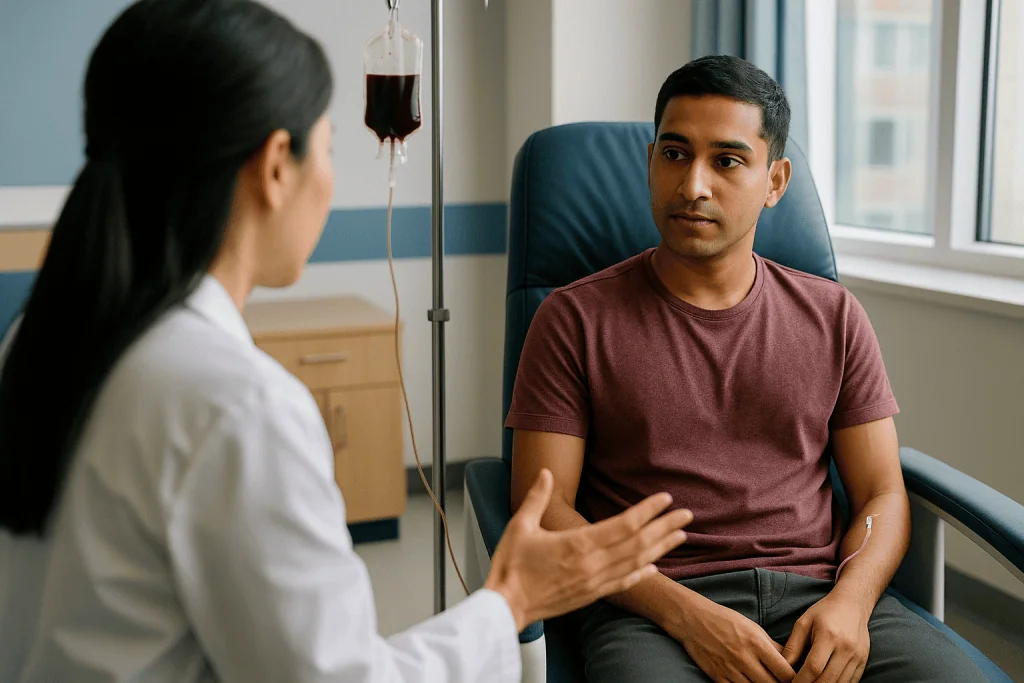
On the day, a nurse checks temperature, pulse, blood pressure, breathing rate, and weight. Weight matters because it informs how much blood is prepared. A small plastic tube called a cannula is placed in a vein, most often in the hand or forearm; children may have numbing cream applied first. Two staff members then verify your identity against the unit’s label, a step that feels repetitive but is the single most effective safeguard against giving the wrong blood (NHS).
The infusion itself runs through a filter and pump. Each unit typically takes a couple of hours, and adults often receive two or more units per visit, so a session commonly spans several hours. Vital signs are rechecked within the first fifteen minutes of each unit, when reactions are most likely, and then at intervals.
People read, sleep, do homework, or work on laptops. Eating and drinking are usually allowed. Once the final unit finishes, the cannula is removed, a final set of observations is taken, and many programs check a post-transfusion hemoglobin. You leave with the date of the next pre-transfusion blood draw, and the cycle resets.
How is donor blood matched for someone with thalassemia?
Ordinary transfusion for surgery matches the two main blood group systems, ABO and Rh(D). Someone receiving blood every month for decades needs more, because repeated exposure to unfamiliar red cell markers can teach the immune system to attack donor cells. This process is called alloimmunization: the body makes antibodies against donor red cell antigens it does not share. Guidelines report it developing in a meaningful minority of people on long-term transfusion, in some series roughly one in ten to one in five, and it becomes more likely the more mismatched exposures accumulate (NIH Bookshelf).
To reduce that risk, thalassemia programs typically determine a person’s extended red cell phenotype before the first transfusion, meaning they map several additional antigen systems beyond ABO and Rh(D). Guidelines recommend matching at least for the Rh antigens C and E and for the Kell system, and many centers match more broadly when antibodies have already appeared.
Two other preparation steps are standard:
- Leukoreduction. White blood cells are filtered out of the unit. They contribute nothing useful to someone with anemia but are a leading cause of fever-type reactions and can carry certain viruses.
- Freshness. Red cells lose viability during storage. Guidelines express a preference for units stored for a shorter period so that more of the transfused cells survive and the interval between visits holds.
Once an antibody forms, it is recorded permanently and every future unit must lack that antigen. This is why carrying a transfusion record, and telling any new hospital about known antibodies, genuinely matters. It also explains why finding compatible blood occasionally takes longer, especially for people whose ancestry differs from most local donors.
Thalassemia transfusion schedule at a glance
The table below summarizes the elements a typical schedule is built around, drawn from the international guideline referenced throughout this article (NIH Bookshelf). Individual plans differ, and every value here is a starting range rather than a rule.
| Element | Typical guideline range | Why it matters |
|---|---|---|
| Interval between visits | Every 2 to 5 weeks | Set so hemoglobin stays above the floor; shorter when the spleen is large or growth is rapid |
| Pre-transfusion hemoglobin | About 9 to 10.5 g/dL (higher in some cardiac cases) | Suppresses marrow overactivity while limiting total iron intake |
| Post-transfusion hemoglobin | Generally not above 14 to 15 g/dL | Avoids thickened blood without added benefit |
| Donor matching | ABO, Rh(D), plus C, E, Kell at minimum | Reduces the chance of forming antibodies |
| Unit preparation | Leukoreduced, preferably recently collected | Fewer reactions, longer red cell survival |
| Iron monitoring | Serum ferritin regularly; organ imaging by MRI as available | Detects iron accumulation before organ damage |
A few observations about how these pieces interact. The interval and the hemoglobin floor are two sides of one coin: hold the floor steady and the interval follows. Matching and preparation protect the schedule from being disrupted by antibodies or reactions. And iron monitoring is the quiet counterweight to everything else, because a schedule that keeps hemoglobin beautifully steady while iron accumulates unchecked is not a successful schedule.
If your own plan sits outside these ranges, that is not automatically a concern. Ask your team what drives the difference; the answer is usually specific and reasonable.
What the days and weeks between transfusions usually feel like
Many people describe a predictable arc. In the first few days after a transfusion, energy is at its peak, color returns to lips and nail beds, and concentration feels easier. A minority notice a mild headache or feel slightly puffy from the fluid volume for a day; this typically settles on its own. Mild soreness at the cannula site is common and fades within a day or two.
The middle weeks tend to be uneventful, which is precisely the point of a well-set schedule. If the interval is right, there should not be a dramatic slump before the next visit. Feeling noticeably breathless, exhausted, or unable to keep pace with friends in the final week is a signal that the schedule may need adjusting, and it is worth mentioning at the next appointment rather than quietly enduring it (Mayo Clinic).
For children, the schedule is woven around school. Some families request the same weekday each cycle so teachers can plan; others rotate days so the same class is not always missed. Older children often take homework to the unit. Sports are generally encouraged between visits, with common sense about contact sports if the spleen is enlarged, a question for the team.
The rest of the routine runs in parallel. Iron-removing medication, discussed in the next section, is usually taken daily regardless of where in the cycle you are. Clinic reviews every few months check growth, heart and liver iron, hormone function, and vaccination status (NHS).
Over years, the rhythm becomes background. The red dot on the calendar stops feeling like a medical event and starts feeling like laundry day: unglamorous, non-negotiable, and simply part of how life runs.
Why iron overload after transfusion happens, and how chelation fits in
Here is the paradox at the heart of thalassemia care: the treatment that keeps someone alive slowly delivers a substance that can harm them. Every unit of red cells contains iron bound inside hemoglobin. When those donor cells reach the end of their life, the iron is released and stored, and the human body has no active mechanism to excrete iron in meaningful amounts. Month after month, it accumulates, first in the liver, then in the heart, pancreas, pituitary, and other glands (CDC).
Untreated, transfusion-related iron overload is the leading cause of serious complications in transfusion-dependent thalassemia, particularly heart failure and rhythm disturbances, along with diabetes, delayed puberty, and liver damage (NIH Bookshelf). This is why the transfusion schedule and iron management are always designed together.
Chelation is the general term for medicines that bind excess iron so it can leave the body in urine or stool. Several agents exist, given by different routes; the class works by grabbing iron molecules and escorting them out. International guidelines describe chelation being considered after roughly the first ten to twenty transfusions, or once the blood marker ferritin rises past a defined level, with the choice of agent, route, and adjustments left to the treating physician (NIH Bookshelf).
Monitoring uses two windows into the body. Ferritin is a blood test that roughly tracks stored iron, though it also rises with inflammation. MRI of the liver and heart, where available, measures iron directly in those organs and has become the preferred way to catch cardiac iron early, since ferritin alone can be misleading.
Adherence to chelation over decades is difficult, and clinicians know it. If the regimen is not fitting your life, the useful conversation is about options, not blame.
What are the risks of long-term transfusion?
Beyond iron, regular transfusion carries a set of risks that a good program manages actively rather than ignores. Presenting them plainly is not meant to frighten; a person who knows what a reaction looks like can act early.
Acute reactions during or shortly after the infusion. The most common are fever and chills, or an itchy rash, usually mild and manageable in the unit. Leukoreduction has made febrile reactions less frequent. Rarely, a severe allergic reaction or an acute hemolytic reaction, in which the immune system destroys the transfused cells, can occur; these are why staff monitor closely in the first minutes of each unit (Cleveland Clinic).
Delayed hemolytic reactions. Days to a couple of weeks later, a previously undetectable antibody can strengthen and begin destroying donor cells. The clue is a hemoglobin that falls faster than expected, sometimes with dark urine or yellowing of the eyes.
Alloimmunization. Discussed earlier, this complicates future matching and can shorten the life of transfused cells.
Infection transmission. Donated blood in well-regulated systems is screened for HIV, hepatitis B and C, and other agents, and the residual risk is very low. Guidelines nonetheless recommend hepatitis B vaccination and periodic screening for people on long-term transfusion (NIH Bookshelf).
Circulatory overload. Too much volume too quickly can strain the heart, particularly in people with existing cardiac iron. Slower infusion rates and careful volume planning address this.
Every one of these risks is weighed against the alternative, which in transfusion-dependent disease is severe, progressive anemia. The comparison is not close. The purpose of naming the risks is to make the schedule safer, not to question whether it should exist.
Transfusion dependent thalassemia treatment: are there alternatives to lifelong transfusion?
For most people with transfusion-dependent thalassemia today, regular transfusion plus chelation remains the foundation of care. Several other approaches exist, each with a specific role and specific limits. They are described here neutrally; whether any applies to a given person is a decision for the treating team.
Stem cell transplant. Replacing the faulty bone marrow with donor stem cells is the only established treatment that can end transfusion dependence. It requires a suitably matched donor, usually a sibling, carries real risks from the conditioning treatment and from graft-versus-host disease, and outcomes vary with age and how much iron-related organ damage has already occurred. Guidelines describe it as best considered early in childhood when a matched donor exists (Mayo Clinic).
Gene-based therapies. Techniques that modify a person’s own stem cells to produce functional hemoglobin have been approved in some countries for certain patients. Long-term data are still accumulating, access is limited, and the treatment involves intensive chemotherapy-style conditioning. This remains a specialist conversation rather than a routine option.
Medicines that improve red cell maturation. A class of injected agents that help immature red cells develop has been shown in trials to reduce transfusion requirements in some adults, without eliminating them. Whether it suits an individual, and what to expect, is for the prescribing hematologist to assess.
Splenectomy. Removing an enlarged spleen can reduce how fast transfused cells are destroyed, lowering blood requirements. Because the spleen fights certain infections, guidelines now reserve this for specific situations and require vaccination and lifelong infection vigilance afterward (NIH Bookshelf).
None of these replaces a well-run transfusion program for the majority. They widen the menu; they do not yet retire the red dot on the calendar for most families.
What people often get wrong about thalassemia transfusions
“If I feel fine, I can push the next transfusion back.” Feeling well at the usual interval is exactly what the schedule is designed to produce; it is evidence the timing is right, not that it is unnecessary. Letting hemoglobin fall lower reactivates marrow overgrowth and spleen enlargement, which are silent until they are not. Skipping or delaying without discussing it with the team undoes the protective effect.
“Iron-rich food or supplements will help my anemia.” In transfusion-dependent thalassemia, the anemia is not caused by iron deficiency, and the body is already receiving more iron than it can handle from transfusion. Iron supplements are generally avoided unless a doctor has confirmed a specific deficiency (CDC). Ask before taking any multivitamin.
“Transfusion is a temporary fix while we wait for the real treatment.” For most people it is the real treatment, and a highly effective one when paired with chelation. Life expectancy for people with transfusion-dependent thalassemia has improved substantially over recent decades largely because of better transfusion and iron management, not because of newer therapies (NIH Bookshelf).
“A higher hemoglobin is always better.” Above the guideline range, extra hemoglobin adds iron and blood viscosity without adding benefit. The target is a window, not a ceiling to aim for.
“Once I have antibodies, blood will never be safe.” Antibodies make matching more complex, not impossible. Laboratories routinely find compatible units for people with several antibodies; it may simply take longer, which is one reason pre-visit samples are drawn early.
“Chelation is only needed when ferritin is high.” Ferritin lags behind organ iron and rises with inflammation. Ongoing chelation is a steady counterweight to steady iron intake, not a response to a single abnormal number.
Questions to ask your care team
A transfusion schedule works best when the person receiving it understands the reasoning. These questions tend to produce useful, specific answers. Write down the replies; they change as you grow and as your situation evolves.
- What is my personal pre-transfusion hemoglobin target, and does it differ from the standard guideline range? If so, why?
- How has my hemoglobin been trending at the pre-visit check over the past year? Is the interval still right?
- Which red cell antigens am I matched for, and do I have any recorded antibodies? Can I have a card or letter listing them for emergencies or travel?
- Is my blood leukoreduced, and how fresh are the units I usually receive?
- How is my iron being monitored? When was my last liver and heart MRI, and what did it show?
- When did or will chelation begin, and how will you decide whether the current approach is working?
- How is my spleen size being tracked, and what would prompt a discussion about splenectomy?
- What vaccinations are recommended for me, including hepatitis B, and are they up to date?
- For a child: how are growth, puberty, and school attendance being monitored alongside the schedule?
- Am I a candidate for any of the newer approaches, and what would that conversation involve?
- Who do I contact, and how, if I develop a fever, dark urine, or unusual breathlessness between visits?
- If I need to travel or relocate, how do I arrange continuity of transfusion and share my records?
Bring a family member or friend to at least one review each year. Two sets of ears catch more, and long-term conditions are easier to carry when the plan is shared (NHS).
When to call your doctor
Most transfusion cycles pass without incident, and the schedule itself is the safety net. Certain signs, however, warrant contacting your hematology team the same day, or seeking emergency care if they are severe.
During or within hours of a transfusion: fever or shaking chills; a new rash, itching, or facial swelling; chest pain, back or loin pain, or a feeling of dread; difficulty breathing or wheezing; a racing heartbeat; blood or dark color in the urine. Staff will stop the infusion and assess. If you have already left the unit and notice these, call the number you were given or go to emergency care (Cleveland Clinic).
In the days and weeks between visits: yellowing of the eyes or skin, dark urine, or sudden fatigue and pallor well before the next appointment, which can signal delayed destruction of donor cells; any fever, especially if the spleen has been removed, because infections can progress quickly in that setting; shortness of breath at rest, swelling of the ankles, or palpitations, which in someone with iron overload need prompt cardiac assessment; abdominal pain, particularly on the left side under the ribs, which can indicate spleen problems (NHS).
For children: refusing to eat or drink, unusual sleepiness or irritability, or a fever that does not settle should be reported promptly rather than waited out.
Do not adjust or stop chelation or any prescribed medicine on your own if you feel unwell; call and ask. Symptoms that seem minor in isolation are often meaningful when placed alongside the trend your team already holds. When in doubt, the phone call is always the right choice, and no experienced team will fault you for making it.
Frequently asked questions
How often do thalassemia patients need a transfusion?
Most people with transfusion-dependent thalassemia receive red cells every two to five weeks, with many settling around every three to four weeks. The interval is individualized so hemoglobin does not fall below the target floor before each visit. Spleen size, growth, infections, and the presence of red cell antibodies all shift where a person lands in that range, and the treating hematologist adjusts the plan over time.
What is the thalassemia hemoglobin transfusion threshold?
International guidelines describe a pre-transfusion hemoglobin target of about 9 to 10.5 g/dL for people on regular transfusion, with a higher range of around 11 to 12 g/dL in specific situations such as heart complications. The aim is to suppress marrow overactivity and support normal growth while limiting total iron intake. Your own target may differ; ask your team why.
What are the latest blood transfusion guidelines for thalassemia?
The core recommendations have remained stable across guideline editions: keep pre-transfusion hemoglobin around 9 to 10.5 g/dL, transfuse every two to five weeks, use leukoreduced blood matched beyond ABO and Rh(D), and pair transfusion with iron monitoring and chelation. Updates tend to refine details such as antigen matching and MRI-based iron assessment rather than change the targets. Your hematology team can tell you which guideline they follow.
What is the recommended transfusion protocol for patients with thalassemia?
A typical protocol includes a pre-visit blood sample for hemoglobin, antibody screening, and cross-matching; identity verification at the chair; leukoreduced red cells matched for ABO, Rh(D), C, E, and Kell; infusion over several hours with monitoring for reactions; and a post-transfusion hemoglobin check. Ferritin and organ MRI track iron, and chelation runs alongside. Details vary by program and are set by the treating team.
How long does each transfusion visit take?
Each unit of red cells usually infuses over roughly two hours, and adults commonly receive two or more units per visit, so a session often spans several hours including observations before and after. Children receiving smaller volumes may be finished sooner. Pre-visit blood draws done a day or two ahead help avoid waiting for the laboratory on the day.
Why does iron overload after transfusion happen if I am anemic?
The anemia in thalassemia is caused by faulty hemoglobin production, not a shortage of iron, so the body is not short of iron to begin with. Every unit of donor red cells brings in iron that is released when those cells break down, and the body has no way to excrete it in meaningful amounts. Over months and years it accumulates in the liver, heart, and glands, which is why chelation accompanies transfusion.
Can I skip a transfusion if I feel well?
Feeling well at the scheduled time usually means the interval is correctly set, not that the transfusion is unnecessary. Delaying allows hemoglobin to fall lower, which reactivates the marrow overgrowth and spleen enlargement the schedule is designed to prevent. If timing is a problem for travel, exams, or work, discuss it with your team, who can sometimes adjust the plan safely rather than leave a gap.
What happens if I develop antibodies to donor blood?
Antibodies, known as alloimmunization, are recorded permanently and every future unit must lack the matching antigen. This makes finding compatible blood more complex and can occasionally take longer, especially where donor ancestry differs from the recipient’s, but it rarely makes transfusion impossible. Carrying a record of your antibodies and informing any new hospital is important for safety.
Is transfusion dependent thalassemia treatment lifelong?
For most people, yes: regular transfusion and chelation continue throughout life. Stem cell transplant is the only established treatment that can end transfusion dependence, and it requires a matched donor and carries its own risks. Gene-based therapies and medicines that improve red cell maturation exist for selected patients, but whether any applies to an individual is a specialist decision made with the treating team.
Should I take iron supplements or eat more iron-rich food?
Generally no. People on regular transfusion already receive more iron than the body can handle, and supplements would add to the burden. Iron is usually avoided unless a doctor has confirmed a specific deficiency, and many teams also advise checking before taking multivitamins. Vitamin C should also be discussed with your clinician, as it can affect how iron is absorbed and released.
References
- Guidelines for the Management of Transfusion Dependent Thalassaemia (NIH Bookshelf)
- About Thalassemia (CDC)
- Thalassaemia: Treatment (NHS)
- Thalassemia (MedlinePlus)
This article is for general information only and is not a substitute for professional medical advice. Please consult a qualified doctor about your individual situation.

More from the Blog

How Neutrophil Counts Are Followed as Neutropenia Recovers and When Precautions Ease
As neutropenia recovers, care teams repeat a complete blood count with differential and watch the absolute neutrophil count (ANC) climb back through defined thresholds:…

How a Bone Marrow Biopsy and Immune Testing Pin Down the Cause of Bone Marrow Failure
A bone marrow biopsy shows whether the marrow is empty, scarred, crowded with abnormal cells or making faulty cells, which a blood count alone…

Transfusion Support in Myelodysplastic Syndrome: How It Is Scheduled and Iron Is Monitored
Transfusion support in myelodysplastic syndrome means giving donated red cells or platelets on a schedule set by the person's symptoms, blood counts, and how…

Living With Myelofibrosis: Fatigue, Appetite and Activity Planning Between Visits
Living with myelofibrosis fatigue usually means working with, not against, a body whose bone marrow is scarred and whose spleen may be enlarged. Between…

Bone Marrow Transplant for Aplastic Anemia: Donor Matching, Conditioning and Recovery
A bone marrow transplant for aplastic anemia replaces a failing marrow with healthy blood-forming stem cells from a donor, usually an HLA-matched sibling or…

Everyday Precautions With Neutropenia: Food Handling, Crowds, Hygiene and Travel
Living with neutropenia means lowering your exposure to germs while your neutrophil count is low. Core precautions include thorough handwashing, cooking meat, eggs and…