

RF Microneedling Downtime: Redness, Grid Marks and When You Can Wear Makeup Again

Key Takeaways
- Redness after RF microneedling typically peaks within the first 24 hours and fades over one to three days, while grid marks and dryness can persist for up to about a week.
- The grid pattern is simply the needle array imprinted in micro-wounds; the channels seal within hours, but the visible dots slough off with normal skin turnover over several days.
- Most care teams advise waiting at least 24 hours, and often two to three days, before applying makeup, and choosing mineral-based, fragrance-free products on clean tools when you do.
- Post-inflammatory hyperpigmentation is a delayed side effect that tends to appear two to four weeks after treatment and is most preventable with strict sun protection during healing.
- Published protocols for acne scarring commonly use three to six sessions spaced about a month apart, so two sessions may address mild texture but rarely deeper scarring or laxity.
- Redness that spreads, deepens, or becomes hot and painful after initially improving is the pattern that points to infection rather than normal healing and needs a same-day call.
RF microneedling downtime is usually short. Redness and mild swelling typically peak in the first 24 hours and fade over one to three days, while fine grid marks, tightness and dryness can persist for up to about a week. Most care teams advise skipping makeup for at least 24 hours and until the skin surface feels closed, but your own clinician sets the exact timing.
It is seven in the evening, the numbing cream has long worn off, and the face in the bathroom mirror looks like it spent an afternoon in a wind tunnel: flushed, faintly puffy, and stamped with a pattern of tiny dots so regular it could have been drawn with graph paper. The treatment took forty minutes. The question that follows takes much longer: is this normal, how long will it last, and can I hide it before Thursday’s meeting?
People rarely worry about the procedure itself. They worry about the days afterward, because those are the days other people can see. Understanding rf microneedling downtime means knowing what the skin is actually doing under that redness, why the grid appears, and which changes are part of healing rather than a sign that something has gone wrong.
This guide walks through that recovery in plain language, day by day, with the evidence where it exists and honest uncertainty where it does not.
What rf microneedling downtime really looks like
Downtime, in the cosmetic sense, is the stretch of time when your skin looks or feels visibly “treated” and daily life has to bend around it. For radiofrequency microneedling, that window is measured in days, not weeks, which is the main reason the procedure attracts people who cannot disappear for a fortnight.
The immediate picture is fairly predictable. The face turns pink to red, roughly the shade of a moderate sunburn, and feels warm and tight. Mild swelling appears around the eyes and along the jaw, often more noticeable the next morning after lying flat overnight. Fine pinpoint dots follow the needle pattern, and in some areas tiny specks of dried blood or a sandy crust form where the needles entered. The Cleveland Clinic describes redness and mild irritation lasting a few days after microneedling, and a comprehensive review in Dermatologic Surgery reports that erythema, the medical word for redness, usually settles within two to three days for standard microneedling, with deeper or more energetic treatments sitting at the longer end.
Radiofrequency adds heat to the picture. Because RF energy warms the deeper skin, swelling and warmth can be slightly more pronounced than after needling alone, and dryness or light flaking is common in the second half of the first week as the surface renews itself. What the evidence does not support is the idea of a fixed, universal timeline. Depth, energy, the number of passes, your skin’s baseline reactivity and whether the neck or chest was treated all shift the range. Treat any day-by-day chart, including the one below, as a typical pattern rather than a schedule your skin has agreed to.
How RF microneedling works, and why the skin reacts the way it does
Two things happen at once during an RF microneedling session. A handpiece studded with very fine needles is pressed into the skin, creating hundreds of microscopic channels through the epidermis, the thin outer layer, into the dermis, the thicker layer beneath where collagen and elastin live. At the tip of each needle, radiofrequency energy, an electrical current oscillating at high frequency, is released for a fraction of a second. The tissue around the tip heats, while the surface between needles is largely spared.
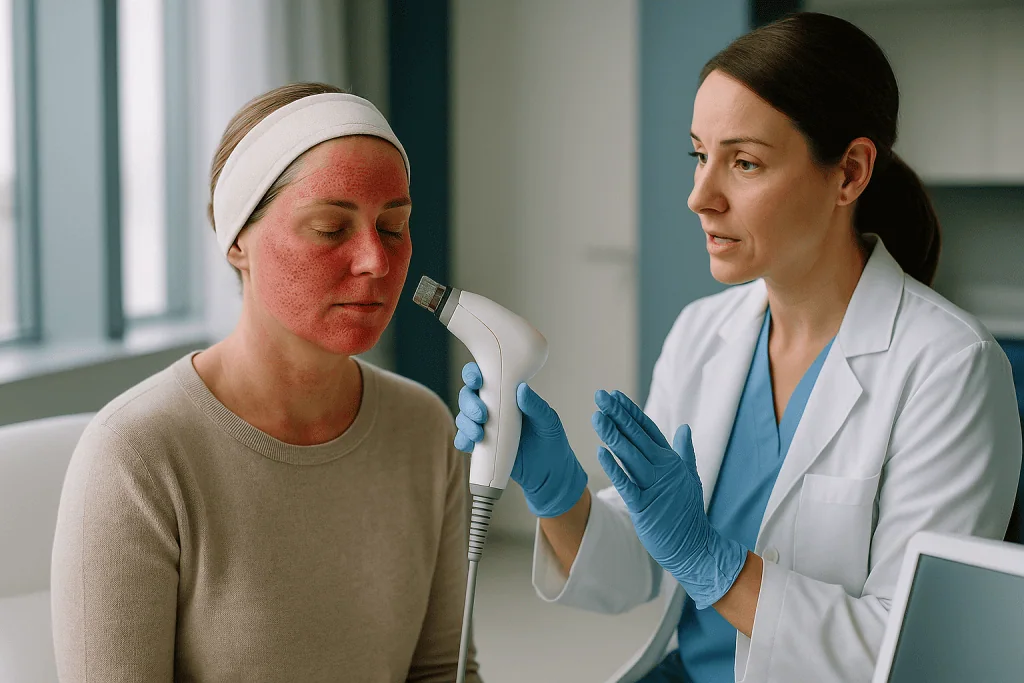
The point is deliberate, controlled injury. Collagen is the structural protein that gives skin its firmness; fibroblasts are the cells that manufacture it. Heat and mechanical puncture together trigger a wound-healing cascade in which fibroblasts are recruited, existing collagen fibers contract, and new collagen is laid down over the following weeks and months. The Dermatologic Surgery review describes this neocollagenesis, meaning new collagen formation, as the mechanism behind improvements in texture, fine lines and acne scarring.
Everything you see during downtime is that cascade in progress. Redness is blood flow rushing to the area. Swelling is fluid carrying immune cells and repair signals. Warmth is the residual thermal effect plus inflammation. The grid is simply where the needles went. None of it is the result; it is the construction site.
Insulated needles, which deliver energy only at the tip, are one reason RF microneedling tends to cause less surface damage than devices that heat the whole skin surface. That design detail is also why the downtime is generally shorter than with ablative lasers, which remove the outer layer entirely, a comparison that becomes clearer in the table further on.
Why do grid marks appear after RF microneedling?
The grid is the feature people photograph and post online, half alarmed, half fascinated. It looks manufactured because it is: the needles sit in a fixed array on the tip, so each stamp leaves an identical pattern of dots. Where stamps overlap or where the operator lifts the device at a slight angle, the pattern can look denser or smeared, especially along the jaw and temples where the skin curves.
Each dot is a micro-wound. Within hours the body seals it with a plug of dried plasma and a few red cells, producing the sandpaper feel that many people notice on the second day. Petechiae, the medical term for pinpoint bleeding under the skin, can accompany the grid in thinner-skinned areas such as under the eyes or on the neck, and these small red-purple flecks fade as the blood is reabsorbed.
Timing follows the general rule for superficial wounds. The Dermatologic Surgery review notes that the microchannels created by needling close rapidly, within hours, which is why the skin is considered a barrier again quite quickly even while marks remain visible. The visible dots usually soften over three to five days and slough off with normal cell turnover during the first week; the Cleveland Clinic similarly frames visible aftereffects of microneedling as lasting a few days. Deeper settings and treatment on the body can stretch that.
What you should not do is help the process along. Picking, scrubbing or using exfoliating acids on grid marks removes the protective plugs before the skin beneath is ready and raises the risk of pigment changes, particularly in medium to deep skin tones. Let the grid leave on its own timetable.
RF microneedling recovery timeline: what the first two weeks usually look like
Think of recovery in three overlapping phases rather than a strict calendar. The ranges here reflect what the Cleveland Clinic and the Dermatologic Surgery review describe for microneedling generally, adjusted for the added heat of radiofrequency; your team’s aftercare sheet overrides all of it.
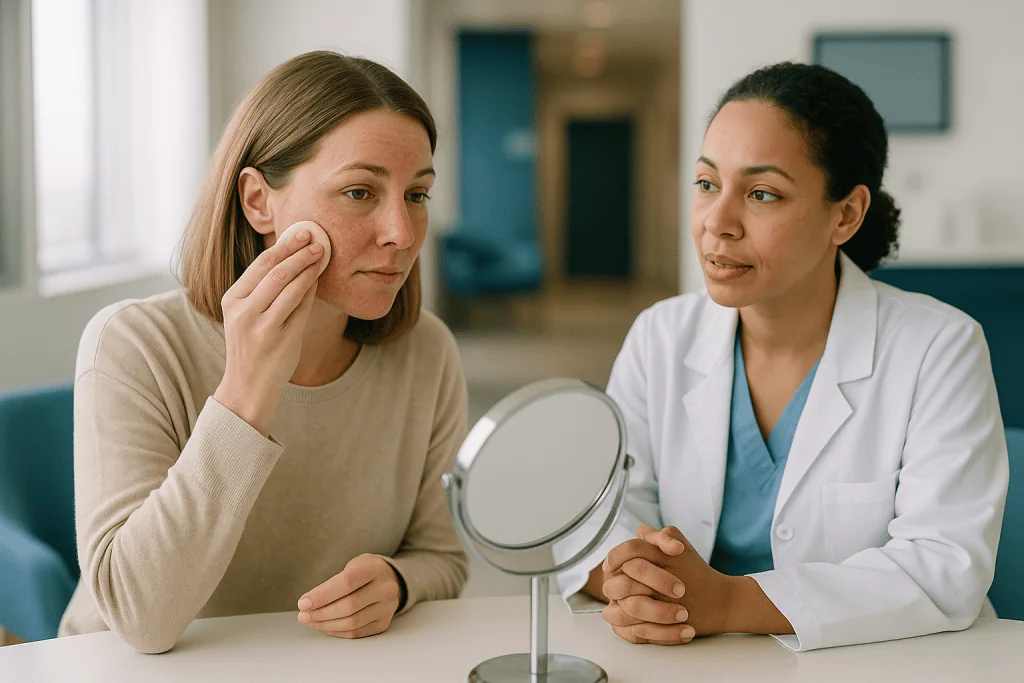
Hours zero to 24: the flush. Redness and warmth are at their most intense in the first few hours. Many people describe a sensation like a hot shower that will not switch off. Swelling builds overnight. Skin may weep tiny beads of clear fluid. Cool, clean compresses and a bland moisturizer approved by your team are the usual comfort measures.
Days one to three: the fade. Redness shifts from red to pink to blotchy. Swelling is often worst on the morning of day two, then recedes. Grid marks become more defined as they dry. The skin feels tight, itchy or papery. This is when most people ask about makeup, a question with its own section below.
Days three to seven: the shed. Fine flaking or roughness appears as the treated surface turns over. The grid loosens and disappears in patches. Pinkness lingers in some people, especially those who flush easily or have a history of rosacea. By the end of the week most faces look unremarkable to anyone who did not know.
Week two onward: the quiet work. Visibly, little is happening. Beneath the surface, fibroblasts are producing collagen, a process the review describes as continuing for weeks to months. Texture improvements, if they come, arrive slowly and cumulatively, which is why teams commonly space sessions roughly a month apart.
When can you wear makeup after RF microneedling?
The honest answer is: when your skin has closed, and your care team says so. Both halves matter, and the second half usually comes with a specific number of hours written on your aftercare sheet.
The reasoning is about barrier function. For a short period after treatment the surface is dotted with microchannels and coated in fluid and micro-crusts. Anything applied during that window, including pigments, preservatives, fragrance and the bacteria living on a used brush, can enter more deeply than it would on intact skin. The Cleveland Clinic advises avoiding makeup in the immediate period after microneedling, and most published patient guidance clusters around a minimum of 24 hours, extended by many practitioners to two or three days for RF devices, where heat prolongs surface sensitivity. Those figures describe common practice, not a rule proven by trials.
When you do return to makeup, the type and the tools matter as much as the timing. Mineral-based, fragrance-free, non-comedogenic products, meaning those formulated not to block pores, are the usual first choice. Clean brushes or a freshly washed sponge reduce the bacterial load. Applying with fingertips is fine if hands are washed first.
Removal deserves equal care. Oil cleansers, micellar water on a soft pad and lukewarm rinsing are gentle; rubbing, scrubbing brushes and exfoliating wipes are not. If makeup stings on application, that is the skin telling you the barrier is not ready. Wait another day.
One practical note for anyone with a fixed event: many people find tinted mineral sunscreen a more forgiving bridge than full foundation in the first week, because it serves the sun-protection goal at the same time.
Redness, swelling and heat: what is normal and what is not
Redness is expected. Redness that behaves unexpectedly is the thing to watch. The distinction lies in direction, symmetry and company.
Normal post-treatment erythema is diffuse, roughly symmetrical, warm rather than hot, and improving each day. It may look worse first thing in the morning and settle by lunchtime. Swelling follows the same arc, peaking within 48 hours and receding. Itching during the flaking phase is common and reflects dryness and nerve endings recovering, not allergy.
The pattern that warrants a call is redness that reverses course: it was fading, then deepened; it was even, then became a single hot, tender, spreading patch; it was painless, then began to throb. Cellulitis, a bacterial infection of the deeper skin layers, typically presents as an expanding area of red, hot, swollen and painful skin, sometimes with fever or chills, according to the NHS. It is uncommon after microneedling when hygiene protocols are followed, but any breach in the skin is a potential entry point.
Small clusters of fluid-filled blisters, particularly around the mouth, are a different problem. Herpes simplex, the cold sore virus, can reactivate after skin trauma; people with a history of cold sores are often asked about it beforehand so the team can decide whether preventive antiviral medicine is appropriate. That decision sits with the prescriber.
Hives, widespread itching, or swelling of the lips and eyelids that appears suddenly points toward a reaction to a topical product rather than the procedure itself. Stop the product and contact the team. Persistent pinkness beyond two weeks without other symptoms is more often a feature of reactive skin than a complication, but it is still worth reporting so the next session’s settings can be adjusted.
RF microneedling side effects that show up later
Most side effects announce themselves in the first three days and leave by the end of the first week. A smaller group arrives later, and these are the ones people are least prepared for because the aftercare sheet has already been thrown away.
Post-inflammatory hyperpigmentation, or PIH, is the appearance of brown or gray patches where skin was inflamed. It typically emerges two to four weeks after treatment rather than immediately, and the risk rises with darker skin tones, unprotected sun exposure during healing, and overly aggressive settings. The Dermatologic Surgery review identifies PIH as a recognized, usually temporary, complication of microneedling. Daily broad-spectrum sunscreen and shade in the weeks after treatment are the primary preventive measures; the CDC’s general guidance to seek shade, wear protective clothing and use broad-spectrum sunscreen applies with extra force to healing skin.
Tram-tracking describes fine linear marks left when the device is dragged rather than stamped. It usually resolves with time but can be slow.
Acne flares can occur in the second week, sometimes from occlusive healing balms, meaning products that seal the skin, trapping oil and bacteria in pores. Small white bumps called milia can form for the same reason.
Prolonged textural roughness or a sensation of numbness or tingling over treated areas occasionally lingers for weeks as small nerve fibers recover. Rare reports describe changes in fat beneath the skin or scarring, generally linked to excessive energy or depth, which is one reason the operator’s training matters more than the brand of device.
Report any of these to the team that treated you. Most respond to time, protection and adjusted settings at the next visit, but they need to be seen, not guessed at.
Who is RF microneedling usually for, and who is asked to wait
The typical candidate is an adult with textural concerns that live in the dermis: acne scarring, fine lines, enlarged pores, mild skin laxity along the jaw or neck, or uneven surface quality that does not respond to skincare alone. The Dermatologic Surgery review lists scarring, rhytides (the clinical word for wrinkles) and skin laxity among the indications with the most supporting evidence, while noting that much of that evidence comes from small studies.
An important strength of needle-based treatments is that they do not rely on pigment as a target, unlike many lasers. This makes RF microneedling a common option across a wider range of skin tones. That said, deeper skin tones carry a higher risk of post-inflammatory pigment change from any inflammatory procedure, so conservative settings and strict sun protection matter more, not less.
Several groups are commonly asked to postpone or to think carefully. Active acne with pustules, open wounds, eczema flares or an active cold sore in the treatment area raise infection and spread risk. A history of keloids, which are raised scars that grow beyond the original wound, is a caution because any injury can trigger them. People taking isotretinoin, an oral retinoid for severe acne, are traditionally asked to wait a period after finishing it; the ideal interval is debated and belongs in a conversation with the prescriber. Pregnancy and breastfeeding are usually treated as reasons to defer because safety data are lacking, not because harm is proven. Anyone on blood thinners, with a bleeding disorder, an implanted electronic device, or metal implants near the treatment site needs a specific discussion, since radiofrequency energy and electrical devices can interact.
None of these is an automatic no. Each is a reason for a longer consultation.
How rf microneedling downtime compares with other resurfacing options
Downtime is a trade-off. Treatments that disturb the surface more tend to produce more dramatic change in one session and demand more recovery; treatments that spare the surface usually require several sessions and offer gradual results. The Mayo Clinic frames laser resurfacing exactly this way, contrasting ablative lasers, which remove the outer skin layer and need one to two weeks of healing, with nonablative lasers, which leave the surface intact and involve minimal recovery.
| Approach | What it does to the surface | Typical visible downtime | Source of range |
|---|---|---|---|
| Traditional microneedling | Mechanical channels, no heat | Redness roughly 1 to 3 days | Dermatologic Surgery review |
| RF microneedling | Channels plus heat in the dermis | Redness 1 to 3 days; grid and dryness up to about a week | Cleveland Clinic; Dermatologic Surgery review |
| Nonablative laser | Heats dermis, surface intact | Hours to a few days of redness and swelling | Mayo Clinic |
| Ablative laser | Removes outer skin layer | Raw, swollen skin healing over 1 to 2 weeks; pinkness for weeks longer | Mayo Clinic |
The table describes typical ranges from mainstream sources, not guarantees, and it omits chemical peels because their downtime spans from nothing to weeks depending on depth. It also says nothing about which option is right for you: an ablative laser may be the better tool for deep etched lines, while RF microneedling may suit someone with acne scarring and a darker skin tone who cannot risk pigment loss. That judgment belongs to the clinician examining your skin, weighing your goals against how much recovery your life can absorb.
How many RF microneedling sessions do you need, and is two enough?
Two sessions may be enough for some goals and nowhere near enough for others, which is not evasion but the shape of the evidence.
Collagen remodeling is slow and incremental. Each session adds a layer of stimulation on top of the last, and the visible effect accumulates rather than appearing all at once. The Cleveland Clinic notes that most people need multiple microneedling treatments to see results, spaced several weeks apart to allow healing between them. The Dermatologic Surgery review reports that studies of acne scarring commonly used a series of three to six treatments at monthly intervals, with improvement measured months after the final session.
Where two sessions land on that spectrum depends on the target. Mild textural dullness or slightly enlarged pores may respond noticeably after two. Rolling acne scars, deeper lines or laxity along the jawline generally sit at the upper end of the series. Skin that reacts strongly and needs conservative settings may need more sessions at lower energy rather than fewer at high energy.
The interval matters as much as the count. Sessions crowded too closely do not give fibroblasts time to complete a remodeling cycle, and repeated inflammation on skin that has not settled raises pigment risk. Spacing of roughly four to six weeks is the pattern most published protocols describe, though your team may lengthen it for reactive or deeper skin tones.
Rather than asking whether two is enough, a more useful question for your consultation is: what change would you expect after two sessions for skin like mine, how will we measure it, and at what point would we decide this approach is not the right one? Teams that answer that specifically tend to set expectations honestly.
What is the best age for RF skin tightening?
There is no best age, and any answer that gives you one is selling a schedule rather than describing skin.
What the evidence supports is a general trajectory. MedlinePlus describes how, with age, the outer skin layer thins, the connective tissue loses strength and elasticity, and the skin becomes more fragile and slower to heal. Collagen production gradually declines from early adulthood onward, and sun exposure accelerates every part of that process. Laxity, the loosening that people call sagging, becomes noticeable at different ages depending on genetics, sun history, smoking, weight changes and skin thickness.
RF microneedling works by stimulating collagen that is still capable of being produced. In practical terms, that means the treatment is generally aimed at mild to moderate laxity, the stage where the skin has begun to loosen but the underlying structure is largely intact. Someone in their thirties with early softening along the jaw and someone in their sixties with significant laxity are asking the device to do very different jobs, and honest clinicians will say when the second job is beyond it. Marked laxity, heavy jowls or excess skin generally point toward a surgical conversation, not a dermal one.
Younger skin is not automatically a better candidate either. Skin without laxity or scarring has little for the treatment to improve, and any procedure carries a small risk of complications; the ratio of possible benefit to possible harm is the thing to weigh. Age matters less than three questions: is there a specific concern a clinician can see, is that concern the kind this treatment addresses, and is the skin healthy enough to recover well? Those questions apply identically at 32 and at 62.
How do you know if RF microneedling is working?
The frustrating truth is that the first sign of success looks like nothing at all. Once the redness fades and the grid sheds, the face returns to baseline, and the collagen response is happening at a depth no mirror can see.
Visible change, when it comes, tends to arrive in a particular order. Surface texture usually shifts first: skin may feel smoother to the touch and reflect light more evenly within a few weeks, as the outer layer renews. Pore appearance and fine lines follow over one to three months. Scarring and laxity are the slowest, because they depend on structural remodeling that the Dermatologic Surgery review describes as continuing for months after treatment. Studies in that review generally assessed final results at least three months after the last session, and some noted continued improvement beyond that.
Because memory is unreliable and lighting is not, standardized photographs are the most honest yardstick. Reputable teams take them before the first session in fixed lighting, at a fixed distance, without makeup, and repeat them at the same settings before each subsequent visit and a few months after the series ends. Side-by-side comparison in those conditions is more trustworthy than a good day in a sunny bathroom.
Absence of improvement after a completed series is meaningful information, not a personal failure. It may indicate that settings were too conservative, that the concern is deeper than the treatment reaches, or that a different approach suits your skin better. It is also worth knowing that no mainstream guideline quotes a success percentage for RF microneedling, and studies use different scoring systems that make pooling difficult. Anyone who gives you a precise figure is quoting a study population, a marketing document, or a guess.
What people often get wrong about RF microneedling downtime
Recovery advice travels quickly online and mutates as it goes. A few of the most persistent misunderstandings deserve a direct correction.
“More redness means it worked better.” Redness reflects blood flow and inflammation, which vary enormously between people. Someone who flushes at a glass of wine will glow for days after gentle settings; someone with calm, thicker skin may barely pink up after a deep pass. Neither tells you how much collagen is being made.
“Microneedling ages you faster because it damages the skin.” There is no evidence in the mainstream literature that properly spaced, professionally performed microneedling accelerates aging. The Dermatologic Surgery review describes the mechanism as a controlled wound-healing response that increases collagen, the opposite direction from age-related loss. What can harm skin is chronic inflammation from sessions crowded too closely, home devices used too often or too deeply, and sun exposure during healing. Frequency and technique, not the concept, are the risk.
“Downtime is over when the redness is gone.” The barrier can remain fragile and sun-sensitive for a week or more after the color fades. Sunscreen, gentle products and no exfoliating acids for the period your team specifies still apply.
“A heavy healing balm speeds recovery.” Occlusive products can trap oil and bacteria in microchannels and provoke breakouts or milia. Bland, light moisturizers are the usual recommendation unless your team specifies otherwise.
“Peeling means the skin is damaged.” Light flaking in the first week is the normal turnover of a stimulated surface. Sheets of peeling, blistering or oozing beyond the first day are not, and those warrant a call.
Questions to ask your care team before and after treatment
A good consultation should leave you able to describe your own recovery before it starts. If it does not, these questions usually get you there.
Start with the specifics of your plan. What depth and energy settings are you proposing for my skin type and concern, and why? How many sessions do you anticipate, and at what interval? What change would you realistically expect after that series, and how will we photograph and measure it? At what point would you conclude this is not the right treatment for me?
Then move to recovery. Given those settings, how long do you expect my redness and grid marks to last? When, specifically, can I wash my face, apply moisturizer, wear sunscreen, and wear makeup, and which products do you want me to avoid? Should I pause any of my current skincare, and for how long? Which of my prescribed medicines, if any, need a conversation with my prescriber before treatment?
Ask about risk in your own terms. What is my personal risk of pigment change, and what will we do to reduce it? Do I need any preventive medicine for cold sores, given my history? What will you do if I develop an infection or an unexpected reaction, and how do I reach you outside clinic hours?
Finally, ask about the operator and the device. Who will actually perform the treatment, and what is their training in this specific procedure? Is the device cleared by the relevant national regulator for this use? Are the needle tips single-use?
Write the answers down. Aftercare instructions given verbally while your face is numb and flushed are the ones most likely to be forgotten by the following morning.
When to call your doctor
Most RF microneedling recoveries need nothing more than patience, sunscreen and a bland moisturizer. A small number need a clinician, and the difference is usually visible if you know what to look for. Contact the team that treated you, or your regular doctor, if any of the following appear.
- Redness that was improving and then spreads, deepens or becomes hot, tender and swollen in one area, particularly with fever, chills or feeling generally unwell. The NHS describes these as features of cellulitis, a bacterial skin infection that requires prompt medical assessment.
- Pus, yellow crusting, or foul-smelling discharge from treated areas.
- Clusters of small fluid-filled blisters, especially around the mouth or nose, which may signal reactivation of the cold sore virus.
- Pain that increases after the first 24 hours rather than easing, or pain out of proportion to the way the skin looks.
- Sudden swelling of the lips, tongue, eyelids or throat, widespread hives, or difficulty breathing. These are signs of a serious allergic reaction and are an emergency.
- Sheets of peeling, open raw areas or oozing that persist beyond the first day or two.
- Dark or gray patches emerging in the weeks after treatment, or areas that have become paler than the surrounding skin.
- Any change in vision or eye pain if the area near the eyes was treated.
None of these is a reason for embarrassment or delay. Clinicians would far rather review a face that turns out to be healing normally than see an infection a week late. Keep the clinic’s out-of-hours number somewhere other than the aftercare sheet, and if you cannot reach them and symptoms are severe or worsening quickly, seek urgent care.
Frequently asked questions
How long is RF microneedling recovery time compared with regular microneedling?
Slightly longer, on average, because radiofrequency adds heat to the mechanical injury. Standard microneedling produces redness that typically settles within one to three days according to a review in Dermatologic Surgery, while RF devices often add a day or two of swelling and a week of dryness or fine flaking. Both are considerably shorter than ablative laser resurfacing, which the Mayo Clinic describes as needing one to two weeks of healing.
Is 2 sessions of RF microneedling enough?
It depends entirely on what you are treating. Two sessions may produce a noticeable change in mild textural concerns or pore appearance, but studies of acne scarring reviewed in Dermatologic Surgery generally used three to six sessions spaced about a month apart, with results assessed months after the last one. Ask your clinician what change they realistically expect after two sessions for your specific skin and how they will measure it.
What is the best age for RF skin tightening?
There is no single best age. RF microneedling works by stimulating collagen in skin that has mild to moderate laxity, a stage people reach at very different ages depending on genetics, sun history and lifestyle. MedlinePlus describes collagen and elasticity declining gradually through adulthood rather than at a fixed point. The useful questions are whether a clinician can see a specific concern this treatment addresses and whether your skin is healthy enough to recover well.
Does microneedling age you faster?
No mainstream evidence supports that idea. The Dermatologic Surgery review describes microneedling as triggering a controlled wound-healing response that increases collagen production, the opposite direction from age-related loss. What can harm skin is chronic inflammation from sessions performed too frequently, home devices used too aggressively, or sun exposure on healing skin. Spacing, technique and sun protection, not the procedure itself, determine whether the effect is constructive.
How do you know if RF microneedling is working?
Mostly by comparing standardized photographs over months, not by looking in the mirror after a week. Texture typically improves first, within weeks, followed by pores and fine lines over one to three months, with scarring and laxity slowest because collagen remodeling continues for months. Reputable teams photograph you in fixed lighting before each session and again several months after the series so change can be judged honestly.
When can I wear makeup after RF microneedling?
Most care teams advise waiting at least 24 hours, and many extend that to two or three days for RF devices, until the skin surface feels closed and any pinpoint crusting has settled. The Cleveland Clinic advises avoiding makeup in the immediate period after microneedling. When you return, mineral-based, fragrance-free products applied with clean tools are the usual choice, and stinging on application means the barrier needs another day.
What are the most common RF microneedling side effects?
Redness, warmth, mild swelling, pinpoint bleeding and a visible grid pattern in the first few days, followed by dryness and light flaking during the first week. Less common effects include post-inflammatory hyperpigmentation appearing weeks later, acne flares from heavy occlusive balms, and temporary tingling or numbness. Infection, scarring and changes in fat beneath the skin are rare and are usually linked to excessive settings or poor technique.
Can I exercise after RF microneedling?
Most teams ask you to avoid vigorous exercise, saunas and hot baths for at least 24 to 48 hours. Sweat carries salt and bacteria across skin whose barrier is still recovering, and heat increases blood flow, which can prolong redness and swelling. Gentle walking is generally fine. Your aftercare sheet will give a specific interval based on the settings used, and that instruction takes priority over general advice.
Why is my skin darker in patches a few weeks after RF microneedling?
This pattern usually suggests post-inflammatory hyperpigmentation, a temporary increase in pigment where skin was inflamed. It is more common in medium to deep skin tones and after unprotected sun exposure during healing, and the Dermatologic Surgery review lists it as a recognized complication of microneedling. Contact the team that treated you so they can examine the patches, advise on sun protection and adjust future settings if needed.
Should I stop my retinoid or other skincare before RF microneedling?
Teams commonly ask people to pause retinoids, exfoliating acids and other active ingredients for several days before and after treatment, because these thin or sensitize the outer skin and can intensify irritation. The exact interval varies with the product and your skin. If any of your skincare is prescribed, or you take an oral retinoid such as isotretinoin, discuss timing with the prescribing clinician rather than stopping on your own.
References
- Cleveland Clinic – Microneedling: What It Is, Uses, Benefits and Results
- MedlinePlus – Aging changes in skin
- NHS – Cellulitis
- CDC – Sun Safety
This article is for general information only and is not a substitute for professional medical advice. Please consult a qualified doctor about your individual situation.

More from the Blog

The Best Age for a Facelift: Why Anatomy Matters More Than Birthdays
There is no single best age for a facelift. Most patients are in their 40s through 60s, but surgeons evaluate anatomy, skin laxity, jowls,…

Reconstructive Surgery in Older Adults: How Age, Heart Health and Healing Are Weighed
Reconstructive surgery in older adults is judged on overall health, not birth date. Surgical and anesthesia teams weigh heart and lung function, frailty, medicines,…
Split-Thickness vs Full-Thickness Skin Grafts: How Surgeons Choose the Graft Type
Surgeons choose between a split-thickness and a full-thickness skin graft mainly on wound size, location, and how much the graft may shrink. Split-thickness grafts…

When Can Acne Scar Treatment Begin? Why Active Acne Must Be Controlled First
Acne scar treatment usually begins only after active acne has been controlled for several months, because every new breakout can create a new scar…
Microdermabrasion Downtime: Why Most People Return to Normal Skincare Within Days
Microdermabrasion downtime is usually short: most people have mild redness, tightness, and a sunburn-like feel for about a day, then return to a gentle…
How Cryotherapy Freezes Skin Lesions: Liquid Nitrogen, Freeze Time and What You Feel
Cryotherapy treats skin lesions by applying liquid nitrogen, a liquid colder than minus 190 degrees Celsius, to a wart, actinic keratosis or similar growth…