

Ringworm: The Fungal Infection That Is Not a Worm: Symptoms and Treatment

Key Takeaways
- Ringworm is caused by keratin-eating fungi called dermatophytes and has no connection to worms, so dewormers, parasite cleanses, and antibiotics have no effect on it.
- The expanding ring forms because the fungus advances at the border while the immune system clears the center, which is why cream must be applied about an inch beyond the visible edge.
- Randomized trials show both azole and allylamine creams clear body, foot, and groin ringworm far better than placebo, with allylamines such as terbinafine achieving fungal clearance in somewhat shorter courses.
- Scalp, nail, and beard-area infections live inside hair follicles or under the nail plate where creams cannot reach, so oral antifungals prescribed by a clinician are the standard.
- The CDC first reported terbinafine-resistant Trichophyton indotineae in the United States in May 2023, and now recommends fungal culture for widespread, recurrent, or treatment-resistant rashes.
- Applying a plain steroid cream to unrecognized ringworm produces tinea incognito, a blurred, spreading rash that is harder to diagnose and treat.
Ringworm is a common skin infection caused by fungi called dermatophytes, not by any worm. It usually appears as a red or pink, scaly, itchy ring with a clearer center and spreads through skin contact, shared towels or gear, pets, and soil. Most patches on the body respond to over-the-counter antifungal creams used as directed for several weeks; scalp, nail, widespread, or stubborn infections need a clinician's assessment and prescription treatment.
A father at a summer swim meet notices a coin-sized pink circle on his daughter’s forearm, edges slightly raised, middle almost clear. He photographs it, searches, and lands in a thicket of videos promising that bleach, garlic, or a “parasite cleanse” will fix it overnight. None of them mention that the thing has no legs.
Ringworm is trending for two reasons that have nothing to do with worms. As of mid-2025, the Centers for Disease Control and Prevention continues to track a dermatophyte strain, Trichophyton indotineae, first reported in the United States in 2023, that shrugs off the tablet most clinicians reach for first. Around that real story, social feeds have built a second, invented one about toxins and home remedies.
This guide separates the two. It explains what the fungus is, how it travels, what the rings look like on different parts of the body, which treatments have trial evidence behind them, and where the evidence thins out.
What changed recently with ringworm, and why it is in the news
Dermatophyte infections have been around for as long as people have shared bathhouses, yet three developments have pushed them back into headlines.
First, in May 2023 the CDC published a report in its Morbidity and Mortality Weekly Report describing the first two U.S. patients infected with Trichophyton indotineae, a species that had already spread widely across South Asia. Both had extensive, itchy rashes that did not improve on standard topical or oral antifungals, and laboratory testing confirmed resistance to terbinafine, the tablet usually chosen for stubborn skin fungus. Cases have since been identified in additional states.
Second, in 2024 CDC clinicians began describing a related strain, Trichophyton mentagrophytes genotype VII, associated with sexual contact and appearing on the groin, buttocks, and face. That pattern was unusual enough to prompt guidance encouraging clinicians to consider fungal culture rather than treating by appearance alone.
Third, the algorithmic churn. Short videos claiming ringworm is a sign of internal parasites, or that it can be scrubbed away with household disinfectants, have collected tens of millions of views. Search interest in “ringworm” tends to peak every late summer as camps, wrestling season, and pet adoptions coincide, and this year the viral claims arrived on top of that seasonal wave.
What has not changed is the basic biology. Roughly 20 to 25 percent of people worldwide experience a superficial fungal skin infection at some point, according to estimates cited by dermatology reference sources, and the vast majority of cases still respond to conventional antifungal treatment. Resistance is a genuine concern for clinicians and laboratories; it is not a reason for the average person with a single ring on the arm to panic.
If ringworm is not a worm, what is it?
The name is medieval. English physicians described the circular, creeping rash centuries before microscopes existed and assumed something was burrowing beneath the skin. The fungus was identified in the 1800s; the name simply never caught up.

Ringworm is caused by dermatophytes, a group of about forty fungal species that feed on keratin, the tough structural protein in skin, hair, and nails. Because they live only in the dead outer layer of skin (the stratum corneum) and in hair and nail, they rarely penetrate deeper tissue in people with healthy immune systems. That is why a ringworm patch is scaly and itchy rather than painful or oozing.
Three genera account for nearly all human cases: Trichophyton, Microsporum, and Epidermophyton. Doctors group the resulting infections under the umbrella term tinea, adding a Latin body-part label. Tinea corporis is ringworm of the body; tinea pedis is athlete’s foot; tinea cruris is jock itch; tinea capitis affects the scalp; tinea unguium affects nails. They are the same family of organisms causing different-looking problems depending on where they land.
The ring shape itself has a mechanism. The fungus grows outward from the point of infection, consuming keratin at its advancing edge. The immune system clears the older center as the frontier moves on, leaving the classic “active border, quiet middle” appearance. On the feet and in skin folds, moisture and friction distort that pattern, which is why athlete’s foot looks more like cracked, peeling skin than a target.
Dermatophytes are neither bacteria nor parasites in the sense that videos imply. Antibiotics do nothing to them. Dewormers do nothing to them. Only antifungal medicines that disrupt fungal cell membranes or cell division actually stop them.
How do you get ringworm? Causes and how it spreads
Dermatophytes travel on flakes of infected skin and hair, and they are remarkably patient. Fungal spores can survive on floors, combs, and upholstery for months, waiting for warm, damp skin.
According to the CDC and Mayo Clinic, there are four routes of transmission:
- Person to person. Direct skin contact with someone who has an active patch. Contact sports such as wrestling, judo, and rugby carry a documented risk; team outbreaks are common enough that wrestling has its own skin-check protocols.
- Animal to person. Cats, dogs, guinea pigs, cattle, and horses carry species such as Microsporum canis. Kittens and puppies are frequent sources for children, and an animal can spread the fungus while showing no obvious bald patches.
- Object to person. Towels, bedding, hats, hairbrushes, gym mats, and locker-room floors. Damp shared surfaces are the classic athlete’s foot route.
- Soil to person. Less common, but certain species live in soil and can infect through prolonged contact with bare skin.
Incubation, the time between exposure and visible rash, runs about 4 to 14 days for skin infections and up to two weeks or more for scalp involvement.
Certain conditions tilt the odds. Sweat trapped under tight clothing, minor skin breaks, diabetes, and a weakened immune system all make it easier for spores to take hold. Children are more prone to scalp ringworm, partly because their sebum, the skin’s natural oil, has not yet developed the fatty acids that inhibit fungal growth after puberty.
Hygiene matters, but not in the way shaming implies. Athletes who shower daily still catch it from shared mats; a spotless household can acquire it from a newly adopted kitten. The fungus exploits warmth and moisture, not moral failing.
What are 5 symptoms of ringworm? Recognizing ringworm symptoms early
The rash rarely announces itself dramatically. Most people first notice a small, slightly itchy patch and assume it is dry skin or a bug bite. Over a week or two it grows, and the features that make ringworm distinctive emerge.
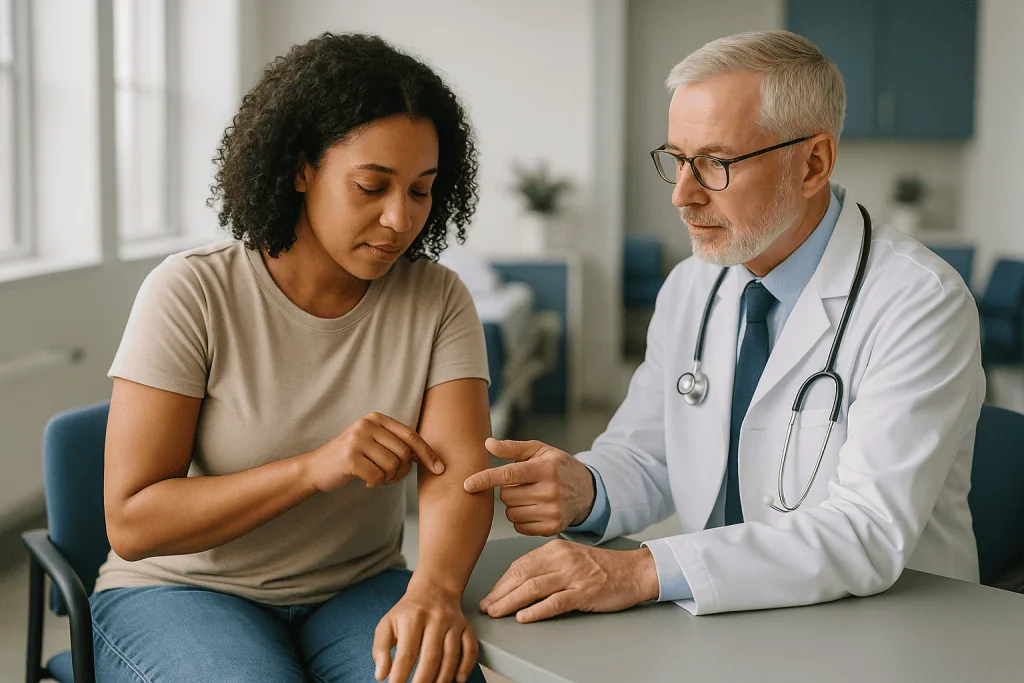
The five hallmark ringworm symptoms on the body, drawn from Mayo Clinic and NHS descriptions, are:
- A ring-shaped patch that expands slowly outward, often reaching one to four inches across, sometimes with several rings overlapping.
- A raised, scaly border that may look bumpy or blistered, while the inside appears clearer, flatter, or slightly lighter than surrounding skin.
- Itching, usually mild to moderate, that intensifies with sweat or heat.
- Color change: pink or red on lighter skin; brown, gray, or darker than surrounding skin on deeper skin tones, where the redness can be subtle and the scale is the more reliable clue.
- Flaking or cracking, especially between toes or in skin folds, where the ring shape flattens into peeling skin.
Location shifts the picture. On the scalp, expect round patches of hair loss with broken stubble, black dots where hairs have snapped at the surface, and sometimes a boggy, tender swelling called a kerion. In the groin, the rash spreads along the inner thigh crease with a sharp border and often spares the scrotum, a detail that helps distinguish it from yeast. On nails, the plate thickens, yellows, and crumbles at the edge.
One presentation deserves special mention: tinea incognito. When a fungal patch is mistaken for eczema and treated with a steroid cream, the inflammation fades, the border blurs, and the fungus spreads under cover. The result looks nothing like textbook ringworm, which is why clinicians ask what has already been applied.
Types of ringworm by body site: a comparison table
Same fungus, different neighborhoods. Where dermatophytes settle determines how the infection looks, who tends to get it, and whether a cream is likely to be enough. The table below summarizes the mainstream picture from CDC, NHS, and Mayo Clinic sources.
| Medical name | Everyday name | Typical appearance | Who is most affected | Usual first-line approach |
|---|---|---|---|---|
| Tinea corporis | Ringworm of the body | Expanding scaly ring, clearer center | All ages; athletes, pet owners | Topical antifungal |
| Tinea pedis | Athlete’s foot | Peeling, cracking between toes; sometimes dry scaling on soles | Adults; swimmers, gym users | Topical antifungal, footwear changes |
| Tinea cruris | Jock itch | Red-brown patch in groin crease, sharp border | Adult men more often | Topical antifungal, loose clothing |
| Tinea capitis | Scalp ringworm | Patchy hair loss, black dots, scaling, possible kerion | Children, especially school age | Oral antifungal (creams alone insufficient) |
| Tinea unguium | Nail fungus (onychomycosis) | Thick, yellow, crumbling nail | Older adults, people with diabetes | Oral antifungal or prolonged medicated lacquer |
| Tinea faciei / barbae | Face or beard ringworm | Scaly patches, pustules around hair follicles | Adults; farm and animal contact | Often oral antifungal for beard area |
Two patterns are worth pulling out of the table. Wherever the fungus lives inside hair follicles or under a nail plate, creams struggle to reach it, and tablets become the standard. And athlete’s foot is the most common form worldwide; it also acts as a reservoir, seeding groin and hand infections when people scratch their feet and then touch other skin. Treating the feet is often the quiet key to stopping a recurring groin rash.
How is ringworm diagnosed, and can you tell it apart from eczema?
Experienced clinicians recognize classic ringworm at a glance, but the look-alikes are numerous: nummular eczema (coin-shaped patches of dermatitis), psoriasis, pityriasis rosea, granuloma annulare, and even early Lyme disease rashes can form rings. Misdiagnosis in either direction is common, and the stakes are not trivial, because steroid creams that soothe eczema make fungus worse.
The standard confirmatory test is quick and painless. A clinician gently scrapes scale from the active border onto a glass slide, adds a drop of potassium hydroxide, and examines it under a microscope. This KOH preparation dissolves human cells and leaves fungal filaments, called hyphae, visible as branching threads. Results come within minutes and, in skilled hands, the test detects most true infections, although a negative result does not fully exclude fungus.
When the KOH is negative but suspicion remains, or when treatment has failed, a fungal culture is sent to a laboratory. Culture takes two to four weeks because dermatophytes grow slowly, but it identifies the species and, increasingly, whether it carries resistance markers. The CDC now specifically recommends culture and susceptibility testing for infections that are widespread, recurrent, or unresponsive to first-line therapy, precisely because of the resistant strains described earlier.
A Wood’s lamp, an ultraviolet light, causes some Microsporum species on the scalp to glow blue-green. It is a helpful screening tool for pediatric scalp cases but misses the more common Trichophyton species, so a dark lamp does not rule out infection.
What a clinician will ask, and what is worth remembering before the visit: when the patch appeared, whether it has grown, who else at home or on the team has something similar, whether there is a new pet, and exactly which creams have already been tried. That last answer often reshapes the diagnosis.
Does ringworm go away on its own?
Sometimes, eventually, and unreliably. That is the honest answer, and it differs by body site.
A small patch of tinea corporis in a healthy adult may resolve over several weeks to months as the immune system gradually clears the fungus, particularly if the area is kept dry and uncovered. Dermatology references describe this, and some people do recall a ring that faded without treatment. The NHS notes, however, that untreated ringworm can persist and spread, and during those weeks the person remains contagious to family members, teammates, and pets.
Athlete’s foot almost never clears without help because shoes recreate the warm, damp conditions the fungus prefers every single day. Groin infections behave similarly. Scalp ringworm in children does not resolve spontaneously in any dependable way and can leave permanent patches of scarring hair loss if a kerion develops. Nail infections are the most stubborn of all; the fungus is sealed under a keratin roof, and the nail grows too slowly for the body to shed it.
The risk of waiting is not only prolonged itch. A growing patch offers more surface for spread to other body parts through scratching. Broken skin at the border can admit bacteria, producing a secondary infection that needs antibiotics. And each week of transmission within a household multiplies the eventual treatment effort.
The practical takeaway from mainstream guidance is straightforward: a single small body patch can reasonably be treated with an over-the-counter antifungal cream from the outset rather than watched. Waiting is a gamble with modest upside and real downside. Scalp, nail, or spreading infections are not candidates for watchful waiting at all and warrant a clinician’s assessment.
What kills ringworm quickly? How ringworm treatment cream works
“Quickly” needs recalibrating. Dermatophytes live in skin cells that turn over every two to four weeks, and treatment works by stopping the fungus from colonizing new cells while the old ones shed. No cream erases a ring overnight, and any product claiming to should be treated with suspicion.
Two classes of topical antifungal dominate pharmacy shelves, both backed by randomized trials and recommended by the CDC and NHS for body, foot, and groin ringworm:
- Azoles (clotrimazole, miconazole, ketoconazole, econazole) block an enzyme the fungus needs to build ergosterol, the main component of its cell membrane. Without it, the membrane leaks and growth stops. They are fungistatic, meaning they halt growth rather than directly killing.
- Allylamines (terbinafine, naftifine, butenafine) hit an earlier step in the same pathway and cause a toxic buildup inside the fungal cell. They are fungicidal, meaning they kill outright, which is why trials generally show shorter treatment courses achieve similar results.
Application details matter more than brand. Guidance consistently advises applying the cream to the visible patch plus a margin of roughly an inch of normal-looking skin, because the fungal frontier extends beyond what the eye sees. The rash usually improves within a week or two, but the medicine should be continued for the full duration on the label or as prescribed, typically extending past the point where the skin looks normal. Stopping when the itch stops is the single most common reason ringworm returns.
Combination products that pair an antifungal with a potent steroid are widely sold, and dermatology guidance is cautious about them. The steroid quiets itching fast but suppresses the local immune response that helps clear the fungus, and prolonged use thins the skin. A short course under clinician direction has a place; routine self-selection does not.
When are antifungal tablets needed instead of cream?
Creams fail for predictable reasons: the fungus is somewhere they cannot penetrate, the area is too large to coat reliably, or the strain does not respond. In those situations clinicians turn to oral antifungals, which travel through the bloodstream and concentrate in keratin from the inside.
Mainstream guidance from the CDC, NHS, and Mayo Clinic identifies the situations where tablets are standard rather than optional:
- Scalp ringworm at any age. The fungus sits deep in the hair follicle, and no cream reaches it. Medicated shampoos are used alongside tablets to reduce spore shedding, not as a substitute.
- Nail infections, where the fungus lives under the nail plate. Medicated nail lacquers exist but have lower success rates in trials than oral therapy.
- Beard-area infection, for the same follicular reason.
- Widespread body involvement, generally described as multiple large patches or rash covering a substantial fraction of skin.
- Failure of a properly used topical course, or a confirmed resistant species.
- Immunocompromised patients, in whom infections are deeper and slower to clear.
The oral options include terbinafine, itraconazole, fluconazole, and, particularly for children with scalp infection, griseofulvin. Each has a distinct side-effect profile and interacts with different medications; terbinafine, for example, requires attention to liver function, while itraconazole interacts with many common heart and cholesterol drugs. Choice of agent, duration, and monitoring belong entirely to the prescribing clinician, who weighs the species suspected, the patient’s age, other medicines, and any liver or kidney history.
Nail treatment is the marathon of the group. Because a toenail takes 12 to 18 months to grow out fully, the nail may look unchanged for months after the fungus is gone. Trials report that even with oral therapy, a meaningful minority of nails do not fully normalize, and recurrence is common.
What the evidence actually says about ringworm treatments
Antifungal therapy for ringworm is one of the better-studied corners of dermatology, but the evidence is uneven across body sites. Here is a grading, using the categories mainstream reviewers apply: randomized controlled trials, observational data, and expert consensus.
Topical antifungals for body, foot, and groin infection: strong. Multiple randomized, placebo-controlled trials, summarized in Cochrane systematic reviews, show that both azole and allylamine creams clear infection far more often than placebo. Head-to-head trials suggest allylamines achieve mycological clearance, meaning no fungus on repeat testing, slightly more often and with shorter courses, though the absolute difference is modest and both classes are considered effective first-line choices.
Oral antifungals for scalp ringworm in children: strong. Randomized trials compared in Cochrane reviews show terbinafine and griseofulvin are both effective, with terbinafine performing better against Trichophyton species and griseofulvin retaining an edge against Microsporum. This is why culture results genuinely change treatment for scalp cases.
Oral antifungals for nail infection: moderate to strong for benefit, honest about limits. Trials show oral terbinafine and itraconazole outperform topical lacquers, but complete clinical and mycological clearance occurs in only a portion of patients, and relapse over subsequent years is well documented in observational follow-up.
Combination antifungal-steroid creams: weak to moderate, with caution. Limited trials show faster symptom relief but no better fungal clearance, and expert consensus warns of tinea incognito and skin thinning with extended use.
Tea tree oil, garlic, apple cider vinegar, bleach, and similar home remedies: weak or absent. A handful of small, mostly uncontrolled studies suggest tea tree oil has antifungal activity in laboratory dishes and possibly in mild athlete’s foot; none meet the standard of a well-run randomized trial against a licensed antifungal. Bleach and undiluted essential oils cause chemical burns, an outcome documented in case reports far more reliably than any benefit.
Resistance guidance: expert consensus informed by surveillance. Recommendations to culture stubborn cases rest on CDC surveillance data and clinical experience rather than trials, which is appropriate for an emerging problem.
Drug-resistant ringworm: how worried should you be?
The phrase sounds alarming, and the underlying science deserves respect, but proportion matters.
Trichophyton indotineae emerged in India during the 2010s, in a setting where combination creams containing high-potency steroids and antifungals were sold freely and used for years at a time. Under that selective pressure, strains carrying mutations in the squalene epoxidase gene, the enzyme allylamines target, became dominant. Those mutations render terbinafine, the standard tablet for stubborn skin fungus, largely ineffective. The species has since been reported across Europe, Canada, and the United States, most often in people with travel or family links to South Asia, though local transmission has also occurred.
What clinicians observe with these infections is consistent: large, intensely itchy plaques on the groin, buttocks, and trunk; rings that merge into map-like shapes; and rashes that partially improve on creams then rebound. The CDC’s 2023 report noted that both New York patients had months of unsuccessful treatment before culture identified the organism.
The 2024 reports of T. mentagrophytes genotype VII added a transmission route, sexual contact, and a presentation on the face and genitals that clinicians had not routinely associated with dermatophytes. Most of those isolates remained susceptible to standard drugs; the concern was recognition, not resistance.
For the general public, the practical implications are limited and manageable. Resistant strains remain uncommon in the United States. Itraconazole and other azoles generally retain activity, so treatment options exist. The scenarios that should prompt a clinician to send a culture are clear: a rash that does not improve after a full, correctly applied course; rapid spread; involvement of unusual sites; or a history of prolonged steroid-antifungal cream use. What resistance does not justify is fear-driven self-experimentation with harsh household chemicals, which damages skin without touching the fungus.
Common myths about ringworm, corrected
Viral claims about ringworm tend to cluster into a few recurring themes. Each has a kernel of misunderstanding worth unpacking.
Myth: Ringworm means there is a worm or parasite in the body. There is no worm, no larva, and no internal infestation. The fungus lives in the outermost dead layer of skin. Dewormers, “parasite cleanses,” and detox protocols have no mechanism of action against dermatophytes, and mainstream medical sources are unanimous on this point.
Myth: Bleach kills ringworm on skin. Diluted bleach can disinfect a hard surface such as a shower floor. On skin it causes chemical irritation and burns, strips the protective barrier, and can worsen the infection by opening a door for bacteria. Case reports of bleach injuries exist; trials of bleach as a ringworm treatment do not.
Myth: Only unclean people or homes get ringworm. Elite wrestlers with daily showers, meticulous households with a new kitten, and swimmers at well-maintained pools all acquire it. Warmth, moisture, and contact drive transmission, not cleanliness.
Myth: Once the itching stops, the fungus is gone. Symptoms fade well before the fungus is fully cleared. Stopping treatment at that point is the leading cause of recurrence, which is why labels and clinicians specify continuing past visible improvement.
Myth: A hydrocortisone cream will calm it down. It will calm the redness while the fungus spreads beneath, producing tinea incognito, a diffuse rash that is harder to recognize and treat. Steroid creams belong on ringworm only when a clinician has deliberately paired them with an antifungal.
Myth: Pets do not need checking if the person is treated. Animals frequently reinfect their owners. Veterinary sources and the CDC recommend having pets examined when a household has recurrent cases.
Myth: Ringworm is a childhood problem. Scalp infection favors children, but athlete’s foot, jock itch, and nail fungus increase with age.
How to stop ringworm spreading at home, including from pets
Treating the patch is half the job. The other half is starving the fungus of the warm, damp, shared environments it relies on, and finding the source so the cycle does not restart.
Mainstream guidance from the CDC and NHS translates into a handful of habits during the treatment period:
- Wash bedding, towels, and clothing that touched the rash in hot water and dry on high heat; do not share towels until the skin has cleared.
- Keep the affected area clean and, above all, dry. Pat rather than rub after bathing, and dry between the toes deliberately.
- Wear loose, breathable fabrics over groin or trunk patches; change socks daily and alternate shoes so each pair dries fully.
- Avoid scratching, and wash hands after applying cream, since fingers are the usual vehicle for seeding a second site.
- Disinfect shared hard surfaces such as shower floors and gym mats with a household disinfectant labeled for fungi.
- Clean or replace combs, brushes, and hats when scalp infection is present.
Children with body ringworm can usually attend school once treatment has started, provided the patch is covered; policies vary, so check with the school. Scalp ringworm is more contagious and often carries stricter return rules.
Pets deserve a specific look. Microsporum canis, the species most often passed from cats and dogs to people, can be carried by an animal with no visible bald spots. If a child develops ringworm and there is a new kitten, or if anyone in the household keeps getting reinfected, a veterinary examination is the logical next step. Veterinarians can culture the animal’s fur and prescribe appropriate treatment; a treated pet stops shedding infective spores, which protects everyone in the home. Farm workers and people who handle cattle or horses face similar exposure, often on the forearms and face.
Ringworm, travel, gyms, and contact sports: reducing the risk
Dermatophytes thrive in exactly the places people go to stay healthy: pools, locker rooms, martial arts studios, yoga floors, and shared showers in hostels and campgrounds. Prevention here is about interrupting skin-to-surface contact and controlling moisture, not avoiding activity.
Footwear is the first defense. Sandals or flip-flops in communal showers and around pools break the foot-floor link that spreads athlete’s foot, the most common dermatophyte infection worldwide and the usual reservoir for groin and hand infection. Moisture-wicking socks and shoes that get a full day to dry between uses deny the fungus its preferred microclimate.
For mat-based sports, national wrestling and judo bodies publish skin-check requirements precisely because outbreaks are frequent. Showering promptly after practice, laundering gear after every session, never sharing headgear or towels, and covering any healing lesion with a breathable dressing are standard protocols. Athletes with an active, untreated patch are typically kept off the mat until a clinician clears them; this is a public health measure, not a punishment.
Travelers face two specific considerations. Hot, humid climates increase sweat and friction, raising the odds that a spore already on the skin will take hold. And because Trichophyton indotineae is far more prevalent in parts of South Asia, the CDC notes travel history as a relevant detail when a rash acquired abroad fails to respond to standard cream. Mentioning recent travel at a medical visit can shorten the path to a correct culture.
Gym hygiene basics remain unglamorous and effective: wipe down shared benches and mats before and after use, sit on a personal towel, and avoid walking barefoot on locker-room floors. None of these steps is dramatic. Together they remove most of the opportunities a patient fungus is waiting for.
When to see a doctor about ringworm: red flags and next steps
Most single patches of body ringworm can be managed with an over-the-counter antifungal cream and patience. Certain situations, however, move the problem out of self-care territory. Mainstream guidance from the NHS, Mayo Clinic, and CDC points to the following as reasons to arrange a medical visit:
- No improvement after a full course of a correctly applied over-the-counter antifungal, or a rash that shrinks and then returns.
- Scalp involvement in anyone, especially patches of hair loss, black dots, or scaling in a child.
- Nail changes such as thickening, yellowing, or crumbling.
- Rapid spread, multiple large patches, or rash covering a substantial area of the body.
- Signs of a bacterial infection layered on top: increasing pain, warmth, swelling, pus, spreading redness, or fever.
- A boggy, tender, swollen area on the scalp (a kerion), which can scar without prompt treatment.
- Weakened immunity from diabetes, HIV, cancer treatment, organ transplant medicines, or long-term steroid use.
- Uncertainty about the diagnosis, particularly if the patch does not look like a classic ring or has been treated with a steroid cream.
- Infection in infants, during pregnancy, or while taking other medicines that may interact with oral antifungals.
- Recent travel to regions with known resistant strains, or a rash on the face, genitals, or buttocks after sexual contact.
At the visit, a clinician may perform a KOH scraping, send a culture, and, where warranted, prescribe an oral antifungal with appropriate monitoring. Every treatment decision, including which medicine, for how long, and whether to combine it with anything else, rests with the prescribing clinician who can see the rash and knows the patient’s history. Anyone already taking a prescribed antifungal should not stop or alter it based on online advice; concerns about side effects belong in a conversation with the prescriber, who can adjust the plan safely.
Frequently asked questions
What causes you to get ringworm?
Ringworm is caused by dermatophytes, fungi that feed on the keratin in skin, hair, and nails. You acquire it through direct skin contact with an infected person or animal, by touching contaminated items such as towels, mats, or hairbrushes, or occasionally from soil. Warm, sweaty skin, minor cuts, tight clothing, diabetes, and weakened immunity make it easier for the fungus to establish. Kittens, puppies, and contact sports are frequent sources.
What kills ringworm quickly?
Over-the-counter antifungal creams containing an allylamine such as terbinafine or an azole such as clotrimazole are the fastest evidence-based options for body, foot, and groin ringworm, with visible improvement usually within one to two weeks. No product clears it overnight, because the fungus lives in skin cells that take weeks to shed. Follow the label duration fully, and see a clinician for scalp, nail, widespread, or unresponsive infections.
What are the first signs of ringworm symptoms?
The earliest sign is usually a small, slightly itchy, scaly patch that many people mistake for dry skin or an insect bite. Over one to two weeks it expands into a ring with a raised, flaky border and a clearer center. On darker skin it may appear brown or gray rather than red. Between the toes or in the groin, the ring flattens into cracked, peeling skin with a sharp edge.
Does ringworm go away on its own?
A small body patch can occasionally fade over weeks or months without treatment, but the outcome is unreliable, and the person remains contagious the entire time. Athlete’s foot, jock itch, scalp ringworm, and nail infections almost never clear on their own because their environments favor the fungus. Mainstream guidance recommends treating even small patches promptly with an antifungal cream and seeing a clinician for scalp or nail involvement.
How do you get ringworm from a pet?
Cats and dogs, especially kittens and puppies, often carry Microsporum canis in their fur and can pass it to people through petting, cuddling, or shared bedding, sometimes while showing no bald patches themselves. Children who hold animals against their faces and arms are particularly affected. If a household has recurring ringworm and there is a pet, a veterinary check with fungal culture is the recommended step to break the cycle.
Is ringworm contagious, and for how long?
Yes, ringworm spreads readily through skin contact and shared items as long as active fungus is present on the skin. Contagiousness drops substantially within about 48 hours of starting effective antifungal treatment, according to NHS guidance, though the rash may still be visible for weeks. Children can usually return to school once treatment has begun and the patch is covered; scalp infection and contact-sport participation typically follow stricter rules.
Which ringworm treatment cream works best?
Randomized trials show that both allylamine creams (terbinafine, butenafine) and azole creams (clotrimazole, miconazole) are effective for body, foot, and groin ringworm. Allylamines tend to achieve fungal clearance with shorter courses, but both are considered appropriate first-line choices. Correct application matters more than brand: cover the patch plus a margin of healthy skin and continue for the full labeled duration, even after the rash appears to have gone.
Can I use hydrocortisone cream on ringworm?
Plain steroid creams are not recommended for suspected ringworm. Hydrocortisone reduces redness and itch temporarily but suppresses the local immune response, allowing the fungus to spread and producing tinea incognito, a blurred rash that is harder to recognize. If a patch worsens or changes after steroid use, a clinician should evaluate it. Combination antifungal-steroid products have a limited role and should be used only under clinician direction.
What is drug-resistant ringworm and is it common?
Drug-resistant ringworm refers mainly to Trichophyton indotineae, a species carrying gene mutations that make terbinafine largely ineffective. The CDC reported the first U.S. cases in 2023, and it remains uncommon in the United States, appearing most often in people with links to South Asia. It typically causes large, itchy, merging plaques that fail standard treatment. Clinicians confirm it with fungal culture and can treat it with alternative oral antifungals.
Do home remedies like tea tree oil or vinegar work on ringworm?
The evidence is weak. Tea tree oil shows antifungal activity in laboratory studies and a few small trials in mild athlete’s foot, but nothing approaching the randomized-trial support behind licensed antifungal creams. Apple cider vinegar, garlic, and bleach have no supporting trials and can irritate or chemically burn skin, worsening the problem. Licensed antifungals remain the evidence-based first choice, with a clinician’s input for anything stubborn or widespread.
References
- CDC: About Ringworm
- CDC MMWR: Notes from the Field: First Reported U.S. Cases of Tinea Caused by Trichophyton indotineae, New York City, 2021–2023
- NHS: Ringworm
- MedlinePlus: Tinea Infections
This article is for general information only and is not a substitute for professional medical advice. Please consult a qualified doctor about your individual situation.

More from the Blog

Lyme Disease Follow-Up: Why Doctors Check Joints, Heart Rhythm and Nerves After Treatment
After treatment for Lyme disease, doctors follow up on joints, heart rhythm and nerves because these are the systems the infection can affect weeks…

RSV Symptoms in Adults: How to Tell It From Flu and COVID, and Who Is at Risk
RSV symptoms in adults usually look like a heavy cold: runny nose, cough, sneezing, sore throat, mild fever and sometimes wheezing, building over several…

Meningitis Vaccines: Types, Who Needs Them and Why University Age Matters
Meningitis vaccines protect against the bacteria behind most sudden bacterial meningitis, chiefly Neisseria meningitidis. The main types are MenACWY, MenB and newer combined MenABCWY…

Why the Days After a Dengue Fever Breaks Need Close Monitoring: Warning Signs Doctors Look For
Dengue is often most dangerous in the 24 to 48 hours after the fever settles, when fluid can leak out of small blood vessels…

Does a Rapid Test Confirm Malaria? Blood Smears, Parasite Species and How Treatment Is Chosen
A rapid diagnostic test can strongly suggest malaria, but it does not fully confirm it on its own. Guidelines from the CDC and WHO…

Typhoid, Yellow Fever and Rabies Vaccines: When Travelers Need Them
Travelers need a yellow fever vaccine when visiting parts of sub-Saharan Africa or South America where the virus circulates, or when a country requires…