

Robotic Gallbladder Surgery From Console to Closure: How the Operation Unfolds
Key Takeaways
- In a robotic cholecystectomy the surgeon controls every instrument movement from a console in the operating room; the system has no independent function.
- The operation uses three or four fingertip-sized incisions and typically takes one to two hours, the same range the NHS gives for standard keyhole gallbladder removal.
- Right-shoulder pain after surgery is referred from carbon dioxide irritating the diaphragm and usually fades within a day or two, according to the NHS.
- The NHS puts typical return to normal activities at about two weeks after keyhole removal versus six to eight weeks after open surgery, and robotic recovery follows the keyhole pattern.
- Bile leakage occurs in around 1 in 100 keyhole gallbladder removals per the NHS and is usually managed with a drain or endoscopic procedure.
- Comparison studies have not shown robotic gallbladder removal to be safer or faster to recover from than laparoscopy, and surgeon experience predicts outcomes better than the platform.
A robotic cholecystectomy procedure removes the gallbladder through a few small abdominal incisions, with the surgeon controlling instrument arms from a console beside the patient. Under general anesthesia, carbon dioxide inflates the abdomen, the gallbladder's duct and artery are clipped and divided, the organ is lifted out through one incision, and the small wounds are closed. Many people go home the same day.
The pre-op nurse has just asked a question that sounds oddly simple: “Do you know which type of surgery you’re having?” You do, technically. The surgeon said “robotic.” You nodded. And then you spent the drive home picturing a machine operating on you while a person watched from somewhere else.
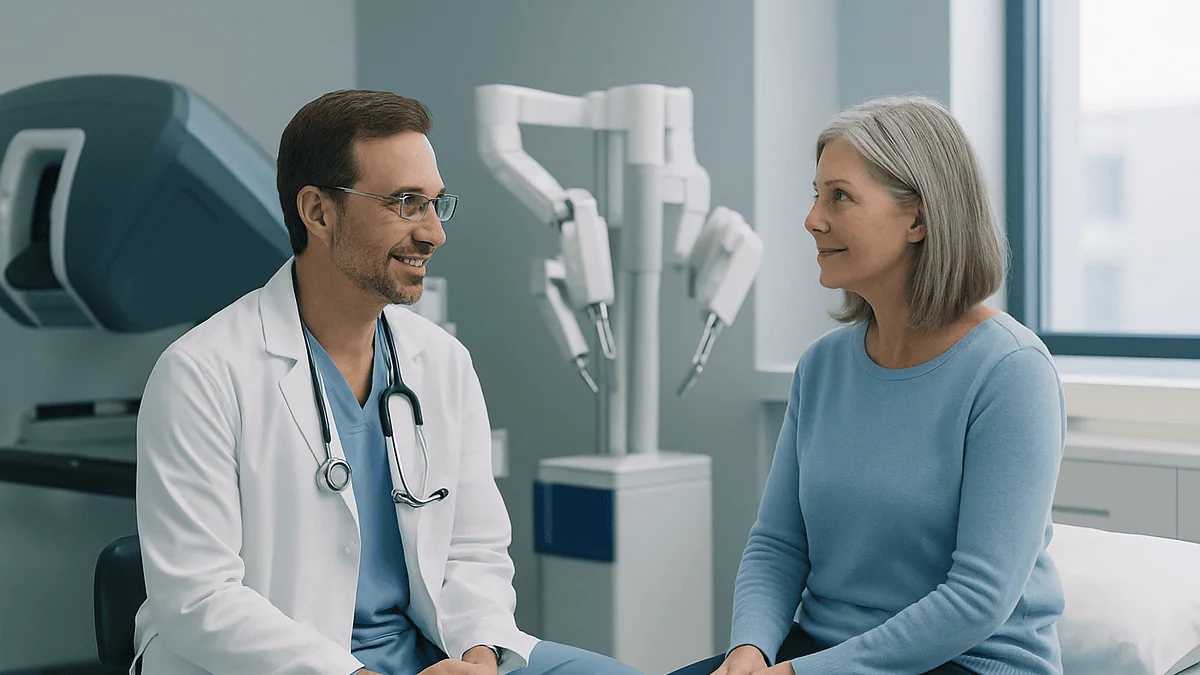
That picture is wrong in a useful way. A robotic cholecystectomy procedure is a human operation from start to finish. The surgeon is in the room, a few feet from the table, moving every instrument in real time. What the robot adds is a steadier wrist, a magnified three-dimensional view and a seat. What it does not add is autonomy, magic or a guarantee.
This explainer walks through the operation the way it actually happens, from the anesthesia mask to the last stitch, and then through the days that follow. Along the way it separates what the evidence supports from what the brochures imply. Every decision, of course, stays with the team that knows your case.
What is a robotic cholecystectomy procedure, in plain language?
Cholecystectomy is the medical word for removing the gallbladder, a thumb-sized pouch tucked under the liver that stores bile between meals. A robotic cholecystectomy procedure does that job through several small cuts, using a surgical robot as an extension of the surgeon’s hands rather than a replacement for them.
The setup has three parts. There is a patient-side cart with mechanical arms that hold a camera and slender instruments. There is a console, usually in the same room, where the surgeon sits, looks into a high-definition 3D viewer and moves hand controls and foot pedals. And there is a tower carrying the video and gas systems that the bedside team monitors. When the surgeon’s fingers turn, the instrument tips inside the abdomen turn the same way, scaled down and filtered for tremor. Cleveland Clinic describes the system plainly as one that translates the surgeon’s hand movements into the movements of the instruments; nothing happens that a surgeon did not initiate.
Why do this instead of standard keyhole surgery? Conventional laparoscopy, meaning surgery through small incisions using long straight instruments and a two-dimensional camera, has been the routine way to remove a gallbladder for decades. The robotic version keeps the same incisions and the same internal steps but changes how the surgeon sees and reaches. The instrument tips bend like a wrist, which straight laparoscopic tools cannot do, and the camera is held perfectly still by a mechanical arm instead of an assistant.
For the person on the table, the experience is nearly identical to laparoscopic surgery: general anesthesia, a few small wounds, and a recovery measured in days rather than weeks. Where the two approaches differ, and whether the difference matters for a routine gallbladder, is a question this article returns to with the evidence in hand.
Who is usually offered robotic gallbladder removal, and who is asked to wait?
The reason to remove a gallbladder rarely changes with the tool. The NHS lists the usual triggers: gallstones causing repeated pain, inflammation of the gallbladder (cholecystitis), stones blocking the bile duct, and, less often, inflammation of the pancreas linked to gallstones. Gallstones that sit quietly and cause no symptoms are generally left alone; Mayo Clinic notes that surgery is reserved for stones that cause problems.

Once surgery is on the table, the choice between robotic and standard laparoscopic approaches usually comes down to the surgeon’s training, the equipment available that day and the specifics of your anatomy. Some surgeons prefer the robotic platform for people with a higher body weight, previous abdominal operations or a gallbladder that imaging suggests will be scarred and stuck, because the wristed instruments give more room to maneuver in a tight space. Others reach the same result with conventional laparoscopy. Neither preference is wrong.
Who is asked to wait? Timing matters more than technology here. If the gallbladder is acutely inflamed, many teams operate within the first days of the attack; if that window has passed, some will treat the inflammation first and schedule surgery for a few weeks later, a decision that varies by team and by how unwell the person is. A stone lodged in the main bile duct is often cleared by an endoscopic procedure through the mouth before or during the operation. Pregnancy, an active heart or lung problem, or a bleeding disorder that needs correcting can all shift the date.
A few people are steered toward a different operation altogether. If severe scarring, unclear anatomy or bleeding makes small-incision surgery unsafe, the surgeon converts to an open operation through a single larger cut. Mayo Clinic describes this as a planned safety option, not a failure, and it applies to robotic and laparoscopic approaches alike.
Before surgery: the checks that shape the operating plan
The operation is decided long before the console is switched on. An ultrasound of the upper abdomen is the standard first test for gallstones and gallbladder wall thickening; blood tests look at liver enzymes, bilirubin and pancreas markers to hint at whether a stone has slipped into the duct. If those numbers are raised, a more detailed scan of the bile ducts or an endoscopic look may follow. MedlinePlus lists these among the routine pre-operative steps for gallbladder removal.
You will also meet the anesthesia team or fill in a detailed health questionnaire. They want to know about heart and lung conditions, sleep apnea, previous reactions to anesthesia, and every medicine and supplement you take. Blood thinners, some diabetes medicines and certain herbal products may need to be paused or adjusted before surgery; the prescribing clinician makes that call, and it is never a decision to make on your own.
Practical instructions are consistent across mainstream guidance. The NHS advises no food for around six hours before a general anesthetic and clear fluids only until about two hours before, though your own team’s written instructions take priority. Smokers are encouraged to stop as far ahead as possible because smoking slows wound healing and raises the risk of chest complications after anesthesia. If you use an inhaler, bring it. Remove jewelry and nail polish; the oxygen monitor clips to a fingertip.
Arrange a ride home and, ideally, an adult to stay the first night. Anesthetic drugs and pain medicines dull judgment for a day even when you feel alert. A loose waistband, slip-on shoes and a pillow to hold against your belly in the car are small comforts that matter more than they sound.
In the operating room: anesthesia, positioning and docking the robot
General anesthesia is not optional for this operation. Your abdomen will be inflated with gas and your body tilted, neither of which is tolerable awake. An intravenous line goes into the back of the hand, monitoring stickers go on the chest, and a mask delivers oxygen while the anesthesia drugs take effect. Most people remember counting and then nothing. Once you are asleep, a breathing tube is placed and a machine breathes for you until the end.
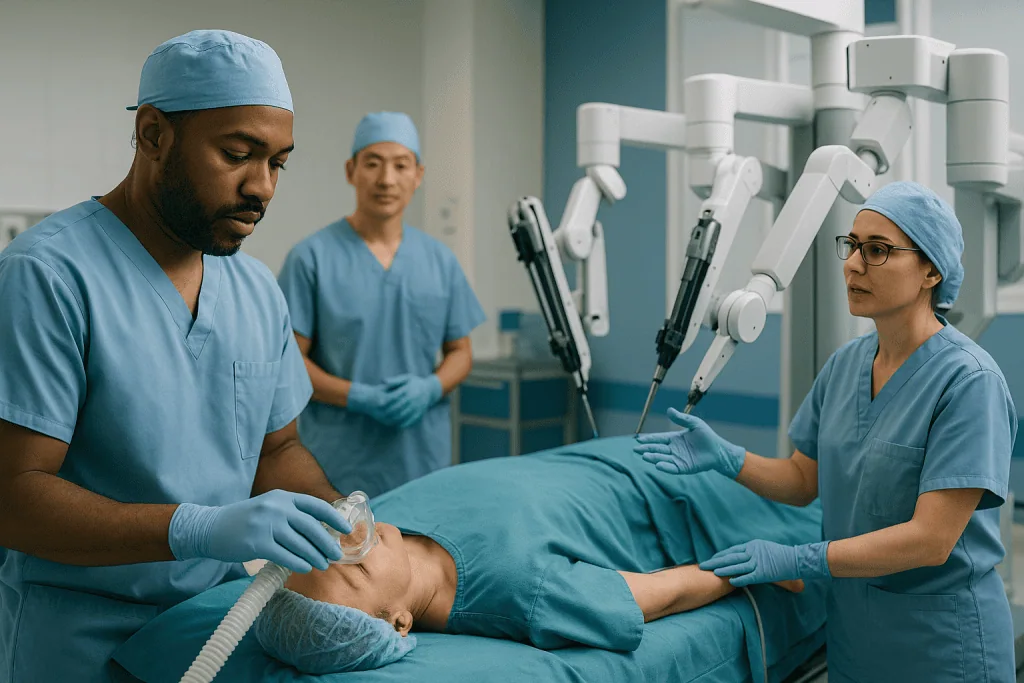
Positioning comes next, and it is more deliberate than it sounds. You lie on your back with arms tucked or secured on padded boards. The table tilts head-up and rolls slightly to the left, so gravity pulls the bowel and stomach away from the liver and gives the surgeon a clear view of the gallbladder. Padding protects pressure points and nerves, and the team checks every strap because the robotic arms will be locked in place relative to your body.
Docking is the step unique to robotic surgery. After the skin is cleaned with antiseptic, the surgeon makes the small incisions, usually three or four, each roughly the width of a fingertip, and inserts hollow tubes called ports. Carbon dioxide flows through one port to lift the abdominal wall away from the organs, creating a working space. The robotic cart is then wheeled in and each arm is clicked onto a port. This docking phase adds a few minutes that laparoscopic surgery does not need, which is one reason robotic cases often take slightly longer overall.
Once docked, the surgeon walks to the console, sits, and adjusts the viewer. A trained assistant stays at your side to swap instruments, pass clips and respond instantly if anything needs a human hand at the table.
From console to closure: how the robotic cholecystectomy procedure unfolds
Seen through the console, the gallbladder looks like a pale green pear hanging from the underside of the liver. The first move is to grasp its dome and lift it toward the right shoulder, which straightens the anatomy at its neck. Everything that follows happens in that small triangle of tissue.
The surgeon strips away the thin covering over the gallbladder neck to expose two structures: the cystic duct, the short tube that connects the gallbladder to the main bile duct, and the cystic artery, the vessel feeding it. Surgical guidance calls this the “critical view of safety”: both structures clearly seen entering the gallbladder, with nothing else in the way, before anything is cut. The wristed instruments help here, because they can sweep around the back of the duct at angles a straight tool cannot reach. Some teams inject a fluorescent dye beforehand that glows in the bile ducts under a special camera light, making the anatomy easier to confirm.
Once the view is secure, small titanium or absorbable clips are placed across the cystic duct and artery, and each is divided between the clips. The gallbladder is then peeled off the liver bed using a cautery instrument that seals small vessels as it cuts. Any bile or stones that spill are rinsed out.
The freed gallbladder goes into a small retrieval bag, which is drawn out through one of the ports, usually the one at the navel, sometimes after the incision is widened slightly for a very large stone. The surgeon inspects the liver bed for bleeding or bile leakage, occasionally leaves a thin drain, and releases the gas. The arms are undocked, the ports come out, and the incisions are closed with dissolving stitches or glue and covered with small dressings. The NHS gives the typical operating time for keyhole gallbladder removal as one to two hours; robotic cases sit in a similar range.
Robotic vs laparoscopic cholecystectomy: what actually differs
People searching “robotic vs laparoscopic cholecystectomy” usually want a clear winner. The honest answer is that the two operations share far more than they differ. The incisions, the anesthesia, the internal steps and the recovery are essentially the same. The differences sit in how the surgeon sees and moves, and in the logistics around the table.
| Feature | Robotic approach | Standard laparoscopic approach |
|---|---|---|
| Incisions | Usually 3 to 4 small cuts; some single-incision variants | Usually 3 to 4 small cuts (NHS) |
| Surgeon’s view | Magnified 3D image at a console | 2D monitor, camera held by an assistant |
| Instrument movement | Wristed tips that bend; tremor filtered | Straight rigid instruments |
| Where the surgeon works | Seated at a console in the room | Standing at the table |
| Setup time | Extra minutes to dock the arms | No docking step |
| Anesthesia | General | General |
| Typical hospital stay | Often same day | Often same day (NHS) |
| Return to normal activity | About 2 weeks for most | About 2 weeks for most (NHS) |
| Conversion to open surgery | Possible if anatomy is unsafe | Possible if anatomy is unsafe |
A few points deserve emphasis. The surgeon loses direct touch on the robotic platform: there is no sense of how firmly tissue is being grasped, so visual cues replace tactile ones, which is one reason training matters. The camera, by contrast, gains stability; it moves only when the surgeon moves it. Whether those trade-offs translate into any measurable benefit for a straightforward gallbladder is discussed later, and the short version is that large reviews have not shown one.
How painful is robotic gallbladder surgery?
Pain after this operation comes from three places, and knowing which is which makes the first days less alarming. The incisions themselves ache, especially the one at the navel where the gallbladder came out. The liver bed, where the gallbladder was peeled away, produces a deeper soreness under the right ribs. And the carbon dioxide used to inflate the abdomen can irritate the diaphragm, which people feel as a sharp ache in the right shoulder or collarbone. The NHS notes that this referred shoulder pain is common and usually settles within a day or two as the gas is absorbed.
How intense is it? Most people describe the first 24 to 48 hours as the hardest, with discomfort that is real but manageable using the medicines the team prescribes, and a steady easing after that. The NHS advises that pain and discomfort are expected for a few days and that most people need only over-the-counter pain relief after the first day or two. Your team will explain which medicines to use, how they work and how long they are typically needed; that plan is theirs to set.
Movement helps more than people expect. Walking to the bathroom, then to the kitchen, then around the block moves trapped gas along and keeps the lungs expanded. Splinting the belly with a folded pillow when you cough, laugh or stand up takes the strain off the incisions. Warmth on the shoulder eases the referred ache.
Is robotic surgery less painful than laparoscopic? The incisions are the same size and number, so there is no mechanical reason it should be, and comparison studies have not shown a consistent difference. If a surgeon frames pain reduction as a specific advantage of the robot, it is fair to ask what evidence supports that for gallbladder surgery in particular.
The first 24 hours: waking up, eating and going home
You wake in a recovery bay with a nurse checking your blood pressure, oxygen level and the dressings on your abdomen. Grogginess, a dry throat from the breathing tube and a floating, disconnected feeling are normal for the first hour. Nausea is common after general anesthesia; the team has medicines ready for it, and many people are given one before they even wake.
Once you can sit up, sip water and keep it down, you will be offered something light. There is no special post-gallbladder diet at this stage; Mayo Clinic advises simply returning to a normal diet as tolerated, though many people find that smaller, lower-fat meals feel gentler for the first few days. Passing urine and walking a short distance with support are the usual milestones before discharge.
Same-day discharge is the norm for uncomplicated keyhole gallbladder removal. The NHS states that most people can go home the same day, while those who had a more complicated operation, live alone, or have other health conditions may stay one night. You will not be allowed to drive yourself, and the discharge nurse will want to know who is collecting you.
Before you leave, you should receive written instructions covering wound care, activity, medicines and the specific symptoms that warrant a call. Dressings usually stay on for a day or two; showering is typically fine after that, with the wounds patted dry rather than soaked. Ask whether stitches need removing or will dissolve, and when your follow-up appointment is. The first night at home often brings broken sleep, a bloated belly and that odd shoulder ache. None of those, on their own, is cause for alarm.
Robotic gallbladder surgery recovery time: the first two weeks and beyond
Robotic gallbladder surgery recovery time tracks closely with standard keyhole surgery, because the wounds and the internal healing are the same. The NHS gives a typical return to normal activities of about two weeks after keyhole removal, compared with six to eight weeks after open surgery. Those are averages, not deadlines; some people feel themselves after a few days and others need the full fortnight.
A rough shape of the first two weeks, drawn from NHS and Mayo Clinic guidance:
- Days 1 to 3: Fatigue, incision soreness and gas discomfort dominate. Short walks several times a day, light meals, plenty of fluids. Bruising around the navel is common.
- Days 4 to 7: Pain eases noticeably. Many desk workers feel able to manage a few hours of work from home. Bowel habits may be loose or irregular as the digestive system adjusts.
- Week 2: Most people resume ordinary daily life. The NHS suggests avoiding heavy lifting and strenuous exercise for a couple of weeks to protect the incisions.
Driving deserves a specific mention. The NHS advises waiting until you can comfortably wear a seatbelt and perform an emergency stop without pain, which for many people is around a week; check with your insurer and your surgeon. Sex can resume when it feels comfortable.
Longer term, the body adapts to life without a bile reservoir. Bile flows steadily from the liver into the intestine instead of being released in a burst with meals. Mayo Clinic notes that some people experience looser stools for weeks to months, which usually improves; a smaller number find that fatty meals continue to trigger urgency. If digestive changes persist or worsen, that is a conversation for your team rather than something to manage alone.
What are the downsides of robotic cholecystectomy?
Every gallbladder operation carries risk, and the robotic platform does not remove any of it. The NHS and Mayo Clinic list the same core complications for keyhole removal regardless of technology: wound infection, bleeding, bile leakage from the liver bed or duct stump, injury to the main bile duct, injury to nearby bowel or blood vessels, blood clots in the legs, and the general risks of anesthesia. The NHS describes bile leakage as occurring in around 1 in 100 cases, usually managed with a drain or an endoscopic procedure. Bile duct injury is rarer but more serious, sometimes requiring a second operation.
Several downsides are specific to the robotic approach. Docking the arms adds time under anesthesia, and longer operations carry marginally more anesthetic exposure. The surgeon cannot feel the tissue, so grasp strength is judged by eye; this is a learned skill and part of why surgeon experience matters. Instrument exchanges require the bedside assistant rather than the surgeon, adding small delays. If something goes wrong quickly, the surgeon must leave the console and return to the table, a transition that well-drilled teams practice for.
There is also a question researchers are actively examining: whether robotic gallbladder removal is associated with a different rate of bile duct injury than laparoscopy. Some large database studies have raised that concern, others have not, and the answer may depend heavily on which surgeons and which patients are studied. The fair summary is that the robotic approach has not been shown to be safer, and the possibility that it is slightly less safe for routine cases has not been ruled out.
Finally, the platform is expensive to run and not available everywhere, which sometimes means a robotic case is scheduled around equipment rather than around clinical need. That is a systems issue, not a reason to fear the operation, but it is worth knowing.
Is robotic gallbladder removal better? What the evidence shows
“Is robotic gallbladder removal better?” is the question underneath most searches on this topic, and it deserves a plain answer. For the routine removal of a gallbladder, the mainstream evidence has not shown that the robotic approach produces better outcomes than standard laparoscopic surgery. Complication rates, length of stay, pain and time back to normal life look broadly similar across comparison studies. Cleveland Clinic and Johns Hopkins both present robotic surgery as one minimally invasive option among several rather than as a superior standard.
Why, then, do surgeons use it? Several plausible reasons, none of which are proven benefits for patients. The 3D magnified view and wristed instruments may make certain difficult cases, such as a severely inflamed or scarred gallbladder, easier to complete without converting to open surgery, though studies on this point are mixed. Sitting at a console is easier on the surgeon’s neck, back and shoulders over a long career, which matters for the people doing hundreds of these a year. And surgeons who use the robot for more complex operations, such as hernia or bowel surgery, may prefer to keep their skills sharp by using it for gallbladders too.
What about the concerns? Some large observational studies have reported a higher rate of bile duct injury with robotic removal; because these studies cannot fully account for which patients were chosen for which approach, they raise a question rather than settle it. Randomized trials are small and few.
The practical takeaway is that the surgeon’s experience with whichever technique they use matters far more than the technique itself. A surgeon who has performed many robotic gallbladder removals and knows the anatomy cold is a reasonable choice; so is one who has done the same with laparoscopy. Asking about experience is a better use of your appointment than asking about the machine.
What people often get wrong about robotic gallbladder surgery
“The robot does the surgery.” It does not. The system has no independent function; it moves only when the surgeon moves, and stops when the surgeon’s hands leave the controls. Cleveland Clinic describes the surgeon as controlling every movement. The word “robot” is a marketing legacy, not a description.
“Robotic means smaller scars.” The incisions are the same number and roughly the same size as laparoscopic ones, because the instruments pass through ports of similar diameter. Single-incision variants exist for both approaches, and they trade a hidden scar for a slightly larger one at the navel.
“Recovery is much faster.” The NHS return-to-normal figure of about two weeks applies to keyhole surgery generally. The gallbladder is removed the same way and the liver bed heals at the same pace regardless of how the instruments were steered.
“Newer must be safer.” Comparison studies have not shown lower complication rates with the robotic approach, and some have raised questions about bile duct injury. Newer technology carries its own learning curve.
“Once the gallbladder is gone, digestion goes back to normal immediately.” Bile still reaches the intestine, but in a steady trickle rather than meal-timed bursts. Mayo Clinic notes that loose stools after fatty meals are common early on and usually improve over weeks to months.
“If the surgeon switches to open surgery, something went badly wrong.” Conversion is a safety decision made when the view is unclear or the anatomy is hostile. It lengthens recovery but reflects good judgment, not failure.
“I should ask for the robot.” A better request is a surgeon who performs gallbladder removal frequently with whichever approach they know best, and who can explain why they are recommending it for you.
Questions to ask your care team
A good consultation leaves you knowing why this operation, why now, why this approach and what to expect afterward. These questions help fill the gaps, and none of them should be unwelcome.
- Why are you recommending the robotic approach for me rather than standard laparoscopic surgery, and would your recommendation change if the robot were not available that day?
- How many gallbladder removals do you perform each year, and how many of those are robotic?
- What in my imaging or blood tests makes you expect a straightforward or a difficult operation?
- How likely is it that you would need to convert to an open operation in my case, and what would that mean for my recovery?
- Will you use fluorescent dye or an X-ray of the bile ducts during surgery to confirm the anatomy?
- Do I have a stone in the main bile duct, and if so, how and when will it be dealt with?
- Which of my medicines need to be paused before surgery, when, and who will tell me when to restart them?
- Should I expect to go home the same day, and what would keep me overnight?
- What pain plan will I go home with, and how do I reach someone if it is not working?
- Will I have a drain, and who removes it?
- When can I drive, return to my specific job, lift my children, and exercise?
- Which symptoms should prompt me to call, and which should send me straight to emergency care?
- Who do I contact after hours, and when is my follow-up appointment?
Write the answers down or bring someone who will. Post-consultation recall is unreliable for everyone, not just when nervous. If an answer to any of these is vague, especially about experience or about why the robotic approach suits you specifically, asking again is reasonable.
When to call your doctor
Most recoveries are uneventful, and the discomforts of the first week, soreness, bloating, shoulder ache, fatigue, loose stools, are expected. A handful of signs are different in kind and should not wait for the follow-up appointment. The NHS and Mayo Clinic list these as reasons to contact your surgical team or seek urgent care after gallbladder removal:
- Fever or shaking chills, particularly in the first two weeks.
- Abdominal pain that is getting worse rather than better, or severe pain not eased by the prescribed medicines.
- Yellowing of the skin or the whites of the eyes, dark urine or pale, clay-colored stools, which can signal bile not draining properly.
- Persistent vomiting or inability to keep fluids down.
- An incision that becomes increasingly red, hot, swollen, or leaks pus or a large amount of fluid.
- A swollen abdomen that feels tight and tender.
- Calf pain, swelling or redness in one leg, which can indicate a blood clot.
- Sudden shortness of breath, chest pain or coughing up blood, which are emergency signs of a clot in the lung and warrant calling emergency services immediately.
- No bowel movement for several days combined with bloating and nausea.
Bile leakage, wound infection and retained stones are uncommon but treatable when caught early, and every one of them announces itself through the signs above. If something feels wrong and is not on this list, call anyway. Surgical teams would far rather answer an unnecessary phone call than meet a preventable problem late. Keep the discharge paperwork, with its after-hours number, somewhere you can reach it from bed.
Frequently asked questions
What are the potential downsides of robotic cholecystectomy?
The downsides include a slightly longer time under anesthesia because the robotic arms must be docked, loss of the surgeon’s sense of touch on tissue, dependence on a bedside assistant for instrument changes, and limited availability of the equipment. It shares all the standard risks of gallbladder removal, including bile leak, bleeding, infection and bile duct injury, and studies have not shown it lowers any of them.
How long does it take to recover from a robotic cholecystectomy?
Most people return to normal activities in about two weeks, the same range the NHS gives for standard keyhole gallbladder removal. The first two to three days bring the most soreness and fatigue, desk work is often possible within a week, and heavy lifting is usually deferred for a couple of weeks. Your surgeon sets the specific timeline based on how your operation went.
How painful is robotic gallbladder surgery?
Pain is usually moderate for the first one to two days and then eases steadily. It comes from the small incisions, the liver bed where the gallbladder was removed, and gas irritating the diaphragm, which is felt in the right shoulder. The NHS notes most people need only over-the-counter pain relief after the first day or two. It is not less painful than laparoscopic surgery, because the incisions are the same.
Is robotic gallbladder removal better than laparoscopic?
For routine gallbladder removal, the evidence has not shown robotic surgery produces better outcomes than standard laparoscopy. Complication rates, hospital stay and recovery look similar across comparison studies, and some large database studies have raised questions about bile duct injury that remain under investigation. The surgeon’s experience with their chosen technique is a stronger predictor of a good result than the technology itself.
What is the difference between robotic vs laparoscopic cholecystectomy?
Both remove the gallbladder through three or four small incisions under general anesthesia. In laparoscopy the surgeon stands at the table using straight instruments and a 2D screen; in the robotic version the surgeon sits at a console with a 3D view and wristed instruments that bend. Docking the robotic arms adds setup time. The internal steps and the recovery are essentially the same.
Does the robot perform any part of the surgery on its own?
No. The robotic system moves only when the surgeon moves the hand controls, and it stops the moment the surgeon’s hands leave them. It has no programmed or autonomous steps. Cleveland Clinic describes the surgeon as controlling every movement of the instruments. The word “robot” describes the mechanical arms that hold the tools, not any independent decision-making.
How long does a robotic cholecystectomy procedure take?
The operation itself typically takes one to two hours, according to NHS guidance on keyhole gallbladder removal, with robotic cases falling in a similar range once docking time is included. Expect to be at the hospital considerably longer, usually several hours, to allow for check-in, anesthesia preparation and recovery before discharge. Many people go home the same day.
Will I have to change my diet after gallbladder removal?
Most people return to a normal diet, as Mayo Clinic advises. Bile still reaches the intestine but flows steadily rather than in meal-timed bursts, so some people notice loose stools or urgency after fatty meals for weeks to months, which usually improves. Eating smaller meals and going easy on very rich foods early on helps many people, but no strict permanent diet is required for most.
What is robotic gallbladder surgery recovery time compared with open surgery?
The NHS gives about two weeks to return to normal activities after keyhole gallbladder removal, which includes the robotic approach, compared with six to eight weeks after open surgery through a single larger incision. Open surgery also usually means a hospital stay of several days rather than same-day discharge. If a surgeon converts from robotic to open during the operation, recovery follows the longer timeline.
Why might a surgeon switch from robotic to open surgery mid-operation?
Conversion to open surgery happens when the surgeon cannot see the anatomy clearly enough to proceed safely, most often because of dense scarring, severe inflammation, unexpected bleeding or unusual anatomy. Mayo Clinic describes it as a planned safety decision rather than a complication. It applies equally to laparoscopic and robotic operations, lengthens recovery, and reflects the surgeon prioritizing the bile duct’s safety over incision size.
References
- NHS: Gallbladder removal
- NHS: Gallbladder removal: Recovery
- MedlinePlus: Gallbladder removal – laparoscopic
- Cleveland Clinic: Robotic Surgery
This article is for general information only and is not a substitute for professional medical advice. Please consult a qualified doctor about your individual situation.

More from the Blog

Why Might Pain Continue After Gallbladder Removal? Retained Stones and What Comes Next
Pain that persists or returns months after gallbladder removal is usually not caused by the surgery itself. Common explanations include a stone left behind…

Preparing for Hepatopancreatobiliary Surgery: Scans, Blood Thinners and Diabetes Medicines
Preparing for liver, pancreas or bile duct surgery usually involves detailed contrast scans to map the anatomy, blood tests and a fitness assessment, and…

Managing Pain After Hemorrhoidectomy: Sitz Baths, Anesthesia Choices and the First Week
Pain after hemorrhoidectomy is expected because the wounds sit in nerve-rich skin at the anal opening, and it usually peaks in the first two…

Fecal Incontinence Treatment Ladder: Diet and Pelvic Floor Therapy Before Any Surgery
Fecal incontinence treatment options usually follow a stepped ladder. Most people start with diet changes, fiber adjustment, a regular toilet routine and, where needed,…

Fecal Incontinence After Childbirth: Why It Happens and How Pelvic Floor Specialists Help
Fecal incontinence after childbirth usually happens because delivery stretches or tears the anal sphincter muscles or the nerves that control them, most often after…

Bleeding After a Hemorrhoid Procedure: Spotting That Is Expected vs Signs to Report
Light spotting of bright red blood on toilet paper or streaked on stool is common for a few weeks after a hemorrhoid procedure, especially…