

Root Canal vs Extraction and Implant: What Keeping the Natural Tooth Changes Long Term

Key Takeaways
- A natural tooth is suspended by a living periodontal ligament that senses pressure and cushions bite force; an implant fuses directly to bone and has no such ligament.
- The NHS reports that about 9 in 10 root-treated teeth can survive up to 10 years, provided the tooth is protected with a crown and kept clean.
- Dental implant treatment is a multi-stage process, and Mayo Clinic describes the bone healing around the post as taking several months before a crown can be fitted.
- A root-treated tooth that later develops problems can often be retreated or have its root tip surgically cleaned, whereas an extracted tooth cannot be restored.
- Smoking and poorly controlled diabetes impair bone and gum healing, which is why they weigh heavily against the implant route in many consultations.
- A dying tooth can stop hurting while infection continues in the bone, so pain fading is not evidence that the problem has resolved.
A root canal removes infected pulp and keeps your natural tooth, root and surrounding ligament in place; extraction and implant replace the whole tooth with a titanium post that fuses to bone over several months. Dental guidance generally favors saving a restorable tooth, but severe fracture, decay below the gumline or failed earlier treatment can make extraction the sounder choice. Your dentist decides case by case.
The X-ray is still on the screen when the dentist turns the monitor toward you. There is a dark shadow at the tip of one root, a molar you had almost forgotten about until it started throbbing at night. Then comes the sentence that sends most people straight to their phones: “We can try to save it, or we can take it out and talk about an implant.”
Root canal vs extraction and implant is one of the most common forks in adult dental care, and it is a genuinely close call more often than either camp admits. Both options have decades of evidence behind them. Both can serve you well for many years. What differs is subtler: what stays in your jaw, how the tooth feels when you bite, how many appointments lie ahead, and which risks you are trading for which.
This explainer walks through what actually happens in each procedure, what keeping the natural tooth changes over the long term, and the questions worth asking before you choose.
Root canal vs extraction and implant: what the choice is really about
Strip away the jargon and the decision comes down to one question: is this tooth worth keeping? A root canal (the procedure dentists call endodontic treatment) removes the diseased soft tissue inside a tooth while leaving its hard shell and root anchored in the jaw. Extraction and implant takes the opposite path: the tooth comes out entirely, and a titanium post is placed in the bone to carry a new artificial crown.
The NHS describes root canal treatment as the standard way to deal with infection at the center of a tooth, whether the cause is deep decay, leaky fillings or trauma. It is a repair, not a replacement. An implant, by contrast, is reconstruction. Mayo Clinic frames dental implant surgery as a series of procedures over months rather than a single visit, because the bone has to grow around the post before anything can be attached.
Why do dentists usually lean toward repair first? Because a natural root does things a titanium post cannot. It sits in a thin cushion of living fibers that senses pressure and flexes with each bite. It keeps the surrounding bone stimulated. And it preserves the option of other treatments later. Extraction closes those doors permanently.
That said, “save the tooth” is a principle, not a rule. A tooth cracked below the gumline, a root so decayed there is nothing to rebuild on, or a tooth that has already failed one round of root canal treatment can tip the balance. The honest answer to the search phrase is that neither option is universally better. The right choice depends on what the X-ray shows, what your mouth can support, and what you want from the next ten or twenty years.
How a root canal actually works, step by step
Inside every tooth is a chamber of soft tissue called the pulp, which holds the nerve and blood vessels. When bacteria reach it, the pulp becomes inflamed and eventually dies, and the infection can spread through tiny canals in the root to the bone beneath. That spreading infection is what shows up as a dark halo on an X-ray, and it is the source of the deep, throbbing pain many people describe.
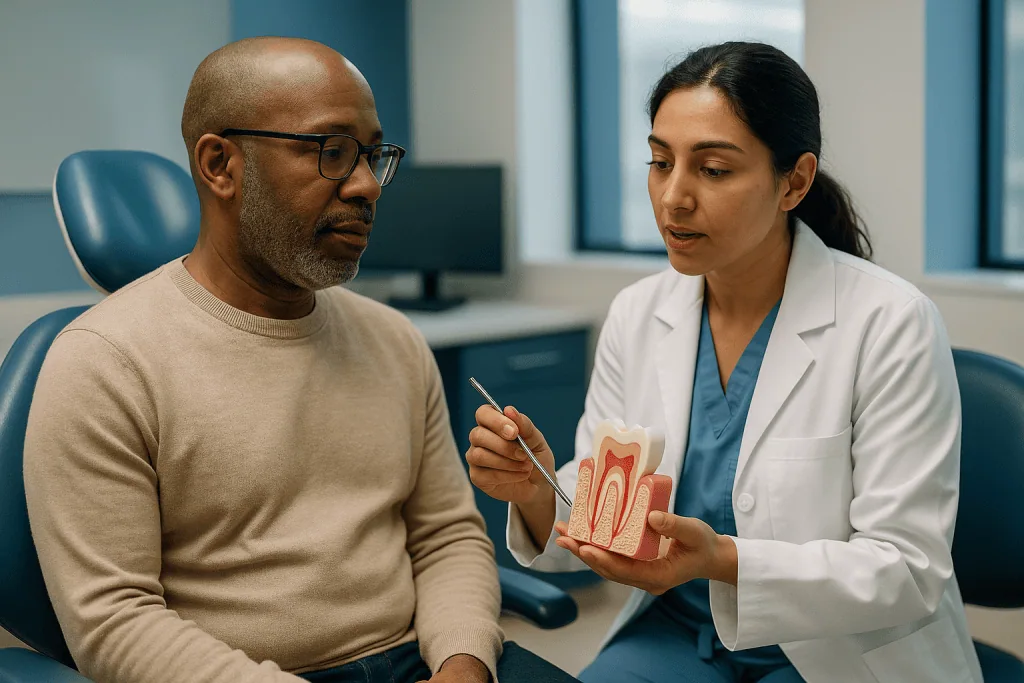
Root canal treatment tackles that chamber directly. According to Cleveland Clinic, the dentist or endodontist (a dentist who specializes in the inside of teeth) first numbs the area with local anesthetic, then isolates the tooth with a small rubber sheet to keep it dry and free of saliva. A small opening is made in the crown, the infected pulp is removed, and each canal is cleaned, shaped and flushed with disinfecting solution.
The empty canals are then sealed with a rubber-like material so bacteria cannot recolonize them. The NHS notes that if the infection is active, a temporary filling and a medicated dressing may be placed first, with the permanent seal completed at a later appointment. Treatment usually takes two or more visits.
The final step is the one people underestimate. A tooth that has lost its pulp becomes drier and more brittle, so the NHS advises that most root-treated back teeth are restored with a crown to protect them from fracture. Skipping that crown is one of the most common reasons a root canal “fails” years later, even though the canal work itself was sound.
Nothing in this process involves removing the root. The tooth stays in its socket, held by the same ligament it has always had, which is exactly the point of choosing this route.
What extraction and implant placement involve
Extraction sounds simpler, and on the day it often is. The dentist numbs the area, loosens the tooth from its socket and removes it. If the tooth is badly broken or the root is curved, it may need to be removed in sections, and a surgical approach through the gum may be required.
The implant pathway starts after that. Mayo Clinic lists the typical stages: removal of the damaged tooth, bone grafting if the jaw is too thin or soft to hold the post, placement of the titanium implant into the bone, a healing period while the bone grows around it, placement of a small connector called an abutment, and finally the artificial tooth. Each stage is separated by healing time, and Mayo notes the whole process can take many months.
The biology at the center of this is osseointegration, the process by which bone cells grow onto the surface of the titanium and lock it in place. Mayo Clinic describes this bone healing as taking several months. There is no shortcut; the implant has to be stable in bone before it can safely carry chewing forces.
Not every jaw is ready. Mayo Clinic explains that when the bone is not thick enough, a graft is placed first, and in some cases that graft itself needs months to mature before the implant can go in. Smoking, uncontrolled diabetes and certain bone conditions can also change the plan or the timing.
Put plainly, extraction and implant replaces a tooth over a season or more, in a sequence of minor surgeries. A root canal repairs a tooth over a couple of appointments. That difference in scale matters when you weigh what each path asks of you.
Who is usually a candidate for saving the tooth, and who is asked to wait
Dentists tend to ask three questions before recommending a root canal. Is there enough healthy tooth structure left above the gum to rebuild and crown? Can the canals be reached and cleaned? And is the bone around the root still sound enough to hold the tooth once the infection settles?

When the answers are yes, root canal treatment is usually the first-line option. Cleveland Clinic lists the common triggers: deep decay that has reached the pulp, a cracked or chipped tooth exposing the inner chamber, repeated dental work on the same tooth, or injury that has damaged the pulp even without a visible crack. Persistent sensitivity to heat, a darkening tooth or a pimple-like bump on the gum are among the signs that bring people in, though only an examination and X-ray can confirm what is happening inside.
Some people are asked to wait rather than proceed immediately. Someone with a spreading facial swelling or fever may need the infection brought under control first, and the NHS notes that antibiotics are sometimes prescribed to manage a dental abscess before definitive treatment. People with very high blood pressure on the day, uncontrolled diabetes or certain bleeding conditions may have treatment rescheduled until their medical team is satisfied. Pregnancy does not rule out root canal treatment, but timing is usually discussed with the obstetric team.
For the implant route, the waiting list is longer. Mayo Clinic notes that implants are generally suited to people whose jawbone has finished growing, who have adequate bone or can have a graft, whose gums are healthy, and who are willing to commit to several months of treatment. Heavy smokers and people with conditions affecting bone healing may be advised toward alternatives or a delay.
When the dentist may lean toward extraction instead
Even the most conservative dentist will sometimes say the tooth cannot be saved. The clearest case is a vertical root fracture, a crack running down the length of the root. No filling material can seal a crack that keeps flexing with every bite, and bacteria will keep finding their way in.
A second scenario is decay that has crept well below the gumline, leaving too little solid tooth to anchor a crown. Mayo Clinic notes that a root-treated tooth needs a restoration to protect it, and if there is nothing left to restore, the repair has no foundation.
A third is advanced gum disease. Root canal treatment addresses infection inside the tooth, but if the bone around the root has already been eroded by periodontal disease, the tooth may be loose regardless of how well the canals are sealed. In that case, extraction and a later implant into healthier bone can be the more predictable path.
Finally, there are teeth that have already been treated once. The NHS explains that if an infection returns after root canal treatment, the work can sometimes be repeated (retreatment), or a small surgical procedure called an apicoectomy can remove the infected root tip. When those options have been exhausted, or the canals are blocked and unreachable, extraction may be the recommendation.
None of these situations means the earlier approach was wrong. Dentistry works with living tissue that changes over time, and a tooth that was savable at one visit may not be a year later. What matters is that the recommendation is grounded in what the examination and imaging show, and that the reasoning is explained to you clearly enough that you could repeat it back.
What keeping the natural tooth changes long term
Here is the part that rarely makes it into a short consultation. A natural tooth is not simply screwed into bone. It hangs in its socket from a thin, living sling of collagen fibers called the periodontal ligament. That ligament does three things an implant cannot replicate.
First, it senses. The ligament is packed with pressure receptors, which is why you can feel a grain of sand between your teeth and instinctively ease off before biting down hard. An implant fuses directly to bone, with no ligament between, so that fine feedback is reduced. People with implants adapt, but the protective reflex is blunted.
Second, it cushions. The ligament lets a natural tooth move fractionally under load, spreading force. A root-treated tooth keeps this shock absorption. An implant transmits force straight into bone, which is one reason crowns on implants and the teeth opposing them can see more wear.
Third, it stimulates. Chewing on a natural root signals the surrounding alveolar bone (the ridge of jawbone that holds teeth) to maintain itself. After extraction, that ridge begins to remodel and shrink. Implants help preserve bone better than leaving a gap, but the bone around an extraction site changes before the implant is ever placed.
Keeping the natural tooth also keeps options open. A root-treated tooth that develops a problem years later can often be retreated or have its root tip surgically cleaned, and extraction with an implant remains available afterward. Once a tooth is removed, there is no path back.
The honest caveat: a root-treated tooth is not a new tooth. It is more brittle than a living one, and it depends on a well-fitting crown and good hygiene. Saving it buys you the biology of the original. It does not buy immunity from future trouble.
Dental implant vs root canal pros and cons: a side-by-side table
Numbers and timelines are easier to weigh when they sit next to each other. The table below summarizes what mainstream guidance from the NHS, Mayo Clinic and Cleveland Clinic describes for each path. It is a map of typical experience, not a prediction for your mouth.
| Factor | Root canal (keeps the tooth) | Extraction and implant |
|---|---|---|
| What stays in the jaw | Natural root and periodontal ligament | Titanium post fused to bone; no ligament |
| Typical appointments | Two or more, plus crown fitting (NHS) | Multiple stages over many months (Mayo Clinic) |
| Anesthesia | Local anesthetic; usually no more painful than a filling (NHS) | Local anesthetic; sedation sometimes offered for surgery |
| Bone involvement | No bone surgery | Bone graft may be needed if jaw is thin (Mayo Clinic) |
| Reported longevity | About 9 in 10 treated teeth survive up to 10 years (NHS) | Long-lasting when bone and gums stay healthy; no single guideline figure cited here |
| If it fails later | Retreatment, root-tip surgery or extraction remain options | Implant removal and possible re-grafting; no return to natural tooth |
| Main risks | Re-infection, fracture of a brittle tooth without a crown | Infection, nerve injury, sinus involvement for upper teeth (Mayo Clinic) |
Two things stand out. The root canal path is shorter and keeps every future option open. The implant path is longer and surgical, but it is the right answer when there is no tooth worth saving. Neither column is a verdict; your dentist weighs the specifics, including bone quality, bite forces and how the rest of your mouth is doing.
What the following days and weeks usually look like after each option
After a root canal, the first few hours are mostly about numbness wearing off. Cleveland Clinic advises waiting until feeling returns before eating, to avoid biting your cheek or tongue. Mild soreness or tenderness when chewing is common for a few days as the tissues around the root settle; the NHS notes that over-the-counter pain relief is usually enough, and that any medicine choice should follow the dentist’s or pharmacist’s advice. Most people return to work or school the next day.
The tooth itself is vulnerable in this window. Until a permanent crown is placed, the NHS recommends avoiding hard or sticky foods on that side, because the tooth has a temporary filling and is more prone to cracking. The crown appointment typically follows once the dentist is satisfied the infection has resolved.
After extraction, the first week centers on protecting the blood clot in the socket. Mayo Clinic and the NHS both describe standard measures: no vigorous rinsing or spitting for the first day, no smoking, soft foods, and gentle salt-water rinses after meals from the day after surgery. Swelling and bruising peak within the first couple of days and then fade.
Then comes the long middle. Mayo Clinic describes bone healing around an implant as taking several months, during which you may wear a temporary tooth for appearance. Follow-up visits check that the post is stable and the gum is healthy. Only then is the abutment and final crown placed, with a short period of adjustment as you learn how the new tooth feels when biting.
Both paths end at the same place, a tooth you can chew on. One gets there in weeks, the other in months, and that difference in time is sometimes the deciding factor for people with busy lives or health conditions that make repeated surgery harder.
How long does a root canal last compared with an implant?
This is the question behind most searches, and it deserves a careful answer rather than a confident one. The NHS states that root canal treatment is usually successful and that in about 9 out of 10 cases the tooth can survive for up to 10 years afterward. That figure comes from population-level data, not from any one practice, and it assumes the tooth was properly restored with a crown and cared for afterward.
Two factors shape whether a root-treated tooth makes it well past that mark. One is structural: a tooth with plenty of remaining wall and a well-sealed crown resists fracture far better than a heavily broken-down tooth patched with a large filling. The other is biological: good brushing, flossing and regular check-ups keep new decay from undermining the crown margins.
Implants are often described as long-lasting, and Mayo Clinic notes that most are successful, but it also stresses that outcomes depend on bone healing, gum health and habits such as smoking. Because no single guideline figure fits every situation, this article does not quote an implant survival percentage. What the evidence does show is that implants can fail in two ways: early, when the bone does not integrate, and late, when inflammation around the implant erodes the bone that holds it. Both are more likely in smokers and in people with poorly managed diabetes or gum disease.
So which lasts longer? The fair summary is that a well-restored root-treated tooth and a well-maintained implant can both serve for many years, and the comparison is close enough that longevity alone rarely settles the decision. What differs is what happens when something goes wrong, which is why the next section matters.
Risks and what can go wrong with each path
Every dental procedure carries risk, and it is reasonable to want them laid out side by side rather than reassured away.
For root canal treatment, the NHS and Cleveland Clinic describe the main concerns. Infection can persist or return if a canal was missed, the seal leaks, or a crack lets bacteria in. The treated tooth can fracture, particularly if a crown is delayed. Occasionally a small instrument tip breaks inside a narrow canal; this is usually managed without harm but may need specialist attention. Rarely, a crown or filling placed afterward fails and needs replacing.
For extraction, the common complications are a painful dry socket if the clot is lost, bleeding, and temporary numbness if a nerve runs close to the root. Lower back teeth sit near a major nerve, and upper back teeth sit near the sinus, so each site has its own anatomy to respect.
Implants add a surgical layer. Mayo Clinic lists infection at the implant site, injury to neighboring teeth or blood vessels, nerve damage causing pain or numbness in the lip, gums or chin, and sinus problems when an upper implant protrudes into the sinus cavity. Later, the bone around an implant can be lost to a gum-disease-like inflammation, which can loosen the post.
Which risk profile suits you is not a general question. A person with excellent gum health and dense bone faces different odds than someone with a history of periodontal disease, and the dentist’s recommendation should reflect that. What you can do is ask which of these risks apply most to your situation, and what would happen next if one occurred. A good answer will include a plan B, not just a reassurance.
Health conditions, smoking and why the plan may change
Dentists do not decide between root canal and implant in a vacuum. Your medical history can nudge the recommendation firmly in one direction, and it helps to know why.
Smoking is the big one. Mayo Clinic notes that it can contribute to implant failure and complications, because it narrows blood vessels and impairs the bone and gum healing an implant depends on. Someone who smokes heavily may be advised to save the natural tooth if at all possible, or to delay implant surgery until they have stopped.
Diabetes matters for the same reason. Poorly controlled blood sugar slows wound healing and raises infection risk, which complicates any oral surgery. Mayo Clinic lists uncontrolled chronic conditions among the factors that can affect implant candidacy. A root canal, with no incision or bone work, is often the less demanding option in this setting, though the infection itself still needs prompt care.
Medicines that affect bone turnover, including certain drugs used for osteoporosis or some cancers, can impair bone healing in the jaw after extraction or implant placement. Anyone taking such a medicine should tell the dentist before treatment; the dental and prescribing teams may liaise, and no medicine should be stopped or altered without the prescriber’s guidance.
Radiotherapy to the head and neck, bleeding disorders, and immune-suppressing treatment can all shift the balance toward the least surgical path. Pregnancy generally does not prevent necessary dental treatment, but elective implant surgery is often deferred.
The practical takeaway is simple: bring a current medication list and an honest account of smoking and health conditions to the consultation. The best plan for your tooth is the one that fits the rest of your body, and the dentist can only build that plan with the full picture.
What people often get wrong about root canals and implants
Few treatments carry more folklore than the root canal, and the implant has picked up its own myths. Several deserve a direct correction.
“A root canal is agonizing.” The NHS states plainly that the procedure should not be painful, and that it is usually no more unpleasant than having a filling. The pain people remember is typically from the infection before treatment, not the treatment itself.
“Root-treated teeth are dead and useless.” The pulp is removed, so the tooth no longer senses hot and cold, but it remains attached by living ligament to living bone and functions normally for chewing. It is drier and needs a crown, not a replacement.
“An implant is a permanent, maintenance-free tooth.” Mayo Clinic is explicit that implants require the same brushing, flossing and regular check-ups as natural teeth, and that bone loss around an implant can occur. Permanent is the wrong word; durable with care is closer.
“It is better to just pull it and start fresh.” Extraction removes the ligament and begins bone remodeling that cannot be reversed. For a restorable tooth, mainstream guidance favors repair first precisely because it keeps the implant option in reserve.
“Root canals cause illness elsewhere in the body.” This idea traces back to discredited research from a century ago. No current major health body supports a link between root-treated teeth and systemic disease; the real risk to general health comes from untreated dental infection, which the NHS notes can spread.
“If the pain goes away, the problem is gone.” A dying pulp can stop hurting as the nerve dies, while infection quietly continues in the bone. Silence is not the same as healing, and imaging is the only way to know.
Questions to ask your care team before you decide
A good consultation leaves you able to explain the decision to someone else. These questions help you get there, and they are the ones experienced dental patients tend to ask.
- What exactly did you see on the X-ray, and is the tooth structurally restorable?
- How much healthy tooth will be left above the gum after the decay is removed, and is that enough to support a crown?
- Is there any sign of a crack, and how confident are you that it does not extend into the root?
- If we try a root canal and it does not resolve the infection, what are the next steps: retreatment, root-tip surgery or extraction?
- If we go straight to extraction, is my bone thick enough for an implant without a graft, and how long would the whole sequence take?
- Which of my health conditions or medicines change the risks of either option?
- Would you refer me to an endodontist or an oral surgeon for any part of this, and why?
- What would happen if I did nothing for now, and how quickly could that change?
- What are the alternatives to an implant for the gap, such as a bridge or a removable denture, and what are their trade-offs?
- How should I care for the tooth or implant in the first weeks, and what signs would prompt an urgent call?
You are entitled to a clear answer to each, and to time to think before committing to surgery. If the explanation feels rushed, asking for a written summary of the findings and options is reasonable. The decision about which path to take rests with you and the treating dental team together, based on the examination, the imaging and your own priorities.
When to call your doctor or dentist
Whichever path you take, and especially while you are still deciding, some signs mean the problem should not wait for the next scheduled visit.
Contact your dentist promptly if pain is worsening rather than easing, if you notice a bad taste or discharge from the gum, if a temporary filling or crown comes out, or if swelling appears or increases around the tooth. After an extraction or implant surgery, bleeding that does not settle with firm pressure, severe pain starting two or three days later, or numbness that persists well beyond the anesthetic wearing off all warrant a same-day call.
Seek urgent medical care, through an emergency department if your dental service is closed, for any of the following red flags. The NHS and Mayo Clinic both list them as signs that a dental infection may be spreading:
- Swelling of the face, jaw or neck that is spreading or making it hard to open your mouth
- Difficulty swallowing or breathing, or a sense of tightness in the throat
- High fever or chills alongside tooth pain
- Swelling around the eye, or pain spreading toward the eye or ear
- Feeling generally very unwell, confused or drowsy
A dental abscess, the pocket of pus that forms when infection has nowhere to drain, can in rare cases spread to the deeper spaces of the neck or into the bloodstream. The NHS notes that antibiotics may be used to control such an infection, but that they do not remove the source; definitive dental treatment is still needed afterward. Any medicine prescribed should be taken exactly as the prescribing clinician directs, and never adjusted on your own.
Finally, if you have a heart valve condition, a weakened immune system or are on bone-affecting medicines, mention this when you call. It changes how quickly your team will want to see you.
Frequently asked questions
Root canal or implant, which is better for a badly infected tooth?
Neither is universally better; it depends on whether the tooth is restorable. If enough solid tooth remains to support a crown and the root is not cracked, mainstream guidance favors a root canal, because it keeps the natural root and ligament and leaves extraction as a later option. If the tooth is fractured below the gumline or too decayed to rebuild, extraction and implant may be the sounder path. Your dentist decides from the X-ray and examination.
How long does a root canal last?
The NHS states that root canal treatment is usually successful and that in about 9 out of 10 cases the tooth can survive for up to 10 years afterward. Many last considerably longer. The two biggest influences are whether the tooth was protected with a well-fitting crown and how well it is kept free of new decay through daily hygiene and regular check-ups.
Can a root canal tooth be extracted later and replaced with an implant?
Yes. Choosing a root canal now does not close off the implant option. If the tooth later fractures or the infection returns and retreatment or root-tip surgery is not suitable, the tooth can be extracted and an implant considered, subject to bone quality at that time. The reverse is not possible: once a tooth is removed, it cannot be put back.
Does a root canal hurt more than an extraction?
Both are done under local anesthetic and should not be painful during the procedure. The NHS describes root canal treatment as usually no more unpleasant than a filling. Afterward, a root canal typically causes a few days of tenderness, while extraction involves a healing socket and sometimes swelling. The pain people associate with root canals usually comes from the infection beforehand, not the treatment.
What are the dental implant vs root canal pros and cons in plain terms?
A root canal keeps your natural tooth, needs no surgery on bone, and is completed over a couple of appointments plus a crown; its downside is that the tooth becomes more brittle and can fail if it cracks or re-infects. An implant provides a stable replacement when no tooth is worth saving, but it involves surgery, months of healing, and risks such as infection, nerve injury and later bone loss around the post.
Why does my dentist want to save a tooth instead of pulling it?
Because the natural root does things an implant cannot. It is held by a living ligament that provides fine pressure sensing and shock absorption, and chewing on it keeps the surrounding jawbone stimulated. Extraction starts irreversible bone remodeling. Saving a restorable tooth also preserves every future option, including an implant, whereas removing it forecloses repair.
How long does the whole implant process take from extraction to final tooth?
Mayo Clinic describes dental implant surgery as a series of stages that can take many months in total. After extraction, the site may need a bone graft that must heal first; then the implant is placed and the bone grows around it over several months; then the abutment and crown are fitted. The exact timeline depends on your bone, healing and overall health, and your surgeon will outline it for you.
Can an infected tooth wait while I decide between the two options?
A short delay to think is usually reasonable, but the infection itself should not be left unmanaged. Untreated dental infection can spread, and the NHS warns that a dental abscess can become serious. If you develop facial swelling, fever, or difficulty swallowing or breathing, seek urgent care. Ask your dentist how long is safe to wait in your particular case and what to watch for in the meantime.
Will a root-treated tooth look or feel different?
It functions normally for chewing because it remains attached to bone by its ligament, though it no longer senses hot or cold since the pulp is gone. Some root-treated teeth darken slightly over time; a crown usually covers this. The tooth is more brittle than a living one, which is why a crown is recommended for most back teeth and why hard foods are best avoided until it is fitted.
Are there alternatives to an implant if my tooth has to come out?
Yes. A fixed bridge uses the neighboring teeth to support a replacement, and a removable partial denture can fill the gap without surgery. Each has trade-offs: a bridge requires reshaping adjacent teeth, and a denture is less stable. Leaving a gap is also an option some people choose, though it allows bone to shrink and neighboring teeth to drift. Your dentist can explain which suits your mouth and health.
References
- NHS: Root canal treatment
- Cleveland Clinic: Root canal
- Cleveland Clinic: Dental implants
- NHS: Dental abscess
This article is for general information only and is not a substitute for professional medical advice. Please consult a qualified doctor about your individual situation.
Add us as a Preferred Source to see more of our trusted health content across Google Search, AI Overviews and Discover.

Planning This Treatment in Turkey
Our full guide for international patients: techniques, hospital stay, recovery and cost.
More from the Blog

When Bad Breath Needs a Dentist: Halitosis That Outlasts Brushing and Mouthwash
Bad breath that persists for more than a couple of weeks despite brushing twice a day, cleaning between teeth and cleaning the tongue is…
After Laser Assisted Dental Procedures: Short-Lived Sensitivity vs Swelling That Needs a Call
Mild gum tenderness, tooth sensitivity to cold, slight seepage of blood-tinged saliva and a little puffiness are common in the first two or three…

When a Night Guard Is Not Helping Bruxism: Adjustment, Replacement and Next Steps
A night guard that is not working usually means one of three things: it fits poorly or has worn out, it is the wrong…

What an Oral Health Therapy Visit Involves: Cleaning, Gum Checks and a Personal Plan
An oral health therapy appointment is a preventive dental visit led by a hygienist or oral health therapist. It usually includes a review of…

What Periodontal Measurements Reveal About Gum Recession: Pocket Depths and Bone Support
Periodontal measurements translate gum recession into numbers a dental team can track. A probe measures pocket depth, the gap between gum and tooth, and…

When Do Children Get Removable Appliances? How Jaw Growth Shapes the Timing
Removable appliances for children are usually fitted during the mixed dentition years, when baby and adult teeth share the mouth and the jaws are…