

Runner’s Knee, IT Band Syndrome and Patellar Tendinopathy: The Three Running Knees, Explained

Key Takeaways
- The IT band cannot slide across the outer knee; anatomical studies show it is anchored to the femur and compresses a sensitive fat pad at roughly 30 degrees of knee flexion.
- IT band syndrome accounts for about 5 to 14 percent of running injuries in registries and is the most common cause of lateral knee pain in distance runners.
- Raising running cadence by 5 to 10 percent measurably reduces hip adduction and patellofemoral joint loading per stride in laboratory studies.
- For patellofemoral pain, randomized trials show hip-plus-knee strengthening outperforms knee-only exercise for pain and function.
- Patellar tendinopathy responds to progressive heavy slow resistance or eccentric loading over about 12 weeks and often needs three to six months to fully settle.
- The IT band is not muscle and cannot cramp; what people call iliotibial band cramp is usually hip muscle spasm or the compression pain of IT band syndrome itself.
IT band syndrome, runner's knee and patellar tendinopathy are three different overuse problems that runners often lump together as knee pain. IT band syndrome hurts on the outer knee, runner's knee behind or around the kneecap, and patellar tendinopathy just below it. All three usually improve with a temporary cut in running load plus progressive strengthening, with imaging and injections reserved for cases a clinician judges unusual.
Somewhere around mile four, a runner slows to a walk, presses a thumb into the bony bump on the outside of the knee, and winces. Within an hour the knee feels normal again, which is exactly why so many people assume it is nothing. Then the next run reproduces it at the same distance, almost to the minute.
That scene is playing out more than usual right now. Spring and autumn race calendars push mileage up fast, and as of early 2026 short-form videos promising to “release” or “lengthen” a tight IT band have been viewed tens of millions of times. Search interest in it band syndrome, runner’s knee and patellar tendonitis tends to spike in step with those two forces: more running, more confident claims about what the pain means.
This piece is the longer, calmer version. It separates the three running knees, explains what each one actually is, and grades the evidence behind the treatments people are being sold on their phones.
Why does the outside of my knee hurt after running?
Outer knee pain that appears partway through a run, fades with rest, and comes back at a predictable distance is the classic signature of iliotibial band syndrome. The iliotibial band, usually shortened to IT band, is a thick strap of connective tissue that runs down the outside of the thigh from the hip to just below the knee. At the knee it passes over the lateral femoral epicondyle, the bony knob you can feel on the outer side of the joint.
Runners describe the pain in strikingly similar ways: sharp or burning, pinpointed to that knob, worse running downhill or slowing down, and often worst at the moment the heel strikes the ground. Many can walk comfortably but cannot run more than a few minutes. Some notice a snap or click as the knee bends past a certain point.
The timing matters for diagnosis. Pain that is there from the first step, pain that wakes you at night, or pain that followed a twist or a fall points somewhere else, and a clinician will want to rule out a lateral meniscus tear, a ligament sprain or a stress fracture before settling on an overuse label.
Not every outer knee complaint in a runner is the IT band, but in population surveys of running injuries it is consistently among the most common, typically accounting for somewhere between 5 and 14 percent of all running-related complaints and the single most frequent cause of lateral knee pain in distance runners. Those are observational figures from injury registries, not trial data, but they are consistent enough across countries to trust.
What is IT band syndrome, and why "friction" is the wrong picture
For decades the condition was called iliotibial band friction syndrome, and the mental image was a cable sawing back and forth over a bony edge every time the knee bent. It is a vivid picture. It also appears to be wrong.
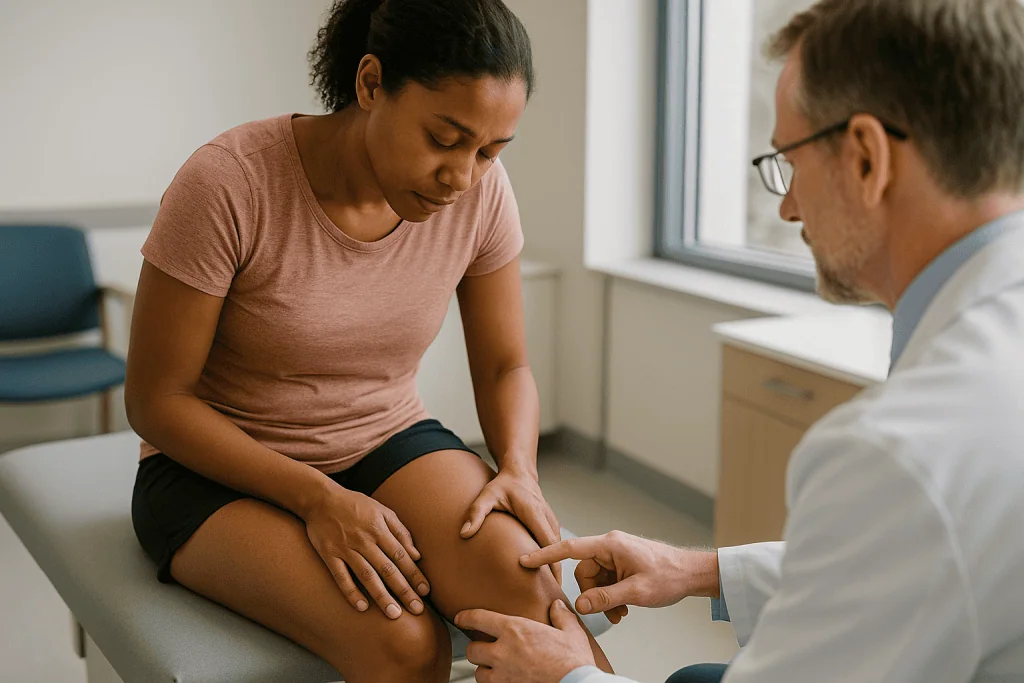
In 2006 an anatomical study published in the Journal of Anatomy examined cadaver limbs and live volunteers with MRI and found that the IT band is firmly anchored to the femur along its length by fibrous strands. It cannot slide forward and backward over the epicondyle the way the friction story requires. What the band can do is press down. As the knee flexes to roughly 30 degrees, tension in the band rises and it compresses a highly innervated layer of fat and connective tissue sitting between the band and the bone.
That shift from friction to compression changes what sensible treatment looks like. If the problem is a strap pressing too hard on a sensitive cushion, the goals become reducing how often and how forcefully that compression happens, and improving how well the hip controls the thigh so the band is not yanked tight on every stride.
Two terms are worth defining here. Tendinopathy means a painful, overloaded tendon whose structure has changed; it is the preferred word over tendonitis because inflammation is usually not the main event. Overuse injury means tissue breaking down faster than it can adapt, usually because load went up quicker than the body could keep pace. It band syndrome fits the second definition well, which is why the first question a clinician asks is almost always: what changed in your training in the last few weeks?
What changed recently
The anatomy has not changed, but the conversation around it has, and a few dated points explain why the topic is trending again.
First, the compression model is now mainstream patient-education language rather than a specialist footnote. Major patient resources describe the IT band as a band that tightens and presses on tissue at the outer knee, and advise against the idea that it can be meaningfully stretched or loosened by hand. The 2006 anatomical work cited in the references underpins that wording, and it has held up in subsequent imaging studies.
Second, the dominant viral claim has shifted. A few years ago the message was “foam roll the IT band until it releases.” The current wave of videos instead promises that a single hip exercise, a specific shoe, or a change in foot strike will stop outer knee pain within days. The grain of truth is real: hip abductor weakness and cadence are legitimate targets. The timeline is not. Observational rehabilitation series report meaningful improvement over about six weeks of structured work, not six days.
Third, the three running knees are being discussed together more often, partly because wearable data has made runners more aware of sudden mileage jumps, the shared root cause. Patient guidance on patellofemoral pain and patellar tendinopathy now leans heavily on progressive loading rather than rest alone, a shift that has been building since the mid-2010s and is reflected in the sources listed below.
What has not changed: no new drug, injection or device has been approved specifically for any of these three conditions, and no large randomized trial has overturned exercise-based rehabilitation as the first-line approach.
Runner's knee: what patellofemoral pain actually is
Runner’s knee is the everyday name for patellofemoral pain syndrome, pain arising from the joint where the kneecap glides in a groove on the front of the thigh bone. The patella, the kneecap, is a small bone embedded in the quadriceps tendon that increases the muscle’s leverage. When the forces pressing it into its groove outstrip what the cartilage and surrounding tissue can tolerate, the front of the knee starts to ache.
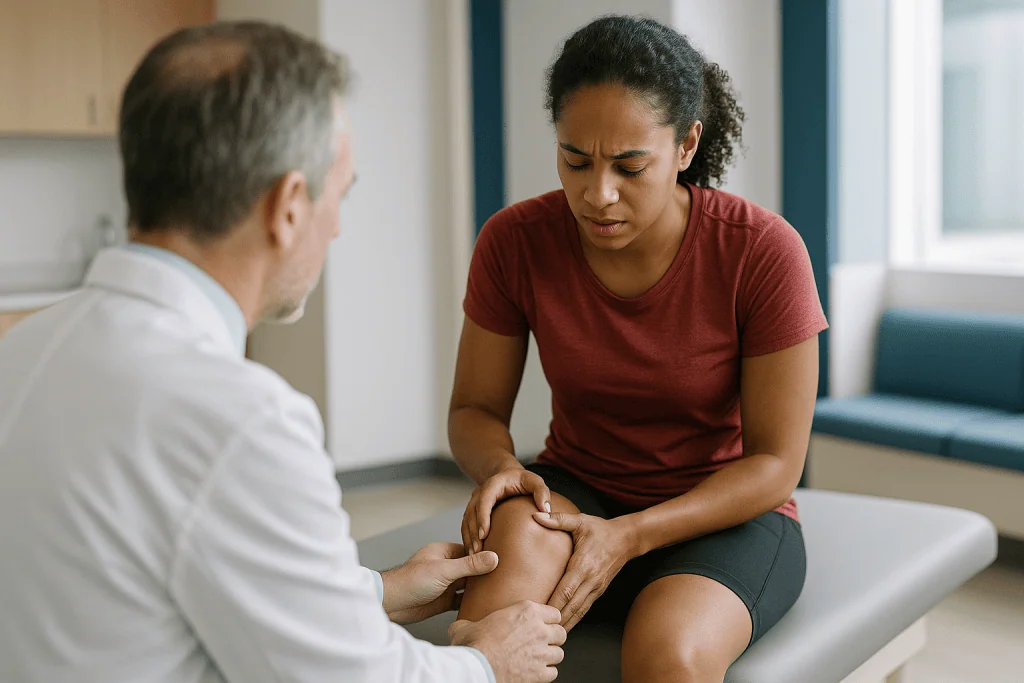
The pain is diffuse rather than pinpoint. People press a whole hand around the kneecap instead of a single fingertip. It is aggravated by stairs, particularly going down, by squatting, and by sitting with the knee bent for a long time; the “theater sign” of stiffness after a movie is a textbook feature. Running uphill and downhill both load the joint, downhill more so because the quadriceps work hard to brake.
Patellofemoral pain is the most frequently diagnosed running injury in most registries, more common in women than men, and most common in the teens through the forties. Imaging is often normal, which frustrates people, but it also carries a reassuring message: in the typical case there is no structural damage to fix.
Contributing factors include weak or slow-firing hip muscles that let the thigh drift inward on landing, a quadriceps that fatigues early, and, above all, a jump in training volume or intensity. Footwear and arch shape get a lot of attention online, yet the evidence linking them to patellofemoral pain is weaker than the evidence for load error and hip control, which is where good rehabilitation spends its time.
Patellar tendonitis or tendinopathy? Why the name matters
Just below the kneecap, a short thick tendon connects the patella to the shin bone. Overload it and you get pain right at its upper attachment, a condition still widely searched as patellar tendonitis and more accurately called patellar tendinopathy, or jumper’s knee.
The naming is not pedantry. Tendonitis implies inflammation, and the natural response to inflammation is rest and anti-inflammatory measures. Biopsy and imaging studies of chronically painful patellar tendons mostly show disorganized collagen, increased ground substance and new blood vessels rather than classic inflammatory cells. Tendinopathy is a failed adaptation to load, and the tissue recovers by being loaded progressively, not by being left alone for months.
Clinically, the pain is sharp and localized to the lower pole of the kneecap. It is provoked by jumping, landing, deep squatting and fast downhill running, and in early stages it warms up during activity only to return afterward. Runners get it less often than basketball and volleyball players, where prevalence in some elite squads exceeds 40 percent, but trail runners and anyone adding hill repeats or plyometrics are at risk.
Distinguishing it from runner’s knee is usually straightforward on examination. Tendinopathy hurts at one fingertip-sized spot below the kneecap and reproduces on a single-leg decline squat; patellofemoral pain is spread around the kneecap and reproduces on stairs and prolonged sitting. Ultrasound can show tendon thickening, though it is not required for diagnosis and findings do not always match symptoms.
A persistent tendinopathy can take three to six months of consistent loading to settle, which is longer than most runners expect and a frequent reason people abandon a program that was working.
The three running knees side by side
Most self-misdiagnosis comes from assuming all knee pain in a runner is the same thing. The table below is the fastest way to tell them apart. It is a guide to conversation with a clinician, not a substitute for examination, because the conditions can coexist and other diagnoses can mimic each.
| Feature | IT band syndrome | Runner’s knee (patellofemoral pain) | Patellar tendinopathy |
|---|---|---|---|
| Where it hurts | Outer knee, over the bony knob | Around or behind the kneecap, diffuse | Just below the kneecap, pinpoint |
| Classic trigger | Set distance into a run, downhill, slowing down | Stairs down, squats, long sitting | Jumping, landing, deep squats, hills |
| Pain character | Sharp or burning, often forces a stop | Dull ache, grinding sensation | Sharp, localized, warms up then returns |
| Typical onset | Weeks after a mileage or hill increase | Gradual, often with new volume | Gradual, often with new speed or plyometrics |
| Key rehab target | Hip abductor strength, stride cadence | Hip and quadriceps strength, load management | Progressive tendon loading, heavy slow resistance |
| Usual recovery window | About 4–8 weeks | Weeks to several months | Often 3–6 months |
Two patterns deserve a flag. Pain that moves between locations over a few weeks often signals a global load problem rather than three separate injuries. And pain in all three regions at once, especially with swelling, is unusual for overuse and warrants an in-person assessment rather than another week of self-management.
What the evidence actually says, graded honestly
Running injury research is dominated by small studies, so it helps to label the strength of each claim rather than present everything as settled.
Strong to moderate evidence. For patellofemoral pain, systematic reviews pooling multiple randomized trials show that exercise therapy reduces pain and improves function compared with no treatment, and that combining hip and knee strengthening beats knee-focused exercise alone. The trials are modest in size and quality is rated low to moderate, but the direction of effect is consistent. For patellar tendinopathy, randomized trials of eccentric decline squats and of heavy slow resistance training both show clinically meaningful improvement over 12 weeks, with heavy slow resistance producing better satisfaction at longer follow-up in one well-cited Danish trial.
Moderate to weak evidence. For IT band syndrome, the most quoted rehabilitation data come from a case series of 24 distance runners treated with a six-week hip abductor program, 22 of whom returned to running pain-free. That is observational, uncontrolled, and two decades old. Cadence manipulation has biomechanical support: laboratory studies show that increasing step rate by 5 to 10 percent reduces peak hip adduction and patellofemoral joint loading, but outcome trials in injured runners remain small.
Weak evidence or expert opinion. Foam rolling for IT band pain has no trial showing it changes outcomes. Corticosteroid injection for IT band syndrome has one small randomized trial showing reduced pain during running at two weeks, with no long-term data. Platelet-rich plasma for patellar tendinopathy has mixed trial results and is not superior to a good loading program. Shoe type, orthotics and foot strike changes rest mainly on biomechanical reasoning and expert consensus.
The honest summary: progressive, specific loading is the only intervention with consistent support across all three conditions.
Who gets IT band syndrome, and what tips the balance
Ask a group of runners with outer knee pain what changed, and the stories rhyme. A marathon plan jumped from 25 to 35 miles a week. A move to a hilly neighborhood. A new habit of running the same cambered road in the same direction, so one leg is always slightly lower than the other.
Training error is the dominant modifiable risk factor across the observational literature, and downhill running is the most specific trigger because the knee spends more time in the 20 to 30 degree flexion zone where the band compresses hardest. Slow, shuffling running does the same thing, which explains the paradox of people who feel fine at tempo pace and terrible on easy days.
Biomechanics add a second layer. Several prospective studies have found greater hip adduction, the thigh drifting inward on landing, and greater internal rotation of the knee in runners who later developed IT band syndrome. Weak or poorly timed hip abductor muscles, chiefly gluteus medius, are the usual suspect, though it is not always clear whether weakness causes the problem or follows it. A low step rate with a long, reaching stride amplifies both.
Anatomy plays a smaller part than the internet suggests. A prominent lateral epicondyle, a leg-length difference or bowed knees may raise susceptibility, but plenty of runners with those features never get the condition, and plenty without them do.
Cyclists get it too, typically from a saddle set too high or cleats angled inward, which is a useful reminder that the common thread is repetitive knee flexion under tension rather than running itself.
How to manage IT band syndrome without starting from zero
The instinct is to stop running entirely and wait. Complete rest usually calms the pain, and it usually comes straight back on the first run, because nothing about the hip, the stride or the training plan has changed.
A more durable approach has three parts that run in parallel.
- Modify load, do not abolish it. Shorten runs to a distance below the point where pain starts, avoid downhill sections and cambered roads, and keep intensity moderate. Cycling with a well-adjusted saddle, pool running or an elliptical can maintain fitness. Mild discomfort that settles within a day is generally acceptable; pain that forces a limp is a sign to pull back further.
- Strengthen the hip and trunk. Side-lying leg raises, side planks, single-leg squats with attention to keeping the knee over the foot, and step-downs target the muscles that keep the thigh from collapsing inward. Progress the difficulty every one to two weeks. Most published programs run six weeks or longer before runners return to full mileage.
- Nudge the stride. Raising cadence by about 5 to 10 percent, often with a metronome app, shortens the stride and reduces the inward drift at landing. It feels odd for a few runs and then becomes normal.
Soft-tissue work and foam rolling may feel good on the outer thigh and are not harmful in moderation, but rolling directly over the painful outer knee tends to irritate the compressed tissue further. Physical therapists sometimes add taping, manual therapy or gait retraining with video feedback; these are reasonable additions on expert opinion, not proven essentials.
Short-term anti-inflammatory medicines are sometimes suggested by clinicians to make rehabilitation tolerable; whether they are appropriate, and for how long, is a decision for the prescribing clinician who knows your history.
Managing runner's knee and patellar tendonitis: loading is the treatment
The unifying principle for the front-of-knee pair is that the tissue needs to be loaded in a controlled, progressive way, and that pain during exercise is tolerated within limits rather than treated as a stop sign.
For patellofemoral pain, the best-supported program combines hip strengthening (abduction, external rotation, bridging) with quadriceps work in ranges that do not provoke sharp pain, typically shallower squats and leg presses early on. Trials show hip-plus-knee programs outperform knee-only ones for pain and function at both short and longer follow-up. A temporary reduction in weekly distance, keeping runs on flat ground, and raising cadence all lower patellofemoral joint stress per stride. Taping and foot orthoses have modest short-term support in some people and are optional rather than foundational.
Patellar tendinopathy follows a slightly different logic. The tendon seems to respond best to heavy, slow, controlled loading performed a few times a week, with squats progressing in resistance over roughly 12 weeks, or to the older single-leg decline squat protocol. Isometric holds, such as a static wall sit, are often used before runs because some trials report a short window of pain relief afterward, though the effect is inconsistent between studies. The most common failure mode is impatience: tendons remodel slowly, and a program abandoned at week five rarely shows its value.
In both conditions a simple rule of thumb from rehabilitation practice is useful: pain up to a moderate level during and immediately after exercise is acceptable if it returns to baseline by the next morning. Pain that is worse the following day means the load was too high.
Injections and surgery sit far down the list for both, considered only after months of well-executed loading, and only by a clinician who has examined the knee.
Common myths about IT band pain, corrected
The viral claims are confident, short and mostly incomplete. Here are the ones clinicians hear most, with what the evidence supports.
“You need to stretch or foam roll the IT band until it lengthens.” The band is a dense sheet of connective tissue anchored to the femur; studies estimate the force needed to deform it meaningfully is far beyond what a foam roller or a stretch can apply. Rolling the outer thigh may ease muscle tension in the tensor fasciae latae and vastus lateralis and can feel pleasant, but it is not changing the band.
“Iliotibial band cramp is a thing.” The IT band is not muscle and cannot cramp. People who describe an outer-thigh or outer-knee cramp are usually feeling spasm in the small hip muscle that tensions the band, or the sharp compression pain of IT band syndrome itself. The distinction matters because the fixes differ.
“It is friction, so the band is rubbing itself raw.” As covered above, the anatomy argues for compression of a sensitive fat pad, not sawing. The practical implication is that pressing harder on the sore spot is counterproductive.
“Stop running completely until it is gone.” Rest alone does not address hip control, stride mechanics or the training error, so recurrence rates after pure rest are high in clinical experience. Modified running plus strengthening is the better-supported route.
“Patellar tendonitis means inflammation, so ice and anti-inflammatories fix it.” Chronic tendon pain is primarily a structural overload problem. Ice may help with symptoms; it is not a treatment for the tendon.
“Runner’s knee means my cartilage is worn out.” Most people with patellofemoral pain have normal imaging, and even when cartilage changes are present they correlate poorly with symptoms.
Is IT band pain common after knee replacement surgery?
Lateral knee pain after a total knee replacement is a frequent search, and the answer needs some nuance. Pain on the outer side of a replaced knee is relatively common in the first months, but true IT band syndrome of the kind runners get is only one of several explanations and not the most frequent.
After replacement, the mechanics of the outer knee change. Surgeons sometimes release part of the lateral soft tissue to balance the joint, the position and size of the components alter where tension falls, and months of altered gait before and after surgery leave the hip abductors weak. Any of these can make the IT band tighter over the outer knee and produce a snapping or aching sensation, especially when standing from a chair or descending stairs. Case reports describe iliotibial band irritation and even a painful snapping band after knee replacement, but these are uncommon relative to the number of operations performed each year.
Other, more frequent causes of outer knee pain after replacement include irritation of the scar and surrounding soft tissue, bursitis over the outer knee, referred pain from the hip, component-related issues such as overhang or loosening, and in the early period simple surgical healing. Pain that is improving steadily over the first three to six months is typical. Pain that plateaus, worsens, comes with warmth, redness, fever or new swelling, or appears years later needs the surgical team’s attention promptly, because infection and loosening are time-sensitive.
For the subset where the IT band is the culprit, treatment mirrors the runner’s version: hip strengthening, gait work with a physical therapist and, occasionally, an injection at the surgeon’s discretion. The decision about what is causing the pain belongs to the operating team, who can review the implant and the X-rays.
When to see a doctor about running knee pain
Most overuse knee pain in runners is safe to self-manage for a short period with reduced load and strengthening. Certain features should move you from self-management to a clinician, and a few need urgent assessment.
Seek urgent or same-day care if you notice:
- a hot, red, swollen knee, especially with fever or feeling unwell, which can signal infection, particularly after any surgery or injection
- a knee that locks, gives way or cannot fully straighten, suggesting a meniscus or ligament injury
- sudden severe pain after a pop, fall or twist, or inability to bear weight
- calf pain, swelling or warmth alongside knee pain, which can indicate a blood clot
- numbness, tingling or a cold, pale foot
Book a non-urgent appointment if:
- pain has not improved after about two to three weeks of sensible load reduction
- pain is present at rest or at night, not just with activity
- there is bony tenderness along the shin or thigh, a possible stress fracture
- pain shifts between locations or affects both knees at once
- you have a history of inflammatory arthritis, a previous knee operation or a replaced knee
- you are a teenager with pain at the shin bump below the kneecap, since growth-plate conditions behave differently
A clinician’s job here is less about ordering an MRI, which is rarely needed early, and more about excluding the diagnoses that are not overuse. Sports medicine physicians, physiotherapists and orthopedic clinicians all manage these conditions; which one you see depends on local pathways. Any decision about anti-inflammatory medicines, injections, imaging or surgery rests with the treating clinician, who weighs your history, examination and goals. If you take any prescribed medicine, do not stop or change it on the basis of knee pain without discussing it with the prescriber.
Returning to running without reopening the problem
The most dangerous week in any knee rehabilitation is the first one where everything feels fine. Pain settles, confidence returns, and the easiest mistake is to resume the exact plan that caused the trouble.
A return that holds tends to follow a few principles. Start below the distance that previously triggered pain, and increase total weekly volume gradually; the oft-quoted 10 percent rule has limited direct evidence but is a reasonable brake. Add back the specific provocation last: downhill for IT band syndrome, stairs and long descents for runner’s knee, hill sprints and plyometrics for patellar tendinopathy. Keep the strengthening going twice a week after symptoms resolve, because the hip strength and tendon capacity you built are the reason the pain left.
Watch the day-after signal rather than the in-run signal. Tendons and joints often report overload with a delay, so stiffness the following morning is the earliest honest feedback you will get. A stride that drifted back to long and slow is a common quiet cause of relapse, and a quick cadence check with a watch or app every few weeks costs nothing.
Finally, treat recurrence as information, not failure. A second episode usually means one variable was missed: the saddle on the bike, a worn pair of shoes that changed the landing, a sudden return to track work, or a training block that stacked long runs on consecutive days. Runners who recover and stay recovered are rarely the ones with the best anatomy. They are the ones who learned what their knees were trying to say the first time, and adjusted the plan rather than the pain.
Frequently asked questions
What is the fastest way to tell IT band syndrome from runner's knee?
Location is the quickest clue. IT band syndrome hurts at one sharp point on the outer knee and typically starts a set distance into a run, while runner’s knee is a diffuse ache around or behind the kneecap that is worse on stairs, squats and long sitting. A clinician confirms the difference with simple provocation tests and by excluding other causes.
Is patellar tendonitis the same as runner's knee?
No. Patellar tendonitis, more accurately called patellar tendinopathy, is overload of the tendon just below the kneecap and hurts at a pinpoint spot there, especially with jumping and deep squats. Runner’s knee is pain from the joint between the kneecap and thigh bone, spread around the kneecap. They can coexist, but rehabilitation emphasizes different exercises for each.
What is iliotibial band cramp?
It is a misnomer. The iliotibial band is connective tissue, not muscle, so it cannot cramp. The sensation people describe is usually spasm in the small hip muscle that tensions the band, or the sharp compression pain of IT band syndrome at the outer knee. Hip strengthening and load management address both far better than stretching the band.
What could cause pain on the outside of my knee when I bend and straighten it?
In a runner, the most common cause is IT band syndrome, where the band compresses tissue over the outer knee as it passes about 30 degrees of flexion, often with a snap. Other possibilities include a lateral meniscus tear, lateral ligament strain, bursitis or referred pain from the hip, so pain with locking, swelling or after an injury warrants examination.
Can I keep running with IT band syndrome?
Often yes, in modified form. Most rehabilitation programs keep runners below the distance where pain starts, avoid downhill and cambered routes, and add hip strengthening and a slightly higher cadence. Pain that forces a limp or lingers into the next day means the load is too high. If pain persists beyond a few weeks of this approach, see a clinician.
Does foam rolling help IT band syndrome?
Not in the way the videos claim. No trial shows that foam rolling changes IT band syndrome outcomes, and the band is too stiff to be lengthened by a roller. Rolling the outer thigh muscles may feel good and is harmless in moderation, but rolling directly over the sore outer knee can irritate the compressed tissue.
How long does IT band syndrome take to heal?
Most runners who follow a structured program of load modification and hip strengthening improve over roughly four to eight weeks, based on observational rehabilitation series. Those who simply rest often feel better sooner but relapse on returning to running because the underlying stride and strength factors were not addressed. Longer-standing cases can take several months.
Why does my knee hurt more running downhill?
Downhill running keeps the knee in the 20 to 30 degree flexion range longer and demands heavy braking from the quadriceps. That range is where the IT band compresses the outer knee hardest and where patellofemoral joint forces climb, so both IT band syndrome and runner’s knee flare on descents. Reintroducing hills last in a return-to-running plan is sensible.
Is IT band pain a common symptom after knee replacement?
Outer knee pain after knee replacement is fairly common in the first months, but true IT band syndrome is only one of several causes and not the most frequent. Scar tissue, bursitis, hip-referred pain and component issues are also possible. Pain that worsens, or comes with warmth, redness, fever or new swelling, should be reviewed promptly by the surgical team.
Do I need an MRI for runner's knee or IT band syndrome?
Usually not early on. Both are typically diagnosed from history and examination, and imaging is often normal in patellofemoral pain. A clinician may order an X-ray, ultrasound or MRI when symptoms do not improve after a reasonable rehabilitation period, when there was an injury, or when features such as locking, swelling or night pain suggest a different diagnosis.
References
This article is for general information only and is not a substitute for professional medical advice. Please consult a qualified doctor about your individual situation.

More from the Blog
Cast or Surgery for a Broken Bone? How Doctors Decide Between Immobilization and Fixation
Doctors choose a cast when a broken bone is stable, the pieces sit close to their normal position and they are expected to stay…

After Trauma Surgery: Circulation and Nerve Checks, Infection Signs and When to Call
After trauma surgery, check the operated limb several times a day for changes in color, warmth, sensation and movement, and look at the wound…

PAO Recovery Timeline: Crutches, Partial Weight-Bearing and the Physical Therapy Phases
A typical PAO recovery timeline runs in phases: a hospital stay of several days, protected weight-bearing on crutches for roughly six to eight weeks…

Driving, Typing and Lifting After Upper Limb Surgery: When Everyday Tasks Return
Driving after upper limb surgery is usually allowed only when you can steer, brake and react without a sling, without impairing pain medicine, and…

Knee Replacement Alternatives: What Genuinely Helps Before Surgery
The best-supported knee replacement alternatives are structured exercise and physical therapy, weight management, activity pacing, walking aids or an unloader brace, and short-term pain…

NHS Knee Replacement Waiting Times: Your Realistic Options in 2026
In England, the NHS standard is that treatment should start within 18 weeks of referral, but that target has not been met nationally since…