

Scalp Psoriasis vs Dandruff: How to Tell Them Apart and Treat Each

Key Takeaways
- Dandruff flakes stay within the hair-bearing scalp, while scalp psoriasis plaques commonly cross the hairline onto the forehead, nape and skin behind the ears.
- Psoriasis speeds skin-cell turnover to roughly three to four days instead of three to four weeks, which is why its scale is thick and silvery rather than fine and greasy.
- Around half of people with plaque psoriasis have scalp involvement, and for some the scalp is the only site, which is why it is so often misread as dandruff.
- If four weeks of a properly used anti-yeast shampoo (five minutes of contact on the scalp) brings no improvement, the diagnosis is probably not dandruff.
- Hair loss from scalp psoriasis is almost always temporary and regrows once inflammation is controlled; permanent loss is rare and tied to years of severe untreated disease.
- Scratching and picking scale can seed new plaques along the line of injury (the Koebner phenomenon), making the itch itself a treatment target.
Scalp psoriasis is an immune-driven condition that produces thick, sharply bordered, silvery plaques that often extend past the hairline, while dandruff is a mild, oily form of seborrheic dermatitis with fine white or yellow flakes confined to the scalp. Dandruff usually settles with medicated anti-yeast shampoos; scalp psoriasis is a long-term condition managed with prescription topicals and, when widespread, phototherapy or systemic medicines chosen by a dermatologist.
The hairdresser pauses, comb in mid-air, and says the sentence that sends thousands of people to a search bar every week: “You’ve got a bit of flaking back here.” Is it dandruff, which half of adults meet at some point, or scalp psoriasis, which touches roughly one in two people living with psoriasis and sometimes shows up nowhere else on the body?
The question is trending for a reason. As of early 2026, dermatology has had a run of news aimed squarely at the scalp: final results from a dedicated trial of an oral psoriasis tablet in so-called special areas (scalp, palms, soles and skin folds), plus newer non-steroid topical foams approved for both seborrheic dermatitis and plaque psoriasis. When one bottle can be prescribed for either condition, people understandably ask which one they actually have.
The honest answer is that the two can look alike for a week and behave completely differently for a decade. Here is how clinicians tell them apart, what the evidence supports for each, and when a flake deserves a doctor’s appointment rather than a new shampoo.
What changed recently in scalp psoriasis care
Scalp psoriasis has been studied for a century, but the framing around it shifted in two steps. The first was institutional. In May 2014 the World Health Assembly adopted a resolution recognizing psoriasis as a serious noncommunicable disease, and in 2016 the World Health Organization published its Global report on psoriasis, estimating that at least 100 million people live with the condition and that prevalence ranges from under 0.1 percent to over 11 percent depending on the country studied. That report also named stigma and under-treatment as problems in their own right, which matters for a disease that is literally on display at the hairline.
The second step is therapeutic and more recent. Scalp, palms, soles and genital skin were long treated as afterthoughts in large psoriasis trials, measured only as a sub-score. Over the past two years, trials have begun recruiting people specifically because those areas are involved, and a non-steroid topical foam has been cleared in the United States for seborrheic dermatitis (late 2023) and then for plaque psoriasis including the scalp (2024). A prescription that works on either side of this diagnostic line is genuinely new.
What has not changed is just as important. There is still no blood test for either condition. Diagnosis rests on what an experienced clinician sees and feels: scale thickness, border sharpness, color, distribution, and whether the rest of the skin and nails tell a story. A biopsy settles the rare ambiguous case. New medicines widen the options once a diagnosis is made; they do not replace the examination, and none of them should be started, swapped or stopped without the prescribing clinician’s guidance.
What is scalp psoriasis, in plain terms?
Psoriasis is a chronic autoimmune skin disease, which means the immune system mistakenly treats healthy skin as a threat. Signaling proteins called cytokines, chiefly interleukin-17 and interleukin-23, drive skin cells to mature and shed in about three to four days instead of the usual three to four weeks. The cells pile up faster than they can fall away, producing a raised plaque with a dry, silvery-white scale on top and inflamed skin underneath.
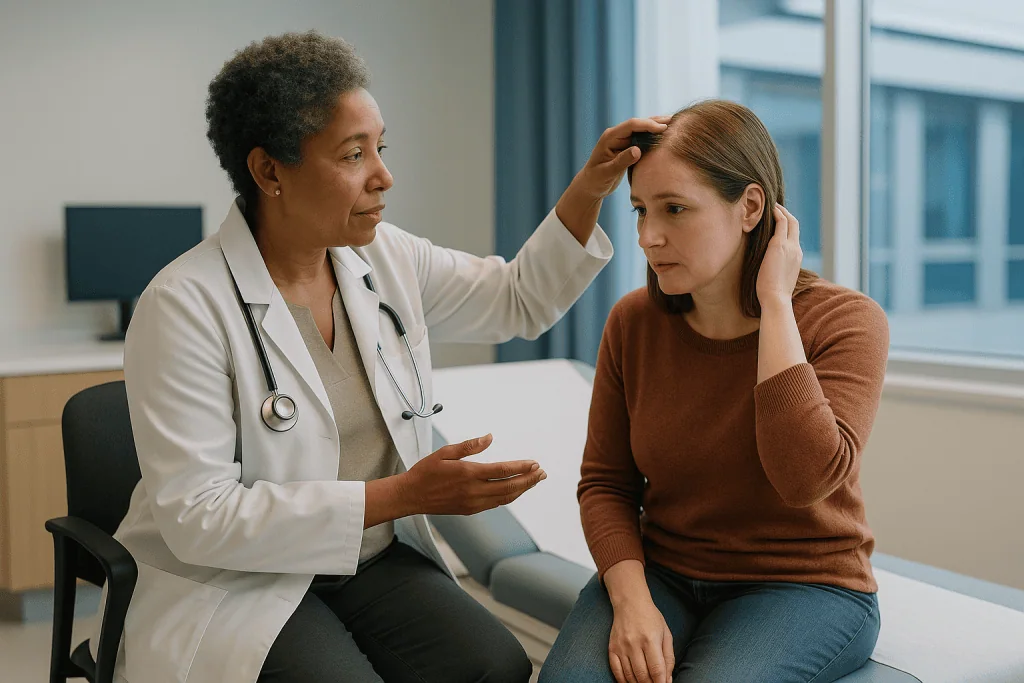
On the scalp, those plaques favor the back of the head, the area behind the ears and the hairline itself, and they often spill a centimeter or two onto the forehead or nape. A plaque feels thick and slightly rubbery when you press it. If a scale is lifted, the skin beneath may show pinpoint bleeding, known as the Auspitz sign, a feature dandruff never produces.
Mayo Clinic and MedlinePlus both describe the scalp as one of the most common sites of psoriasis; around half of people with plaque psoriasis have scalp involvement, and for some it is the only place the disease shows. Severity ranges from a few barely visible patches to a thick crust covering the whole scalp.
Psoriasis is not contagious and is not caused by anything you did. Genes set the stage (a variant called HLA-C*06:02 is the best-known), and triggers pull the curtain. Because it is a systemic disease, it keeps company with other conditions: up to 30 percent of people with psoriasis develop psoriatic arthritis, and observational data link moderate to severe psoriasis with higher rates of cardiovascular disease, obesity and depression. That association is a reason to treat it properly, not a reason for alarm.
What is dandruff, and how is it related to seborrheic dermatitis?
Dandruff is the mild, scalp-only end of a condition called seborrheic dermatitis, an inflammatory reaction in oil-rich skin. The usual suspect is Malassezia, a yeast that lives on nearly everyone’s scalp and feeds on sebum, the natural oil produced by hair follicles. In some people the yeast’s breakdown products irritate the skin, speeding up cell shedding and producing the familiar white or slightly yellow flakes.
The NHS and Mayo Clinic describe dandruff as common, affecting around half of adults at some point, and more frequent in men, in people with oily skin, and in winter when indoor heating dries the air. Flakes are small, loose and often greasy, the scalp may itch, and the skin underneath is pink at most, without the thick, raised texture of a plaque.
When seborrheic dermatitis is more active it steps off the scalp onto other oily zones: the eyebrows, the folds beside the nose, inside and behind the ears, the beard area and the center of the chest. Those patches look salmon-pink with a greasy, yellowish scale. In babies the same process is called cradle cap and usually fades on its own.
Two things dandruff is not: a sign of poor hygiene, and a form of dry skin. Washing more aggressively tends to make it angrier, and slathering on oil can feed the yeast. It is also not a cause of hair loss by itself, although persistent scratching can snap hairs at the surface. Dandruff waxes and wanes with stress, illness, fatigue and season, and for most people a medicated shampoo used correctly is the whole story.
Scalp psoriasis vs dandruff: the side-by-side differences
Clinicians rarely rely on a single feature. They look at the pattern, and the pattern below is the one most dermatology sources describe.

| Feature | Scalp psoriasis | Dandruff / seborrheic dermatitis |
|---|---|---|
| Scale color and texture | Dry, silvery-white, thick, powdery when rubbed | White to yellowish, fine, often greasy |
| Borders | Sharply defined raised plaques | Diffuse, ill-defined pink areas |
| Location | Often crosses the hairline onto forehead, nape, behind ears | Mostly within hair-bearing scalp; may involve eyebrows and nose folds |
| Bleeding when scale lifted | Pinpoint bleeding can occur (Auspitz sign) | Not typical |
| Itch | Variable; can be intense or absent | Usually mild to moderate |
| Elsewhere on body | Elbows, knees, lower back, nail pitting, joint symptoms | Oily facial zones, chest, ear canals |
| Response to anti-yeast shampoo | Partial at best | Usually clear improvement within weeks |
| Course | Lifelong, relapsing and remitting | Episodic, often seasonal |
Three of these rows do most of the work. The hairline test is the quickest: dandruff respects the hair; psoriasis does not. The texture test is next: dry and silvery leans toward psoriasis, greasy and yellow toward seborrheic dermatitis. The response test is the slowest but most telling: if a month of properly used anti-yeast shampoo has made no difference, the odds have shifted away from dandruff.
One complication deserves a name. Sebopsoriasis is the term for scalp disease that shares features of both, with greasy scale on sharply bordered plaques, often in people who have psoriasis elsewhere. It is not rare, which is why a clinician may treat for both at once rather than forcing the picture into one box.
What is mistaken for scalp psoriasis?
Dandruff is the most common look-alike, but it is not the only one, and some of the others need very different treatment.
- Tinea capitis is a fungal infection of the hair shafts, most common in children. It causes scaly patches with broken hairs or outright bald spots and sometimes a boggy, tender swelling. Shampoos alone cannot reach the fungus inside the hair; it needs an oral antifungal prescribed by a doctor, so misreading it as psoriasis costs time and hair.
- Allergic contact dermatitis from hair dye (often the chemical paraphenylenediamine), fragrance or a new styling product produces an itchy, weeping, red scalp and often swelling of the eyelids or ears within a day or two of exposure.
- Atopic eczema on the scalp tends to be diffusely dry and itchy without thick plaques, usually in someone with eczema elsewhere.
- Lichen planopilaris is an inflammatory condition that destroys hair follicles, leaving smooth, shiny bald patches with redness and scale around remaining hairs. Because the hair loss is permanent, early diagnosis matters.
- Head lice leave nits that are glued to the hair shaft and will not brush off; flakes slide away freely.
- Pityriasis amiantacea describes very thick, asbestos-like scale that wraps around hair shafts. It is a pattern rather than a diagnosis and can sit on top of psoriasis, seborrheic dermatitis or eczema.
A dermatologist separates these with a few quick tools: a dermatoscope (a hand-held magnifier with polarized light), a skin scraping examined under a microscope for fungus, and, when the picture is unclear, a small punch biopsy. None of this is exotic, and none of it can be done from a mirror and a search result, which is the quiet argument for an in-person look when flakes do not behave.
What triggers scalp psoriasis?
A trigger is anything that switches on or worsens a condition the genes have already made possible; it is not a cause. For scalp psoriasis the list overlaps with psoriasis in general, with a few scalp-specific additions.
The scalp-specific one is physical trauma, through what dermatologists call the Koebner phenomenon: psoriasis appearing in skin that has been injured. On the scalp, injury is everyday life. Vigorous scratching, picking at scale, tight braids or ponytails, aggressive brushing, hot blow-drying, chemical relaxers and bleach can all seed a new plaque along the exact line of damage. People who notice psoriasis tracking along a part line or behind the band of a hat are seeing Koebnerization in real time.
Beyond the scalp, the triggers with the most consistent support in guidelines and observational studies are:
- Infections, particularly streptococcal throat infections, which classically precede a sudden shower of small guttate plaques.
- Psychological stress, reported by a majority of patients as a flare trigger in surveys, though self-report is weaker evidence than it feels.
- Cold, dry weather, which strips moisture and thickens scale; many people improve in summer.
- Alcohol excess and smoking, both associated in cohort studies with more severe disease and poorer response to treatment.
- Certain medicines, including some blood-pressure drugs (beta blockers), lithium and antimalarials. If you suspect a medicine, raise it with the prescriber rather than stopping it yourself; abrupt withdrawal of some of these carries its own risks.
- Weight gain and metabolic changes, linked observationally to higher psoriasis activity.
Hormonal shifts around pregnancy and menopause can swing psoriasis in either direction. Keeping a simple two-column note of flares and what preceded them for a few months is more useful than any generic trigger list, because the pattern that matters is yours.
What is the biggest trigger for psoriasis?
People want a single villain, and the honest answer is that there is not one. The “biggest” trigger depends on whether you measure how often people report it, how strong the biological evidence is, or how much it worsens disease once it strikes.
If the yardstick is how often patients blame it, stress wins comfortably; in surveys, somewhere between a third and three-quarters of people with psoriasis say stress sets off their flares. The science behind that is plausible (stress hormones influence immune signaling), but the evidence is mostly observational and relies on memory, which tends to connect a bad week with a bad scalp whether or not one caused the other.
If the yardstick is strength of evidence for a direct link, infection takes the prize. The association between streptococcal throat infection and guttate psoriasis is well documented, and flares after other infections, including viral illnesses, are common enough to appear in every mainstream review. HIV infection is a recognized cause of severe, treatment-resistant psoriasis.
If the yardstick is what makes established disease harder to control, the lifestyle factors come forward. Cohort studies link smoking and heavy alcohol use with more extensive psoriasis and with weaker responses to systemic treatment, and higher body weight is associated with both greater severity and reduced effectiveness of some medicines. These are associations, not proof of cause, but they point in the same direction across many studies.
For the scalp specifically, skin injury is probably the trigger people most underestimate, because scratching feels like relief rather than harm. Breaking the itch-scratch-plaque cycle, often with adequate treatment of the itch itself, is one of the most practical things a clinician can help with. Decisions about medicines that might be contributing always sit with the person who prescribed them.
Does scalp psoriasis cause hair loss, and does it grow back?
Hair loss is the question that brings many people to this topic, and the answer is reassuring in most cases. Scalp psoriasis itself does not destroy hair follicles. Shedding happens for three main reasons, all of which are usually reversible.
First, mechanical breakage. Scratching, picking thick scale, and tugging a comb through matted plaques snap hairs at or near the surface. Second, inflammation. An inflamed scalp can push follicles early into their resting phase, a process called telogen effluvium, so that hairs fall out in larger numbers two to three months after a bad flare. Third, treatment itself. Harsh descaling, overly frequent washing or irritating products can thin hair temporarily.
When the inflammation is brought under control, follicles resume their cycle and hair typically regrows over several months. Cleveland Clinic and the NHS both describe psoriasis-related hair loss as temporary in the great majority of people. The exception is severe, long-standing, untreated disease, where years of inflammation can occasionally scar follicles; this is uncommon and is a strong reason not to leave a thick, persistent plaque unexamined.
Two caveats matter for anyone tracking their hairline. Psoriasis does not protect against the ordinary hereditary thinning that affects most men and many women with age, so both can coexist, and a dermatologist may need to treat them separately. And if hair is leaving smooth, shiny patches, or if shedding continues months after the scalp looks calm, the cause may be a different condition altogether, such as lichen planopilaris or alopecia areata, which need their own diagnosis.
Dandruff, for its part, does not cause hair loss. The only link is the scratching, which is one more reason to treat the itch rather than live with it.
How is dandruff treated?
Most dandruff is handled with an over-the-counter medicated shampoo, and the ingredient matters less than the technique. The NHS and Mayo Clinic list several active ingredients with decent trial support: antifungal agents such as ketoconazole that reduce Malassezia; zinc pyrithione and selenium sulfide, which slow yeast growth and cell turnover; coal tar, which slows shedding; and salicylic acid, a keratolytic, meaning a substance that loosens and dissolves built-up scale.
Technique is where most people go wrong. A medicated shampoo needs contact time with the skin, not the hair: massage it into the scalp and leave it for about five minutes before rinsing, following the label on frequency. Many clinicians suggest alternating two different ingredients, since a single one can lose effect over time, and switching to a maintenance rhythm of once or twice a week once flakes settle. For textured or tightly coiled hair that is washed less often, applying the medicated product to the scalp on wash day and using a gentle conditioner on the lengths avoids the dryness that puts people off treatment.
Give any regimen about four weeks. If flakes and itch have not improved by then, the NHS advice is to see a pharmacist or GP, both because dandruff may not be the diagnosis and because more active seborrheic dermatitis sometimes needs prescription help: a stronger topical antifungal, a short course of a mild topical corticosteroid to quiet inflammation, or a non-steroid anti-inflammatory cream for the face and ears. Those choices, and how long to use them, belong to the clinician who examines you.
What does not help: scrubbing harder, washing twice a day, or skipping shampoo in the belief that the scalp is dry. The yeast thrives on oil, and irritation feeds the flaking.
Scalp psoriasis treatment: what a dermatologist actually uses
Scalp psoriasis is managed, not switched off, and the plan is built around how thick the plaques are, how much of the scalp is involved and whether psoriasis is active elsewhere. Guidelines from mainstream sources follow a broadly similar ladder.
For most people the first rung is a prescription topical corticosteroid, chosen in a form that reaches the skin through hair: a solution, foam, gel, oil or medicated shampoo rather than a thick ointment. Corticosteroids calm the immune reaction within the plaque. Alongside or in combination, a vitamin D analogue (a synthetic relative of vitamin D that slows skin-cell growth) is commonly used; fixed combinations of the two exist and have the strongest trial evidence for scalp disease. Coal tar preparations and salicylic acid are used to soften and lift heavy scale so that other medicines can reach the skin underneath. Newer non-steroid topicals in the PDE4-inhibitor class have joined the options.
Phototherapy, controlled exposure to ultraviolet B light, is effective for psoriasis on the body but awkward on a hairy scalp; specialized comb-style devices exist, and the hair is sometimes parted to improve reach.
When plaques are extensive, stubborn or accompanied by psoriasis elsewhere or joint symptoms, dermatologists move to systemic treatment: traditional immune-modulating tablets, newer oral small molecules that block specific signaling pathways, or injectable biologic medicines targeting interleukin-17 or interleukin-23. Large trials of these include scalp-specific scoring, and scalp clearance rates are generally high.
Every one of these carries trade-offs. Potent topical steroids can thin skin with prolonged, unsupervised use; systemic medicines need monitoring and screening before they start. How much, how often and for how long are questions for the prescribing clinician, and a medicine that is working should never be stopped or stretched without that conversation.
What the evidence actually says, graded honestly
Not every statement in this article rests on the same footing. Here is how the main claims rank, from strongest to weakest.
Strong evidence (multiple randomised controlled trials, systematic reviews). Potent topical corticosteroids, alone or combined with a vitamin D analogue, improve scalp psoriasis more than placebo and more than the vitamin D analogue alone; systematic reviews consistently rank the combination at or near the top for both effect and tolerability. Biologic medicines targeting interleukin-17 and -23 produce high rates of scalp clearance in large trials. For dandruff, anti-yeast and zinc pyrithione shampoos beat plain shampoo in controlled studies.
Moderate evidence (smaller or older trials, consistent clinical experience). Coal tar and salicylic acid reduce scale and itch; the trials are older, smaller and often lack modern design, but the mechanism is plain and guidelines still include them. Phototherapy for scalp disease has limited, device-specific data.
Weak evidence (observational data, surveys, small studies). Stress as a trigger, alcohol and smoking as aggravators, and weight loss as an improver of psoriasis all rest on cohort and survey data. The direction of the findings is consistent, which gives them credibility, but they cannot prove cause.
Anecdote or expert opinion only. Apple cider vinegar rinses, tea tree oil, coconut oil, aloe, and gluten-free diets in people without celiac disease. Some are harmless, some sting an inflamed scalp, and none has trial data showing a meaningful effect on psoriasis plaques. A small subset of people with psoriasis do have celiac disease and benefit from excluding gluten, which is a reason to be tested if symptoms suggest it, not a reason for everyone to change their diet.
Reading grades like these is the fastest way to tell a reasonable treatment plan from a viral one.
Common myths about scalp psoriasis and dandruff
Scalp conditions attract confident folklore. These are the claims clinicians hear most, and what the evidence says instead.
“Psoriasis is contagious.” It is not. It cannot be passed by sharing a hat, a pillow, a comb or a hairdresser’s chair. The same is true of dandruff. The WHO report singled out this misconception as a major driver of stigma.
“Flakes mean dirty hair.” Neither condition is a hygiene problem. Over-washing with harsh products can worsen both.
“Dandruff is just dry scalp, so use oil and wash less.” Dandruff is an oily-skin condition driven by yeast. Oil feeds it. Dry scalp does exist, but it produces tiny, non-greasy flakes without pink skin and improves with gentler, less frequent cleansing.
“Scalp psoriasis will make you permanently bald.” Hair loss from psoriasis is almost always temporary and regrows once inflammation is controlled. Permanent loss is rare and linked to years of severe, untreated disease.
“Sunbathing fixes psoriasis.” Ultraviolet light does help many people, which is why supervised phototherapy exists. Uncontrolled sun exposure also causes burns (which can trigger new plaques through the Koebner effect) and raises skin cancer risk. The scalp, with thin or parted hair, burns easily.
“Apple cider vinegar clears plaques.” No trial supports it, and vinegar on cracked or scratched skin stings and can irritate.
“If a dandruff shampoo didn’t work, nothing will.” It more likely means the diagnosis is not dandruff. Scalp psoriasis responds to a different class of treatment, and that is exactly the moment to see a clinician.
“Natural means safe.” Essential oils and herbal rinses are frequent causes of allergic contact dermatitis on the scalp, which can be mistaken for a flare of the original condition.
Everyday scalp care that helps both conditions
Treatment is what the doctor prescribes; care is what happens between appointments, and it influences how well the treatment works. These habits are supported by mainstream dermatology sources and apply whether the diagnosis is psoriasis, seborrheic dermatitis or a mix of both.
Soften before you lift. Picking dry scale injures skin and can trigger new plaques. Instead, apply a prescribed or recommended descaling product, or a plain emollient, to the scalp and leave it on for the time advised before washing, so scale loosens on its own. Use fingertips, never nails, and a wide-toothed comb.
Wash with lukewarm water and let medicated products sit. Hot water and immediate rinsing strip the scalp without giving active ingredients a chance to work. Pat rather than rub when drying, and keep blow-dryers on a cool setting.
Loosen the hairstyle during flares. Tight braids, buns and extensions pull on inflamed follicles and can worsen both plaques and breakage.
Choose fragrance-free products and patch test anything new, especially hair dye. Ask your colorist to keep dye off the scalp during active flares; many will use techniques that color the hair lengths while avoiding the skin. Tell them about your diagnosis so they can avoid vigorous scrubbing or heat.
Protect exposed plaques from the sun. Thin hair and plaques at the hairline burn quickly; a hat or a scalp-friendly sunscreen prevents a burn that could seed new patches.
Tend the whole person. Sleep, moderate alcohol, not smoking and a healthy weight are associated with calmer psoriasis in observational studies, and they help with dandruff too. None replaces treatment; all of them make treatment easier.
Finally, agree a flare plan with your clinician in advance: which product to restart, how to recognize a flare early, and when to call. That single conversation prevents weeks of guesswork.
When to see a doctor about scalp flakes
Most dandruff never needs a clinic visit, and many people with mild scalp psoriasis manage well once they have a plan. Certain signs, though, mean the next step is an appointment rather than another product.
Book a routine visit if:
- Four weeks of a correctly used medicated shampoo has not improved flaking or itch.
- Scale is thick, silvery and sits on raised patches, or extends onto the forehead, neck or behind the ears.
- Lifting scale leaves pinpoint bleeding, or the scalp is cracking and sore.
- You notice hair thinning or shedding that lasts beyond a few weeks, or any patch of smooth, shiny skin with no hair.
- You have patches of psoriasis elsewhere, pitted or lifting nails, or scalp symptoms are affecting sleep, work or mood.
- A child has a scaly patch with broken hairs, which may be a fungal infection needing oral treatment.
Seek prompt care, within days, if:
- The scalp is weeping, crusted yellow, swollen or warm, or you have a fever or tender lymph nodes in the neck, which can signal a bacterial infection on top of the skin condition.
- You develop joint pain, morning stiffness lasting over half an hour, a swollen “sausage” finger or toe, or heel pain. These can be early psoriatic arthritis, and earlier treatment protects joints.
- Redness spreads rapidly across the scalp and body, or you feel unwell with chills, which can indicate a rare severe flare.
- Eyelid swelling, facial rash or breathing difficulty follows a hair product or dye, which may be an allergic reaction.
Bring a list of everything you have tried, every medicine you take, and photos of flares at their worst. Whatever is diagnosed, the choice of medicine, its strength, how long to use it and when to change course rest with the clinician who examines you. Never stop or alter a prescribed treatment on the strength of something you read, including this.
Frequently asked questions
What is the difference between scalp psoriasis vs dandruff at a glance?
Scalp psoriasis forms thick, raised, sharply edged plaques with dry silvery scale that often extend past the hairline, while dandruff produces fine, loose, often greasy white or yellow flakes on skin that is pink at most and stays within the hair. Psoriasis may come with plaques on elbows or knees and pitted nails; dandruff may come with greasy scale in the eyebrows and beside the nose.
Can scalp psoriasis be cleared for good?
Scalp psoriasis is a long-term condition that can be controlled, often to the point of clear skin, but it is not permanently switched off; plaques can return after months or years of calm. Modern topicals, phototherapy and systemic medicines produce high clearance rates in trials, and many people stay clear on maintenance treatment. The right regimen is chosen and adjusted by a dermatologist.
What triggers psoriasis of the scalp?
The scalp-specific trigger is skin injury: scratching, picking scale, tight hairstyles, heat and chemical treatments can seed plaques along the damaged line through the Koebner phenomenon. General triggers include streptococcal and other infections, stress, cold dry weather, alcohol, smoking, weight gain and certain medicines such as beta blockers or lithium. Any suspected medicine trigger should be raised with the prescriber, not stopped on your own.
What is mistaken for scalp psoriasis?
Seborrheic dermatitis is the most common mimic, followed by fungal scalp infection (tinea capitis) in children, allergic reactions to hair dye or fragrance, atopic eczema, head lice, and lichen planopilaris, a scarring condition that destroys follicles. Sebopsoriasis is an overlap of psoriasis and seborrheic dermatitis. A dermatologist separates these with examination, a dermatoscope, a fungal scraping and occasionally a small biopsy.
What is the biggest trigger for psoriasis?
There is no single biggest trigger. Stress is the one patients report most often, but that evidence is observational and self-reported. Infection, particularly streptococcal throat infection, has the strongest documented link to flares. Smoking, heavy alcohol use and excess weight are most consistently associated with more severe disease and weaker treatment response in cohort studies. For the scalp, skin injury from scratching is the most underestimated trigger.
Does scalp psoriasis cause hair loss?
It can cause temporary shedding through hair breakage from scratching, inflammation pushing follicles into their resting phase (telogen effluvium), and irritation from harsh products, but it does not destroy follicles in the vast majority of cases. Hair typically regrows over several months once the scalp is controlled. Permanent loss is rare and linked to years of severe untreated disease, so persistent thick plaques deserve a specialist’s look.
Can I have scalp psoriasis and dandruff at the same time?
Yes. Malassezia yeast lives on almost every scalp, so a person with psoriasis can also develop seborrheic dermatitis, and the overlap pattern is common enough to have its own name, sebopsoriasis. In that situation a clinician may prescribe a combination that addresses both the yeast-driven greasy scale and the immune-driven plaques, rather than treating one and waiting to see what remains.
Is scalp psoriasis contagious?
No. Psoriasis is an autoimmune condition, not an infection, and cannot be spread by touch, shared hats, combs, pillows or a hairdresser’s tools. Dandruff is not contagious either. The World Health Organization’s 2016 global report identified the contagion myth as a major source of stigma for people with psoriasis, which is one reason clinicians work to correct it.
Does dandruff shampoo help scalp psoriasis?
Only partially. Shampoos containing coal tar or salicylic acid can soften scale and ease itch in mild scalp psoriasis, and anti-yeast shampoos may help if seborrheic dermatitis is also present. They do not address the immune inflammation driving plaques, so most people with scalp psoriasis need prescription treatment such as topical corticosteroids, vitamin D analogues or, for extensive disease, systemic medicines chosen by a dermatologist.
Can I dye my hair if I have scalp psoriasis or seborrheic dermatitis?
Often yes, with precautions. Dye is best avoided during an active flare, because chemicals on cracked or inflamed skin can sting, irritate and trigger new plaques. Always do a patch test two days ahead, since hair-dye allergy can mimic a flare, and ask your colorist to keep product off the scalp using foils or balayage-style techniques. If in doubt, check with the clinician treating your scalp.
References
- MedlinePlus: Psoriasis
- MedlinePlus Medical Encyclopedia: Seborrheic dermatitis
- NHS: Dandruff
- WHO: Global report on psoriasis (2016)
This article is for general information only and is not a substitute for professional medical advice. Please consult a qualified doctor about your individual situation.

More from the Blog
Oral Minoxidil: Why Dermatologists Now Prescribe the Blood-Pressure Pill for Hair
Oral minoxidil is a prescription tablet approved to treat severe high blood pressure that dermatologists increasingly prescribe off-label, in amounts far below the blood-pressure…
What Causes Hair Loss? The 10 Medical Reasons and How Doctors Tell Them Apart
Hair loss has about ten common medical causes: pattern (androgenetic) hair loss, telogen effluvium after stress or illness, autoimmune alopecia areata, thyroid disease, iron…
Dutasteride for Hair Loss: How It Differs From Finasteride and What Trials Show
Dutasteride is a prescription medicine approved in the United States for enlarged prostate, not for hair loss, though it is approved for male pattern…
Exosomes for Hair Loss: Promising, Unproven, and What That Means for You
Exosome therapy for hair loss is experimental. Early laboratory and animal studies suggest exosomes, microscopic particles that carry signals between cells, might stimulate hair…
Does Microneedling Help Hair Growth? A Careful Reading of the Trials
Small randomized trials suggest microneedling can improve regrowth in androgenetic (pattern) hair loss, mostly when combined with a proven topical hair-growth medication; evidence for…
Derma Rolling for Hair: What Needling Can Add, and Its Limits
Derma rolling can modestly support hair regrowth in pattern hair loss, mainly when paired with a clinician-recommended topical treatment; small randomized trials show greater…