

Scalp vs Face: Why Seborrheic Dermatitis Treatment Differs by Area and Rarely Fits One Plan

Key Takeaways
- Scalp and face seborrheic dermatitis share the same cause, an oil-loving yeast plus an over-reactive skin response, but are treated differently because facial skin is thinner, hairless and far more prone to steroid side effects.
- Medicated scalp shampoos work through contact time and need to be worked into the scalp and left briefly before rinsing, whereas facial treatment relies on thin layers of leave-on cream or gel.
- Mayo Clinic advises that topical corticosteroids on the face be used only for short periods because prolonged use can thin the skin and cause visible small vessels.
- Antifungal creams and shampoos reduce Malassezia numbers rather than eliminating the yeast, so relapse after stopping is expected and a maintenance phase is usually planned from the start.
- Cleveland Clinic estimates roughly 11% of people have seborrheic dermatitis, with peaks in infants under three months and adults aged about 30 to 60.
- Cradle cap in babies usually clears on its own within 6 to 12 months according to the NHS, and adult scalp or facial products should never be borrowed for an infant.
Seborrheic dermatitis is treated differently on the scalp and the face because the two areas differ in skin thickness, oil output, hair cover and sensitivity. Scalp care usually relies on medicated shampoos left in contact with the skin, while facial care leans on gentle cleansing, short courses of mild anti-inflammatory creams and antifungal preparations. Most people need an area-specific plan set by their clinician, revisited over time.
The shampoo bottle is already in her hand when she stops. It has calmed the flaking along her hairline for years, so why not rub a little into the pink, scaly patch that has settled between her eyebrows? Something about the label, and the memory of how her face stung the last time she tried, makes her put it down and search instead. What she finds is confusing: half the advice seems written for the scalp, the other half for the face, and almost none of it explains why the two are handled so differently.
That gap is the whole story of scalp vs face seborrheic dermatitis. It is one condition, driven by the same mix of oil, yeast and an over-reactive skin response, yet it lands on two very different surfaces. One is thick, hair-covered and forgiving. The other is thin, exposed and quick to react to anything harsh.
This explainer walks through what actually differs, what the evidence supports for each area, and why a single plan so rarely works for both.
What is seborrheic dermatitis, and why does scalp vs face seborrheic dermatitis behave like two conditions?
Seborrheic dermatitis is a common, long-term inflammatory skin condition that favors the oiliest parts of the body: the scalp, the eyebrows, the folds beside the nose, the ears and the central chest. It shows up as pink or discolored patches topped by greasy or powdery scale, often with itch, and it tends to come and go rather than disappear for good.
Nobody has pinned down a single cause. Mayo Clinic describes it as probably arising from a yeast called Malassezia (a microorganism that lives harmlessly on nearly everyone’s skin and feeds on skin oil), combined with an overactive immune response and the amount of sebum, the natural oil produced by glands attached to hair follicles. The yeast breaks sebum down into by-products that irritate susceptible skin; the skin answers with inflammation and a speeded-up shedding of cells, which is what you see as scale.
Cleveland Clinic estimates that roughly 11% of people have the condition, with two age peaks: infants under three months, where it is called cradle cap, and adults between about 30 and 60. It is more common and often more stubborn in people with Parkinson’s disease, HIV, or recovery from a serious illness, and it flares under stress and in cold, dry weather.
So why does the same process feel like two different diseases? Because treatment has to reach the yeast and calm the inflammation without damaging the skin underneath, and the scalp and face give a clinician completely different margins for error. On the scalp, a medicated wash can sit on thick skin under a protective canopy of hair. On the face, that same wash meets thin, hairless skin around the eyes and mouth, where irritation and side effects appear faster. Same condition, different terrain, different tools.
Seborrheic dermatitis vs dandruff: where does one end and the other begin?
Ask three people what dandruff is and you will get three answers. Clinically, the NHS treats dandruff as the mildest end of the same spectrum: loose white flakes on the scalp without much redness or soreness. When the scalp also becomes inflamed, itchy and scaly in defined patches, or the process spreads to the face and ears, the term seborrheic dermatitis is used instead. There is no sharp line, and many people move back and forth along the spectrum over a lifetime.
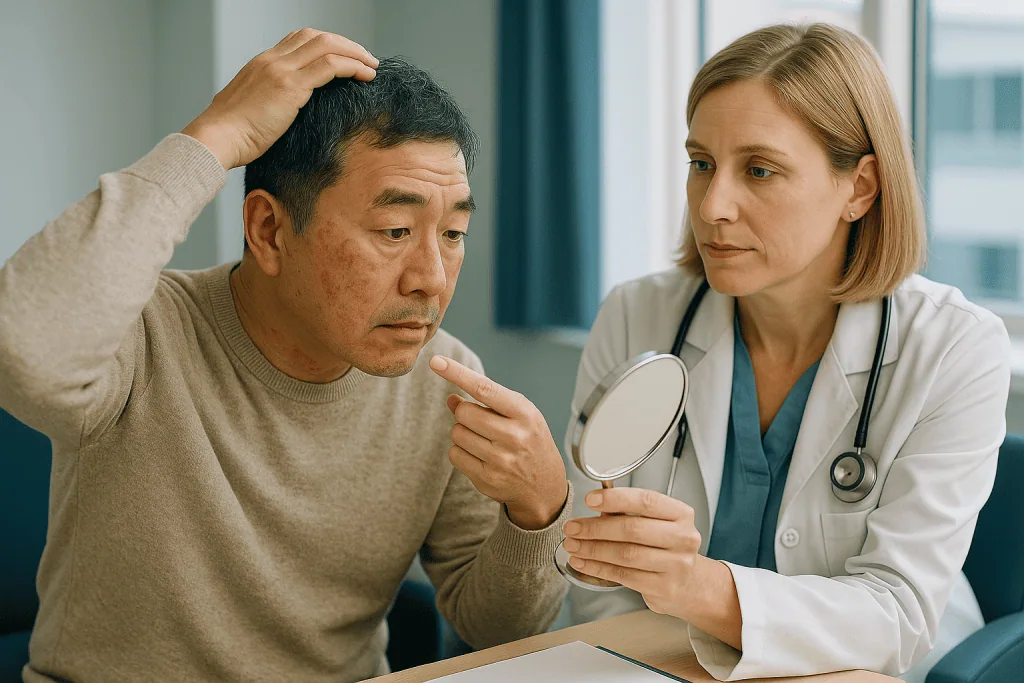
The distinction matters for one practical reason. Dandruff rarely leaves the scalp, so a wash-based approach usually covers it. Seborrheic dermatitis often does not stay put; the same oily, yeast-friendly skin exists in the eyebrows, the creases beside the nose and behind the ears, and those areas cannot be shampooed. Anyone whose flaking has crept beyond the hairline is, by definition, dealing with more than dandruff, and that is the moment the one-plan approach starts to fail.
It also helps to know what seborrheic dermatitis is not. It is not caused by poor hygiene, and washing harder does not fix it; if anything, aggressive scrubbing strips the skin barrier and invites more inflammation. It is not contagious, so it cannot be passed to a partner or a child. And it is not scalp psoriasis, although the two can look alike; psoriasis scale is usually thicker, silvery and drier, and it may appear on elbows, knees or nails as well. Because the treatments overlap only partly, a clinician who examines the scalp and the rest of the skin can save weeks of guessing. MedlinePlus notes that the diagnosis is usually made on appearance alone, without tests.
Why the scalp and the face are such different skin environments
Stand a strand of scalp skin next to the skin of an eyelid under a microscope and the difference is startling. Scalp skin is among the thickest on the body, crowded with large hair follicles and some of the most productive oil glands anywhere. Facial skin, especially around the eyes and at the sides of the nose, is thin, richly supplied with blood vessels and packed with nerve endings. Anything applied to the face is absorbed more readily and felt more acutely.
Hair changes the picture further. On the scalp it acts as a physical barrier that keeps creams from spreading evenly and makes greasy ointments miserable to live with, which is why dermatology reaches for shampoos, foams, lotions and solutions there. The medicine has to travel through hair and along the scalp surface, sit long enough to work, then rinse away cleanly. On the face, a thin layer of cream or gel can be smoothed directly onto the patch and left in place, so the vehicle (the base that carries the active ingredient) can be far gentler.
Sebum output differs too. The scalp and the central face are both oily, but the scalp’s thick skin tolerates the drying, keratolytic ingredients used to loosen scale (a keratolytic is anything that softens and lifts dead surface skin cells). Those same ingredients on facial skin can leave it tight, stinging and more inflamed than before.
Finally, the stakes of a side effect are not equal. A topical corticosteroid, an anti-inflammatory cream that dampens the skin’s immune reaction, can cause skin thinning, visible small blood vessels and acne-like eruptions if used for too long on the face, as Mayo Clinic cautions. The scalp is far more forgiving of the same medicine. This single difference explains most of why facial plans look more cautious.
Seborrheic dermatitis scalp treatment: what usually happens
Scalp treatment is built around contact time. The aim is to get an antifungal or scale-loosening ingredient onto the skin, keep it there for a few minutes, and repeat regularly enough to keep the yeast population and the inflammation in check. Rinsing a medicated shampoo off immediately, the way most people wash their hair, wastes most of its effect; many labels and clinicians ask that it be worked into the scalp rather than just the hair and left on briefly before rinsing.

Mayo Clinic lists the ingredient families commonly used: antifungals such as ketoconazole or ciclopirox, which reduce Malassezia; selenium sulfide and zinc pyrithione, which have both antifungal and cell-turnover-slowing actions; salicylic acid, which lifts scale; and coal tar, an older agent that slows the rapid shedding of skin cells. None of these is a recommendation; which one a person uses, and in what rhythm, is a decision for the clinician who has seen the scalp. Several are available without prescription and some in stronger prescription forms, and people frequently rotate between two ingredients when one seems to lose effect over time.
For thicker or more inflamed scalp disease, a clinician may add a corticosteroid in a lotion, foam or solution designed to reach through hair, or an antifungal in a similar base. Because scalp skin is thick, these are generally better tolerated there than on the face, though prolonged use still needs supervision.
Mayo Clinic describes the typical pattern as regular use for several weeks until the scalp settles, followed by a maintenance phase in which the medicated wash is used less often to prevent relapse. The exact schedule is individual. One quiet point worth stressing: a scalp regimen that works is often the reason the face keeps flaring, because the same person assumes it is doing the job everywhere.
Seborrheic dermatitis on face treatment: why the gentler tool comes first
Facial treatment starts from the opposite assumption: do the least that works, then hold. Cleveland Clinic and Mayo Clinic both describe a stepped approach that begins with gentle daily cleansing using a mild, fragrance-free wash, avoiding alcohol-based toners, harsh scrubs and heavy occlusive products that trap oil.
When cleansing alone is not enough, an antifungal cream or gel is a common next step. Ketoconazole and ciclopirox are the generic names most often cited; they work by reducing the Malassezia yeast rather than by directly suppressing inflammation, so improvement tends to be gradual and the effect depends on continued use. Many clinicians favor antifungals for long-term facial control precisely because they do not carry the skin-thinning risk of steroids.
For visibly inflamed, itchy patches, a short course of a low-potency topical corticosteroid may be used to settle the flare. Mayo Clinic is explicit that these should be used only for brief periods on the face because of side effects such as thinning skin and streaks or lines, and that stopping and restarting repeatedly can lead to rebound. The prescribing clinician sets how short and how mild.
Where steroids are unsuitable or the problem is near the eyes, topical calcineurin inhibitors, a class of non-steroid anti-inflammatory creams that includes tacrolimus and pimecrolimus, are an alternative Mayo Clinic lists. They calm the immune reaction without thinning skin, though they can sting or burn on first application, especially on already-irritated skin, and they are generally reserved for cases that have not responded to first-line measures.
The common thread across every facial option is restraint: thin layers, short flare courses, long gentle maintenance, and no shampoo-strength ingredients on the eyelids or around the mouth.
Scalp vs face seborrheic dermatitis at a glance
Laying the two side by side shows why a clinician often writes what amounts to two plans on one prescription pad. The table summarizes the differences that shape treatment, drawing on the descriptions published by Mayo Clinic, Cleveland Clinic and the NHS.
| Feature | Scalp | Face |
|---|---|---|
| Skin thickness | Among the thickest on the body | Thin, especially eyelids and nasal folds |
| Hair cover | Dense; blocks creams, favors washes | Sparse except brows and beard |
| Typical sites | Crown, hairline, behind ears | Eyebrows, nasal creases, eyelid margins, ear folds |
| Usual vehicle | Medicated shampoo, foam, solution, lotion | Cream, gel, gentle cleanser |
| Antifungal use | Shampoo left on briefly, then rinsed | Leave-on cream or gel in a thin layer |
| Scale-lifting ingredients | Often well tolerated | Generally avoided; risk of stinging and dryness |
| Corticosteroid tolerance | Higher; longer supervised use possible | Low; short courses of mild strength only |
| Non-steroid anti-inflammatory options | Rarely needed | Calcineurin inhibitors when steroids unsuitable |
| Main side-effect worry | Dryness, hair feel, irritation | Skin thinning, visible vessels, eye irritation |
| Maintenance pattern | Less frequent medicated washing | Gentle cleansing plus intermittent antifungal |
Two rows deserve a second look. The vehicle row explains most of the confusion people feel: the active ingredient in a scalp shampoo and a facial cream may be the same generic antifungal, yet the base and the way it is used are engineered for different skin. The corticosteroid row explains most of the caution: what is a reasonable supervised choice on the scalp can be a real problem on the cheek.
None of this means the two areas are treated in isolation. Clinicians usually address them at the same visit, because a flaring scalp seeds the hairline and brows, and a face that will not settle often points to a scalp that has been under-treated.
Who is treatment usually for, and who is usually asked to wait?
Not everyone with flaking needs a medical plan. Mayo Clinic notes that seborrheic dermatitis can clear on its own in some people and that mild cases often respond to regular use of a nonprescription medicated shampoo and gentle skin care. For an adult with a few flakes at the hairline and no facial involvement, a clinician may reasonably suggest a trial of self-care and a review only if it fails.
Treatment is usually offered more actively when the condition is spreading beyond the scalp, when itch is disturbing sleep or concentration, when the face, ears or eyelids are involved, or when the appearance is affecting confidence and daily life. People with underlying conditions that make seborrheic dermatitis more severe, including Parkinson’s disease, HIV and certain neurological or psychiatric conditions, tend to be reviewed earlier and followed more closely, because their disease is often more extensive and more resistant, according to Mayo Clinic and Cleveland Clinic.
Babies sit at the other end. Cradle cap, the infant form, is common in the first months of life, and the NHS advises that it usually clears by itself within 6 to 12 months and rarely troubles the baby. Parents are generally asked to wait, soften the scale with gentle washing and a soft brush, and avoid picking. Medicated products are not routinely used in infants unless a clinician specifically advises them, and adult scalp or facial treatments should never be borrowed for a baby.
People are also sometimes asked to pause before starting something new: those with very irritated, cracked or weeping skin may be steered toward barrier repair and a clinical look first, since an infection or a different diagnosis such as contact dermatitis, rosacea or psoriasis can mimic seborrheic dermatitis and would call for a different route entirely. Waiting, in that setting, is not neglect; it is the clinician making sure the right condition is being treated.
What the first days and weeks usually look like
The honest expectation is slow and uneven. Antifungal approaches work by shrinking the yeast population rather than switching off inflammation, so the first change most people notice is less scale and less greasiness, with redness and itch fading later. Mayo Clinic describes scalp regimens as needing several weeks of regular use before the benefit is clear, and it warns that symptoms may return once treatment stops, which is why a maintenance phase is usually planned from the start rather than added as an afterthought.
On the face, a short course of a mild corticosteroid can visibly settle a flare within days, which is exactly why it is tempting to keep using it. The clinician’s plan will usually shift to an antifungal or a non-steroid anti-inflammatory for the longer stretch, and this handover point is where many people drift, because the steroid worked quickly and the alternative feels slower. Sticking to the handover is what protects the skin over months.
The first week can include mild stinging, particularly with calcineurin inhibitors, and a temporary feeling of dryness with medicated shampoos. Cleveland Clinic and Mayo Clinic both describe these as common and usually settling; persistent burning, worsening redness or swelling are not typical and should be reported.
Across the weeks that follow, most people find a rhythm: a medicated wash used less often, gentle facial cleansing every day, an antifungal cream reintroduced at the first sign of flaking rather than after a full flare. Winter and periods of stress tend to demand more attention; summer sun and lower stress often bring quieter spells, a pattern both sources note. Seborrheic dermatitis is best thought of as a condition to be controlled over time, and the goal of those first weeks is to learn what your own skin responds to, not to find a permanent fix.
Does seborrheic dermatitis spread from the scalp to the face?
It can appear to, but the mechanism is not what most people imagine. Seborrheic dermatitis does not travel across the skin like an infection, and it is not passed by touching or by pillowcases. What happens is that the same underlying tendency exists wherever oil glands are dense, so the hairline, eyebrows, nasal folds and ears are primed to flare whenever the overall condition is active. A busy scalp is a sign the process is switched on, and the face often follows because it shares the same triggers, not because flakes have migrated downward.
That said, the hairline and the skin behind the ears are genuine border zones. Medicated shampoo running down the temples can irritate facial skin, and scalp inflammation directly at the hairline blends into forehead skin without a clear boundary. Clinicians often ask people to rinse shampoo with the head tilted back and to apply facial treatments right up to, but not through, the hair, so that each area gets the product designed for it.
Because the condition is not contagious, there is no reason to isolate towels, hats or combs from other household members, though keeping hair tools clean is a reasonable part of general scalp care. Children do not catch it from a parent; cradle cap in infants is a separate expression of the same tendency and, as the NHS notes, usually resolves on its own.
The more useful question is what a face flare tells you about your scalp. In practice, facial seborrheic dermatitis that keeps returning despite good facial care is often a signal that the scalp regimen has lapsed or that the maintenance phase was dropped too soon. Treating both at once, with area-appropriate products, is the approach Mayo Clinic and Cleveland Clinic describe, and it is why the two are best discussed together at any review.
Beard, ears, eyelids and chest: the zones in between
The scalp and face are the headline areas, but seborrheic dermatitis is fond of every oily fold and crease, and each of these in-between zones borrows from both playbooks.
A beard behaves like a small scalp. Hair blocks creams, oil collects at the root and scale builds under the growth. Clinicians often suggest treating the bearded chin and jaw with the same type of medicated wash used on the scalp, worked into the skin beneath the hair, while keeping the hairless cheeks above the beard line on the gentler facial regimen. Shaving is not required, although some people find a shorter beard easier to manage during a flare.
The ears are a mix of both. The outer ear fold and the crease behind the ear tolerate a slightly wider range of products than the eyelids, while the ear canal is delicate and should never receive shampoo or thick creams. Cleveland Clinic lists the ears among the classic sites, and the crease behind the ear is a frequent spot for cracking and secondary infection when scale is picked.
Eyelids are the most delicate zone of all. Seborrheic dermatitis of the lid margins overlaps with blepharitis, an inflammation of the eyelid edges that causes crusting at the base of the lashes and gritty, irritated eyes. Gentle lid hygiene with warm compresses and a diluted cleanser is the usual starting point, and any medicated product near the eye is chosen by the clinician with the eye’s safety in mind; ordinary facial creams are not simply extended to the lashes.
The central chest and upper back follow the facial pattern in principle but have thicker skin, so they often tolerate antifungal creams or washes well. As always, the area dictates the tool, and the treating team decides how each zone is handled.
Which triggers and daily habits actually matter?
Much of what circulates about triggers is guesswork, so it is worth separating what mainstream sources actually list from what is merely repeated online.
Both Mayo Clinic and Cleveland Clinic name stress, fatigue and cold, dry weather as recognized flare factors, along with hormonal shifts, some medications and certain medical conditions. Sunlight often improves the condition for a while, which is one reason many people notice quieter skin in summer, though sun protection still applies and nobody should seek sun exposure as a treatment.
Hygiene habits matter, but not in the direction people assume. Overwashing with hot water and harsh cleansers dries and irritates the skin barrier, which makes inflammation easier to trigger; underwashing lets oil and scale accumulate. Regular gentle cleansing sits in the middle. Heavy, oil-based hair products and pomades can trap sebum on the scalp and hairline, and alcohol-heavy toners or aftershaves can sting facial patches. Fragrance-free, non-comedogenic products (products formulated not to block pores) are the usual suggestion.
Diet is where the evidence runs thin. No specific food has been shown to cause or reliably improve seborrheic dermatitis in high-quality studies, and eliminating whole food groups on that basis is not supported by the sources cited here. Alcohol is sometimes reported as a flare factor by individuals, but the evidence is anecdotal.
Picking and scratching deserve a paragraph of their own. Removing scale by force damages the surface, encourages weeping and cracking, and opens the door to bacterial infection, particularly behind the ears and in the nasal folds. Softening scale with a warm compress or a gentle cleanser and letting it lift on its own is the approach both clinical sources describe. It is slower, and it works.
What people often get wrong
The most common mistake is the one in the opening scene: using scalp shampoo as a facial cleanser. Even when the active ingredient is one that would be reasonable for facial skin, the shampoo base is designed to strip oil from hair, and on the cheeks and eyelids it often leaves the skin tighter, redder and more reactive. Products designed for the face exist for a reason.
The second is the opposite error: treating the face with a facial steroid for months because it keeps the patches quiet. Mayo Clinic is clear that topical corticosteroids on the face are for short-term use, and that prolonged use can thin the skin and produce visible small vessels and acne-like eruptions. Quiet skin at the cost of damaged skin is not control.
Third, many people believe seborrheic dermatitis means they are unclean or that their hair is dirty, and they respond by washing harder. It is a condition of oil chemistry and immune response, not hygiene, and scrubbing usually makes it worse.
Fourth, the belief that it is a fungal infection to be eliminated. Malassezia lives on almost everyone; the aim is to reduce its numbers and the skin’s reaction, not to remove it entirely, which is why relapse after stopping treatment is expected and why maintenance is part of the plan rather than a failure of it.
Fifth, that it is contagious or that a child caught cradle cap from a parent. It is not, and they did not.
Sixth, that a single dramatic product or a special diet will end it. The published evidence supports a modest set of ingredient classes used in area-appropriate ways over time, and nothing more spectacular than that. A plan that respects the difference between scalp and face, kept up patiently, is the unglamorous thing that actually works.
Questions to ask your care team
A good consultation about seborrheic dermatitis is as much about the map as the medicine. Arrive knowing which areas are affected, which products you have already tried and for how long, and what happened when you stopped. Then the questions below can turn a quick prescription into a plan you understand.
- Which of my areas are you treating as scalp, which as face, and how do I handle the hairline and the skin behind my ears?
- Is anything on my scalp or face suggesting a different or additional condition, such as psoriasis, rosacea or contact dermatitis?
- For each product, am I meant to leave it on or rinse it off, and roughly how long should I expect before I can judge whether it is helping?
- Which of these is for settling a flare, and which is for long-term maintenance? When do I switch from one to the other?
- If a steroid cream is part of the plan, what is the maximum stretch you want me to use it on my face, and what should I do instead once that time is up?
- What early signs of overuse or side effects should make me stop and contact you?
- How should I treat my eyelids or my beard, if they are involved, and what should never go near my eyes?
- Do any of my other conditions or medicines make my seborrheic dermatitis harder to control, and is that worth a wider review?
- What is a reasonable point to come back if things are not improving, and what would make you refer me to a dermatologist?
Write the answers down. The single most useful thing you can leave with is a clear separation between what goes on the scalp and what goes on the face, and a sense of when each is due for review. Every adjustment after that, including any change to a prescribed product, belongs to the clinician who knows your skin.
When to call your doctor
Seborrheic dermatitis is rarely dangerous, but a few situations deserve a prompt call rather than another week of trying products at home.
Contact your clinician promptly if the affected skin becomes hot, swollen, painful or starts weeping yellow fluid or forming honey-colored crusts, since these can signal a bacterial infection on top of the dermatitis, particularly behind the ears and in the nasal folds. Seek advice the same day if you have eye involvement with pain, light sensitivity, blurred vision or a red, sticky eye, because eyelid disease can affect the eye surface and needs proper assessment. Fever alongside a spreading rash, or a rash that suddenly covers large areas of the body, is not typical of seborrheic dermatitis and should be seen without delay.
Arrange a routine review if there is no improvement after several weeks of following the plan as agreed, if itch is disturbing your sleep, if the skin on your face looks thinner, shinier or shows fine visible vessels, or if patches keep returning quickly each time a treatment stops. A new or changing patch that does not fit the pattern of your usual flares, especially one that bleeds, is raised, or has an irregular edge, should be examined to rule out other skin conditions.
For infants, the NHS advises a check if cradle cap spreads to the face or body, looks infected, or if the baby seems uncomfortable, and always before using any medicated product on a baby’s skin. Adults with HIV, Parkinson’s disease or other conditions linked to more severe disease should have a lower threshold for asking, since their seborrheic dermatitis may need closer follow-up.
Whatever you notice, do not stop, start or change a prescribed treatment on your own; describe what is happening and let the treating team decide the next step.
Frequently asked questions
Can I use my dandruff shampoo on my face for seborrheic dermatitis?
Not without checking with your clinician. Shampoo bases are designed to strip oil from hair and can leave thin facial skin tight, stinging and more inflamed, even when the active ingredient is one sometimes used on the face in a cream form. Facial seborrheic dermatitis is usually managed with a gentle cleanser and a leave-on antifungal or short-course anti-inflammatory cream chosen for facial skin.
What is the difference between seborrheic dermatitis vs dandruff?
Dandruff is the mildest end of the same spectrum: loose scalp flakes without much redness. When the scalp becomes inflamed and itchy in defined patches, or the scale spreads to the eyebrows, nasal folds or ears, the condition is called seborrheic dermatitis. The NHS treats them as related, and the practical difference is that dandruff usually responds to scalp washing alone while seborrheic dermatitis often needs an area-specific plan.
Does seborrheic dermatitis spread from the scalp to the face?
It does not spread like an infection and is not contagious. The same tendency exists wherever oil glands are dense, so the eyebrows, nasal creases and ears often flare when the scalp is active because they share the same triggers. Recurrent facial flares despite good facial care can signal that the scalp regimen has lapsed, which is why clinicians usually address both areas together.
How long does seborrheic dermatitis scalp treatment take to work?
Mayo Clinic describes scalp regimens as typically needing several weeks of regular use before the benefit is clear, with scale and greasiness usually improving before redness and itch. Symptoms often return when treatment stops, so a less frequent maintenance phase is usually planned. The exact schedule is set by your clinician and depends on how thick the scale is and how your scalp responds.
Is seborrheic dermatitis on face treatment safe long term?
Long-term facial control is usually built on gentle cleansing and antifungal creams, which do not thin the skin. Topical corticosteroids are reserved for short flare courses because Mayo Clinic warns that prolonged facial use can cause thinning, visible vessels and acne-like eruptions. Non-steroid calcineurin inhibitors are an alternative some clinicians use. Any long-term plan should be reviewed periodically by the prescribing clinician.
Why does my face sting when I apply treatment but my scalp does not?
Facial skin is thinner, more richly supplied with nerve endings and absorbs products more readily than the thick, hair-covered scalp. Mild stinging in the first days is described as common with some facial products, including calcineurin inhibitors, and usually settles. Persistent burning, worsening redness or swelling is not typical and should be reported to your clinician rather than tolerated.
Is seborrheic dermatitis caused by poor hygiene?
No. It arises from a combination of skin oil, a yeast called Malassezia that lives on almost everyone, and an over-reactive skin response. Washing harder or more often with harsh products tends to strip the skin barrier and make inflammation easier to trigger. Regular gentle cleansing sits in the middle and is what mainstream sources such as Mayo Clinic and Cleveland Clinic describe.
Can seborrheic dermatitis affect my eyelids, and how is that treated?
Yes. Seborrheic dermatitis of the lid margins overlaps with blepharitis, an inflammation of the eyelid edges that causes crusting at the lash bases and gritty eyes. Gentle lid hygiene with warm compresses is the usual starting point. Ordinary facial creams are not simply extended to the lashes; any medicated product near the eye is chosen by the clinician with eye safety in mind.
Does diet or stress make seborrheic dermatitis worse?
Stress, fatigue and cold, dry weather are recognized flare factors listed by Mayo Clinic and Cleveland Clinic, and many people notice quieter skin in summer. Diet is different: no specific food has been shown in high-quality studies to cause or reliably improve the condition, so eliminating whole food groups on that basis is not supported by the sources cited here.
Should I treat my baby's cradle cap with my own scalp products?
No. Cradle cap is the infant form of seborrheic dermatitis and the NHS advises it usually clears on its own within 6 to 12 months. Gentle washing and softening the scale with a soft brush are the usual measures. Medicated adult scalp or facial products should not be used on a baby unless a clinician specifically advises it, and a check is sensible if it spreads or looks infected.
References
- Cleveland Clinic: Seborrheic dermatitis
- NHS: Dandruff
- NHS: Cradle cap
- MedlinePlus: Seborrheic dermatitis
This article is for general information only and is not a substitute for professional medical advice. Please consult a qualified doctor about your individual situation.

More from the Blog

How Atopic Dermatitis Treatment Escalates: Barrier Repair, Topicals, Phototherapy and Beyond
Atopic dermatitis treatment steps move up a ladder: daily barrier repair with moisturizers and gentle bathing first; then anti-inflammatory creams such as topical corticosteroids…

When Is It Time to See a Dermatologist for Acne? Signs Over-the-Counter Care Is Not Enough
It is usually time to see a dermatologist for acne when a consistent over-the-counter routine has not helped after roughly two to three months,…

When Does Cellulitis Need Hospital Care? How Doctors Decide Between Tablets and IV Antibiotics
Most cellulitis is treated at home with oral antibiotics, usually for about a week. Doctors move to hospital care and intravenous antibiotics when the…

Hair and Scalp Care With Alopecia Areata: Sun Protection, Gentle Styling and What to Avoid
Hair care with alopecia areata is about protecting the scalp and the hair you still have, not forcing patches to regrow. Wash gently with…

Dandruff Myths Corrected: Hygiene, Dryness and Why Washing Less Often Rarely Helps
Dandruff is not caused by poor hygiene or a dry scalp. It is a mild form of seborrheic dermatitis, driven by scalp oil, a…

Vitiligo Treatment After You Fly Home: Planning Phototherapy and Follow-Up Across Borders
Vitiligo treatment usually continues for months, so anyone who starts phototherapy or topical treatment while away from home needs a written plan before flying.…