

Shockwave Therapy: How It Works and Which Conditions Respond
Key Takeaways
- Shockwave therapy descends directly from kidney-stone lithotripsy, first performed in Munich in 1980, after researchers noticed the waves also stimulated tissue repair.
- The strongest evidence supports chronic plantar fasciitis, calcific shoulder tendinopathy, and tennis elbow, all degenerative tendon or fascia problems lasting three to six months or more.
- A standard course is three to six weekly sessions of roughly 2,000 to 3,000 pulses, each visit lasting five to fifteen minutes with no downtime.
- Judge results at about twelve weeks, not immediately, trials show benefits often continue building for months as tissue remodels.
- Typical side effects are short-lived soreness, redness, and bruising; serious problems like tendon rupture are rare and linked mainly to high-energy protocols or already-weakened tissue.
- Shockwave amplifies a progressive loading exercise program rather than replacing it, trials combining the two often beat either treatment alone.
Quick Answer
Shockwave therapy (extracorporeal shockwave therapy, or ESWT) is a noninvasive treatment that sends acoustic pressure waves through the skin to stimulate healing in stubborn tendon and soft-tissue problems. Research supports it best for chronic plantar fasciitis, calcific shoulder tendinopathy, and tennis elbow. A typical course involves three to six brief sessions; discomfort is usually mild and brief, and results are commonly judged around twelve weeks.
The runner in the waiting room has heard it all. Stretch your calves. Buy better shoes. Roll a frozen water bottle under your arch. Eight months into heel pain that greets her with every first step out of bed, someone finally says a word she hasn’t Googled yet: shockwave.
It sounds vaguely alarming, like something borrowed from a science-fiction script. In fact, the technology has been in hospitals since 1980, when German physicians first used focused sound waves to shatter kidney stones without a scalpel. Somewhere along the way, clinicians noticed something odd: bone and soft tissue near the treatment zone seemed to heal more vigorously.
That accident of observation grew into a legitimate rehab tool with a real, if uneven, evidence base. Some conditions respond impressively. Others barely budge. Knowing which is which, before you book a course of sessions, is exactly what this guide is for.
What is shockwave therapy, exactly?
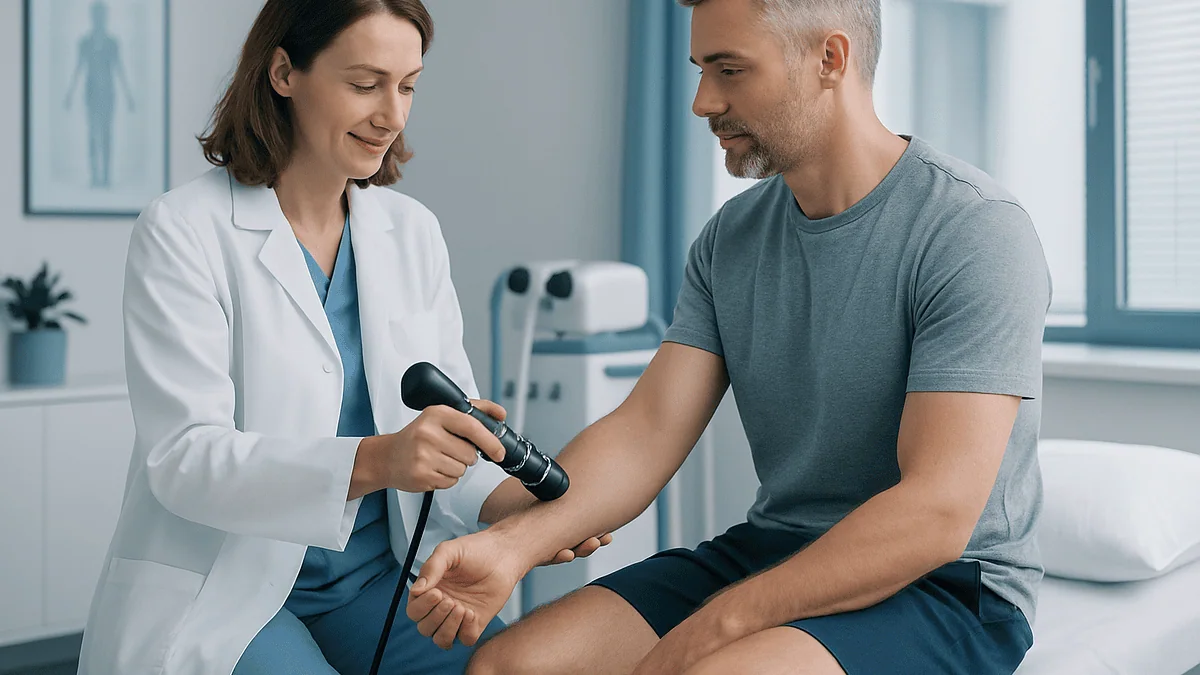
Strip away the branding and shockwave therapy is surprisingly simple: a handheld applicator pressed against your skin delivers rapid pulses of acoustic energy into an injured tendon, ligament, or muscle attachment. The formal name is extracorporeal shockwave therapy, ESWT, where “extracorporeal” just means the energy is generated outside the body.
Despite the name, there’s no electricity passing through you and nothing is being burned, frozen, or cut. A shockwave is a pressure wave, physically similar to the sonic boom of a jet but scaled down and aimed with millimeter precision. Each pulse lasts microseconds, rises to high pressure almost instantly, then drops into a brief negative-pressure phase. That sharp rise-and-fall is what distinguishes a true shockwave from the gentle, continuous vibration of therapeutic ultrasound.
The treatment lives in an interesting middle zone of medicine. It’s more intensive than a massage or heat pack, yet far less invasive than an injection or surgery. No anesthesia is needed for most musculoskeletal applications, no incision is made, and you walk out the same way you walked in, which is precisely why physical therapists, sports medicine physicians, and podiatrists have adopted it for chronic problems that have stalled despite months of conventional care.
One caveat worth stating early: shockwave is not a universal pain eraser. Its track record varies dramatically by condition, by the type of device used, and by how chronic the problem is. Those distinctions matter more than any brochure will tell you.
From kidney stones to sore heels: a short history
The origin story starts in Munich in 1980, when urologists successfully pulverized a patient’s kidney stone using focused shockwaves: a procedure called extracorporeal shockwave lithotripsy that remains a standard, well-documented treatment today, as MedlinePlus describes. Patients who once needed open surgery could suddenly pass stone fragments in their urine after an outpatient session.
Then came the serendipity. Researchers studying lithotripsy in animal models noticed thickening and increased density in pelvic bone near the shockwave path. Instead of only breaking things apart, the energy appeared to provoke tissue into rebuilding. Through the late 1980s and 1990s, orthopedic teams in Europe began testing lower-energy versions on slow-healing fractures, calcium deposits in the shoulder, and chronic tendon pain.
Regulators followed the data. In the United States, the FDA cleared shockwave devices for chronic plantar fasciitis in 2000 and for tennis elbow in 2002, and additional devices and indications have been cleared since. In the UK, the treatment is available through the NHS for selected conditions, including stubborn plantar fasciitis.
Two decades on, the field has matured from novelty to niche workhorse. Thousands of published studies now exist, of admittedly variable quality, and professional guidelines in podiatry and sports medicine mention ESWT as a reasonable option for specific chronic tendon problems. Not a first resort, and not a miracle. A tool, with a proper place in the toolbox.
How does shockwave therapy work?
Here’s the honest version: researchers understand a great deal about what shockwaves do to tissue, and somewhat less about which of those effects matters most for your aching heel. Several mechanisms have solid laboratory support.
- Mechanotransduction. Cells sense mechanical force and respond biochemically. Shockwave pulses appear to switch chronically injured tissue back into an active repair mode, increasing production of collagen: the structural protein tendons are built from.
- New blood vessel growth. Animal and human studies show shockwaves stimulate release of growth factors, including those that drive formation of tiny new blood vessels. Chronic tendinopathy is notoriously poorly perfused; better blood supply means better delivery of oxygen and repair cells.
- Breaking down calcium deposits. In calcific tendinopathy of the shoulder, imaging studies have documented deposits shrinking or disappearing after focused, higher-energy treatment: the closest modern echo of the original kidney-stone effect.
- Pain signal disruption. Shockwaves reduce concentrations of substance P, a chemical messenger involved in transmitting pain, and may exhaust overactive nerve endings around the injury. Some of the relief patients feel in the first days is likely this analgesic effect rather than true healing.
That last point explains a pattern clinicians see often: pain dips after a session, drifts partway back, then improves more durably over weeks as biological repair catches up. The immediate relief is real, but the meaningful change, the reason to commit to a full course, unfolds on tissue-healing timescales, typically measured at around twelve weeks.
Focused vs. radial shockwaves: what’s the difference?
Not all machines are created equal, and this is where an informed patient can ask sharper questions than most.
Focused shockwave devices generate true shockwaves, electrohydraulic, electromagnetic, or piezoelectric, and concentrate the energy at an adjustable depth, up to several centimeters below the skin. Energy at the target can be substantial, which is why some higher-energy protocols use local numbing. Focused devices are the ones studied for calcific shoulder deposits and slow-healing bone, where depth and precision count.
Radial pressure wave devices work differently: a projectile inside the handpiece strikes an applicator, producing a pressure wave that spreads outward like ripples from a pebble. Energy is highest at the skin surface and fades with depth. Physically speaking, these aren’t true shockwaves at all, the pressure rise is thousands of times slower, but the term “shockwave” has stuck commercially, and radial devices dominate outpatient physiotherapy because they’re cheaper, simpler, and well suited to shallow targets like the plantar fascia, Achilles tendon, and elbow.
Does the distinction matter clinically? Sometimes. For superficial tendon problems, trials suggest both types can help, and head-to-head comparisons haven’t crowned a consistent winner. For deep targets: a calcium deposit inside the rotator cuff, for example, focused devices have the better-supported track record.
The practical takeaway: ask your clinician which type they use and why it suits your specific condition. A thoughtful answer is a good sign you’re in capable hands.
Which conditions respond best to shockwave therapy?
Decades of trials have sorted the contenders into rough tiers. The strongest and most consistent evidence clusters around chronic tendon problems, ones that have lingered at least three to six months despite standard care. Here’s how the major indications stack up.
| Condition | Evidence picture | Worth knowing |
|---|---|---|
| Chronic plantar fasciitis | Strongest, multiple randomized trials and guideline support | Best studied after 6+ months of stretching and standard care |
| Calcific shoulder tendinopathy | Strong for focused, higher-energy devices | Imaging often shows deposits shrinking or dissolving |
| Tennis elbow (lateral epicondylitis) | Moderate; trial results mixed but overall favorable | Appears to work best paired with a loading exercise program |
| Achilles tendinopathy (mid-portion) | Moderate | Roughly comparable to structured calf-loading exercise in some trials |
| Greater trochanteric pain (outer hip) | Moderate | Some studies show durable benefit at 12-month follow-up |
| Patellar tendinopathy (jumper’s knee) | Mixed | May help stubborn cases; less consistent than heel or shoulder data |
Notice a theme: every strong performer is a chronic, degenerative tendon or fascia problem near a bone attachment. That’s not a coincidence. These tissues heal poorly on their own precisely because of sparse blood supply and stalled repair: the two things shockwaves seem best at reactivating. Fresh injuries, by contrast, are usually still healing fine on their own and are generally not shockwave candidates.
Does shockwave therapy actually work?
The fairest one-sentence answer: yes, for the right conditions, with realistic expectations, and the fine print matters.
For chronic plantar fasciitis, the flagship indication, pooled analyses of randomized trials show shockwave beats sham treatment for both pain and function, which is why the Mayo Clinic lists it among options for persistent cases and the NHS offers it when simpler measures haven’t worked. Success rates in trials commonly land in the range of 50 to 80 percent of patients meaningfully improved, genuinely useful, though clearly not everyone.
For calcific shoulder tendinopathy, focused high-energy treatment has produced some of the most objective evidence in the field: not just pain scores, but calcium deposits visibly shrinking on X-ray or ultrasound.
Elsewhere the picture softens. Tennis elbow trials point in a positive direction overall, but several well-run studies found little difference from sham, likely because the condition often improves on its own within a year. Achilles and hip tendinopathy data are moderate, helpful, not transformative.
Three honest caveats deserve airtime. First, sham-controlled trials in this field are hard to blind perfectly, since real treatment stings and sham doesn’t, which may inflate apparent benefits. Second, protocols vary wildly, energy levels, pulse counts, session numbers, making studies hard to compare. Third, shockwave performs best as part of a rehab plan, not instead of one. The clinics with the best results almost universally pair it with progressive loading exercise. That combination, not the machine alone, is what the strongest evidence actually supports.
Where the evidence is thinner, and marketing gets ahead of science
Success in one arena tends to breed enthusiasm everywhere, and shockwave is no exception. A few areas where the sales pitch currently outruns the data:
- Knee osteoarthritis. Small trials suggest short-term pain relief, but study quality is generally low and no major guideline endorses shockwave as a core arthritis treatment. Arthritis is a joint-cartilage problem, not a tendon problem: a fundamentally different target.
- Slow-healing fractures. Focused, high-energy shockwave has genuine supporting studies for certain bone nonunions, but this is a hospital-level procedure, done with imaging guidance and often anesthesia: a different animal from the radial device at a storefront clinic.
- Erectile dysfunction. Low-intensity shockwave is an active research area with some promising small trials, but major urology organizations still classify it as investigational, best delivered inside clinical studies. Anyone presenting it as proven is ahead of the evidence.
- Cellulite, muscle “recovery,” and general wellness. Here the evidence ranges from thin to essentially absent. Acoustic waves aimed at healthy tissue have no well-demonstrated benefit.
None of this means the emerging uses are fraudulent, some may pan out as trials accumulate. It means the burden of proof hasn’t been met yet, and your money and time are better spent on indications with a real track record. A useful filter: if a clinic advertises shockwave for a dozen unrelated problems, treat that breadth as a caution flag rather than a credential.
Is shockwave therapy painful?
Uncomfortable, usually. Unbearable, rarely. Most patients describe radial shockwave over a tender tendon as a rapid, deep tapping or snapping, imagine a firm rubber band flicking the sore spot about ten times per second. On an already irritated plantar fascia or elbow, that earns a solid “ouch” for the first thirty seconds or so; many people then report the sensation dulling as the area’s nerve endings adapt during the session.
Several factors move the needle:
- Energy setting. Clinicians typically start low and titrate upward. Good practice is treating at the highest level you can comfortably tolerate, trials suggest adequate energy matters for results, while never pushing into genuine distress.
- Location. Spots where bone sits close under the skin, like the inner heel or the outer elbow, tend to smart more than fleshier areas.
- Device type. Focused high-energy protocols can hurt more, which is why some are performed with local numbing; standard radial sessions generally are not, partly because feedback from the patient helps the clinician aim.
Afterward, expect the treated area to feel bruised or achy for a day or two, similar to the deep soreness after a vigorous sports massage. Some people actually feel temporarily better immediately after, thanks to the pain-signal-disrupting effect: a pleasant quirk, though not the durable change you’re paying for.
If a session ever feels sharply or intolerably painful, say so. Settings can be adjusted instantly, and pain beyond firm discomfort adds no known benefit.
What are the negative side effects of shockwave therapy?
For a treatment that sounds dramatic, the side-effect profile is reassuringly modest, one reason it has found a home between conservative care and surgery. Commonly reported, and almost always temporary:
- Redness or minor swelling over the treatment area, typically fading within hours to a couple of days
- Bruising, especially in people who bruise easily
- Soreness or a temporary flare of the original pain for one to three days
- Small skin surface changes, pinpoint red dots from tiny capillaries, occasionally a minor abrasion
- Numbness or tingling near the site, usually resolving quickly
Serious complications are rare and cluster around specific circumstances. Tendon rupture has been reported occasionally, mostly involving high-energy treatment, already severely degenerated tendons, or tendons weakened by prior injections, one reason a proper assessment beforehand matters. Case reports also describe bone bruising with aggressive protocols over thin bone. These events are uncommon enough that large reviews consistently describe ESWT as a low-risk intervention when delivered by trained clinicians at appropriate settings.
Two practical protections stack the odds in your favor. First, disclose your full health picture, bleeding tendencies, medication use, prior injections into the area, any numbness in the region. Second, make sure a qualified professional has actually diagnosed your problem before treating it; shockwave aimed at the wrong diagnosis is at best useless and at worst delays care for something that needed different attention entirely.
Who should skip shockwave therapy?
A short list of situations makes shockwave a poor or unsafe fit, and reputable clinics screen for every one of them.
- Pregnancy, when treatment would be anywhere near the abdomen or pelvis: a standard exclusion across devices.
- Bleeding disorders or blood-thinning medication. Shockwaves disrupt tiny blood vessels by design; impaired clotting raises the risk of significant bruising or bleeding into tissue. This calls for a physician conversation, not automatic disqualification.
- Cancer or infection at the treatment site. Energy that stimulates cell activity and blood flow is exactly what you don’t want near a tumor or active infection.
- Open growth plates. Children and adolescents whose bones are still growing are generally excluded from treatment near those zones.
- Sensitive structures in the beam path. Clinicians avoid directing shockwaves over the lungs, major nerves, large blood vessels, or the spinal cord.
- Recent steroid injection into the same tendon. Many protocols impose a waiting period, since the combination may raise rupture risk in weakened tissue.
- Implanted electronic devices such as pacemakers warrant individualized medical clearance, particularly for treatment near the chest.
None of these should be discoveries made mid-session. A legitimate provider takes a history, reviews your medications and imaging, and confirms the diagnosis before the applicator ever touches your skin. If the intake process at a clinic amounts to a signature and a swipe of your card, keep walking, thoroughness at the front desk usually predicts thoroughness everywhere else.
What happens during a session, and how many will you need?
The whole encounter is briefer than most people expect. After confirming the target, often by pressing to find the most tender point, sometimes with ultrasound imaging: the clinician applies a coupling gel, the same slippery stuff used for pregnancy ultrasounds. It’s not there for comfort; air blocks acoustic waves, and the gel gives them a clear path into tissue.
The applicator then delivers somewhere in the neighborhood of 2,000 to 3,000 pulses over five to fifteen minutes, with the clinician adjusting position and intensity based on your feedback. Then you’re done. No bandages, no crutches, no recovery room. Most protocols ask you to ease off high-impact activity for a day or two and to skip anti-inflammatory pain relievers around treatment time: the inflammation shockwave provokes is deliberate, part of restarting the healing process, and blunting it may work against the goal.
A standard course runs three to six sessions, spaced about a week apart. Improvement rarely arrives on a neat schedule: some people notice change after the second session, others not until weeks after the final one. Clinical trials most often measure outcomes at twelve weeks, and benefits frequently continue accruing beyond that as tissue remodels, studies of hip and heel pain have documented gains persisting or growing at one-year follow-up.
Set your expectations accordingly. Judging shockwave after one session is like judging a strength program after one workout. If nothing at all has shifted by the end of a full course plus a month or so, that’s the point to reassess the plan with your clinician rather than reflexively booking more.
How much do shockwave treatments cost?
Here’s where geography and insurance fine print matter more than biology. In the United States, shockwave therapy for musculoskeletal conditions is frequently classified by insurers as investigational or not medically necessary, which means many patients pay out of pocket. Prices vary widely by region, clinic type, and device: radial sessions at physical therapy and podiatry practices commonly run from roughly $100 to $500 each, while focused high-energy procedures done in hospital settings, sometimes with anesthesia and imaging guidance, can cost considerably more as a single package.
Multiply a per-session price by the typical three-to-six-session course and you’re often looking at several hundred to a couple of thousand dollars total. Before committing, three questions are worth asking in writing:
- What is the full anticipated cost of the complete course, not just the first visit?
- Will my insurer cover any portion, and can the clinic provide documentation to submit a claim?
- What happens, clinically and financially, if I’ve had no meaningful improvement after the planned course?
Elsewhere the math differs. In the UK, the NHS provides shockwave for selected indications such as persistent plantar fasciitis at no direct cost when clinically appropriate, though availability varies by region and waiting lists apply. Several other countries’ public or statutory systems cover specific, well-evidenced indications.
A candid word about value: for a condition with strong evidence, say, plantar fasciitis that has defied six months of diligent stretching, paying out of pocket can be a reasonable gamble with better odds than most. For a weakly supported indication, the same money often does more good funding a quality rehab program.
How shockwave fits alongside exercise, orthotics, and other rehab
The most common misunderstanding about shockwave isn’t about safety or cost: it’s about role. Patients arrive hoping the machine will replace the rehab work. The evidence says nearly the opposite: shockwave works best as an accelerant layered onto the treatments that remain first-line.
For most chronic tendon problems, the foundation is progressive loading exercise, carefully dosed strengthening that stimulates tendons to rebuild along lines of stress. For mid-portion Achilles tendinopathy, structured calf-loading programs have evidence rivaling shockwave itself, and trials combining the two often outperform either alone. For plantar fasciitis, guidelines from major medical centers still start with calf and fascia stretching, supportive footwear, activity modification, and time, reserving shockwave for the stubborn minority, roughly one in ten cases, that persists past six months or so.
Thinking of it this way also clarifies sequencing. Shockwave sits sensibly after a genuine trial of conservative care and before more invasive options like surgery. That middle position is arguably its greatest virtue: for someone staring down an operation on a chronically painful heel or shoulder, a low-risk, noninvasive course with a reasonable success rate is an attractive off-ramp, and surgeons increasingly treat it as one.
What it should never become is a substitute for diagnosis. Heel pain isn’t always plantar fasciitis; elbow pain isn’t always tendinopathy. Nerve entrapments, stress fractures, and inflammatory arthritis can all masquerade as tendon problems, and each calls for entirely different care. The applicator is only as smart as the assessment behind it.
When to see a doctor about persistent tendon or heel pain
Shockwave is a treatment for diagnosed chronic problems, which means the step before any session is making sure your pain has actually been evaluated. See a physician or physical therapist promptly if:
- Pain has lasted more than a few weeks despite rest, activity changes, and sensible self-care
- Pain is severe, worsening, or waking you at night
- You felt a sudden pop or snap, or you can’t bear weight or use the limb normally, possible tendon rupture or fracture, which need urgent assessment
- The area is hot, markedly swollen, or red, or you have a fever, infection and inflammatory conditions can mimic overuse injuries
- You have numbness, tingling, or weakness, which points toward nerve involvement rather than tendon
- You have diabetes, circulation problems, or take blood thinners and develop new foot or limb pain
Even without red flags, a proper evaluation earns its keep. Clinicians distinguish plantar fasciitis from heel stress fractures and nerve entrapment, tennis elbow from joint problems, Achilles tendinopathy from partial tears, distinctions that determine whether shockwave is a smart option or a costly detour. Sometimes that assessment includes ultrasound or X-ray; often a careful history and hands-on exam suffice.
And if you’ve already completed a full shockwave course with little to show for it, that result is itself useful information. Bring it back to your clinician. Sometimes the answer is a revised diagnosis; sometimes a different modality; occasionally, a frank conversation about surgical options. Persistent pain deserves a plan, not just another round of pulses.
Frequently asked questions
What are the negative side effects of shockwave therapy?
The common side effects are mild and temporary: soreness, redness, swelling, bruising, and occasionally tingling or small skin marks at the treatment site, usually resolving within one to three days. Serious complications such as tendon rupture are rare and mostly associated with high-energy protocols or tendons already weakened by severe degeneration or prior injections. Screening by a trained clinician keeps risks low.
How much do shockwave treatments cost?
In the US, radial shockwave sessions commonly cost roughly $100 to $500 each, and a full course of three to six sessions can total several hundred to a couple of thousand dollars. Many insurers classify it as investigational and don’t cover it, so ask about total cost in advance. In the UK, the NHS provides it for selected conditions such as persistent plantar fasciitis at no direct charge.
Does shockwave therapy actually work?
For the right conditions, yes, randomized trials show it outperforms sham treatment for chronic plantar fasciitis and calcific shoulder tendinopathy, with success rates often between 50 and 80 percent. Evidence for tennis elbow and Achilles tendinopathy is moderate and more mixed. It works poorly, or is unproven, for arthritis and most wellness uses, and results are best when combined with an exercise program.
Is shockwave therapy painful?
It’s usually uncomfortable rather than truly painful, most people describe rapid, deep tapping over the sore spot that stings for the first half minute, then becomes more tolerable. Clinicians start at low energy and adjust to what you can handle. High-energy focused protocols can hurt more and sometimes use local numbing. Expect a bruised, achy feeling for a day or two afterward.
How many shockwave sessions will I need?
Most protocols call for three to six sessions spaced about a week apart. Each session takes five to fifteen minutes and requires no downtime. Improvement is typically assessed around twelve weeks after starting, and benefits often continue building for months afterward as the tissue remodels. If a full course plus several weeks produces no change at all, it’s time to reassess the diagnosis and plan.
What’s the difference between radial and focused shockwave therapy?
Focused devices concentrate true shockwaves at an adjustable depth, making them better suited to deep targets like calcium deposits in the rotator cuff or slow-healing bone. Radial devices produce a pressure wave that’s strongest at the skin surface and fades with depth, which fits shallow problems like plantar fasciitis, Achilles tendinopathy, and tennis elbow. Radial machines are cheaper and dominate outpatient physiotherapy clinics.
Can I have shockwave therapy if I take blood thinners?
Not without a physician’s input. Shockwaves deliberately disrupt tiny blood vessels to trigger healing, so impaired clotting raises the risk of significant bruising or bleeding into tissue. Blood-thinning medication and bleeding disorders are standard screening questions at reputable clinics. Depending on your situation, your doctor may approve treatment, adjust timing, or recommend an alternative, but it’s a decision to make together, not to skip.
Is shockwave therapy the same as ultrasound or TENS?
No. Therapeutic ultrasound uses continuous, gentle sound waves mainly to warm tissue; TENS delivers mild electrical currents through skin pads to dampen pain signals. Shockwave delivers discrete, high-pressure acoustic pulses designed to mechanically stimulate a biological repair response, new blood vessel growth, collagen production, and breakdown of calcium deposits. The mechanisms, sensations, and evidence bases are entirely different, so the treatments aren’t interchangeable.
Can I exercise after a shockwave session?
Light activity is generally fine, but most protocols advise easing off high-impact or heavy loading of the treated area for a day or two, since the tissue is deliberately irritated and mildly inflamed. Many clinicians also suggest avoiding anti-inflammatory pain relievers around treatment time, because that inflammation is part of how the therapy restarts healing. Your provider will usually pair sessions with a structured, progressive exercise plan.
Does shockwave therapy work for erectile dysfunction?
It’s promising but still investigational. Small trials of low-intensity shockwave for erectile dysfunction related to blood-vessel problems have shown encouraging short-term results, but studies are limited in size and duration, and major urology organizations recommend it primarily within clinical research settings. Anyone marketing it as a proven cure is ahead of the evidence. Discuss established options with a physician before paying for experimental treatment.
References
This article is for general information only and is not a substitute for professional medical advice. Please consult a qualified doctor about your individual situation.

More from the Blog

Before Your First Vestibular Rehabilitation Visit: Symptom Diary, Hearing Tests and Medicines
Before a vestibular rehabilitation first appointment, most teams ask for three things: a short symptom diary recording when dizziness happens, how long it lasts…
Skin Checks and Pressure Relief After Spinal Cord Injury Rehabilitation: A Daily Routine
Pressure sore prevention after spinal cord injury rests on a daily routine: inspect skin over bony areas at least once or twice a day,…

What a Pulmonary Rehabilitation Session Involves: Exercise, Breathing Training and Education
Pulmonary rehabilitation is a supervised program for people with chronic lung disease that combines exercise training, breathing techniques and education. A typical session includes…
Daily Life After Vision Rehabilitation: Practicing Contrast Strategies and Orientation Skills
Living with low vision after rehabilitation works best when contrast and orientation skills become daily habits: use dark-on-light or light-on-dark pairings for food, stairs,…

Shockwave Therapy for Plantar Fasciitis: What the Trials Show
Shockwave therapy shows moderate evidence of benefit for chronic plantar fasciitis. Randomized trials and meta-analyses find it relieves heel pain better than sham treatment…

Inside a Bobath Treatment Session: Guided Handling, Positioning and Task Practice
A Bobath therapy session is a hands-on neurological rehabilitation appointment, usually with a physiotherapist or occupational therapist, in which the therapist guides your movement,…