

Stroke Rehabilitation Timeline: From Hospital Bedside to Outpatient Therapy and Home Practice
Key Takeaways
- Rehabilitation typically begins within 24 to 48 hours of a stroke, while the person is still in the acute hospital, according to the Mayo Clinic.
- Very high-dose mobilization within the first 24 hours was linked to worse three-month outcomes in the AHA guideline's cited trial, so early activity is gradual rather than aggressive.
- Johns Hopkins describes the first three months as the period of fastest recovery, with improvement slowing but not stopping after about six months.
- The AHA guideline recommends organized inpatient rehabilitation for eligible patients because it is associated with better functional outcomes than less intensive settings.
- Repetition drives neuroplasticity, so a written home exercise program practiced daily carries much of the recovery that clinic hours alone cannot deliver.
- The NHS advises not driving for at least one month after a stroke and obtaining medical clearance afterward; rules vary by jurisdiction.
A stroke rehabilitation timeline usually begins at the hospital bedside within about 24 to 48 hours, moves to an inpatient rehabilitation unit or home-based therapy in the first weeks, and then continues as outpatient sessions plus daily home practice. Most measurable recovery happens in the first three to six months, but guided improvement can continue for years, and the pace differs widely from one person to the next.
On the second morning after her father’s stroke, a woman stood at his bedside and watched a physical therapist ask him to lift a plastic cup with his right hand. The cup rose an inch, wobbled, and went down again. She had expected to feel devastated. Instead she found herself asking the question every family in that room eventually asks: what happens next, and how long will it take?
The honest answer is that the stroke rehabilitation timeline is less a calendar than a route map. It runs from a hospital bed through an inpatient unit or a first fragile week at home, into outpatient clinics, and finally into the living room, where most of the real work gets done. The stops are fairly predictable. The pace is not.
What follows is a plain description of that route, grounded in what stroke guidelines and long-term recovery research actually show, so that the cup rising an inch can be read for what it is: the first step, not the verdict.
What does a stroke rehabilitation timeline actually describe?
A stroke happens when blood flow to part of the brain is interrupted, either by a clot (an ischemic stroke) or by bleeding (a hemorrhagic stroke). Brain cells in the center of that area die within minutes. Cells around the edge are stunned rather than destroyed, and a surrounding zone of swelling temporarily disrupts far more tissue than the stroke itself damaged.
Rehabilitation does not repair the dead tissue. It works on everything else. The central mechanism is neuroplasticity, the brain’s ability to reorganize by strengthening surviving connections and recruiting nearby regions to take over lost functions. That reorganization is driven by repetition: the same reaching movement, the same word, the same step practiced hundreds of times until an alternative pathway becomes reliable.
Three processes overlap along the way, and understanding them explains why the timeline is shaped the way it is. The first is spontaneous biological recovery, as swelling settles and stunned cells resume work, mostly over the early weeks. The second is learning-dependent recovery, in which practice reshapes the brain; this is the part therapy targets directly. The third is compensation, learning to do a task differently, such as dressing one-handed. Good rehabilitation blends the second and third rather than settling for the third alone.
The American Heart Association guideline on adult stroke rehabilitation describes rehab as an organized, interdisciplinary process that begins in the acute hospital and continues across settings for as long as meaningful goals remain. That phrase, meaningful goals, is the quiet heart of the whole timeline. The schedule bends around the person; the person is not fitted to the schedule.
What happens at the hospital bedside in the first 24 to 72 hours?
The first days belong to two jobs at once: protecting the brain from further injury and starting rehabilitation before deconditioning sets in. On a stroke unit, that means blood pressure, heart rhythm, blood sugar, oxygen and temperature are watched closely while the therapy team begins its assessment.
One of the earliest steps is a swallow screen. Dysphagia, meaning difficulty swallowing, is common after stroke and raises the risk of food or liquid entering the lungs. Until a screen is passed, nothing goes by mouth, which is why a patient may be kept from water for a stretch that feels unkind to relatives but is protective.
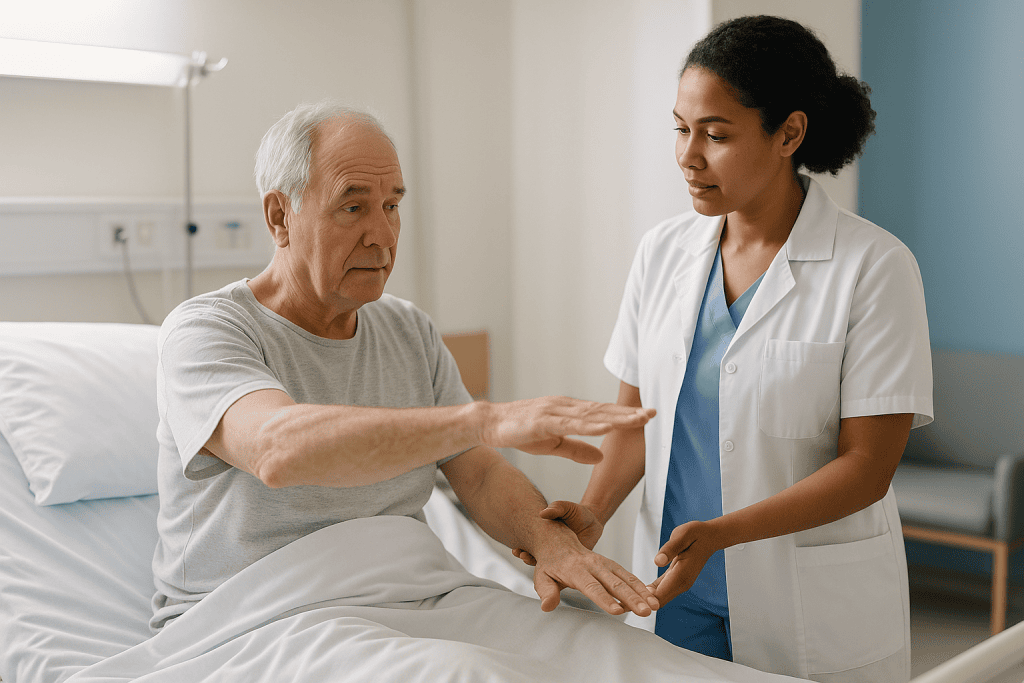
Nurses position the weaker limbs to reduce shoulder injury and pressure sores. Clot prevention for the legs, using compression devices or medicines chosen by the team, begins early because an immobile leg is a risk for deep vein thrombosis. Physical therapists, occupational therapists and speech-language pathologists each evaluate what has changed: strength, sensation, balance, vision, language, attention and the ability to manage everyday tasks.
The Mayo Clinic notes that rehabilitation typically begins about 24 to 48 hours after a stroke, while the person is still in the acute hospital. Early does not mean aggressive. The AHA guideline reports that very high-dose, very early mobilization within the first 24 hours was associated with worse outcomes at three months in a large trial and is not recommended; gentler, gradually increased activity is the standard. Sitting up, moving to the edge of the bed and standing with help usually come first. The team then uses these early observations to recommend where the next phase should happen.
Who is usually referred for inpatient stroke rehabilitation, and who is asked to wait?
Toward the end of the acute stay, the team makes a decision that shapes the next month: where should rehabilitation continue? The options described by MedlinePlus include an inpatient rehabilitation facility, a skilled nursing facility with therapy, outpatient clinics and home-based programs.
An inpatient rehabilitation facility, sometimes called an acute rehab unit, is a hospital-level setting where a person receives daily therapy from several disciplines under medical supervision. The AHA guideline recommends this organized, coordinated setting for stroke patients who qualify and who are able to take part, because it is associated with better functional outcomes than less intensive settings. In practice, the people usually referred there have meaningful deficits, a realistic prospect of improvement, enough stamina to participate in several therapy sessions a day, and a plan for where they will live afterward.
Some people are asked to wait, and the reasons are medical rather than a judgment about their potential. Blood pressure that remains erratic, an unstable heart rhythm, ongoing brain swelling, a new infection or a low level of alertness can all make intensive therapy unsafe for now. A person who cannot yet stay awake through a session may begin at a slower pace in a skilled nursing setting, with a review for transfer when tolerance improves.
At the other end, someone with a mild stroke and a supportive home may go directly home with outpatient or home-visit therapy. That is not a lesser pathway; it simply matches intensity to need. Whatever the route, the same guideline principles apply: assessment, goals, repetition and follow-up, with the treating team deciding when a change of setting is appropriate.
The first two weeks in an inpatient rehab unit: what a day looks like
Mornings on a rehabilitation unit start early and purposefully. Getting washed and dressed is not a warm-up for therapy; it is therapy, and the occupational therapist may be right there, coaching a one-handed technique for a shirt or a safer way to stand at the sink.
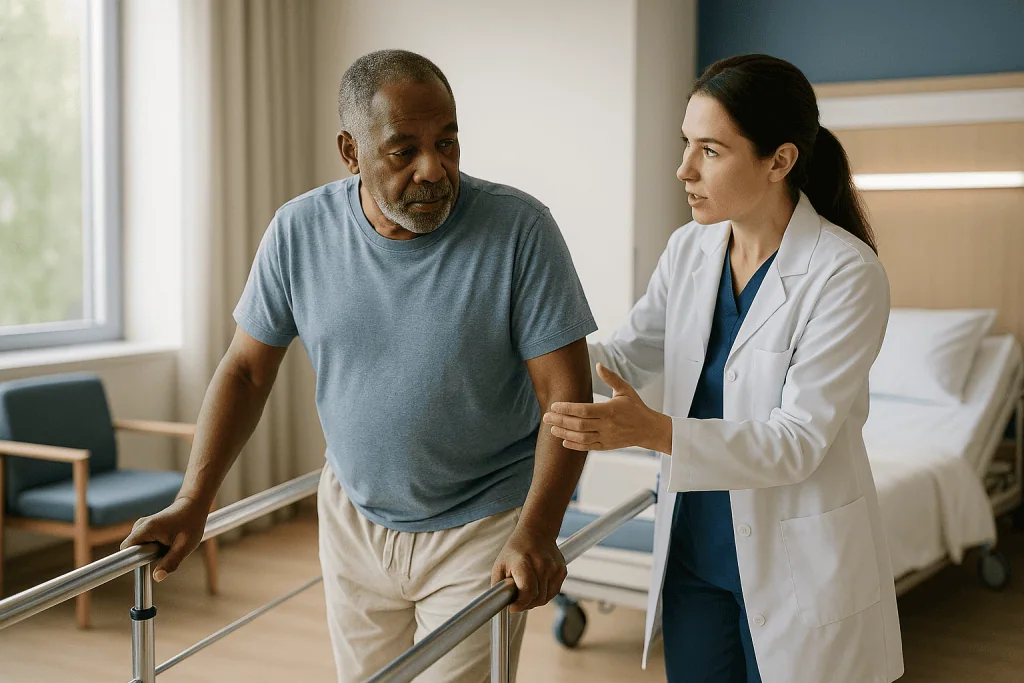
A typical day divides among three core therapies. Physical therapy addresses hemiparesis, the weakness on one side of the body, working on sitting balance, transfers from bed to chair, standing and eventually walking, often with a frame, a cane or a temporary brace. Occupational therapy targets the arm and hand as well as daily living skills: eating, grooming, toileting, kitchen safety. Speech-language pathology covers aphasia, the loss of ability to produce or understand language, along with dysarthria (slurred speech from muscle weakness) and swallowing.
Rehabilitation nursing runs through the whole day, reinforcing what therapists teach, managing bladder and bowel routines, protecting skin and watching for spasticity, the involuntary muscle tightness that can develop in the weeks after stroke. Neuropsychologists assess memory, attention and mood; social workers begin the practical planning for home.
Once a week or so, the team meets to review each person’s progress against agreed goals and to adjust the plan. Families are drawn in deliberately: learning safe transfers, cueing techniques for communication, and how to set up a bathroom. Some units arrange a home assessment or a trial day at home before discharge.
The Johns Hopkins recovery timeline describes this period as one of rapid change for many people, because spontaneous recovery and intensive practice are happening at the same time. Small daily gains, a firmer sit, a longer walk, a word retrieved, are what the team is watching for.
Stroke recovery stages: why the first three months matter so much
Ask any experienced rehabilitation clinician when recovery is fastest and the answer is consistent: early. Johns Hopkins describes the first three months as the period when most people see the greatest improvement, driven by spontaneous recovery as swelling resolves and stunned brain tissue comes back online, layered with the effect of intensive therapy. Recovery generally continues after that, but at a slower pace.
Why the early window matters is partly biology and partly opportunity. In the weeks after injury the brain is unusually receptive to forming new connections, and practice during that period appears to be used more efficiently. This is the argument for starting therapy in the acute hospital, keeping intensity high in the rehab unit, and not letting the transition home become a gap.
The stages people pass through are not fixed steps, but there are recognizable patterns. Trunk control and sitting balance often return before standing; standing before walking; the leg frequently recovers useful function before the hand, because fine finger control depends on pathways that are easily disrupted. Language recovery in aphasia tends to follow its own, often longer, arc.
By around six months, Johns Hopkins notes, improvement typically slows, and this is where the word plateau enters conversations. A plateau in measurable recovery does not mean the brain has stopped changing. It often reflects a change in the type of gain, from big visible leaps to smaller refinements in speed, endurance and confidence, or a mismatch between the current program and what is now needed.
The NHS is direct on this point: rehabilitation may need to continue for months or years, and the need for it does not end at a specific date. The first three months are the steepest part of the climb, not the whole mountain.
Stroke rehabilitation timeline at a glance
The phases below are typical ranges drawn from the Mayo Clinic, Johns Hopkins and the AHA rehabilitation guideline. They overlap, and a person may skip a setting or return to an earlier one after a setback. Treat the table as orientation, not as a schedule to be met.
| Phase | Typical timing | Usual setting | Main focus | Core team |
|---|---|---|---|---|
| Acute care | First 24 to 72 hours, sometimes up to a week | Stroke unit | Medical stability, swallow screen, clot prevention, early sitting and standing, assessment | Stroke physicians, nurses, PT, OT, SLP |
| Early intensive rehab | Roughly weeks 1 to 4 | Inpatient rehab unit, skilled nursing with therapy, or intensive home program | Transfers, walking, arm use, self-care, communication, swallowing, family training | Rehab physician, nurses, PT, OT, SLP, psychology, social work |
| Subacute recovery | Roughly months 1 to 3 | Outpatient clinic, home visits, tele-rehab | Real-world tasks, endurance, hand function, community walking, cognition, mood | Outpatient therapists, primary care, rehab physician |
| Consolidation | Roughly months 3 to 6 | Outpatient plus home practice | Refining skills, return to driving or work assessments, spasticity management | Therapists as needed, physician review |
| Long-term recovery | Beyond 6 months, potentially years | Home, community programs, periodic therapy blocks | Maintaining gains, new goals, fitness, secondary prevention | Primary care, periodic specialist review |
Two features of this table deserve emphasis. First, the settings become less medical and more everyday as time passes, which is the point: the goal is a life, not a therapy schedule. Second, the team shrinks but never disappears. Follow-up with a physician for blood pressure, cholesterol and clot-prevention review continues indefinitely, because preventing another stroke is part of rehabilitation.
Outpatient therapy: what changes when you go home
Going home is the moment most people have been aiming at, and also the moment the timeline is most likely to stall. On the unit, therapy arrived at the door. At home, it has to be sought, scheduled and driven to. Programs that plan this handover carefully, with a first outpatient appointment booked before discharge, tend to avoid the drift.
Outpatient therapy changes emphasis. The unit taught safe transfers and walking a corridor; the clinic asks whether you can carry a bag of groceries, cross a road before the signal changes, or stir a pot while standing at the stove. Sessions are typically shorter and less frequent than inpatient care, with the frequency set by the team based on goals and progress, and the gap between sessions is where home practice takes over.
Several approaches the AHA guideline considers reasonable for appropriate patients appear here. Constraint-induced movement therapy involves restraining the stronger arm for part of the day so the weaker one is forced to work. Task-specific training practices the exact activity that matters, buttons rather than generic grip exercises. Treadmill training with or without body-weight support builds walking endurance. Mirror therapy, in which movement of the unaffected hand is reflected to look like the affected one, is listed as a reasonable adjunct for arm recovery.
Two milestones commonly arise in this phase. Driving: the NHS advises not driving for at least one month after a stroke, with medical clearance afterward; rules differ by country and state, and a formal driving assessment may be recommended. Work: return is usually gradual and negotiated with an occupational therapist. Tele-rehabilitation, delivering therapy by video, is increasingly used to bridge distance and fatigue, and the guideline regards it as a reasonable option when in-person care is not practical.
Home exercises after stroke: turning practice into the real engine of recovery
Here is the uncomfortable arithmetic of rehabilitation. A person might receive a few hours of supervised therapy a week as an outpatient. The brain rewires in response to thousands of repetitions. The difference between those two numbers is filled, or not filled, at home.
A home exercise program is written by the therapists, individualized to the person’s deficits and safety, and updated as goals change. It typically mixes movement practice for the weaker leg and arm, balance work, stretching for muscles at risk of tightening, and functional tasks such as sit-to-stand repetitions from a firm chair. The Mayo Clinic identifies dedicated, repetitive practice as the single most important factor in recovery, and home is where repetition lives.
Safety comes before ambition. Falls are a major hazard after stroke; the AHA guideline recommends a falls-prevention program for anyone at risk. That translates into practical rules: exercise near a stable surface, have someone nearby for standing work in the early weeks, clear rugs and cables, and stop any exercise that provokes dizziness, chest discomfort or sharp pain.
Consistency beats intensity. Ten minutes several times a day, folded into ordinary routines, usually adds up to more than a single heroic session that ends in exhaustion. Many people keep a simple log of repetitions or minutes; therapists use it to adjust the program, and it also makes slow progress visible.
Caregivers are part of the program, not spectators. Learning how to cue a movement, how to guide a weak arm without pulling on the shoulder, and when to step back and let a task be slow are skills the therapy team can teach. The best home practice looks less like a gym routine and more like everyday life done deliberately: reaching into a cupboard, setting a table, walking to the mailbox with attention.
Speech, swallowing and thinking: the parts of the timeline that walking hides
Walking is what visitors notice, so it becomes the unofficial measure of recovery. For many survivors, the harder losses are invisible from across a room: the sentence that will not form, the meal that has to be pureed, the bill that cannot be understood.
Aphasia affects language itself, understanding, speaking, reading or writing, and it follows a longer recovery arc than most physical deficits. Speech-language therapy works on both restoring language and building compensations: gesture, drawing, communication boards and, increasingly, tablet-based programs for extra practice between sessions. The AHA guideline recommends speech and language therapy for people with aphasia and notes that intensive treatment appears beneficial when a person can tolerate it. Improvement can continue well beyond the first year.
Dysarthria is different: language is intact but speech muscles are weak or uncoordinated, producing slurred or quiet speech. Therapy focuses on breath support, articulation and pacing.
Dysphagia often improves within weeks as swallowing coordination returns, but during that period a modified-texture diet and thickened liquids protect the lungs. The speech-language pathologist reassesses regularly and advances textures as safety allows; the team decides each step.
Cognitive changes after stroke include slowed processing, poor attention, memory lapses and difficulty planning. Neglect, in which a person is unaware of one side of space or of their own body, is common after right-sided strokes and can be dangerous, because the person may not notice a doorframe or a car on the affected side. Vision may be lost in part of the visual field on one side.
Cognitive rehabilitation uses structured exercises, compensatory strategies such as checklists and alarms, and environmental changes. The AHA guideline recommends cognitive assessment for all stroke survivors, because these deficits shape every other part of the timeline, including whether a person can safely follow a home program at all.
Medicines during stroke rehabilitation: what they do and who decides
Medicines are not the engine of recovery, but they run alongside the timeline and influence it, and patients routinely ask about them. The decisions belong to the prescribing clinician; what follows explains mechanisms and typical roles only.
Secondary prevention starts in the acute hospital and continues for life. For most ischemic strokes, an antiplatelet medicine makes blood platelets less sticky; when the stroke was caused by a clot from an irregular heart rhythm, an anticoagulant that slows the clotting cascade is usually chosen instead. Statins lower cholesterol and stabilize artery plaque. Blood pressure medicines protect small vessels in the brain. None of these help the paralyzed arm directly, but a second stroke would set the whole timeline back to zero, which is why follow-up appointments to review them matter as much as therapy sessions.
Spasticity may need treatment when it interferes with function or causes pain. Oral muscle relaxants act across the whole body, which limits their use because of drowsiness. Botulinum toxin injected into specific overactive muscles blocks the nerve signal locally; its effect builds over days and fades over several months, so it is usually paired with stretching and therapy and repeated by the team if it helps. The AHA guideline supports this approach for focal spasticity.
Mood and fatigue medicines are sometimes discussed. Antidepressants in the class that raises serotonin availability are used for post-stroke depression. Whether they also speed motor recovery has been studied; results have been mixed, and the AHA guideline does not treat them as an established motor-recovery therapy.
Any medicine that causes unusual bleeding, dizziness, confusion or falls should be reported promptly. Stopping or adjusting any of these on your own carries real risk; the prescribing clinician weighs benefits and side effects together.
Fatigue, mood and sleep: the timeline nobody puts on the whiteboard
Around the third or fourth week, a pattern often shows up. The person who pushed through every session on the unit arrives home and sleeps most of the afternoon. Relatives wonder whether motivation has gone. Usually it has not. Post-stroke fatigue is a recognized consequence of the injury itself, unrelated to how much rest a person had, and it can persist for months.
Fatigue is managed rather than defeated: planning demanding tasks for the best time of day, building in rests before exhaustion rather than after it, and accepting that a productive day may be shorter than before. Therapists adjust intensity around it, which is one reason the home program should be realistic rather than aspirational.
Depression and anxiety are common after stroke, and they are not simply a reaction to disability; the brain changes involved in stroke can themselves alter mood. Untreated depression slows rehabilitation because it saps the drive to practice. The AHA guideline recommends screening for depression and offering treatment, which may include psychological therapy, medicines chosen by the clinician, or both. Persistent low mood, loss of interest or hopelessness are things to raise at every follow-up, not to endure quietly.
Sleep-disordered breathing, particularly obstructive sleep apnea in which the airway repeatedly closes during sleep, is frequent after stroke and worsens fatigue, blood pressure and cognition. The guideline suggests that a sleep study is reasonable for stroke survivors because treating apnea may improve outcomes. Loud snoring, gasping in sleep or unrefreshing sleep are worth mentioning.
Caregivers travel this timeline too. Strain, isolation and their own low mood are common and affect the survivor’s progress. Rehabilitation teams increasingly ask how the family is doing, and the answer is a legitimate clinical concern, not a distraction from the patient.
What people often get wrong about the stroke recovery timeline
Myths about stroke recovery are persistent, and several of them actively slow people down.
“Recovery stops at six months.” Improvement does slow after the early months, as Johns Hopkins describes, but the NHS is explicit that rehabilitation may continue for months or years. Later gains are usually smaller and require deliberate practice, which is different from being impossible.
“Rest is the best medicine after a stroke.” Medical stability comes first, and very high-intensity mobilization within the first day is not recommended. Beyond that, prolonged bed rest weakens muscles, stiffens joints, raises clot risk and delays the practice that drives neuroplasticity. Guidelines favor early, gradually increasing activity.
“If the hand hasn’t moved by now, it never will.” Hand recovery is often the slowest and least complete, and early return of some finger movement is a favorable sign. But absent early movement does not fix the outcome, and there is no calendar date after which therapy becomes pointless. The treating team, not a rule of thumb, judges realistic goals.
“More therapy is always better.” Intensity helps up to the point a person can tolerate and consolidate it. Exhaustion, pain and falls erase gains. Dose is individualized.
“A plateau means therapy failed.” Plateaus often signal that the program needs to change, or that gains have shifted from visible to subtle. They are a prompt for review.
“This device or supplement rewires the brain.” Products marketed for stroke recovery frequently rest on small or uncontrolled studies. The AHA guideline grades therapies by evidence; anything promising rapid or guaranteed recovery deserves a direct question to your team about what the studies actually show.
“Walking means recovered.” Language, cognition, mood and fatigue often take longer than walking and matter at least as much for daily life.
Questions to ask your care team at each stage
Rehabilitation goes better when the person and family understand the plan, and teams generally welcome specific questions. The list below is organized by phase so it can be used as the timeline unfolds.
In the acute hospital
- What type of stroke was this, and which functions has it affected?
- Has a swallow screen been done, and what does the result mean for eating and drinking?
- Which rehabilitation setting are you recommending next, and why that one rather than the alternatives?
- What is being done to prevent clots, pressure sores and another stroke?
In the inpatient unit
- What are the specific goals for the next week, and how will you measure them?
- Which therapies is my relative receiving, and roughly how much time is spent in each?
- What should we as a family learn before discharge, such as transfers or communication cues?
- Has mood, cognition and vision been assessed?
At discharge and in outpatient care
- When is the first outpatient appointment, and who do we call if it has not been arranged?
- What is the written home exercise program, and what are the stop signs?
- What changes at home would reduce fall risk?
- What are the rules and assessments for returning to driving or work?
- Which medicines are for preventing another stroke, and when will they be reviewed?
When progress seems to slow
- Is this a plateau, and does the program need changing?
- Are spasticity, pain, fatigue, mood or sleep getting in the way, and what could be done about them?
- What would a further block of therapy realistically aim at?
Bring a notebook or ask permission to record answers. Fatigue and aphasia both make it hard to retain a conversation, and a written plan is something the whole household can work from.
When to call your doctor: red-flag signs during stroke recovery
Most of the rehabilitation timeline is slow and steady, which makes it easy to dismiss a sudden change as a bad day. Some changes should never be waited out.
Call emergency services immediately, do not drive to a clinic, if any sign of a new stroke appears: sudden weakness or numbness of the face, arm or leg, especially on one side; sudden confusion or trouble speaking or understanding; sudden loss of vision in one or both eyes; sudden trouble walking, dizziness or loss of balance; or a sudden severe headache with no known cause. The CDC summarizes the quick check as F.A.S.T.: face drooping, arm weakness, speech difficulty, time to call. A second stroke is treatable only if help arrives quickly, and a person already recovering from one is at higher risk.
Seek urgent care the same day for a fall with a head strike or new pain that prevents weight-bearing; new swelling, warmth or pain in a calf, or sudden breathlessness or chest pain, which can indicate a clot; fever, a wet cough or breathing difficulty in someone with swallowing problems, which may signal aspiration; a seizure; unusual bleeding or black stools in someone on clot-preventing medicines; or a sudden worsening of drowsiness or confusion.
Contact the treating team within a day or two for rapidly increasing muscle tightness or joint pain, a shoulder that has become painful, new skin redness over pressure points, a marked drop in appetite or fluid intake, persistent low mood or any thoughts of self-harm, or a home program that has become impossible because of pain, dizziness or exhaustion.
None of these signs means the timeline has failed. They mean it needs a clinician’s eyes before the next step, and reporting them early keeps small problems from becoming setbacks.
Frequently asked questions
How long does stroke recovery take?
There is no single answer; recovery is fastest in the first three months, slows after about six, and can continue for years. Johns Hopkins describes the early months as the period of greatest improvement, while the NHS notes rehabilitation may last months or years. The size and location of the stroke, age, other health conditions and the amount of practice all shape the pace.
What are the stroke recovery stages after leaving hospital?
Most people move from acute care to early intensive rehabilitation in an inpatient unit or at home, then to outpatient therapy over the first three months, then to a consolidation phase and long-term home practice. The stages overlap, and a setback such as illness or a fall can mean returning temporarily to a more supported setting. Your team decides each transition.
What does inpatient stroke rehabilitation involve day to day?
It involves daily sessions of physical therapy, occupational therapy and speech-language therapy, supported by rehabilitation nursing and medical oversight. Days are structured around practicing transfers, walking, arm use, self-care, communication and swallowing, with weekly team reviews of goals. Families are usually taught safe handling and communication techniques before discharge.
Which home exercises after stroke are most useful?
The most useful exercises are the ones your therapists prescribe for your specific deficits, practiced often and safely. Programs commonly include sit-to-stand repetitions, balance work, reaching and grasping tasks for the weaker arm, and stretches for tightening muscles. The Mayo Clinic identifies repetitive, dedicated practice as the most important factor, so consistency matters more than any single exercise.
Can recovery still happen after six months?
Yes, although gains after six months are usually smaller and require deliberate practice. Johns Hopkins notes recovery slows after this point rather than stopping, and the NHS states rehabilitation may continue for years. Language and hand function in particular can keep improving. A plateau is a reason to review the program with your team, not a sign that therapy is finished.
Why can't my relative eat or drink yet?
Because swallowing is often impaired after a stroke and food or liquid can enter the lungs, teams keep people off oral intake until a swallow screen has been passed. Dysphagia frequently improves over the early weeks. A speech-language pathologist reassesses regularly and advances food and drink textures as it becomes safe, with the team making each decision.
When can someone drive again after a stroke?
Rules vary by country and state, so check with your treating team and licensing authority. The NHS advises not driving for at least one month after a stroke and only resuming with medical clearance. Vision, reaction time, attention and neglect all need to be assessed, and a formal driving evaluation through an occupational therapist is often recommended before returning to the road.
Is more therapy always better?
No; intensity helps only up to what a person can tolerate and consolidate. The AHA guideline reports that very high-dose mobilization within the first 24 hours was associated with worse outcomes, and later in recovery, exhaustion and falls can erase gains. The right dose is individualized, increased gradually and adjusted around fatigue, pain and mood by the treating team.
What causes spasticity, and how is it treated?
Spasticity is involuntary muscle tightness caused by disrupted signals from the damaged brain to the muscles, often developing in the weeks after stroke. Management includes stretching, positioning, splints and therapy; when tightness limits function or causes pain, clinicians may consider oral muscle relaxants or botulinum toxin injected into specific muscles, whose effect fades over months. Decisions rest with the prescribing clinician.
How can family members help with the stroke rehabilitation timeline?
Families help most by learning the techniques therapists teach, supporting daily home practice safely, and watching for red-flag signs. That includes cueing movements without pulling on a weak shoulder, reducing fall hazards at home, keeping follow-up appointments for stroke-prevention medicines, and raising concerns about mood, fatigue or sleep. Caregivers should also report their own strain; it affects recovery too.
References
This article is for general information only and is not a substitute for professional medical advice. Please consult a qualified doctor about your individual situation.

More from the Blog

Before Your First Vestibular Rehabilitation Visit: Symptom Diary, Hearing Tests and Medicines
Before a vestibular rehabilitation first appointment, most teams ask for three things: a short symptom diary recording when dizziness happens, how long it lasts…

Skin Checks and Pressure Relief After Spinal Cord Injury Rehabilitation: A Daily Routine
Pressure sore prevention after spinal cord injury rests on a daily routine: inspect skin over bony areas at least once or twice a day,…

What a Pulmonary Rehabilitation Session Involves: Exercise, Breathing Training and Education
Pulmonary rehabilitation is a supervised program for people with chronic lung disease that combines exercise training, breathing techniques and education. A typical session includes…
Daily Life After Vision Rehabilitation: Practicing Contrast Strategies and Orientation Skills
Living with low vision after rehabilitation works best when contrast and orientation skills become daily habits: use dark-on-light or light-on-dark pairings for food, stairs,…
Shockwave Therapy for Plantar Fasciitis: What the Trials Show
Shockwave therapy shows moderate evidence of benefit for chronic plantar fasciitis. Randomized trials and meta-analyses find it relieves heel pain better than sham treatment…

Inside a Bobath Treatment Session: Guided Handling, Positioning and Task Practice
A Bobath therapy session is a hands-on neurological rehabilitation appointment, usually with a physiotherapist or occupational therapist, in which the therapist guides your movement,…