

What Swallowing Rehabilitation Involves: Exercises, Texture Changes and Safe Eating Positions

Key Takeaways
- A normal swallow uses roughly 30 pairs of muscles in under a second, so rehabilitation targets the specific stage that has failed rather than swallowing in general.
- Silent aspiration, inhaling food or drink without coughing, is common enough that an instrumental swallow study is often needed before exercises and textures are chosen.
- Exercises such as the effortful swallow, Mendelsohn maneuver and head-lift aim to change the muscles over weeks, while textures and postures are compensations that make eating safer now.
- Thickened drinks reduce airway penetration on imaging but often cut fluid intake, so texture levels should be the least restrictive proven safe and reviewed regularly.
- Sitting fully upright at 90 degrees for every meal and keeping the mouth clean are two of the most consistently recommended ways to lower pneumonia risk.
- After a single event such as stroke, many people recover much or all of their swallow over weeks to months; in progressive disease the realistic goal is preserving safe eating.
Swallowing rehabilitation, usually led by a speech-language pathologist, combines three things: targeted exercises that strengthen and retrain the tongue, throat and airway-protecting muscles; changes to food and drink textures that keep eating safer while those muscles recover; and posture and technique strategies such as sitting fully upright or tucking the chin. A swallow assessment decides which pieces apply, and the treating team reviews progress and adjusts the plan over time.
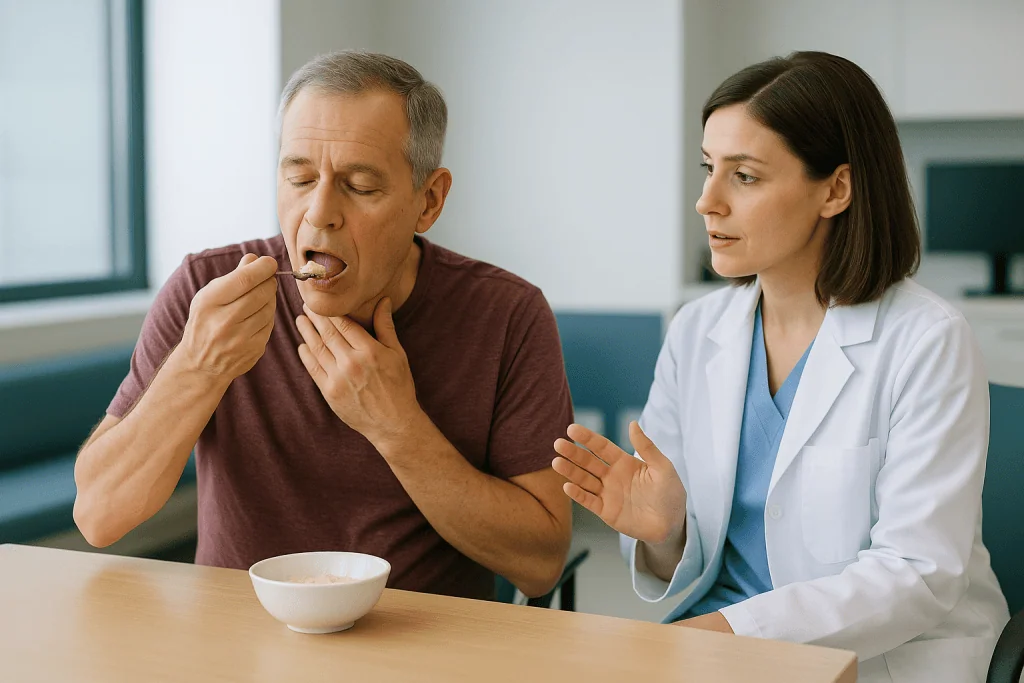
The coffee was the tell. Ten days after his stroke, a retired bus driver sat at a rehab-ward breakfast table and took the sip he had taken every morning for fifty years. It went down the wrong way. He coughed, his eyes watered, and a nurse quietly swapped the cup for a small spoon and a bowl of something thickened. He asked the question almost everyone asks in that moment: is this permanent?
Often it is not, but the answer depends on why the swallow failed and on what happens next. What happens next, in most hospitals, is a referral for swallowing therapy exercises and a set of practical changes that can feel oddly humbling: pureed vegetables, thickened tea, a reminder to sit up straight.
This explainer walks through what that program actually involves, what the evidence supports, where it is honest about uncertainty, and how to tell when a swallowing problem needs urgent attention rather than patience.
How does swallowing normally work, and where does it break down?
A single swallow recruits around 30 pairs of muscles and several cranial nerves in less than a second. It helps to picture three stages. In the oral stage, the lips seal, the tongue shapes food into a soft ball and pushes it back. In the pharyngeal stage, the soft palate lifts, the voice box rises and tips forward, and a small flap called the epiglottis folds over the airway while the muscles of the throat squeeze downward. In the esophageal stage, the tube to the stomach carries the food the rest of the way with a wave of contractions.
Dysphagia, the medical word for difficulty swallowing, means one or more of those steps is slow, weak or badly timed. Weak lips let liquid dribble. A sluggish tongue leaves residue in the cheeks. A throat that squeezes late lets food pool above a closed esophagus, where it can spill toward the airway when the person breathes in.
That spill is aspiration: food, drink or saliva entering the airway below the vocal cords. Some aspiration produces a dramatic cough, which is protective. Some produces nothing at all. Clinicians call this silent aspiration, and it is one reason a bedside impression is not the same as a diagnosis; the person who never coughs may still be inhaling small amounts at every meal, which raises the risk of aspiration pneumonia, a lung infection caused by inhaled material.
The NIH’s National Institute on Deafness and Other Communication Disorders estimates that roughly one in 25 adults experiences a swallowing problem each year, so this is not rare. Understanding which stage is failing is the whole point of assessment, because the exercises, textures and positions that follow are chosen to match the specific weak link, not dysphagia in general.
What actually happens in swallowing rehabilitation?
Rehabilitation begins with looking, not exercising. A speech-language pathologist, the clinician trained in swallowing as well as speech, usually starts with a clinical swallow evaluation at the bedside or in clinic. They watch the lips, tongue and voice box, listen to the voice before and after sips, feel the throat during a swallow and trial small amounts of different textures.

When the picture is unclear or aspiration is suspected, an instrumental study follows. A videofluoroscopic swallow study, sometimes called a modified barium swallow, is a moving X-ray taken while the person swallows food and drink mixed with barium so the path shows on screen. A fiberoptic endoscopic evaluation of swallowing passes a thin flexible camera through the nose to view the throat directly during real swallows. Both tests, described by Mayo Clinic and the NHS as standard tools, reveal timing, residue and whether material reaches the airway.
Only then does the plan take shape, and it typically rests on three pillars:
- Rehabilitative exercises aimed at changing the muscles and their nerve control over time.
- Compensatory strategies, including texture changes and postures, that make swallowing safer today without necessarily changing the underlying swallow.
- Education and monitoring, so the person and their family know what to watch for and when the plan should be revisited.
Sessions may happen daily on a stroke or rehabilitation ward, weekly in outpatient clinics, or partly by video with a home program in between. The therapist reassesses at intervals, sometimes with a repeat instrumental study, and adjusts the textures and exercises as the swallow changes. Dietitians, nurses, physicians and sometimes dentists join in, because nutrition, hydration, medicines and oral health all affect how safely a person eats. No single step is fixed; each is a decision the treating team makes with the patient and revisits.
Who is swallowing therapy usually for, and who is asked to wait?
The largest group is people recovering from stroke. The American Stroke Association describes swallowing difficulty as one of the most common early effects of stroke, and most stroke units screen swallowing before the first oral intake for exactly that reason. Other common referrals include people treated for head and neck cancer, where surgery or radiation can stiffen or weaken throat tissues; people with progressive neurological conditions such as Parkinson’s disease, multiple sclerosis or motor neuron disease; people with dementia; and older adults whose swallowing muscles have simply lost some strength and speed, a change sometimes called presbyphagia.
People who have spent time on a breathing tube in intensive care, or who have had prolonged illness and lost muscle mass, are also frequently referred. So are those with certain structural problems, although here therapy often runs alongside other treatments rather than replacing them.
Some people are asked to wait. Someone who is drowsy, medically unstable or unable to sit up is usually not a candidate for oral trials until they can stay alert through a meal, because attention and posture are part of a safe swallow. When an instrumental study shows large, uncontrolled aspiration, the team may pause oral intake while exercises continue without food, a distinction explained later. Where the cause is a narrowing of the esophagus, a tumor or severe reflux disease, the first step is treating that cause; the NHS notes that dysphagia arising in the esophagus is often managed with procedures or medicines rather than exercises alone.
For progressive conditions the goal is framed differently. Rather than restoring a lost swallow, therapy aims to preserve function, delay decline and keep eating as safe and enjoyable as possible for as long as possible. Who fits which category, and when the timing is right, is a judgment the treating team makes after assessment; it is not something to self-assign from a symptom list.
Which swallowing therapy exercises do therapists use most often?
Most programs draw from a fairly small menu of well-described maneuvers, each targeting a specific weak link found on assessment. The table below explains the common ones in plain language. A therapist chooses, teaches and sets the repetitions; none of these should be self-started from a description, because several are unsuitable for particular problems or medical conditions.
| Exercise or maneuver | What it targets | How it works in plain terms |
|---|---|---|
| Effortful swallow | Tongue base and throat squeeze | Swallowing as hard as possible, imagining a large pill, to clear residue more completely |
| Mendelsohn maneuver | Voice-box lift and opening of the upper esophagus | Holding the voice box at its highest point mid-swallow for a moment before letting go |
| Supraglottic swallow | Airway protection timing | Holding the breath, swallowing, then coughing before breathing in to expel anything near the airway |
| Head-lift (Shaker) exercise | Muscles that pull the voice box forward | Lying flat and lifting only the head to look at the toes, in timed holds and repetitions |
| Tongue-hold (Masako) maneuver | Back wall of the throat | Swallowing saliva with the tongue tip held gently between the front teeth |
| Lingual resistance | Tongue strength | Pressing the tongue upward or forward against a spoon, a device or the roof of the mouth |
| Chin tuck against resistance | Front-of-neck muscles | Pressing the chin down onto a soft ball or the fist and holding |
| Expiratory muscle strength training | Breath support and cough | Blowing forcefully into a small handheld device that resists the airflow |
| Lip and jaw exercises | Oral seal and chewing | Puckering, pressing lips together against resistance, sustained jaw opening |
Two ideas sit behind all of them. The first is the ordinary principle of strength training: muscles adapt when asked to work harder than usual, repeatedly, over weeks. The second is skill training: swallowing is a coordinated sequence, and rehearsing the sequence with attention, and often with feedback from a therapist’s hand on the throat or a screen showing muscle activity, can sharpen timing as well as force. Some exercises are done with saliva only, others with carefully chosen textures, and that choice is itself part of the prescription.
How to strengthen swallowing muscles safely at home
Most of the work in swallowing rehabilitation happens between appointments, which is why the home program matters as much as the clinic session. A few principles, all consistent with guidance from the NHS and Mayo Clinic on dysphagia treatment, separate useful practice from risky improvisation.
Follow the written plan exactly. The therapist has matched each exercise to a finding on your assessment, decided whether it is done with saliva, with a specific texture or with nothing at all, and set the count. Doing more than prescribed does not speed strengthening and can leave muscles too fatigued to protect the airway at the next meal.
Keep exercise and eating separate unless told otherwise. Several maneuvers, including the tongue-hold and head-lift, are never performed with food or drink in the mouth. Others, like the effortful swallow or chin tuck, may be prescribed both as practice and as a strategy to use during meals; the plan should say which.
Watch for the wrong kind of fatigue. Mild muscle tiredness in the tongue or neck after a set is expected. Dizziness, chest pain, breathlessness or a headache during breath-hold maneuvers is not, and anyone with heart disease, uncontrolled blood pressure or a recent neck or spine problem should already have flagged this to their team, because some exercises are modified or avoided in those situations.
Build a routine rather than a marathon. Short sets spread across the day are easier to sustain than one long session. A simple log, ticking off sets and noting any coughing, voice change or pain, gives the therapist real information at review.
Finally, resist the temptation to add exercises from videos or forums. An exercise that strengthens the front-of-neck muscles helps someone whose upper esophagus opens poorly and does nothing for someone whose problem is a weak tongue. Strengthening the wrong thing wastes weeks; practicing the wrong technique with food can cause harm.
Why texture changes are part of swallowing therapy, and what the levels mean
Modified textures are the part of rehabilitation people like least and misunderstand most. The logic is mechanical. Thin liquids move fast and split into unpredictable streams, so a throat that closes late lets them slip toward the airway. Hard, crumbly or mixed-consistency foods (soup with chunks, cereal in milk) demand precise control the weak swallow may not have. Softer, more cohesive textures travel as a single mass at a speed the impaired swallow can handle.
Most services now describe textures using the International Dysphagia Diet Standardisation Initiative framework, a common set of definitions with eight levels so that a term means the same in every kitchen and ward. Drinks range from thin through slightly, mildly, moderately and extremely thick. Foods run from liquidized through pureed, minced and moist, soft and bite-sized, up to regular. Simple tests, such as how a liquid flows through a syringe or whether a fork can press a food apart, define each level.
Thickened drinks, made with a commercial thickening powder or gel, slow the liquid so the swallow has time to organize. They are widely used, but the evidence is more mixed than people expect. Thickened fluids reduce the amount reaching the airway on X-ray studies, yet they leave more residue in the throat, many people drink less of them and dehydration becomes a real concern. The NHS and Mayo Clinic present texture modification as a compensatory measure, a safety net while the swallow recovers or as a long-term adjustment when it will not, not as a treatment that strengthens anything.
That distinction shapes good practice. Textures should be the least restrictive level shown to be safe on assessment, reviewed regularly, and stepped up as exercises take effect. A dietitian usually monitors weight and fluid intake alongside, because a diet that is safe but not eaten is not safe at all. Presentation matters too: pureed food shaped and seasoned well is eaten; gray mounds are pushed away.
Safe eating positions and compensatory swallowing strategies
Positioning is the cheapest intervention in dysphagia care and one of the most consistently recommended. The Cleveland Clinic and NHS both advise sitting fully upright, ideally at 90 degrees with the feet supported and the head level, for every meal, drink and mouthful of medicine. Gravity then works with the swallow rather than pulling material toward the airway, and the throat muscles have the mechanical advantage they evolved for. Eating slumped in bed or reclined in an armchair undoes much of the benefit of everything else.
Beyond upright sitting, therapists prescribe specific postures that redirect the flow of food, each matched to a finding on the swallow study:
- Chin tuck: lowering the chin toward the chest narrows the airway entrance and widens the space behind the tongue, useful when the swallow triggers late. It is not right for everyone; in some people it worsens residue.
- Head turn: turning toward the weaker side closes that side of the throat and steers food down the stronger side, used after some strokes and head and neck surgeries.
- Head tilt: tilting toward the stronger side uses gravity to favor it.
Alongside posture come techniques for the mouthful itself: small sips and bites, one at a time; swallowing twice to clear residue; a gentle cough or throat clear after every few swallows; alternating solids with sips of an approved liquid to wash residue through. Straws are often discouraged because they deliver liquid fast and far back, although a therapist may specifically allow or even recommend one in certain patterns.
Two habits round out the picture. Stay upright for a while after eating, which several clinical sources recommend to reduce reflux and late aspiration of residue. And keep the mouth clean: good oral hygiene lowers the bacterial load in saliva, and since some aspiration is inevitable in many people with dysphagia, cleaner saliva means a lower risk that aspiration turns into pneumonia. Meals should also be unhurried, in a quiet setting, with the person alert; conversation and television can wait.
How long does it take to strengthen swallowing muscles?
This is the question behind most of the others, and the honest answer has two parts: a general principle and a wide individual range.
The principle comes from exercise physiology. Muscles gain strength in two phases. The first, over the initial days to a couple of weeks, is mostly neural: the nervous system learns to recruit more fibers and coordinate them better. Genuine growth of muscle fibers follows over subsequent weeks. Swallowing muscles are small but obey the same rules, so most structured programs described in the research literature run for several weeks before a formal re-evaluation, and therapists commonly reassess with a repeat instrumental study around that point rather than expecting change in a few days.
The individual range depends on the cause. After stroke, the NHS describes swallowing problems as often improving over weeks to months as the brain recovers, and a share of people regain a normal or near-normal swallow with therapy; others are left with a lasting but manageable change. After head and neck cancer treatment, radiation can keep altering tissues for a long time, so therapy may continue in phases and gains can be slower. In progressive neurological disease the goal is to hold ground, and success is measured by stability and safety rather than by returning to baseline.
Age, nutrition, general fitness, other illnesses, how consistently the home program is done and how quickly therapy started all shift the timeline. None of these can be turned into a promise for one person, and a clinician who declines to give a date is being accurate, not evasive.
What can be said is that improvement is rarely linear. People often notice a week or two of little change and then a step forward, such as tolerating a thinner liquid or finishing a meal without fatigue. Tracking small functional markers, rather than waiting for a single moment of being fixed, is both more realistic and more motivating.
Can you regain the ability to swallow? What the evidence shows
Many people do, particularly when the cause is a single event such as a stroke, a period of critical illness or a surgical recovery. The mechanism is neuroplasticity, the brain’s capacity to reorganize control of a function around damaged tissue. Repeated, effortful, attentive practice is the signal that drives that reorganization, which is why swallowing therapy exercises emphasize intensity and focus rather than casual repetition.
The evidence is genuinely encouraging but should be graded honestly. Reviews of exercise-based swallowing therapy after stroke find improvements in swallow physiology and in the textures people can safely manage, with lower rates of chest infection in some studies, though trials vary in size and in the exact programs used. Several individual maneuvers have good physiological evidence, meaning they demonstrably change what the swallow looks like on X-ray in the moment, and more modest evidence that those changes translate into long-term recovery. The Cleveland Clinic and NHS both frame therapy as effective for many people while noting that outcomes depend on the underlying cause.
Some causes respond differently. When the problem is structural, such as a narrowing of the esophagus, a pouch, or a tumor, exercises cannot fix it; procedures or medical treatment address the cause, and therapy plays a supporting role. When the disease is progressive, the honest framing is preservation. And when dysphagia is caused by a medication effect or by dry mouth, the fix may sit with the prescribing clinician reviewing the treatment plan rather than with the therapist at all.
What the evidence does not support is the idea of a single best therapy. Programs that combine targeted exercises, appropriately chosen textures, positioning and good oral care outperform any one element alone, because they address both the swallow itself and the safety of eating while it recovers. Anyone offered a single technique as the answer for everyone should ask what the assessment showed.
What the following weeks of swallowing rehab usually look like
Timelines differ, but the shape of a typical program is recognizable enough to describe, with the caveat that the treating team sets the pace.
The first days are about assessment and immediate safety. A clinical evaluation, often followed by an instrumental study, establishes the safest starting textures and positions. If oral intake is not yet safe, nutrition and hydration are provided another way while exercises begin without food. Family members are shown the positioning and the mealtime rules, because they will supervise many of the meals.
Across the next few weeks the exercise program is the main event. Sessions with the therapist check technique and progress the difficulty; the home program carries the volume. Small texture upgrades may be trialed under supervision as the swallow changes, such as moving from pureed to minced and moist food, or from a moderately thick drink to a mildly thick one. Weight, fluid intake and any chest symptoms are monitored in parallel.
A formal reassessment usually follows, often with a repeat videofluoroscopy or endoscopic study, and the findings decide the next phase: continued strengthening, a step up in textures, a change of exercises or, in some cases, acceptance that the current level is the safe long-term plan. This is also the point where a feeding tube placed early may be reconsidered if oral intake is meeting needs.
Discharge from active therapy does not mean the end. Most people leave with a maintenance program, written guidance on textures and positions, and clear instructions on the warning signs that should trigger a return. For those living with a progressive condition, review appointments continue at intervals, with the plan adjusted as the disease evolves. Throughout, the milestones that matter are functional ones: a full meal eaten comfortably, a favorite drink tolerated again, a month without a chest infection.
What people often get wrong about dysphagia exercises for adults
Misunderstandings about swallowing rehabilitation are common, and some of them cause harm. A few deserve direct correction.
“You can reverse dysphagia naturally with home remedies.” There is no reliable evidence that honey, herbal teas, throat sprays or supplements restore a weak swallow, and some homemade approaches, such as swallowing ice or thin liquids to practice, can cause aspiration. Exercises done with the body’s own muscles are, in a sense, the most natural treatment available; the difference is that they are targeted, taught and monitored.
“No cough means no aspiration.” Silent aspiration is well documented and is precisely why instrumental studies exist. Absence of coughing is reassuring only when a study has confirmed the airway is protected.
“Thickened drinks fix the problem.” They compensate for it. They do not strengthen anything, they can reduce fluid intake and they should be reviewed regularly rather than continued indefinitely by default.
“More repetitions mean faster recovery.” Overworked swallowing muscles are less able to protect the airway at the next meal. The prescribed count balances training load against safety.
“Practice while eating.” Several maneuvers are never done with food. The plan states which techniques are exercises and which are mealtime strategies, and the two are not interchangeable.
“Pureed food is baby food, and a feeding tube means failure.” Pureed food is a texture level, not a judgment, and it can be well seasoned and appetizing. A feeding tube, whether short-term through the nose or longer-term through the abdominal wall, is a way of keeping a person nourished and hydrated so they have the strength to rehabilitate; many people continue exercises and return to eating while a tube is in place.
“Every swallowing problem is the same.” An exercise that helps one pattern can be useless or unsafe for another, which is why copying a program from someone else, or from a search result, is a poor idea.
Risks, alternatives and where feeding tubes fit in
Swallowing therapy is low risk, but it is not risk-free, and a fair explainer should say so. Breath-hold maneuvers can raise blood pressure and are usually modified or avoided in people with certain heart conditions. The head-lift exercise strains the neck and is unsuitable for some people with cervical spine problems. Exercises done with food carry a small aspiration risk if technique lapses, which is why they begin under supervision. Texture modification carries the quieter risks already described: dehydration, weight loss and a loss of enjoyment that can erode appetite.
Alternatives and adjuncts exist, and their evidence varies. Neuromuscular electrical stimulation applies surface electrodes to the neck to contract muscles during exercise; studies are mixed, and mainstream sources describe it as an adjunct under investigation rather than a standalone treatment. Biofeedback, using a screen that shows muscle activity or tongue pressure, has reasonable evidence for improving how well people learn techniques. Pharyngeal electrical stimulation and newer brain stimulation approaches remain largely within research settings. Where the problem is structural, endoscopic dilation, which gently stretches a narrowed esophagus, or surgery may be the primary treatment, with therapy supporting recovery, as the NHS describes for esophageal causes.
Medicines rarely treat dysphagia directly, but they matter around its edges. Drugs that reduce stomach acid may be used when reflux is inflaming the esophagus; those that dry the mouth or dull alertness can worsen swallowing, and a review by the prescribing clinician sometimes helps. Any such change is that clinician’s decision.
Feeding tubes deserve a plain description. A nasogastric tube passes through the nose into the stomach and is typically used for days to weeks. A gastrostomy tube is placed through the abdominal wall directly into the stomach for longer-term needs. Both maintain nutrition and hydration and can be removed when oral intake is safe and sufficient. Whether, when and for how long to use one is a decision made by the treating team with the patient and family, weighing the person’s overall condition and goals, not a verdict on how hard anyone has tried.
Questions to ask your care team
A swallowing assessment produces a lot of information in a short time, and much of it is technical. Bringing a short list of questions, and asking for a written copy of the plan, turns a confusing conversation into one you can act on. The following are the questions therapists most often wish people had asked.
- Which stage of my swallow is affected, and what exactly did the study show reaching or nearly reaching my airway?
- Which of my exercises are meant to strengthen the swallow, and which are strategies to use only during meals?
- Are any of my exercises done with food or drink, and if so, with which texture?
- What texture level am I on for food and for drinks, and what is the plan for reviewing it?
- How will I know the exercises are working, and when is my next formal reassessment?
- Which posture am I meant to use, and is a chin tuck right for my pattern or not?
- Are there exercises I should avoid because of my heart, blood pressure, neck or breathing?
- How should I take my tablets, and does anything need to be reviewed by the prescriber because it affects swallowing or alertness?
- Who monitors my weight and fluid intake, and what should I do if I notice I am drinking less?
- What signs mean I should stop, ring the team or seek urgent help?
- If I need a feeding tube, is it expected to be temporary, and can I keep doing exercises and eating with it in place?
- Is there a maintenance plan after active therapy ends, and how do I re-refer if things change?
Write the answers down or ask a family member to. A good team will welcome the questions; they are the ones that make the home program work.
When to call your doctor: red-flag signs during swallowing rehab
Most of swallowing rehabilitation happens at home, so knowing the difference between an expected rough day and a genuine warning matters. Sources including the NHS, Mayo Clinic and MedlinePlus agree on the signs that should prompt contact with the treating team promptly, and a smaller set that means emergency care.
Contact your doctor or therapist the same day if you notice a fever, a new or worsening cough, chest discomfort or breathlessness, particularly after meals, because these can signal aspiration pneumonia. The same applies to a voice that sounds wet or gurgly after eating, repeated coughing or choking with textures that were previously fine, food regularly feeling stuck in the throat or chest, unexplained weight loss, signs of dehydration such as dark urine, dizziness or confusion, or a meal pattern that has quietly shrunk because eating has become exhausting or frightening.
Seek emergency care immediately if someone cannot breathe or speak because something is blocking the airway, if they are unable to swallow their own saliva and are drooling continuously, if food or a tablet is completely lodged and will not pass, if there is sudden severe chest pain, or if they become blue around the lips, confused or very drowsy. New swallowing difficulty appearing suddenly alongside facial drooping, arm weakness or slurred speech is a possible stroke and also needs emergency services.
Not every setback is an emergency. A single cough on a drink, mild neck-muscle tiredness after exercises or a day of lower appetite during an unrelated illness can simply be noted in your log and raised at the next review. The team will tell you which of your own symptoms count as red flags given your particular pattern, and those instructions should take precedence over any general list. When in doubt, call; swallowing problems are far easier to manage early than after a chest infection has taken hold.
Frequently asked questions
What is the best therapy for swallowing?
There is no single best therapy; the most effective approach combines targeted exercises chosen after a swallow study, appropriate texture changes and positioning, and good oral care. Programs that address both the swallow itself and the safety of eating while it recovers perform better than any one element alone. Which exercises suit you depends entirely on which stage of swallowing is weak.
Can you regain the ability to swallow after losing it?
Often, yes, particularly when the cause was a single event such as a stroke, critical illness or surgery. The brain can reorganize control of swallowing through repeated, effortful practice, and the NHS describes stroke-related dysphagia as frequently improving over weeks to months. Recovery is less predictable in progressive conditions, where the aim shifts to preserving safe eating for as long as possible.
How long does it take to strengthen swallowing muscles?
Muscles strengthen over weeks, not days, and most structured swallowing programs run for several weeks before a formal reassessment. Early gains come from better nerve coordination; muscle growth follows. Individual timelines vary widely with the cause, age, nutrition and consistency of practice, so clinicians usually track functional milestones rather than promising a date.
How can I reverse dysphagia naturally?
No home remedy, herb or supplement has reliable evidence for restoring a weak swallow, and practicing with thin liquids or ice at home can cause aspiration. The most natural effective treatment is targeted exercise of your own swallowing muscles, taught and monitored by a speech-language pathologist. Good posture, oral hygiene and adequate nutrition support that work.
Are swallowing exercises after stroke started right away?
Most stroke units screen swallowing before any oral intake and refer for assessment early, often within the first days. Exercises without food can begin as soon as the person is alert and stable enough to participate; trials with food or drink wait until an assessment shows a safe texture. The treating team decides the timing based on alertness, medical stability and study findings.
What does a speech-language pathologist do for swallowing?
A speech-language pathologist assesses the swallow at the bedside and through instrumental studies, identifies which stage is failing, prescribes and teaches exercises and mealtime strategies, recommends texture levels, monitors progress and works with dietitians, nurses and physicians on nutrition and safety. They are the clinicians trained specifically in swallowing as well as speech.
Are dysphagia exercises for adults done with food in the mouth?
Some are and some never are. Maneuvers such as the tongue-hold and head-lift are performed with saliva only or with nothing in the mouth. Others, like the effortful swallow or chin tuck, may be prescribed both as dry practice and as a strategy during meals. Your written plan should state which, and food-based practice begins under supervision.
Will I need thickened drinks forever?
Not necessarily. Thickened drinks are a compensation, not a treatment, used while the swallow recovers or as a long-term adjustment when it will not. They should be the least restrictive level shown safe on assessment and reviewed regularly, because many people drink less when fluids are thickened. Reassessment often allows a step to thinner levels as exercises take effect.
Is the chin tuck position right for everyone with dysphagia?
No. Tucking the chin helps when the swallow triggers late by narrowing the airway entrance, but in some patterns it increases residue in the throat and can make things worse. Postures such as chin tuck, head turn or head tilt are prescribed to match findings on a swallow study, which is why they should not be adopted from general advice alone.
What do the dysphagia texture levels mean?
Most services use the International Dysphagia Diet Standardisation Initiative framework, which defines eight levels from thin liquids through increasingly thick drinks to liquidized, pureed, minced and moist, soft and bite-sized, and regular foods. Each level has simple flow or fork tests so a term means the same in every kitchen. Your therapist assigns levels for drinks and foods separately.
References
- NHS: Dysphagia (swallowing problems), treatment
- NIH NIDCD: Dysphagia
- MedlinePlus: Swallowing disorders
This article is for general information only and is not a substitute for professional medical advice. Please consult a qualified doctor about your individual situation.

More from the Blog

Before Your First Vestibular Rehabilitation Visit: Symptom Diary, Hearing Tests and Medicines
Before a vestibular rehabilitation first appointment, most teams ask for three things: a short symptom diary recording when dizziness happens, how long it lasts…

Skin Checks and Pressure Relief After Spinal Cord Injury Rehabilitation: A Daily Routine
Pressure sore prevention after spinal cord injury rests on a daily routine: inspect skin over bony areas at least once or twice a day,…

What a Pulmonary Rehabilitation Session Involves: Exercise, Breathing Training and Education
Pulmonary rehabilitation is a supervised program for people with chronic lung disease that combines exercise training, breathing techniques and education. A typical session includes…

Daily Life After Vision Rehabilitation: Practicing Contrast Strategies and Orientation Skills
Living with low vision after rehabilitation works best when contrast and orientation skills become daily habits: use dark-on-light or light-on-dark pairings for food, stairs,…

Shockwave Therapy for Plantar Fasciitis: What the Trials Show
Shockwave therapy shows moderate evidence of benefit for chronic plantar fasciitis. Randomized trials and meta-analyses find it relieves heel pain better than sham treatment…

Inside a Bobath Treatment Session: Guided Handling, Positioning and Task Practice
A Bobath therapy session is a hands-on neurological rehabilitation appointment, usually with a physiotherapist or occupational therapist, in which the therapist guides your movement,…