

Sinus Lift: Why Upper-Jaw Implants Sometimes Need It, and How It Heals
Key Takeaways
- The sinus membrane being lifted is typically well under a millimeter thick, thinner than a business card, which is why the no-nose-blowing rule matters for weeks after surgery.
- After an upper molar is lost, bone gets squeezed from two directions: the ridge shrinks from below while the sinus expands downward, a process called pneumatization.
- Membrane tears occur in roughly 10–25% of sinus lifts, but most are small, patched during the same surgery, and do not compromise the final result.
- A lateral-window graft usually needs four to nine months to mature before an implant is placed, while a crestal lift often allows same-day implant placement.
- Long-term studies report implant survival around 90% or higher in grafted sinuses, comparable to implants placed in natural bone.
- Swelling peaks around 48–72 hours and then recedes; pain that worsens after day three breaks the normal healing curve and warrants a call to your surgeon.
A sinus lift is a surgical procedure that adds bone between the upper jaw and the maxillary sinus so a dental implant has enough support. The surgeon gently raises the thin sinus membrane and places grafting material beneath it, which matures into solid bone over roughly four to nine months. It is typically needed when missing back-upper teeth have left the jawbone too thin for an implant.
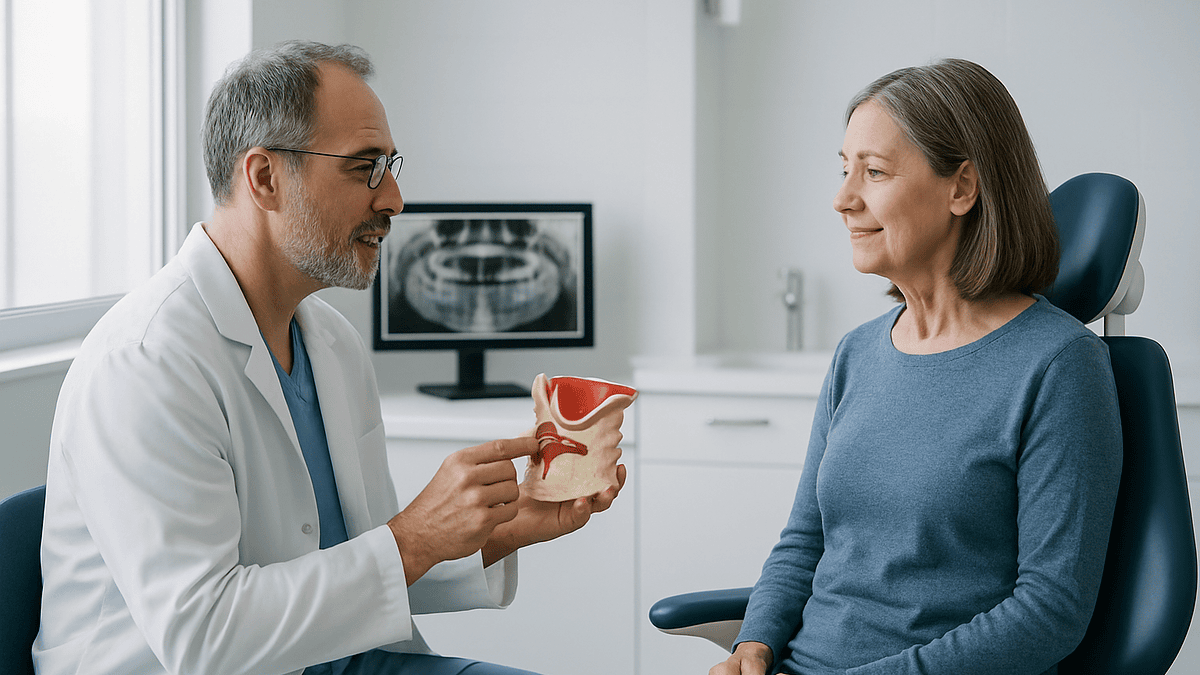
The moment usually arrives in front of a panoramic X-ray. The dentist traces a shadowy dome above the spot where a molar used to be and says something like, “You have plenty of sinus here, and not quite enough bone.” For a lot of people, that is the first time they learn their upper jaw shares a wall with an air-filled cavity the size of a walnut.
It sounds alarming. It usually is not. Grafting bone under the sinus floor has been a routine part of implant dentistry since the 1980s, and the long-term data on it are genuinely reassuring. The catch is that the procedure comes with a healing timeline measured in months, a short list of odd rules, no nose blowing, sneeze with your mouth open, and enough confusing terminology to fill a second appointment.
Here is what the evidence actually says about why the upper jaw runs out of room, what the surgery involves, how it feels, and what happens under the surface while you wait.
What is a sinus lift, exactly?
A sinus lift, surgeons call it sinus augmentation or a maxillary sinus floor elevation, is a bone graft with an unusual location. Instead of building bone outward or across a gap, the surgeon builds it upward, into space currently occupied by the bottom of your maxillary sinus.
The sinus itself is lined with a delicate membrane, and that membrane is the whole game. During the procedure, the surgeon creates a small access point in the bone, eases the membrane upward the way you might lift a wet sticker without tearing it, and packs grafting material into the pocket underneath. The membrane stays intact above the graft; the sinus simply becomes slightly smaller, which has no meaningful effect on breathing or sinus function, according to Cleveland Clinic.
Over the following months, your body treats the graft as scaffolding. Blood vessels grow into it, bone-forming cells migrate through it, and the particles are gradually replaced or fused with your own living bone. Once that new bone is dense enough, confirmed with imaging, it can hold a titanium implant as securely as the jaw did before the tooth was lost.
Two things a sinus lift is not: it is not sinus surgery in the ear-nose-throat sense, and it is not the implant itself. Think of it as pouring the foundation before the post goes in. Sometimes both happen the same day; often they are separated by several months, and that spacing is deliberate.
Meet your maxillary sinus, the neighbor upstairs
You have four pairs of paranasal sinuses, and the maxillary pair is the largest, two pyramid-shaped air pockets sitting inside the cheekbones, one on each side of the nose. Their floors rest directly above the roots of your upper premolars and molars. In some people, molar roots actually bulge into the sinus floor, separated from the air space by a millimeter or two of bone.
The lining of each sinus, often called the Schneiderian membrane, is remarkably thin, typically well under a millimeter, thinner than a business card in many people. It produces mucus, sweeps it toward the nose with microscopic cilia, and does not appreciate being poked. Its fragility explains almost every precaution your surgeon will give you, from the gentle instruments used during the lift to the no-nose-blowing rule afterward.
Why does this anatomy matter for implants? A standard implant needs a certain depth of solid bone to anchor into, commonly around 10 millimeters. In the front of the mouth, that is rarely a problem. In the back of the upper jaw, the sinus caps the available height like a low ceiling. When the ceiling sits too close to the ridge, drilling an implant to full depth would punch straight into the air space.
So the surgeon raises the ceiling. That is the entire logic of the procedure, and it is why sinus lifts are almost exclusively an upper-back-jaw issue. Lower-jaw implants contend with a nerve canal instead: a different problem with different solutions.
Why does the upper jaw lose bone after a tooth comes out?
Bone is not a fixed structure; it is living tissue on a use-it-or-lose-it budget. Tooth roots transmit chewing forces into the jaw thousands of times a day, and those forces signal the bone to keep renewing itself. Remove the tooth, and the signal stops. Research on ridge changes consistently shows the most dramatic shrinkage in the first year after extraction, with bone width losing as much as a quarter of its dimension before the pace slows.
The upper back jaw gets squeezed from two directions at once:
- From below: the ridge resorbs downward and inward once the molar is gone, because nothing is loading it.
- From above: the sinus expands into the vacated space, a process called pneumatization. Without a tooth root pushing back, the sinus floor gradually drops.
Wait long enough, years, sometimes just a couple, and the bone that once measured 10 or 12 millimeters tall can dwindle to 3 or 4. Gum disease, which is a leading cause of adult tooth loss in the first place, often destroys bone before the tooth ever comes out, so some people start the clock already behind.
This is why timing matters more than most people realize. A person who replaces a molar within months of losing it may need no grafting at all. The same person, five years later, may need a full lateral-window lift for the same tooth. Neither situation is a personal failing, bone loss here is biology, not neglect, but earlier planning genuinely keeps options open.
Who needs a sinus lift, and who can skip it?
The deciding factor is a single measurement: how many millimeters of bone remain between the crest of your ridge and the sinus floor. A cone-beam CT scan, a low-dose 3D image taken in the dental office, gives the answer within a fraction of a millimeter, along with a preview of your sinus health and membrane thickness.
As a rough guide used across implant dentistry:
- Around 10 mm or more: a standard implant fits in native bone. No lift needed.
- Roughly 5 to 8 mm: often a candidate for a smaller, internal lift performed through the implant site itself, sometimes with the implant placed the same day.
- Under about 4 to 5 mm: usually calls for the larger lateral-window approach, with months of graft healing before the implant goes in.
Bone height is not the only consideration. Active sinus infections need treatment first, grafting into an inflamed sinus invites trouble. Uncontrolled diabetes slows bone healing. Smoking is a significant risk factor for graft complications and implant failure, and many surgeons ask patients to stop well before surgery. None of these automatically rules out the procedure, but each one changes the conversation, and an honest surgeon will have it with you before quoting a plan.
People considering multiple upper-back implants, or an implant-supported denture, are the most frequent candidates, simply because those plans depend on exactly the region where bone runs thin.
Lateral window or crestal approach? The two techniques compared
Surgeons reach the sinus floor by one of two routes, and which one you get is determined mostly by how much bone you have left, not by preference or price.
The lateral window technique is the classic version. Working through the gum on the cheek side, the surgeon outlines a small oval window in the thin outer wall of the sinus, hinges or removes that bony panel, lifts the membrane under direct vision, and fills the space with graft. It handles severe bone loss and large lifts, at the cost of a bigger surgical site and more swelling.
The crestal (or transcrestal) technique works through the future implant channel itself. The surgeon stops the drill just shy of the sinus floor, then uses hand instruments or hydraulic pressure to nudge the floor and membrane upward a few millimeters, feeding graft material through the same narrow tunnel. It is gentler and faster, but blind, the surgeon cannot see the membrane, and it only gains modest height.
| Lateral window | Crestal approach | |
|---|---|---|
| Typical remaining bone | Under ~4–5 mm | About 5–8 mm |
| Height gained | Often 5–10+ mm | Usually 2–5 mm |
| Implant placed same day? | Sometimes; often delayed 4–9 months | Frequently yes |
| Swelling and downtime | More; peaks at 2–3 days | Minimal for many patients |
| Surgeon’s view of membrane | Direct | Indirect (by feel and imaging) |
Neither approach is “better” in the abstract. The right one is the one matched to your scan.
What actually happens during the procedure, step by step
Most sinus lifts happen in a dental chair under local anesthesia, sometimes with oral or IV sedation for comfort. Plan on 45 minutes to two hours depending on the technique and whether one or both sides are treated.
For a lateral-window lift, the sequence runs like this. After the area is fully numb, the surgeon makes an incision along the gum and folds it back to expose the side wall of the sinus, bone about as thick as an eggshell in that spot. A round bur or ultrasonic tip traces the window. Then comes the most delicate minute of the operation: blunt, curved instruments slide between bone and membrane, peeling the lining upward the way you would separate plastic wrap from dough. Modern ultrasonic (piezoelectric) instruments cut bone but tend to spare soft tissue, one reason perforation rates have improved.
With the membrane tented up, the surgeon packs graft granules into the new pocket, enough to create the planned bone height, sometimes covering the window with a dissolvable collagen sheet before stitching the gum closed. You will feel pressure and hear instruments; you should not feel pain.
Crestal lifts skip the window entirely. The lift happens through the implant channel with tapping or hydraulic pressure, and in many cases the implant itself goes in immediately, acting as a tent pole for the graft around it.
Either way, you walk out the same day with gauze, written instructions, and a follow-up scheduled within a week or two to check the incision.
What is the bone graft actually made of?
Patients often picture a solid block of bone being implanted. In reality, sinus grafts are usually granules, coarse, sand-like particles that pack into the lifted space and act as scaffolding for your own cells. Four material families are in common use, per Cleveland Clinic and the broader implant literature:
- Your own bone (autograft): harvested from elsewhere in the jaw or, rarely now, the hip. It brings living cells with it, but requires a second surgical site.
- Donor bone (allograft): processed, sterilized human bone from tissue banks, screened under strict federal standards.
- Animal-derived mineral (xenograft): most often the mineral framework of bovine bone with all organic material removed. It resorbs slowly, which helps the lifted space hold its shape.
- Synthetic materials (alloplasts): lab-made calcium-based ceramics and glasses that mimic bone mineral.
Surgeons frequently blend materials: a slow-resorbing mineral for structural stability mixed with material that encourages faster cell ingrowth. Head-to-head studies have not crowned a single winner; implant survival rates in grafted sinuses look strong across material types, which is why surgeon experience and case fit matter more than the label on the vial.
Whatever the material, the biology is the same. The graft itself is not the final product. It is a placeholder that your body remodels, over months, into vascularized bone that belongs to you.
How painful is a sinus lift, honestly?
Less than most people fear: that is the consistent picture from patient-reported outcome studies and from the major medical centers that describe the procedure. During surgery itself, local anesthesia means you feel pressure and vibration, not pain. The membrane has few pain fibers; the lifting sensation is strange rather than sharp.
The honest part comes afterward. Expect the first two to three days to feel like a moderately involved tooth extraction: a dull ache in the cheek and upper jaw, tenderness when chewing, and facial swelling that peaks around 48 to 72 hours before receding. Bruising along the cheek shows up in a minority of patients and fades within a week or two. A little pink-tinged fluid from the nose in the first day or two is common and expected.
Most people manage comfortably with the over-the-counter or prescribed pain-relief plan their surgeon recommends, cold compresses in the first 24 hours (15 minutes on, 15 off), and soft food. Many return to desk work within one to three days after a crestal lift, and within two to four days after a lateral-window procedure, though strenuous exercise waits longer, because raised blood pressure and straining stress the surgical site.
The trajectory matters more than the intensity. Discomfort that steadily eases from day two onward is normal healing. Pain that plateaus and then worsens after day three is not, and it deserves a phone call, more on that below.
The healing timeline: what your body is doing month by month
The visible recovery is short. The invisible one is where the outcome is decided.
Days 1–3: a blood clot forms throughout the graft, and inflammation, unpleasant but purposeful, recruits the cells that run the whole repair project. Swelling peaks and starts to fade.
Weeks 1–2: the gum incision seals. Stitches dissolve or come out at the follow-up visit. Most everyday restrictions lift, though sinus precautions typically continue for two to four weeks.
Weeks 2–8: capillaries grow into the graft from the surrounding bone walls, millimeter by millimeter. This is why graft height and the number of bony walls touching the graft influence healing speed, blood supply arrives from the edges inward.
Months 2–6: osteoblasts lay down woven bone, an immature, quickly built framework, threading through and around the graft particles. On an X-ray the graft slowly loses its granular look and starts reading as bone.
Months 4–9: woven bone remodels into lamellar bone: the organized, load-bearing kind. Somewhere in this window, guided by a follow-up scan, your surgeon declares the site ready. Crestal lifts with simultaneous implants sit at the short end; large lateral-window grafts sit at the long end.
After the implant is placed, add another two to six months for osseointegration, the implant fusing with the new bone, before the final crown. From first incision to finished tooth, a staged sinus lift commonly spans six to twelve months. Nobody loves that number, but rushing it is the most reliable way to end up doing everything twice.
The first two weeks: rules that protect the graft
Every instruction on the post-op sheet exists to protect one thing: the pressure balance across a membrane thinner than a business card, with fresh graft material sitting directly beneath it. Sudden pressure spikes, in either direction, can shift granules or open a tear.
- Do not blow your nose, typically for two to four weeks. Dab and wipe instead. This is the rule surgeons care about most.
- Sneeze with your mouth open. It feels undignified and vents the pressure harmlessly.
- Skip straws, and do not spit forcefully. Suction inside the mouth tugs on the healing site from below.
- No smoking or vaping. Beyond the pressure mechanics of inhaling, smoking constricts the very blood vessels the graft is waiting for; it is one of the strongest predictors of graft complications in the literature.
- Postpone flying and scuba diving for the window your surgeon specifies; cabin-pressure changes stress the sinus.
- Sleep with your head slightly elevated for the first few nights to ease swelling and congestion.
- Eat soft and chew on the other sidesoups, eggs, yogurt, well-cooked grains, for at least the first week.
Feeling a few tiny, gritty granules on your tongue or in a tissue during the first days can happen and is usually insignificant. A steady stream of particles from the nose is different: that suggests a membrane opening and warrants a call. Gentle saline nasal sprays are often encouraged; ask your surgeon what they want you using and for how long.
What is the downside of a sinus lift? The risks, plainly stated
Every surgery has a downside column, and pretending otherwise helps no one. For sinus lifts, the ledger looks like this.
Membrane perforation is the most common intraoperative complication, reported rates in the literature cluster roughly between 10% and 25%, higher when the membrane is unusually thin or scarred. Here is the reassuring part: most tears are small, and surgeons repair them on the spot with a dissolvable collagen patch, then proceed. Studies show small, repaired perforations usually do not doom the graft. A large tear may mean pausing the procedure and returning after the membrane heals, frustrating, but a delay rather than a disaster.
Sinus infection or sinusitis develops in a small minority of patients afterward, more likely in people with a history of chronic sinus trouble. It is treatable, but it needs prompt attention because infection threatens the graft.
Graft failurethe material failing to integrate, is uncommon in healthy non-smokers but real. Smoking, uncontrolled diabetes, and untreated sinus disease raise the odds substantially. A failed graft can often be redone after the site settles.
Other downsides are less dramatic but worth naming: cost (below), a total treatment timeline that can approach a year, temporary swelling and bruising, rare bleeding or benign fluid cysts in the sinus, and the small but nonzero chance of an oro-antral communication, a persistent opening between mouth and sinus, requiring further repair.
Weigh all of that against the alternative for many patients: no fixed tooth in that spot at all, or a removable option they did not want. For most candidates, the evidence supports the trade.
How much does a sinus lift cost, and why quotes vary so much
There is no single honest number, and any article that gives you one is guessing. In the United States, quotes commonly cited for a sinus lift range from roughly $1,500 to $5,000 or more per side, before the implant and crown are added, but the spread is wide for legitimate reasons.
What moves the price:
- Technique. A crestal lift adding a few millimeters is a smaller procedure than a lateral-window graft rebuilding a nearly empty ridge.
- Graft material and volume. Larger lifts consume more material, and some materials cost more than others.
- Imaging and sedation. Cone-beam CT scans, IV sedation, and follow-up imaging each add line items.
- One side or two. Bilateral lifts for full-arch plans roughly double the surgical scope.
- Geography and provider training, as with all dental surgery.
Insurance coverage is genuinely inconsistent. Many dental plans classify sinus lifts as part of implant treatment and exclude them; some medical plans contribute when bone loss stems from trauma or disease. The only reliable path is a written pre-treatment estimate submitted to your insurer before you commit.
One consumer-protection note that costs nothing: ask any quoting provider two questions. How many millimeters of bone do I have now, and which technique are you proposing? A quote unaccompanied by a 3D scan measurement is a quote built on air.
How long does a sinus lift last? What the success data show
Here is the good news buried under all the caveats: once a sinus graft matures into living bone, it behaves like living bone. It has its own blood supply, remodels normally, and, critically, is kept alive by the chewing forces the implant transmits into it. A successful sinus lift is not a part with an expiration date. For most patients it lasts as long as the implant does, which is often decades.
The numbers back this up. Long-term studies and systematic reviews of implants placed in grafted sinuses consistently report survival rates around 90% and frequently higher, in the same neighborhood as implants placed in native bone. That equivalence held up across graft materials in most comparative reviews, which is one of the more encouraging findings in implant dentistry.
What can shorten the graft’s life is largely the same list that threatens any implant:
- Peri-implantitis, the implant version of gum disease, which erodes supporting bone if plaque control slips and maintenance visits lapse.
- Smoking, which degrades outcomes at every stage, before and after healing.
- An unused site. If a graft heals but no implant is ever placed, the bone slowly resorbs again: the use-it-or-lose-it rule never stops applying.
The practical takeaway: the lift is durable, but it is durable in partnership with routine hygiene, professional cleanings, and actually completing the implant it was built for.
When to see a doctor: symptoms that should not wait
Normal healing follows a downhill curve, each day a little better than the last, with day two or three as the low point. Anything that breaks that curve deserves attention. Contact your oral surgeon or dentist promptly if you notice:
- Pain or swelling that worsens after day three instead of easing, or swelling that returns after it had begun to fade.
- Fever of 100.4°F (38°C) or higher, chills, or a general run-down feeling that develops after the first day.
- Bleeding that does not respond to 30 minutes of steady gauze pressure.
- Graft granules streaming from your nose, or the sensation of air or liquid passing between your mouth and nose, possible signs the membrane or incision has opened.
- Foul taste, bad-smelling discharge, or thick yellow-green nasal drainage on the treated side, which can signal a developing sinus infection.
- Stitches that loosen early with a visibly gaping incision.
Seek urgent care, not just a dental office message, for facial swelling that spreads toward the eye, difficulty swallowing or breathing, or vision changes. These are rare, but they are emergencies.
One more scenario people hesitate to report: congestion and facial pressure that linger beyond two weeks. Post-surgical sinusitis is treatable, and the NHS notes that sinus infections lasting more than a couple of weeks warrant medical review in any context. After a graft, the threshold for calling should be lower, not higher. Surgeons universally prefer a five-minute phone call about nothing over a delayed call about something.
Can you avoid a sinus lift? The honest alternatives
Sometimes, yes, and a good surgeon will tell you when. Several strategies can work around thin upper-back bone rather than rebuilding it.
- Short implants. Modern implants as short as 6 millimeters, sometimes less, have accumulated respectable survival data in carefully selected sites. When 6 to 8 millimeters of decent-quality bone remain, a short implant may sidestep grafting entirely.
- Tilted or angled implants. Placing implants at an angle lets them anchor in denser bone in front of the sinus. Full-arch restorations often use this geometry deliberately to avoid grafts.
- Zygomatic implants. Extra-long implants anchored in the cheekbone itself, reserved for severe bone loss and performed by surgeons with specific training. A significant procedure in its own right: an alternative, not a shortcut.
- A bridge or removable partial denture. No bone required, lower upfront cost, faster timeline. The trade-offs are real: bridges require reshaping neighboring teeth, and neither option stops the underlying bone loss the way a loaded implant does.
- Doing nothing, for now. A legitimate choice, with the caveat that pneumatization continues, and the graft you decline this year may be a larger one later.
The evidence does not anoint one universal answer. It says the decision should start with a 3D scan, an honest millimeter count, and a conversation about your timeline, budget, and tolerance for surgery. If a provider presents a sinus lift as the only conceivable option without discussing any of the above, a second opinion is a reasonable next step, as it is before most elective surgery.
Frequently asked questions
What is the downside of a sinus lift?
The main downsides are a longer treatment timeline (often four to nine months of graft healing before the implant), added cost, and surgical risks, chiefly membrane perforation during surgery, sinus infection afterward, and occasional graft failure. Perforations happen in roughly 10–25% of cases but are usually repaired on the spot without harming the outcome. Smoking, uncontrolled diabetes, and untreated sinus disease raise all of these risks noticeably.
How painful is a sinus lift?
Most patients describe it as comparable to a tooth extraction, pressure but no pain during surgery, then a dull ache and facial swelling that peak around days two to three and fade over a week. Discomfort is typically managed with the pain-relief plan your surgeon recommends plus cold compresses and soft food. Pain that worsens after day three is not normal healing and should prompt a call to your surgical office.
How much does a sinus lift cost?
Commonly quoted U.S. figures run roughly $1,500 to $5,000 or more per side, excluding the implant and crown, though prices vary widely with technique, graft material, sedation, imaging, and geography. Many dental insurance plans exclude sinus lifts as implant-related; some medical plans contribute when bone loss followed trauma or disease. Request a written pre-treatment estimate, and make sure any quote is based on an actual 3D scan measurement.
How long does a sinus lift last?
A successful sinus lift effectively lasts as long as the implant it supports, often decades, because the graft matures into living bone with its own blood supply that is maintained by normal chewing forces. Long-term studies report implant survival around 90% or better in grafted sinuses. The graft can be lost to peri-implantitis, smoking, or if no implant is ever placed, since unloaded bone slowly resorbs.
How long after a sinus lift can I get the implant?
It depends on the technique and how much bone you started with. Crestal lifts often allow implant placement the same day. Lateral-window grafts usually heal for four to nine months first, so the new bone is dense enough to grip the implant. Your surgeon confirms readiness with follow-up imaging rather than the calendar alone. After placement, the implant itself needs roughly two to six more months to fuse before the crown.
Why can't I blow my nose after a sinus lift?
Because nose blowing creates a pressure spike against the freshly lifted sinus membrane, which is thinner than a business card and sitting directly on loose graft particles. That pressure can tear the membrane or displace the graft into the sinus. Surgeons typically prohibit nose blowing for two to four weeks, along with straws, forceful spitting, and smoking. If you must sneeze, do it with your mouth open to vent the pressure.
Can a sinus lift cause sinus problems later?
For most people, no: the sinus becomes slightly smaller but functions normally, and studies do not show lasting breathing or drainage problems after uncomplicated lifts. A small minority develop sinusitis in the weeks after surgery, especially those with pre-existing chronic sinus disease, and this needs prompt treatment to protect the graft. That is why surgeons screen the sinus on a 3D scan and resolve active infections before operating.
When can I fly after a sinus lift?
Most surgeons ask patients to avoid flying for at least one to two weeks, and some prefer longer for large lateral-window grafts, because cabin pressure changes stress the healing membrane. Scuba diving carries even greater pressure swings and is usually restricted for several weeks or more. Timelines vary with the size of the lift and how healing progresses, so confirm the specific window with your own surgeon before booking travel.
Does smoking really affect sinus lift success?
Yes, substantially. Smoking constricts the small blood vessels the graft depends on for cell and nutrient delivery, and it is consistently associated in the research with higher rates of membrane complications, graft failure, and implant loss. Many surgeons require patients to stop smoking for a period before and after surgery, and some decline to graft active smokers. If you smoke, raising it honestly at the consultation leads to better planning.
How do I know if my sinus lift is failing?
Warning signs include pain or swelling that worsens after the first few days instead of improving, fever, foul taste or bad-smelling discharge, persistent graft granules coming from your nose, a sensation of air or fluid passing between mouth and nose, or graft material visibly leaking from the incision. Any of these warrants a prompt call to your surgeon, early intervention often saves a struggling graft, while delay rarely does.
References
This article is for general information only and is not a substitute for professional medical advice. Please consult a qualified doctor about your individual situation.

More from the Blog
Impacted Canine vs Impacted Wisdom Tooth: Why One Is Often Saved and the Other Removed
An impacted canine is usually saved because it is a cornerstone tooth with the longest root in the mouth, guides the bite and anchors…
Do Root Canals Make You Sick? Old Myths About Treated Teeth, Corrected
No. Current evidence does not show that a properly treated root canal tooth causes cancer, heart disease, arthritis or other illnesses. The idea traces…
Do Teeth Need Straightening Before Porcelain Veneers? When Orthodontics Comes First
Not everyone needs braces before veneers, but many people benefit from straightening first. Porcelain veneers can mask mild rotations, small gaps, and uneven edges,…

How 3D Imaging Changes Oral and Maxillofacial Surgery Planning Around Nerves and Sinuses
3D imaging in oral surgery planning, most often a cone beam CT scan, gives surgeons a layered view of the jaw so they can…

Oil Pulling: The Ancient Practice vs the Actual Evidence
Oil pulling, swishing edible oil in the mouth for 10 to 20 minutes, may modestly reduce plaque and mouth bacteria, according to a handful…

How Laminate Veneers Are Placed: Impressions, Minimal Preparation and Bonding the Shells
A laminate veneers procedure usually unfolds over two or three dental visits spread across a few weeks. The dentist first assesses the teeth and…