

How Laminate Veneers Are Placed: Impressions, Minimal Preparation and Bonding the Shells
Key Takeaways
- Traditional porcelain veneer preparation removes a thin layer of enamel from the front of the tooth, typically around half a millimeter, and that change is permanent.
- The laboratory-made porcelain pathway usually involves two to three visits over a few weeks, while direct composite veneers can often be completed in one appointment.
- Bonding relies on etching enamel with a mild acid gel, priming both surfaces and light-curing a resin cement, which is why the tooth must be kept completely dry during the fitting.
- Porcelain veneers are commonly described as lasting around a decade, composite for several years, with grinding, hard biting and marginal decay the main reasons either fails early.
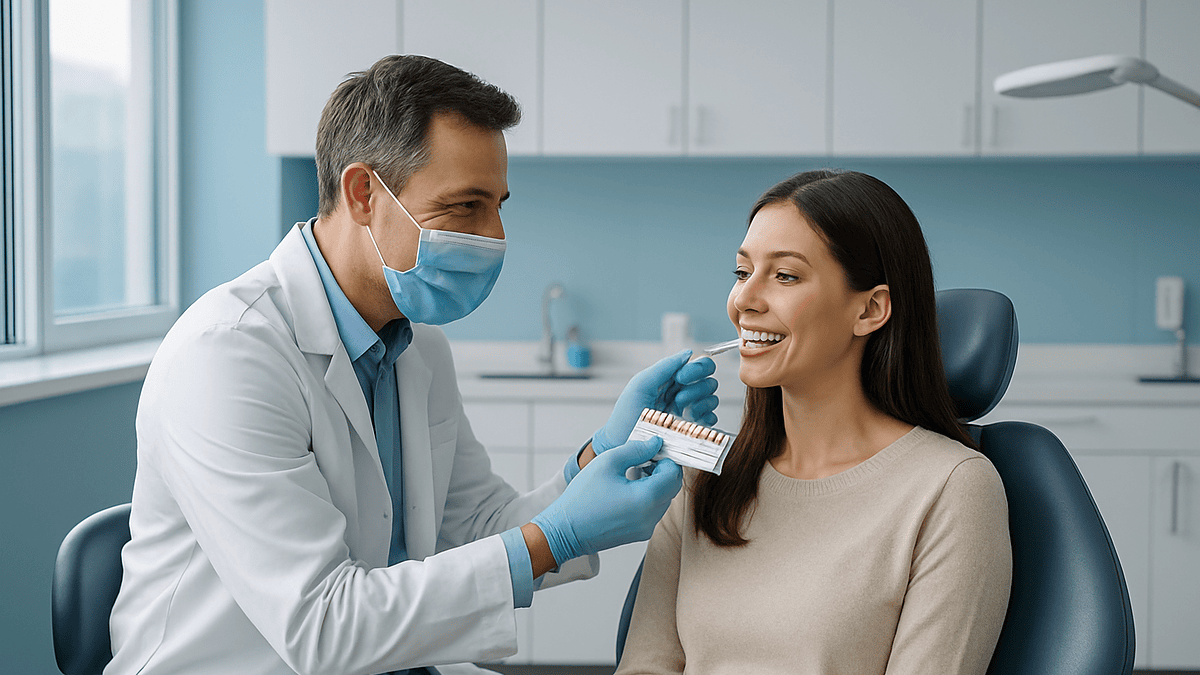
- Porcelain cannot be whitened afterward, so any whitening of the natural teeth is best completed before the shade for the veneers is matched.
- A mock-up or a period wearing temporaries lets the design be changed while it still costs nothing in tooth structure, which is why unhurried planning matters more than speed.
A laminate veneers procedure usually unfolds over two or three dental visits spread across a few weeks. The dentist first assesses the teeth and takes impressions or a digital scan, then removes a thin layer of enamel, often about half a millimeter, so the shell sits flush. A laboratory makes thin porcelain or composite shells, which are trial-fitted, adjusted for color and bite, and bonded to the etched tooth surface with a light-activated resin cement.
She had rehearsed the smile in the bathroom mirror for years: lips closed just enough to hide the chipped corner of one front tooth and the gray stain on its neighbor that no whitening strip had touched. When a dentist finally said the words “laminate veneers,” her first question was not about color. It was, “What exactly are you going to do to my teeth?”
That is the right question, and it deserves a fuller answer than most brochures give. The laminate veneers procedure is not one appointment and one glue job. It is a sequence: planning, impressions, a small and deliberate amount of enamel shaping, a laboratory stage, and a bonding visit where chemistry does most of the work.
This article walks through each step in the order it happens, explains what the evidence says about durability and risk, and leaves the final decision where it belongs: with you and your treating team.
What are laminate veneers, in plain language?
A laminate veneer is a thin shell, usually porcelain or a tooth-colored resin called composite, that is bonded to the front surface of a tooth to change its color, shape or length. “Laminate” simply describes the layering: a thin covering fixed over an existing structure, the way a countertop laminate covers particleboard, except here the base is living tooth and the bond is chemical.
The shells are thin. Cleveland Clinic describes traditional porcelain veneers as roughly the thickness of a fingernail, and the amount of enamel removed to make room for them is typically around half a millimeter. That thinness matters because enamel, the hard outer layer of the tooth, does not grow back. Whatever is removed is removed for good, which is why the planning stage carries so much weight.
Veneers are usually placed on the teeth visible when someone smiles: the upper front six to ten teeth are the common range, though a single tooth can be veneered when only one is chipped or discolored. Back teeth, which take the heaviest chewing forces, are rarely veneered because thin shells are more likely to fracture there.
Two broad families exist. Porcelain (ceramic) veneers are made in a laboratory from an impression or scan and bonded at a later visit. Composite veneers can be built directly on the tooth in one appointment, sculpted layer by layer, or made indirectly in a lab. The step-by-step description that follows focuses on the laboratory-made porcelain pathway, because it is the version most people mean when they search for the laminate veneers procedure, and because its impression, preparation and bonding stages are distinct enough to be worth understanding one at a time.
How the laminate veneers procedure works, step by step
Strip away the technical vocabulary and the sequence is straightforward. A dentist examines the teeth and gums, sometimes with X-rays, to confirm the teeth are healthy enough to carry a bonded shell. Photographs and a record of the bite are taken. Many dentists then produce a mock-up, a temporary resin preview shaped over the unprepared teeth, so the patient can see and feel a proposed result before anything irreversible happens.

At the preparation visit, local anesthetic may be offered, although some patients with minimal-preparation plans need none. The dentist shapes the front surface of each tooth with a fine bur, guided by a depth-marked plan, removing a thin layer of enamel so the veneer will not look bulky or catch food at the gumline. An impression or digital scan captures the prepared teeth in detail, and temporary coverings may be placed.
The scan or mold goes to a dental laboratory, where a technician builds each shell to a shade and shape agreed in advance. Cleveland Clinic notes this stage often takes a couple of weeks.
The bonding visit is the moment everything converges. Each shell is tried in with a water-based paste to check fit and color. The tooth surface is then cleaned, etched with a mild acid gel to create microscopic roughness, and coated with a bonding agent. The inside of the veneer is treated similarly. A resin cement is applied, the shell is seated, and a blue curing light hardens the cement within seconds. Excess is trimmed, the bite is checked, and the edges are polished.
A follow-up visit a week or two later lets the dentist confirm the gums have settled and the bite feels natural. That is the whole arc: assess, plan, shape, capture, build, bond, review.
Who laminate veneers are usually for, and who is asked to wait
Veneers solve surface problems. The typical candidate has teeth that are structurally sound but cosmetically troubled: intrinsic staining that whitening cannot lift, small chips, mild gaps, slightly uneven lengths, or a tooth that is a little rotated or set back. Because the shell only covers the front and biting edge, it cannot fix what lies underneath.
That is why the assessment visit looks past the enamel. Active tooth decay, gum disease or a tooth that has lost much of its structure are usually treated first; a veneer bonded to a weak or infected tooth is a veneer with a short future. The NHS description of dental treatments frames veneers as an option for damaged or discolored teeth once the mouth is otherwise healthy.
Several groups are commonly asked to wait or to consider a different route:
- People who grind or clench their teeth heavily. Bruxism, the medical term for grinding, puts repeated force on thin porcelain and raises fracture risk; a night guard is often part of the conversation.
- Children and teenagers whose teeth and gums are still changing position, because a shell fitted now may sit wrongly in a few years.
- Anyone with very little enamel left, from erosion or previous work, since the bond to enamel is stronger than the bond to the softer inner dentin.
- Those whose main concern is alignment. A veneer can disguise mild crowding but cannot move roots; orthodontic treatment may serve better and preserve more tooth.
- People who have not yet tried simpler options such as professional whitening or minor bonding, when those could address the concern.
None of these is an absolute bar. They are prompts for a longer discussion in which the treating dentist weighs how much tooth would be sacrificed against how much benefit the shell can realistically deliver.
What happens at the consultation and the mock-up
The first appointment does not involve a drill. It involves a mirror, a camera and a lot of questions. A dentist will want to know what bothers the patient about the smile, how the teeth feel when chewing, whether any tooth is sensitive to cold, and whether there is a history of grinding, dental trauma or previous fillings on the front teeth.

The clinical exam checks gum health, looks for decay and cracks, and assesses how the upper and lower teeth meet. Edge-to-edge bites, where the front teeth clash rather than overlap, place more stress on veneers and may change the plan. X-rays are taken if needed to look beneath the enamel, in line with routine adult dental care described by MedlinePlus.
Shade is discussed at this stage rather than at the end. Natural teeth are not one color; they are usually more yellow near the gum and more translucent at the edge. A skilled technician can build that gradient into porcelain, but only if the shade instructions are clear. Photographs under standardized lighting help the laboratory match the neighboring teeth.
The mock-up is the most valuable part of this visit for many patients. Using an impression of the current teeth, the laboratory or dentist creates a wax or resin model of the proposed veneers, then transfers a temporary version onto the unprepared teeth. The patient can speak, smile and check whether the new length catches on the lower lip. Nothing has been removed, so the design can still be changed freely.
Patients sometimes feel this stage is slow. It is meant to be. Every adjustment made here costs nothing in enamel; every adjustment made after preparation does.
Impressions and digital scans: how the mold for veneers is made
An impression is a negative copy of the teeth, and a veneer can only be as accurate as the impression it was built from. Two methods are in common use, and both aim at the same thing: a record of every edge, margin and neighboring tooth surface precise to a fraction of a millimeter.
The traditional method uses a putty-like material, often a silicone, loaded into a tray that is pressed over the teeth and held still while it sets, typically a few minutes. A thin, fluid version of the material is first syringed around the prepared teeth to capture the fine detail at the gumline; the heavier putty in the tray supports it. Some people find the sensation of the tray uncomfortable or gag-inducing, which is worth mentioning in advance, since positioning and breathing techniques can help.
The digital method replaces the tray with a handheld wand that photographs the teeth thousands of times a second and stitches the images into a three-dimensional model on a screen. There is no material to set and the scan can be repeated instantly if an area is blurred. The file is sent electronically to the laboratory, where the veneers are designed on software and either milled from a ceramic block or printed as a model for hand-layering.
Whichever method is used, the dentist also records the bite, how the upper and lower teeth close together, and often takes an impression of the opposing arch. A gum-retracting cord may be placed briefly around the prepared teeth so the margin, the line where veneer meets tooth, is captured cleanly. A veneer with a poorly captured margin can leave a ledge that traps plaque, so this quiet, unglamorous step is one the treating team takes seriously.
Minimal preparation: how much enamel is actually removed?
This is the part people worry about, and the honest answer is: some, but less than most imagine. Cleveland Clinic puts the typical enamel reduction for porcelain veneers at around half a millimeter from the front surface, about the thickness of a fingernail. The goal is to make room for the shell so the finished tooth is not thicker than the original.
Dentists work to a plan rather than by eye. Depth-cutting burs leave shallow grooves of a known depth across the enamel; the dentist then smooths the surface down to the floor of those grooves and no further. Where the mock-up shows the new veneer will already add length or bulk, the preparation can be lighter in that area. Where a tooth is set back, almost nothing may need removing.
The biting edge is often shortened slightly and wrapped, so the veneer has a stopping point and does not rely on the front surface alone. Near the gum, the margin is usually kept just at or slightly above the gumline so it stays cleanable.
Why not skip preparation entirely? “No-prep” or ultra-thin veneers exist and suit a small number of cases, typically teeth that are already small or set back. On average-sized teeth, an unprepared veneer adds thickness, can look opaque, and may create an overhang at the gum that irritates tissue.
Why does preparation matter beyond looks? Enamel is the strongest bonding surface a dentist has. Staying within enamel, rather than cutting into the softer dentin beneath, gives the resin cement its firmest grip and keeps the tooth’s inner nerve well insulated. Minimal preparation is therefore not just about preserving tooth; it is about making the bond last.
Temporaries and the laboratory weeks
Between the preparation visit and the bonding visit, the prepared teeth need protecting, and the patient needs to be able to smile at work. Temporary veneers, made from the mock-up mold in a tooth-colored resin, are placed for that purpose. They are held with a weak spot-bond so they can be removed easily later.
Temporaries serve a second function that is easy to overlook: they are a live test of the design. Wearing the proposed shape for a couple of weeks reveals whether the new length interferes with speech, whether the edges feel sharp to the tongue, or whether the shade looks too bright under office lighting. Any of these observations can still be sent to the laboratory before the porcelain is fired.
They are not built to last, and a few sensible habits protect them: avoid biting directly into hard or sticky foods with the front teeth, brush gently around the gumline, and floss by sliding the floss out sideways rather than pulling it up through the contact, which can lift a temporary off. If one comes loose, it is not an emergency, but the dentist should be told so the exposed tooth can be re-covered and sensitivity limited.
Meanwhile, at the laboratory, a technician either layers ceramic powders onto a model by hand and fires them in a furnace, or mills the veneer from a pre-shaded block and adds surface stains and glaze. Cleveland Clinic describes this fabrication period as commonly taking a couple of weeks, though it varies with the laboratory’s workload and whether adjustments are requested. Try-in of the finished shells against the shade photographs is often done at the laboratory before they ship.
Bonding the shells: what happens at the fitting appointment
The bonding visit is longer than most people expect, often more than an hour for several teeth, and much of that time is spent on steps that are invisible to the patient. Getting them right is what keeps a veneer on for years rather than months.
The temporaries come off and the teeth are cleaned of any residual resin. Each porcelain shell is seated with a water-soluble try-in paste that mimics the color of the final cement; different paste shades can nudge the overall tone warmer or brighter. Fit is checked with magnification, the margins are felt with a fine probe, and the patient is handed a mirror. This is the last opportunity to change anything, because once the shell is bonded, it can only be removed by grinding it off.
Isolation follows. The teeth are kept dry with cotton rolls, a retractor or a thin rubber sheet, since moisture weakens the bond. The tooth surface is etched with a mild phosphoric acid gel for a short, timed interval, rinsed, dried and painted with a bonding agent. The inside of the veneer, which the laboratory has already roughened, is treated with a silane coupling agent, a chemical primer that helps resin grip ceramic.
Resin cement is loaded into the shell, the shell is pressed into place, and a curing light, blue and bright, is held against it in short bursts. The cement hardens within seconds. Excess is flicked away with a fine instrument and floss, the light is applied again to be sure, and the margins are polished smooth.
Finally the bite is checked with marking paper. Any high spot on the veneer is adjusted with a fine diamond and repolished, because an edge that hits first under load is an edge that may chip.
Porcelain vs composite veneers: how the two pathways compare
The word “laminate” covers two materials with quite different workflows, and patients often choose between them without realizing how much the procedure itself changes. Porcelain follows the multi-visit, laboratory-made route described above. Composite can be sculpted directly onto the tooth in a single appointment, with the dentist building and shaping resin by hand and curing it layer by layer.
| Feature | Porcelain (laboratory-made) | Composite (direct) |
|---|---|---|
| Number of visits | Usually two to three | Often one |
| Enamel removal | Typically a thin layer, around half a millimeter | Often minimal or none |
| Who shapes it | Laboratory technician from an impression or scan | Dentist, freehand, in the mouth |
| Stain resistance | High; glazed ceramic resists surface staining | Lower; resin can pick up stain over time |
| Repair if chipped | Usually requires replacement of the shell | Often repairable in the mouth |
| Reversibility | Not reversible once enamel is shaped | More easily removed if little enamel was taken |
| Typical longevity | Longer, often quoted around a decade | Shorter, often quoted at several years |
The longevity figures above reflect ranges described by Cleveland Clinic and are averages, not guarantees; individual results depend on bite forces, hygiene and habits.
Neither material is universally better. Composite suits someone who wants a conservative, adjustable change and accepts the likelihood of earlier touch-ups. Porcelain suits someone prioritizing color stability and a longer interval before replacement, and who is comfortable with a small permanent change to the enamel. Many dentists offer both, and the honest ones will say which they think fits a particular mouth rather than which they prefer to make.
What the following days and weeks usually look like
The first evening after bonding often feels strange rather than sore. The teeth may seem larger to the tongue, speech can feel slightly different, and if local anesthetic was used the gums may be tender as it wears off. Most of this settles within a few days as the mouth adapts.
Cold sensitivity is common in the first week or two, because a thin layer of enamel has been reshaped and the tooth is adjusting to its new covering. Cleveland Clinic lists temporary sensitivity among the expected after-effects. It usually eases on its own; a toothpaste formulated for sensitive teeth can help, and the dentist should be told if it persists or sharpens rather than fading.
The gums around the margins may look slightly reddened for the first several days, particularly if a retraction cord was used during impressions. Gentle brushing along the gumline with a soft brush, rather than avoiding the area, helps the tissue recover.
Eating habits deserve a short adjustment period. Biting straight into very hard foods with the front teeth, chewing ice or opening packaging with the teeth are habits worth dropping permanently rather than for a week. Staining foods and drinks affect the natural teeth and any composite more than glazed porcelain, so people who whiten periodically often plan their whitening before veneers so the shade can be matched.
A review visit is typically scheduled within a week or two. The dentist checks that no excess cement remains, that the bite has settled, and that the gums are healthy. If grinding was identified beforehand, a night guard is often fitted at this stage. After that, veneers slot into ordinary dental care: routine check-ups, daily brushing with fluoride toothpaste and cleaning between the teeth, as described in MedlinePlus guidance on adult dental care.
How long do laminate veneers last?
Any single number is misleading, so here is what the mainstream sources actually say. Cleveland Clinic describes porcelain veneers as commonly lasting around a decade or more, with composite veneers typically lasting a shorter period of several years before needing repair or replacement. Those are averages drawn from clinical experience, not promises for an individual mouth.
What shortens a veneer’s life is fairly predictable. Grinding and clenching top the list; porcelain is strong under compression but brittle when flexed, and a night of unconscious clenching applies exactly the kind of force it dislikes. Using front teeth as tools, biting nails or chewing pens adds micro-fractures over time. Decay at the margin, where veneer meets tooth, can undermine the bond and is the reason cleaning the gumline matters more, not less, after veneers.
The quality of the bond set at the fitting appointment also matters: a veneer cemented to well-isolated, etched enamel behaves differently over the years from one bonded to dentin or a surface contaminated with saliva. This is one reason dentists insist on the unglamorous drying and etching steps.
What “failure” means varies. Sometimes a veneer debonds cleanly and can be rebonded. Sometimes a corner chips and a small repair or replacement is needed. Sometimes the veneer is intact but the gum has receded, exposing a line of darker root that the shell no longer covers, and a cosmetic rather than structural problem prompts replacement.
The practical implication is that veneers are a long-term commitment with a maintenance cycle. Because enamel has been shaped, a veneered tooth will generally always need a veneer or another covering. Anyone considering the procedure should assume at least one replacement over a lifetime and factor that into the decision with their dentist.
What are the downsides of laminate veneers?
Every honest explainer owes the reader this section. Veneers have real advantages for the right teeth, and they have real costs in tooth structure, upkeep and risk. Cleveland Clinic and the NHS both list the main ones.
- Irreversibility. Once enamel is shaped for a traditional veneer, the tooth will always need some form of covering. This is the single most important fact to understand before agreeing.
- Sensitivity. Temporary sensitivity to hot and cold is common after preparation. In a minority of cases it persists, and rarely the tooth’s inner pulp becomes inflamed and needs further treatment.
- Chipping and debonding. Thin porcelain can fracture under grinding, trauma or biting hard objects. A debonded veneer can often be re-cemented; a fractured one usually cannot be repaired invisibly.
- Color mismatch over time. Porcelain does not whiten. If the surrounding natural teeth darken or are later whitened, the veneers will no longer match.
- Gum changes. Recession can expose the margin, and an overhanging or rough margin can inflame the gum and trap plaque.
- Decay is still possible. The covered tooth can decay at the edges or on its uncovered back surface.
- Not a fix for the bite. Veneers disguise; they do not realign roots or correct how the jaws meet.
Alternatives exist for many of the concerns that lead people to veneers. Professional whitening addresses many stains without removing enamel. Direct composite bonding can repair a chip or close a small gap in one visit and is easier to reverse. Orthodontic treatment moves teeth rather than masking them. Crowns are considered when a tooth has lost too much structure to support a thin shell. Which of these fits a given mouth is a clinical judgment, and it is reasonable to ask a dentist to explain why veneers are being proposed over each of them.
What people often get wrong about the laminate veneers procedure
Some of the most persistent ideas about veneers come from social media rather than from dentistry, and a few of them lead to real disappointment. Here are the ones worth correcting.
“Veneers mean shaving your teeth to pegs.” The images that circulate online often show teeth prepared for full crowns, which do require reducing the whole tooth. A laminate veneer preparation removes a thin layer, typically around half a millimeter, from the front surface only, according to Cleveland Clinic. The two procedures are not the same.
“No-prep veneers are always the safer choice.” Skipping preparation preserves enamel, but on normal-sized teeth it produces a bulkier result and a margin that can overhang the gum. Whether a tooth suits no-prep is an anatomical question, not a marketing one.
“Veneers are a permanent fix.” The change to the tooth is permanent; the veneer itself has a lifespan measured in years, and replacement should be expected.
“You can whiten veneers later.” Porcelain does not respond to whitening agents. Shade must be decided at the start, and any whitening of natural teeth is best done beforehand.
“Once veneers are on, the teeth underneath are protected.” The front surface is covered; the edges and back are not. Decay at the margin is a recognized cause of veneer failure, and daily hygiene matters as much as before.
“Composite veneers are the budget version of porcelain.” They are a different material with a different workflow, more conservative in some cases and more easily repaired, with the trade-off of lower stain resistance and shorter longevity. Neither is simply a lesser copy of the other.
Understanding these distinctions before the first appointment tends to produce a calmer, more useful conversation with the treating dentist.
Questions to ask your care team
The most useful appointments are the ones where the patient arrives with a short list. These questions are drawn from what people report wishing they had asked, and they are phrased so the answers can be compared honestly rather than sold.
- Why are veneers the right option for my teeth rather than whitening, bonding, orthodontics or a crown? What would each alternative involve?
- Which teeth are you proposing to veneer, and why that number?
- Will you use porcelain or composite, and what led to that choice for my case?
- Roughly how much enamel will be removed from each tooth, and will the preparation stay within enamel or reach dentin?
- Can I see a mock-up or wear temporaries before anything irreversible is done?
- Do you see signs that I grind or clench, and would you recommend a night guard afterward?
- What is the condition of my gums and the surrounding teeth, and does anything need treating first?
- How will the shade be chosen, and should I whiten my other teeth before we match it?
- What sensitivity or other after-effects should I expect, and for how long?
- What happens if a veneer chips or comes off, and how are repairs handled?
- How often will you want to review the veneers, and what maintenance is expected of me?
- Based on your experience, what typically shortens the life of veneers like these, and how do I avoid it?
Cost is a legitimate question and belongs on the list; this article does not discuss figures, because they vary widely with materials, laboratory work and individual clinical needs, and the treating practice is the right place to ask.
A dentist who welcomes these questions and answers them plainly is giving useful information about how the rest of the treatment relationship is likely to go.
When to call your doctor
Most people move through the laminate veneers procedure with nothing more than a few days of mild sensitivity and a slightly unfamiliar feeling in the mouth. A small number of signs, however, warrant a prompt call to the dentist rather than waiting for the scheduled review.
- Pain that is sharp, throbbing or keeps you awake, especially if it worsens rather than eases over several days. Persistent pain can signal inflammation of the tooth’s inner pulp or a bite that is hitting too hard on one veneer.
- Sensitivity to hot or cold that lingers for many seconds after the trigger is removed, or that appears weeks after bonding when it had previously settled.
- A veneer or temporary that feels loose, moves when touched, or has come off entirely. Keep the piece if you can; it may be re-bondable.
- A visible chip, crack or rough edge, particularly one that catches the lip or tongue.
- Gums around a veneered tooth that are swollen, bleed easily on gentle brushing, or remain red beyond the first week or two.
- A bad taste or odor from around a margin, which can indicate trapped plaque or a gap under the edge.
- Any swelling of the face or jaw, fever, or difficulty opening the mouth, which should be assessed urgently, as they can indicate infection.
Bleeding that does not stop, rapidly spreading facial swelling, or trouble breathing or swallowing are emergencies and should be treated as such through the usual emergency services in your area.
Outside these situations, the ordinary rhythm of care applies: keep the review appointment, mention anything that feels different even if it seems minor, and continue routine check-ups. Veneers are a long relationship between a patient and a treating team, and the small early conversations are the ones that prevent the larger later problems.
Frequently asked questions
What are the downsides of laminate veneers?
The main downsides are irreversibility, temporary sensitivity, and the risk of chipping or debonding over time. Once enamel has been shaped for a porcelain veneer, the tooth will always need a covering. Veneers also cannot be whitened, so they may mismatch if surrounding teeth change color, and the uncovered edges of the tooth can still decay. A dentist can explain how each risk applies to a particular case.
How long do laminate veneers last?
Porcelain veneers are commonly described by Cleveland Clinic as lasting around a decade or more, while composite veneers typically last several years before repair or replacement. These are averages, not guarantees. Grinding, biting hard objects, decay at the margins and gum recession all shorten a veneer’s life, and most people should expect to replace veneers at least once over a lifetime.
How much do laminate veneers cost?
This article does not give price figures, because costs vary widely with the material chosen, the number of teeth, laboratory work and any preparatory treatment a mouth needs. The treating dental practice is the right place to ask for a written estimate that reflects your own plan. It is reasonable to also ask what future replacement or repair might involve, so the long-term commitment is understood from the start.
What do people wish they knew before getting veneers?
Most commonly, that the enamel change is permanent and that veneers will eventually need replacing. People also report wishing they had whitened their natural teeth before shade matching, asked about grinding and a night guard, and worn temporaries longer to test the shape. Understanding that veneers disguise rather than realign teeth, and that hygiene at the gumline matters more afterward, also comes up often.
Does the laminate veneers procedure hurt?
Preparation is usually done with local anesthetic when enamel is being shaped, so the visit itself is generally not painful. Afterward, mild sensitivity to hot and cold and some gum tenderness are common for a few days to a couple of weeks, according to Cleveland Clinic. Persistent or worsening pain is not expected and should prompt a call to the dentist, as it may indicate a bite problem or pulp inflammation.
What are no-prep veneers and are they better?
No-prep veneers are ultra-thin shells bonded without removing enamel. They preserve tooth structure but only suit teeth that are already small, set back or have room for added thickness. On average-sized teeth they can look bulky and leave a ledge at the gumline that irritates tissue. Whether a tooth is a candidate is an anatomical judgment, and the dentist can explain which approach fits your mouth.
Porcelain vs composite veneers: what is the difference?
Porcelain veneers are made in a laboratory from an impression or scan and bonded at a later visit; they resist staining and typically last longer. Composite veneers are usually sculpted directly onto the tooth in one appointment, remove little or no enamel, are easier to repair, but stain more readily and tend to last a shorter time. Neither is universally better; the choice depends on the teeth and the goals.
How many visits does the laminate veneers procedure take?
Laboratory-made porcelain veneers usually take two to three visits: a consultation and planning appointment, a preparation and impression visit, and a bonding visit, often with a short review afterward. Cleveland Clinic notes the laboratory stage between preparation and bonding commonly takes a couple of weeks. Direct composite veneers can often be completed in a single appointment because the dentist shapes the material in the mouth.
Can veneers be whitened or stained?
Glazed porcelain does not respond to whitening products and is highly resistant to surface staining, though the cement line at the edge can discolor over years. Composite resin can pick up stains from coffee, tea, red wine and tobacco and cannot be whitened either, though it can be polished or replaced. Because of this, any whitening of natural teeth is best done before the veneer shade is chosen.
What should I avoid after veneers are bonded?
Avoid biting directly into very hard foods with the front teeth, chewing ice or pens, and using teeth to open packaging, since these habits are common causes of chipping. Continue brushing twice daily with fluoride toothpaste and cleaning between the teeth, paying attention to the gumline where the veneer meets the tooth. If grinding has been identified, wearing the night guard as advised protects the shells from repeated stress.
References
- Cleveland Clinic – Dental Veneers
- MedlinePlus – Dental care – adult
- MedlinePlus – Dental Health
- CDC – Oral Health
This article is for general information only and is not a substitute for professional medical advice. Please consult a qualified doctor about your individual situation.

More from the Blog
Impacted Canine vs Impacted Wisdom Tooth: Why One Is Often Saved and the Other Removed
An impacted canine is usually saved because it is a cornerstone tooth with the longest root in the mouth, guides the bite and anchors…
Do Root Canals Make You Sick? Old Myths About Treated Teeth, Corrected
No. Current evidence does not show that a properly treated root canal tooth causes cancer, heart disease, arthritis or other illnesses. The idea traces…
Do Teeth Need Straightening Before Porcelain Veneers? When Orthodontics Comes First
Not everyone needs braces before veneers, but many people benefit from straightening first. Porcelain veneers can mask mild rotations, small gaps, and uneven edges,…
Sinus Lift: Why Upper-Jaw Implants Sometimes Need It, and How It Heals
A sinus lift is a surgical procedure that adds bone between the upper jaw and the maxillary sinus so a dental implant has enough…
How 3D Imaging Changes Oral and Maxillofacial Surgery Planning Around Nerves and Sinuses
3D imaging in oral surgery planning, most often a cone beam CT scan, gives surgeons a layered view of the jaw so they can…

Oil Pulling: The Ancient Practice vs the Actual Evidence
Oil pulling, swishing edible oil in the mouth for 10 to 20 minutes, may modestly reduce plaque and mouth bacteria, according to a handful…