

Sleep Divorce: Why Sleeping Apart Is Rising and What Sleep Medicine Says About It
Key Takeaways
- Surveys suggest more than one in three US adults sleep apart from a partner at least occasionally, with adults under 45 doing so more often than those over 65.
- Actigraphy studies show people move and wake more when sharing a bed yet often report sleeping better together, so your diary of daytime alertness matters more than a wearable's score.
- The American Heart Association added seven to nine hours of sleep to its Life's Essential 8 cardiovascular checklist in June 2022, placing sleep alongside blood pressure and cholesterol.
- Loud snoring interrupted by pauses, gasps or snorts is the classic partner-witnessed sign of obstructive sleep apnea, a condition most people who have it have never been diagnosed with.
- Sleeping in another room removes the disturbance from your night but leaves your partner's snoring, restless legs or nocturia untreated, so the cause still needs its own appointment.
- A two-week trial with a simple sleep diary, plus an agreed plan for bedtime closeness, is the approach sleep clinicians most often recommend for testing separate rooms.
A sleep divorce means partners sleep in separate beds or rooms so both can rest well, and surveys suggest roughly one in three US adults do this at least sometimes. Sleep medicine views it as a reasonable, often healthy choice when snoring, mismatched schedules or restlessness keep one partner awake, provided the underlying cause, especially possible sleep apnea, is discussed with a doctor rather than simply moved down the hall.
The phrase started as a punchline and has become a search term. Over the past two years, sleep divorce has moved from late-night joke to dinner-party confession, pushed along by celebrity interviews, a wave of social media posts filmed from tidy guest bedrooms, and professional surveys finding that more than a third of American adults now sleep apart from their partner at least occasionally. As of spring 2025, the question people type most often is not what it means but whether it is allowed to feel this good.
Picture a couple in their fifties. He snores, she wakes at 3 a.m. and lies there counting his breaths. For years they treated the arrangement as a test of devotion. Then one of them slept on the sofa after a cold, woke rested for the first time in a decade, and quietly never came back.
That story sits at the center of this trend. It deserves better than either a shrug or a scolding. It deserves the evidence.
What changed recently to make sleep divorce a mainstream topic?
Three shifts converged. The first was cultural: separate beds, once associated with mid-century television and marital frost, lost their stigma as public figures described sleeping apart with no apparent embarrassment. The second was measurement. Consumer wearables now hand people nightly graphs of their own restlessness, and a partner who elbows you at 2 a.m. shows up as a jagged line you can screenshot and share.
The third shift came from medicine itself. In June 2022 the American Heart Association added sleep duration to its Life’s Essential 8, the checklist it uses to define cardiovascular health, placing seven to nine hours a night alongside blood pressure, cholesterol and physical activity. That was a quiet but consequential move. Sleep stopped being a lifestyle nicety and became a vital sign that cardiologists ask about.
At the same time, the Centers for Disease Control and Prevention continued to report that about one in three US adults regularly gets less than the recommended seven hours, and the National Heart, Lung, and Blood Institute updated its public guidance linking chronic sleep deficiency to higher risk of high blood pressure, type 2 diabetes, obesity and depression. When the health cost of poor sleep is stated that plainly, people start auditing the causes, and for many the loudest cause is lying beside them.
Clinician-written explainers followed. Cleveland Clinic published a plain-language piece on sleep divorce that treated the arrangement as a practical tool rather than a symptom of trouble, and that framing spread quickly through health media. None of this was a trial or a regulatory approval. What changed is that the medical establishment began speaking about sleeping apart without apology, and search behavior tracked the permission.
What is a sleep divorce, exactly?
Strip away the drama and the term describes a scheduling decision. A sleep divorce is any arrangement in which two partners deliberately sleep separately, in different beds or different rooms, so that each can get uninterrupted rest. The word divorce is doing a lot of theatrical work; nothing about the relationship is being dissolved. Some couples prefer the gentler phrases sleeping apart or separate sleeping, and clinicians tend to use those.

The arrangement comes in degrees. At one end sits the Scandinavian approach: one bed, two separate duvets, no tug-of-war over the covers and no shared heat. A step further is two beds pushed together or placed side by side in the same room, which preserves conversation and presence while ending mattress transmission of every turn. The full version is separate rooms, either every night or on a schedule, such as weeknights apart and weekends together.
What distinguishes a sleep divorce from simply being exiled to the sofa is intent. Both people agree that the purpose is better sleep for both, they decide how intimacy and downtime will be protected, and they keep the option of returning. Sleep specialists sometimes call this a sleep alliance, since the goal is a shared outcome pursued by separate means.
It also helps to be clear about what the arrangement is not. It is not a treatment for snoring, insomnia or restless legs. Moving to another room removes the disturbance from one partner’s night without touching the cause in the other’s. That distinction matters enormously, and it runs through every section that follows: separate rooms can be a fine solution for the listener while leaving the snorer with an unexamined medical problem.
What percent of married couples sleep in separate beds?
The honest answer is that no national registry counts bedrooms, so every figure comes from surveys, and surveys vary with how the question is asked. Ask whether people ever sleep apart from a partner and the number is large; ask whether they do so every night and it shrinks considerably.
Recent US polling by sleep-medicine professional bodies has found that more than one in three adults say they occasionally or consistently sleep in a different room from their partner to protect their sleep. Broken down by age, the pattern is not what most people expect. Younger adults in their late twenties and thirties report sleeping apart more often than those in their sixties and seventies, which cuts against the assumption that separate beds are a feature of long, tired marriages. The likely explanations are early parenthood, shift work and a generation that grew up hearing sleep discussed as a health priority.
Men report choosing a separate room somewhat more often than women in these polls, although women more often report being the disturbed party. That mismatch fits the clinical picture: snoring and obstructive sleep apnea are more common in men, at least before menopause, so the person leaving the room and the person causing the problem are frequently not the same.
Historical context is useful here. Separate beds were normal among couples who could afford the space through much of the nineteenth and early twentieth centuries, and the shared double bed as a symbol of marital health is a relatively modern idea. What is rising now is not the behavior so much as the willingness to name it. Whatever the precise percentage, sleeping apart is common enough that a couple considering it is joining a large and unremarkable group.
Is it true that I sleep better alone than with my partner?
Possibly, and the gap between what you feel and what a sleep lab would record is one of the most interesting findings in this field. Studies that fit couples with actigraphy, a wrist device that tracks movement to estimate sleep and wake periods, consistently find that people move more and wake more often when sharing a bed. Movement is contagious: when one partner shifts, the other is measurably more likely to shift within seconds. On objective measures, then, most people do sleep a little more lightly with company.
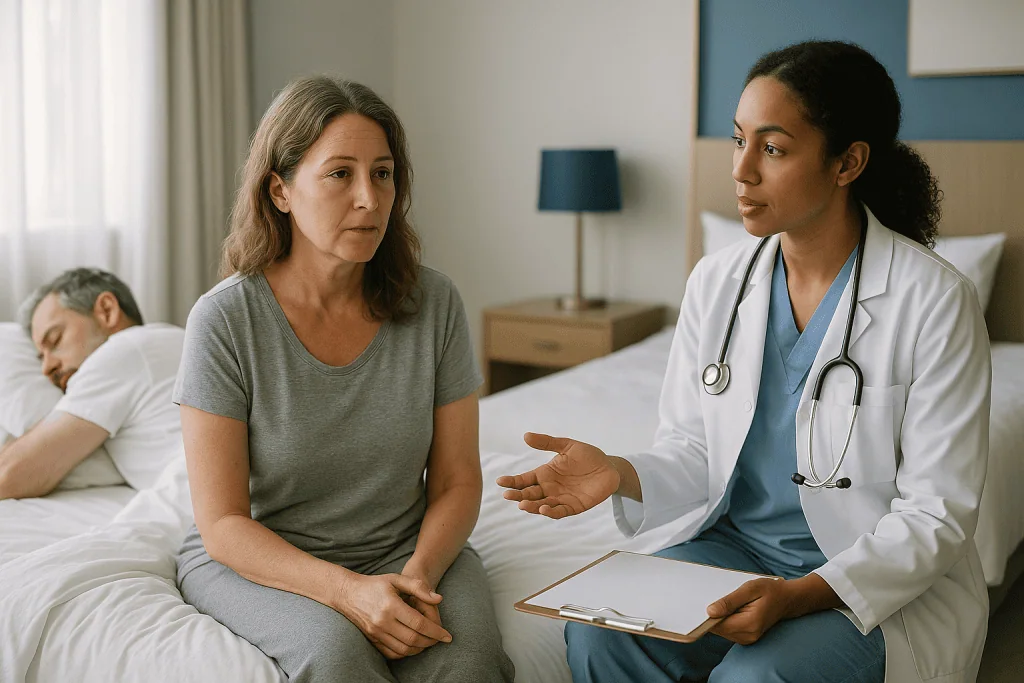
Now ask the same people how they slept, and many say they slept better together. This subjective-objective split appears in several small studies of both heterosexual and same-sex couples. Feeling safe and warm seems to buy a sense of restedness that the movement counts do not capture. Researchers have proposed that the shared bed lowers stress hormone levels and stabilizes body rhythms, though the data on those mechanisms are limited and mostly observational.
Which measure should you trust? Both, depending on the problem. If your partner’s presence causes brief, unremembered arousals but you wake feeling fine and function well, the objective fragmentation is probably not worth acting on. If you are lying awake for long stretches, tracking their breathing, resenting every rustle, then your subjective misery is the more important signal, and the wearable’s confirmation is almost beside the point.
One practical test outperforms any device. Sleep apart for two weeks, keep a simple diary of bedtime, wake time, how many times you woke and how you felt at midday, then compare with two weeks together. Sleep researchers use exactly this kind of diary because memory of a single bad night distorts the picture. Most couples discover the answer is not universal; one partner sleeps better alone and the other does not.
What the evidence actually says about sleeping apart
Grading the science is the honest way to talk about a trend, so here is where the claims stand.
Strongest evidence, from randomised trials and large cohorts: chronic short sleep, under seven hours for adults, is associated with higher rates of hypertension, type 2 diabetes, obesity, depression and cardiovascular events, and experimental sleep restriction in healthy volunteers measurably impairs glucose handling, mood and attention within days. The CDC, the NHLBI and the American Heart Association all rest their seven-hour recommendation on this body of work. If a bed partner is the reason you fall below that threshold night after night, the harm of that lost sleep is well established.
Moderate evidence, mostly observational: bed partners of people with loud snoring or untreated obstructive sleep apnea show more fragmented sleep, more daytime sleepiness and lower reported quality of life than partners of quiet sleepers. Small studies find that when the snorer’s apnea is treated, the partner’s sleep improves too, which is a strong hint that the disturbance is real and measurable rather than imagined.
Weaker evidence, from small studies and expert opinion: the specific claim that sleeping apart improves relationship satisfaction. Some surveys report couples who sleep separately describe less irritability and fewer arguments, but these are self-selected groups reporting their own outcomes. No randomised trial has assigned couples to separate or shared rooms and followed their marriages. The plausible pathway is indirect: better sleep reduces irritability, and less irritability helps relationships, a chain supported by lab studies showing sleep-deprived people read their partners’ emotions less accurately.
Absent evidence: any suggestion that separate sleeping harms a healthy relationship. Nobody has shown that either. The fair summary is that the health case for protecting sleep is strong, the case that a shared bed matters medically is weak, and the relationship effects in either direction are largely a matter of how the couple handles it.
Snoring and sleep apnea: what the noise may be telling you
The most common reason couples cite for sleeping apart is snoring, and this is where a sleep divorce can quietly conceal a diagnosis. Simple snoring is turbulence: air squeezing past relaxed tissue in the throat. Obstructive sleep apnea is something else. It is a condition in which the upper airway repeatedly collapses during sleep, cutting off breathing for ten seconds or longer, sometimes dozens of times an hour, until the brain jolts the body awake just enough to reopen the airway.
The person with apnea rarely remembers these arousals. The bed partner often witnesses them: a run of loud snoring, then silence, then a gasp or snort as breathing restarts. That pattern, snoring punctuated by pauses, is the single most useful observation a partner can bring to a doctor’s office. Mayo Clinic lists it alongside morning headaches, dry mouth on waking, difficulty concentrating and excessive daytime sleepiness as reasons to seek evaluation.
Untreated apnea is not a nuisance condition. It is associated with high blood pressure, atrial fibrillation, stroke and insulin resistance, largely because each breathing pause triggers a surge of stress hormones and a dip in blood oxygen. Estimates suggest tens of millions of US adults have the condition and that most have never been diagnosed, partly because the person who hears the evidence has moved to another room.
This is the strongest argument for treating a sleep divorce as a conversation opener rather than an endpoint. If snoring is the reason you are considering separate rooms, the sequence that sleep medicine would recommend is: note the pattern, especially any pauses or gasping, ask the snorer about daytime sleepiness, and raise it with a primary care clinician who can decide whether a sleep study is warranted. Sleep apart in the meantime if you need to. Just do not let the quiet down the hall stand in for an answer.
Mismatched chronotypes: when one of you is a lark and the other an owl
Not every bedroom conflict involves a medical condition. A great deal of it comes down to chronotype, the natural tendency of a person’s internal clock toward earlier or later sleep timing. Chronotype is partly genetic, shifts across the lifespan, and does not respond much to willpower. A lifelong owl who marries a lark has not found a partner with bad habits; they have found a partner with a different clock.
The friction is concrete. The lark climbs into bed at 9:30 p.m. and is woken at 11:45 by a partner brushing their teeth. The owl finally reaches deep sleep around 1 a.m. and is roused at 6 by an alarm that is not theirs. Each loses the most restorative part of the night on a regular basis, and each tends to blame the other’s discipline rather than biology.
Shift work compounds this. Nurses, first responders, warehouse staff and many others sleep during hours when the house is awake. For these couples separate rooms are less a preference than a safety measure, since fatigue on the job carries real risk, and the NHLBI counts shift-work sleep disruption among the recognized contributors to chronic sleep deficiency.
What does the evidence support? Consistency of sleep timing is one of the better-studied levers in sleep hygiene, the set of daily habits that support good sleep. Going to bed and waking at roughly the same times, including weekends, strengthens the internal clock, and experts across the CDC and NHS guidance emphasize it. A shared bed with a wide timing gap works directly against that consistency for at least one partner.
Couples who keep a shared bed often manage by building a ritual around the earlier bedtime, with the owl lying down for twenty minutes of conversation before getting up again to read elsewhere. Those who cannot make that work usually find that separate rooms restore both clocks within a couple of weeks.
Restless legs, hot flashes and other quiet bed-wreckers
Snoring gets the headlines, but several less noisy conditions drive couples apart just as effectively.
Restless legs syndrome is a neurological condition producing an uncomfortable urge to move the legs, typically worse in the evening and at rest, relieved briefly by movement. Its close cousin, periodic limb movements of sleep, involves repetitive leg kicks the sleeper does not notice. The partner notices. A mattress transmits every twitch, and the kicked partner often sleeps worse than the kicker. Restless legs is sometimes linked to low iron stores, pregnancy or kidney disease, and can be a side effect of certain medicines, which is why it warrants a medical conversation rather than a shrug.
Temperature is a second, underappreciated saboteur. Core body temperature needs to fall by roughly a degree to initiate and maintain sleep, and two bodies under one duvet generate a lot of heat. Menopause adds hot flashes and night sweats that wake the person having them and, when the covers come off in a hurry, the person next to them. Mayo Clinic notes that disturbed sleep is among the most common complaints of the menopausal transition. Separate duvets or a cooler room solve some of this; a clinician can discuss the rest.
Then there are the small frequent things. Nocturia, waking to urinate more than once a night, becomes common with age and prostate enlargement and can also flag poorly controlled diabetes or heart failure. Acid reflux, chronic pain, a cough that lingers, a smartphone screen glowing at midnight: each is a small disturbance that a shared bed doubles. The clinical point is the same in every case. When a specific symptom is the reason you cannot share a bed, that symptom deserves its own appointment, whether or not you end up sleeping apart.
Is sleep divorce healthy for the relationship, or just for sleep?
This is the question underneath all the others, and the research offers reassurance with caveats.
Start with what poor sleep does to a couple. Laboratory studies in which one partner is kept awake find that the sleep-deprived person shows less empathy, misreads facial expressions and rates the same disagreement as more hostile than a rested partner does. Couples asked to resolve a conflict after a bad night use more negative language and less humor. Sleep loss, in other words, is a reliable way to make two reasonable people unkind to each other. Removing a chronic source of sleep loss should, on this logic, help. Surveys of couples who have chosen separate rooms tend to report exactly that: fewer petty arguments, more patience, and in some cases more deliberate affection because closeness now has to be planned.
The caveats concern what a shared bed does that separate rooms do not. The bed is where many couples do their unscheduled talking, the unguarded ten minutes before sleep when small worries surface. Skin contact releases oxytocin, a hormone involved in bonding, and morning proximity makes spontaneous intimacy easier. None of these effects has been shown to require a shared bed all night, but they can quietly disappear if nobody replaces them.
So the evidence-based verdict is conditional. Sleeping apart is likely healthy for a relationship when both partners chose it, when the reason is sleep rather than avoidance, and when the couple deliberately protects the functions the bed used to serve: a bedtime check-in, a weekend morning together, physical closeness that does not depend on unconsciousness. It is likely unhealthy when one partner experiences it as rejection, when it is used to sidestep an unresolved conflict, or when it becomes a reason never to address a snore that needs a doctor.
Sleeping in separate beds vs. separate rooms: a summary table
Couples rarely need the most drastic option first. This table lays out the common arrangements, the problems each addresses well, and where each falls short. Think of it as a ladder rather than a menu.
| Arrangement | Solves well | Does not solve | Best first try for |
|---|---|---|---|
| One bed, two separate duvets | Cover-stealing, shared heat, mild temperature mismatch | Snoring, movement transfer, timing gaps | Couples who mainly fight about blankets and warmth |
| Two mattresses or beds side by side, same room | Movement transfer, leg kicks, different mattress firmness | Snoring, light from a partner’s phone, bedtime gaps | Restless sleepers and back-pain mismatches |
| Same room, scheduled quiet rules | Screen light, late-night noise, mild timing gaps | Snoring, apnea, shift work | Lark-and-owl couples with a one-hour gap |
| Separate rooms, some nights | Most disturbances on those nights, keeps shared nights | Any problem on the nights spent together | Couples testing the idea, or with a partner who travels |
| Separate rooms, every night | Snoring, wide timing gaps, shift work, chronic pain | The underlying cause of the disturbance | Couples where one partner’s sleep is consistently poor |
Two notes on reading it. The right-hand columns describe the sleep of the disturbed partner, not the health of the disturbing one; no row in this table treats apnea, restless legs or reflux. And the ladder metaphor cuts both ways. Couples who move straight to separate rooms sometimes discover that a second duvet would have been enough, while couples who spend years on the lower rungs, trying earplugs and white noise against a partner who stops breathing forty times an hour, are working hard on the wrong problem.
How to bring up sleeping apart without it sounding like a breakup
The conversation is where most sleep divorces succeed or fail, and clinicians who counsel couples on sleep tend to give similar advice.
Choose a rested moment. Raising the idea at 2 a.m. after the fourth elbow of the night guarantees it will land as an accusation. A weekend afternoon, after both of you have slept, lets the proposal be what it is: a logistics discussion.
Lead with your own body rather than their behavior. There is a large difference between “your snoring is ruining my life” and “I have been averaging five hours and I am not functioning well at work.” The first invites defense. The second invites problem-solving, and it happens to be the more accurate framing, since the goal is your sleep rather than their reform.
Make it an experiment with an end date. Sleep researchers use two-week trials because that is long enough for a new pattern to settle and short enough to feel reversible. Propose two weeks apart, agree to compare notes, and promise a real conversation at the end rather than a silent continuation. The reversibility takes most of the sting out.
Name what you will protect. Decide together when you will be physically close: a bedtime wind-down in one room before parting, coffee in bed on Saturdays, a standing agreement that either person can knock. Couples who skip this step are the ones who later report drift.
Finally, treat the snoring or restlessness itself as a shared medical question, not a fault. “Would you be willing to mention this to your doctor, and can I come along to describe what I hear?” is a sentence that has led to a great many sleep-apnea diagnoses. It reframes the arrangement from a verdict on one partner into a joint project, which is what a good sleep alliance is.
I can't sleep when my husband is away: understanding sleep dependence
A large group of people has the opposite problem from the one this article has been describing. They sleep well beside their partner and badly alone, lying awake in a house that suddenly seems to creak. The complaint is common, it is not a sign of weakness, and it has a recognizable mechanism.
Falling asleep depends on the nervous system judging the environment safe enough to disengage. For many people a partner’s breathing, warmth and weight on the mattress have become the cues that signal safety, learned over years in the same way a particular pillow or the sound of rain does. Remove the cue and the brain stays partly on watch, a state sleep scientists describe as hyperarousal. This is the same conditioning that makes hotel rooms hard to sleep in, and it runs in both directions: some people who sleep apart for years find the shared bed newly disruptive when they return to it.
The evidence-based approach is to broaden the set of cues rather than fight the feeling. Keep bedtime and wake time identical whether or not your partner is home, because a stable schedule is the strongest anchor the clock has. Reproduce the sensory features you associate with them where you can: a heavier blanket for weight, a warm room, a familiar low sound. Avoid the two things that reliably worsen the situation, which are lying in bed awake for long stretches and checking the clock. If twenty minutes pass without sleep, get up, sit somewhere dim, and return when drowsy; this is a core technique from cognitive behavioural therapy for insomnia, the structured, non-drug treatment that the NHS and most sleep specialists recommend first for persistent sleep trouble.
Alcohol as a nightcap deserves a specific warning. It shortens the time to fall asleep and then fragments the second half of the night, so the lonely evening drink tends to produce exactly the 3 a.m. waking it was meant to prevent. If solo nights are frequent and the pattern lasts more than a few weeks, that is a reasonable thing to bring to a clinician.
Common myths about sleep divorce, corrected
Viral claims travel faster than footnotes. These are the ones clinicians hear most.
Myth: Couples who sleep apart are heading for actual divorce. No study has shown that. The surveys that exist find separate sleepers reporting relationship satisfaction similar to or higher than bed-sharers, though these are self-reports from couples who chose the arrangement. Sleeping apart because you cannot stand each other is a different situation from sleeping apart because one of you snores, and the bedroom is not what distinguishes them.
Myth: Sharing a bed is essential for a healthy sex life. Fatigue is a far better documented enemy of desire than distance. Couples who sleep separately often report that intimacy became more intentional rather than less frequent. What matters is whether closeness is planned for, not which room the sleep happens in.
Myth: A sleep divorce fixes snoring. It fixes the listener’s night. The snorer’s airway is unchanged, and if the snoring reflects obstructive sleep apnea, the associated cardiovascular risks continue in the empty room. This is the myth with real health consequences.
Myth: You can train yourself to sleep through a partner’s noise. Habituation is real but limited. Loud, irregular snoring, the kind with pauses and snorts, is precisely the sound the brain is built not to ignore, because irregularity signals something worth waking for. Earplugs and white noise help with steady sound and do little against the gasp.
Myth: Wanting your own bed means you are not really in love. Separate beds were unremarkable among couples for centuries and remain common today across cultures with very different views of marriage. The linking of one bed to one heart is a modern, largely commercial idea. Sleep medicine has no position on love. It does have a position on seven hours.
When to see a doctor
Sleeping apart is a lifestyle choice, but the reasons behind it frequently are not. A primary care clinician can sort ordinary disturbance from something that needs evaluation, and any decision about tests or treatment belongs with them. Book an appointment, for yourself or with your partner, if any of the following applies.
- Snoring that is loud enough to hear through a door, especially with witnessed pauses in breathing, gasping or choking sounds. These are hallmark features of obstructive sleep apnea and warrant assessment even if the snorer feels fine.
- Falling asleep unintentionally during the day: at a desk, in a meeting, while watching television, or, most urgently, while driving. Drowsy driving is a medical emergency in slow motion.
- Waking with a headache, a dry mouth or a racing heart on a regular basis.
- High blood pressure that is hard to control, new atrial fibrillation, or a recent diagnosis of type 2 diabetes in someone who also snores, since sleep apnea commonly travels with these conditions.
- Leg discomfort or an urge to move the legs in the evening that interferes with falling asleep, or a partner who reports repeated leg kicks during the night.
- Waking to urinate more than twice a night, particularly with increased thirst, swollen ankles or breathlessness lying flat.
- Trouble falling or staying asleep at least three nights a week for three months or more, whether or not a partner is involved. That is the clinical threshold for chronic insomnia, and structured non-drug treatment exists for it.
- Night sweats with unexplained weight loss, fever or persistent cough.
- Sleep problems accompanied by low mood, loss of interest, or thoughts of self-harm. Sleep and mood disorders reinforce each other and both are treatable.
Seek urgent care for chest pain, severe shortness of breath on waking, or a partner who cannot be roused normally. Otherwise, bring a two-week sleep diary and, if you are the observer, a description or a phone recording of what you hear at night. Partners are often the most valuable witnesses a sleep clinician has.
Making the decision: what matters most, according to the evidence
Strip this trend down and one principle survives. The medical evidence for protecting seven or more hours of consolidated sleep is strong, graded from randomised experiments and large cohorts, and it links directly to blood pressure, blood sugar, weight and mood. The evidence that two people must lose consciousness on the same mattress to remain devoted is, by comparison, nonexistent. When those two facts sit side by side, the sensible order of priorities is clear.
That does not make separate rooms the answer for everyone. Many couples share a bed for decades and sleep beautifully, and the subjective comfort of a partner’s presence is a real benefit that objective movement counts undersell. The question is not whether a shared bed is good or bad. It is whether, in your bed, on most nights, both people are getting the sleep their bodies need. If the answer is yes, there is nothing to fix. If it is no, the fix should follow the cause.
Which brings the argument back to its most important point. The cause deserves a name before it gets a spare room. Snoring with pauses is a symptom. Kicking legs are a symptom. Waking three times to use the bathroom is a symptom. A sleep divorce that quietly files these away as personality quirks trades one partner’s rest for the other’s undiagnosed condition, and that is a poor bargain dressed up as a modern one.
Handled well, sleeping apart looks like this: a rested conversation, a two-week trial, a diary, a plan for closeness that does not depend on the bed, and a doctor’s appointment for whichever of you is the reason the trial started. Handled that way, the arrangement is not a divorce of any kind. It is two people deciding that their health, and each other’s, matters more than a furniture convention.
Frequently asked questions
Is a sleep divorce healthy?
For most couples, yes, when it is chosen together to protect sleep rather than to avoid each other. Adults who consistently get under seven hours face higher risks of high blood pressure, diabetes and depression, and a disruptive bed partner is a common reason for that shortfall. The arrangement becomes unhealthy only if it replaces a medical evaluation of snoring or restlessness, or if one partner experiences it as rejection and the couple stops making time for closeness.
What percent of married couples sleep in separate beds?
Roughly a third of US adults report sleeping in a separate room from their partner at least occasionally, according to recent professional sleep surveys, while the share doing so every night is smaller. Figures vary with how the question is worded. Younger adults report sleeping apart more often than older ones, and men more often than women, likely reflecting parenthood, shift work and the higher rate of snoring in men.
Is it true that I sleep better alone than with my partner?
Objectively, most people move less and wake less when sleeping alone, as movement-tracking studies of couples show. Subjectively, many people still feel they sleep better with a partner because of warmth and a sense of safety. Whether you personally sleep better alone is best answered by a two-week trial apart and two weeks together, with a diary recording night wakings and midday alertness rather than a single memorable bad night.
I can't sleep when my husband is away. What can I do to help?
Keep your bedtime and wake time exactly the same as on nights he is home, since a stable schedule is the strongest anchor for your body clock. Reproduce the cues you associate with him where possible: a heavier blanket, a warm room, a familiar low sound. If you are awake for more than about twenty minutes, get up and sit somewhere dim until drowsy. Skip alcohol as a sleep aid, which fragments the second half of the night.
Does sleeping in separate beds mean a relationship is in trouble?
No. There is no evidence that couples who sleep apart are more likely to separate, and surveys of separate sleepers report relationship satisfaction similar to or higher than bed-sharers. Separate beds were common for centuries before the shared double bed became a cultural symbol. What predicts trouble is the reason and the handling: sleeping apart to dodge conflict, or without protecting time for closeness, is different from sleeping apart because of snoring.
Can couples sleeping apart still have a healthy sex life?
Yes, and many report that intimacy improves because it becomes deliberate rather than dependent on falling asleep in the same place. Fatigue and irritability are far better documented enemies of desire than physical distance at night. The couples who do well decide in advance when they will be close, such as a wind-down together before parting or shared weekend mornings, so that affection has a place in the schedule.
Will a sleep divorce fix my partner's snoring?
No. Moving to another room improves your sleep but changes nothing about your partner’s airway. If the snoring is loud, irregular, or broken by pauses and gasps, it may reflect obstructive sleep apnea, which is linked to high blood pressure, heart rhythm problems and stroke when untreated. Encourage your partner to mention it to a doctor, and offer to describe or record what you hear, since partners are often the key witnesses.
What is the Scandinavian sleep method and does it work?
It is the practice of sharing one bed while each partner uses a separate duvet or blanket. It works well for cover-stealing and for couples who run at different temperatures, since core body temperature must drop to maintain sleep and two bodies under one duvet trap heat. It does nothing for snoring, movement transfer through the mattress or mismatched bedtimes, so it is a sensible first rung rather than a universal fix.
How do I ask my partner to sleep in separate rooms without hurting them?
Raise it when you are both rested, not in the middle of a bad night. Describe your own sleep and functioning rather than their behavior, propose a two-week trial with a real conversation at the end, and name what you will protect, such as a bedtime check-in or weekend mornings together. Framing any snoring or restlessness as a shared medical question to bring to a doctor turns the arrangement into a joint project.
Are there sleep problems that separate rooms should not be used to manage?
Several. Snoring with breathing pauses, unintended daytime sleepiness, leg discomfort that prevents falling asleep, waking to urinate more than twice a night, and insomnia lasting three months or more all warrant a clinician’s evaluation regardless of sleeping arrangements. Separate rooms can ease the disturbed partner’s nights in the meantime, but they should not become the reason the underlying condition never gets examined or treated.
References
- CDC: About Sleep
- NIH National Heart, Lung, and Blood Institute: Sleep Deprivation and Deficiency
- NHS: Insomnia
This article is for general information only and is not a substitute for professional medical advice. Please consult a qualified doctor about your individual situation.

More from the Blog
Cognitive Shuffling: The Fall-Asleep Trick Backed by a Small Study
Cognitive shuffling is a bedtime technique in which you picture a random series of unrelated, emotionally neutral objects, often by working through the letters…
The Military Sleep Method and 4-7-8 Breathing: Do the Viral Fall-Asleep Techniques Work?
The military sleep method and 4-7-8 breathing are relaxation routines that combine muscle release, slow breathing and calming imagery. They are low-risk and can…
The Best Temperature for Sleep: Why a Cooler Room Deepens Sleep
For most healthy adults the best temperature for sleep is roughly 60 to 67°F (about 15.5 to 19.5°C), with some guidance settling around 64…
How to Sleep Better: The 12 Evidence-Backed Habits, Ranked by How Much They Actually Help
To sleep better, keep the same wake time every day, get outdoor light within an hour of waking, use the bed only for sleep,…

Caffeine Half-Life: Why a 3 pm Coffee Is Still in Your Blood at Midnight
Caffeine half life is the time your body needs to clear half of a dose, about five hours in a typical healthy adult, with…
Sleep Score: What the Number Means and How Seriously to Take It
A sleep score is a proprietary estimate, usually on a 0-to-100 scale, that blends how long you slept, how restless you were, and sleep…