

Sleep Positions Explained: Back, Side or Stomach: What Each Does to Breathing, Spine and Reflux
Key Takeaways
- Roughly half of adults with mild to moderate sleep apnea have far more breathing pauses on their backs than on their sides, which is why side sleeping is the first positional step clinicians suggest.
- Lying on the left places the stomach below the junction with the esophagus, and acid-sensor studies consistently show less overnight acid exposure on the left side than the right.
- Raising the head of the bed by about 15–20 cm with blocks or a wedge tilts the whole torso and helps reflux; stacking pillows bends the waist and works less well.
- The claim that side sleeping clears brain waste rests on a single 2015 rodent study with no human confirmation.
- Infants should be placed on their backs for every sleep until age one; US sudden infant death rates fell by about half after the 1994 Back to Sleep campaign.
- Stomach sleeping is the rarest adult position, used mainly by fewer than one in ten, and it is the only posture whose core problem, hours of neck rotation, cannot be fixed with pillows.
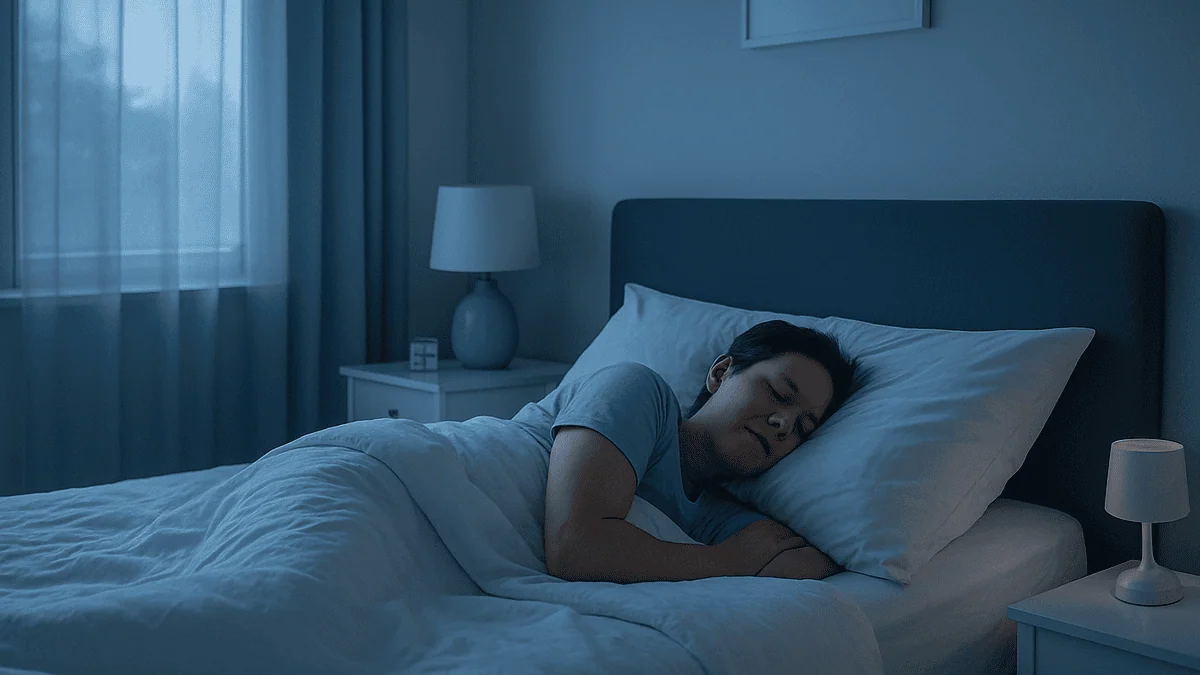
No single sleep position is best for everyone. Side sleeping suits most adults: it keeps the upper airway more open, reduces snoring and, on the left side, may ease nighttime reflux. Sleeping on your back supports a neutral spine but tends to worsen snoring and sleep apnea. Stomach sleeping twists the neck and arches the lower back. Breathing, pain and comfort, not trends, should decide.
If your feed has recently filled with confident strangers insisting that one way of lying down will drain toxins from your brain, flatten your face or wreck your spine, you are not imagining it. As of mid-2025, sleep position has become one of the most-searched sleep topics online, pushed along by short videos that promise a single correct posture and warn darkly about all the others.
The real picture is both more modest and more useful. Doctors have studied how people lie in bed for decades, mainly because position matters a great deal for three specific things: how freely air moves through the throat, how much stomach acid creeps upward overnight, and how the neck and lower back are held for seven or eight hours at a stretch.
Some of that research is strong enough to shape national guidance. Some of it rests on a handful of volunteers wired to pressure sensors. And some of the loudest claims rest on a few dozen rats. This guide sorts out which is which.
What changed recently in sleep position advice
The current surge of interest did not come from a new trial. It came from the collision of two older bodies of evidence with a very new way of sharing health tips. Still, the official ground has shifted in a few dated, verifiable ways worth knowing.
In June 2022 the American Heart Association added sleep to its list of core heart-health measures, renaming the checklist Life’s Essential 8. That was a formal statement that how you sleep, not just how long, belongs in the same conversation as blood pressure and cholesterol. It did not endorse a specific posture, but it moved sleep from the margins of cardiovascular advice to the center.
Infant guidance has been stable for longer, and it is the clearest position recommendation in all of medicine. The NIH-led Safe to Sleep campaign, which began in 1994 as Back to Sleep, continues to advise that babies be placed on their backs for every sleep until their first birthday. US sudden infant death rates fell by roughly half in the years after the campaign launched, one of the largest public-health effects ever tied to a change in sleep position.
For adults, the newer movement has been in reflux care. Mayo Clinic and NHS guidance now routinely list two positional measures alongside diet changes: raising the head of the bed and avoiding lying down soon after meals. Evidence that the left side specifically reduces acid exposure, discussed below, has grown over the past few years.
What has not changed is the lack of any guideline telling healthy adults to adopt a single position. The viral certainty on this point is not reflected in the medical literature.
How sleep position affects breathing, snoring and sleep apnea
Lie flat on your back and gravity pulls the tongue and soft palate toward the back of the throat. The airway narrows, air moves faster through the gap, soft tissue vibrates, and the result is snoring. Narrow it further and the airway can close entirely for ten seconds or more. That repeated closure is obstructive sleep apnea, a condition in which breathing stops and restarts during sleep because the throat collapses.
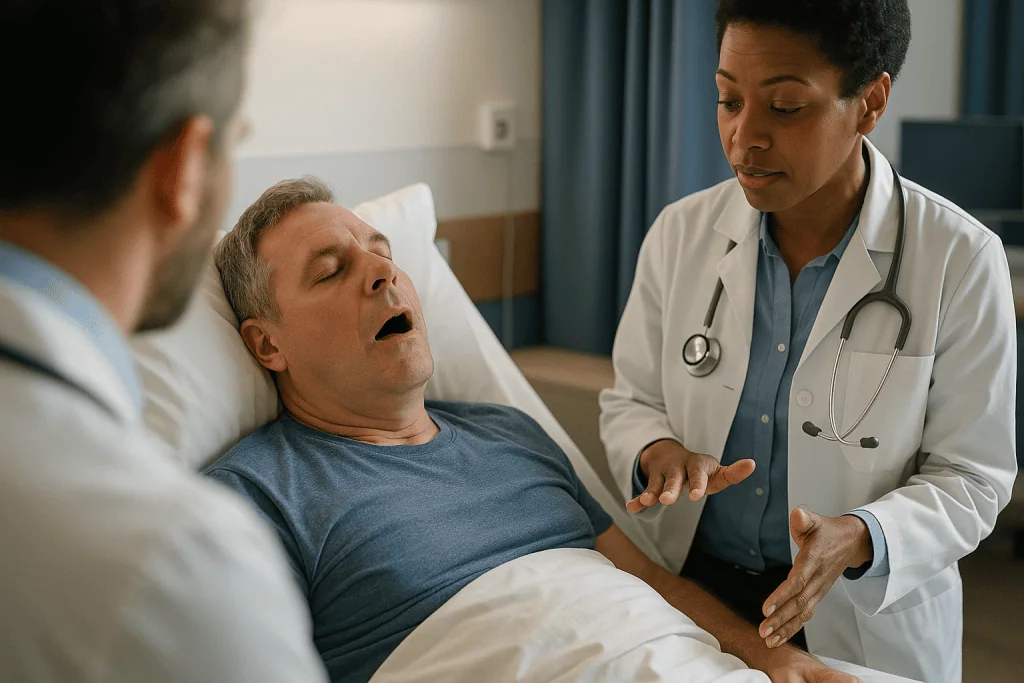
Position is not a minor factor here. Sleep-laboratory studies have long shown that many people have far more breathing pauses on their backs than on their sides, a pattern clinicians call positional sleep apnea, meaning apnea that is at least twice as frequent when lying face-up. Estimates vary, but roughly half of adults with mild to moderate sleep apnea fall into this category.
Turning onto the side changes the geometry. The tongue falls sideways rather than backward, the throat stays wider, and both snoring and pauses often ease. Stomach sleeping also keeps the airway open, which is why some heavy snorers drift toward it, though it carries other costs for the neck and back.
Two cautions keep this in proportion. First, position helps most when apnea is mild; severe apnea usually persists in every posture and needs treatment that a sleep specialist prescribes. Second, a quieter night is not proof the problem is solved. Breathing pauses can continue silently on the side. Anyone whose partner reports gasping or choking sounds should treat that as a reason for assessment, not as a cue to experiment with pillows.
Sleeping on your back: who it helps and who it harms
Supine sleeping, the clinical word for lying face-up, has one real advantage: with a modest pillow, the head, neck and spine rest in a roughly straight line, and body weight spreads evenly across the mattress rather than loading one shoulder or hip. Physical therapists often suggest it for people with shoulder pain for exactly that reason, sometimes with a pillow tucked under the knees to soften the arch of the lower back.
Skin specialists add a smaller point. Pressing one side of the face into a pillow for years can deepen sleep lines on that cheek. The evidence is observational and the effect is cosmetic, but it is real.
The downside is the airway, as the previous section explained. Back sleeping is the position most strongly linked to snoring and to more frequent breathing pauses. For a person with no breathing problems, that is not a reason to avoid it. For a person who snores loudly or has been diagnosed with sleep apnea, it is often the position a sleep specialist asks them to avoid.
Pregnancy is the other situation where guidance is specific. The NHS advises people to go to sleep on their side from 28 weeks onward, because observational studies have linked settling to sleep on the back in late pregnancy with a higher risk of stillbirth. The likely mechanism is the weight of the uterus compressing the large vein that returns blood to the heart. The absolute risk remains low, and waking up on the back is not a cause for alarm; the advice concerns the position you fall asleep in.
Side sleeping: the position most guidelines quietly favor
Ask sleep clinicians, gastroenterologists and obstetricians which posture they would pick for a patient with no other information, and most land on the side. Not because side sleeping has been proven superior in a large randomized trial, but because it rarely makes anything worse and often makes two things better.

The first is breathing. Lateral sleeping, the clinical term for lying on one side, keeps the throat wider and reduces both snoring and positional breathing pauses. Devices that nudge sleepers off their backs, from tennis balls sewn into pajamas to vibrating belts, exist precisely because the lateral position works for a subset of people with apnea.
The second is reflux, covered in detail in the next section, where the left side has a specific anatomical edge.
Side sleeping also happens to be what most adults already do. Surveys consistently find it is the most common posture, chosen by well over half of people for most of the night, with the proportion rising with age as the joints and spine become less tolerant of other positions.
Its weaknesses are mechanical. Shoulder and hip pain can flare when one side bears the load for hours. The top leg tends to slide forward and twist the pelvis, which is why a pillow between the knees is the single most common piece of advice for side sleepers with lower-back pain. And a pillow that is too thin lets the head drop toward the mattress, bending the neck sideways all night. The fix is a pillow roughly as thick as the distance from the ear to the outside of the shoulder.
Left side or right side: does it matter for acid reflux?
Gastroesophageal reflux disease, usually shortened to GERD, is the condition in which stomach acid flows backward into the esophagus, the tube connecting the throat to the stomach, often enough to cause heartburn or damage. Nighttime reflux is particularly unpleasant because lying flat removes gravity’s help in keeping acid down.
Here the two sides are not equal. The stomach sits mostly to the left of the midline, and the junction where the esophagus meets it is on the stomach’s upper right edge. Lie on the left and the stomach hangs below that junction, so any acid pools away from the opening. Lie on the right and the stomach sits above it, the valve between the two, called the lower esophageal sphincter, tends to relax more often, and acid can wash upward.
Studies using small sensors placed in the esophagus to measure acid overnight have shown this repeatedly: acid exposure and the time taken to clear it are both greater on the right side than the left. These are small crossover studies in which the same volunteers sleep in each position, so the evidence is physiological and consistent rather than large-scale. A small randomized trial of a wearable device that keeps sleepers on their left side reported fewer reflux symptoms, which adds modest support.
Raising the head of the bed by roughly 15–20 cm, using blocks under the bed legs or a wedge under the mattress, is recommended by Mayo Clinic and the NHS. Stacking ordinary pillows does not work as well, because it bends the body at the waist rather than tilting the whole torso. Neither measure replaces a prescribed treatment plan; anyone already taking medication for reflux should keep taking it exactly as directed.
Sleeping on stomach: is it really as bad as the videos claim?
Prone sleeping, lying face-down, is the position with the worst reputation online, and the mechanics do justify some of it. To breathe, a stomach sleeper must turn the head sharply to one side, often close to 90 degrees, and hold it there for hours. That twists the upper neck joints and shortens the muscles on one side. The pelvis sinks into the mattress, exaggerating the inward curve of the lower back. Many stomach sleepers wake with a stiff neck or a dull ache above the hips and never connect the two.
Against that, stomach sleeping keeps the airway open and snoring tends to be minimal. A few people with mild positional apnea sleep better on their fronts than on their backs.
So is it unhealthy? For a comfortable adult who wakes without pain, there is no evidence that stomach sleeping shortens life or damages the spine over time. The claims circulating that it compresses the heart or lungs do not hold up: the ribcage is designed to carry body weight, and healthy lungs inflate adequately in every position.
The honest summary is that stomach sleeping is the position most likely to produce morning aches and the least adaptable to pillows and supports. People who wake sore but cannot fall asleep any other way can reduce the strain with a very thin pillow or none at all under the head, and a flat pillow under the pelvis to level the lower back.
It is also the position to avoid completely for infants under one year, for the safety reasons explained earlier, and the one most pregnant people abandon naturally once the abdomen makes it impossible.
Sleep position and the spine: what the evidence actually says about back and neck pain
Here is where a careful writer has to lower the volume. Advice about sleep position and back pain is everywhere, delivered with great confidence, and almost none of it comes from controlled trials. What exists is a mix of small mechanical studies, pressure-mapping experiments and the collective experience of physical therapists. That is useful expert opinion, and it is honest to call it that rather than proven fact.
Within those limits, a few principles recur across sources such as the NHS and Mayo Clinic. The spine has natural curves at the neck and lower back; a position that preserves those curves without exaggerating them is likely to feel better than one that bends or flattens them. Side sleepers achieve this with a pillow that fills the gap between ear and shoulder and another between the knees. Back sleepers achieve it with a lower pillow and something under the knees. Stomach sleepers struggle to achieve it at all.
Mattress firmness interacts with all of this. A surface so soft that the hips sink below the shoulders bends a side sleeper’s spine into a sideways curve; one so hard that the hips cannot sink at all leaves a side sleeper’s waist unsupported. Medium-firm surfaces have the best, if still limited, trial support for people with chronic lower-back pain.
The most important point is also the least dramatic. Pain that is present on waking and fades within an hour is usually positional and responds to pillows and mattress changes. Pain that worsens through the night, wakes you repeatedly, or comes with numbness or weakness in the legs is a different matter and belongs with a clinician, not a sleep hack.
What the evidence actually says, graded by strength
Readers deserve to know how much weight each claim can carry. The grading below follows the usual hierarchy: randomized controlled trials rank highest, well-designed observational studies in people come next, physiological studies in small groups follow, and expert opinion or animal data sit at the bottom.
Infants should sleep on their backs. This rests on large population studies across several countries showing dramatic falls in sudden infant death after back-sleeping campaigns. No randomized trial could ethically be run, but the consistency and size of the effect make this the strongest position recommendation in medicine.
Side sleeping reduces breathing pauses in positional sleep apnea. Supported by decades of sleep-laboratory data in humans and by several small randomized trials of positional devices. Strong for mild to moderate apnea; weak for severe disease, where position matters little.
Left-side sleeping reduces nighttime acid exposure. Supported by consistent small physiological crossover studies using acid sensors, plus one small randomized device trial. Moderate evidence for the mechanism; modest evidence that symptoms improve.
Side sleeping in late pregnancy lowers stillbirth risk. Based on case-control studies in several countries, pooled in meta-analysis. Observational, so causation is inferred rather than proven, but the mechanism is plausible and national guidance has adopted it.
Specific positions relieve back or neck pain. Mostly expert opinion and small mechanical studies. Reasonable to try, but no one should expect a guaranteed result.
Side sleeping clears brain waste. One 2015 study in rodents found slightly better clearance in the lateral position. No human study has shown this, and the finding should be treated as a hypothesis, not a reason to change habits.
Back, side or stomach: a side-by-side comparison
The table pulls the preceding sections into one view. It describes typical effects in healthy adults; individual anatomy, body weight and existing conditions shift the balance, which is why the final column matters more than any single row.
| Position | Breathing and snoring | Spine and joints | Reflux | Often suggested for | Often advised against for |
|---|---|---|---|---|---|
| Back (supine) | Airway narrowest; most snoring and breathing pauses | Neutral alignment with low pillow; pillow under knees eases lower back | Acid clears slowly when flat; head-of-bed elevation helps | Shoulder pain, hip pain, facial sleep lines | Loud snoring, sleep apnea, late pregnancy, infants under one year are the exception and should always be on the back |
| Left side | Airway wider; less snoring | Needs pillow filling ear-to-shoulder gap and one between knees | Stomach sits below the esophageal junction; least acid exposure | Nighttime heartburn, mild positional apnea, late pregnancy | Left shoulder or hip pain |
| Right side | Airway wider; less snoring | Same support needs as left side | More acid exposure and slower clearance than left side | Mild positional apnea, general comfort | Frequent nighttime reflux |
| Stomach (prone) | Airway open; minimal snoring | Neck rotated for hours; lower back arched; hardest to support | Pressure on abdomen may push contents upward | Rarely recommended; some snorers tolerate it | Neck pain, lower-back pain, pregnancy, all infants |
Two patterns stand out. The side positions are the only ones with no major strike against them for breathing or reflux, which is why they appear so often in clinical advice. And every position has a support strategy that can rescue its weak point, with the single exception of the stomach, whose problem is built into the neck rotation it demands.
What is the healthiest position to sleep in?
The question people type most often has an answer that will frustrate anyone who wants a single word: it depends on what your body is dealing with, and for a healthy adult who wakes rested and pain-free, the healthiest sleep position is the one they are already in.
That is not a dodge. People shift position many times a night without waking, and the brain seems to do a reasonable job of moving the body when one posture becomes uncomfortable. Trying to override that with willpower usually means lighter, more fragmented sleep, which is a worse outcome than any posture.
Where a clear answer does exist, it is driven by a specific condition. For someone who snores or has mild sleep apnea, the side is healthier than the back. For someone with nighttime heartburn, the left side is healthier than the right, and both are healthier than lying flat on the back without the bed raised. For someone in the third trimester of pregnancy, either side is advised over the back. For an infant, the back is the only recommended option.
If pressed for a default for an adult with no such condition, most clinicians would name side sleeping with proper pillow support, because it is the posture with the fewest known downsides. That is a judgment call built on mechanisms and modest evidence, not a finding from a trial in which healthy people were assigned positions and followed for years. No such trial exists, and given how often people move during the night, it is hard to imagine one being possible.
What matters most, in this writer’s view, is not the position itself but whether it is producing a symptom: snoring, heartburn, a stiff neck, numb arms. Symptoms are the signal to change; a video is not.
Which sleep position should you not sleep in? The genuinely unhealthy cases
The phrase unhealthy sleep position is searched thousands of times a month, usually by people who have just been told their habit is dangerous. The useful answer separates situations where guidance is firm from those where it is simply a matter of comfort.
Firm guidance covers three groups. Infants under one year should never be placed on their stomachs or sides to sleep; the back is the only recommended position, on a firm, flat surface without soft bedding. People in late pregnancy are advised to settle to sleep on their side rather than their back. People diagnosed with positional sleep apnea are usually asked by their specialist to avoid their backs, sometimes with a device to help.
Beyond those groups, no position is forbidden. Stomach sleeping is the one most likely to produce aches, and back sleeping is the one most likely to produce snoring, but neither is unhealthy for an adult who tolerates it without symptoms.
Two position-related habits deserve more suspicion than any posture. The first is sleeping propped on a high stack of pillows to ease breathing, which can be a sign that lying flat causes breathlessness, something that warrants medical review rather than more pillows. The second is sleeping with an arm under the head or pillow for long stretches, which can compress nerves at the shoulder and elbow and cause numbness or tingling in the hand on waking. Occasional pins and needles that fade quickly are harmless; a hand that stays numb or weak into the morning should be assessed.
The pattern throughout is that position becomes unhealthy when it is paired with a condition, not on its own.
What is the rarest sleeping position, and does it matter?
Surveys of adults in several countries agree on the broad ranking. Side sleeping is by far the most common, chosen by well over half of people for most of the night. Back sleeping comes next. Stomach sleeping is the rarest, reported as the main position by fewer than one in ten adults, and the proportion falls further with age as the neck and lower back become less willing to tolerate it.
Popular articles subdivide these into named postures: the fetal curl, the log with arms straight down, the starfish with arms up on the back, the freefall face-down with arms around the pillow. Of these, the starfish and the freefall are usually described as the rarest. The names are catchy and the personality claims attached to them are entertainment, not science. No study has reliably linked a sleep posture to character traits, and the surveys that produce the rankings rely on people reporting a position they are, by definition, unconscious during.
The more interesting finding from camera and sensor studies is how much people move. Most adults change position many times a night, often a dozen or more, usually during brief arousals they do not remember. The question of which position someone sleeps in is really a question about which one they spend the most time in, and that can differ from the one they fall asleep in.
Does rarity matter for health? Not directly. A position is not harmful because few people use it. Stomach sleeping is rare and also mechanically awkward, but the two facts are related through comfort, not through danger. Someone who sleeps soundly in the freefall position and wakes without pain has no reason to change on the grounds of being unusual.
Common myths about sleep position, corrected
The current wave of videos recycles a handful of claims that sound medical and are not. Here is what the evidence actually shows for each.
Myth: sleeping on your left side drains toxins from your brain. The brain does have a waste-clearing network, called the glymphatic system, which flushes fluid through brain tissue mainly during sleep. A 2015 study found that anesthetized rodents cleared a tracer slightly faster when lying on their sides than on their backs or stomachs. That is the entire human-relevant evidence base: there is none in humans. Side sleeping may be sensible for other reasons, but brain detox is not one of them.
Myth: sleeping on your right side damages the heart. There is no evidence of this in people with healthy hearts. Some people with heart failure find the left side uncomfortable and prefer the right, which is a symptom worth mentioning to their doctor, not a hazard of the position itself.
Myth: stomach sleeping is safe because it stops snoring. Stomach sleeping does tend to reduce snoring, but silence is not the same as healthy breathing, and the position carries real costs for the neck and lower back. It is also the one position that must never be used for infants.
Myth: a specific position prevents wrinkles. Pressing one cheek into a pillow for years can deepen lines on that side, and back sleeping avoids that pressure. The effect is modest and cosmetic; sunlight and smoking matter far more for skin aging.
Myth: everyone should train themselves into one correct position. Healthy sleepers move many times a night. Fighting that produces lighter sleep. Position changes are worth the effort only when they target a specific symptom.
How to change your sleep position without losing sleep
Suppose a specific reason has emerged: a partner reports snoring that stops on the side, heartburn is worse after nights spent on the right, or the neck aches every morning after stomach sleeping. Changing a lifelong habit is possible, and the most effective methods come from sleep clinics rather than social media.
Start by making the target position comfortable before trying to stay in it. For side sleeping, that means a pillow thick enough to keep the head level with the spine and a second pillow between the knees. Many people who think they cannot sleep on their side are actually reacting to a neck bent sideways by a pillow built for back sleepers.
Then make the old position mildly awkward. The classic approach for back sleepers with snoring is a firm object, such as a tennis ball, in a pocket sewn or pinned to the back of a sleep shirt; rolling onto it prompts an unconscious shift to the side. Full-length body pillows serve the same purpose for people who roll forward onto their stomachs. Wearable devices that vibrate gently when the sleeper lies face-up exist and have small trial support for positional apnea, though they are usually introduced through a sleep specialist.
For reflux, the structural change is raising the head of the bed, as discussed earlier. Combine it with finishing meals three hours before lying down.
Give any change two to three weeks. Early nights are often lighter as the body adjusts. If sleep remains fragmented after that, or the symptom that prompted the change persists, the position was probably not the main cause, and that is useful information to bring to a clinician.
When to see a doctor about your sleep position and symptoms
Position changes are reasonable for mild snoring, occasional heartburn or morning stiffness. Certain signs mean the problem is bigger than posture and needs a clinician, who will decide what, if anything, should be prescribed. No one should start, stop or adjust any medication based on an article, including this one.
See a doctor about breathing during sleep if there is loud, regular snoring with pauses, gasping or choking sounds witnessed by someone else; waking unrefreshed despite enough hours in bed; falling asleep unintentionally during the day; morning headaches; or blood pressure that is hard to control. These are recognized warning signs of sleep apnea, which is diagnosed by a sleep study, not by trying positions at home.
See a doctor about reflux if heartburn occurs more than twice a week, if swallowing is difficult or painful, if food feels stuck, if there is unintentional weight loss, persistent vomiting, or vomit that looks like coffee grounds or stool that is black. Chest pain that is new, severe, or comes with breathlessness, sweating or pain spreading to the arm or jaw needs emergency care immediately, because heartburn and heart attack can feel alike.
See a doctor about back or neck pain if it follows an injury or fall, wakes you repeatedly at night, comes with fever, numbness or weakness in the legs, or any change in bladder or bowel control; the last of these needs same-day assessment.
In pregnancy, any noticeable reduction in the baby’s movements should be reported the same day, regardless of sleep position. And for infants, any difficulty breathing, blue or grey color around the lips, or unusual limpness is an emergency.
Everything else, including the question of whether your usual position suits you, is fair to raise at a routine appointment.
Frequently asked questions
What is the healthiest position to sleep in?
For a healthy adult who wakes rested and pain-free, the healthiest sleep position is the one they already use. Where a condition is present the answer sharpens: the side for snoring or mild sleep apnea, the left side for nighttime reflux, either side in late pregnancy, and the back for every infant under one year. No trial has assigned healthy adults to positions and followed them long term.
Is sleeping on your back bad for you?
Not for most people. Sleeping on your back keeps the spine in neutral alignment and spreads weight evenly. Its drawback is the airway: the tongue falls backward, so snoring and breathing pauses are more frequent. People with sleep apnea, loud snoring, or who are past 28 weeks of pregnancy are generally advised to favor their sides, while infants should always sleep on their backs.
Is side sleeping better on the left or the right?
For reflux, the left is better. The stomach sits mostly left of center, so lying on the left keeps acid pooled below the opening of the esophagus, and studies with acid sensors show less exposure and faster clearance than on the right. For breathing and spine comfort, the two sides are equivalent, so people without heartburn can choose whichever shoulder and hip tolerate the load.
Is sleeping on stomach bad for your spine?
It is the position most likely to cause morning neck and lower-back aches, because the head must turn sharply to one side for hours and the pelvis sinks, arching the lower back. There is no evidence it causes lasting spinal damage in adults who wake comfortable. A thin or absent head pillow and a flat pillow under the pelvis reduce the strain for people who cannot sleep any other way.
Which position should you not sleep in?
Firm advice exists for three groups: infants should never be placed on their stomachs or sides; people in late pregnancy are advised against falling asleep on their backs; and people with positional sleep apnea are usually asked by their specialist to avoid lying face-up. For everyone else, no position is forbidden. A posture becomes a problem when it produces symptoms such as snoring, heartburn, numbness or pain.
What is the rarest sleeping position?
Stomach sleeping is the rarest main position among adults, reported by fewer than one in ten in surveys and declining with age. Within popular posture names, the face-down freefall and the arms-up starfish are usually listed as least common. Rarity has no bearing on health; most adults also change position many times a night, so the position you fall asleep in is not necessarily the one you spend most time in.
What is the best sleep position for acid reflux?
The left side, combined with raising the head of the bed by about 15–20 cm using blocks under the legs or a wedge under the mattress. Both measures appear in Mayo Clinic and NHS guidance. Finishing meals about three hours before lying down adds to the effect. Anyone already prescribed treatment for reflux should continue it as directed and raise persistent symptoms with their clinician.
Does side sleeping help sleep apnea?
Often, if the apnea is mild to moderate and position-dependent, which describes roughly half of people with those grades. Sleep-laboratory studies show fewer breathing pauses on the side, and small randomized trials of devices that keep sleepers off their backs support the effect. Severe apnea usually persists in every position. Quieter breathing is not proof of resolution, so suspected apnea still needs a sleep study.
Does sleeping on your left side drain the brain?
There is no human evidence for this. The brain’s glymphatic system does clear waste during sleep, and one 2015 study found slightly faster clearance in anesthetized rodents lying on their sides. That single animal finding is the entire basis for the viral claim. Side sleeping has reasonable support for breathing and reflux, but brain detox should be regarded as an untested hypothesis.
What is an unhealthy sleep position in pregnancy?
From about 28 weeks, the NHS advises going to sleep on your side rather than your back, because observational studies link settling to sleep face-up in late pregnancy with a higher stillbirth risk, probably through pressure on the main vein returning blood to the heart. The absolute risk is low. Waking up on your back is not a cause for alarm; simply turn onto your side again.
References
- MedlinePlus: Sleep Apnea
- NHS: Heartburn and acid reflux
- NIH Eunice Kennedy Shriver NICHD: Safe to Sleep campaign
- NHS: Back pain
This article is for general information only and is not a substitute for professional medical advice. Please consult a qualified doctor about your individual situation.

More from the Blog
Blue Light and Sleep: How Much Screens Really Matter, According to the Research
Blue light from screens can delay melatonin release and shift the body clock, but the effect of typical evening phone use is modest. Laboratory…

Mattress Firmness and Back Pain: What the Evidence Says About Medium-Firm
The best-studied answer is medium-firm. In a randomized trial of 313 adults with chronic low back pain, people given a medium-firm mattress reported less…
Sleep Restriction Therapy: The Counterintuitive Insomnia Treatment That Works
Sleep restriction therapy is a structured part of cognitive behavioral therapy for insomnia that temporarily limits time in bed to roughly the hours a…
Exercise Before Bed: Does Evening Training Ruin Sleep? What the Trials Say
For most healthy adults, exercise before bed does not ruin sleep. Randomized trials show moderate evening workouts leave total sleep time and deep sleep…
Sleeping Too Much: When Long Sleep Is a Symptom Rather Than a Luxury
Sleeping too much is usually defined as regularly needing more than nine hours a night and still feeling unrefreshed. It can be a normal…
Cognitive Shuffling: The Fall-Asleep Trick Backed by a Small Study
Cognitive shuffling is a bedtime technique in which you picture a random series of unrelated, emotionally neutral objects, often by working through the letters…