

Staged Excision for Larger Tattoos: How Surgeons Remove Tattooed Skin in Steps

Key Takeaways
- Staged tattoo excision removes a large tattoo in two or more operations so the surrounding skin can stretch between stages, avoiding the wide scars and wound breakdown that come from closing a big defect under tension.
- Excision removes ink completely regardless of color, which is why it is often chosen for green, yellow, white or layered cover-up tattoos that laser struggles with.
- Every excision leaves a permanent scar, usually longer than the tattoo was wide but much thinner; the goal of staging is a fine line, not invisible skin.
- Wounds typically seal within about two weeks, but scars keep changing for a year or more, so the final appearance cannot be judged until long after the last stage.
- Ink removed by excision leaves the body inside the excised skin, so the liver-toxicity worry attached to laser removal, which itself lacks clinical evidence, does not apply.
- A history of keloids, smoking, poorly controlled diabetes or tattoos over tight skin such as the shin or hand are the usual reasons surgeons advise waiting or choosing another method.
Staged tattoo excision is a surgical approach in which a larger tattoo is cut out in two or more planned operations, spaced weeks to months apart, so the surrounding skin can stretch and be closed neatly each time. It removes ink completely in the treated area but leaves a permanent surgical scar, and surgeons usually reserve it for tattoos that are too large or ink-dense for a single excision or for laser alone.
The tattoo covers most of his forearm, a dense block of black shading he chose at nineteen. Three laser sessions have faded the edges into a gray smudge that somehow looks worse than the original. Now a plastic surgeon is sketching dotted lines on his arm and explaining that removing it will take more than one operation. He came in hoping for a clean ending. He is leaving with a schedule.
That is the ordinary reality of staged tattoo excision. It is not a single dramatic procedure but a series of smaller ones, each removing a strip of tattooed skin and borrowing a little elasticity from the skin around it. The idea is old, borrowed from how surgeons remove large birthmarks and scars, and the trade is honest: ink disappears, a scar takes its place.
This explainer walks through what the surgery involves, why it is done in steps, what healing typically looks like, and where the myths about surgical tattoo removal fall apart under the evidence.
What is staged tattoo excision, and why remove skin in steps?
Excision means cutting the tattooed skin out entirely, then bringing the healthy skin edges together with stitches. When the tattoo is small, a surgeon can do this in one sitting. When it is large, pulling the edges together would put the wound under so much tension that it could split open, heal with a wide scar, or distort nearby structures such as a joint crease or the shape of a limb.
Staged tattoo excision, also called serial excision, solves that problem with patience. In the first operation the surgeon removes only the central portion of the tattoo, usually as an elongated ellipse, and closes the wound. Over the following weeks the skin on either side gradually stretches. Skin does this through two related properties: mechanical creep, the immediate give of skin fibers under steady pull, and biological creep, the slower process in which skin under sustained tension actually grows more surface area. Once that stretch has happened and the scar has settled, the surgeon returns, removes the old scar together with the next band of ink, and closes again. The cycle repeats until the last of the tattoo is gone and only a single linear scar remains.
The NHS notes that surgical removal is generally practical only for smaller tattoos, precisely because of this tension problem. Staging is the workaround that extends surgery to bigger designs, at the cost of more operations and more time. Whether that trade makes sense for a particular tattoo, body site and person is a judgment the treating surgeon makes after examining the skin, not something a diagram can decide.
What actually happens during a staged excision session
Most stages are done under local anesthetic, meaning the skin is numbed with an injection while the person stays awake. Larger areas or awkward sites sometimes call for sedation or a general anesthetic; the anesthesia team decides based on the size of the planned excision and the person’s health. The Mayo Clinic describes surgical tattoo removal as a same-day procedure in the great majority of cases.
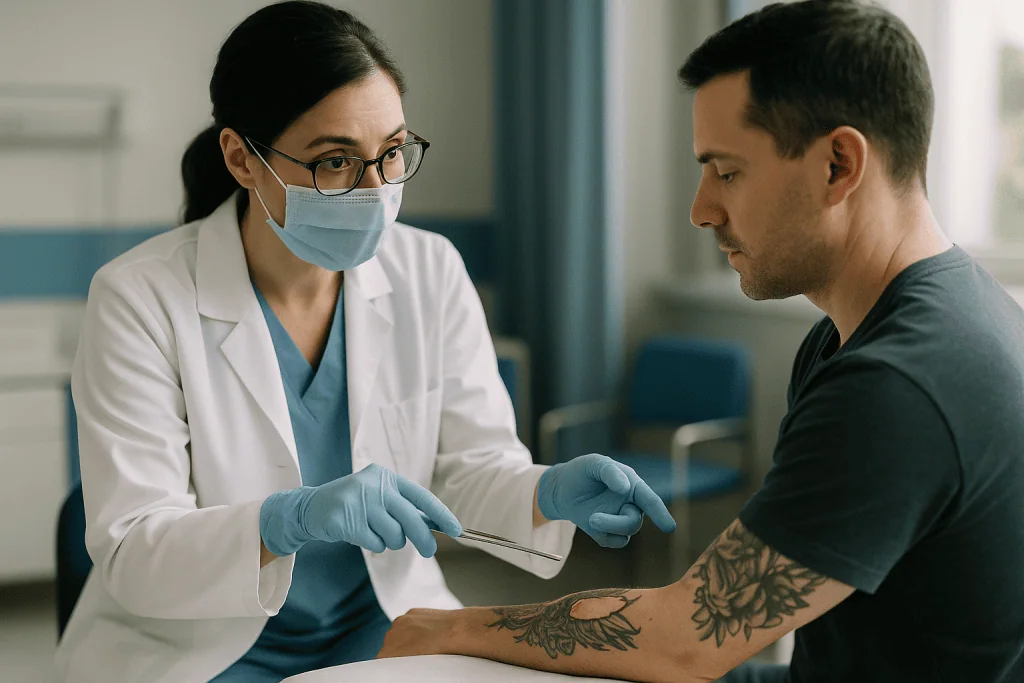
The surgeon first marks the planned ellipse with a skin pen, checking that its long axis runs along the natural tension lines of the skin so the eventual scar sits where it will be least visible and least likely to widen. After numbing, the marked skin is removed down to the fatty layer beneath. The surgeon may then free the skin edges from the underlying tissue for a short distance, a technique called undermining, which lets the edges slide together with less pull.
Closure usually happens in two layers. Deep, dissolvable stitches take the tension. A finer row at the surface lines up the skin edges; these may be dissolvable or may need removing at a follow-up visit. A dressing goes on, and the person typically leaves within an hour or two with instructions on keeping the wound clean and dry.
Each later stage follows the same steps but starts by cutting out the previous scar so that the final result is one line rather than several. Between stages, some surgeons add adhesive tapes or a pressure garment to support the scar; the evidence for these is modest and their use varies. What no stage involves is any process that fades ink chemically or thermally: the ink leaves the body inside the removed skin, which is why excision does not depend on tattoo color.
Who is usually offered staged excision, and who is asked to wait
Surgeons tend to consider staged tattoo excision when three things line up: the tattoo is too large or awkwardly placed for single excision, laser has been tried or ruled out, and the person accepts a permanent scar in exchange for complete ink removal. Common situations include dense black or heavily colored tattoos that resist laser, tattoos with pigments that darken rather than lighten under laser light, cover-up tattoos with several ink layers, and tattoos sitting over tissue that needs examination for another reason.
Body site matters as much as size. Areas with loose, mobile skin, such as the upper arm, back or abdomen, stretch readily between stages. Skin over the shin, ankle, hand or upper chest has far less give and scars more visibly, so surgeons are cautious there.
Several groups are usually asked to wait or advised toward other options:
- People with a personal or family history of keloids, which the Mayo Clinic describes as raised scars that grow beyond the original wound; any incision can trigger a new one.
- Smokers, because nicotine narrows small blood vessels and slows wound healing; many surgeons ask for a period of abstinence before elective skin surgery.
- People with poorly controlled diabetes, active skin infection at the site, or conditions and medicines that impair healing or raise bleeding risk.
- Anyone with a fresh tattoo; surgeons generally want the skin fully healed and settled first.
- Pregnancy, where elective surgery is normally deferred.
None of these are absolute bans. They are reasons for a longer conversation, and sometimes for treating the underlying issue before the first stage is booked. The decision belongs to the person and the surgical team together.
Staged excision vs single excision vs laser: how surgical tattoo removal compares
The three mainstream routes to getting rid of a tattoo differ less in their goal than in what they ask of the person. Laser treatment uses short pulses of light absorbed by ink particles, shattering them into fragments that immune cells carry away over time. Single excision removes small tattoos in one operation. Staged excision extends surgery to larger ones. The table summarizes the trade-offs as described by the Mayo Clinic and the NHS.
| Feature | Laser removal | Single excision | Staged excision |
|---|---|---|---|
| Best suited to | Most tattoos, especially black ink on lighter skin | Small tattoos on loose skin | Larger tattoos where laser is unsuitable or has stalled |
| Number of visits | Several sessions, weeks apart | One operation plus follow-up | Two or more operations, each with follow-up |
| Ink outcome | Fading; some ink may remain, colors vary | Complete removal of treated area | Complete removal of treated area |
| Skin outcome | Possible lightening or darkening of skin; scarring uncommon but possible | Permanent linear scar | Permanent linear scar, longer than the tattoo’s width |
| Main limitation | Color, ink depth and skin tone affect response | Size | Time, number of procedures, scar length |
A fourth option, dermabrasion, sands away the upper skin layers; the Mayo Clinic lists it as less commonly used because results are unpredictable. Skin grafting, where tattooed skin is replaced with skin from elsewhere, is occasionally used for very large areas but leaves a visible patch and a second wound at the donor site, so most surgeons prefer staging when the skin allows it.
Which route is right depends on the tattoo, the skin and the person’s tolerance for scars versus sessions. A surgeon who offers only one method should be able to explain why the others are not suitable in your case.
How long does tattoo excision take to heal?
Healing after excision follows the same stages as any surgical wound, and the timeline depends more on the body site and closure tension than on the tattoo itself. The first few days bring swelling, bruising and a pulling sensation along the incision. Pain is usually manageable with simple pain relief; the surgical team advises on what is appropriate, since some common over-the-counter pain relievers thin the blood and are often avoided in the first days.
Stitch removal, where surface stitches are not dissolvable, typically happens within one to two weeks depending on location, with longer intervals for areas under more movement such as joints. MedlinePlus describes the early wound as most vulnerable to infection and separation during this window, which is why surgeons ask people to avoid stretching, heavy lifting and soaking the wound.
By around two to three weeks the incision has usually sealed and gained enough strength for normal daily activity, though sport and heavy exertion involving the area are often held back longer. The scar itself continues changing well after that. The Cleveland Clinic notes that scars commonly look red, raised and firm for months before gradually flattening and fading, and that full maturation can take a year or more.
For staged excision this matters in two ways. First, the interval between stages is set partly by scar healing: surgeons want the wound strong and the skin relaxed before operating again. Second, the final appearance cannot be judged after the last stage. Someone who finishes a three-stage removal should expect to wait many months before knowing what the settled scar truly looks like. Tattoo excision healing time, in other words, is measured in weeks for the wound and in months for the result.
How many stages does serial excision usually take, and how far apart?
There is no guideline that fixes the number of stages or the gap between them, and anyone quoting a precise figure before examining the skin is guessing. What surgeons work from is a set of principles.
The number of stages depends on how much skin can be removed each time without excessive tension. A useful rule of thumb many surgeons use is that each stage can safely remove a strip roughly as wide as the surrounding skin will comfortably give, which is greater on the trunk and upper arm than on the lower leg or hand. A palm-sized tattoo on the upper arm might need two stages; a similar tattoo over the shin might need three or four, or might be judged unsuitable for excision altogether.
The interval between stages is governed by two processes running in parallel. The wound needs to regain enough tensile strength that cutting next to it and pulling again will not cause it to break down. The skin around it needs time to creep, meaning to relax and expand under the sustained pull of the previous closure. Both take weeks to a few months. Surgeons generally examine the scar and pinch the skin at follow-up to decide when it is ready, rather than working to a fixed calendar.
A few practical consequences follow. A three-stage removal is realistically a project lasting the better part of a year once healing intervals are included. Each stage carries its own small anesthetic and infection risk. And because each stage removes the previous scar, the final scar is usually longer than the original tattoo was wide, because ellipses need pointed ends to close flat.
Some surgeons shorten the process with a tissue expander, a silicone balloon placed under nearby skin and gradually inflated with saline over weeks to grow extra skin. It adds an operation and a period of visible swelling, so it is reserved for select cases.
What does the tattoo removal scar look like after staged excision?
Every excision leaves a scar. That sentence deserves to be repeated because it is the single most common source of disappointment. The aim of staging is to make that scar a thin, flat line lying along the skin’s natural creases, not to avoid it.
Fresh scars are typically pink or red and slightly raised. Over months they usually pale and soften. On lighter skin the mature scar often ends up paler than surrounding skin; on darker skin it may end up darker or lighter, and the Cleveland Clinic notes that people with more melanin have a higher tendency toward raised and thickened scars. Scar width matters more than length for how noticeable it is. A long, hairline scar draws less attention than a short, wide one, which is why surgeons fuss over tension and closure technique.
Two scar problems come up repeatedly in consultations. Hypertrophic scars are raised, red and thick but stay within the boundary of the original wound; they often improve slowly on their own. Keloids extend beyond the wound edges and may keep growing; the Mayo Clinic describes them as more common on the chest, shoulders, earlobes and upper back and in people with a family history. Both are reasons surgeons take a scar history seriously before offering excision.
Treatments exist for troublesome scars, including silicone sheets or gels, steroid injections into the scar, pressure therapy and laser resurfacing. Their evidence base is mixed and the treating team chooses among them case by case. What no treatment can offer is skin that looks as though nothing happened. Anyone considering staged tattoo excision should ask to see the surgeon’s own photographs of settled scars from similar body sites, understanding that these show possibilities, not a promise.
Risks and complications of staged tattoo excision
Excision is a low-risk operation in healthy people, but low is not zero, and staging multiplies exposure by the number of stages. Surgeons usually discuss the following.
- Bleeding and bruising. A collection of blood under the closed wound, called a hematoma, can stretch the incision and occasionally needs draining.
- Infection. MedlinePlus lists increasing redness, warmth, swelling, pain and pus as the typical signs; most surgical site infections respond to antibiotics chosen by the treating team, but an infected wound can widen the eventual scar.
- Wound dehiscence. This is the medical term for the wound edges separating. It is the specific risk that staging is designed to reduce, and it becomes more likely with tension, smoking, infection or early heavy activity.
- Nerve injury. Small sensory nerves in the skin are cut in any excision, leaving numbness around the scar that usually improves but may be permanent. Deeper nerves are rarely at risk on the limbs or trunk when the surgeon stays in the skin layer.
- Poor scarring. Wide, raised, depressed or discolored scars, described in the previous section.
- Contour changes. Removing skin over a curved surface can flatten or pull it; on the forearm this is rarely noticeable, near a joint or the breast it can be.
- Anesthetic reactions. Uncommon with local anesthesia; discussed separately if sedation or general anesthesia is planned.
- Residual ink. Deep or spread ink at the tattoo margin may remain and need a small touch-up excision or laser.
The NHS advises anyone considering cosmetic surgery to check that the surgeon is appropriately registered and trained for the procedure. A good consultation covers these risks in plain terms and records that they were discussed before consent is signed.
What's the hardest type of tattoo to remove?
The answer differs by method, and the difference explains why surgeons see certain tattoos more often than others.
For laser, difficulty is about ink chemistry and skin tone. Black ink absorbs light across a wide range of wavelengths and responds best. According to the Mayo Clinic, colors such as green, yellow and some blues absorb light less predictably and are harder to clear. White, flesh-toned and some red inks contain metal oxides that can darken permanently under laser, a reaction called paradoxical darkening, which is why practitioners test-spot cosmetic tattoos before treating. Professional tattoos are placed deeper and more densely than amateur ones and need more sessions. Cover-up tattoos stack ink layers and are among the most stubborn. Darker skin tones absorb more laser energy in the skin’s own pigment, raising the risk of lightened or darkened patches and limiting how aggressively the tattoo can be treated.
For excision, ink color is irrelevant because the ink leaves with the skin. The hard tattoos are defined by geometry instead: large surface area, placement over tight skin such as the shin or hand, position across a joint where a scar could restrict movement, and sites prone to poor scarring such as the sternum and shoulder. A wide, sprawling design on the calf can be harder to excise well than a larger one on the upper back.
This is why the two methods are often combined. Laser thins out the ink and shrinks the area that still needs removing; staged excision then takes care of what laser could not shift. The tattoo that is genuinely hardest for everyone is the large, multi-colored, layered cover-up over tight skin on a person prone to keloids. For that combination, honesty from the surgeon sometimes means advising that partial fading is the realistic goal.
Is tattoo removal hard on your liver?
This question surfaces constantly online, usually with a worried tone, so it deserves a mechanism-level answer.
When a tattoo is placed, ink particles lodge in the dermis, the deeper skin layer, where they are too large for immune cells to carry off. That is why tattoos are permanent. Laser removal works by fracturing those particles into smaller fragments. Immune cells called macrophages then engulf the fragments and transport them through the lymphatic system, the body’s drainage network, to the regional lymph nodes. Studies of lymph nodes in tattooed people have found ink pigment there, which is well documented and is where the online worry begins.
What the evidence does not show is liver injury from tattoo removal. The Mayo Clinic and NHS patient guidance on laser removal lists local effects such as skin lightening or darkening, blistering, infection and scarring; neither lists liver toxicity, and large clinical series have not reported it. The quantity of ink in a tattoo is small, its release is spread over months, and most of it is filtered in the lymph nodes rather than reaching the bloodstream in meaningful amounts. Some inks contain trace metals and some breakdown products of certain pigments raise theoretical concerns in laboratory studies, which is a fair reason for ongoing research, but a theoretical laboratory signal is not a clinical liver disease.
For staged tattoo excision the question largely dissolves. The ink is removed inside the excised skin and goes to the pathology laboratory or the clinical waste stream, not into the body. Nothing is broken down or circulated. Someone with existing liver disease should still tell the surgical team, because liver function affects clotting and anesthetic choices, but that is about the operation, not about the ink.
Partial tattoo removal: can excision be combined with laser or with a new tattoo?
Not everyone wants a tattoo gone entirely. Some want a name removed from a larger design, a section cleared to make room for a cover-up, or a laser-resistant patch dealt with surgically. Staged tattoo excision fits into all of these plans, with some caveats.
Removing part of a design is technically straightforward when the part sits at an edge or can be taken as an ellipse without cutting through detail people want to keep. A name in a banner across a forearm piece is a common example. The surgeon plans the ellipse to include the unwanted lettering and as little of the surrounding art as possible. The scar then runs through the design. On busy tattoos the line can be surprisingly easy to lose; on open, simple designs it stands out.
Combining laser and excision is the more common hybrid. Laser goes first to lighten the tattoo and reduce ink density, then excision removes the residual core. Because scar tissue absorbs laser energy differently and heals unpredictably, surgeons generally prefer to laser before cutting rather than after. The Mayo Clinic notes that laser can also be used afterward on the scar itself to soften its color and texture, which is a separate goal from removing ink.
Tattooing over an excision scar is possible once the scar has fully matured, which the Cleveland Clinic places at a year or more. Scar tissue holds ink less evenly than normal skin and has fewer nerve endings, so results and sensation both differ. Anyone planning a cover-up should tell the surgeon early; scar placement can sometimes be planned with the new design in mind, and tattoo artists experienced with scarred skin are worth seeking out.
What people often get wrong about surgical tattoo removal
Consultations for staged tattoo excision tend to circle the same misunderstandings. Correcting them early prevents regret later.
Myth: surgery removes the tattoo without a trace. Surgery removes the ink without a trace. It leaves a scar, always. Photographs online showing skin with no visible mark after excision are either very early, very well lit, heavily edited or not excisions at all. Several of the most-viewed before-and-after images circulating for tattoo removal have been shown to be fabricated or mislabeled, which is why the NHS encourages people to ask for a practitioner’s own results rather than relying on marketing.
Myth: staging means the surgeon is stretching out the work. Staging exists because skin has limited stretch. Trying to close a large defect in one go is what produces wide scars and wounds that fall open.
Myth: the final scar is the same size as the tattoo. It is usually longer, because ellipses need tapered ends to lie flat, and it is far thinner.
Myth: black tattoos are the hardest to remove. For laser, black is the easiest. For excision, color is irrelevant.
Myth: once the stitches are out, healing is done. The wound is closed; the scar has barely begun maturing.
Myth: creams or home acids can dissolve tattoo ink. Ink sits below the layer creams reach. Products that do act on it are burning the skin, with real risk of chemical injury and scarring, and none has evidence of safe, effective removal.
Myth: excision is only for people who cannot afford laser. It is a clinical choice based on the tattoo and skin, offered when it is the better tool.
Questions to ask your care team before the first stage
A good consultation should leave you able to describe the plan in your own words. These questions help get there.
- Why are you recommending staged excision rather than laser, single excision or leaving it alone, for this tattoo on this part of my body?
- How many stages do you expect, what determines that number, and what would make you change it partway through?
- Roughly how far apart will the stages be, and what are you looking for at follow-up before booking the next one?
- Where exactly will the final scar run, how long do you expect it to be, and can I see photographs of your own settled scars from similar sites?
- What anesthetic will be used at each stage, and will I need someone to take me home?
- What should I stop or change beforehand, such as smoking, supplements or medicines that affect bleeding, and for how long? Any change to prescribed medicines is a decision for the prescribing clinician, so ask who will coordinate that.
- How much time off work or sport should I plan for after each stage?
- What are the specific signs of infection or wound separation I should watch for, and who do I contact out of hours?
- What is your plan if the scar becomes raised or a keloid forms?
- Will the removed skin be sent for examination under a microscope, and why or why not?
- If ink remains at the edges after the final stage, what happens next?
- What are your qualifications and registration for this procedure, and how often do you perform it?
Write the answers down or ask permission to record them. The MedlinePlus overview of tattoos and their removal is a useful, neutral reference to read before the appointment so the conversation starts from shared facts.
When to call your doctor after staged tattoo excision
Most wounds after excision heal quietly, with soreness, mild swelling and a little bruising that fade over the first week. The surgical team will give written aftercare and a contact number; use it. Some signs mean the wound should be checked promptly rather than waited on.
Contact the surgical team the same day for:
- Redness spreading outward from the incision, especially with increasing warmth or pain after the first two or three days, when discomfort should be easing rather than growing.
- Pus, cloudy discharge or a bad smell from the wound.
- A fever or chills. MedlinePlus lists fever alongside local changes as a typical sign of a surgical site infection.
- Wound edges pulling apart, or a stitch that has come loose leaving a gap.
- A rapidly enlarging, tense, painful swelling under the incision, which may be a collection of blood.
- Bleeding that soaks through the dressing and does not stop with ten minutes of firm pressure.
- Numbness, weakness or tingling extending well beyond the incision, particularly in a hand or foot.
Seek emergency care immediately for difficulty breathing, swelling of the face or throat, a widespread rash or faintness in the hours after the procedure, which can indicate a serious allergic reaction to an anesthetic, dressing or medicine; for red streaks tracking up a limb from the wound; or for heavy bleeding that will not stop.
Later, once the wound has closed, a scar that keeps thickening, itches persistently, or grows beyond the line of the incision over the following months is worth a review, because early treatment of hypertrophic scars and keloids tends to be more effective than late treatment, according to the Mayo Clinic. When in doubt, a phone call to the team costs nothing but a few minutes and is always the right move.
Frequently asked questions
How long does tattoo excision take to heal?
The incision usually seals within one to two weeks, when any surface stitches come out, and gains enough strength for normal daily activity by around two to three weeks. The scar itself keeps remodeling for far longer, typically appearing red and raised for months before flattening and fading over a year or more. Heavy exertion involving the area is generally held back until the surgical team confirms the wound is strong.
How much does it cost to have a tattoo surgically removed?
This article does not publish cost figures, because they vary widely by country, health system, body site, number of stages and anesthetic type. Surgical tattoo removal for cosmetic reasons is usually not covered by public health services or insurance. Ask the surgical team for a written breakdown covering every planned stage, follow-up visits and any scar treatment, so you can compare like with like.
What is the difference between serial excision and staged tattoo excision?
They are the same procedure under two names. Serial excision is the older surgical term, used for removing large birthmarks and scars in successive operations; staged excision describes the same stepwise approach applied to tattoos. Both involve removing a central strip, allowing the skin to relax, then removing the old scar with the next band of tissue until the area is cleared.
What does a tattoo removal scar look like after excision?
A settled excision scar is usually a thin, flat line, pale on lighter skin and sometimes darker or lighter on deeper skin tones. For the first several months it looks pink or red and slightly raised, which is normal. Scars can become wide, thick or keloid in people prone to this or where the skin was closed under tension, which is why body site and scar history matter so much.
Is surgical tattoo removal painful?
The operation itself is done under local anesthetic, so most people feel pressure and pulling rather than pain. Afterward there is soreness and tightness along the incision for several days, generally controlled with simple pain relief advised by the team. Pain that increases after the first few days, rather than easing, is a reason to call, as it can signal infection or a blood collection under the wound.
Can staged excision be used on a tattoo the laser could not remove?
Yes, this is one of its most common uses. Laser struggles with certain green, yellow, white and flesh-toned inks, with dense professional or cover-up tattoos, and on darker skin where aggressive settings risk pigment changes. Excision removes ink inside the skin regardless of color. Surgeons often use laser first to shrink the ink-dense area, then excise what remains in one or more stages.
How long do you wait between excision stages?
No guideline sets a fixed interval. Surgeons wait until two things have happened: the previous wound has regained enough strength to withstand a new incision beside it, and the surrounding skin has relaxed enough to allow the next strip to be closed comfortably. In practice that means weeks to a few months, judged by examining the scar and pinching the skin at follow-up rather than by a calendar.
Will the tattoo removal scar be smaller than the tattoo?
It will be much thinner but usually longer. To close flat, the excised shape is an ellipse with tapered ends, and those ends extend beyond the edges of the tattoo. A tattoo the width of a palm may leave a scar somewhat longer than the tattoo’s width, running as a single line along the skin’s natural tension lines where it is least visible.
Is tattoo excision safe for people with darker skin?
Excision is often preferred over laser on darker skin because laser energy is absorbed by the skin’s own pigment, raising the risk of lightened or darkened patches. Excision avoids that, but people with more melanin have a higher tendency toward raised, thickened or keloid scars, so the surgeon will ask carefully about previous scars and may recommend extra scar care after each stage.
Can I tattoo over the scar after staged excision?
Usually yes, once the scar has fully matured, which typically takes a year or longer. Scar tissue takes ink less evenly than normal skin and has reduced sensation, so results differ. Tell the surgeon early if you plan a cover-up, because the scar’s position can sometimes be planned to suit a new design, and an artist experienced with scarred skin is worth seeking out.
References
- NHS: Tattoo removal
- MedlinePlus: Piercing and Tattoos
- MedlinePlus: Surgical wound infection – treatment
- Cleveland Clinic: Scars
This article is for general information only and is not a substitute for professional medical advice. Please consult a qualified doctor about your individual situation.

More from the Blog

Microsurgery Risks Explained: Why Blood Flow Is Watched Hourly in the First Days
Microsurgery complications most often involve the tiny reconnected blood vessels that feed transplanted tissue, called a flap. A clot in the artery or vein…

Scar Treatment Results: What Realistic Improvement Looks Like and Why Sessions Repeat
Realistic scar treatment results mean a scar that is flatter, softer, paler and less noticeable, not a scar that vanishes. Scar tissue is permanent,…

Neck Lift Recovery Time: Healing Stages, Scars and Results That Settle
Most people look socially presentable about two to three weeks after a neck lift, once visible bruising fades and swelling starts to settle. Full…

How to Prepare for Microneedling: Sun, Retinoids and the Two Weeks Before Your Session
Preparing for microneedling usually means keeping the skin out of strong sun and free of sunburn or tan for the two weeks beforehand, pausing…

IPL Photorejuvenation Results: Why Spots Darken Before They Fade and How Sessions Build
IPL photorejuvenation results usually appear gradually. Treated brown spots often turn darker and coffee-ground-like for several days before flaking away over one to two…

Surface Reconstruction Recovery: Early Supervised Walking, Physical Therapy and Milestones
Surface reconstruction recovery after ocular surface surgery usually unfolds in stages: the corneal surface layer re-covers over days, comfort and light sensitivity settle over…