

Stiffness, Swelling or Giving Way After ACL Surgery: What Is Expected and What Is Not
Key Takeaways
- Loss of full knee extension is the early-stage stiffness that matters most, because it alters gait and is harder to correct later than a limited bend.
- Buckling on flat ground in the first three months usually reflects an inhibited quadriceps muscle rather than a failed graft, while giving way during twisting with a pop or new swelling points to a structural problem.
- Swelling should follow a downward curve after the first two weeks; swelling that rises without new activity, or arrives with heat and fever, is the pattern that warrants a same-day call.
- The graft continues to remodel into ligament-like tissue for many months after the incisions heal, which is why Mayo Clinic describes a return to demanding sport at nine months or more.
- Mayo Clinic notes that people with a prior ACL injury carry a higher risk of both a second tear and long-term osteoarthritis in that knee, whether or not they had surgery.
- Calf pain, warmth or swelling separate from the knee are the deep vein thrombosis signs MedlinePlus describes, and sudden breathlessness or chest pain is an emergency.
After ACL reconstruction, some stiffness, swelling and a sense of unsteadiness are expected for weeks while the graft heals and the thigh muscles recover. Concern rises when knee motion stops improving, swelling worsens after the first two weeks, the joint feels hot or looks red, calf pain or breathlessness appears, or the knee truly gives way under load months later. Those signs warrant a prompt call to the surgical team.
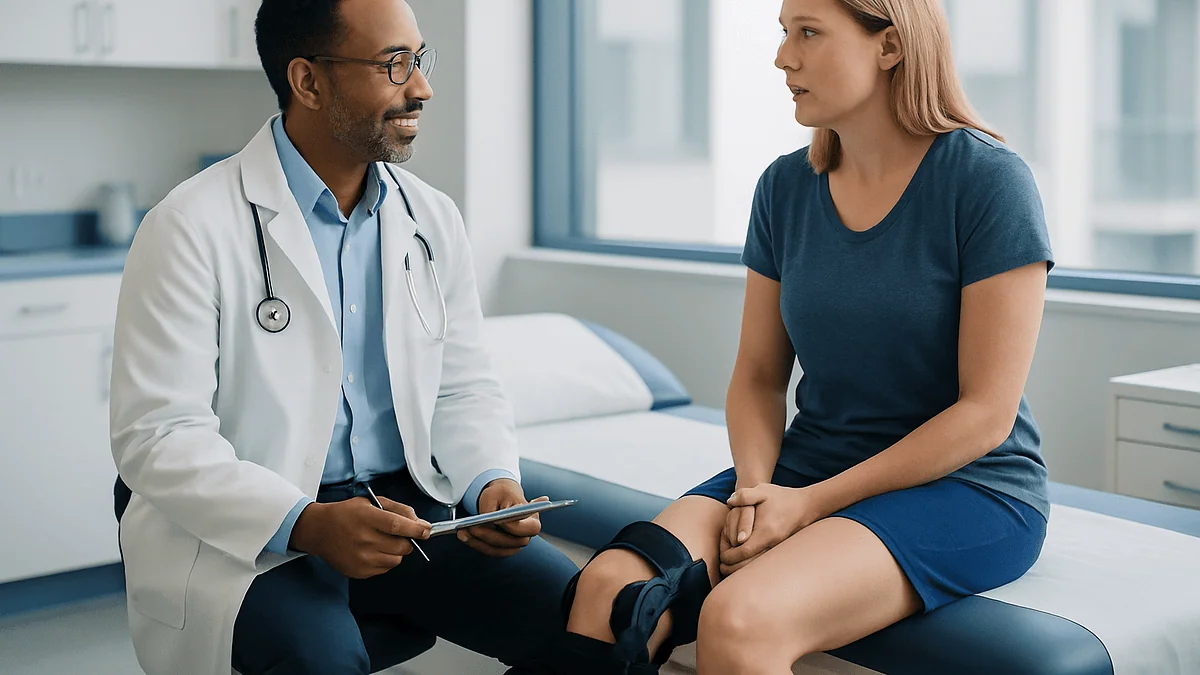
Ten days after her operation, a college midfielder sits on the edge of the bed and tries to straighten her knee. It stops a few degrees short. The joint is puffy, warm to the touch, and when she stands, the leg feels like it belongs to someone else. She reaches for her phone to search whether this counts as one of the acl surgery complications her surgeon mentioned, or whether it is simply what healing looks like.
Almost everyone who has an anterior cruciate ligament reconstruction asks a version of that question. The honest answer is that stiffness, swelling and a wobbly feeling are part of the ordinary story for a while. The skill lies in knowing when the story changes course.
This explainer walks through what usually happens, what should not, and the handful of signs that deserve a call rather than another day of waiting.
What actually happens during ACL reconstruction surgery
The anterior cruciate ligament, or ACL, is a short cord of tissue in the center of the knee that keeps the shin bone from sliding forward and rotating too far under the thigh bone. When it tears, the ends rarely knit back together on their own, so surgeons usually replace it rather than stitch it. That replacement is called a graft, meaning a piece of tendon borrowed from elsewhere to do the ligament’s job.
According to Mayo Clinic, the graft may come from the patient’s own body (an autograft), most often the patellar tendon below the kneecap, the hamstring tendons at the back of the thigh, or the quadriceps tendon above the kneecap, or from a donor (an allograft). The surgeon works through small incisions using an arthroscope, a pencil-thin camera, drills tunnels in the shin and thigh bones, threads the graft through those tunnels and anchors it with screws or buttons.
Two details explain much of what patients feel afterward. First, harvesting an autograft creates a second surgical site, so the front of the knee or the back of the thigh has its own healing to do. Second, the graft is initially a strip of tendon held by hardware; over months, blood vessels grow into it and it slowly remodels into something more ligament-like. MedlinePlus describes this remodeling as the reason rehabilitation is gradual and why the new ligament is not at full strength when the incisions look healed.
The operation usually takes one to two hours and most people go home the same day, per MedlinePlus. What follows at home is where the real work, and most of the worry, begins.
Which acl surgery complications are common, and which are genuinely rare?
It helps to separate three groups: expected effects of healing, uncommon problems that respond well when caught early, and rare events that need urgent care.
The expected group includes swelling, bruising that can track down the shin, a warm knee, difficulty fully straightening or bending, thigh muscle weakness, numbness in a patch of skin near the incisions, and fatigue. MedlinePlus and NHS guidance both describe these as part of the normal course rather than complications.
The uncommon group covers problems that most surgeons see a few times a year rather than every week. Persistent loss of motion (sometimes called arthrofibrosis, meaning excess scar tissue inside the joint), anterior knee pain when kneeling, especially after a patellar tendon graft, irritation from a screw or button under the skin, and a graft that gradually loosens all sit here. Mayo Clinic lists knee pain and stiffness, graft weakness and re-tear among the recognized risks.
The rare group is small but serious: deep infection inside the joint, a blood clot in the calf or thigh vein (deep vein thrombosis) that can travel to the lungs, injury to a nerve or artery around the knee, and the graft tearing again through a fresh injury. MedlinePlus names infection, bleeding and blood clots as risks of any knee surgery and adds stiffness and graft failure as risks specific to ACL reconstruction.
No single figure captures all of this fairly, because published rates vary with graft type, age, sport and how a complication is defined. What the mainstream sources agree on is the shape of the picture: minor, self-limiting effects are the norm, and the dangerous events are the exception. The rest of this article is about telling them apart.
Knee stiffness after ACL surgery: what is expected, and when it becomes a problem
A stiff knee in the first two to three weeks is almost universal. The joint capsule has been stretched, the lining is inflamed, and the quadriceps muscle at the front of the thigh often switches off after surgery, a phenomenon sometimes called quadriceps inhibition. That shut-down alone can make the knee feel locked even when nothing is mechanically blocking it.
If one measurement matters most in these early weeks, it is extension: whether the knee can go completely straight. Losing a little bend is common and usually recovers. Losing the last few degrees of straightening is the change most rehabilitation protocols work hardest to prevent, because a knee that cannot fully extend alters walking, overloads the front of the joint and is harder to correct later. NHS recovery guidance emphasizes early exercises to restore straightening and to keep the kneecap moving.
Stiffness becomes a concern when the trajectory flattens. In an expected recovery, range of motion improves week on week even if pain lingers. When motion plateaus or worsens despite consistent therapy, or when a hard block appears at the end of straightening that was not there before, the treating team will usually want to look closer. Two named causes are worth knowing. Arthrofibrosis is a diffuse build-up of scar tissue throughout the joint. A cyclops lesion is a discrete knot of scar tissue that forms at the front of the graft and physically stops the knee from straightening; it gets its name from its rounded, eye-like appearance on arthroscopy.
Both are treatable, often with intensified therapy and sometimes with a further arthroscopic procedure to clear the tissue. Neither is caused by the patient doing something wrong, and neither should be pushed through silently.
Swelling after ACL surgery: the normal curve and the signs it has stalled
Picture swelling as a curve rather than a switch. It typically peaks in the first several days, softens over the following two weeks, then lingers at a low level for weeks or months, rising a little after busy days and settling overnight. Fluid inside the joint is called an effusion; when that fluid is mostly blood in the early days, clinicians call it a hemarthrosis. Both are expected in small amounts because the surgeon has drilled into bone.
The everyday tools you will be told to use, elevation above heart level, cold packs wrapped in cloth, gentle ankle pumps and staying within the walking limits set by your team, work by reducing fluid leakage and encouraging the lymphatic system to drain it. MedlinePlus advises following the surgeon’s instructions on ice, elevation and activity closely in the first weeks.
Swelling that is following the wrong curve tends to show one of three patterns. It may increase rather than decrease after the first two weeks without any new activity to explain it. It may arrive with rising warmth, redness spreading beyond the incision lines, or a fever. Or it may come on suddenly and tightly, with the knee feeling like an overfilled balloon that is painful to bend even slightly.
The first pattern often reflects doing too much too soon and usually settles with rest and a review of the exercise plan. The second raises the question of infection and should be assessed the same day. The third can mean fresh bleeding into the joint or a new injury and also deserves prompt contact.
Everyday swelling that fluctuates with activity, is not hot, and is trending down over weeks is the joint doing its job. Swelling that is loud, hot or headed the wrong way is the joint asking for help.
Why does my knee give way after ACL reconstruction?
Giving way is the symptom that frightens people most, because it is the very thing surgery was meant to fix. Two very different mechanisms can produce the same sensation, and telling them apart is the treating team’s job, not yours.
The first, and by far the more common in the early months, is muscular. A quadriceps that has been inhibited by pain and swelling cannot hold the knee steady when weight shifts onto it. The result is a buckle, a sudden dip, or a feeling that the leg might fold on stairs. The graft itself is intact; the muscle simply is not yet firing fast or hard enough. This form of giving way improves as strength, balance and reaction time return, which is why rehabilitation protocols spend so long on the thigh and hip rather than the knee alone. NHS guidance describes muscle strengthening as the core of recovery.
The second mechanism is true instability: the shin bone actually slides or rotates too far because the graft has stretched, loosened at its fixation points, or torn. This usually announces itself differently. It tends to happen during a twist, a plant-and-turn or a landing rather than a plain step, is often accompanied by a sharp pain, a pop, or rapid swelling, and it recurs with pivoting movements. Mayo Clinic lists graft failure and re-injury among the recognized outcomes that need surgical review.
A practical rule of thumb: buckling in the first three months on flat ground, without swelling or a pop, is most often a strength problem. Giving way during rotation or sport after the knee had become reliable, especially with a pop or new swelling, needs an examination and probably imaging. Neither should be ignored, but only the second is a likely structural failure.
Can a repaired ACL tear again?
Yes. A reconstructed ACL can tear again, and the ligament in the other knee can tear too. Mayo Clinic notes that people who have had one ACL injury face a higher risk of a second, and that the risk is greatest in younger athletes who return to cutting and pivoting sports. Exact rates in the medical literature vary widely depending on age, sport, graft type and how long patients were followed, so any single percentage quoted online should be treated with caution.
The mechanisms behind re-tear are worth understanding because they shape prevention. In the first year, the graft is still remodeling and is biologically weaker than a native ligament even when it feels solid; a return to sport before the tissue and the surrounding muscles are ready leaves it exposed. Later re-tears more often mirror the original injury: a landing with the knee straight and the hip rotated inward, a sudden deceleration, or contact from the side.
Two factors are within a patient’s influence. The first is time. Mayo Clinic describes a return to demanding sport at nine months or more, and notes that returning earlier is associated with higher re-injury risk. The second is readiness, which is not the same as time passed. Many programs test hopping distance, single-leg strength and landing mechanics on both legs before clearing pivoting sport, because symmetry between the legs is a better signal than the calendar.
If a graft does fail, a second operation, called a revision reconstruction, is possible. It is usually more complex because the original bone tunnels have to be worked around or filled, and rehabilitation tends to be longer. That is one more reason to treat the first recovery as a single, unhurried project.
Is ACL surgery a high risk surgery? Blood clots, infection and nerve injury in perspective
In the language clinicians use, ACL reconstruction is an elective, arthroscopic procedure on a generally healthy population, which places it toward the lower end of the surgical risk spectrum. That does not make it trivial, and the three risks below are the ones that justify the safety instructions you are given.
Deep vein thrombosis, a clot in a deep leg vein, is a risk after any lower limb surgery because the leg moves less and the veins drain more slowly. MedlinePlus describes the warning signs as swelling, pain or tenderness in the calf or thigh, warmth and skin discoloration over the area. A clot that breaks off and reaches the lungs, a pulmonary embolism, causes sudden breathlessness, chest pain or coughing up blood and is a medical emergency. Early ankle movement, walking within your limits and staying hydrated all support venous flow; some patients are also prescribed clot-preventing medicine, a decision that rests with the surgical team based on individual risk.
Infection can be superficial, at the incision, or deep, inside the joint. Deep infection is rare but serious because bacteria can damage cartilage and the graft. Increasing pain, a hot swollen knee, fever, or wound drainage that starts or worsens after the first few days are the classic signals.
Nerve and vessel injury is uncommon. The most frequent nerve effect is a patch of numbness on the front or side of the shin from small skin branches of the saphenous nerve, which is often permanent but rarely troublesome. Injury to the major vessels behind the knee is very rare.
Weighed together, these risks explain why patients are asked to walk early, watch their calves and report fevers. The precautions are proportionate; the alarm should be too.
Who is usually offered ACL surgery, and who is asked to wait
Not every torn ACL needs an operation. NHS guidance is explicit that surgery is usually recommended when the knee keeps giving way during daily life or sport, when other structures such as the meniscus are also damaged, or when a person wants to return to activities involving pivoting and jumping. Someone whose knee feels stable during work, walking and cycling, and who is content to avoid cutting sports, may do well with structured physiotherapy alone.
Timing matters as much as selection. Surgeons commonly ask patients to wait until the acute swelling has settled, the knee can straighten fully and bend well, and the thigh muscles have regained reasonable strength. This preparation period, sometimes called pre-habilitation, exists because operating on a swollen, stiff knee is associated with more stiffness afterward. Waiting a few weeks is therefore not a delay in care; it is part of the care.
Children and adolescents whose growth plates are still open are a special group. The bone tunnels used in adult reconstruction pass close to the growth plate, so surgeons use modified techniques or, in some cases, recommend bracing and therapy until the skeleton has matured. Decisions here are highly individual and belong with a pediatric sports specialist.
People who may be asked to wait or reconsider include those with an active infection anywhere in the body, uncontrolled medical conditions that raise anesthetic risk, or advanced arthritis in the same knee, where a new ligament would not address the main source of pain. Smoking and poorly controlled diabetes are known to slow wound and graft healing, so some teams ask patients to address these first.
None of this is a verdict. It is a conversation between a patient’s goals and a surgeon’s assessment of what the knee can safely be asked to do.
Expected versus not expected after ACL surgery: a week-by-week guide
The table below summarizes the general pattern described by MedlinePlus, NHS and Mayo Clinic. Individual protocols differ, and your surgeon’s instructions always take precedence over any general guide.
| Time after surgery | Usually expected | Usually not expected |
|---|---|---|
| Days 1–7 | Marked swelling, bruising into the shin, pain needing prescribed relief, difficulty straightening, crutches, small patches of skin numbness | Fever, spreading redness, wound leaking pus, calf pain or tightness, sudden breathlessness |
| Weeks 2–4 | Swelling easing, straightening improving, bend increasing weekly, buckling on stairs from muscle weakness, tiredness | Swelling increasing without cause, motion plateauing or worsening, new heat in the joint, wound reopening |
| Weeks 5–12 | Mild swelling after activity, walking without aids, aching around graft site, stiffness on waking that eases with movement | Hard block to straightening, persistent effusion that does not settle overnight, pain that is worsening rather than improving |
| Months 3–9 | Steady strength gains, running when cleared, occasional soreness after new exercises | Giving way during twisting, a pop with rapid swelling, feeling the knee shift under load |
| Beyond 9 months | Return to sport when readiness testing is passed, minor stiffness after long inactivity | Recurrent instability, locking, catching, or an inability to trust the knee despite strength recovery |
Two patterns in this table deserve a second look. In every row, the concerning column describes a change in direction rather than a level of discomfort: swelling that rises instead of falls, motion that shrinks instead of grows, a knee that becomes less reliable rather than more. Pain intensity alone is a poor guide because it varies so much between people.
The second pattern is that the character of worrying signs shifts over time. Early on, the red flags are about infection and clots. Later, they are about the graft. Knowing which phase you are in tells you which questions to ask.
ACL surgery recovery time: what the following days, weeks and months usually look like
The first week is about protection and small wins. Most people leave the hospital on the day of surgery, per MedlinePlus, with a bandage, often a brace, and crutches. The early goals are straightforward: keep the wound clean and dry, get the knee fully straight when resting, wake the quadriceps with gentle contractions, and pump the ankles to keep blood moving.
Weeks two to six bring the first taste of normality. NHS recovery guidance describes most people walking without crutches within a few weeks and returning to desk-based work in a similar timeframe, while physically demanding jobs take considerably longer. Driving is usually permitted once the leg can operate the pedals safely and strong pain relief is no longer needed, a judgement your surgeon will make with you. Physiotherapy shifts from range of motion to closed-chain strengthening: squats, step-ups and cycling, movements where the foot stays planted and the graft is protected.
Months two to four are the long middle. Swelling is low but not gone. Strength returns unevenly, with the operated thigh visibly thinner than the other for some time. Many protocols introduce jogging in this window, but only once the knee is quiet and strength has crossed a threshold set by the therapist.
Months four to nine are about power and confidence: hopping, changing direction, and sport-specific drills under supervision. Mayo Clinic describes a return to demanding sport at nine months or longer, and the NHS notes it can take up to a year before a return to full sport. Those are typical ranges observed in patient groups, not promises for any one knee.
Beyond a year, the graft continues to mature and the goal becomes protection: maintaining strength, landing well and respecting fatigue, since tired muscles protect ligaments poorly.
Can I walk after a torn ACL, and how soon after surgery?
Many people can walk after tearing an ACL, sometimes surprisingly soon, which is one reason the injury is under-recognized on the field. The ligament controls forward sliding and rotation of the shin, not straight-line weight bearing, so a person can often limp or even walk normally once the initial swelling settles. What they cannot do reliably is decelerate, cut or pivot, and that is where the knee betrays them. Walking on a torn ACL is therefore not the same as having a safe knee, and repeated episodes of giving way risk damaging the meniscus and cartilage.
After reconstruction, walking usually resumes within days, using crutches and often a brace that keeps the knee straight. MedlinePlus notes that surgeons vary in how much weight they allow initially, particularly if the meniscus was also repaired, in which case weight bearing may be restricted for several weeks to protect the stitches. NHS guidance describes a period of a few weeks on crutches for most people before walking unaided.
The quality of early walking matters more than the quantity. A knee that is kept slightly bent to avoid discomfort teaches the body a limp that can persist long after the pain is gone. Therapists spend time on heel-to-toe gait with the knee fully straightening at each step precisely because those first thousand steps set the pattern.
Stairs are a separate milestone. Going up is usually manageable early because the strong leg leads. Coming down asks the operated quadriceps to control the body’s weight while lengthening, which is why stairs are often the place people first notice buckling. Taking them one at a time with a hand on the rail is standard until the therapist clears a normal pattern.
What people often get wrong about acl surgery complications
Myth: pain equals damage. In the first months, pain tracks inflammation and muscle fatigue far more closely than it tracks the graft. A sore knee after a hard therapy session is expected; a hot, swollen knee with fever is not. The character of pain, not its volume, carries the information.
Myth: stiffness means you are not trying hard enough. Some stiffness is a normal healing response, and true arthrofibrosis is a biological tendency to over-scar, not a character flaw. Forcing a stiff knee through pain can inflame it further. The right response to motion that has stalled is a conversation with the therapist and surgeon about adjusting the program, not private heroics.
Myth: once the incisions have healed, the knee is healed. The skin closes in about two weeks. The graft takes many months to remodel into ligament-like tissue, and MedlinePlus describes that maturation as the reason for the long rehabilitation timeline. A knee that looks fine at eight weeks is not ready for a soccer match.
Myth: giving way always means the graft has failed. Early buckling is usually the quadriceps not firing, not the ligament stretching. The two feel similar but have opposite implications.
Myth: a brace will protect the graft during sport. Evidence that functional braces reduce re-tear rates in reconstructed knees is limited, and mainstream guidance does not rely on them as a substitute for strength and movement retraining.
Myth: surgery removes future arthritis risk. Mayo Clinic notes that people who have had an ACL injury, whether or not they had surgery, carry a higher long-term risk of osteoarthritis in that knee. Reconstruction aims to restore stability and protect the meniscus; it does not reset the joint to its pre-injury state.
Questions to ask your care team about stiffness, swelling and stability
Recovery goes more smoothly when patients know what their particular protocol expects, because protocols differ in ways that matter. Bring these to your first follow-up or write them on the wall by the bed.
- Which graft did you use, and what does that mean for where I will feel pain and which movements I should avoid early on?
- Was anything else repaired during surgery, such as the meniscus, and does that change how much weight I can put through the leg or how far I can bend?
- How much straightening and bending do you expect at two weeks, six weeks and three months, so I know whether I am on track?
- What should swelling look like by the end of the first month, and what pattern would make you want to see me sooner?
- What is the difference, in my case, between muscle-related buckling and a sign the graft is loosening, and how would you assess that?
- Do you want me to take any measures against blood clots, and for how long?
- What are your criteria for clearing me to jog, then to pivot, then to play? Are they time-based, test-based or both?
- How do I reach the team out of hours, and which symptoms should prompt that call rather than waiting for the next appointment?
- What is your approach if my knee stiffens and stops improving despite therapy?
- Looking ahead years, what can I do to protect the knee from a second injury and from arthritis?
The answers will be specific to your knee and your surgeon’s technique. Write them down; the details blur quickly once the appointment ends, and they are the reference you will want at week three when the knee feels wrong at midnight.
When to call your doctor after ACL surgery: red-flag signs
Most recoveries never need an unscheduled call. When they do, the signs are usually clear, and the cost of ringing about a false alarm is far smaller than the cost of sitting on a real one.
Call the surgical team the same day, or attend urgent care if you cannot reach them, for any of the following:
- Fever, chills, or a knee that becomes increasingly hot, red or swollen after the first few days, especially with rising pain
- Wound drainage that starts or increases after the first week, changes color, or has an odor, or a wound that gapes open
- Pain, tenderness, warmth or swelling in the calf or thigh that is different from the knee itself, which MedlinePlus describes as typical of deep vein thrombosis
- Sudden inability to move the knee at all, or a rapid tense swelling that came on over hours
- A pop, a giving-way episode during a twist, or the knee shifting under you, followed by new swelling
- Numbness or weakness in the foot, or a foot that is cold or pale compared with the other
- Range of motion that has stopped improving for two consecutive weeks despite following your program
Call emergency services immediately for sudden shortness of breath, chest pain, coughing up blood, fainting, or a racing heart. These can signal a clot that has traveled to the lungs and are treated as emergencies regardless of how well the knee itself feels.
Every one of these judgments, from whether a stiff knee needs a scan to whether a swollen calf needs an ultrasound, belongs with the treating team. Your task is simply to notice a change in direction and report it plainly. A good team would rather hear from you twice unnecessarily than not at all when it counts.
Frequently asked questions
How long does it take to recover from ACL tear surgery?
Most people walk without crutches within a few weeks and return to desk work in a similar window, according to NHS guidance, but a return to pivoting sport typically takes nine months or longer, per Mayo Clinic, and the NHS notes it can be up to a year. These are typical ranges observed across patient groups, not guarantees; your surgeon’s protocol and your own strength testing determine the actual timeline.
How common is ACL retear after surgery?
Re-tear is a recognized risk, and Mayo Clinic notes it is highest in younger athletes returning to cutting sports. Published rates vary widely with age, sport, graft type and follow-up length, so a single percentage would be misleading. Returning to sport before nine months and before passing strength and hop testing is associated with higher re-injury risk, which is why readiness testing matters as much as time.
Is ACL surgery a high risk surgery?
It is generally considered a lower-risk elective procedure because it is arthroscopic and performed on mostly healthy people. Serious events such as deep infection, blood clots and nerve or vessel injury are uncommon but real, which is why MedlinePlus lists them and why you are asked to walk early, watch your calves and report fevers. The precautions are proportionate rather than a sign of high danger.
Can I walk after a torn ACL without surgery?
Often yes, because the ACL controls forward sliding and rotation of the shin rather than straight-line weight bearing. Many people walk or even jog on a torn ACL once swelling settles. The knee tends to fail during cutting, pivoting or sudden stops, and repeated giving way can damage the meniscus and cartilage, so a stable-feeling knee still deserves specialist assessment.
How much knee stiffness after ACL surgery is normal?
Some stiffness is expected for the first several weeks, particularly on waking and after sitting. What matters is direction: range of motion should improve week on week even if pain lingers. Motion that plateaus for two consecutive weeks, worsens, or develops a hard block to straightening may indicate excess scar tissue and should be reviewed by the surgical team rather than pushed through.
Why is my knee still swollen months after ACL surgery?
Low-level swelling that rises after activity and settles overnight can persist for months as the joint lining recovers and the graft remodels. It becomes a concern if it is increasing rather than decreasing, is accompanied by heat or fever, does not settle with rest, or appears suddenly after a twist. Those patterns can signal overuse, infection or a graft problem and warrant a check.
What is a cyclops lesion after ACL reconstruction?
A cyclops lesion is a rounded knot of scar tissue that forms at the front of the new graft and physically blocks the knee from fully straightening. It is named for its eye-like appearance through the arthroscope. It typically presents as a firm end-point to extension that appears weeks after surgery. It is treatable, sometimes with a further arthroscopic procedure, and is not caused by patient error.
Does the knee giving way after ACL surgery mean the graft failed?
Not usually in the early months. Buckling on flat ground or stairs without swelling or a pop is most often the quadriceps muscle failing to fire quickly enough, which improves with strengthening. Giving way during rotation or sport, especially with a pop, sharp pain or rapid swelling after the knee had become reliable, is the pattern that raises concern about the graft and needs examination.
Which graft has the fewest complications?
No graft is free of trade-offs. Mayo Clinic describes patellar tendon, hamstring, quadriceps and donor grafts as established options. Patellar tendon grafts are associated with more kneeling pain, hamstring grafts with some posterior thigh weakness, and donor grafts with slower incorporation. The best choice depends on age, sport, anatomy and surgeon experience, and the decision sits with you and your treating team.
What happens 20 years after ACL surgery?
Many people remain active for decades, but Mayo Clinic notes that anyone with a prior ACL injury, operated or not, carries a higher long-term risk of osteoarthritis in that knee. Reconstruction aims to restore stability and protect the meniscus, which may reduce further damage, but it does not restore the joint to its pre-injury state. Maintaining strength and healthy weight remain the main protective habits.
References
This article is for general information only and is not a substitute for professional medical advice. Please consult a qualified doctor about your individual situation.

More from the Blog
How Recovery Differs After Knee, Shoulder and Ankle Arthroscopy: Milestones by Joint
Arthroscopy recovery differs by joint because each one carries a different load. Knee procedures usually allow walking within days, with sport weeks to months…
Wrist Tenosynovitis After Pregnancy: Why New Parents Get It and How Treatment Is Adapted
Tenosynovitis after pregnancy, usually de Quervain's, is irritation of the sheath around two thumb tendons at the wrist, aggravated by repeated lifting of a…

Does a Torn Rotator Cuff Heal on Its Own? Common Rotator Cuff Myths, Corrected
A torn rotator cuff rarely reattaches itself. Partial-thickness tears can settle with rest and guided exercise, and pain often improves even when the tendon…
Tendon Surgery for Athletes and Manual Workers: How Return to Load Is Planned
Tendon surgery for athletes and manual workers stitches or reconstructs a torn tendon, then relies on a staged rehabilitation plan that adds load gradually.…
Meniscus Surgery After Fifty: Why Degenerative Tears Are Treated Differently From Sports Tears
After 50, most meniscus tears are degenerative: slow wear in cartilage that is already thinning, often alongside early arthritis. Randomized trials show that for…
Why Does a Shoulder Keep Dislocating? Recurrent Instability and When Surgery Is Advised
A shoulder keeps dislocating because the first dislocation usually tears or stretches the structures that hold the ball in its shallow socket, such as…