

Suture Suspension (Thread) Lift vs Facelift: Where Threads Stop and Surgery Begins

Key Takeaways
- Threads grip the fatty layer just under the skin and remove nothing, while a facelift repositions the fibrous SMAS layer and trims excess skin, which is why only surgery corrects true skin redundancy.
- Mayo Clinic notes that no facelift is permanent, and Cleveland Clinic describes results commonly lasting around a decade, whereas thread effects are reported in months to a small number of years and rest on small, short studies.
- The most frequent thread complications in published reports are surface problems, dimpling, visible or palpable threads, and extrusion, plus asymmetry and early drop of the lift.
- Hematoma is the most common serious early facelift complication and typically presents as sudden, painful, one-sided swelling in the first day or two, requiring prompt return to the surgeon.
- Nicotine use is a leading reason surgeons defer facelift surgery, because it narrows blood vessels and raises the risk of skin loss along incisions, as both the NHS and Mayo Clinic warn.
- Age alone is not a barrier to facelift or neck lift surgery; candidacy depends on heart, lung, blood pressure, and blood sugar health and on skin quality, assessed by the treating team.
A thread lift places absorbable barbed sutures under the skin to gently reposition mildly sagging tissue, usually under local anesthesia, with results that are modest and temporary. A facelift is surgery that lifts and secures the deeper support layer of the face and removes excess skin, with longer-lasting but more involved recovery. Threads suit early laxity; established jowls and loose neck skin generally need surgery.
She is 52, sitting in a parked car after a dental appointment, tilting the rearview mirror down instead of up. Two fingers rest just in front of each ear and pull back a quarter inch. There it is: the jawline she remembers. Then she lets go, and the small soft folds settle back along the jaw. Somewhere in her phone is a saved video of a procedure done in forty minutes with a few needles, and a bookmarked page about surgery that talks about incisions and general anesthesia. Both promise the thing her fingers just did.
The thread lift vs facelift question is really a question about layers. Faces do not sag as a single sheet; skin, fat pads, and a fibrous supporting layer each loosen at different rates, and each approach reaches a different depth. Knowing which layer has let go in your own face predicts, more than any marketing, which option can honestly help.
This explainer walks through what happens under the skin in each procedure, how long the effects tend to hold, where the real risks sit, and why many surgeons speak about threads with such reserve. The final decision belongs to you and the clinician examining you, not to a mirror in a parked car.
What does a thread lift actually do under the skin?
A thread lift, sometimes called a suture suspension lift, uses fine sutures studded with tiny barbs or cones that catch in the fatty layer just beneath the skin. Most modern threads are absorbable, made of materials such as polydioxanone (PDO), poly-L-lactic acid, or polycaprolactone, the same families of material used for dissolving stitches inside the body after surgery. The word absorbable simply means the body gradually breaks the material down over months.
The procedure itself is brief. After local anesthetic numbs the area, the clinician passes a thin needle or blunt cannula along a planned path, typically from near the temple or hairline down toward the jaw or cheek. The thread is fed through, the barbs engage the tissue, and the clinician pulls gently upward so the soft tissue bunches slightly along the thread and sits a little higher. The upper end is anchored in firmer tissue, the excess trimmed, and the entry point closed with nothing more than a small dressing.
Two effects are proposed. The first is mechanical: tissue is physically lifted by the barbs, much as a curtain is gathered on a cord. The second is biological: the body reacts to any foreign material by laying down collagen and scar tissue around it, and proponents argue this leaves a subtle firming after the thread dissolves. The mechanical effect is real but limited by physics, because the barbs grip fat, not the strong fibrous layer that surgeons rely on. The collagen effect has been described mostly in small studies with short follow-up, so its size and durability remain uncertain.
What a thread cannot do is remove skin. If there is genuinely more skin than the frame needs, threads redistribute it rather than reduce it, and that distinction sets the ceiling on what they can achieve.
How does a facelift work, and what is the SMAS?
A facelift, medically called a rhytidectomy, is an operation that repositions the deeper supporting tissues of the lower face and neck and removes skin that has stretched beyond what the frame can hold. Mayo Clinic describes it as a procedure to create a smoother, firmer appearance in the lower two thirds of the face, typically performed under general anesthesia or intravenous sedation with local anesthetic, and taking a few hours in the operating room.
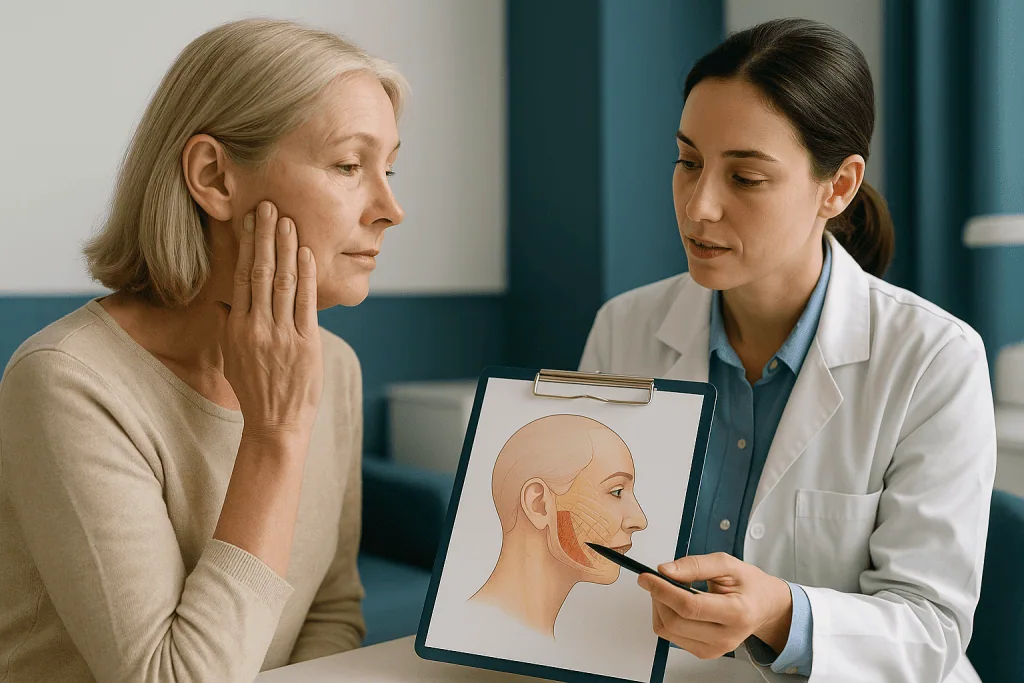
The key structure is the SMAS, the superficial musculoaponeurotic system: a continuous sheet of muscle and fibrous tissue that sits beneath the fat and connects the facial muscles to the skin. When the SMAS loosens, cheeks descend and jowls form along the jaw. Surgeons make incisions that usually begin in the hair at the temple, run in the natural crease in front of the ear, curve behind the earlobe, and end in the lower scalp. Through these, the skin is lifted, the SMAS is tightened, folded, or released and repositioned, and redundant skin is trimmed before closure.
Variations differ mainly in how the SMAS is handled. A SMAS plication folds and stitches the layer; a SMAS flap cuts and shifts it; a deep plane facelift releases the ligaments that tether the SMAS to bone and moves skin and SMAS together as one unit. Each has advocates, and comparative evidence favoring one technique over another for most people remains limited rather than settled. A neck lift, which addresses banding of the platysma muscle and excess neck skin, is often performed at the same time.
Because surgery works at the structural layer, it can correct things threads cannot: true skin excess, heavy jowls, a soft jawline that blurs into the neck. The trade is real anesthesia, incisions, and weeks of recovery, covered further down.
Thread lift vs facelift at a glance
Placing the two side by side clarifies where the line falls. The table summarizes typical features described by MedlinePlus, Mayo Clinic, and the NHS for facelift surgery, and by general clinical descriptions for suture suspension. Durations are ranges reported in the literature, not promises for any one person.
| Feature | Thread lift | Facelift |
|---|---|---|
| Layer treated | Subcutaneous fat, just under skin | SMAS and skin; often neck muscle |
| Anesthesia | Local, awake | General or sedation |
| Incisions | Needle entry points, no cutting | Around ear and into hairline |
| Skin removed | None | Yes, excess trimmed |
| Procedure time | Under an hour is typical | A few hours |
| Return to desk work | Often within days | Roughly two weeks (NHS) |
| Durability | Months to a small number of years; material dissolves | Years; aging continues (Mayo Clinic) |
| Best suited to | Mild early laxity | Moderate to significant laxity, jowls, neck |
| Characteristic risks | Dimpling, visible or extruding thread, asymmetry | Hematoma, nerve injury, scarring, hair loss at incision |
| Evidence base | Small studies, short follow-up | Decades of surgical literature |
Read the rows on layer treated and skin removed first. Those two facts explain nearly every other difference in the table. A procedure that grips fat and removes nothing will always be gentler, faster, and shorter-lived than one that anchors the fibrous layer and takes away the slack.
Neither column is better in the abstract. Someone with early softening along the jaw and good skin elasticity has no need to take on the recovery of surgery, and someone with a full neck fold will be disappointed by threads however skillfully placed. Matching the tool to the anatomy is the whole exercise.
How long does a thread lift last compared with a facelift?
Nothing that lifts a face is permanent, because the underlying process, the slow loss of collagen, fat volume, and bone support with age, does not pause for any procedure. Mayo Clinic is explicit that facelift results are not permanent and that facial skin may begin to sag again over time. The realistic question is how much time each approach typically buys.

Facelift longevity is commonly described in years. Cleveland Clinic notes that results can last around a decade for many people, though how a face ages afterward depends on genetics, sun exposure, smoking, weight changes, and skin quality. Because surgery moves the structural SMAS layer and physically removes redundant skin, the correction has a solid mechanical basis that does not depend on a foreign material staying in place.
Thread lift longevity is shorter and less certain. The threads themselves are designed to dissolve over a period of months; once the material is gone, any remaining lift depends on the scar and collagen the body formed around it. Published reports generally describe visible effects lasting from several months up to a small number of years, with considerable variation between people. Most of these reports come from small case series with limited follow-up and no untreated comparison group, which makes it difficult to say confidently how much of the reported effect reflects the thread and how much reflects natural variation, swelling, or concurrent treatments.
A practical consequence follows. Someone who chooses threads for ongoing maintenance will usually need repeat sessions, and each session adds another round of the same small risks. Someone who chooses surgery accepts a larger single event with a longer horizon before anything further is considered. Neither path is wrong; they simply distribute risk and recovery differently across time, which is worth discussing plainly with the treating team.
Who is a thread lift usually for, and who is usually asked to wait?
The ideal candidate for threads is described consistently across clinical sources: someone with early, mild laxity, reasonable skin thickness and elasticity, a healthy weight, and a wish for subtle change rather than dramatic correction. In practice this often means people in their late thirties through fifties who notice the first softening along the jaw or a slight flattening of the mid-cheek, without heavy folds or a loose neck.
Skin quality matters as much as age. Threads sit close to the surface, so very thin or sun-damaged skin can show or feel the thread beneath it, and dimpling at the barb points is more likely. Heavier faces present the opposite problem: a fine suture holding a large volume of fat against gravity is asked to do more than it can, and the correction tends to drop quickly.
Clinicians commonly ask people to wait or reconsider in several situations:
- Active skin infection, inflamed acne, or a cold sore flare in the treatment area, because inserting a foreign material through infected skin raises infection risk.
- Pregnancy or breastfeeding, for which safety data are lacking.
- Known tendency to form thick or keloid scars, since the procedure relies on controlled scarring.
- Use of blood-thinning medicines, which increases bruising and bleeding; any change to such medicines is a decision for the prescriber, never something to alter before a cosmetic appointment.
- Autoimmune connective tissue disease or a history of reacting to dissolvable sutures.
- Expectations of surgical-level change, which threads cannot meet.
A candid clinician will also say when threads are simply the wrong tool. If two fingers must pull firmly rather than gently to restore the jawline, the tissue has likely moved beyond the range a suture in fat can hold.
Who is a facelift usually for, and when do surgeons say not yet?
Facelift surgery is generally considered when laxity is moderate to significant: established jowls, deep folds running from nose to mouth corner, a jawline that has lost definition, and loose or banded skin in the neck. MedlinePlus lists these as the changes the operation addresses, and it also notes what surgery does not fix: fine wrinkles, sun damage, skin color changes, and volume loss are treated, if at all, by other means.
Age by itself is not the deciding factor. People in their sixties and seventies undergo facelifts routinely, and the question a surgeon asks is not how many birthdays have passed but how the heart, lungs, blood pressure, and blood sugar are doing, and whether the skin will heal well. Mayo Clinic frames candidacy around overall health and the absence of conditions that impair healing or raise anesthetic risk.
Surgeons commonly defer or decline in these circumstances:
- Smoking or nicotine use, which the NHS and Mayo Clinic both flag because nicotine narrows blood vessels and raises the risk of skin dying along the incision. Most surgeons ask for a nicotine-free period before and after surgery.
- Poorly controlled diabetes or high blood pressure, which increase bleeding and wound problems.
- Blood-clotting disorders or medicines that affect clotting; management of these rests with the prescribing clinician and the anesthesia team.
- Recent significant weight change or planned major weight loss, since the result depends on a stable facial volume.
- Unrealistic goals, or a wish to look like a different person rather than a rested version of oneself.
- Body dysmorphic disorder or acute life stress, where the NHS advises careful counseling before any cosmetic surgery.
Being asked to wait is not a rejection. It usually means the surgeon wants the odds of uncomplicated healing to be as favorable as they can be before making incisions.
What are the downsides of a thread lift?
Threads are often presented as low-risk, and compared with surgery they are. Low risk is not no risk, and the complications that do occur are distinctive because of where the sutures sit. Reported problems fall into a few groups.
Surface irregularities are the most frequent complaint in published case reports. Dimpling or puckering appears where a barb grips tissue too close to the skin; it often smooths as swelling settles, but not always. A thread can be visible as a fine ridge under thin skin, or palpable as a cord when the face moves. Occasionally a thread end works its way outward and extrudes through the skin, which requires removal.
Asymmetry is common enough to be discussed routinely, because tension on each side is set by hand and tissue on the two sides of a face is never identical. Early drop of the lift, sometimes within weeks, occurs when barbs slip through fat that is too soft or too heavy to hold them.
Deeper complications are less frequent but more serious. Infection along the thread track can be stubborn because bacteria adhere to foreign material, and treatment may mean removing the thread. Injury to small sensory nerves can leave patches of numbness or tingling, and injury to the parotid salivary gland or its duct, which lies in the path of cheek threads, has been reported. Bruising and prolonged swelling are expected rather than exceptional.
Two downsides are structural rather than medical. The first is repetition: because results fade, many people return for further sessions, and each carries the same set of risks. The second is what a thread leaves behind. Scar tissue and fragments of absorbing material can make later surgery technically harder, a point surgeons raise often and one worth weighing if a facelift is a realistic future possibility.
What are the risks of a facelift?
Surgery carries risks in proportion to its reach, and facelift complications reflect the fact that skin has been lifted from its blood supply, nerves lie in the operative field, and anesthesia is involved. Mayo Clinic and MedlinePlus list the same core group.
Hematoma, a collection of blood under the skin, is the most common serious complication in the first day or two. It typically declares itself as sudden, painful, one-sided swelling and needs prompt return to the surgeon to be drained, because untreated pressure can damage the overlying skin. Men and people with high blood pressure have higher reported rates.
Nerve injury is the risk surgeons discuss most carefully. Sensory nerves are almost always stretched, so numbness around the ears and cheeks is expected and usually improves over months. Injury to branches of the facial nerve, which move the muscles of expression, is uncommon; when it occurs it is most often temporary weakness of a brow or lip, though permanent weakness is possible and is part of every honest consent discussion.
Other recognized problems include:
- Skin loss along the incision, particularly in smokers, which heals slowly and may leave a wider scar.
- Hair loss at incision sites in the temple or behind the ear, sometimes permanent.
- Scars that widen or thicken, and a change in the position or shape of the earlobe if the closure is under tension.
- Infection, which is uncommon but treatable when caught early.
- Fluid collections (seroma), prolonged swelling, and firmness that takes months to soften.
- General anesthetic risks and, as with any operation, the small risk of blood clots in the legs or lungs.
Numbers vary widely between studies and surgeons, so this article does not quote a single complication rate. What can be said is that a surgeon who names these risks unprompted, and explains how each is prevented and managed, is giving the standard of information the NHS advises every cosmetic surgery patient should receive.
Why do many plastic surgeons dislike threads?
Ask a room of facial surgeons about threads and the temperature changes. Their objections are worth hearing in full, because they are not simply about protecting a more expensive operation.
The first objection is mechanical. Surgeons spend careers learning that lasting lift comes from repositioning the SMAS and releasing its ligaments, and they see threads as pulling on the wrong layer. Fat has no tensile strength; a barb in fat is like a hook in a sponge. The lift looks convincing on the treatment table and, in their experience, drifts down over months.
The second is evidence. The surgical literature on facelift spans decades, with long follow-up and detailed complication tracking. Thread lift studies are mostly small, short, sponsored or single-center, and rarely compare treated people with untreated controls. Surgeons trained to grade evidence find this thin, and they are uncomfortable with confident marketing claims resting on it.
The third is what they encounter later. Surgeons describe operating on faces that have had multiple thread sessions and finding tracks of scar tissue, retained fragments, and distorted planes that make dissection slower and, in their view, riskier. They also describe treating complications, extruding threads and infections and dimples, that were not clearly disclosed when the procedure was sold as lunchtime maintenance.
The fourth is language. Threads are frequently marketed as a nonsurgical facelift, and surgeons regard that phrase as a category error that sets people up for disappointment.
Balance matters here. A minority of surgeons do use threads selectively, for very early laxity, for people who cannot have anesthesia, or as a small adjunct. Their position is not that threads never help but that threads help a narrow group modestly and briefly, and that anyone told otherwise deserves a second opinion. That is a fair summary of where mainstream surgical opinion sits.
What the first days and weeks look like after each procedure
Recovery is where the two approaches diverge most visibly, and where expectations most often go wrong.
After threads, the face is typically swollen and tender for a few days, with bruising along the thread paths that fades over one to two weeks. A sensation of tightness or pulling when smiling or chewing is common early on. Clinicians usually advise sleeping with the head elevated, avoiding wide mouth opening, vigorous facial expressions, dental work, and face-down massage or facials for a couple of weeks so the barbs can settle. Small dimples at entry or anchor points often flatten within this window; persistent dimples, visible ridges, or a thread end at the surface warrant a review appointment rather than waiting. Desk work is often resumed within days.
After a facelift, the first day or two are the watchful period for hematoma. A padded dressing, and sometimes small drains, are usually in place for the first day. Swelling and bruising peak around the second or third day and then recede over two to three weeks, during which the face can look tighter and more swollen than the eventual result. The NHS advises that most people take around two weeks off work and avoid strenuous activity for longer, and Mayo Clinic notes that incisions are typically checked within the first week and stitches removed over the following days.
Beyond the first month, residual swelling and firmness soften gradually. Numbness around the ears and cheeks improves over months. Scars are pink and slightly raised at first and mature toward pale, flat lines over roughly a year. Mayo Clinic describes the final appearance emerging over several months as swelling fully resolves.
The honest headline is this: a thread lift interrupts a week; a facelift reorganizes a season. Planning around that difference, work, caregiving, events, matters as much as the procedure itself.
Mini facelift vs thread lift: is one a substitute for the other?
People searching for a middle path often land on the mini facelift, and it is worth being precise about what it is, because the name invites confusion with threads.
A mini facelift is surgery. It uses shorter incisions, typically confined to the crease in front of the ear and a short run into the temple hair, and it addresses the SMAS through a smaller opening, usually by folding and stitching it rather than releasing it widely. Less skin is removed, the neck is often left untouched, and the operation is shorter and frequently done under sedation with local anesthetic rather than full general anesthesia. Recovery is quicker than a full facelift, though still measured in weeks rather than days.
What the mini facelift shares with its larger relative is the layer it works on. It anchors the fibrous SMAS, not fat, and it removes skin. That places it firmly on the surgical side of the line this article is drawing, and it explains why surgeons consider a mini facelift a scaled-down operation rather than a scaled-up thread lift.
Where do the two overlap? Both are aimed at people with mild to moderate laxity confined to the lower face, without a heavy neck. For someone at the milder end of that range who is unwilling to accept incisions, threads may be the only option on offer. For someone at the more advanced end, or someone who wants a result measured in years, a mini facelift is the more durable tool.
The mistake is to assume equivalence because both are described as less invasive. Less invasive than what is the question. A mini facelift is less invasive than a full facelift; a thread lift is less invasive than a mini facelift; and each step down in invasiveness is also a step down in what can be corrected and for how long.
What people often get wrong about threads and facelifts
Several beliefs circulate widely enough to deserve direct correction.
Threads are a nonsurgical facelift. They are a temporary suspension of superficial tissue. A facelift repositions the deep support layer and removes skin. The two are different procedures on different layers, and the phrase nonsurgical facelift describes neither accurately.
Threads have no downtime. Swelling, bruising, tightness, and a short period of restricted facial movement are typical, and dimples or asymmetry can take weeks to settle. Downtime is short, not absent.
Collagen stimulation means results improve over time. The body does react to threads with collagen and scar. Whether that reaction produces a visible, lasting lift after the thread dissolves has not been shown convincingly in controlled studies. Treat this claim as plausible but unproven.
A facelift makes everyone look pulled or windswept. That appearance historically came from tightening skin alone. Techniques that reposition the SMAS aim to move tissue upward and back along its natural vector rather than stretching skin sideways. Overdone results still occur, which is a reason to look at a surgeon’s healed cases, not a reason to assume all surgery looks artificial.
A facelift treats wrinkles and skin quality. MedlinePlus is clear that it does not. Fine lines, pigmentation, and texture belong to other treatments, which is why surgeons often discuss skin care or resurfacing alongside surgery.
Once you have had threads you cannot have a facelift. You can. Surgeons report that prior threads can make dissection more tedious because of scar tracks and fragments, but they do not make surgery impossible.
At sixty it is too late. Health, not age, drives candidacy. Many people in their sixties and seventies undergo facelift and neck lift after a medical assessment finds them fit for anesthesia.
Correcting these ideas before a consultation makes the conversation in the consultation far more useful.
Questions to ask your care team before deciding
A good consultation is a conversation, and the quality of the answers you receive depends partly on the questions you bring. These are the ones clinicians say they wish more people asked.
- Which layer of my face has actually loosened, and which of the two approaches reaches that layer? Ask the clinician to show you in the mirror.
- If I chose threads, what change would you realistically expect me to see in three months, and in a year? Ask for the honest range, not the best case.
- How many of these procedures do you perform, and what complications have you personally managed? Ask about dimpling and extrusion for threads; hematoma and nerve weakness for surgery.
- What training and credentials do you hold for this specific procedure, and who will be present if something goes wrong during it?
- What would the recovery look like for my job and home responsibilities, week by week?
- Which of my medicines and health conditions affect the plan, and who coordinates any changes with my prescribing doctor?
- If I have threads now and want surgery later, how would that affect the operation?
- What would you recommend I do instead, or in addition, if you think neither procedure suits me?
- How are follow-up visits arranged, and whom do I contact after hours if I develop a red-flag symptom?
- May I see healed results, months rather than days after the procedure, of people with a face similar to mine?
Two further habits protect you. Ask for the consent information in writing and take it home; the NHS recommends a cooling-off period before any cosmetic procedure, and a reputable clinician will welcome that. And if the answers lean heavily on how quick, easy, or trending a procedure is rather than on your anatomy, that is a signal to seek a second opinion before committing.
When to call your doctor after a thread lift or facelift
Most recoveries are uneventful, and the ordinary course of swelling, bruising, tightness, and patchy numbness does not need a call. Certain signs do, because they point to problems that are far easier to manage early. Contact your treating team the same day, or seek urgent care if the team cannot be reached, if you notice any of the following.
- Sudden swelling or pain that is markedly worse on one side of the face, especially in the first two days after surgery. This can indicate a hematoma that needs draining.
- Spreading redness, heat, increasing pain, pus, or a foul smell at an incision or thread entry point, or a fever, all of which suggest infection.
- Skin near an incision or along a thread path turning dusky, dark, or white, which can mean the blood supply is compromised.
- A thread visible at or through the skin, or a wound edge that has opened.
- New weakness of facial movement: difficulty raising an eyebrow, closing an eye, or moving one side of the mouth. Some weakness can be from swelling or local anesthetic, but new or worsening weakness should be assessed promptly.
- Bleeding that soaks through dressings or does not stop with gentle pressure.
- Severe pain not eased by the measures your team advised.
Call emergency services rather than the clinic for chest pain, sudden shortness of breath, or a swollen, painful calf after surgery, since these can signal a blood clot; and for severe difficulty breathing or swallowing, a rapidly expanding neck swelling, or signs of a severe allergic reaction such as facial or throat swelling and widespread hives.
Keep the after-hours number from your team somewhere you can find it half asleep, and err on the side of calling. Clinicians would far rather hear about a false alarm than see a preventable complication a day late.
Frequently asked questions
Why do plastic surgeons not like threads?
Most objections come down to the layer threads work on and the quality of the evidence. Surgeons see lasting lift as coming from the SMAS, not the fat threads grip, and they find the studies supporting threads small and short. Many also describe scar tracks and retained fragments that complicate later surgery, and they dislike marketing that calls threads a nonsurgical facelift. Some surgeons still use threads selectively for very early laxity.
What is the average cost of a thread lift?
This magazine does not publish price figures for any procedure, because costs vary widely by region, clinician, number of threads, and whether other treatments are combined, and a single average would mislead. The more useful financial point is structural: thread results fade and are usually repeated, so total outlay accumulates over time, whereas surgery is a larger single event. Ask any clinic for a written, itemized quotation and what follow-up it includes.
What are the downsides of a thread lift?
The main downsides are short duration, surface irregularities such as dimpling and visible or palpable threads, asymmetry, and occasional thread extrusion through the skin. Infection along the thread track, bruising, prolonged swelling, and small patches of numbness are also reported, and cheek threads pass near the parotid salivary gland. Because effects fade, repeat sessions carry the same risks again, and scar tissue can make a later facelift technically harder.
Is 60 too old for a neck lift?
No. Age by itself does not rule out neck lift or facelift surgery; people in their sixties and seventies have these operations routinely. What matters is general health: blood pressure, blood sugar, heart and lung fitness for anesthesia, nicotine use, and skin quality. A surgeon and anesthesia team assess these before offering surgery. Some people in their sixties are excellent candidates, and some younger people are asked to wait.
How long does a thread lift last?
Reported effects range from several months to a small number of years, with wide variation between people. The threads themselves dissolve over months, so any later effect depends on collagen and scar the body forms around them, which has not been measured reliably in controlled studies. Heavier faces and softer tissue tend to lose the lift sooner. Treat any specific duration you are quoted as an estimate rather than a guarantee.
PDO threads vs facelift: which gives a more natural result?
Both can look natural or unnatural depending on the anatomy and the hands involved. PDO threads produce a subtle change that suits mild laxity; pushed beyond that, they cause dimpling and bunching rather than a natural lift. Modern facelift techniques move the SMAS along its natural vector, aiming for a rested rather than pulled look, though overdone results occur. Reviewing a clinician’s healed cases months after treatment tells you more than any comparison in the abstract.
Can a thread lift replace a mini facelift?
Not as an equivalent. A mini facelift is surgery that tightens the SMAS through short incisions and removes some skin, giving a result measured in years. A thread lift suspends superficial tissue temporarily and removes nothing. The two overlap only for people with mild lower-face laxity who decline incisions, in which case threads may be the only offered option, with the understanding that the effect is smaller and briefer.
Can you have a facelift after threads?
Yes, a facelift remains possible after thread lifts. Surgeons do report that prior threads leave scar tracks and sometimes retained fragments that make the dissection slower and more tedious, and they factor this into planning. Tell any surgeon exactly how many thread sessions you have had, which materials were used, and when, so the operation can be planned with that history in mind.
Does a thread lift hurt, and what is recovery like?
The procedure is done under local anesthetic, so most people describe pressure and tugging rather than sharp pain. Afterward, tenderness, swelling, and bruising along the thread paths are typical for a few days to two weeks, along with a tight or pulling sensation when smiling or chewing. Clinicians usually advise limiting wide mouth opening and facial massage for a couple of weeks. Persistent dimples or a visible thread end should be reviewed rather than waited out.
What is a deep plane facelift, and is it better than a standard facelift?
A deep plane facelift releases the ligaments that tether the SMAS to the facial bones and moves skin and SMAS together as one unit, rather than separating skin from SMAS and tightening the SMAS alone. Advocates argue this gives a more natural midface lift; other surgeons achieve comparable results with SMAS flap or plication techniques. Comparative evidence favoring one method for most people is limited, so surgeon experience with the chosen technique matters more than the label.
References
- MedlinePlus Medical Encyclopedia: Facelift
- NHS: Facelift (cosmetic surgery)
- Cleveland Clinic: Facelift (Rhytidectomy)
This article is for general information only and is not a substitute for professional medical advice. Please consult a qualified doctor about your individual situation.

More from the Blog

Mole Removal Healing: Dressing Changes, Stitch Removal and When Swimming Is Safe Again
Mole removal healing time depends on the technique. A shallow shave site usually closes at the surface within about two to three weeks, while…

Can a Mole Grow Back After Removal? Why It Happens and What Dermatologists Do Next
Yes, a mole can grow back after removal, most often when a shave technique leaves pigment cells below the surface that repopulate the healing…

Acne Scar Treatment Results: How Sessions Build and What Improvement Realistically Means
Acne scar treatment results usually build gradually over several sessions and months, because most procedures work by prompting the skin to remodel its collagen…

Healing After Reconstruction for Skin Disease: Graft Survival Checks and Scar Maturation
After reconstruction for skin cancer, a skin graft usually begins forming its own blood supply within about 36 hours and looks settled within 2–3…

Dermabrasion Results: What Scars and Fine Lines Realistically Look Like Once Healed
Once healed, dermabrasion typically leaves skin smoother in texture, with raised or shallow scars looking flatter and less sharply edged, and fine surface lines…

Life After Disease Reconstruction: Activity Limits, Swelling and How the Area Settles Over Time
Life after reconstructive surgery usually unfolds in stages: several weeks of restricted lifting and reaching, months of gradual swelling reduction, and a year or…